

’57 Chevys are still quite common; a fair number of ’57 Fords have been preserved (especially the Retractables and convertibles), but how many ’57 Plymouth sedans do you see on the street? Probably none, at least within the last 50 years. So when I found these pictures on Shutterstock of a relatively nearby 1957 Plymouth Savoy with lots of patina (but still surviving), I thought, “Wow, this is quite a find!”

To me, this is a Curbside Classic in its purest form–a very old car, once common but now extremely scarce, unrestored and unmodified but potentially still running and driving, parked at the curb. I really love the two-toned color scheme, which I believe is the original paint: Jade Green over Meadow Green. (If Rust and Primer Pink are colors, this is now a four-tone.)
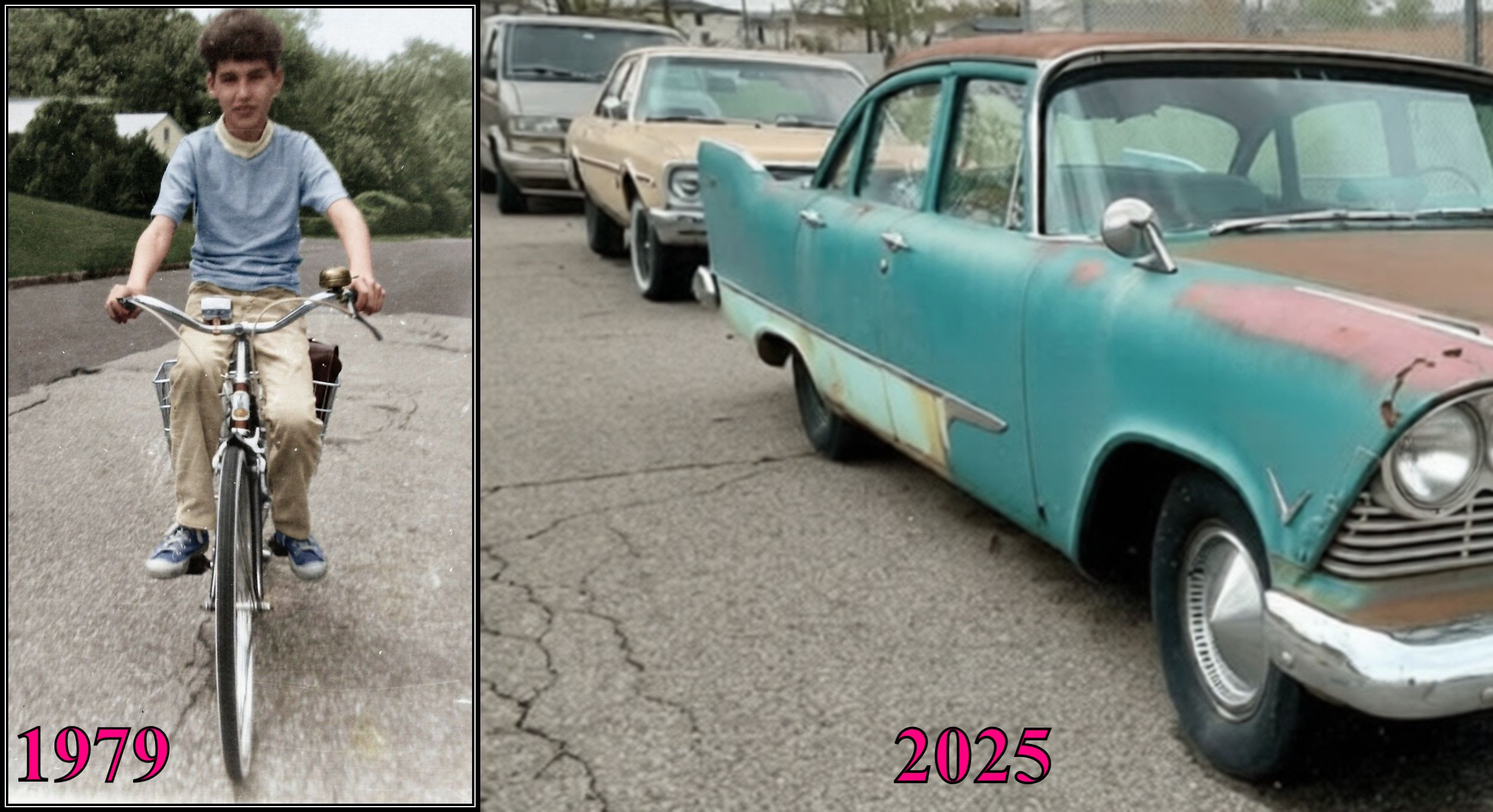
This is like a snapshot out of my distant past. The Plymouth Volare behind the Savoy adds to the nostalgic realism. I can just see 13-year old me on my bike entering this scene, exploring a seedy residential neighborhood like this one. If I found a ’57 Plymouth like this (one of my favorites of all time, and almost never seen), I would be all over it, checking out every detail.

When I got home, I would look it up in my Tad Burness Car Spotter’s Guide–“Ah, yes–it’s a Savoy, the middle line–with that style of chrome trim on the side, and the SAVOY emblem on the fin.” (I would have pronounced it SAV-oy instead of Sa-VOY, because I didn’t know any better). I’m sure I would remember the car for the rest of my life, where it was–and if I returned to the same location years later, I would say, “There was a green ’57 Plymouth here once.”

I don’t know who took these photographs and why, and I don’t know where on Staten Island this is. What I do know is that the pictures are dated April 19th, 2025–almost exactly one year ago.
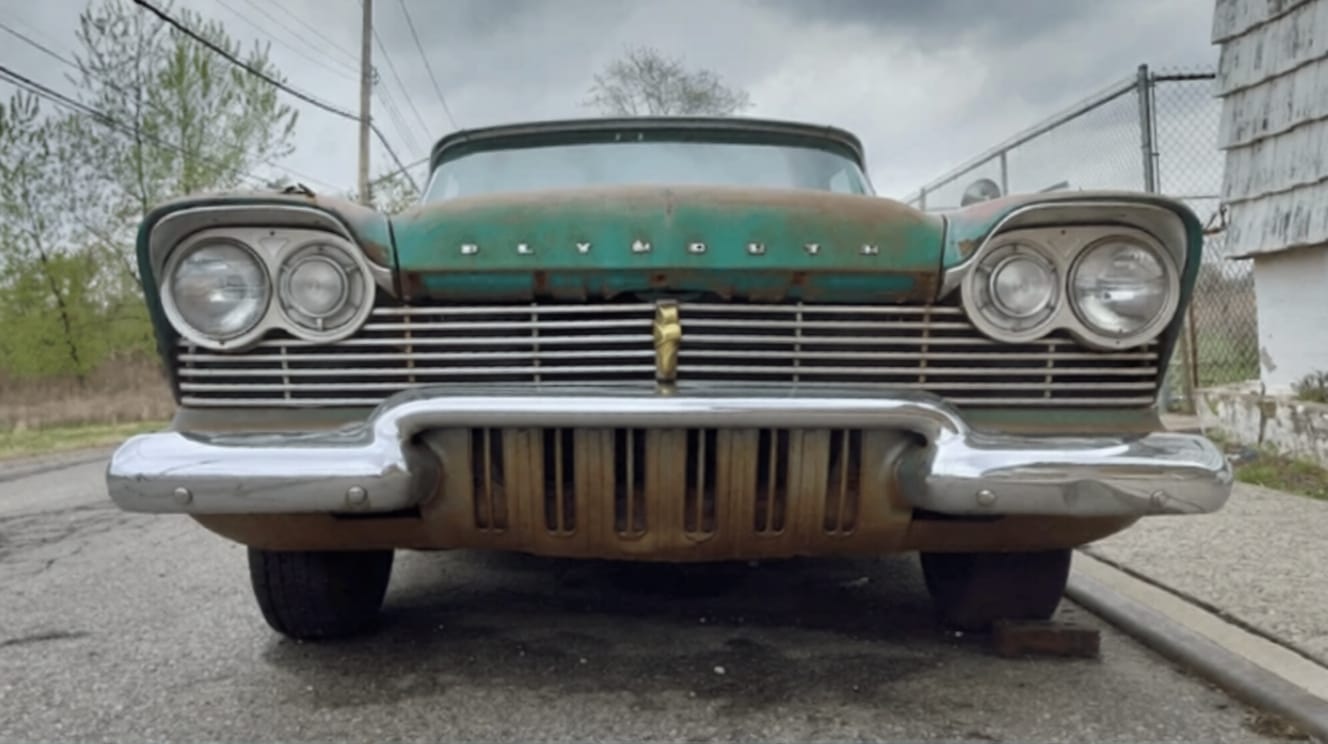
These images raise all kinds of questions: How did this one particular example survive, while tens of thousands like it perished long ago? By the mid-60s, most 1957 Plymouths had become rusted out, failure-prone wrecks– back-of-the-used-car-lot turkeys no one wanted anymore. Who loved it enough and preserved it so that it would make it this far? And does its present owner have plans for restoration? (Hopefully it won’t be turned into another “Christine” clone–ugh!)

There were no interior shots, so I found this photo on the AACA Forum. The dashboard is a rather unusual design, used in both 1957 and ’58. The speedometer reminds me of a big frowning mouth, but it is very legible.

If our subject car has an automatic transmission, it will have one of these little pods with buttons like the ones on Mom’s washing machine. Torqueflite (3-speed) will have five buttons (R N D 1 2), while Powerflite (2-speed) will have R N D L. No Park position–you set the parking brake as you would in a car with manual transmission. Unlike Edsel’s and Packard’s electric push-button controls, these mechanical units were quite reliable and durable (but they don’t engage with the same clean, satisfying “snap” as the electrical ones).

The curious may ask, “What were these ’57 Plymouths like to drive?” And the answer is–quite nicely (for the time). Consumer Reports testers called the ’57 Plymouth “A joy to drive” thanks to Torsion-Aire Ride (torsion bars in front, leaf springs in the rear). It combined two good things: smooth, level riding and relatively flat cornering. Full-Time Power Steering was super-easy, and its “quick” ratio made for effortless handling around town with minimum steering wheel winding. The V-8 engines also seemed peppier than most of the ones offered by the competition.

The problem was “structural rigidity” (i.e. body shake, squeaks and rattles) according to CR. That and early rust-out, door handles that fell off, torsion bars that snapped, and a host of other maladies that plagued these cars as they were rushed out the factory door before all the bugs and defects could be corrected. Later model years were better, but the otherwise excellent ’57s deteriorated fast, which is part of the reason their survival rate is so low.

I would suspect that my ’60 Dodge Dart drives a lot like the ’57 Plymouth. Both share Torsion-Aire Ride, the pushbutton Torqueflite transmission, the super-easy Full-Time Power Steering, and a fair number of other things. Much was improved by 1960, including the adoption of Unibody construction which made the cars much more solid–and did away with a lot of squeaks and rattles (though I still have some dash rattles I can’t get rid of). The all-new 225 Slant Six engine was a big improvement over the old flathead six. In my car, this new six is very smooth and delivers decent power. My Dodge is an excellent-driving car, one I look forward to taking out on the road when the opportunity presents itself.

It’s hard to say how many 1957 Plymouth sedans are still out there. But America is a big country, with an endless number of barns, garages, driveways, and back yards where rarities like this could be hiding. For me at least, it would be a rare treat to see one at a show, parked at the curb, or cruising down the road–defying that mysterious thing that creates and destroys all that exists–TIME!
Further CC Reading:
Curbside Classic: 1957 Plymouth Belvedere–Truly The Star Of The Forward Look by Laurence Jones
eBay Classic: 1957 Plymouth Belvedere Sedan–Fairest Among Ten Thousand by Stephen Pellegrino























The Green Plymouth Savoy sedan in the picture right above the 1960 Dodge Dart Phoenix is mislabeled – it says “1957 Savoy” but it actually is a 1958 Savoy. You can tell by the taillight and headlight profile. I have always liked the “Forward Look” of the Plymouths, although I have to say that the 1958 is my favorite style of them all. Just something about the 58 that I find to be quite attractive – more so than the 57.
I don’t recall any sedans, but someone in Mid-Michigan has restored a four door hardtop that I see around occasionally.
I loved your comment about riding your bike around your neighborhood when you were little to check out the local cars and remembering where specific ones were to this day. That was a snapshot of my early years, and like yourself, I can still recall almost every car from my childhood neighborhood. Thanks for the memory – jog!!
Me too. Lots a places around the town as well.
It could be interesting to see how many 1958 and 1959 Plymouths are still on the road compared to the 1957?
Still, that 4-door sedan remind me of the two 1959 taxis cabs used in the car chase from the movie “It’s a Mad, Mad, Mad World”.
Ha, ha–I never tire of watching that sequence! The actors and their facial expressions, the music; the madcap, totally reckless driving (real stunts, not fake computer graphics). The era in which it was filmed, with all those stars of the early- to mid-20th century appearing together in one movie and the inspired talent they brought to it. The idea that such an insane thing could happen on a typical day in California…
Those ’59 Plymouths must have been tough to take all that abuse and keep going.
I guess it’s not culturally possible for a great movie like this to be made anymore.
Love it, the Savoy is upmarket from the 57 Plaza that my parents owned. Dad says it was the worst car he over had and it was quickly replaced with a 60 Pontiac.
If you still need parts for your 57 Plymouth I saw that Alden Auto Salvage in Lamont Alberta is crushing their vintage stock. There’s a video on Cold War Motors YT channel about it. Hurry!
Is it just me, or does the front bumper on the subject car look like a piano keyboard? The front bumper on the Car Life cover looks different though – I assumed it must be a different model/trim, but Google image search results don’t confirm a correlation between series name and bumper grille insert.
Car behind the Savoy is a Dodge Aspen not a Volare (body side molding in center of door = Aspen SE, body side molding on lower door = Volare Premier. This is one of the very few differences between these two cars, one that took me years to notice.)
By the mid-’70s, late-50s Chrysler products were gone from my area, though there were a few ’55-56 cars still out there. ’55 and later Chevys were still occasionally-seen daily drivers, not perceived as iconic collectors’ cars yet.
If my memory serves me correctly, there were two different valance panels in the front of 57 Plymouths. The one with the extra thinner, upright pieces is a later one. It was a midyear running change because people were complaining that too many rocks and debris were getting into the valance panel and laying in the bottom of it.
I am the outlier because I prefer the 59 hands down to the 57-8. The styling, the tighter (though not as good as the 60+) structure and the interior detailing. These were nice driving cars when they were sorted. And yes, there are far too many attempts at Christine clones in the world.
The “Suddenly It’s 1960!” Slogan was somewhat ironic; by 1960, most of these cars were already in the junkyard. But what an impression they made! It made every automobile not made by Chrysler look ten years older.
Given my choice, I’ll take the ’57 over the later models. The headlights being flush with the grille is an improvement over the goggle-eyed 1958. I also like the big tail lights filling the entire fin area.
People chide Chrysler’s forsaking the pot of gold to chase the rainbow, but the mission was accomplished. The public wanted these cars, and the business they sacrificed with their shoddy quality would have been lost to the 1958 recession, anyway.
At the same time, imagine the difficulty dealers would have had trying to move 1956 left overs or trade ins on the used car lot. The 1957s looked nothing like their cousins from the year before, like something designed ten years earlier.
How long do you think it took for running 1956 Plymouths (and Dodges and Chryslers) to outnumber running ’57s?
I realize you’re being hyperbolic, but this was not actually true. The very large majority of 1957 Plymouths were still registered as of July 1, 1960. By 1964, that had fallen to roughly three-fourths, and it was down to a little over one-fourth by 1967. However, even in 1967, there were still more ’57s on the road than ’56s.
Fascinating data. I’ve always been curious about statistics like that. When did we get to 1%? Where are we now–0.01%?
Unfortunately, I don’t have total registrations by make data after the late ’60s. The automotive trades used to hire firms like R.L. Polk to compile registration data from state DMV tallies, but Automotive Industries scaled way back on their statistical issues in the ’70s, and Automotive News was more concerned with new car registrations. (I don’t have any Ward’s that old, so I don’t know about them.)
My parents had a 2 door sedan that they bought used, so probably in 1958. It was a V8 with the 3-speed automatic, the first automatic that they owned. I vividly remember the push buttons on the left side, but looking at the pictures of the instruments, they also look familiar. We did have a torsion bar snap, and it happened when the car was sitting in the driveway. I would expect it to happen when you were driving. It was loud enough that we heard it inside the house. The other thing I remember is that in the fall, when it was cool, but not cold (this was Toronto) the carb would ice up and the car would stall. My mother was not pleased.
I hope someone saves this one before it’s too late .
My ’58 Plymouth ‘Plaza’ two door had the powerflite trans (2 speed) and flathead i6 engine, it was indeed a very good driver .
-Nate
I’d rather see a four door made into a “Christine” replica as the car in the original book was a four door. Anyone who has read the book will agree its much better than the movie
I recently read it, and there is indeed at least one reference to back doors. But then it could not have been a Fury (which the book clearly says it is), which was only a 2-door model until 1959. It also did not have a “Hydra Matic” or a gear shift lever like the book said. These and some others were annoying lapses in a book that I agree was really good.
I read recently that King is not a big fan of the John Carpenter film, calling it a little boring.
IDK how much research King did for the book, but simply making the car a 1959 would have solved these anamolies since a red Fury 4-door sedan was available for that year.
Of course, the 1959 Dodge Coronet Custom Royal Lancer was way more malevolant looking than the Plymouth, too.
I’m just not into fins. Never liked them and looking at this car reminds me why.
Yes, the ’57 Chrysler products had a significant rust problem. A lot of owners swore off Chrysler products after seeing their ’57s rust away in front of their eyes. The ’58 and ’59 models were better but the ’60 models were much better. Then the horrible ’62 models were introduced and were a majorr flop.