
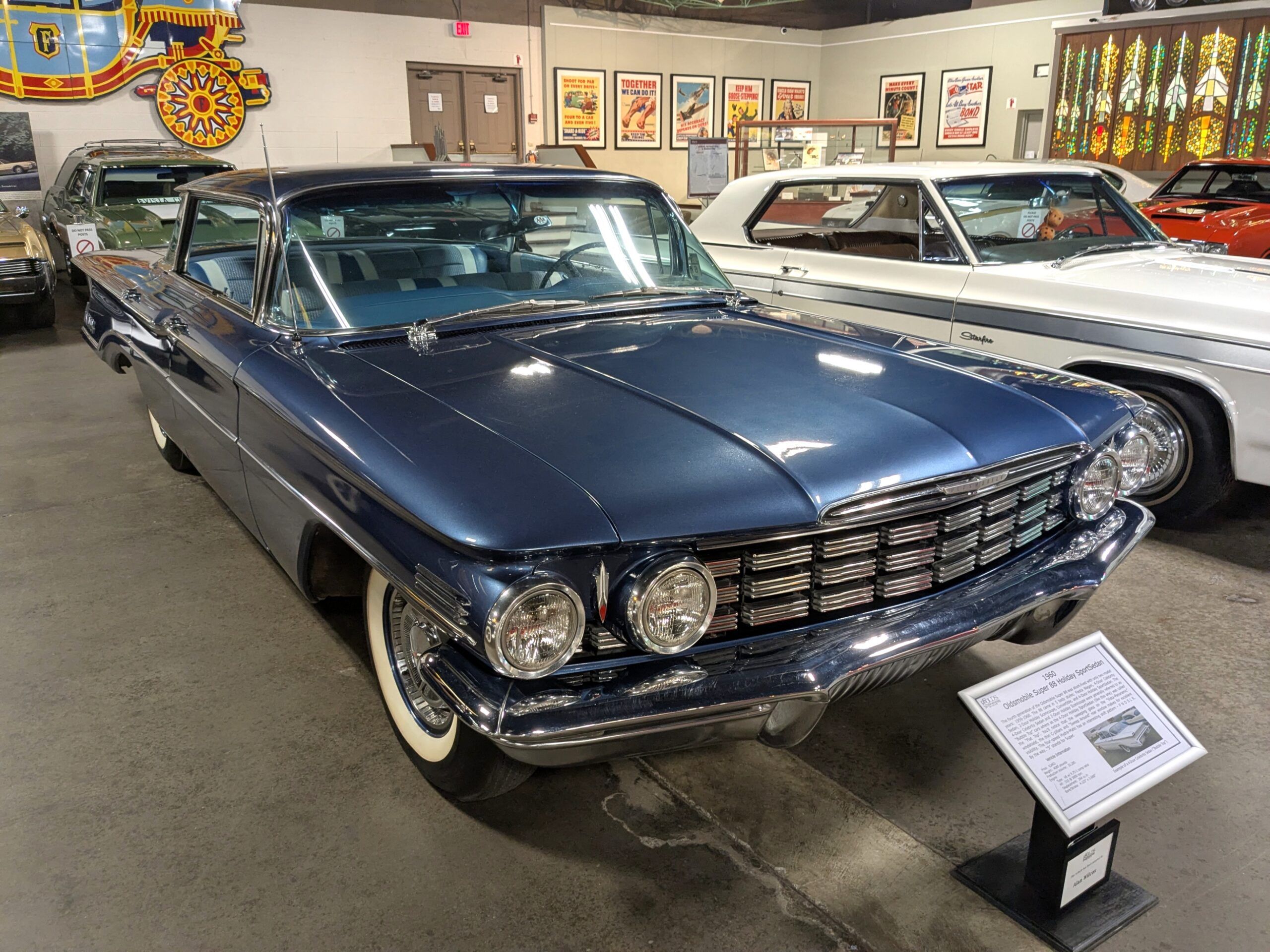
I hope I never reach a day in my life where I no longer “geek out” when I see that certain old car that hits me the right way, just as this 1960 Oldsmobile Super 88 did. In this case, however, my reaction was not the result of its great beauty or historical significance, but rather for the little details sprinkled everywhere. It’s a styling delight.
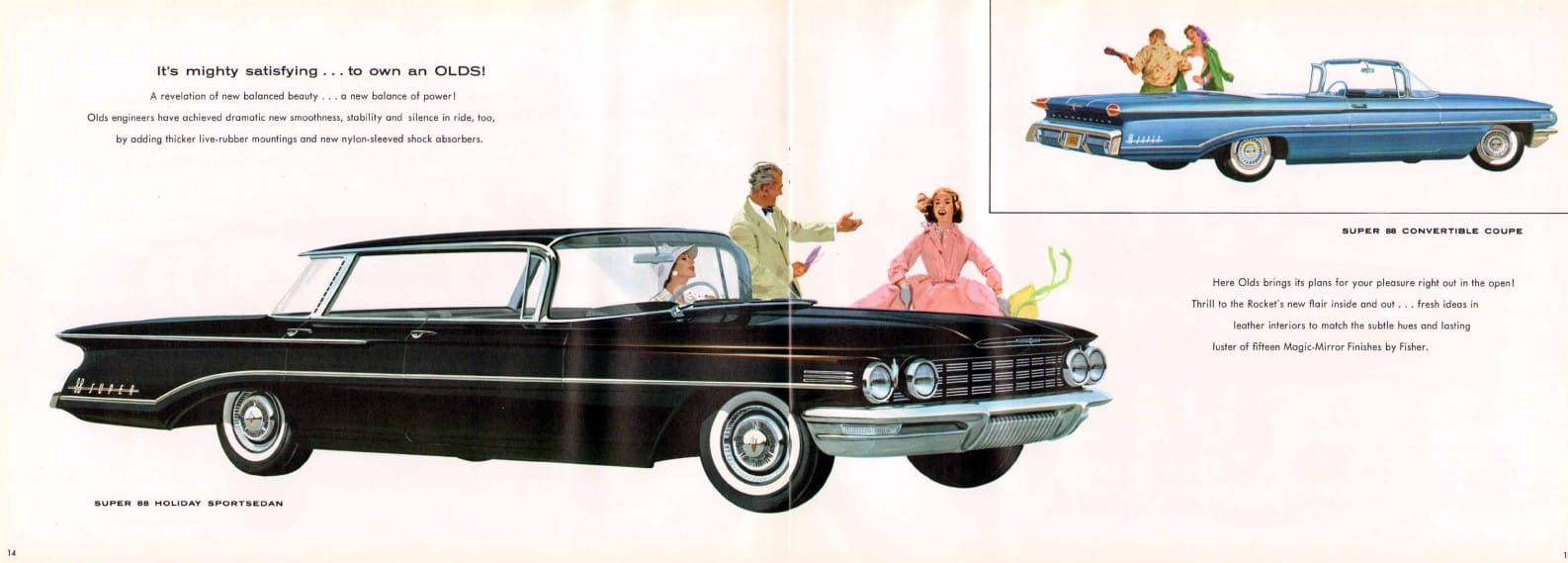
Let’s get this out of the way first: I did not use a misnomer when I called the car a Holiday “SportSedan,” as that’s what Oldsmobile called it in the 1960 sales catalog. Of course, “Holiday” was Oldsmobile slang for its hardtop bodystyles, and let’s give their marketing department some credit: “Holiday” is the perfect name for such a bodystyle, just as “Riviera” is the perfect name for Buick’s hardtops. Both evoke sunshine, money, and carefree fun.
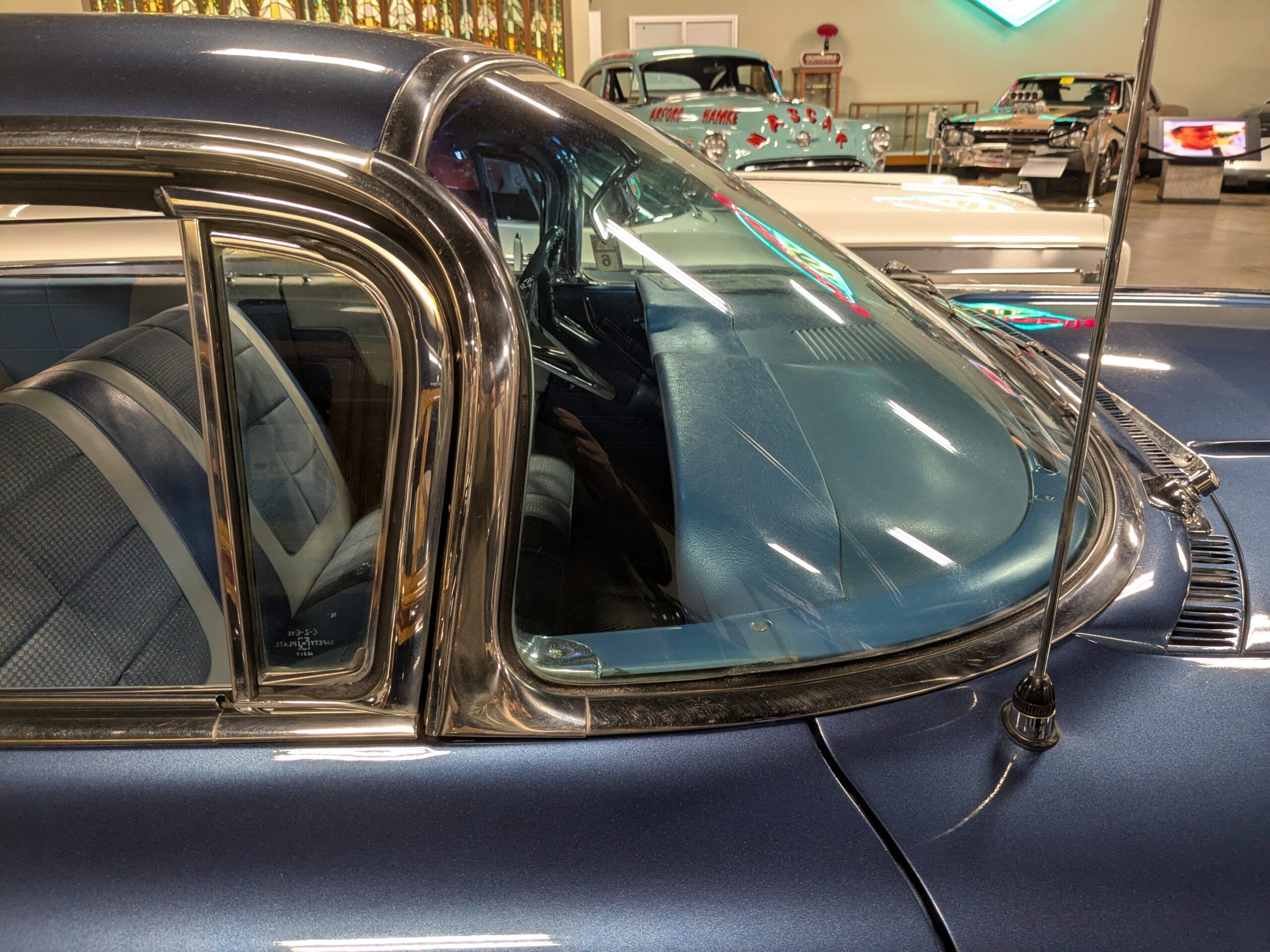
Today’s look at this Super 88 will be a walkaround, and one of the first things you notice about any 1960 General Motors full-size car is the windshield; not only is it a wraparound windshield (or a “knee-knocker,” as some will call it), but it is a “wrapup” windshield. The compound curves of this piece are unreal, causing my wife to muse that finding a replacement must be difficult. Luckily for the Oldsmobile buyer, General Motors’ platform-sharing plan means that any windshield that will fit the popular Impala will also fit your Super 88.
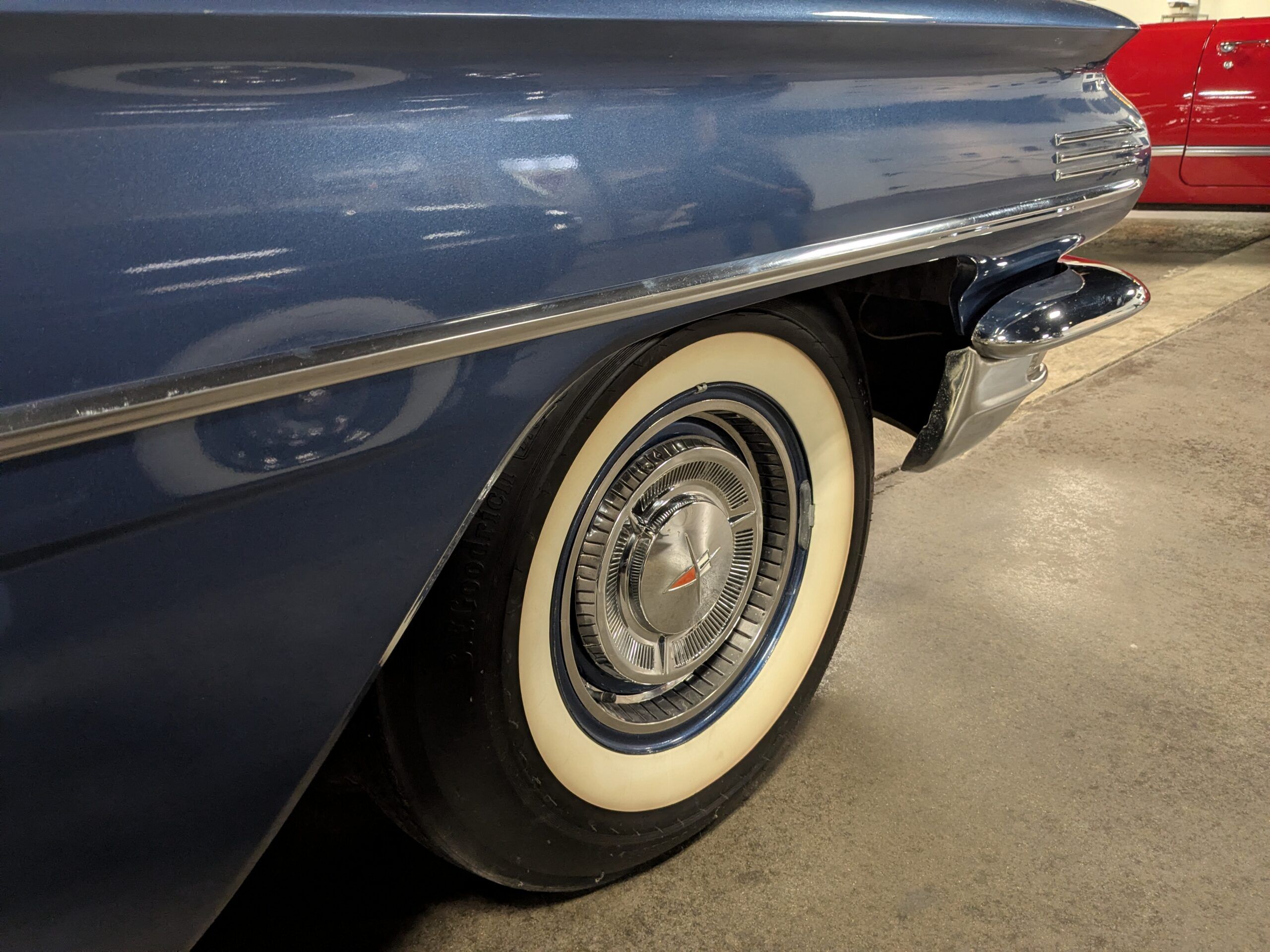
Wheel covers and hubcaps of the 1950s and 1960s don’t get enough of our attention when we’re looking at a classic car, but they were often intricate one-year-only pieces. This example looks mechanical, as if it were emulating a bearing cage or a transmission sprag, and it of course has a “rocket” stamped into the center, even though it looks vaguely like something found in a book of medieval heraldry in this case. Also notice that it is not a one-piece wheel cover, but rather a small hubcap and trim ring (which was an option).
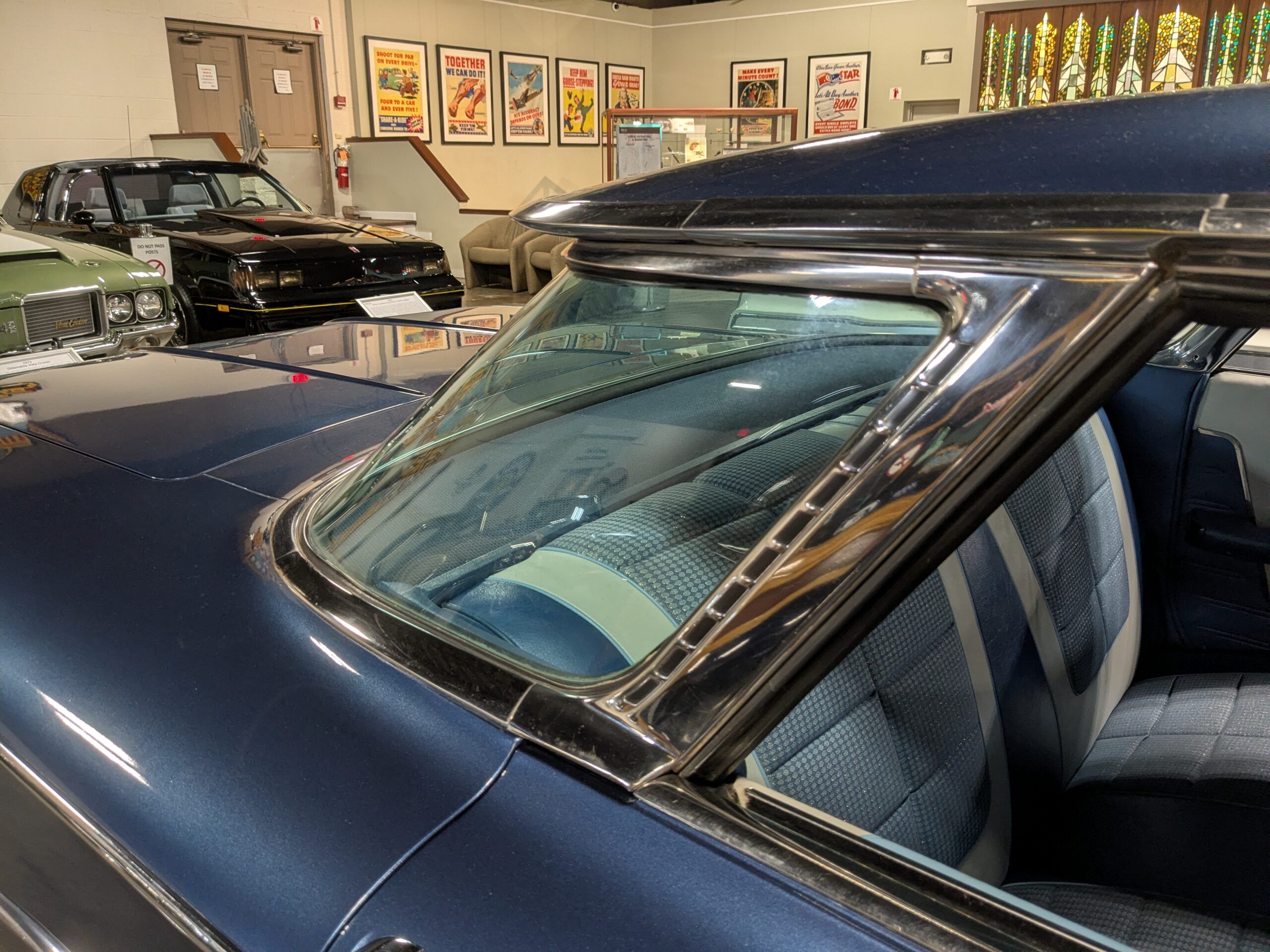
Of course, one of the reasons why many people like 1959-60 General Motors four-door hardtops is the “Flying Wing” roof design, which is credited to stylist “Bud” Sugano. It was seen on all full-size GM four-door hardtops for a short time, and its last appearance was on the 1964 Corvair Sedan.
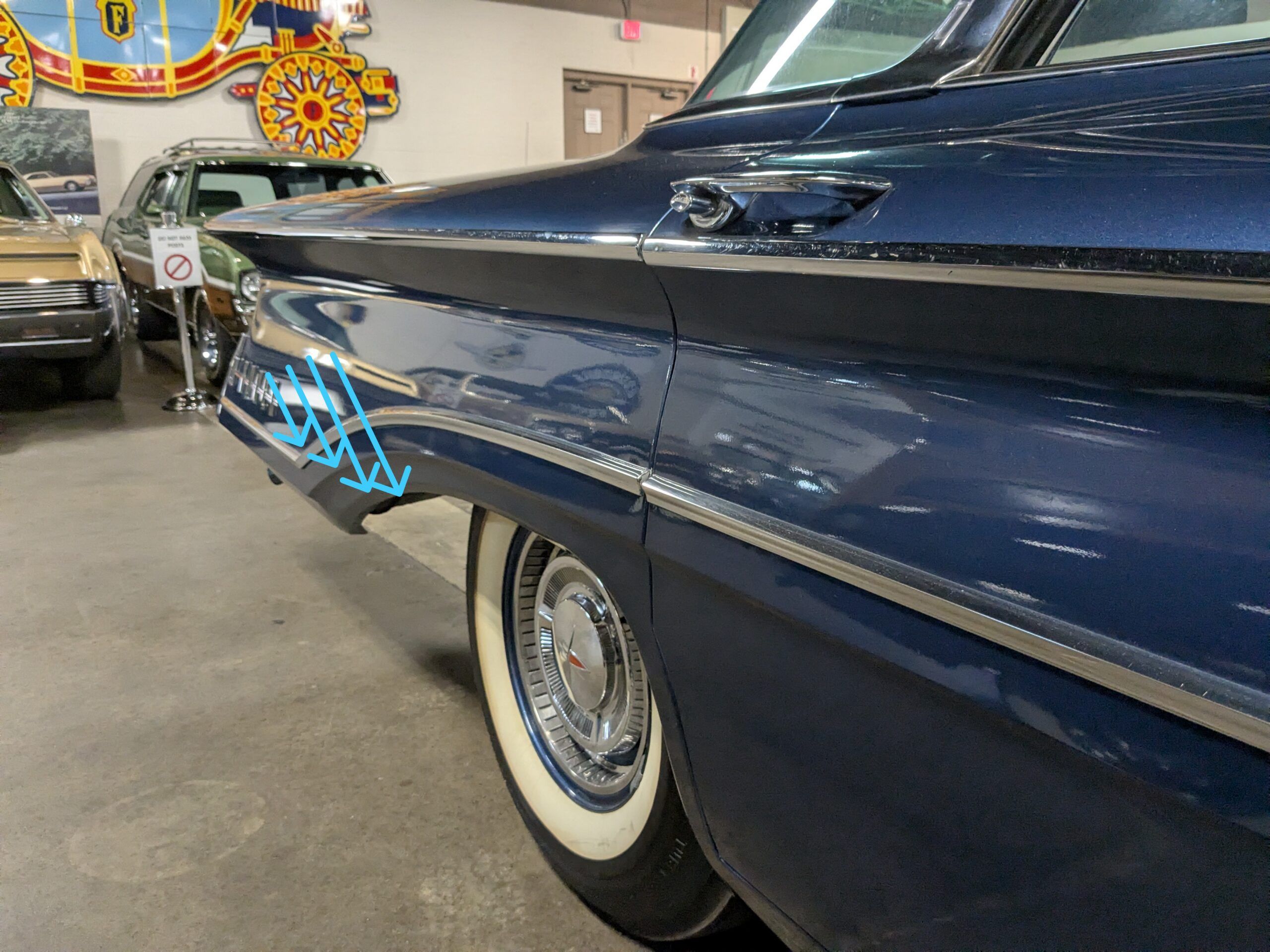
Something I never noticed was how the quarter panel trim and stamping create a “rainbow” effect, as four arcs follow each other around the rear wheel. Those lines culminate in a lower quarter panel that wraps outward, rather than inward as you may expect.
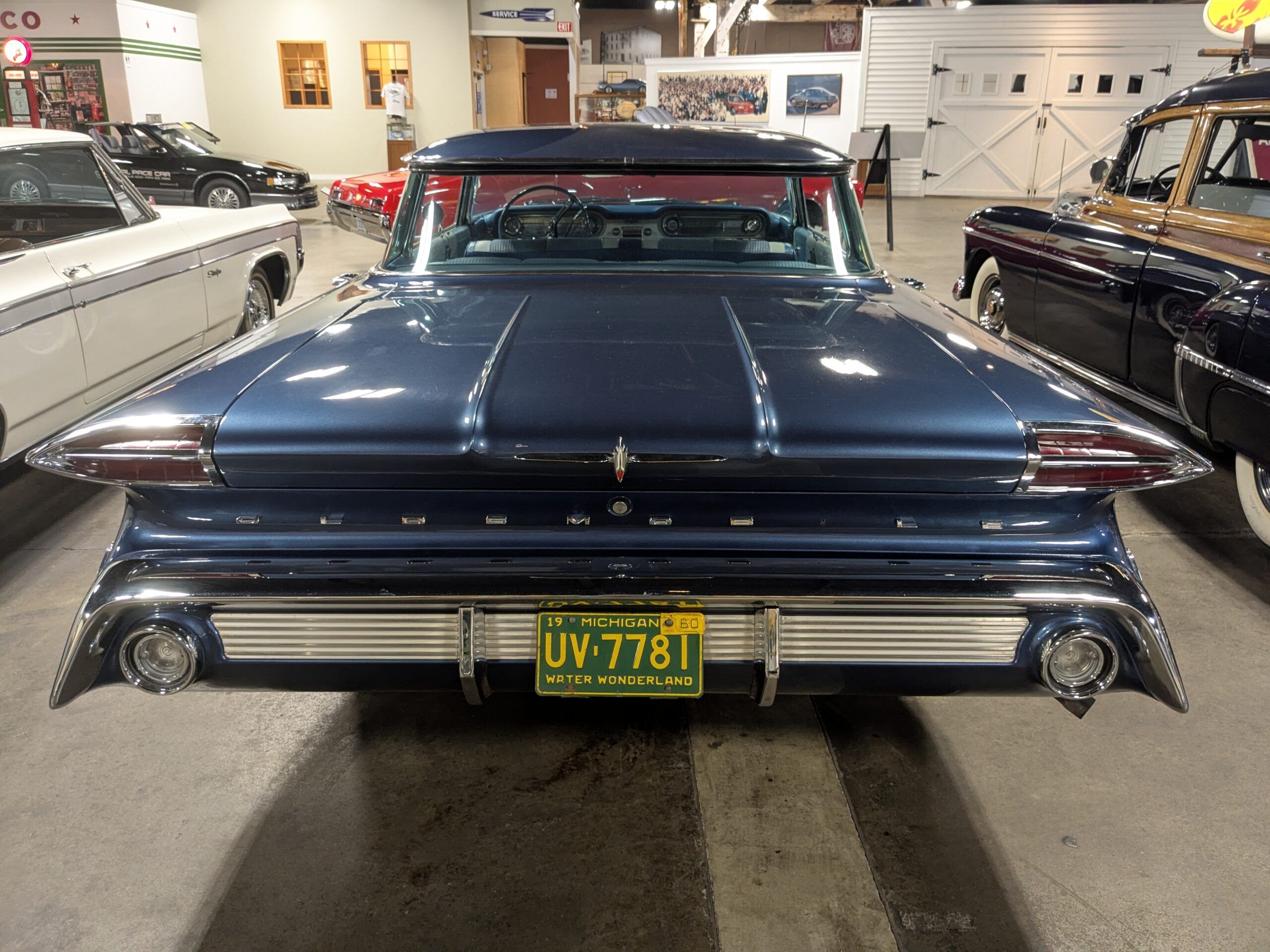
That creates the in-vogue double-fin motif in the rear.
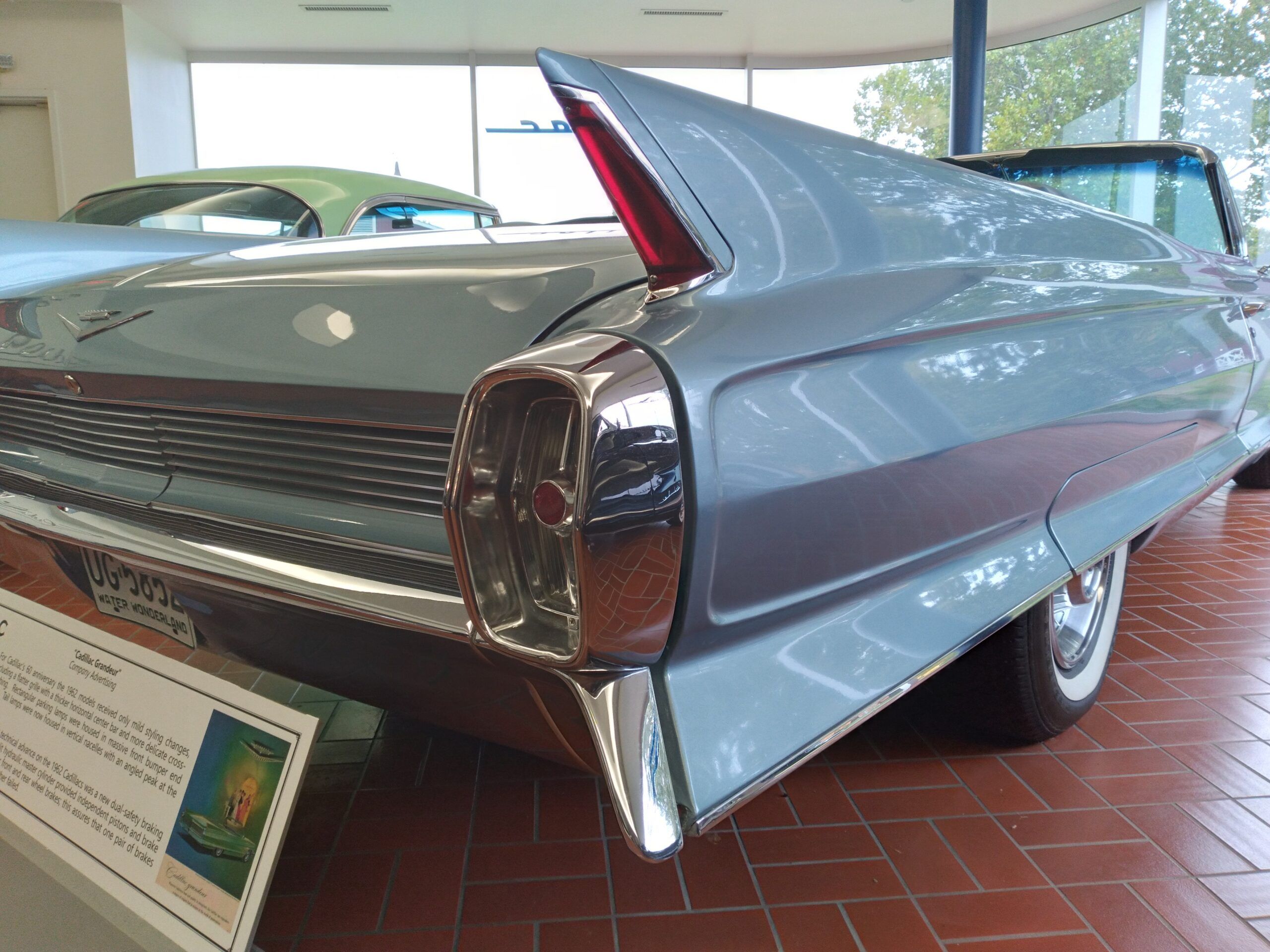
Cadillacs used a more pronounced variation of this when they added “skegs” to their 1961-62 models, but the Oldsmobile follows this same theme in its own way.
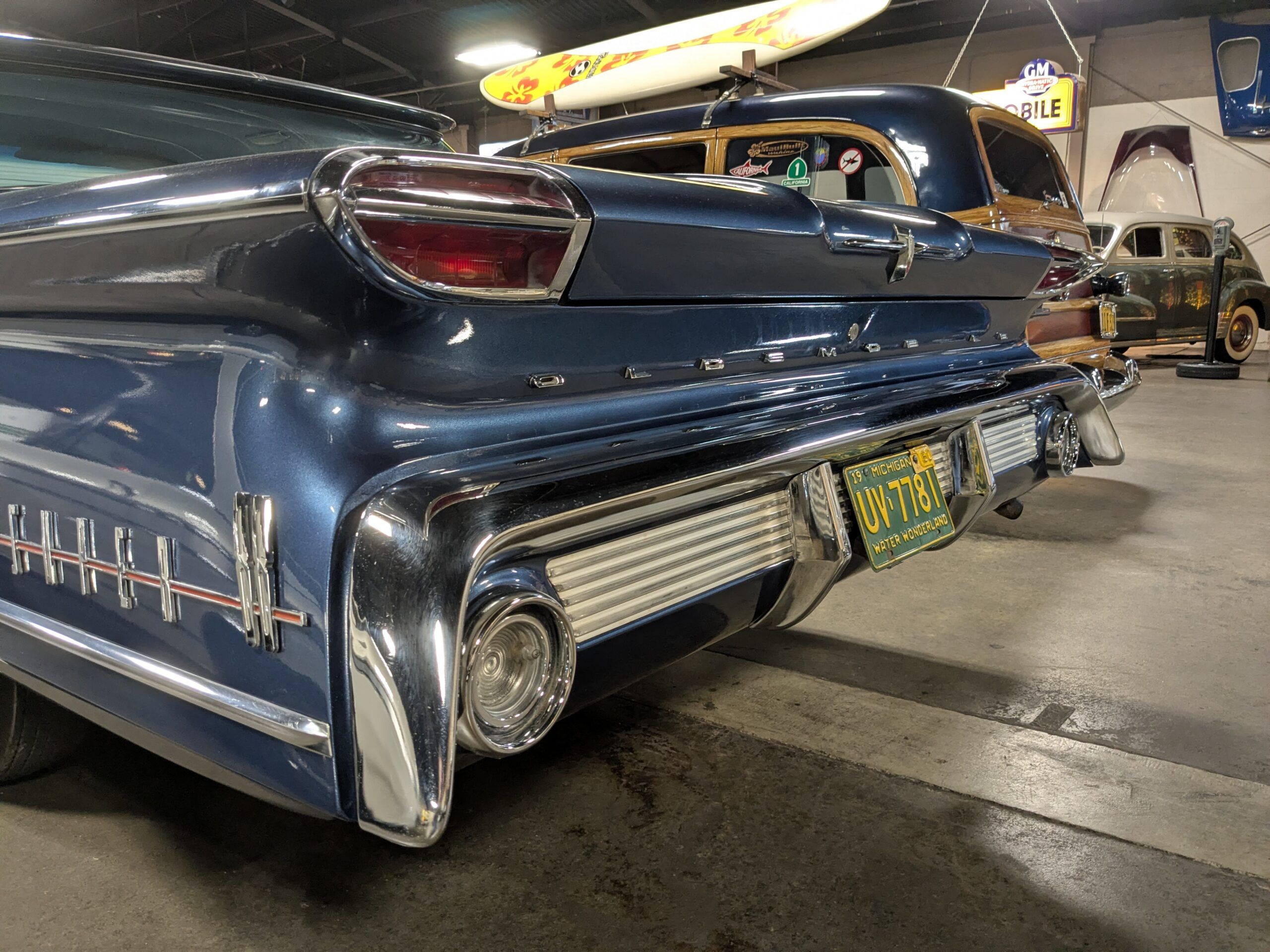
The rear is busy, but no more than you would expect for the tail-end of the jet age. The thing that’s always fascinated me about 1960 Oldsmobiles is that there appears to be two “floors” when viewed from behind. The bumper curves down like a handlebar mustache, and the huge backup lights flank horizontal ribs. Aside from some paint spritzed in as it wraps beneath the car, it’s all glitz and brightwork. At the top, aside from the taillights pointing in each direction, it’s all body color, intricately alternating between creases, ribs and a deep concave indenture with “OLDSMOBILE” block lettering jutting out toward the viewer. (OK, this one is an OLDSMOBLE, missing its “I.”)
Also, nobody will miss that the proud owner stepped up to the more powerful “Super 88,” which cost almost $400 more than the more popular “Dynamic 88.” The font is huge, and the bisecting red trim cuts through it like a contrail.
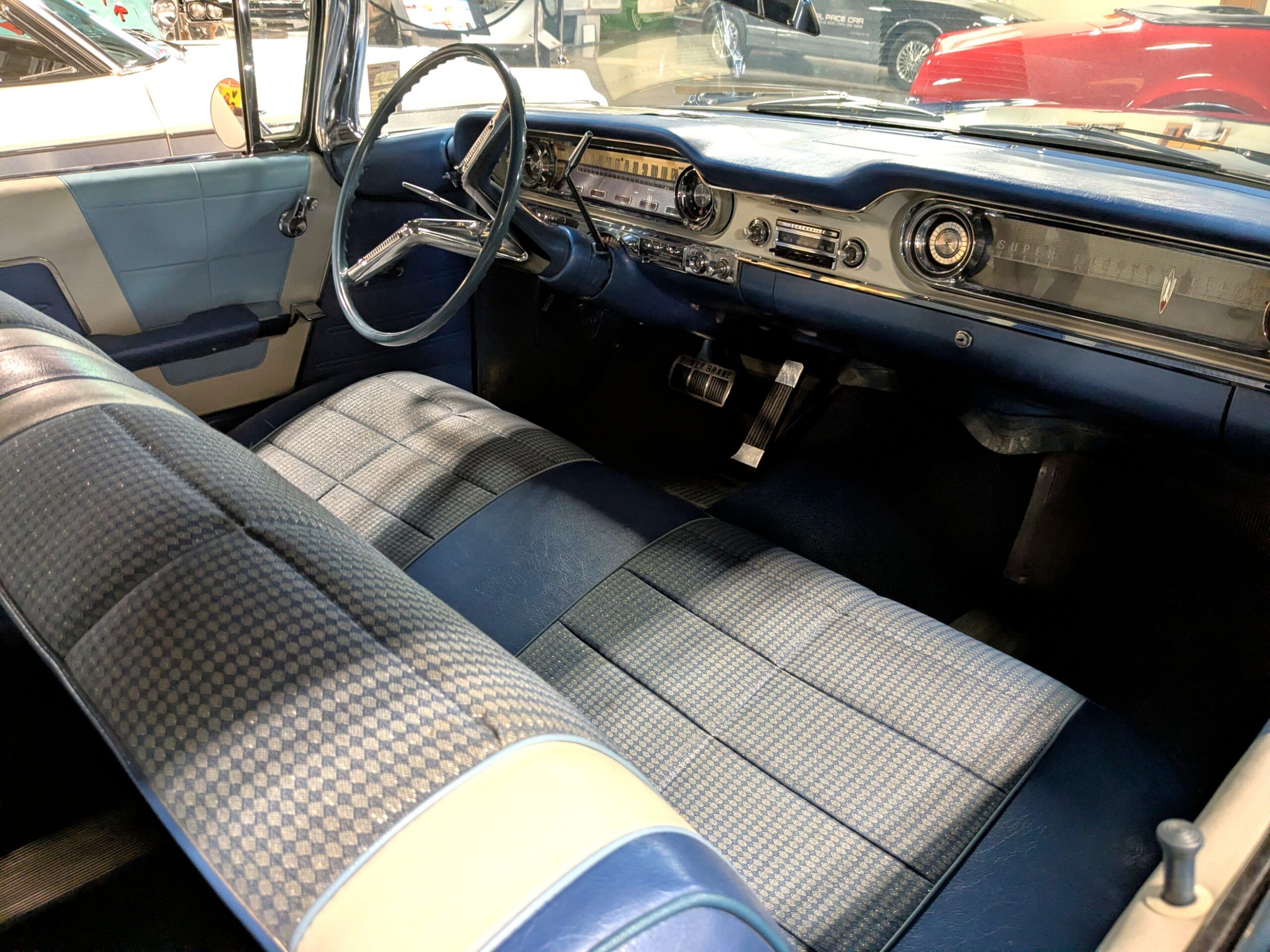
The interior is no less distracting for those with middling attention spans. The steering wheel may be the most deeply “dished” of any in the industry, and “S U P E R E I G H T Y E I G H T” is spelled out in block letters in front of the passenger, so everyone who ogles the interior through the passenger window will know. The Oldsmobile is a rolling large-print section of the library: the speedometer’s numbers are massive, and “POWER BRAKE” is spelled out in a manner that will allow nobody to forget that Dad’s going to pitch you onto the floor the next time he slams on the brakes for a yellow light.
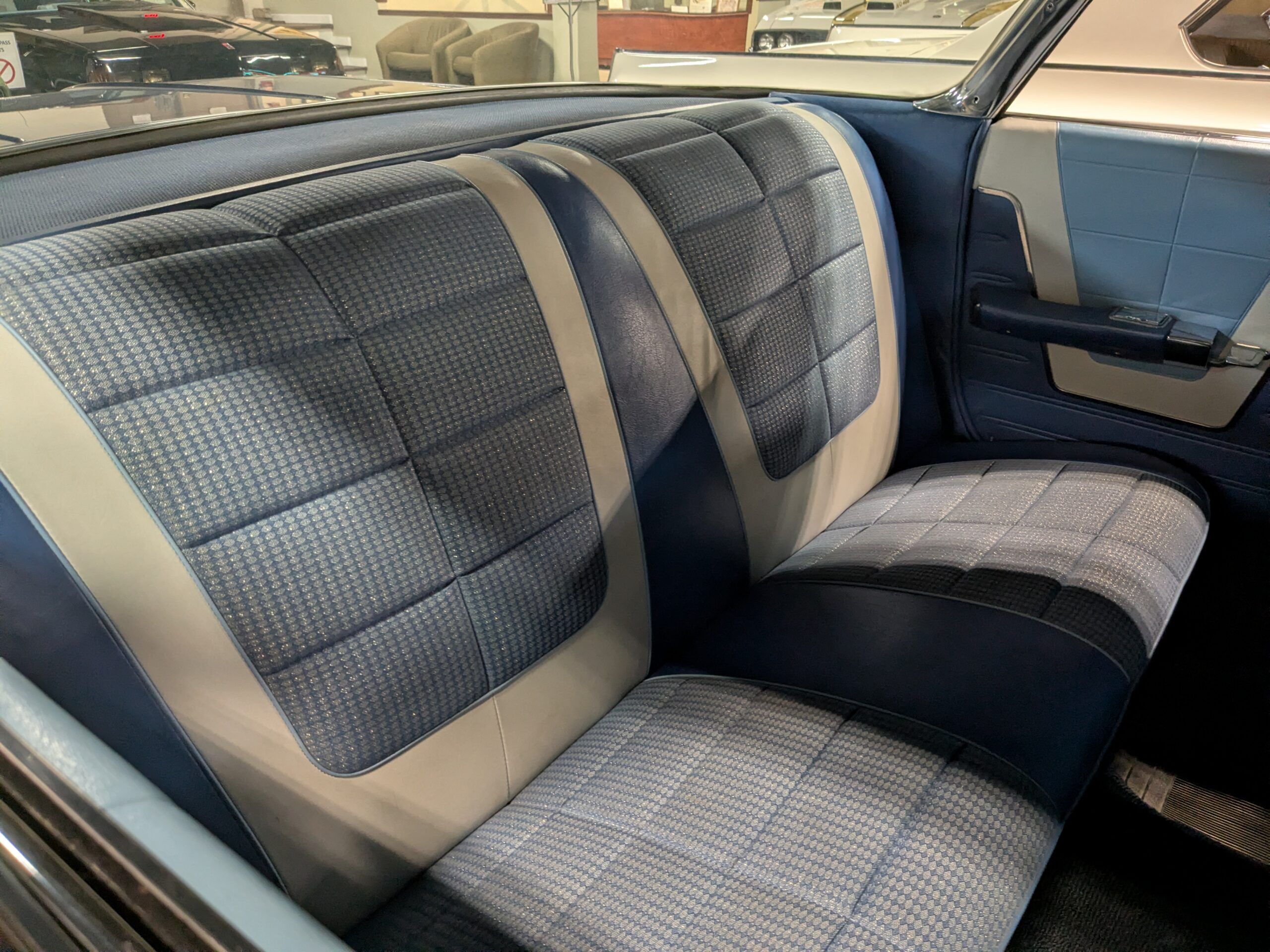
The seatback upholstery pattern mimics the door panels (or vice-versa), and both are tri-toned in two shades of blue and white.
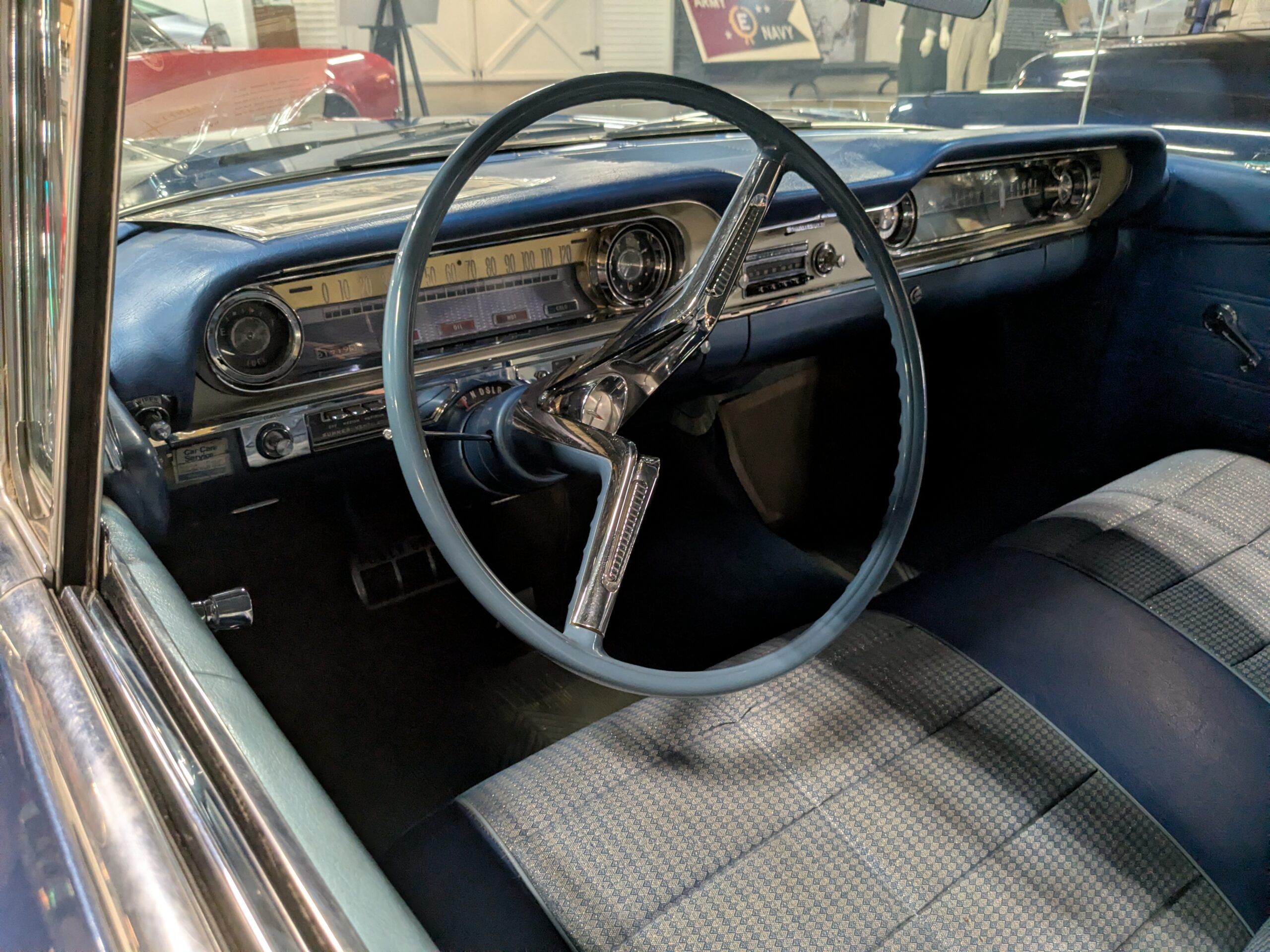
A good reason to buy a 1960 Oldsmobile rather than one of its immediate successors was the transmission: It was the last year that Oldsmobile used the “Jetaway Hydra-Matic” transmission, which was the four-speed unit that most people find to be superior to the 1961-64 “Slim Jim” Roto Hydra-Matic. Whether this was intentional or not, I don’t know, but Ford used an instrument panel design very similar to this one in their 1963 full-size cars, in addition to later Falcons and Mustangs. Oldsmobile’s design is more symmetrical, however, as the instrument panel’s pattern continues on the passenger side.
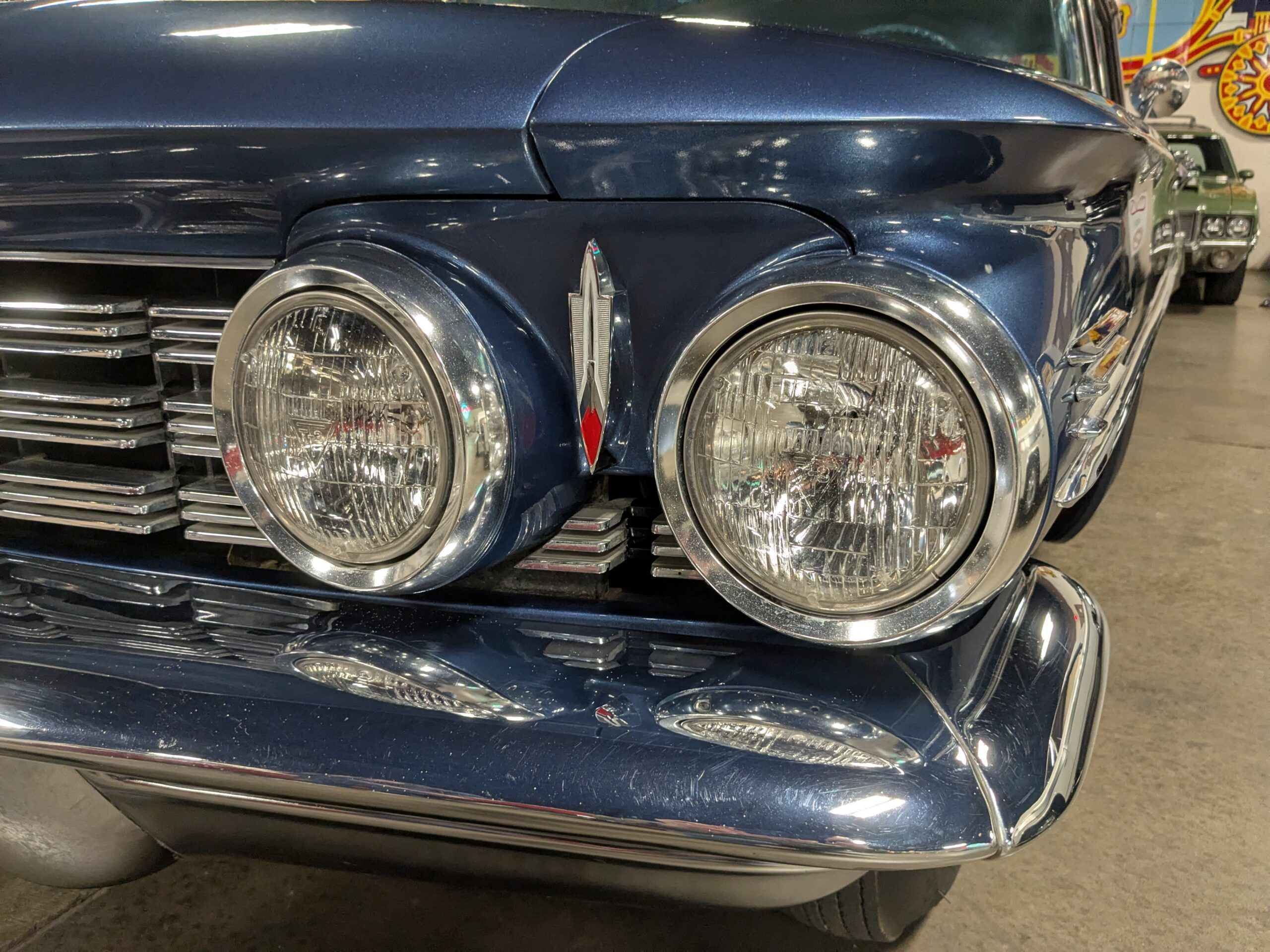
In case you felt that Oldsmobile wasn’t giving you enough “rocket” for your money, there’s an emblem between the headlamps on each side of the 88’s grille. By the way, this car appears to be sporting original Guide T-3 headlamps, which seem to hold up well to time (they could also be reproductions).
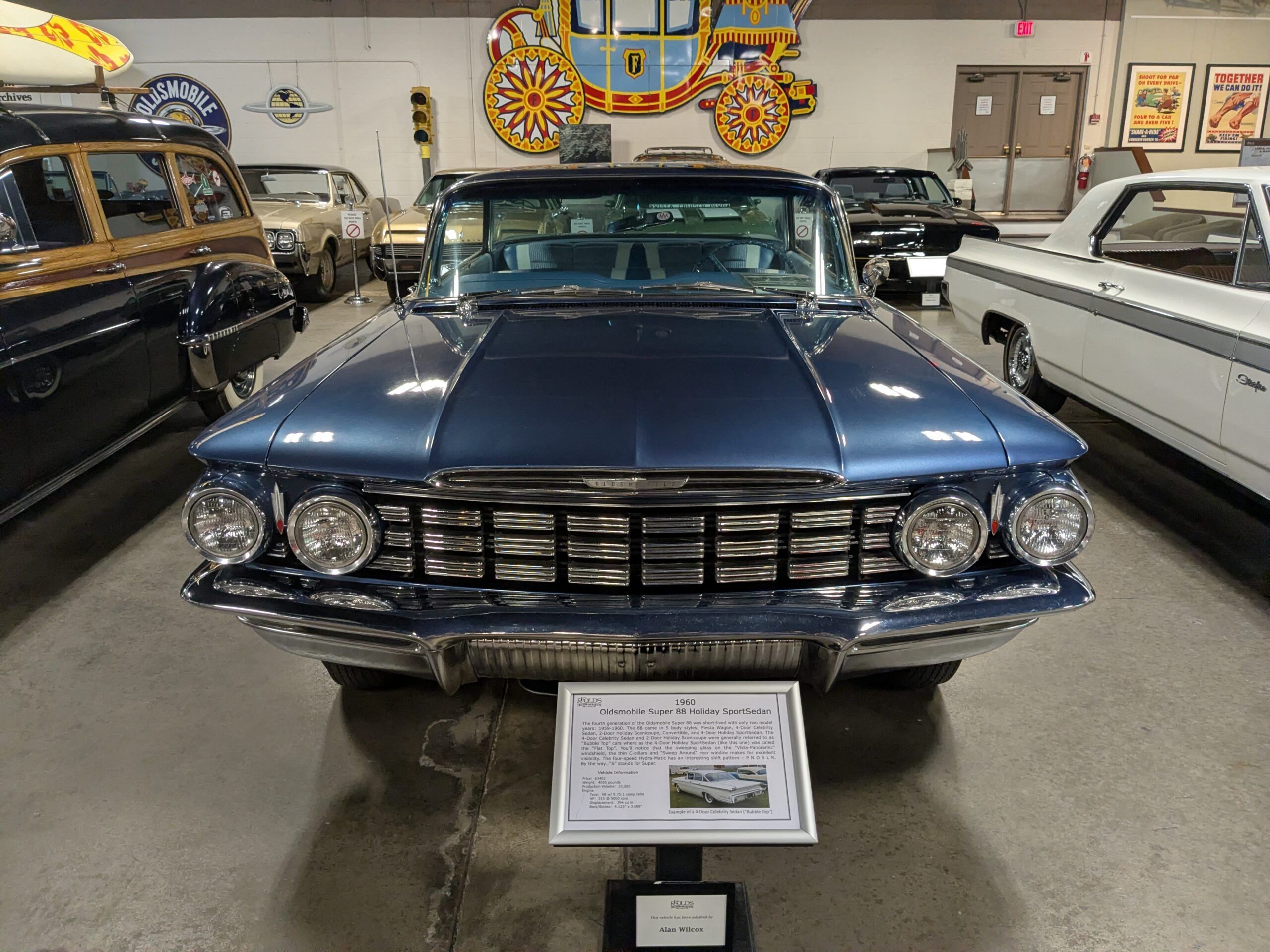
When viewed from the front, the old Harley Earl trick of letting the public know that there’s a lot of power under this domed hood spilled over into the 1960s. While it’s not as prominent a bulge as you’ll find on something like a 1950 Cadillac, the jutting “scoop” informs admirers that there’s a 315-horsepower 394 Rocket V8 under the hood. The front bumper vaguely mimics the 1957 Plymouth, with vertical indentations spanning the center section between the bumper extensions, and the grille itself is a complex pattern of a couple-dozen neat horizontal bars presented in threes. It’s not as intricate as the grille of a 1958 Buick, but it’s something to see, and definitely a chore to keep clean.
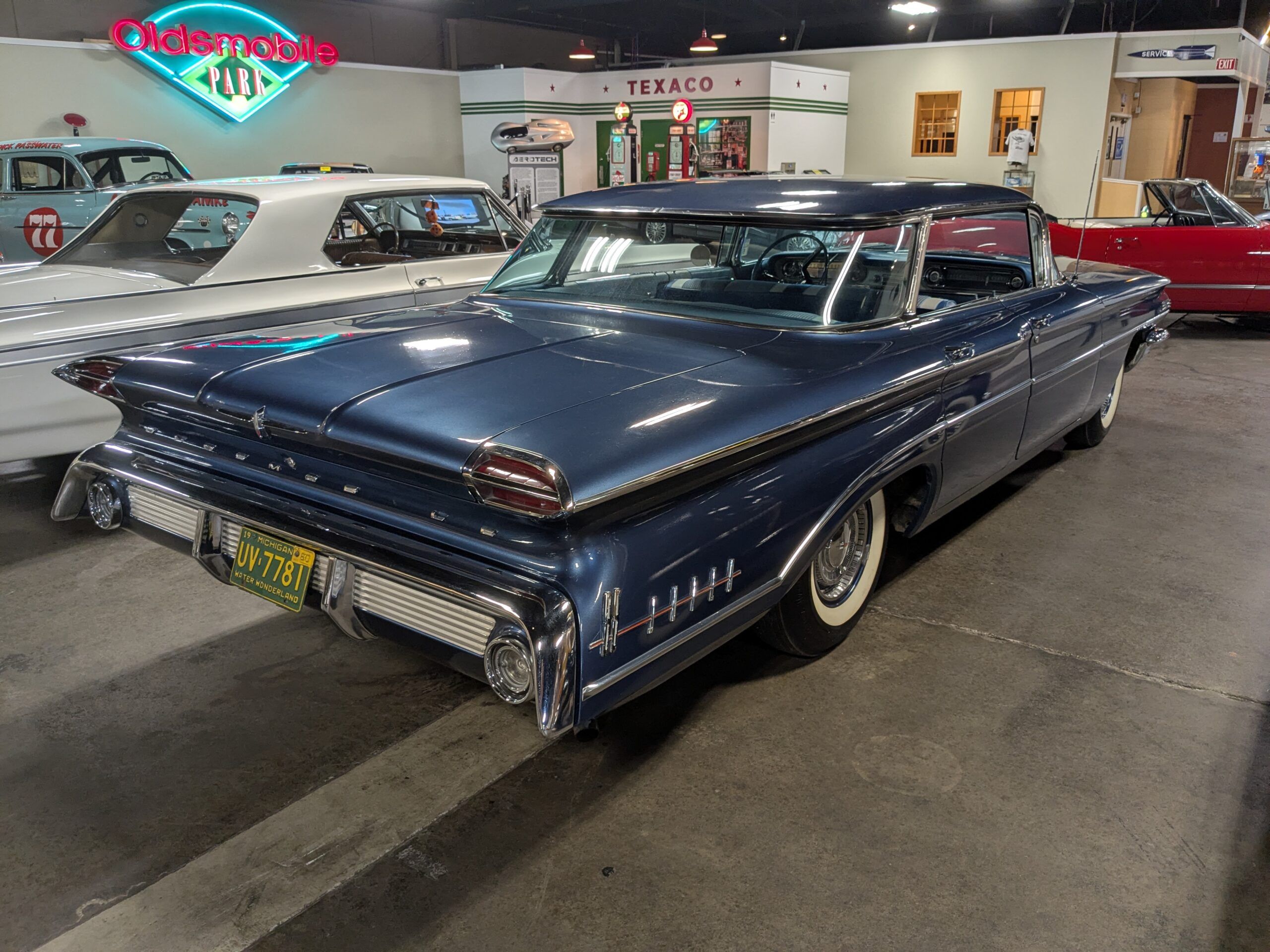
Taken as a whole, it might be easy to dismiss this dazzling Gulf Blue “SportSedan” as an old “more door,” but while it’s design may not be in the best of taste, it is always exciting. Some cars are best appreciated by standing back and admiring their simplicity and elegance of line, but on the other hand, the Big Three of 1960 demanded that you stand close and look for all the Easter eggs. This Super 88, which you can see at the R.E. Olds Transportation Museum in Lansing, Michigan, is just such a treat.
Related Reading:
Cohort Pic(k) Of The Day: 1960 Oldsmobile Super 88 – Back To Earth (by Rich Baron)
Curbside Classic: 1960 Oldsmobile Dynamic 88 – Reaching For the Stars (by Jason Shafer)























Is this the Oldsmobile with the speedometer horizontal bar that changes color as the speed increases? I think from green to. Yellow to red.
My family’s 61 Dynamic 88 had the colour changing speedometer.
This one really brings back memories. My grandfather had this same car in black. He was a loyal Oldsmobile man, and always ordered a Super 88 4 door hardtop with whatever the largest most powerful engine option available.
As noted, the 1960 did also have the speedometer with the changing colors.
Typically I am not a four-door person but have always loved these ‘flat-tops’.
A true landbarge on wheels ! Those GM cars , were beautiful in their day and truly works of art . Nothing , like it even comes close to those vintage automobiles . Obviously , they were not thinking about economy when they designed those, but luxury and great comfort!
Much better looking than the ’59. There were more than a few 2 door hardtops converted to “customs”.
here’s an example. They clean up real nice.
Being a ‘child’ of 1960, I’ve always been drawn to the overall looks of these models. The flat deck with arrows on each end for taillights, the downward angled rear edge of the quarter panels, and the beautiful interiors (esp. the 98’s!) always said to me, “this is DeLuxe!”. The horizontal fins–if you can call them that–shows Oldsmobile was definitely entering a new era of the 1960’s.
My favorite Oldsmobiles? The 1957 models. It still amazes me the difference in styling in just 3 short years! And the 1960 models were designed when the `57’s hit the market! Back then every year was totally new in looks. As a kid, my favorite time of year was around my birthday in September when dealers would soap their showroom windows to “hide” their newest offerings for introduction day! I rode my bike to many car dealers just to get a peek!
https://www.curbsideclassic.com/blog/car-show-classic/car-show-classic-1957-oldsmobile-super-88-pressed-in-a-book/
I found a nice one of those a few years ago…
When I was in high school (1980s) I had a paper route, and parked at one of the houses I delivered to was a 1960 Super 88 hardtop that looked just like this picture. It was parked outside, but was still in mint condition. I really loved seeing that car, even though I prefer the ’59 to the ’60. An interesting thing is that on one side, it’s a -SUPER–88- and on the other side, it’s an -88–SUPER- !
A few years later, I saw a 1960 Dynamic 88 2 door hardtop at the mall. It was silver/gray with a fair amount of patina, but still running and driving. Someone re-sprayed it metallic light blue, which improved the looks. I then saw it parked by the side of the highway, semi-abandoned, never moving. Rust was bubbling thru the new paint. The doors were unlocked, and I would sit in the driver’s seat, imagining that it could be mine. Then one day it disappeared forever.
Right now, there’s a 1959 98 4-door hardtop for sale two blocks from me. Red and white–a real monster of a car–and so beautiful! Mint condition, but no title. I’d photograph it and post it on CC, but the car is in a garage. $25,000 is the reported price (which I feel is on the high side). I’m not really interested in taking on any additional obligations right now, but it is tempting.
My maternal grandmother had a ’59 98 4-door sedan in black. I actually like the gracefully downsloping roofline of the sedans very much too, but most hobby people don’t agree with me on that. So I buy the sedans and pay less! 🙂
The ’60 was much improved stylistically over the ’59, which was a bit of a mess, especially at the rear.
My older brother’s friend had a hand-me-down bubbletop coupe version; this was in about 1967-1969, and it presented as a solid but decidedly older car. I went along on a few rides with them and remember the distinctly different shift characteristics of the H-M compared to say our T-F Dodge. I was quite taken with the big Olds and it served him well for a few more years.
Good call on the dash design showing up at Ford.
Count me as another fan of the 60 Olds. This is the rare Olds from that decade that was not in my life, but I remember the convertible on the TV show “Hawaiian Eye”! I won’t call it beautiful, but it is an automotive candy store!
They’re sort a “time period, correct”. Just not a fav of mine. This one looks good; interior is quite welcoming.
I’ve grown to like these flat top four door hardtops, even over the bubble top coupes. That final shot of the rear 3/4 view, that really displays the drama and aggression of this design. It’s like a jet fighter or a rocket, like the X15! Skeg fins were used on my different manufacturer’s cars during this period. The featured Lincoln from yesterday just displayed the points of the skeg in the bumper design. My Dad had a ’59 Impala coupe but I don’t like that rear end design as much as this Oldsmobile.
Apologies for hijacking this thread, but that Vista Cruiser sitting behind has a ram air hood. A quick search shows a Hurst trackside Vista with same, but was this a factory option for the wagon?
It was not, although it was easy enough to install one.
Thank you for this! I love these design analyses!
You’re welcome! Thanks for reading. 🙂
These wheels have the rare quality of making something look effortless while clearly reflecting a great deal of effort. Totally Tubulor! 🏄♂️