

In writing about the “Loadomatic” distributor Ford used in its six-cylinder models for decades, I found this 1965 Galaxie 500 Convertible that is powered by the new-for-1965 “Big Six.” Although that was the standard engine in the Galaxie 500, it’s an interesting choice in a sporty convertible, a model where you might expect to find one of the optional FE V8s.
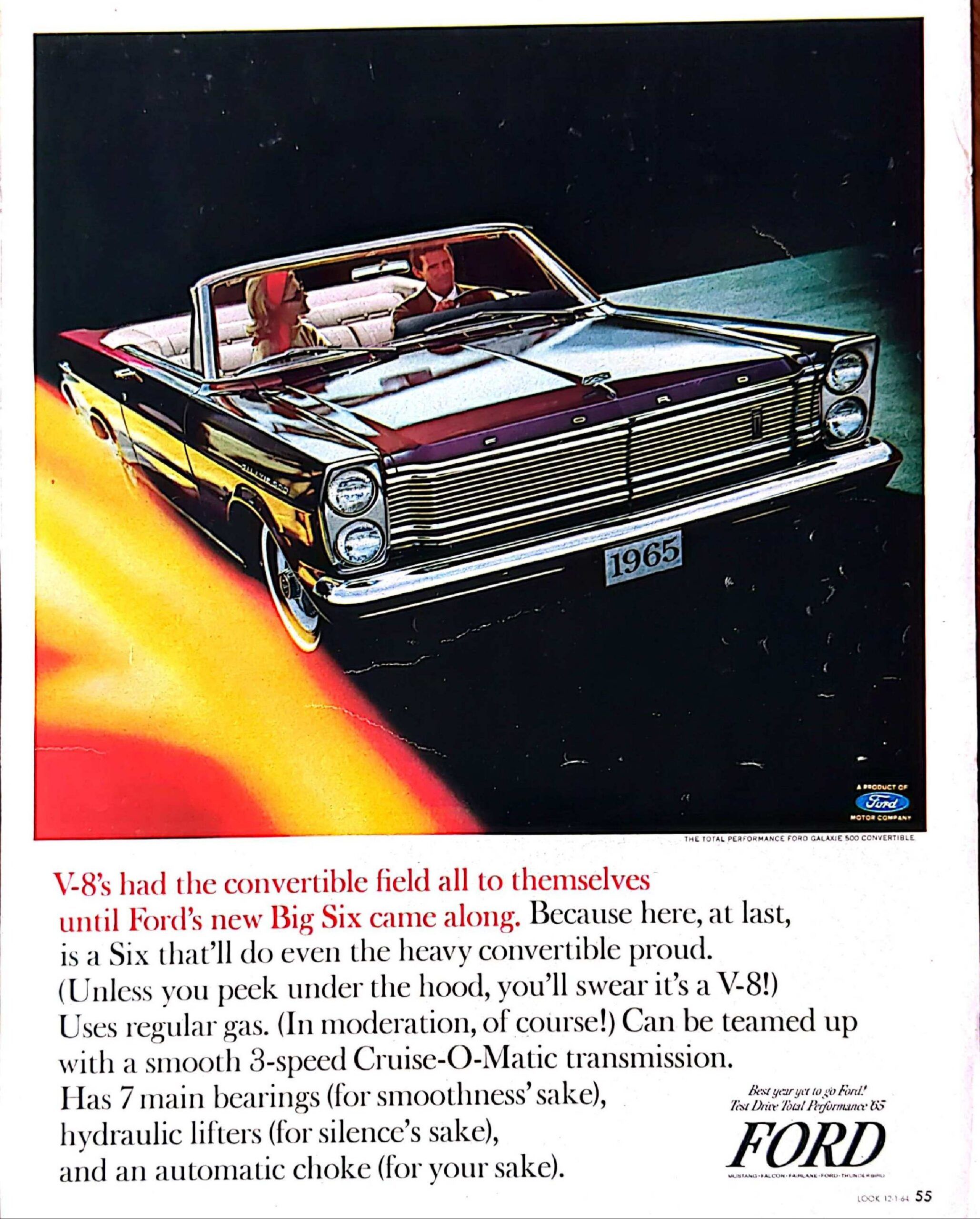
Interesting, yes…but it may not be all that uncommon. At least there is some evidence that Ford promoted the combination; this ad showed up in Look Magazine in the December 1, 1964, issue, and it could be the impetus that drove our Galaxie’s original owner to order such a machine. The ad says that the six will “do even the heavy convertible proud,” but with 150 horsepower and 234 lb.-ft. of torque (at 2200 rpm), I’m not so sure. A 289-powered Galaxie was no great screamer, and before anyone mentions that low-down torque of a six, the 289’s 282 lb.-ft. of maximum rated torque was taken at 2400 rpm, just 200 higher than the 240’s. For the sake of comparison, the 240 has the same 4-inch bore as the 289, but the stroke is a longer 3.18 inches.
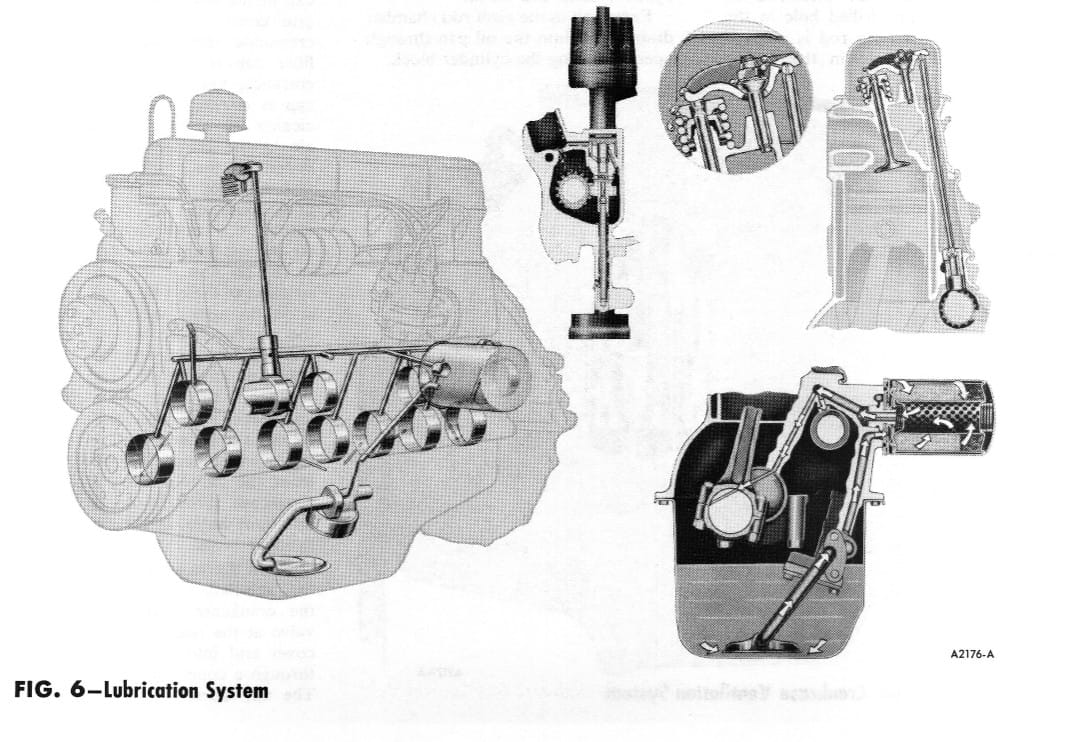
The 240/300 series of engines is well-known as being one of the toughest sixes of all time for several reasons, one of which is mentioned in Ford’s ad: seven-main-bearing smoothness. Whether or not this was a dig at Chrysler’s already well-known Slant Six (which uses four main bearings) is hard to say, but the installation of hydraulic lifters might be. The Slant Six had solid lifters for years after the 240 was released, but as the owner of a Slant-Six-powered car myself, I can attest that they are quiet and low-maintenance.
The 240 has a good oiling system, as the oil pump feeds the main bearings and cam bearings directly, and the oil from the cam bearing gallery feeds the hydraulic lifters. Simple but effective.

You may be wondering about the engine color in this Silver Blue convertible: It’s almost correct. The block and cylinder head were painted black from the factory, but the valve cover should be painted red (as the air cleaner is). Ford didn’t switch to “Ford Blue” as a rule until the following year, 1966. This car has power steering and power brakes, and someone has converted it to a dual-circuit master cylinder, which is an easy job considering that the 1967 Fords (which came standard with such a safety feature) were fundamentally identical mechanically.

The selling dealer was kind enough to post the data plate, which is riveted to the driver’s door, and it’s the best way to figure out a Ford’s factory equipment. Here’s what we can learn about the Galaxie:
- 76A: Galaxie 500 Convertible
- Y: Silver Blue Exterior Paint
- 62: Blue/Light Blue Metallic Vinyl Trim
- 17E: Scheduled Build Date of May 17, 1965 (This may or may not have been the day the car was actually built.)
- 13: New York City District Sales Office
- 1: 3.00:1 Open Differential
- 6: C-4 Dual-Range Automatic
The VIN works out to:
- 5: 1965 Model Year
- E: Mahwah, New Jersey Assembly
- 65: Two-Door Convertible
- V: 240-Cubic-Inch Six-Cylinder Engine
The “V” in the engine code answers the question everyone is asking: “Is this a clone of a real six-cylinder-powered Galaxie Convertible?” The answer is no—it’s true blue.

The all-new Ford for 1965 had an all-new interior, and its rectangular motif appropriately matches the square-rigged exterior styling. The big Fords were prescient, as cars from the later 1960s and early 1970s centered all controls around the driver. The radio and climate controls here are located so the driver can easily reach them, and the owner of a six-cylinder convertible will certainly not mind the lack of gauges.

Ah, it’s too bad about those speakers. The car does have an underdash aftermarket radio, but cutting a giant hole in an original door panel is just silly.

Less egregious are the headrests.

They’re either a dealer add-on or an aftermarket accessory, although I’m not certain how effective they’d be in reducing the effects of whiplash.

This car was presented by the selling dealer as being a 53,000-mile car, which has to be true if the car originated in New York. These Fords have no better a reputation for corrosion resistance than anything, yet this trunk floor, although clearly restored, looks immaculate.

Of course, images of an undercoated undercarriage immediately raise suspicions, but any work done is not obvious. The big trouble area in full-size Fords of this era is surprisingly the frame; it was redesigned with (dare I say it) some inspiration from the General Motors’ A-Body of 1964. Much of the car’s strength was carried in the body structure itself, and the frame had four torque boxes to tune out any ride discomfort. Ford replaced the rear leaf springs from 1964 with a set of coils.
Unfortunately, that new perimeter frame tended to rust beneath the front fenders (and sometimes even farther back toward the rear wheels), so it’s something to look carefully at when looking at a big Ford. You can also see some rocker panel reinforcements that apparently were added to convertibles.
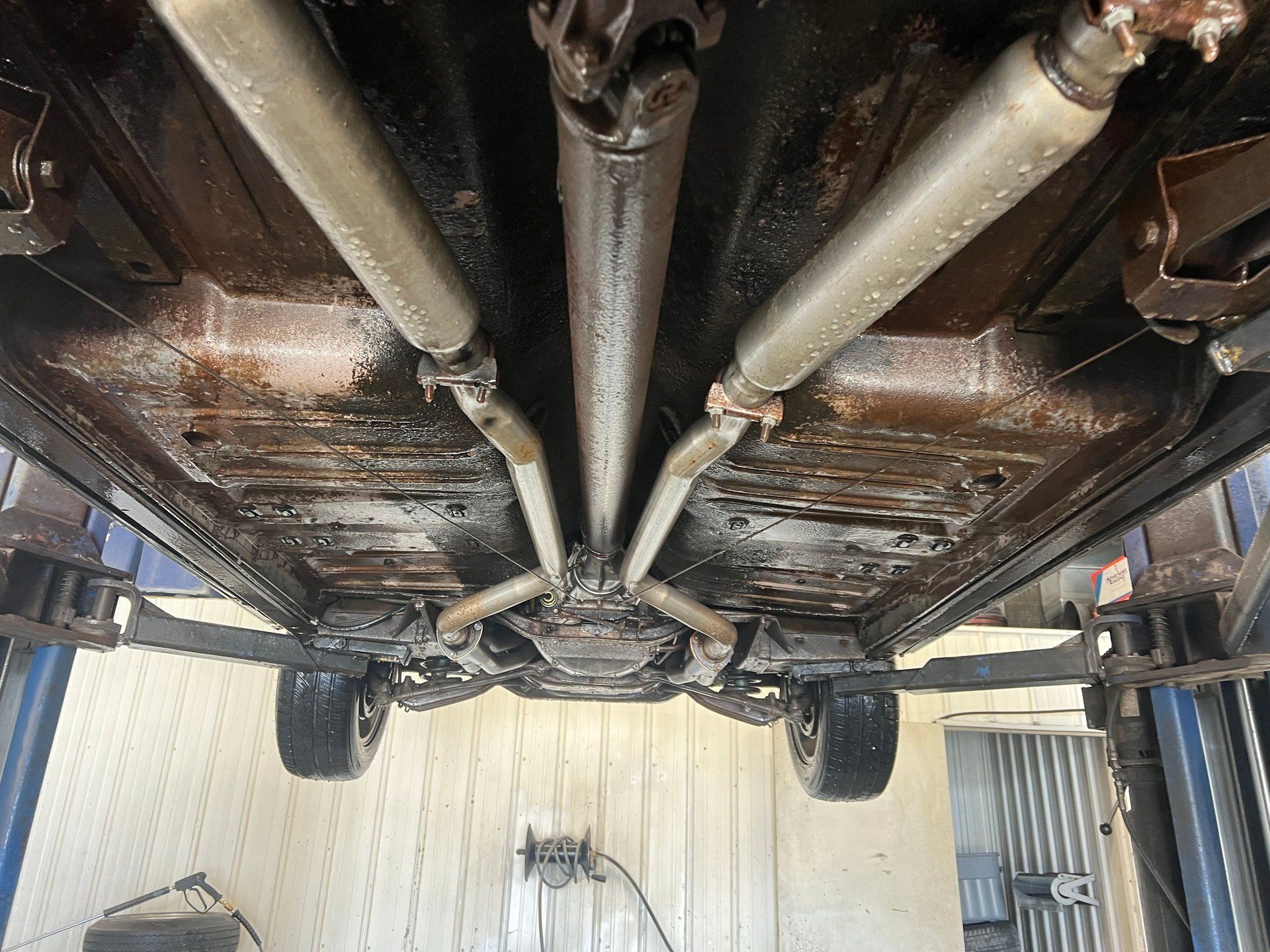
Here is the undercarriage of a 1965 Galaxie 500 Hardtop for comparison.

Regardless of the frame design, powerplant, and holes in the door panels, this is a beautiful example of a 1965 Ford. The only thing I’d change is those wide-whites, which have no place on any car built in the mid 1960s. No engine breakouts are available for the 1965 Galaxie 500 line, but a healthy 31,930 convertibles were produced, and we have to assume that a fairly small percentage had the new six-cylinder engine. That somebody was willing to take care of this one so well for so long (and give it a pretty nice restoration) must mean that Ford was onto something when they tried to sell you a “Big Six.”
Here’s the original dealer advertisement for this car.
Related Reading
The Brain Is In The Carburetor? Understanding Ford’s Forgotten Loadomatic Distributor (by me)
CC Tech: What Is A Torque Box? What They Do – And What They Don’t (by Aaron Severson)
1965 Ford Galaxie 500 LTD: In Honor Of The VHS Car Commercial Compilation (by me)
CC Capsule: 1965 Ford Galaxie 500 Convertible – Straight-Laced In A Curvaceous New World (by Paul N.)























This may be one of my favorite color combinations on a car from this era, and really shows off this car’s lines at their best. You mention the headrests and radio speakers, but I scratch my head at people who insist on a 1950’s whitewall size on a mid 60’s car. I find them jarring.
It was my memory from watching these age in real time that the bodies on these were amazingly resistant to the big rust holes that eventually showed up on about everything. And for reasons I never figured out (cost cutting?) the 66-68 cars were more rustprone in their rear quarters. And I will never forget the first one of these I saw with a rusted-through frame – a rusty 66 LTD with one rear wheel sitting way too far back in its wheelhouse in what was probably its last trip to the repair shop.
I spent a lot of time combing through junkyards for parts on my 67 (also a 76A) and don’t remember seeing many of these cars with the 6 under the hood. Really, with the choice of this 6, the 289 and the FE engines, it was hard to make a wrong choice for how to power your new Ford.
What a beauty .
The 240 i6 was a stout engine make no mistake, it wasn’t very powerful though .
-Nate
That is a pretty car. And I understand what JP is saying about the whitewalls, but I find them attractive. Make for a stylish upgrade to my eye.
A neighbor gave me a ride in his dark green Custom 500 with the new 6 right after he got it, I was very impressed with how silky smooth and quiet it was, more so even than the 289 in Dad’s ’64 Custom 500 company car that he’d gotten just 6 months before. Both had Cruise-O-Matic 3 Spd automatic. The new Six was apparently a big improvement over it’s predecessor.
There’s a few things that likely explain why Ford was advertising their new Big Six:
The new ’65 Ford lost a couple of hundred pounds from its overweight predecessor. That, combined with the new six’ improved power output, made the six a more viable competitor. Ford had never sold a lot of sixes in its big cars, given its rep for V8s, whereas Chevy sold a lot of them. It’s clear Ford wanted to be more competitive with sixes. And now it was.
The 240 six (I know it very well) was the most powerful six in 1965, rated at a healthy 129 net hp (in the pickup, maybe it lost on or two to the sedan’s longer exhaust system). That’s more than a lot of the smaller V8s in the era to come, and essentially the same as Ford’s 302 V8 in the late ’70s. The downside was teaming it up with the automatic; vintage reviews consistently sowed Fords with it being more sluggish due to slow shifting and poor efficiency. I’d be happy with that convertible and the all-synchro top leader three-speed manual.
There’s another reason why Ford was likely pushing its new Big Six: it was struggling to build enough 289 V8s due to the Mustang’s phenomenal success. This problem became acute in 1966, and it was rare to see a big Ford with a 289, as almost all dealer stock cars came with the lo-po 2V 352 due to the severe shortage.
It’s almost quaint to see this ad, as it was the last hurrah of sixes in big American cars. Gas prices were dropping, in adjusted terms, and incomes were increasing, and everyone was piling into cars with V8s and automatics and power accessories and increasingly air conditioning. Chevy’s new 250 six that came out in 1966 would be the last really new inline six in this field, and it was even a bit more powerful than the Ford 240.
This is a great find, but I’d like it even better if it had the three-speed manual.
I wonder if the six held up better with the C4 automatic, which was a lot better than some of the previous slugs with Fordomatic. I don’t think I’ve ever seen a road test of a 1965 Ford with the six; that would be an interesting one to dig up.
I had access to one, and referred to it in the ’66 Bel Air six (PG) vintage reviews. Here’s a snippet:
here’s the stats from their test of the Ford six. Its 240 cubic inch six was rated at 150 hp gross, 5 less than the Chevy six. For what it’s worth, that same engine in my ’66 F100 was rated at 129 net hp; it’s possible that there might have been a very minor difference in the as-installed (net) hp for the passenger cars, but we can safely assume that its net rating was at least 125 hp, which is what the Chevy 250 had. Torque ratings were 235 ft.lbs for the Chevy, 234 ft.lbs for the Ford. So essentially an equal match, power-wise.
The Ford weighed 80 lbs more; that’s insignificant. It had a 3.00:1 axle ratio, also insignificantly different form the Chevy’s 3.08:1. The Ford’s automatic had a 2.46:1 first gear and a 1.46:1 second gear. The 2.10:1 (max) ratio of its torque converter yielded an effective 5.16:1 ratio at stall speed, significantly lower than the Powerglide’s 3.82:1 at stall speed. That should have made it quicker off the line. despite all that, the Ford was…slower, taking 16.3 seconds for the 0-60 (Chevy: 15.5), and 20.7 seconds @66 mph for the 1/4 mile (Chevy: 20.5 @69 mph). The 30-70 passing test took a full 19 seconds compared to the Chevy’s 16.2 seconds.
One of the most unexpected things I’ve learned from these vintage reviews is how well (the oft-maligned) Powerglide acquits itself in acceleration times, and how Fords of the era tended to be sluggish, despite the presumed advantage of a three-speed automatic. I could show you several other examples.
Having said all of that,the Ford’s 0-60 in 16.3 seconds for a full size six is quite adequate and within the normal range.
Being raised in a Ford household, I remember being consistently disappointed by how often they lagged behind the competition in old road tests. It was almost universal; I think the Cobra Jet cars and maybe the rare Boss 351s were the only cars that lived up to the hype.
While we are on the subject, I have a friend that has a built 300 six and top loader 4 speed in a short box ’68 F-100. You better buckle up and hold on to your hat! The 300 has the same 3.98 stroke as the 428FE
Nice ride, but the whitewalls have to go! And I would, while nobody was looking, slip a 300 long block in it. 🙂
Pretty car. Love the color combination, especially the interior. I miss color keyed interiors.
I’m not crazy about the ‘TV-test-pattern’ wheel covers, but they are period accurate, and are in great shape.
Although the speakers in the doors are not good due to cutting holes in the door cards, they are integrated well and color coordinated. And being a man of a certain age, didn’t we all do that to our used Fords in the seventies? My ’73 LTD had holes cut for the speakers. ;o)
Finally, about those headrests: They would give better whiplash protection if they were simply turned around. They are on backwards in that picture. The brackets should not be leaning back. They should be pointed forward towards the front seats.
Like to see a pic with the top up.
I posted a link to the selling dealer’s original ad at the bottom of the article, and it has plenty of pictures of the car with the top up and down.
My very first thought, those wide whites have GOT to go. I have a friend who had a ’65 LTD 4dr hardtop back in the late 70’s, she called me up to say she could back up but couldn’t go forward. I went to look at it, the rear end had broken away from the frame on the left side (rusted out) so when she tried to go forward the rear end swung back and pulled on the emergency brake cable. That was the end of that LTD.
I’m surprised no one noticed Fords claim in the advertisement that” V8s had the convertible field all to themselves until Fords new Big Six came along” That seems to imply that convertibles where unavailable with a cylinder count of less than 8 until the new for 1965 240 inline 6 was available. Of course everyone here knows that not to be the case. Also I doubt the 65 Galaxy 240 had better acceleration than a 230 Impala or a Fury with the 225.
Well, it’s an ad, which are notorious for their hyperbole.
The 240 six (150 hp) was a bit more powerful than the Chevy 230 (140) or the 225 slant six (145 hp). But Ford’s automatics at the time were notoriously inefficient, so yes, with an automatic, the Ford would lose. But on an equal basis with a manual and the same rear axle ratio, I would give the Ford the nod. The only six more powerful than the 240 Ford at the time was the AMC 232 six. Both the 240 and the 232 were the most modern sixes and it showed.