

American automakers were surprisingly slow to give up vivid lime greens in the mid-1970s. General Motors offered two shades as late as 1976, while Ford marketed three lime greens across its truck lineup in 1974. This 46,000-mile Bronco is painted a very pretty shade called “Pastel Lime,” and it’s the perfect thing for a springtime drive along the beach.
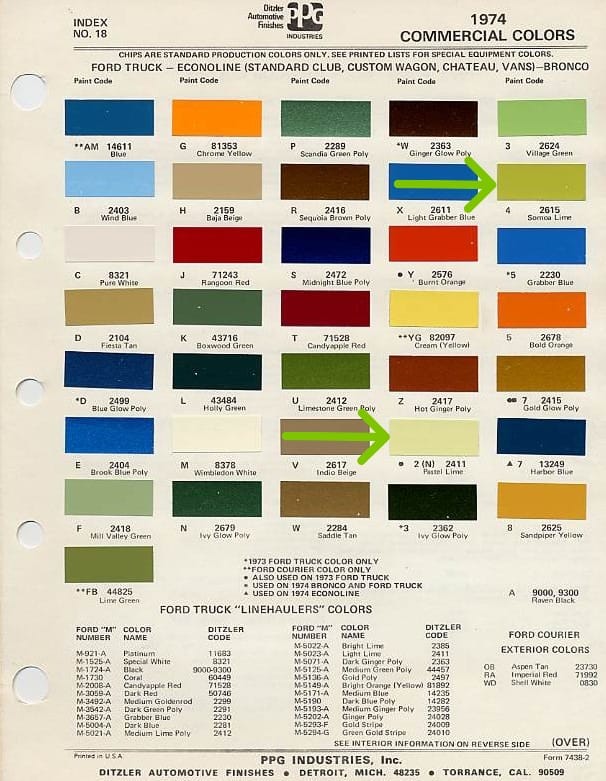
Look at all the bright, vibrant colors offered on Ford Trucks in 1974. Broncos were available with Code 4 “Samoa Lime” or Code 2 “Pastel Lime,” which is what our featured Bronco is painted. Plain old “Lime Green” was an option on the Mazda-based Courier, and “Limestone Green Metallic” was a not-really-lime option on Broncos, too. All those oranges, reds, and yellows were certainly worth a look, but choosing a color was painful for the indecisive.
Ford was also adept at naming colors, with “too far” names such as “Anti-Establish Mint” making way for clever Kinksesque names such as “Village Green.”

Considering how popular and expensive first-generation Broncos are today, it’s interesting to know that they were never huge sellers when new; the 1974 model was the most-popular, yet only 25,974 were sold. The slowest-selling model of the 1966-1977 generation came one year after the best-seller, with only 13,125 units hitting the lots in 1975. Truth be told, however, most model years averaged between 15,000 and 20,000 Broncos, so their sales were fairly consistent as a whole.

Most Broncos are not as solid as the Pastel Lime beauty pictured here; they rusted with abandon, although their popularity ensures that repair panels are available, and almost any Bronco can be a worthy proposition considering their sale prices over the last decade. Although it’s easy to assume that Broncos were based on the Falcon or the Mustang platform because they shared engines, the Bronco actually had a separate frame, unlike the unibody structure shared by the cars.

Ford’s sales catalog labels the Bronco’s front suspension as a “Mono-Beam,” a nice anagram of Moon Beam, which would have been a fun trade name for a shade of green. Instead, it was advertising jargon for a solid front axle, which many off-roaders would prefer over something like Ford’s “Twin-I-Beam” setup. It looks like there’s a not-too-beefy skid plate protecting the Dana 20 transfer case, which was standard on the Bronco.

Optional was the 302 small-block, which produced 137 horsepower (the 89 net-horsepower 200 six was standard). This one has power steering, power brakes, and air conditioning, but it has a standard three-speed manual, as we’ll see in a minute. Check out the angle of the power booster and master cylinder, which was necessary for engine clearance with the V8.
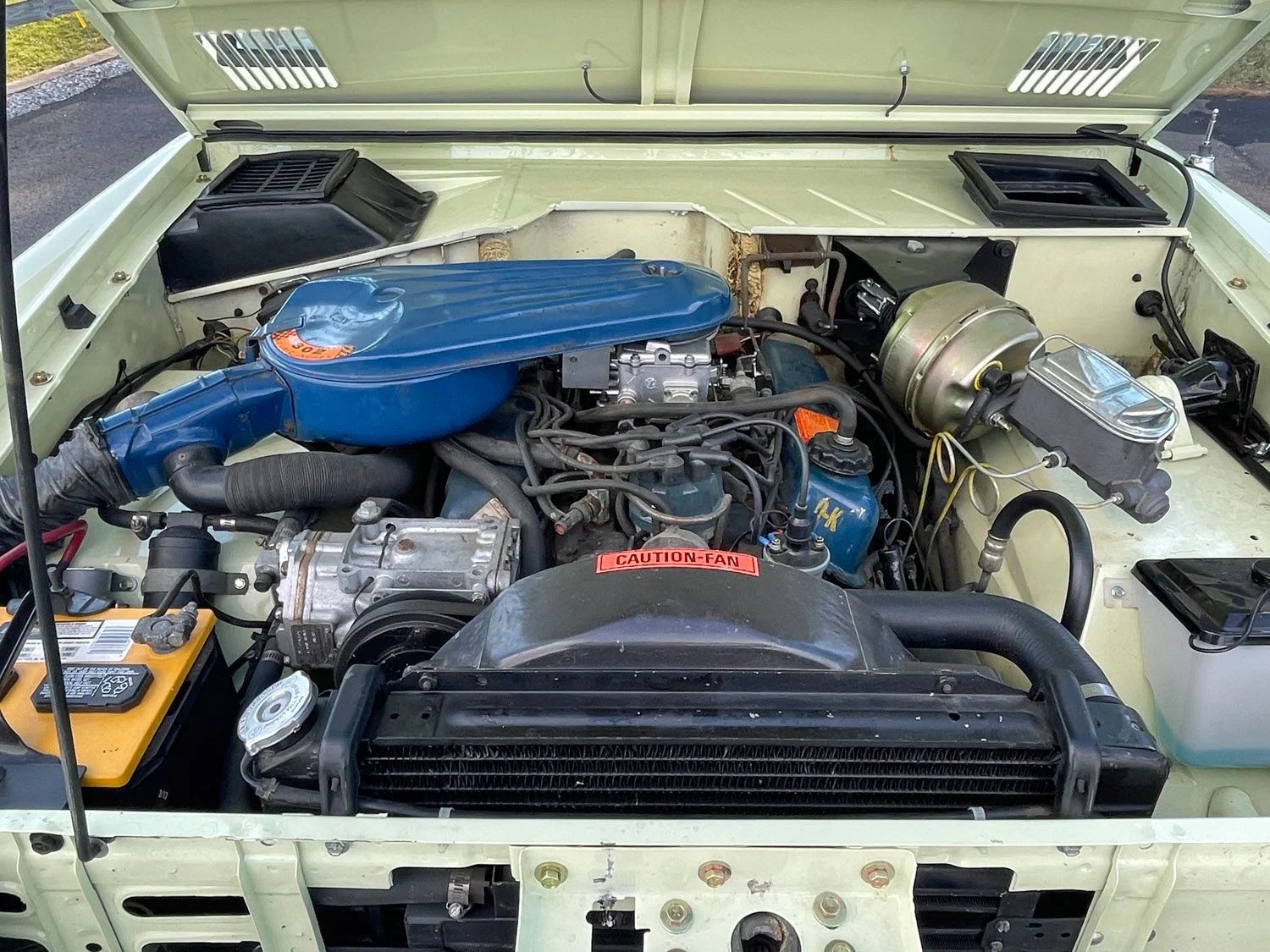
You can see the setup a little better straight on, as the booster would certainly hit the driver’s side valve cover and/or the throttle linkage if it were mounted straight to the firewall.

Ford’s door tags always tell us a lot more about how cars and trucks were ordered. Here’s what we can learn about this Bronco, starting from the top:
- U15: U100 Wagon (the only bodystyle offered by 1974)
- G: 302 V8
- L: Michigan Truck Assembly (Wayne, Michigan)
- U08275: Unit number, which falls in the range of 1974 models
On the bottom rows:
- 092: Wheelbase
- 2: Pastel Lime paint
- U153: This probably denotes the U15 bodystyle with the GVW code, which I was unable to find. Broncos came in four “packages,” with the third being 4,500 pounds.
- 34: This may be the trim code, which would have indicated a parchment interior.
- C: Three-speed manual, fully synchronized
- 18: 3.50:1 axle ratio
- 22: Charlotte, North Carolina, District Sales Office

The nice thing about first-generation Broncos is that a 1974 model looks much like a 1966 model; like a Volkswagen, you were sort of frozen in time. The bucket seats appear to be straight out of the sixties, as does the speedometer, the steering wheel, the underdash air-conditioning unit, the control knobs, and of course, there’s a rubber mat and plenty of Pastel Lime painted surfaces. The shift control for the transmission is on the column and the transfer case selector is on the floor.

The rear seat is of the “safety third” variety, as was expected in small, rugged SUVs in the 1970s.

All this does make one wonder who would order such a thing in 1974. It’s fairly well-optioned for a Bronco, yet its manual-transmission argues that it was either outfitted for fun or for its actual off-road capability. On the other hand, its relatively low mileage suggests that perhaps it was someone’s beach-house cruiser on the North Carolina coast, a car that spent some time on the shores of the Atlantic or something equally romantic. Its Pastel Lime paint implies that the original owner was a fun-loving sort with a hint of whimsy in their makeup, so maybe it’s best to imagine it that way: windows down, sea breeze drifting through the driver’s hair, maybe a dog on the passenger seat with its head out the window. Just make sure to vacuum up the sand from that rubber mat when you get home.
Related Reading
Lime Aid: How These Lime Green 1976 Chevrolets Brightened Up The Bicentennial (by me)
Dealer Ad For Pastel Lime 1974 Bronco























Lovely, what a pallete of colors available in 1974. Can you imagine if the Bronco had only been available in white, black, silver, pewter and special metallic black? Yawn.
I was a big fan of the Bronco when this one was new. Since I was only 7 years old I didn’t have the finances to buy one and live out my dreams of off road adventure.
Yep, and living out those dreams now would require a truly ludicrous amount of money. These things, and all small SUVs of the 1960s and ’70s, are HOT!
1974 was the first year an automatic was even available, along with power steering. It was also the final year of the six-cylinder engine. They were all V8s after that.
Thanks for all the information on this nice little 4×4.
You’re welcome, as always.
This prompted me to visit the build and price site for the new Bronco, and I was pleasantly surprised at how close you can get to this oldie. A base 2-door hardtop 4×4 with a manual transmission and a good selection of exterior colors (for our time, anyway) and steelie wheelies. It even looks more or less correct. Not a bad effort by Ford at all.
Just yesterday, I saw a two-door Bronco in that Baby Blue retro-themed variation, and it looked really cool. My sister drives a Bronco Sport in that color scheme, and it’s just nice that Ford has offered some variety in their trim levels. Usually, there’s very little fun in selecting a new car.
A 1974 Ford PPG color card. Sigh….
What amazes me is how ‘pastel’ this pastel lime is. On my monitor it’s almost white; my phone shows a bit more differentiation between body and grille/bumper. They’d never make a colour this pale nowadays.
Will we ever get real colours back?
Cute little thing. Bet it scampered over the rough stuff with that 302.
I love this Bronco! It’s exactly how I would have optioned it out if I’d ordered it. The only thing I might have done different is the AC: you can get by pretty well without it where I live, but I’d check that box in a heartbeat in AZ, the deep south, etc.
I can’t say I’d have gone straight for that color, but I wouldn’t think of changing that if I were lucky enough to buy it. I’d like to see some pastels like this back in style. Some haven’t aged well, but they’re still so much better than the “clay bar” colors that seem so popular all of a sudden. Of course, some of the cars you see those colors on might as well have the most “blah” color imaginable…
I remember a 1972 cream yellow (I think) Bronco on the showroom floor with Mickey Thompson offroad package, flared rear fenders, front fog lights, 302, roll bar, for something like $4,500. Couldn’t quite pull it off. Now that same rig in good shape would be $80 g’s.
Those Broncos were nice alternatives to Jeeps.