
 Photos from the CC Cohort by Hyperpack.
In general, the public has a fascination with origin stories—and endings. Today, we have one of the latter, with a closing chapter that fans of full-size American cars enjoy revisiting: GM’s final year of B-body convertibles, in the form of a 1975 Pontiac Grand Ville Brougham. Just 4,519 were built that year, which was also the final year for the Grand Ville name and the only year the Brougham designation was attached to it. So lots of relevant events and small tidbits that come with this last of its breed Grand example.
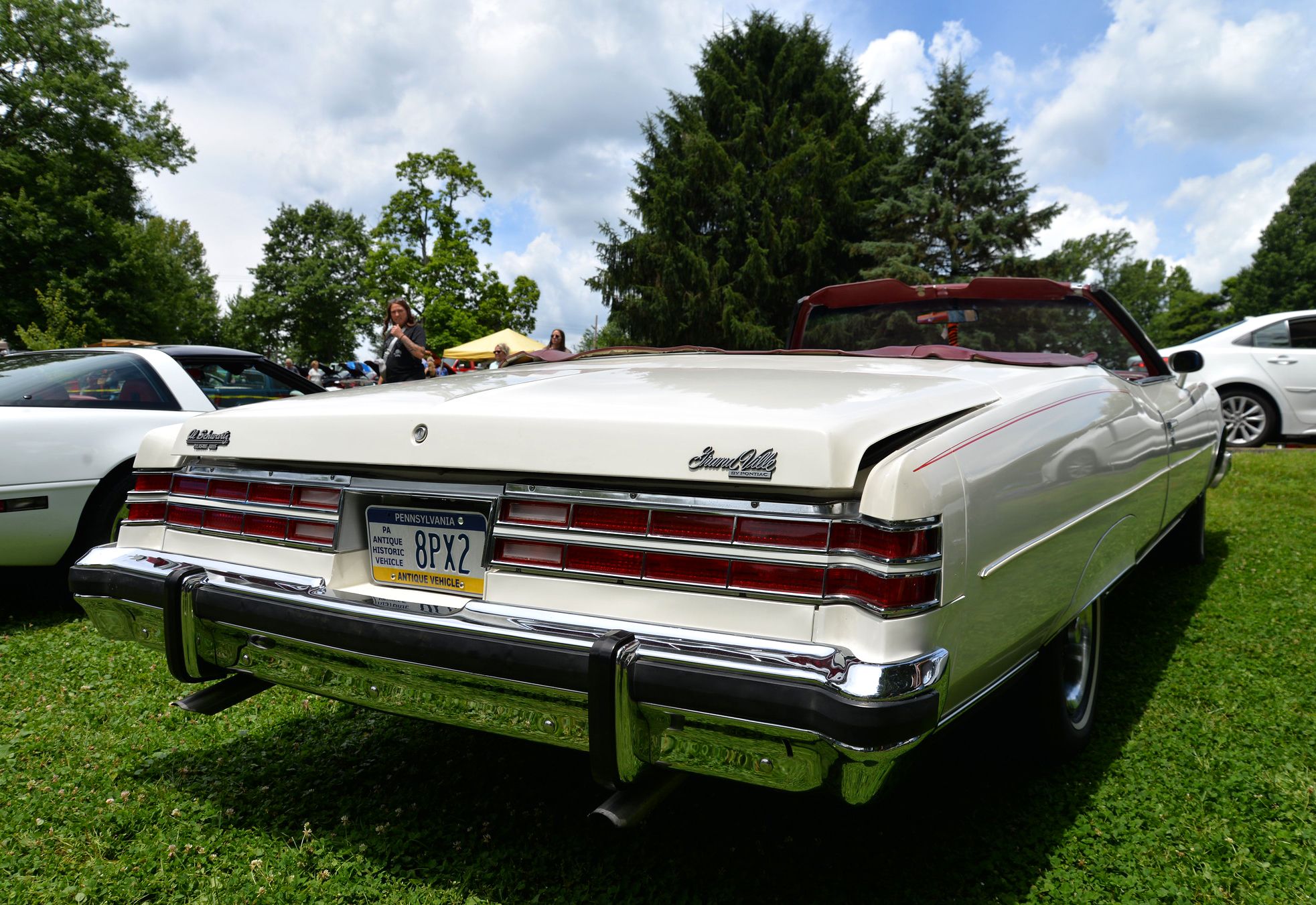
“You don’t know what you’ve got until you lose it,” or words to that effect, certainly seem to apply to this find. Reasons behind the demise of GM’s full-size droptops were several, and if you wish to delve deep into those, Aaron S. covered them in detail in a previous post. Suffice to say that they were going away, and that even in those pre-internet days, word got quickly around. Sales of Pontiac’s version of the niche body style had fallen to just 3,000 in 1974, then bounced back to 4,519 for its final 1975 run.

Beyond being the last of its species, this Grand Ville Brougham offered plenty of full-size luxury for the time. Although Pontiac had usually been one step above Chevrolet, the Grand Ville Brougham was now the priciest of the GM B-bodies. It had a standard 400 CID V-8, with a 455 CID optional, plus Turbo Hydra-Matic, power steering, power front disc brakes, power windows, and a fancy Brougham interior. In all, the model provided the effortless, hands-off cruising and plush trim buyers in this class expected. Furthermore, it could be loaded with most of the doodads the luxury segment demanded, like automatic temperature control air conditioning and power locks.
As such, the Grand Ville checked all the Brougham era luxury boxes. So, why choose a Buick or an Oldsmobile? Brand and dealer loyalty? Styling preferences?

Perception, of course, had as much to do with a purchase like this as anything else. In the unspoken tradition of encroaching on other divisions’ turf, Pontiac had been expanding both downward and upward when the Grand Ville arrived in 1971 as the brand’s new top offering. Initially, the Grand Ville, like the discontinued Pontiac Executive and Star Chief, rode on a 2.5-inch-longer wheelbase than other full-size Pontiacs (126 inches versus 123.5), and across the lineup, the models moved the division toward the Brougham-y Neoclassical flavors that defined the early ’70s.
Meanwhile, the formerly top-of-the-line Bonneville (which also rode the longer wheelbase) was moved down to second best as Grand Villes appeared on showroom floors. How those conversations went, I always wondered: “Sir, you looking for a Bonneville? That’s not tops anymore—we’ve got a GRAND Ville now! Want to take a look?”

Pontiac’s market repositioning didn’t do much for the division’s fortunes, however, slipping from its former third place in sales to fourth in 1971 and 1973, and down to fifth in 1972 and 1975.
So, as if to make clearer the division’s intentions to those who hadn’t quite grasped it, for 1975 it was the Grand Ville Brougham. The Grand Ville, Bonneville, and Catalina were now the same size on the outside, as Pontiac had consolidated with a single 124-inch wheelbase for all models back in 1973. Besides the updated name, the model, alongside the Bonneville, carried then-trendy square headlights. Meanwhile, the entry-level Catalina had to make do with a face that said, “Feels like 1974, doesn’t it?”

As mentioned earlier, “luxury” wasn’t just a marketing ploy with these Grand Villes. For 1975, the convertible’s base price was $5,858—$725 more than the Chevrolet Caprice or Buick LeSabre Custom. That included a couple pieces of extra equipment, but the Grand Ville also had the fanciest Brougham-iest interior of them all.

Depending on which options were added or subtracted from the final delivery price, the numbers varied among the B-bodies, but the bottom line is that the whole Grand Ville line was really expensive for 1975. Indeed, the four-door hardtop actually cost more than the convertible; “Pontiac’s most luxurious full-sized car.”

Plush trim and fancy gadgets aside, sales figures suggest buyers weren’t entirely sold on Pontiac’s upmarket, Brougham-y push. Oldsmobile, riding high at the time, and Buick remained the preferred choices for driveway bragging rights, with more cachet and reputation for better build quality—the latter something Pontiac had struggled with during its aggressive early ’70s production push (So perhaps there was a reason to buy a Buick instead!)
With just 27,652 Grand Ville Broughams sold for 1975, the name was dropped in favor of the Bonneville Brougham, Pontiac’s new top offering for 1976.

But that was then, and this is now. As final year full-size convertibles, these are conversation pieces and have lots to offer, and the Pontiac version makes a nice variant.
I’ve sung the praises of Bill Mitchell’s styling department before, although by the 1970s, GM’s ever-expanding model lineup had started to spread some of that magic a little thin. Still, I feel that Mitchell’s fondness for reworking classic-era themes found a good home on this Grand Ville. It also helps that it’s a convertible; the missing roof adds some lightness to the otherwise substantial body, while the fender skirts seem to work better here than on some of GM’s other full-size offerings of the period.

The burgundy and white combo is a neat eye-grabbing one, and could this still be the original Morrokide upholstery? Meanwhile, even if this is a 1975 model, the dashboard still has that “driver-oriented” instrument cluster that had been a novelty early in the decade.
And then, how about that tiger tail hanging from the rear view mirror?

Must be a nod to Pontiac’s “GTO Tiger” ad campaign of the mid-‘60s. Kind of a nice touch, though that was performance era Pontiac; “Purrs if you’re nice. Snarls when you prod it.” Fun stuff, but today’s Grand Ville Brougham ain’t really Tiger material, if you ask me.

Elsewhere in the cabin, 8-tracks, in case anyone had any doubts about what decade we’re talking about here. Can I bring my father’s Roberta Flack cartridge to play? Oh, never mind. I’ll just use the Johnny Cash one already there.

Of course, when it comes to GM, the question usually comes down to choices. To close out the B-body droptop era, would you pick this Pontiac, a Chevrolet Caprice, Buick LeSabre, or Oldsmobile Delta 88? Personal bias pushes me toward the Caprice, but I’m not that dogmatic. And truth be told, while I find many other ’70s Pontiacs stylistically overdone, this one is looking pretty good to me. Like a lot of endings, this one leaves plenty to ponder.
Related CC reading:
1975 Pontiac Grand Ville Convertible – Looking Right At Home In The Netherlands.























The Grand Ville Brougham was the fanciest full size car in the Pontiac store, so it made sense to position it as a C body competitor. The six window hardtop Pontiac sedan body looked like the common C body.
Pontiac had sold a stretched full size car for years, and the 1971 Bonneville and Grand Ville were true C bodies (exc convertible) because the 1971 clamshell wagon required C body sized doors for all brands. By 1975 Pontiac had abandoned true C body sedans and coupes.
not really The 1971 Pontiac Grand Ville was built on a stretched-wheelbase version of the GM B-body platform, not a true C-body. It rode on a 126-inch wheelbase shared with other large Pontiacs like the Bonneville, but it used formal, upright C-pillar roof treatments inspired by GM’s 127-inch-wheelbase C-body luxury cars. Even though the Grand Ville looked just as long as a C-body on the street, it didn’t have the same rear passenger room. On a true C-body (like an Electra or Olds 98), that extra wheelbase went directly into stretching the rear floorboards for limousine-like rear legroom. In the Grand Ville, the extra length was all on the outside in the hood and overhangs. To streamline manufacturing and reduce assembly costs, Pontiac unified all three models onto a standardized 124-inch wheelbase in 1973.
The Pontiac Grand Safari shared its exact B-body foundations, leaf-spring rear suspension, and “Glide-Away” clamshell tailgate with the Chevrolet Kingswood Estate, Oldsmobile Custom Cruiser, and Buick Estate.
Pontiac had only true C-Body: The 1940 Torpedo. Chevy never did.
Yeah, Pontiacs were kind of confusing in those years. In 1971-72, the models on the 126″ wb had that extra two inches ahead of the cowl. So you didn’t get any more interior room than the 124″ wb Catalina. One exception was the hardtop coupe, though. That formal roofline let them push the rear seat a bit further back, to the point that the Grand Ville coupe had as much legroom in back as any of the B-body sedans or 4-door hardtops. I think it was 38.8″ but not positive. For comparison, I think the rest of the B-body coupes (Catalina, Bonneville, LeSabre/Delta 88/Caprice/Impala) had something like 35.6″.
I’m wondering if the ’71-74 Grand Ville coupe might have actually used the same roof as the sedan, and that’s why the dimensions were identical?
The Bonneville and Grand Ville both dropped to the 124″ wb for 1973. I have a feeling that these cars were big enough already, nobody really noticed the extra 2″ up front.
In ’75 when they re-did the rooflines for the Grand Ville (and moved the Bonneville to the Grand Ville’s roof), I have a feeling that legroom advantage for the coupe might have disappeared.
That formal roof of the Grand Ville does look deceiving, as it’s close to the proper C-body roof in style. But, it’s sort of a C-body roof, force-fitted onto a B-body. The rear doors of a Grand Ville are a few inches shorter, as is the window glass.
Full-sized Pontiacs must have been kind of expensive to build in ’71-76. With Buick and Olds, the front fenders and hoods were the same, whether it was a B- or C-body. But with Pontiac, for those first two years, they had unique front fenders and hood for the Catalina vs the Bonneville/Grand Ville. And then for the entire run, they had that Grand Ville/’75-76 Bonneville roofline, that was unique, and not shared with any other division.
I wonder if they would’ve been better off just making the Grand Ville a true C-body? Then again, across the kind of volume that GM did in those days, perhaps all those variations really didn’t cost all that much to offer?
Had a ’76 Grand Ville Brougham, used and very low mile, for a while, very plush but didn’t like at as it felt a bit willowy. Traded it for an equally low mile ’77 Gran Fury Brougham (broughams everywhere then!). I liked it much better, and kept it for 10 years as a daily driver accumulating over 200k near trouble-free miles!
I do like this car, but I have to wonder who Pontiac identified as the customer for the Grand Ville. They had just spent the previous decade producing exciting cars like the GTO, Firebird, LeMans, and the Grand Prix. I suppose the Grand Prix driver who suddenly needs a bigger car might be tempted into a Grand Ville, but at that price point you’re in Oldsmobile or Buick territory with their brand cachet, real or perceived. The Sloan ladder was obsolete by this point, so I suppose Pontiac could justify the upmarket push. I was seven when this car was new, but I must confess I don’t remember seeing many big Pontiacs.
Pontiac was near death in the 50s and early 60s until DeLorean took over. He pulled it back from the brink by giving it a sporty and youthful makeover. But Malaise took it all away. Pontiac should have been shut down by 1983.
No way! Pontiac was very successful in the 1980s. Their sales numbers in the US alone proved that starting in 1982 when several all-new models came out from the F-body (Firebird) to J-body (Sunbird 2000) to A-body (6000). Every successive year saw increased sales. By 1990 Pontiac was the #3 selling brand behind Ford and Chevrolet the #1 and #2 respectively in the US.
Even into the 1990s Pontiac was still selling well and making money for GM. The Grand Am, Grand Prix, and Bonneville were very successful sellers sustained into the 1990s, and the Firebird wasn’t doing too bad either. In fact, CCC posted an article here back in 2020 with a chart showing that 1980s spike and Pontiac holding its own in the 1990s. Millions of cars were sold in those last two decades, and losing Pontiac then would have been a massive blunder and loss to GM’s bottom line:
https://www.curbsideclassic.com/blog/chart/chart-of-the-day-pontiac-market-share-1947-1996/
I can’t say that I have a lot of love for these cars. They are huge just for the sake of being huge and the space efficiency is awful. A car this big should have a generous passenger compartment, that was not the case with the featured car.
There used to be one of these in my neighbourhood. The owner had no garage to keep it in, so he covered it with tarps. That worked for a couple of years until the for sale sign appeared.
Back in 1985, I distinctly remember seeing a beige one for sale in the Publix parking lot for, I think, $4,000. I was sorely tempted, but I restrained.
Wow you’ve got one photographic memory. I can only remember vividly a few things from certain months and times in 1985 as I was in high school then. But seeing a beige car for sale in a grocery store parking lot and remembering the asking price certainly wouldn’t be one of them if I did even see it!
I have always loved these full size convertibles. I was age 24 in 1975, and had started to lose interest in these B-body convertibles after 1972 and the introduction of the big bumpers. If I were to buy one today my first choice would be split between Buick & Pontiac, then Olds, last Chevy. However, in 1975, my heart raced first time I saw the revised styling of the 1975 Eldo convertible. Early on I ordered a white w/ red interior 1976 Eldo conv., before I heard all the hype of the last convertible. I checked about all the option boxes to get it my way. I didn’t order it because it was a Cadillac, just because I was instantly attracted to the body style of the convertible. I grew up in the backseat of family convertibles from the mid 1950s – early 1960s, and received a new 1974 Buick LeSabre conv. I kept my 1976 Eldo conv. for ten years and 100,000 miles and enjoyed every top down mile. If I ever have to give up my current 1966 T-Bird convertible, my shopping list will include another 1976 Eldo conv. If I ever have to give up my daily driver, will shop for a last generation Mercedes S-Class convertible, a full size convertible.
I always liked the look of these among the GM convertibles, and by 75 the interiors were looking nicer than the earlier years. We were a Pontiac family, but Dad never stepped up to a Grand Ville. It didn’t make a lot of sense compared to a loaded lesser Pontiac. The dash was the same, you could get the same 400, and the wheelbase was the same (after 72). In the case of our Catalina, Dad had auto climate control (yes, available in the entry model), the finned hubcaps, power windows, trunk opener, and whatever the best upholstery was available at that level…though I don’t believe you could get a split front seat.
Unlike at Olds or Buick (C bodies), Pontiac just didn’t give customers enough reasons to splurge for the top of the line model.
That said, I’d take any low mileage 73-75 Grand Ville convertible, followed by a 71/2 Centurion.