

A few weeks ago, I discussed my love affair with a full-size Pontiac that eluded me years ago, and like so many lost loves, I’ve never quite gotten over it. On a related note, I let one of the above land barges get away a couple Aprils ago, and although it doesn’t exactly get under my skin the way the ’65 Catalina does, I still suffer from pangs of non-buyer’s remorse over the ’65 New Yorker 2-door hardtop.

The brochure for the 1965 Chrysler line asks a simple question, which may or may not be rhetorical. I’ll answer and not answer, respectively. No, I couldn’t agree to buy the double-white New Yorker for sale on the side of the road in Traverse City, MI, for the simple reason that it wouldn’t fit in my garage with my other old cars in it. At 218.2 inches long, it’s over a foot longer than my ’65 Skylark and ’53 Special Riviera, which are both really big. This thing gives the phrase “road hugging weight” some, well, weight.
Rhetorically, there’s nothing more to say but that I love the new-for-’65 modern look of this New Yorker. Chrysler had a banner year (as did almost everybody else) in ’65, and its clean new three-box-mobiles looked contemporary and fresh. On the other hand, I can’t imagine my choosing this car over a GM B-Body if I were buying a full-sizer in 1965. Today, it’s common for car-crazy dorks like me to have several old cars, but if I had one choice in a full-sizer, I would have been all over the Pontiac.

My intention is not to damn with faint praise, however. If I lived on an ample plot of land with a sizable pole barn, I could have gleefully lived out my days with that white New Yorker. This nice 4-door hardtop version exhibits a few reasons why. The taillights are unique: a combination of clear lenses and colored bulbs, an uncommon look that should have caught on (but I think was changed to more traditional lenses midyear). Additionally, I think the rear panel is among the most stylish of the big cars in ’65, with those gorgeous taillights bookending concave polished trim.

www.imperialclub.com
I always thought I preferred the Newport/300’s faster sloping c-pillar, but the New Yorker roofline almost seems more “expensive,” more in tune with the theme of the car. The two creases running along the beltline and through the rear fender skirts are in harmony with each other and the gently convex bodyside. Not too much not to like back here.

I don’t, however, think I’d play glamorous race car driver in it. Even with torsion-bar suspension and a 413 disgorging up to 340 rated horsepower, I’d think I’d be happier highway cruising (or floating), at least until I had to fill up the gas tank. I am very familiar with the old Carter AFB, however, so maybe with a little tweaking and prodding…oh, never mind. I’d be happy with 12 MPG.
As I researched the New Yorker, mulling over its purchase, I asked around the C-Body Forum, looking for pitfalls with this model. From all their answers, one very familiar caveat became evident: parts availability. Chrysler Corporation only produced 9,357 New Yorker 2-door hardtops in ’65, and even some of the mechanical parts like shifter cables were different from later model years.

Since I don’t want to be a spoil-sport, let’s avoid discussing the negatives and return to one of the reasons I should have bought this Mopar. I like its dashboard; my favorite dashboards of 1965 have always been Chrysler’s and Mercury’s. Chrysler abandoned pushbutton drive for ’65, which gave them room to completely redesign the instrument cluster, and the half-circle speedometer and dashpad look architectural, like an arch in some gothic building. With this dashboard, Chrysler shed the last of Exner’s asymmetrical baggage, and as much as I appreciate Exner’s designs, this dashboard seems more in keeping with the time period.
Looking at this picture now, as it’s 0 degrees outside, I just want to climb behind that three-spoke wheel and go somewhere, anywhere (well, somewhere warmer). There’s something magical about peaked fenders, especially when there are directional indicators involved. There’s no technology like space-age technology.

In front, the New Yorker had one of the coolest features in the industry: glass-covered headlights. They’re unique and refreshing because they didn’t jump on the stacked-headlight bandwagon. On the other hand, the vinyl-covered C-pillar on the New Yorker takes some getting used to, and the white colored fabric on the one I contemplated purchasing was not in good shape, but that’s no big deal. I could have locked both doors with the key on the driver’s side like the gentleman in the brochure, and that would have more than made up for weak vinyl inserts.
I guess I’ve done enough beating around the bush. I didn’t buy the car and that’s that. The owner emailed me that it ran and drove well (not that that means anything), and I didn’t find any rust on the car as I looked it over (admittedly in the rain). He was only asking $3500 for it, but parts availability and size were the main factors in my “nay” decision.
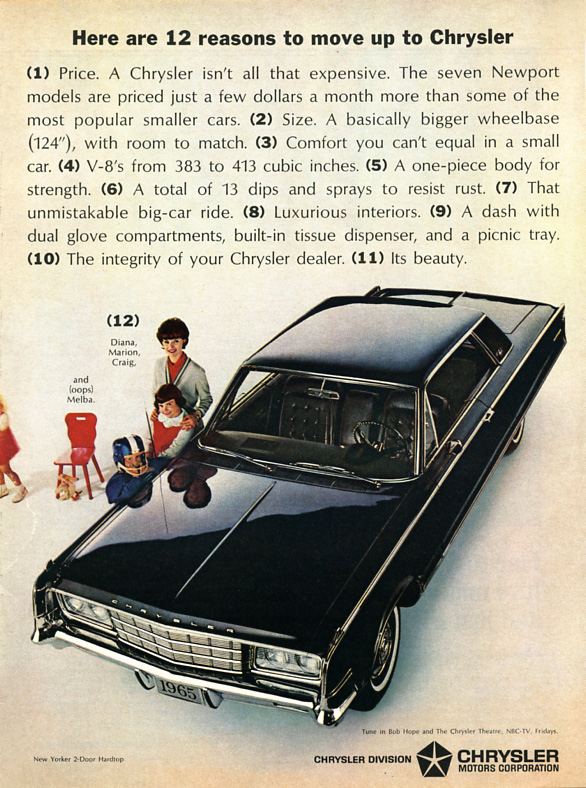
After I made the decision not to pursue the car, my wife bought me the above advertisement so I’d have something to remember it by. I know she was secretly happy I decided the way I did; she didn’t seem to like the “docking instead of parking” aspect of it. I did get my Big Three fix by purchasing my more reasonably-sized ’65 Dart, so instead of buying the top-of-the-line model, I went with the bottom of the barrel, but that’s a story for another time.
Note: a rerun of an older post.























The rear clear tail lights actually have red glass cups that screw on over the clear incandescent 1157 bulbs.
I have installed a 300L grille on my car with the center badge that lights up.
Obviously Chrysler was enamored of Cadillac’s clear tail lights which glowed red, but resorted to a jerry-rigged and needlessly complex lens. The failure rate in production was unsustainable, so before long they just used 300 and Newport lenses.
I feel the pain. I have kept my eye out for a 65-66 New Yorker for over a decade. Only out my way they are a rare find. Have also been on the C Body board for over a decade due to my Polara. So I know there are some unique things about the 65 as compared to 66 on up. Given that I’d prefer a 66 New Yorker because of that and because the 413 is traded for a 440 that year.
Actually the last time I saw a 65-66 New Yorker was in 2013 at a Mopar show. Several hundred cars and out of all of those only four C bodies with us parked off at the fringe.
My very 1st car was a 1965 Chrysler Newport. I like the head and tail lights on the Newport better, but not much different. I loved that dash… it had a COLD button that would go out when warmed up, and once it did I knew the heater would blow hot. Also had a REAR HEAT button that powered a heater element under the front seat for the back seat. And the style, it was a six window that just looked elegant. Man, I miss that car. What great memories!
I just saw an Imperial of this very vintage cruising along, yesterday. I never cared for (or even about) these at the time but it looked very elegant in 2026.
My eyes are giving me fits when I look at the front end pics and the apparent tilt angle of the headlight covers and the surrounding trim in the lead photo. Is it the camera angle, the angle of the chrome surround or just my brain that perceives the passenger side cover and surround to be tilted forward and the driver side tilted backward? The outward angle of the inside surround is what is probably fooling my eyes and/or brain.
I can see what you are seeing, but yes, I think it is all the different corresponding planes and angles causing the illusion.
One thing I like with these lights, if you look at the car without looking directly at the lights, particularly the top photo, they look like futuristic one piece headlamps.
I too love these cars. One of the first cars I remember is my grandmother’s, and later my grandfather’s 1965 New Yorker four-door hardtop. It was a kind of teal color, and for the life of me, I can’t remember it having the vinyl C-Pillars.
I wonder if was a delete option, or if my grandmother got a special factory order as she was part-owner of our family’s C-P dealership. I do know that because of customer experience in Pittsburgh’s rust-breeding environment no one in the family ever ordered a car with a vinyl roof.
The fender section is really interesting and unique, and makes Engel’s earlier Continental look bulky by comparison.
The v-8 Firepower was available with an optional 4-speed manual transmission? …and console
I agree with everything the OP said about the 1965 New Yorker. I have been a fan of this body style since it was new. I was age 15 when my best friend parents bought a new 1966 Chrysler New Yorker, six-window four door. His parents were conservative, dull, and their New Yorker was beige on beige. They could easily afford a Cadillac but surprised they didn’t get a Newport for less money. I rode in that New Yorker when it was new and remember the ride was smooth as butter.
My friend parents never let him drive the New Yorker. On his 16th birthday (1967) they gave him an elderly aunts 1954 Pontiac. My parents gave me their 1963 T-Bird and I occasionally drove my parents 1966 T-Bird Town Landau. I remember to this day when his mother told me to park my parents 1966 Bird on the street, not in their driveway. Banished to the street. Occasionally I wonder what my best friend drove later in life. Looking decades back and knowing my friend was adopted, I now assume he was pale skinned mixed race, and that was the reason he was treated more like a servant than a son and never allowed to drive the New Yorker. It was the 1960s, North Carolina.