

There it sits, a ’61 Pontiac Bonneville. Although fifth in sales in 1961, this Pontiac encompasses all the critical elements for future success: a Wide Track stance, a lovely split grille, and that intangible Pontiac style. While this Curbside Classic left the factory with four doors, all Bonnevilles came with frameless door glass, and simply opening the windows will give us that wide open hardtop look so popular with the baby boomer generation.
A very complete and original car, it does lack factory wheel covers. I’d love to see a completely correct car, but here in Southern California it seems all Curbside Classics come equipped with alloy wheels. Maybe next time…

1961 was a soft year for cars sales, and Pontiac lost a little ground from the previous year. However, most other nameplates lost ground as well, and two of the nameplates in front of Pontiac (Plymouth and Rambler) were about to slip back into the pack. This allowed Pontiac to move into third place in 1962 and remain there for the rest of the decade. Your eyes aren’t fooling you–this Bonneville really is starting to pull ahead!

This rear view helps establish this car as one of Pontiac’s top models. The big block letters spelling out Bonneville let us know the owner bought a trim level with a lot of chrome, the reverse lights in the bumper say, “I’m no stripped out base model,” and of course triple taillights ALWAYS equal the top dog trim level.

Checking my Catalina statistics, I guarantee it came from the factory with a 389 Pontiac V-8. The 421 didn’t arrive until 1963, and it would be a few years before GM started mixing and matching division engines. Narrowing down the exact 389 is a bit more complicated, as Pontiac offered eight different horsepower ratings on their full sized offerings, at least three of them in the Bonneville. For economy-oriented buyers (probably few), the three speed manual came standard with a low compression four-barrel 235 hp “Trophy V8”; ordering the Hydra-Matic teamed it up with a high-compression version with 303 hp, although there was also an “Economy Special Trophy” that had a 230 hp two-barrel 389 teamed up with the Hydra-Matic and a 2.56 rear axle ratio. And if this hood hides a Tri-Power induction system, it’s the top engine option delivering 318 hp.

Looking at this interior shot, I’m still not sure if this is an automatic or manual. Perhaps the owner removed the shift lever to help prevent theft, or perhaps they added a floor shift I can’t see in this shot. Either way, it seems to have an automatic quadrant display at the base of the steering column.
I didn’t notice any interior modifications outside of speakers in the rear package shelf. You can see the car is very nicely preserved, with a patina that indicates the paint and interior pieces may all be original.

During my walk around, the body sculpting along the side caught my eye. The subtle kick up along the top of the rear door helps mark this as a GM car. Not many manufacturers had the advantage of the Fisher Body division. Using this resource, GM divisions delivered complex body panels that set them apart from the also-rans. Check out the subtle character line running across the C-pillar and then up the roof to outline the window openings. I love those little details that catch the eye. New cars lack such detailing, sacrificed at the twin altars of aerodynamics and fuel efficiency.

Here’s another shot showing the sheet metal sculpture, along with a small fin and an exaggerated Pontiac shield. There really weren’t a lot of notable cars built in 1961, and I think this image helps explain why. A year of flux, designers were abandoning the jukebox styling of the fifties, but were still searching for a new direction. The sheet metal dynamism present in the ’64 Pontiacs hadn’t quite burst on the scene, and the chrome detailing on this ’61 was still a bit heavy handed.

Speaking of detailing, the “Bonneville” script mounted on the side trim was missing a few letters on both sides of the car. Given this Bonneville is 53 years old, I’ll let these little imperfections slide. Most of the Pontiacs built that year have lost far more than an “I” or “L.” The mounting clips for the front spear also appear to be missing in action, but those sheet metal screws provide an even more reliable mounting system, and will keep the trim in place for years to come.
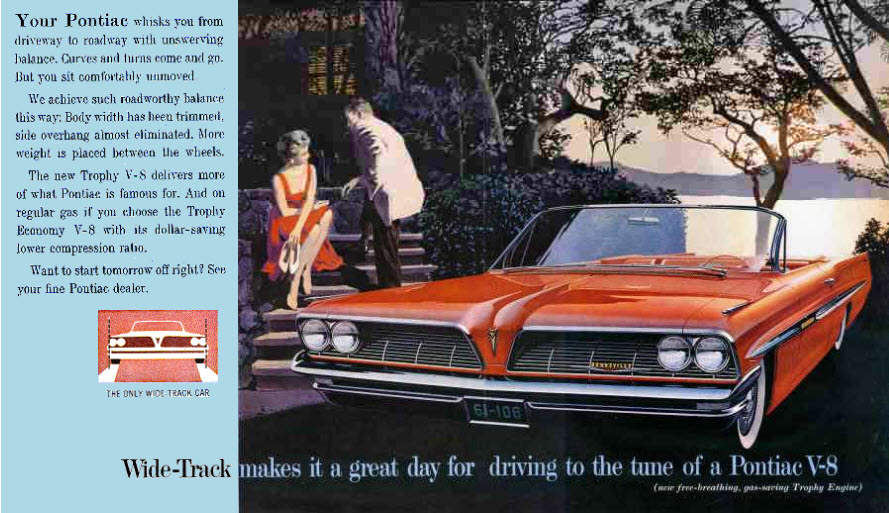
How to wrap up this fine Curbside Classic? I’ll defer to the tag line in this ad: “Wide-Track makes it a great day for driving to the tune of a Pontiac V-8.” Looking at that Catalina Convertible, I agree with that sentiment wholeheartedly. The ’61 Pontiac may have finished fifth place in sales, but an underlying greatness would help move it to third place the next year, and that burbling Pontiac V-8 would keep it there for the rest of the decade.
Note: a rerun of an older post.























My long since passed dad would have loved all those sheet metal screws holding the passenger side trim moldings in place. He had many glass jars with sheet metal screws in a lot of sizes and lengths both slotted and hex head. They were his go to fastener on an aging car.
Zooming in on the interior pic and with full brightness on the image reveals a “T” shift lever and a wide automatic style brake pedal.
Nice, although probably the least attractive year for big Pontiacs of the ’60s. What’s with the Chevy taillights? The styling tweaks on the next year’s ’62 helped, and the more extensive changes for ’63-’64 made Pontiacs the best looking big GM car, possibly excepting the Riviera.
LOL ’50s/’60s advertising, when you drew the car the way you wished it looked instead of how it really did look. I’m pretty sure those proportions on the red convertible are accurate. Also, what’s going on with the two people on the bench? Interesting pose; trying to read the body language here. Why is the woman in the red dress sitting on the backrest of the bench? She looks afraid the guy will snatch her shoes. Feet must have been really hurting for her to have taken her shoes off in the first place…
The 1961-1962 Sport Sedan roof design on this 4 door pillarless ‘61 Pontiac was of course shared with Chevrolet, Oldsmobile and Buick. It’s a favourite of mine. The unique convertible inspired crease lines set it apart from the plain roof sections used 1963 and later model GM 4 door hardtops.
Also the curved ‘A’ pillar is so much better than the straight ‘A’pillars used from 1963. The dash, well it’s a knock out with its full length chrome insert. The ‘61 Pontiac dash was actually used in right hand drive form on all full size 1961 to 1964 export RHD Chevrolets and Pontiacs. I simply lovely dash panel.
The triple taillights, which were also used on Australian GMH assembled RHD 1961 Pontiac Laurentian’s also appeals. In summary this ‘61 Pontiac in its fast disappearing 4 door pillarless hardtop body is worth of a detailed ground up restoration. Lovely car!
Yes, a beautiful car then and now in spite of the ravages of time .
I’d rather have a ’64 Oldsmobile but I remember these when new, reasonably speedy and passable handling plus good looks and bragging right simply because you could afford a PONTIAC ! .
The R.F. stainless spears sheet metal screws remind me of the Barrio Beaters in L.A. back in the day .
-Nate
You’d get a real 4 speed Hydramatic with a Bonneville while a ’64 Olds would be saddled with the weak Roto imitation.
My first car was a 1961 Pontiac Bonneville, that was very well used. It had 100,00 miles on the odometer. White with a red interior and black top. I didn’t pay much for it, and fortunately my brother-in-law had a used car lot, and mechanics available. We replaced the freeze plugs, the automatic transmission, and eventually the ring and pinion gears. All form the nearby junkyard. Bu I owned it fortwo years, and loved it, in spite of the mileage, and the top needed help putting it up. Gas was 25 cents/gallon for premium. A fun car that I sold for what I paid for it, including repairs. I think everyone loves their first car!
The 1961 Pontiac has gradually become one of my favourite designs of that era. I’m not a great fan of GM greenhouse design in early 60’s – the pronounced curve in the A-pillar here has always looked out of place to me, given the more sophisticated crispness of the rest of the design. But the overall look has an elegance to it that has aged well.