

The passage of time is a curious thing. As events fade into the distance, memories become selective, and the mind picks the ones to cherish and preserve, and the trying and humbling ones to forget. Either way, when it comes to pleasurable or painful experiences, strong emotions are at play and can be easily evoked. Then there are those other moments, the almost non-events; the daily routines and uneventful businesslike tasks that fall into oblivion. Not that they deserved such a fate, but alas, that’s basically where they reside.
In the case of cars, a 4-door sedan like today’s Plymouth Belvedere II is probably the type that falls into that latter category. A piece of daily 1960s transport, still in running condition, that today serves as a nice counterpart to the wild and fun 1960s Muscle Car fantasies car shows usually portray. This is not a “Dukes of Hazzard” tribute Charger, nor a hot-rodded Hemi Road Runner in wild colors, but a sensible boxy 4-door sedan with room for a MoPar-faithful family –and with its twin tail pipes, indicating some form of V8 power. So, a pragmatic package, with a bit of verve. A rather different version of the 1960s, quite apart from those sexy Muscle Car dreams that define the decade nowadays.

I know, I’ve touched on this topic a few times. But it’s difficult for me not to do so when exposed to a rare daily-life survivor from those days. If one goes by what public consciousness and the media portray, the 1960s were nothing if not tumultuous and rowdy; from social upheavals, to bikini-rock-jammed youthful films, to British Invasion rock, all co-existing with drag-strip worthy muscle cars. The Fun Wild Sixties! You know? Those kids were crazy then!
But leaving all that (consequential) noise aside, the era was adult-centric. Bonanza was huge, Mantovani still sold records, the Tijuana Brass was a thing, and deep down, folks like my dad seriously doubted about leaving the planet’s future in the hands of clownish teens with long hair screaming their lungs out on live TV (plus acting in childish and irresponsible ways… also on live TV).

If we get away from all that cultural stuff and go to the automotive world, Muscle Cars may have only been a slice of 1960s traffic in reality, but admittedly, even adult car land wasn’t wholly exempt from that era’s disruptive vibes. Curves entered that world, in all forms of seductive shapes, particularly at GM, which generally set the tone. Responsibilities or not, even grownups like their cultured pleasures, and as we know, are more than Ok with acceptable degrees of allure.

But for those who found those tendencies too eye-catching and wanted something more buttoned-down, with small pleasures to discover in its efficient innards, here’s an automotive antidote. And in this survivor, no extroverted mods, no wild paint schemes, and not even sexy automotive hips. And far from the 1960s model that will pop into common folks’ heads when the decade is mentioned.
Instead, it’s a Plymouth, in its most conservative boxy 1960s styling and as sensibly packaged as a low-long-wide intermediate could be in that era. Can’t stand the lustful looks of a 1960s Pontiac? Well, Mr. Sensible MoPar family man, this could be your chariot of choice!

MoPar fans know their Belvederes, but let’s revisit some details about these cars for the uninitiated. For 1966, Plymouth’s intermediate B-bodies arrived in Belvedere, Belvedere II and Satellite lines, with the II being the middle child and the Satellite, the top trim. And unlike what Muscle Car car show myths showcase, 4-doors were big business. In the case of the Belvedere II, the 4-door sedan was Plymouth’s most numerous intermediate for that year, with 49,941 units built.

The Belvedere nameplate had gone through lots of ups and downs (along with Chrysler as a whole) since it first appeared as a trim option on the 1951 Cranbrook line. Debuting, short after, as a stand alone line as Plymouth’s top trim in 1954, it would get demoted to second best when the Fury line appeared in 1959. It would then remain as second-best during the downsized “full-sizers” 1962-1964 era, and would officially become an intermediate in 1965 (still riding on the 116″ 1962 wheelbase, B-body), with the Fury becoming –again– a proper Detroit full-sizer on a 119″ wheelbase; the C-body. Did you follow that? In any case, it’s not like the Belvedere would abandon the second-best title in its new role, since a new top trim Satellite appeared that same year.
And for 1965, Plymouth’s intermediates wore the boxy conservative styling that Chrysler Corp. was pushing throughout its product line. No more quirky, Googie-modernist Jet Age eccentricities, but plain practical squarish wrappers (with an occasional brutalist touch, as in the B-body coupe hardtop roofs), meant to appeal on their engineering goodness rather than desperate trendsetting efforts.

As was common practice then, styling got wholly refreshed for 1966, veering on brutalist squarishness by then. Just as it had in 1965, the Satellite line would remain at the top for 1966; I would guess, in accordance with all that Space Age thing, which was still in vogue despite all (No more Space-Age sci-fi otherworldly styled Exner-wonders, but can’t toss aside a bankable fad all at once, right?).

If Mr. MoPar family man didn’t want to pay up for a Satellite, Belvederes could be had in base and II model lines. The II’s, having a good amount of additional trim to prove it wasn’t an entry-level offering; a nice way to set it apart from a fleet special, something for which these B-bodies were known for (Hey, there’s gotta be a downside to pragmatism. You know?)

Besides the added bright work, Belvedere IIs came in 10 models, from hardtops to sedans, to convertibles and station wagons. As it was common practice, a variety of options were available, from 14 basic colors (with two-tone possibilities) to various interior finishes and amenities. In the hardware department, either 3 and 4-speed manuals or TorqueFlite auto for shifting, and at least 5 engine possibilities; from the standard 225CID Slant-Six, up to the optional 383CID Commando V-8.

The brightwork in today’s find is the very telling sign this is a Belvedere II trim line model, with its “gas filler cap that is designed as an integral part of the side molding.”
Now, I’ve no idea about the unpainted bit on this Belvedere II’s rear quarters. A non-spec bumper at some point in its life before its current worn respray?

Today’s find was captured in El Cerrito during a short stay of mine in the Bay Area back in 2024. As some probably noticed, the shots come from two different days; the first being a sunny one where the car’s front was annoyingly blocked by a Focus wagon. On that day, a 1966-1967 Dodge D-Series across the street suggested the car belonged to a MoPar family. And yes, we’ll revisit “Big Eyes” D-Series up close some other time.

A bit hard to see, but the tailpipe on the passenger’s side is somewhat visible in this shot (And in the gas cap one further above). A sign that this Belvedere II ain’t the Slant-Six kind. Now, as the brochure stated, these came with several V-8 choices; 273CID , 273CID 4-barrel Commando, 318CID, 361CID Commando, and 383CID Commando in 2 or 4 barrel configurations.
And what if today’s has been retrofitted? Is this Belvedere II adequate 1960s performer, or discreet mighty sleeper?
If IIRC, the car had Torqueflite, though I may be mixing that up. I think I also tried to look into that “For Sale” sign, which as can be seen in the photo, had been on that rear window for… a long… time. I don’t remember it being that legible.

On the second visit, it was drizzly in a traditional Bay Area way. A bunch of junior high kids walked by, paying no attention to my interest in the car and just sticking to casual teenage chit chat. No one seemed to mind this midlife guy taking photos of some old car. I doubt any of them knew why I had any interest in this unlikely survivor… and thinking some more about it, I doubt any of them even know what in the world a Plymouth is.

So, the kids walked by, leaving me alone, free to capture the II’s fairly vanilla surfaces. And why should they stop to ask anything? You wanted excitement in those days? That belonged to the trendsetting stuff coming from GM, and well, that Mustang World Event from Dearborn.
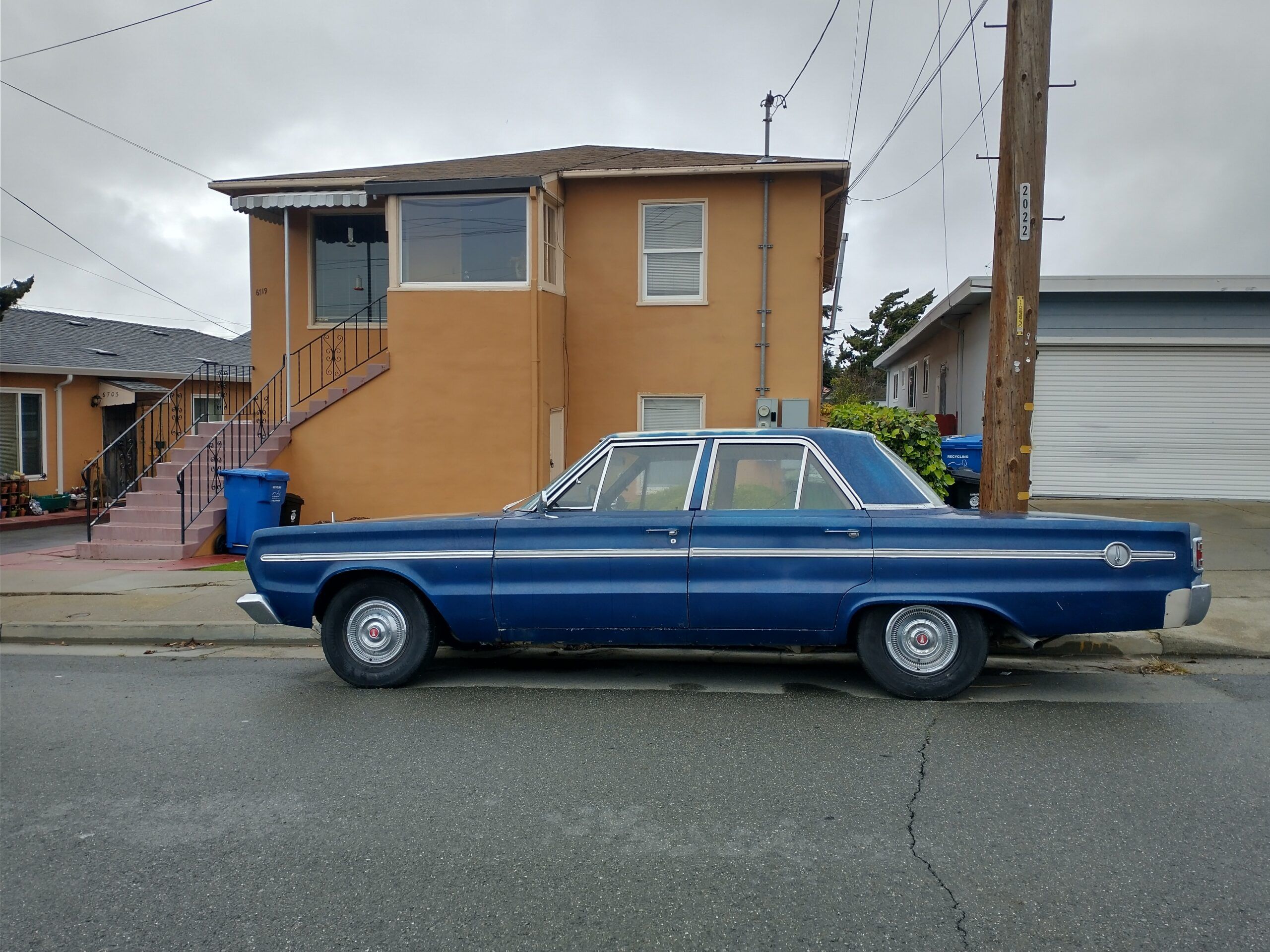
I enjoyed coming across this Belvedere II, a car I’ve seen little aside from old TV shows and films, usually as taxis or cop cars (with a very prominent role on In The Heat Of The Night). I found the car’s lines conservatively handsome, enough so not to be overly generic, though far from memorable. Still, it’s a version of the 1960s I rarely ever get to see, and from its boxy utilitarian office-worker-wrapper to its discreet V-8 power, it just reminded me that folks of my parents’ generation enjoyed their pleasures in educated and selective ways.
In all, a car to fill the missing gaps in the living 1960s automotive fossil record. And seen from today, doesn’t a Belvedere II stand out more than the usual fixed up Chevelle? After all, that’s the joy of the sedate and straightlaced; to go from businesslike invisibility to curiously unique. The revenge of the nerds, especially those who had a bit of verve to begin with.
Related CC reading:
1966 Plymouth Belvedere II 2-door Hardtop – Suddenty It’s 1963
Car Cruise Classic: Nine Reasons To Buy A 1966 Plymouth Belvedere























My grandfather had a ’65 Belvedere 4 door sedan with a slant six and Torqueflite. It was his last car and he drove it until he was in his mid-90s around 1986. Very reliable and pretty rust free.
I think the ’66 with a 383 automatic and A/C would have been a keeper. It wasn’t in style when new so it never went out of style. Solid and honest.
Typical grandpa car. My grandfather’s last car was also a ’65 Belvedere II four door sedan, 318/Torqueflite. It was turquoise inside and out, as mid-60’s as it can get. This was his only V-8 since the ’32 Ford he hated.
Great essay, and an important reflection on what the 60s were really like.
I couldn’t agree more. Essays like this balance the history of car culture in those days.
This was like the car that the FBI agent drove all through the recent mini-series “Duster”…one of my favorite vehicles in that show! Such a plain, white-bread sedan that, even back in the sixties, just kinda faded into the background. So glad they didn’t wreck it!
And despite being sponsored by Ford, some Plymouth Belvederes (and its sibling the Dodge Coronet) did some cameos in some Quinn Martin productions like this Belvedere as a police car in The Fugitive.
https://www.imcdb.org/vehicle_1285587-Plymouth-Belvedere-RL41-1966.html
or this one from an episode of Cannon.
https://www.imcdb.org/vehicle_1336121-Plymouth-Belvedere-RL41-1966.html
> If one goes by what public consciousness and the media portray, the 1960s were nothing if not tumultuous and rowdy; from social upheavals, to bikini-rock-jammed youthful films, to British Invasion rock, all co-existing with drag-strip worthy muscle cars. The Fun Wild Sixties! You know? Those kids were crazy then!
Yes, this! I like to remind people that for every person that attended Woodstock in 1969, four people bought a 45rpm copy of the Archies’ “Sugar, Sugar”. The ’60s as they are remembered are not like the ’60s as they actually happened.
This Belvedere looks very much like a cross between a Fury and the next year’s Valiant. This was Chrysler’s look between the Exner space age googie era and the fuselage era to follow, and seems less remembered than either.
While I was one of those short hair non-hippies in ’66, even I thought these were boring. The’65 Belvy was much more appealing, especially in the rear view though hardly wild. The ’66 rear has to be one of the most anodyne and forgettable hind ends ever, even the ’66 Coronet that belonged to a family frend had at least some panache, well, sort of. GM kicked Mopars butt in the mid-size world, but at least the C bodies held their own a bit better, in a conservative way the classy ’65 NYer really stood out.
I wondered how the mid-size Mopars fared against the mid-size Fords offerings?
Chrysler Corporation held its own against Ford in this segment.
While the Fairlane sold well, the Mercury intermediates went nowhere. The Dodge Coronet outsold its Plymouth corporate cousins. The Plymouth, however, sold well enough that Chrysler managed to hold down the second-place spot – behind GM – in the intermediate segment in some years during the late 1960s.
One of the most telling things about the 1960s that I’ve ever read came from Ray Manzarek of the Doors. He said that they played in Des Moines, Iowa for a crowd of 34 people when the weekend before 5,000 had come to the same building to see The Association. That told me that I’d probably been sold a lie about what the 1960s were really like.
Yep ;
Dishwater dull but these were very good cars indeed .
It seemed like older more Conservative types had them when new .
That the often handily outran the others was lost on me back then .
I still like Herb Alpert & The Tijuana Brass =8-) .
-Nate
+1 on Herb Alpert, and he was a great guy from what I read.
Also Glen Campbell was great, every housewife had his records too.
I really like car. I learned to drive on a 1966 Plymouth Fury 3, a beautiful car.
Google search, St. John’s Hall El Cerrito, and look at what pops up in the top right corner. St. John’s is closed but was now painted and the Plymouth is right there.
Great read. This car’s brutalist squarism (was that the phrase you used?; it was brilliant) is all the more compelling to me in 2026 given the proliferation of rounded aero shapes that are the norm.
I actually think it’s a quite handsome shape, and I like many of its little details. The late ’60s seems like that last time that the Plymouth brand had some solid verve, baked even into workaday machines like this Belvedere.
I like imagining that this was a nice family’s main car and had served them well when new.
When my family pulled the plug on Standard Auto Chrysler-Plymouth in 1967, my great aunt, the dealer, ordered a blue 1967 model of the same car. It was solid, but there was a lot of painted metal in the interior, in contrast to the full size offerings.
Like the blocky Alfa Giulias of the same era, these were deceptively aerodynamic and outdueled their GM contemporaries on the NASCAR circuit. The visually swoopier 1968s turned out to be aerodynamic dogs.
Neighbors had a dark green, “67 Satellite”. Tudor, hardtop. Replaced a “59 Buick. (tudor sdn) They went to “Expo 67”, in the “Plymouth”.
My first car ever was a ‘66 Belvedere I 2 door, old phone company car. 6 cylinder, 3 on the tree…at least it had a heater and AM radio. Free shag carpeting to cover the holes in the floor. Paid $15 for it and got my monies worth that senior summer.