
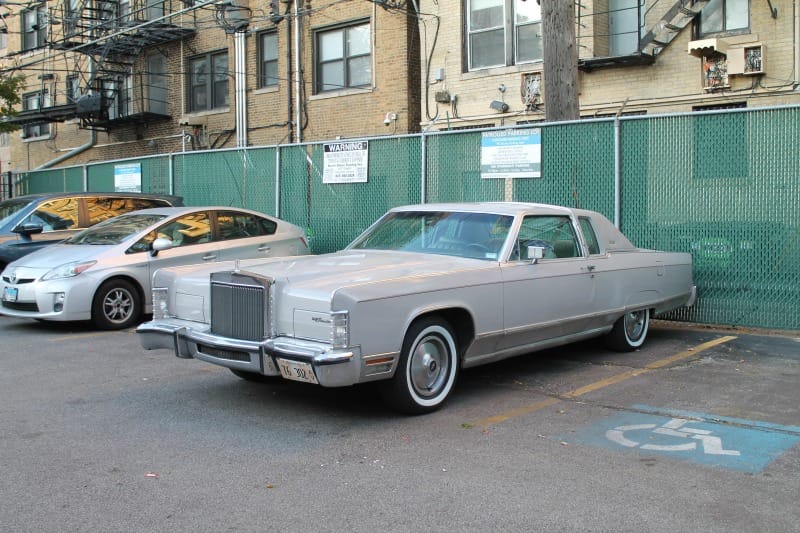
A couple of things about this 1977 Lincoln Town Coupe made themselves known before I took a closer look. Striding toward the train with my focus straight ahead, its sheer size still managed to grab my attention out of the corner of my eye. At 233 inches long, this two-door Lincoln isn’t just large—it’s on another level, stretching well beyond even the largest cars most people remember and close to the top in that regard for its era. It’s a lot of car, and a lot of two-door traditional luxury.
When I was a youngster dreaming of owning my first car, part of that fantasy often included a custom or “vanity” license plate. I’m mentally running through a list of some of the alphanumeric combinations I had dreamed about: “JVLN AMX”, “69 CHVL”, and a few others. If I remember correctly, vanity plates in Michigan allowed for up eight characters, including spaces. This was around the early ’90s, which is when I became a licensed driver.
I would also spend a lot of time sketching cars in my free time, as my teenage dream career of the future was to be a car designer. These drawings often included custom plates that included model year and/or the name I had come up with. While I enjoyed drawing cars, a young Ed Welburn or Chuck Jordan I was never going to be, so while I’ve kept many of my drawings, none of them are currently displayed anywhere in my home.

This creampuff of a Lincoln Continental was situated in the parking lot of my favorite, local coffee roastery last fall. I walk past Metropolis Coffee Company on my way to and from the CTA Red Line train, and I can count fingers on more than one hand the number of times a car or truck I’ve spotted there has contributed to me being late in getting somewhere. To be clear, I accept full responsibility for my tardiness in those instances. If I wasn’t always trying to engineer every last minute of efficiency in the use of my time (procrastinating) and would leave well in advance of what would be a reasonable ETA, stopping for five or ten minutes to take some pictures wouldn’t throw off my punctuality under normal circumstances.

As mentioned, a couple of things about this car jumped immediately out at me from my peripheral vision while I strode decisively toward my morning train that day. First, there was its sheer size. It doesn’t matter that my eyes were aimed ahead toward the station two blocks away with almost like laser-like focus. This Town Coup-ay didn’t need to be painted in some outlandish color for me to notice it out of the corner of my left eye. You think a Buick Electra 225 that originally measured in at that many inches from bumper-to-bumper is a big car? This two-door Lincoln is a full eight inches longer than that, at 233″ from stem to stern. To be fair, the downsized ’77 Electra 225 four-door measured in at only 222.1″ long – but still. This Lincoln is a lotta car. A lot of two-door car.

I immediately gave kudos mentally to its owner for having parked it not only facing forward, but also solidly between the yellow lines. Impressive. Notice also how many inches feet the front of this car protrudes from its demarcated space. This was a parking job that could have been the handiwork of an experienced valet. It was from its front, three-quarter angle that I noticed the custom plate out front, which read: “76 302”. I didn’t really think much of those numbers when snapping these pictures, but I do remember being thankful that they probably provided some clues about this car that would eliminate a license plate search. Or, did they?

The Continental Town Car and Coupé were restyled up front with a much more vertical, radiator-style grille for ’77. It’s entirely possible that this dove gray beauty rolled off the line at Wixom Assembly in the fall of ’76, so those first two digits aren’t necessarily problematic, even if slightly misleading. It’s the “302” that threw me for a loop. I’m not the Lincoln expert by a long shot, but I am adept at searching for information, both online and on physical pages. Even if I wouldn’t have bet my entire “Final Jeopardy” fortune on guessing what was under the hood, the fact that the most powerful, same-year Mustang II had a 302 (and was still somewhat underpowered) caused me to raise an eyebrow when considering that this two-and-a-half ton Lincoln may be powered by Ford’s 4.9L mill.

A 400-cubic inch V8 with 179 horsepower was standard for all big Lincolns that year (including the Continental Mark V), with a 208-hp 460 being optional. In fact, the 302 (with no more than 137 horsepower for ’77) wasn’t offered even in the Ford Granada-based Versailles, which had a 135-horse 351 as the only engine available for it that year. The 302 would become standard for the Versailles for ’78, continuing though that model’s final year of 1980.

Thinking about the Lincoln Continental’s place in the North American marketplace often leads me to comparisons with Cadillac’s comparable DeVille series. Much like Lincoln did with denoting “Town Car” as the four-door and “Town Coupé” as the two-door, Cadillac did something similar with the nomenclature of its “Sedan” and “Coupe” Deville. That GM’s mainstream luxury make and model was “right-sized” for ’77 has been covered at CC before, but in looking at production figures of both the Lincoln and Cadillac before the latter’s big shrink, there was one clear trend. By the mid-’70s, more Cadillac buyers preferred their DeVilles as coupes, and more Lincoln buyers preferred their non-Mark Continentals as four-doors.

Following ’73, where almost as many Sedan deVilles (103,000) found buyers as Coupe deVilles (113,000), the ratio of the latter to the former was almost 2:1 the very next year. There was no such contest at Lincoln. With the exception of model year ’75 (21,000 coupes to 33,000 sedans), most model years saw the two-doors comprising a much lower fraction of non-Mark Continental production. Aesthetics are always subjective, but I honestly don’t think the two-door Cadillac looks any more “coupe”-like than its Lincoln counterpart, and both vehicles have their big-car charms. The same goes for the four-door versions of both rivals. I don’t see the basic styling of either vehicle being more or less suitable as a big sedan.

It’s a cloudy day outside my windows as I write this. The peaceful color of the dimly lit noon sky seems to echo the pretty dove gray finish of our featured car. I imagine that this Lincoln positively floats over uneven surfaces, and that the interior envelops its occupants in creamy, cumulus-like comfort. Hopefully, this car is parked in a secure, dry garage while its owner awaits his or her next opportunity to fire up its mighty 460. If I was its owner, though, I might occasionally find myself practicing a little “social distancing” in its garage, behind the wheel, cradled in this two-door expression of some of the finest automotive luxury the 1970s had to offer.
Edgewater, Chicago, Illinois.
Wednesday, October 23, 2019.
Note: a rerun of an older post.























The two door is badly proportioned with its long hood and long trunk, yet the cabin looks short and stubby.
It was the 1970s, and I frequently drove a friends 1972 Mark IV on weekends from Richmond VA, to DC. Occasionally drove the Mark to NC, or Florida. 1976, I got my new Eldorado convertible, drove it from Richmond to DC, clubbing, to Florida and Houston.
I love these big two door cars, and parking was not an issue as parking spaces were larger in the 1970s.
I always enjoy your articles. Maybe some has to do with the fact that I was born and raised in NW Illinois. So I enjoy seeing pics of these IL cars and places.
That Lincoln is so nice and seems like it’s had a loving owner.
Just last week I saw one of these at the local BP station, in a palette of orange red tangerine, kind of hard to describe. I suspected it belonged to one of the station’s “customer service associates” — it does and I had a nice chat with him about the car. It has the 400 cubic inch engine and he said he had just bought it recently, because his dad had one. He is a body shop man when not working at the gas station so he knows what he is doing fixing cars, he told me what maintenance he had done already. Didn’t get a picture as it was raining that day, but hoping I’ll see it again. When I realized Coupe de Ville and Sedan de Ville were French for Coupe of the City and Sedan of the City we joked about our bosses’ new City Sedan when he bought a Lincoln Town Car.
“I would also spend a lot of time sketching cars in my free time, as my teenage dream career of the future was to be a car designer. These drawings often included custom plates that included model year and/or the name I had come up with”.
So I wasn’t the only one to do this??
Not by a long shot, Huey.
None of mine survived though.
Sure, it’s knife edge design and pop up headlights are from a different era, but somehow the last of these big Lincolns ozzed presence. Moreso than any modern car/cuv. The big Caddies up until 77 didn’t quite have this timeless perfection. Lincoln also seemed to have the quality down, unlike Cadillac.
Plus maybe it was the biodegradable bumper extenders giving me this idea, but the Cadillacs degraded cosmetically far faster, though wouldn’t die with their chalky paint, destroyed armrests, creaking suspensions, rotten mufflers with cracked exhaust manifolds as hoopties.
The Mark series pretty neatly absorbed demand for two door Lincolnness. I think that the Eldorado was a little too exotic for a majority of Cadillac buyers.
The Continental Mark III was very, very much like the 1969 Lincoln Continental coupe. The Rolls grille and the Continental hump gave it a very strong non-Lincoln image, but the front-to-back bladed fenders, the vertical kickup on the rear quarters, the tail lights, and the roof are very much a straight copy of the Continental coupe.
Our house in Dayton was a four-bedroom ranch built in the early 70’s. Even then, the garage barely fit my 78 Town Coupe – maybe an inch or two to spare when closing the door.
A lot of car indeed – a lot of wasted space – but I still loved it.
Last ’70s Continental with the proper, wall-like Lincoln dashboard; the ’78/79 used a generic Ford/Mercury dash which cheapened the look whille driving it substantially. I like the more reserved grilles used in ’75 and ’76 though. I agree with Scampman that the Mark IV/V syphoned off buyers who otherwise would have bought the Town Coupe. That little oval opera window was a signature Lincoln design element in the mid-late ’70s; the Mark and Continental 4 door had them but the Continental 2 door didn’t.
I see these cars as a throwback to the pre-depression era, when a two door coupe this size might seem a perfectly reasonable purchase if you could afford it.
That’s what history tells me, anyway, I can barely imagine a car of this size (5.9m) at all, let alone as a coupe – nor could I imagine who would want one. Different culture, I guess. And different times.
It’s hard to fathom Lincoln weathering the early-mid sixties with no coupe offering at all, then having two. The difference is easy to see, but it’s hard to imagine why a buyer would choose this instead of the Mark IV or V. Roomier, perhaps? Was this seen as more formal? Did that matter? Surely any LIncoln of the era was formal?
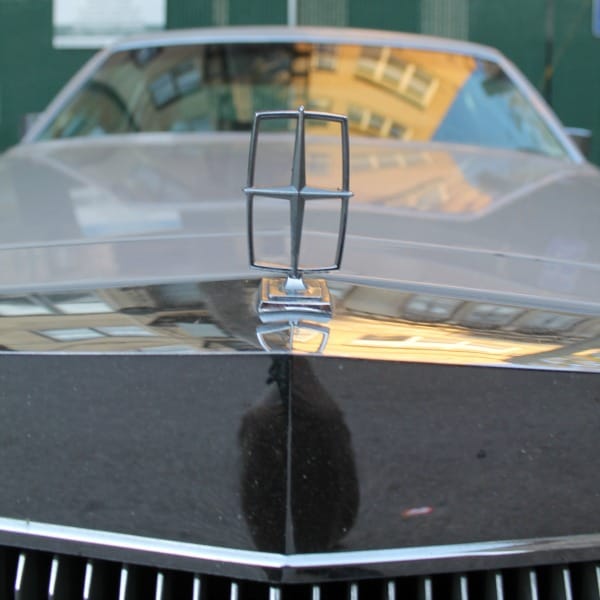
Your last photo reminds me how static and architectural the styling is. The headlamp door detail looks like a wall with a wing jutting out to either side. All it needs is a couple of bonsai trees on the bumper, framing the ‘garage door’. 🙂
The coupe body on this enormous car is 1) a style statement and 2) an assertion that this car is for the owner’s pleasure, not passengers.
Lincoln was a dead end when Ford decided to give Lincoln another chance with the 1961 clapdoor sedan. The sedan was sufficiently well received that Lincoln revived the Continental coupe for 1966.
Before the compact car era, each American car brand made more or less one size of car (maybe two wheelbases). The two-passenger roadster was built on the same chassis as the smallest four-door trunkback sedan.
When Lincoln introduced the clapdoor sedan, the “two-door Lincoln” really was the Thunderbird (which was built in the same factory). The four-seat Thunderbird was as glamorous as a Cadillac or Lincoln when it was introduced. The Thunderbird created the “personal luxury car.” Over time, the Thunderbird lost some of its novelty and distinction; Ford created the Mark III and its successors to revive the Thunderbird as an actual Lincoln.
I will stop and stare at one of these whenever the opportunity presents. My father’s 78 Town Coupe was my favorite of every car he owned during my lifetime. But I will confess that I have always gone back and forth over whether I prefer the 77 or the 78. I think the fender skirts look just fine on this car, and the fuller wheel opening of the 78-79 took some getting used to for me back then. The 77 also has the better dash panel. Both of them are usually found with the big 460, that was more satisfying to drive than with the smaller 400 V8, but the 400 was all you got for the final 1979 model.
I also love these slightly wide whitewalls, and enjoyed seeing them on cars during the 2 or 3 years either side of 1980 when they were usually on cars of this class. I also really liked that dove gray paint. It seemed a throwback to the classic era, and I was truly over the then-popular earth tones by the late 1970’s. Thanks for sharing this one!
I had the pleasure of owning a ’75 Lincoln Town Car with the 460. Mileage was really bad — maybe I could get 18 mpg on the highway at 55 (which was the limit in those days) if I was careful. Around town, 8 was pretty good. One did not buy a Town Car or a Town Coupe for it’s handling. What one bought it for was the ride! It was the best highway car I have ever owned. With snow tires on the rear, it was surprisingly good in the snow, as long as you didn’t[t want to turn. Coming up to a big snow drift? No problem, just barrel through it. I never got stuck in the winter with it.
The size was huge! Lots of room inside which was covered in leather. The trunk was huge! When we went skiing there was no need for either a rooftop carrier or a pass through, we just put the skis (and they were long in the ’70’s) in the trunk. 5 sets? No problem at all. Also room for 5 sets of ski boots, jackets and luggage!
One summer we hosted an exchange student from Japan. When we picked him up from the Grand Rapids airport and took him the that big Lincoln, he was literally in shock! He had never seen a car that big!
Yup, that was one of my favorite cars of the many I have owned and rented.
The local Lincoln-Mercury dealer was a really good customer of our family business back then. Got to know the owner, sales manager, and most of the salesmen very well. They also sold Nissan and we had bought a number of trucks from them for our company fleet. When the second oil crisis hit in 1979 sales of the big Lincolns and Mercurys pretty much stopped. They also had a bunch of unsold 1979 Cougars. As 1980 wore on they resorted to giving you a free Cougar if you bought one of the 1979 Lincolns they still had. That got rid of all but one. So 1981 rolled around and this light blue metallic 1979 Town Coupe was still sitting on the lot. I had decided I wanted a Lincoln and they were begging me to buy it. I forget the sticker price but they offered it to me for about a third of that. I probably would have taken it but I just didn’t like the leather seats. About then someone traded in a 1979 Mark V Collector’s Series on one of the 1981 downsized Mark VI sedans. It was white on white with a dark blue cloth interior. I really liked the looks of that car so I bought it instead. They finally sold the Town Coupe late in 1981.
I find myself comparing it with my pickup truck, and apart from some more rear legroom and a trunk lid my 2002 F150 XLT Super Cab Long Bed has this beat. My truck was ordered with leather seats, power windows and mirrors and power locks plus a good stereo so it has most of the same luxury features. My truck is actually slightly longer at 246″ and has a 260hp engine and an 8′ cargo box.
My maternal grandparents owned a 1975 Lincoln Continental Town Car. It was a 4-door model with a dark brown exterior and beige vinyl top. My first time driving was in 1979. It was my junior year in college, and my step grandmother wanted me to drive her to Philadelphia from their home in Chester, Pennsylvania. It took a moment to adjust to the size of the car, but the ride was very smooth. Since my grandmother demanded I take the local roads for the drive, I did not get to open it up. The following year my grandparents let my parents borrow the car to drive to the funeral of my biological maternal grandmother who I was not close to. We drove from Chester to Jacksonville, Florida. There were six of us on the trip and everyone was extremely comfortable. My father and I split all the driving. On the highway, this car was such a smooth ride. It took a while to get this behemoth up to speed and handled like crap. But on a highway, it was one of the best cars to ride in. Gas mileage was horrible but this was not car you bought if gas mileage is a big concern.