

Here’s a blue-themed image from the Cohort by Curtis Perry that gave me, well, a bit of the blues. After all, how can I not feel some blues when a malaise era non-wonder as a Mav shows up? Pure blues; in spirit, execution, performance, and more. After all, Aaron S. talked about the Maverick being the right dismal car for a dismal age. And those who lived those days know he has a point; dismal cars were quite common at the time, and the spirit of the era was a troubled one.
But I’m not here to throw (many) rocks at this Mav, which was still, barely, standing when this photo was taken in 2020. Ford’s Maverick may have been dismal, but I’m a kid of the seventies, and tons of stuff was less than stellar in those days; even dismal. But we can’t choose the times we live in, right? We gotta do the best with what we’ve got, and as dismal and unsatisfying as the Maverick may have been, these were the cars we had to live with. Malaise-era blues, and the blues we got to experience, endure, and to some degree, eventually embrace.

Were the days before the Maverick better? Car wise, many swear so. By the time this mid-seventies Mav came to the world, power had come down, regulations were coming in, and new, untried and poorly tested technologies arrived, along with several other foundational changes in our lives. And ever since then, I, kid from the seventies, have lived under the aura of better times past; the muscle car era, the great PLC days, rock’s greatest times, rock ‘n roll’s golden era, musicals, westerns! I could go on, and on.
Did I miss out on some of those? Absolutely. All the same in the end, since I can’t do anything about it. The seventies were their own, very odd thing; from quality-failing, power-deprived, oddly styled automobiles, to very questionable dress fashions. An odd, peculiar, politically distressed age, which I remember mostly from unsettling headlines, and my color-coordinated polyester clothing itching like hell in the heat. That, along with weird kid TV shows that caused me nightmares to this day (What was the deal with Lidsville?).
But all ages have their ups and downs. Several films from the seventies are now true cinema classics, from the downbeat ones from the decade’s beginning to the popcorn cultural flagships we’re still talking about daily. Disco was either culture’s bottom or apex, depending on your likes; but a cultural event nonetheless. Then, AOR music (remember that?), which some friends of my age are fixated with. And finally, car wise, the malaise-era was a transition that gave us safer and easier to live with transport. Evolution isn’t necessarily linear, nor painless.

Then we entered the eighties, which was no less peculiar, and had its own peaks and valleys. Like the hatchback’s golden days (ever heard of that one?), or the Japanese econobox heyday (Whoopee…). Don’t dismiss those so flippantly; everyone knew of someone who owned one, and I learned to drive on a completely forgettable and anodyne Sentra in ’91. An almost non-event that can’t make me get the blues in any form, as it was so undeserving of memory cells (unlike the 1950s Chevy my mother drove into a ditch as she learned to drive. Any mention of that Chevy was certain to bring about some blues in her.)
So, in several ways, a cozier and easier, if less iconic, car reality is what I inherited after those malaise-era blues.

Am I being too hard on the Maverick? When the model arrived in 1970, it came with neat, flowy styling, the car’s nicest trait. Elsewhere, the car’s execution was seriously questioned and seemed like a harbinger of what was to come. Period reviews? How about the start of this one from R&T: “Seriously now, if the Ford Motor Company really thinks that their new Maverick is going to instantly render the imported economy sedan unnecessary for the American driver, they’ve got to be out of their minds.”
True that. For ’70, the optional 200CID 6 was considered lively enough, but otherwise, space efficiency was worse than the Falcons that had preceded it, Ford’s original compact (Ford insisted it had spent dearly on the model and wasn’t just a cut-down Falcon, but lots of Falcon was still found underneath). Driving dynamics? Steering, clumsy and way slow; brakes, unimpressive; a watery and soft ride. Seat and interior materials were considered poor, driving position uncomfortable, outward vision also poor, no glovebox, and trunk space unsatisfactory. As told earlier, traits covered in detail in previous CC posts (links below).
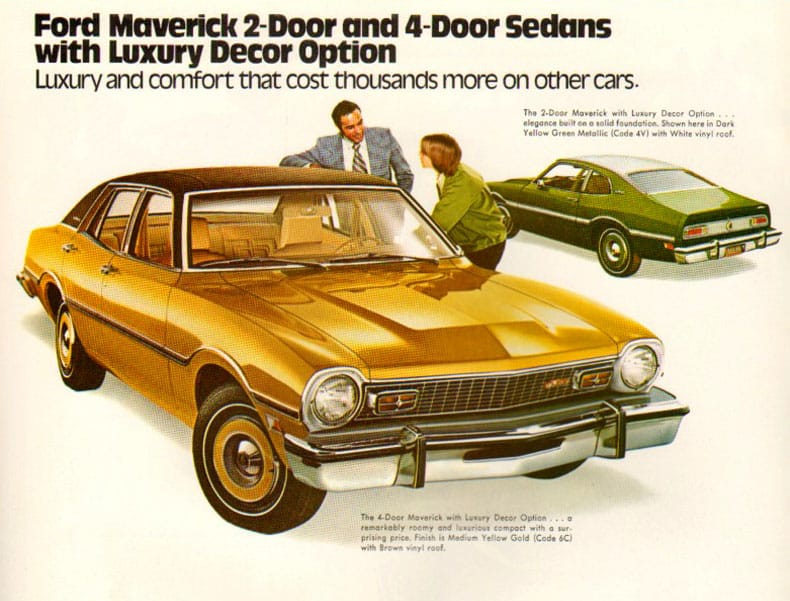
But as said, lots of stuff was dismal, and domestic competitors like the Gremlin, Pacer, or Vega, didn’t make a better case for themselves. The thing is, unlike the stuff arriving from Japan that was steadily improving, these never seemed to get better over the years (unless trim packages were your thing).
Today’s find is a 1974-1977 model, with the larger bumpers and updated styling. If we stick to 1974-1975 for today’s find, that means the car could carry either the standard 200CID I6 with 84 HP (all of 75 HP in ’75), or the optional 250CID I6 with all of 91 HP (with a precipitous drop to 72 HP in ’75). Meanwhile, Chrysler’s 198 slant six had 95 HP, and the 225 had 105 HP in ’74; the 225 had 95 HP in ’75. The Chevy six in the Nova was rated at 100 HP in ’74, and 105 HP in ’75.
So figures that for ’74 were subpar, and that for ’75 were, well, just plain dismal. About the worst for a six ever, and it’s no wonder a close relative, the 250CID 1975 Granada, holds the title for the most malaise of the malaise era.

These could also come with an optional 302CID V8 (140 HP in ’74, 122 HP in ’75), but I doubt that’s what’s under the hood of today’s subject car. Instead, it looks trimless and pretty much 4-door entry level, so period correct average low-cost transport; ultimately, the Maverick’s mission and for which it had been designed. Coinciding with those troubled times, 1974 was the model’s second peak, with 301,048 units built. Economic upheavals notwithstanding, age started to hit the car in 1975, with numbers diving to 162,572.
Then again, these were our cars, and can’t choose the times you lived, right? Comments on these range from “Depressingly cheap and dreary…” to a car that “…felt like each one of its corners wanted to go in a different direction…” and finally to “Toss me the keys, I’ll drive it.”
That last one, someone who loves and has embraced the Maverick blues.
Do I like old Mavericks? Never thought of that before, and back in the day, I wouldn’t have. But I don’t dismiss them as easily as I used to. These used to be everywhere, and any survivor brings a taste of the world I knew. However, not all memories are rosy, with many being blues inducing. But I think I’ve grown enough to learn to embrace those moments that made me, be they pleasant or challenging.
That said, one thing is for past events defining who we’re, and an altogether different thing is to relive them. So, as far as the Maverick blues go, all good and all fine, as long as they remain in the past.
Related CC reading:
Why The 1970 Ford Maverick Was A Hit: The Right Dismal Car At The Right Dismal Time
Curbside Classic: Ford Maverick – The Simple(ton) Machine
Curbside Classic: 1975 Ford Maverick LDO – Let’s Drive Opulently
Curbside Classic: 1970 Ford Maverick – The Car To Send Your Kid To College In 1969, Or 2015
Vintage R&T Test: 1970 Ford Maverick – “… They Got To Be Out Of Their Minds”
Curbside Classic: 1970 Ford Maverick – It’s Got A Six But No Sex
An Introduction To Practicality, Automotive and Otherwise, Via a 1971 Ford Maverick
1974 Ford Maverick – Peak Bumper
Curbside Classic: 1973 Ford Maverick – Taking A Gapp Year
1971 Ford Maverick: Fifty One Year Old Yearling























My Dad had a ’74 four door Maverick, black vinyl interior and V8. The front rotors warped at 20k miles. Since the car was bought as a demonstrator with an extended warranty, the dealership would only replace the pads, not the rotors. What a bummer!!
It also had the dreaded “interlock”. As a young boy, it was my duty to pop the hood and press the button to get the engine started if the seat belts were buckled out of sequence. No way my Mother was going to pop that hood!! The engine developed a distinctive knock at 40k miles. The only good thing on the car was the A/C.
As a WWII vet, I was never more surprised when my father traded the Maverick for a blue Toyota Corolla lift back. The next two cars were Asian as well. At least his final car was a Buick.
Several years later, I heard that knock at a grocery store parking lot. Someone was crazy enough to buy the Maverick as a cheap commuter car.
The 1974 Maverick sums up the Malaise Era real well. It wasn’t the only poster child for the era, though, as all US market cars received those ugly 5-mph bumpers at each end that year. I bought my first magazine that was dedicated to classic & collectible cars in late 1973 when I didn’t expect cars to improve any; either in looks or performance. (It didn’t for a good ten years.) I got hooked on vintage cars since that time, and continued to buy Car Classics/Car Collector magazine right up until its demise in 2009. Around 1974, Motor Trend ran an article of JDM cars that were only available in Japan to show what we were missing out on, including a few cars that were offered in North America with the proper bumpers that they were designed with in the first place, and not the hastily added rubber-capped heavy extruded aluminum battering rams they ended up with to satisfy the NHTSA regulations. If any Maverick out there has an element of collectability, it will have to be a 1970-’72 without the ugly bumpers, and only a Grabber or Sprint trimmed one at that.
Coming off driving age near Detroit in the late 70’s, I had considerable exposure to US compacts from the early and mid 70’s. My initial exposure to the Maverick was my land lady’s hatred of her ’74 4-door with manual steering. Later driving a 2-door ‘71, I was schooled on the difference a shorter wheelbase and a bit more power made. Nicely proportioned styling, too. I genuinely liked driving that one and liked its big 6/automatic, though the front seat was awful and the back seat was too small for most adults. Of course, I was comparing it to a ‘70 Nova 2-door with dreadfully slow, heavy steering, an iffy 250 and a nice-shifting 3-speed. I was also comparing it to a completely stripped ‘73 Dart Sport, which was roomier and steered well but had a saggy front seat, a truly awful column shifter and a unsynchronized low gear. Rounding out the bunch was a ‘73 Hornet with automatic and power steering. That one had great but unfashionable styling, the best visibility, an interior made of bits that all seemed about to break off, the least comfortable front seat, vague steering, scary brakes, and a lot of road noise. Any of these cars became much nicer (more LTD-like) to drive with a v8, automatic, power steering and disk brakes, but they lost all pretensions of economy at that point and you didn’t see many equipped that way in the road.
The ‘75 GM compacts were a revelation in styling and driving dynamics (make mine a Skylark 4-door with the new/old v6), but the ones that I knew didn’t hold up well. The Granada was a disaster, with underpowered engines whose rats nest of vacuum hoses started to disintegrate in their second year. The Aspen/Volare were nice-enough cars famously plagued with rust and other durability issues. Was it any wonder that so many Coronas, Celicas and Corollas started to appear in Detroit’s back yard?
My mother occasionally got use of a company car in one of her jobs, so it was always an event for me when something new and different showed up in the driveway. At least once she brought home a Maverick. This was probably around 1973 or 74, and I still remember the unappealing white paint with the light lime green vinyl interior. It was a low-trim 4 door, and was clearly something that only a skinflint would love. I was amazed that an American car of that class cold come without a glovebox.
In later years I got to experience several cars in the Valiant/Dart/Duster family, and learned that between those and the Nova and its clones, true blue Ford loyalists really got shafted. But today? I might embrace the 1970’s version of the Henry J just for the fun of it.
My friend is malaise prone.. His gorgeous silver Granada ghia sedan which he owned for at least 10 years got totalled a few months back. Loved that car. His only collector car with a/c.. Also has a 72 mustang coupe. But the one that gets driven most is his sky blue 74 comet, a Mav in Merc clothing… in very good condition and still running strong with its straight 6 and auto trans.. He is stuck in the malaise period. We won’t hold that against him though
My parents purchased a used maverick around 1982. it was 4 door dark blue inside&out. cramped, non airy. dismal. Particularly since i had a Friend with a 61 falcon as his HS car few years earlier. that Maverick precursor was so very much airier & roomier & honest inside. I always thought the exterior lines of the maverick were hideous. so, yeah. The Dismal adjective certainly applies to mavericks, IMO.
Malaise? I guess it depends on one’s POV, one’s age, and what one was doing. I had a blast that entire decade. Between living in San Diego for SDSU and all the beaches, to grad school at UC Berkeley in Berkeley and San Francisco, and pretty much company cars, for five years costing me nothing, I cannot complain. The other years I had the 68 Cougar to use before retiring the car in 1980. I guess avoiding owning one of those cars and not being in the job market might explain that, Although have to say the 74 Duster slant six and 75 Nova with six seemed perfectly fine to me.
I’m a few years younger than tbm3fan but he makes a good point about the context. Plus maybe California was less malaised. I was in high school, college and early in my career in the Seventies and while I was aware of Vietnam, inflation, and plummeting horsepower and broughamization, I was too young to be affected by some of those things and too poor to have much exposure to new cars.
But as a teenage car buff I did find the Maverick particularly weird. Replacing both the Falcon and the Cortina it had none of the practicality of either, especially since it was launched as 2 door only, and yet no sportiness. As such it presaged the Pinto, although at least rack and pinion steering and an optional OHC engine gave the Pinto some sportiness. Sometime later in the decade I got a few minutes behind the wheel of a 3-on-the-tree Maverick and it was even more depressing, with flaccid dynamics and very poor visibility. No wonder Corolla’s and 510’s were selling like hotcakes in the Bay Area.
I have a love/hate relationship with Mavericks. Yes, Mom’s ’72 four-door was the car I learned to drive in, but as I’ve said before, it’s quite possibly the worst car Ford ever made! The styling was pleasant enough, but that’s about the only thing these Malaise Era Econoboxes had going for them! I won’t rehash the issues, others have done so admirably here. The Edsel was uglier, but at least it had decent room and was no better or worse than its contemporaries in the power, ride and handling departments.
Lately, however, Mavericks have been commanding more money in the classic car market, as a cheaper alternative to a much more expensive Mustang. Most Mustang go-fast goodies will fit, and a Ford small-block, either a 302 or 351 is a popular engine swap. So, despite its flaws, the Maverick, particularly in two-door form, lives on!
The seventies were actually a terrific decade in so many ways. Sure, the energy crisis hit some folks (it didn’t phase me in my 32 mpg VW), but there was so much good happening, both personally as well politically/socially. I mostly loved the ’70s, and it was a decade of huge growth and opportunities for me.
What a lot of folks don’t realize is that most of the socio-political changes activists were pushing for in the ;60s didn’t really start to be implemented until the ’70s. The Clean Air Act and an explosive growth of awareness of environmental issues. Women and minorities all made huge progress in the ’70s. A whole generation of progressive-minded young adults began to see how political power could utilized effectively better than just protesting in the streets. The ’70s were actually the most progressive decade in modern American history.
The whole “Malaise” thing was started by a certain writer based on a belated response to what was actually an extremely honest speech by Jimmy Carter. That speech’s honesty and sincerity make the current political reality look like a nightmare in comparison. It’s worth watching.
…and I concur wholeheartedly!
Our generation looks back on the 70s tempered by 1/2 century of life experience. Subsequent generations no doubt will remember the decade in which they lived through their 20s. It is such a formative period.
I can only guess how a 20-something will look back on the 2020s some 50 years in the future. Will they remember their 1st ride in an electric car? Their 1st time riding in a lifted truck? Their 1st burn out in a hot Charger? How will they look back on the contrast between Presidents Biden or Trump? The war in Ukraine or Iran?
One thing I’d bet on. Every one will have some strong memories of the decade in which they spend their 20s.
PS: Not all my memories of the 70s are good. Disco was an unforgivable musical travesty.
Was young, dumb; not young now..lol Could a got a nicely, optioned, “final year, Maverick” quite cheap in “81”. Would a had it paid for in a year tops. Had about “25k” on the odometer.
Got a new car, took almost the three years to pay it off.
It was a 1974 model. From 1975-1977 the “Maverick” nameplate on the grille and deck lid was replaced with “FORD” in block letters on the hood and rear body panel.
It’s hard to imagine the thinking behind no glove box but Ford did it again shortly after by putting the horn button in the turn signal stalk .
These made pretty good fleet cars, sturdy and reliable, that’s not saying much but they were .
I remember these as sluggish and no fun to drive .
Does anyone here know what year they got a glove box door ? .
-Nate