
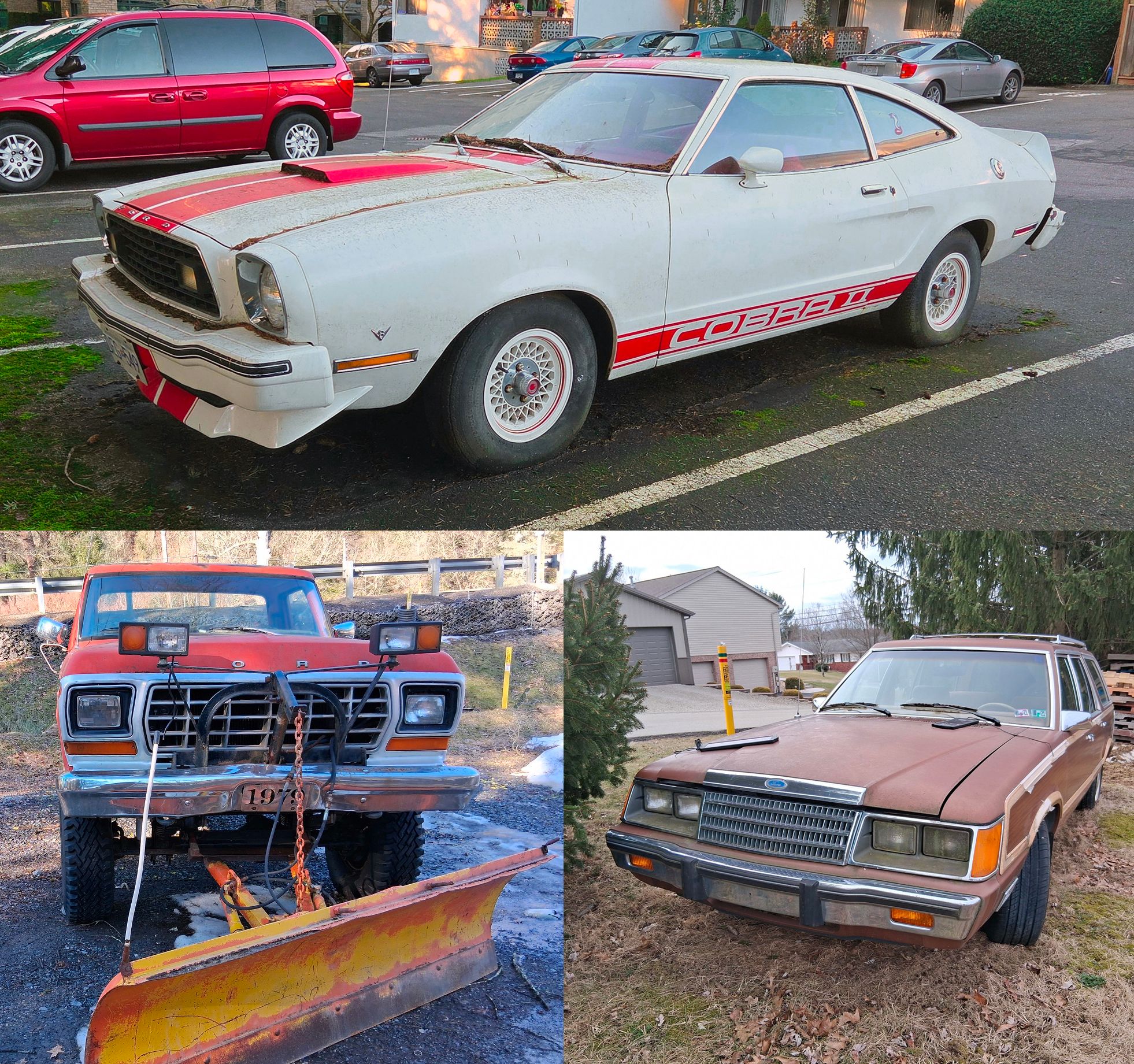
It doesn’t come up quite as often today as Lee Iacocca’s “white knight” tales of business heroics at Chrysler, but Ford was up to their necks in the soup in the late 1970s and early 1980s, and they too managed to turn things around with new aerodynamic styling, greatly improved chassis dynamics, and a catchy “Quality is Job 1” slogan. However, things lined up in the CC Cohort recently to show us three cars and trucks Ford was peddling when quality was somewhere in their top-five, but perhaps not number one.

We’ve covered Donald Petersen before here at Curbside Classic; he was the dynamic CEO who truly saved the company at a time when they were suffering yearly losses in the billions. In 1980, when he took control, Ford lost a record $1.5 billion, $516 million in the fourth quarter alone. David Halberstam’s excellent book titled The Reckoning, which was published in 1986, lays out the forces that led Ford’s fiscal woes. Although this is a gross oversimplification, Ford relied too much on their accountants rather than their product people, and the product therefore suffered.

Taken on a case-by-case basis, however, I don’t think the picture is quite as bleak. Nobody can really blame the Mustang II for sinking a company; after all, Ford sold 161,513 of them in 1977, when this Cobra II was built. Unfortunately, that was down precipitously from the 338,136 units that Ford sold just three years earlier. Interestingly, for all the complaining about a lack of a V8 option when the Mustang II was introduced, only 36,150 were sold with the small-block in the 1977 model year.

Nifticus392 took these pictures of this V8-powered example, whose 302 two-barrel produced 139 horsepower in 1977. According to Car and Driver, that was enough to propel the Cobra II to 105.7 miles per hour, enough to take a distant last place in a top-speed shootout of American cars. Oh well, it was a start, and much peppier than the 1974 model’s 2.8-liter V6 line-topper.

I like the styling of the Mustang II hatchback, especially in Mach 1 or Cobra II form, and unless you are observing it in profile view, the slightly odd proportions (the front overhang especially) and tiny tires aren’t so evident. Things would certainly get better from here, but the Mustang II isn’t as bad as its reputation would have you believe. This one seems to have spent some time lingering in the same place, and I hope somebody revives it soon before it becomes a permanent part of the scenery.

It’s also hard to point at Ford’s evergreen F-Series and say that it was responsible for tanking a company: Fomoco sold over 742,000 of them in 1979. Of those, 189,742 were F-250s like this one, which was clearly outfitted as a working person’s rig.

With a little rust here and there courtesy of Pennsylvania’s Department of Transportation, it was captured taking a roadside break by Hyperpack, who posted it on the CC Cohort.

The “Custom” interior package was as bereft of equipment as an F-250 got in 1979, which was the final model year of the “Dentside” bodystyle introduced for 1973. Trucks back in 1979 were available with a dizzying array of powertrains; in this case, the buyer could get anything from a big 300-cubic-inch six all the way up to the big-block 460 (although my copy of Krause’s Standard Catalog of 4x4s: 1945-2000 mentions that the 169-horsepower 400 was the top option on 4x4s, and that the automatic was only available with the 400). This one has an automatic, and with a new seat cover and a dash pad, it could look almost new in here. Plus, you could clean it out with the hose after a hard day’s work; my mom and dad did that when they borrowed my late uncle’s 1983 Chevy C10 for the day back in the ’80s. It was a disaster in there…long live the rubber mat (of course, all that water probably hung up under the mat for the next calendar decade).

According to the brochure, the F-250 Regular Cab was only available with the 8′ long box, so this example, which appears to be a lurid shade of “Coral,” lines up well with the buyer’s guides. The rear axle should be (and it looks like) a Dana 60, and leaf springs were standard front and rear. Honestly, if you asked which of the three I’d want to take home, it would probably be this beefy plow truck.

It would probably not be this vanilla 1984 LTD Squire Wagon, a car so anonymous that I pored over my materials trying to determine its model year. The grille and steering wheel gave it away, but if I’m mistaken, please point it out in the comments. Hyperpack captured this one as well.
Also, this car squeaked into the “Quality Is Job 1” era, which began in 1981, but few would argue that the LTD wasn’t fundamentally a Fairmont.

To me, this LTD best personifies what went wrong at Ford in the early 1980s. It’s not that it was a bad car, far from it, but by 1984, it was a few years past its prime, looking little different from the Fairmont that begat it, and much more archaic than the Taurus that replaced it two model years later. Unlike the Taurus, it simply blended in (although the Taurus would eventually blend in, too).

The interior is typical Ford of the early ’80s. The dashboard looks eerily similar to my dad’s hideous 1980 Thunderbird’s, as one might expect considering that half the product line at Ford shared the Fairmont’s platform during those years. Engine choices were limited: the 2300 four or the not-much-better Ford 3.8-liter V6.

The little details remind me of those Fords I knew growing up; I spent much of my youth observing these little details from different angles as I got taller. The little sticker on the driver’s windows of all Fords reminded us to “get it together” (good advice in many ways), and the optional lighting group afforded a fancy rectangular door lock escutcheon, which illuminated the lock so it was easier for the driver to send the key home on a dark night. I may not want the car, but I love the memories.

Realistically, the best thing to do with this solid-looking wagon would be sacrilegious to some, but the drag-and-drive guys would love to drop an LS engine or a Ford Coyote into this thing and turn it into a “sleeper.” The Fox Mustang has made this platform ubiquitous, so engine swaps are about as easy as engine swaps get. Weld in a roll cage and carry your spares right in the back. The LTD wagon may have been underwhelming when new (not terribly: 59,569 wagons were sold in 1984), but it would make a great strip terror today. And hey, it already has Mustang 10-hole alloys on it, so it looks the part.

Since car collecting is more about nostalgia than anything truly empirical, it’s unsurprising that cars we’ve long thought of as being afterthoughts are now cherished by the people who remember them from their youth. I’ve already mentioned that I wouldn’t hate driving off in this beefy F-250, but which one of these Fords from their darkest days would you like to take home?
Related Reading
Automotive History: Ford’s Déjà Vu Moment – How Donald Petersen Saved Ford In The Eighties (by Paul N)
Automotive History: 1979 Ford Indianapolis Speedway Official Truck Package (by Vince C)
Curbside Classic: 1976 Mustang II Cobra II – Ford’s Deadly Sin II (by Paul N)
Curbside What If? CC Builds A Better Mustang II (by Paul N)
Car Show Classic: 1978 Mustang II King Cobra – The First 5.0 And A Screaming Cobra (by me)























In 1977 my father, my uncle and I took a tour of the River Rouge plant on a hot summer day. Back then you actually walked through the plant on catwalks. At the final stop the Mustang IIs were undergoing final inspection, we could walk around freely. One of the veteran employees was inspecting Mustang IIs that had been sent out to a subcontracting firm to install the T-tops, he said they were prone for leaks. Here was somebody who did care about quality. And notice the Fairmont had the optional vent windows.
Weren’t the old-school factory tours great? My dad took me through Buick City in Flint when I was a kid back in 1986-87, and we could walk right out on the factory floor. That plant had one of the best quality records in the industry, so of course, GM closed it and tore it down.
I did the Rouge tour probably 5-10 years ago, and it is so sanitized that you really can’t see much of what’s going on.
I toured the San Jose (actually Milpitas) California plant in 1978. Watched Pinto’s, Mustang II’s and dentside F series trucks getting built. Speed seemed to be Job 1 … at many stations, the workers raced through their tasks and then took a smoke break before the next car or truck trundled down the line. The guy driving the Pinto’s and Mustangs off the end of the line would burn rubber on the slick concrete floor for 20 feet before skidding to a halt. Brake testing?
For me? The F-250, no question.
It was a period of time when the Big 3 were still arrogant enough that they didn’t really believe they had to be competitive with the Europeans and Japanese. Then the person who owned the Mustang II got a ride from their buddy in his new Celica. The Big 3 lost a lot of customers when those sorts of things happened.
Me, I’d take the LTD wagon and build it into a wagon version of the LTD LX that one of the car mags called a “4-door Mustang”
The whole “Quality is job 1” never made it in to the Fords, Mercury or Lincolns that were a big part of our family. And that’s what took us to other brands.
We could start with the low mileage 1983 Mustang GL V6 that Cindy owned when I met her. My memory isn’t as good, but it seems like at under 30,000 miles we had overheating issues and the transmission was junk. Ford agreed to pay for the parts for the transmission rebuild and we would cover the labor. But the service manager admitted that they were unable to determine the reason for the overheating. So Ford gave us $350 trade assistance.
We then thought, since that would only apply toward a new Ford, we’d lease an 86 Mustang. No more V6 for us (and insurance said no to the GT) so we took the wheezy if not dependable 2.3 engine. Simple, right? Well at the 12 month mark, the black had faded to the primer on all horizontal surfaces. Ford refused to do anything. They did nicely remind me that since it was a Red Carpet lease, any damage would carry fines. And towards the tail end, that transmission was slipping but it did have 70,000 miles. (We had Macco do a scratch and shoot job on the paint and my least mileage was for 72,000 miles so I paid no damage or over miles fines)
Next up was a new 88 Sable LS wagon with the 3.8 Essux. At about 4000 miles, I went to pass a car on a two lane. Flooring the accelerator caused the transaxle to make a terrible grinding noise, followed by an over drive to first gear downshift.
Ford didn’t really know what to think so they added some special anti friction fluid but things finally got so bad it had to be towed in. After about a month of arguing, Ford agreed to meet us at the dealer. He admitted that the 3.8 was too much torque for that transaxle. Ford would replace the whole unit- one time. Or we could trade it in with “some assistance “. We chose to have them replace the unit- something that cost them $4200! From there, that car was in the shop more than not, and my father in law became smart. We took over the lease and he went over to Acura!
I could go on, but you see the point.
I read all the time about the GM deadly sins, and for the most part, I can’t disagree. Not Ford made promises to build a better quality car and didn’t. Did I mention my father in laws Continental with the ceiling mounted map lights that fell? Or the real wood veneer that was replaced 4 times because Quality was job 1?
I’ll take the LTD wagon, which was essentially a more practical version of a Mustang and accepts many of the widely available aftermarket mods. Ford built this wagon three ways – first as a Fairmont, then a Granada (for one year), then as an LTD. The LTD did indeed have a 80-82 T-bird dash although the rest of the interior wasn’t as plush as high-trimmed Thunderbirds. Granadas got a slightly fancier variation of the Fairmont dash and door panels, whereas the Fairmont was usually quite plain and used the Mustang dash but without the full set of gauges (which was a rare option on the Fairmont starting in 1979). I recall reading the gasoline tanks on these have a woefully small capacity.
Yes I had a 1990 Mustang and while its looks were so much more modern, the tiny gas tanks and overall body quality were NOT.
If Google is right, the various Fox-platform cars had several different gas tank sizes, ranging from 11.5 gallons in some early Mustangs to 18.5 optional in LTD wagons, with later Fox Mustangs having a 15.4gal tank. I didn’t even look at more distant Fairmont/Mustang relatives like the Lincoln MkVII.
Whadya know. 15.4 gallons. I may have remembered wrong, for a four cylinder fuel mileage was awful.
There were a bunch. The early Fox Mustang/Capri might have 11.5, 12.5, or 16.0 gallons, later consolidated to 15.4 gallons. The Fairmont typically had a 16-gallon tank, but from 1982, there was a 20-gallon extended range tank. The 1980 Thunderbird had a 17.5-gallon tank, the 1983 had either 18.0 or 20.7 gallons. It really depended on not only the model and year, but which engine it had.
Yep, my parents’ 1988 Mustang GT has a 15.4-gallon tank, which isn’t too far off the original Mustang’s 16-gallon tank. I do remember reading about those small tanks in the early cars though. Twelve gallons doesn’t go too far when you’re getting under 20 miles per gallon.
Ford sometimes offered a larger gas tank as an a la carte option in that era. I recall the 1st-gen Taurus had an option tank that was about 2 gallons larger. That option was eliminated on the 2nd gen Taurus.
My 1982 Granada was a factory order car and I specified the extended range (20 gallon) fuel tank. It was a $46 option (see sticker attached).
I was tossed in Facebook jail, over a discussion of Ford Fox bodies.
Most of the guys that populate a couple automotive groups I read are decades younger than I. The only Fox bodies they have ever known, are the few that someone labored over, for decades, fixing everything on them.
The first car I ever bought new, was a 78 Zephyr Z7 coupe. Spent all my vacation time from work, over the next two years, dragging that thing into the shop for it’s monthly visit. A coworker bought a new 79 Mustang. He had the same experience, but only endured it for one year. When my dad died, in 90, I inherited his car: a Fairmont Futura coupe, with the 2.3. I only found two or three service work orders for the Futura, but one of them said “towed in by customer”. I thought “yup”.
One day, the guys on Facebook started signing the praises of Fox bodies. I replied “Kill all Fox bodies with fire!”, “Clang” went the door of Facebook jail. Their text reading bot doesn’t like to see “kill”. I protested. Then some human apparently looked at the context of what I had written, and I was released from jail. Or, maybe, the person who reviewed my post had once owned a Fox body, and agreed?
A good reason to hate AI.
I’d say more a reason to hate Facebook. Reliance on a brilliant yet flawed resource is on the user not the concept.
If “Quality is job 1” how come Ford has issued 94 recalls so far this year?
I’m afraid “Quality Is Job #1” went by the wayside some time back at Ford, which has been the recall queen for quite a few years now. I keep wondering when they’re going to turn that around.
Why is it that I cannot look at a MII without thinking that it looks like a fake fiberglass body set on a go kart chassis? The overhangs in every direction are so outsize and the wheels and track are so profoundly undersized. I struggle with how this was ever approved for production.
My obsession on this subject is all too well known, which is why CC “built” a better MII:
https://www.curbsideclassic.com/blog/what-if-cc-builds-a-better-mustang-ii/
I feel the same way. But what’s interesting about the front 3/4 view photo, from the driver side, of this white V8 example, is how the roofline looks 100% Pinto. I’ve seen thousands of MII’s though not for a few years now, and I never noticed this. Perhaps because my eyes were drawn to that front overhang. Uggh.
I still have a soft spot for those Fox body wagons. One with the Mustang 5.0 swapped in would be really pleasant, though the already short range from the skimpy fuel tank would mean frequent fill ups.
My BIL had 1 or 2 of those F-250 dentsides on his farm for years.
Kind of thinking that dent side was as well built as any vehicle of the era from any manufacturer in any country, particularly as the FE V8s were replaced. I see multiple examples of these 47 year old things daily, even in the winter. Still doing work. Sucking gas though.
That Cobra looks to be in rather good shape for something sporting a 1994 license plate decal (they were decals here in BC, not tags) although we have not had decals for a couple of years now so maybe got new insurance and cleaned up? Then left to sit again? No sign of a temp permit either.
My takeaway from this is that Iacocca was the motivating force behind the Pinto-stang. It was the right car at the right time but, as stated in the text, took a quick downturn. Then the Granada followed, with a seemingly similar overall trajectory. The 1977 LTD II, effectively just a rebodied Torino, wasn’t anything terrific, either.
The bottom line is I’ve always wondered what really transpired to make Henry Ford II cashier Iacocca in 1978. Is it possible it was the one-two punch of the Mustang II and Granada, maybe along with some other, less than stellar efforts at Ford during the late seventies (like the miserable 1980-82 Fox-platform Thunderbird)?
In the first year of Mustang II’s my girlfriend had one as a loaner, it had the 4 cylinder engine that was woefully under powered .
Now, look at this white one I think it looks okay .
-Nate
Have respect for each of the above:
– The Mustang II generated enough cash to finance the Fox Body
– The Granada/LTD/T-Bird/Mustang & Cougar/Marquis/Capri were icing on the cake versus the original development costs of the Fairmont/Zephyr and provided the cash flow to develop the Taurus/Sable
– The F series was a steady seller that kept the lights on and paystubs flowing at Corporate headquarters.
Of the above, I would like the LTD wagon with a V8. More cargo space than some mammoth SUVs sold today.
Better yet, a LTD LX which had a tach on the dash and fuel injected V8 under the hood…what more could you ask for!!!