

It was just a few months ago when I spotted this forlorn-looking Mercedes in a body shop parking lot; now I’ve found another classic M-B sedan, this time at a local towing company. Both cars have seen better days, and it looks as if neither of them is running. But they survive, you see–and that’s what’s important!
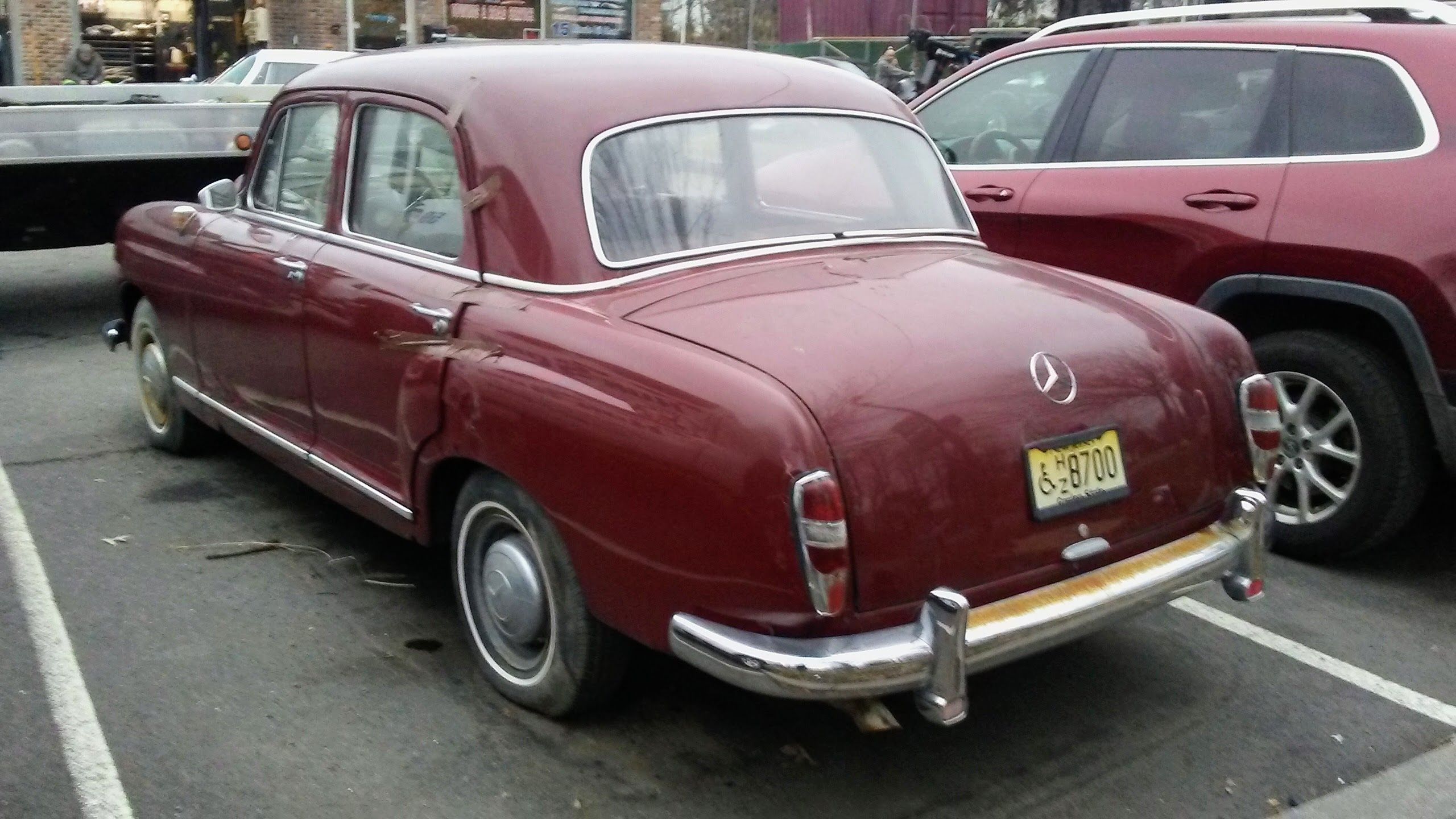
In this case, it’s either a 180 or 190 (W121), the entry level Mercedes four cylinder sedan at the time. And it’s the second to last year for these Ponton style cars.

Strangely, the trunk emblem is missing, so it’s kind of hard to positively identify what model this is.

180? 190? Gas or diesel? There’s a bright metal trim strip along the side…but there’s no ready way to tell the difference.

The inside doesn’t give us many clues either. That’s a 4-on-the-tree manual transmission. Other parts of this car may be tired and worn, but those M-B vinyl seats seem to last forever!

The same cannot be said for the elegant tri-star upright hood ornament, which so often seems to be missing from older Mercedes cars.

I was tempted to open the hood (which was already cocked open) to photograph the engine, which would greatly aid in identification. But I was hesitant to be seen opening the hood of someone else’s car, and I didn’t want to get in trouble.
I asked Paul (our CC founder) about this; and in an email he replied, “I would absolutely lift the hood. What are they going to do? If someone asks, just tell them you’re doing what you’re doing. The very worst that can happen is that they ask you to leave. That’s the only way you’d know if it’s a gasser or diesel.”

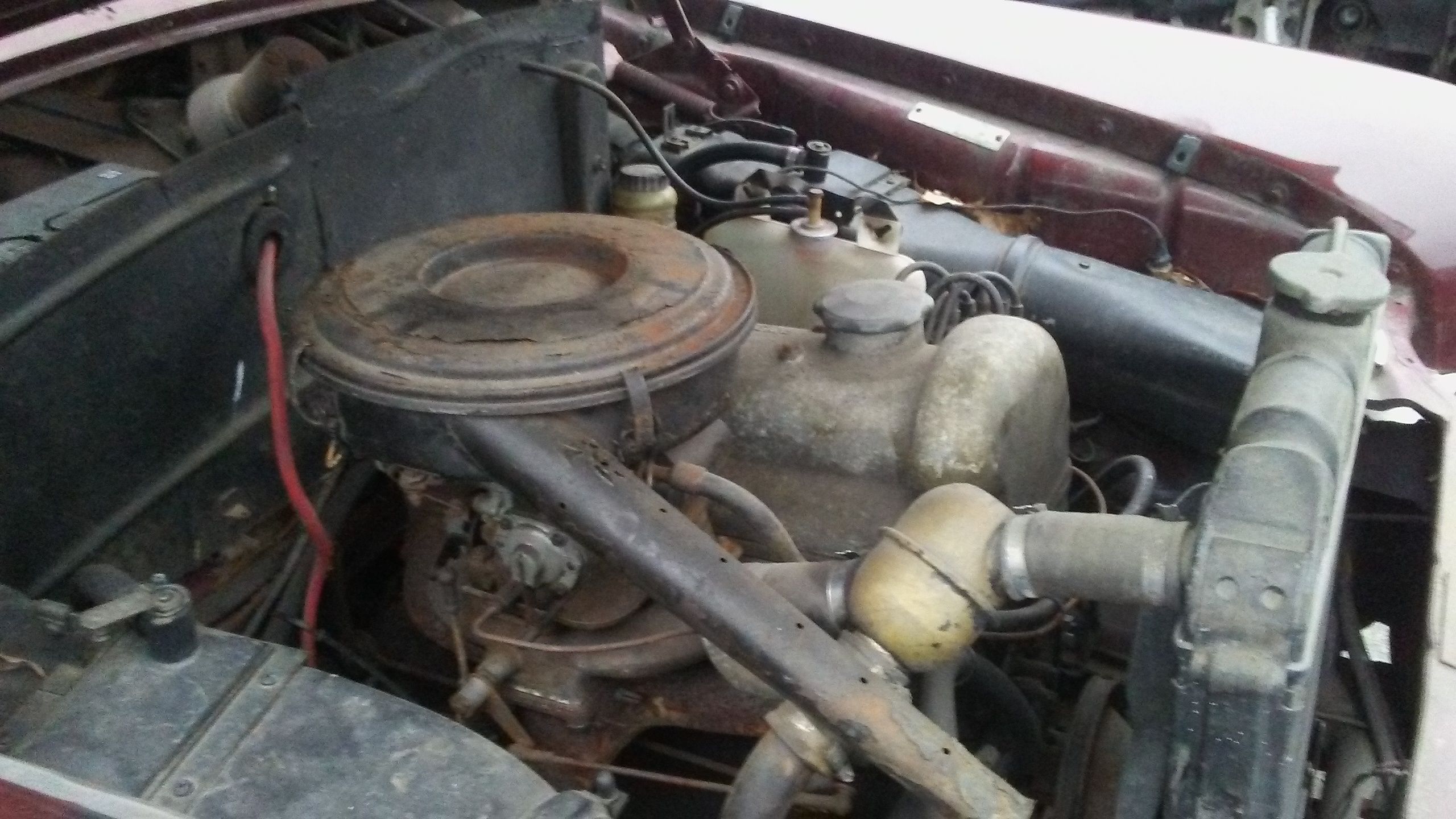
So I went back, lifted the hood and took these pictures. Which is why I am writing this post from a jail cell, awaiting charges of trespassing and attempted auto theft. But at least I got my engine pics!
It’s obviously a gas engine, the 1.9 L M121 engine. But the only difference between the 180 and 190 gas sedans was some minor tuning differences; the 180 had 78 hp where the 190 had 90 hp.

Here’s a 1961 vintage ad for the 180 sedan. These older Ponton fours were still in production even though the new 190 “fintail” was already in production as of 1961. 1962 would be the last year for these older cars, kept on as entry level cars, although their $3,250 price was hardly cheap, roughly about the price of a nicely-optioned Chevy Impala V8. But the Mercedes was “Low Cost Elegance”.
Haha–just kidding! Actually I didn’t get arrested. In fact, I went back to the towing company (driving my ’60 Dodge Phoenix–so everyone would know I was a real “car person”). As I pulled in, I saw a couple guys sitting on some old tires, who suddenly perked up when they saw my light blue Dodge with fins all over the place. I got out of my car, walked over to one of them and asked, “Hi…Um, do you happen to know what year that Mercedes is?” He called out to someone in the back office–“Hey, what year is that Mercedes?” “’61!” Ah, now I have positive ID on the year.

Me: “Heh, heh–Do you think it would be OK if I lifted the hood to take pictures of the engine? I’d really like to see what the engine looks like in that car.” “Sure, go ahead” was the reply. You see, no laws were broken, all nice and legal.

Another shot of those indestructible seats.

I’ve never seen auto paint peel like this. I’m guessing the car was originally white but was re-painted deep red.

Just to give you some local history and color, if you were standing in this very spot around the same time this car was built…

…this is what you would see.

This cute little farmhouse (now long gone) which I believe was owned by the Bates family.

Farther down the road you can see a repurposed BURGER CHEF sign which used to be in front of the fast food restaurant…

…and would have looked something like this.
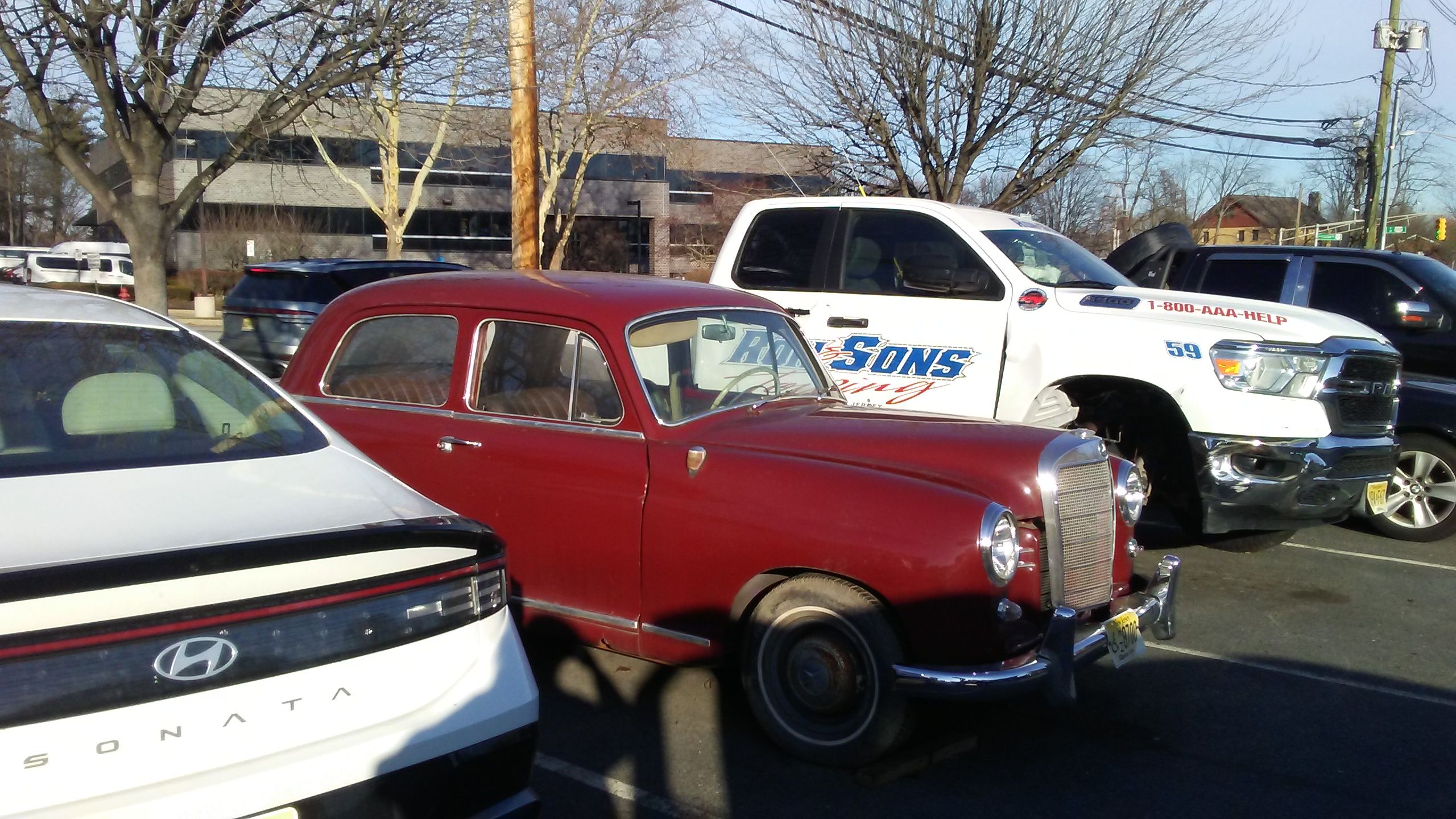
Yes, here and there we find these little artifacts from another era surrounded by modernity–and not yet swept away by the ever-flowing river of time. It would be nice to know if this elderly Mercedes will be loved, preserved, and made driveable once again. However, this is one of those “oddball classics” that not too many people will be interested in putting a lot of time and money into. So for now it sits–an interesting curiosity for those who can appreciate such things.
Further CC reading:
CC Capsule: 1959 Mercedes-Benz 220S W180 II–Like No Other by Mr. Tactful
Vintage Kodachrome: Upgrading From a VW to a Mercedes, and More by Paul Niedermeyer























Diesel versions of the Ponton-Benz can be distinguished from their gasoline-powered brethren by looking at the dashboard.
The diesels got an additional pull switch for activating the glow plug system – see below.
(Image: Daimler-Benz AG)
Wow, this car is a complete doppelganger for one parked in a driveway nearby in the Philly suburbs. So much so that I’m thinking of driving by to see if it’s still there, it could have sold and migrated to NJ. I’ve seen it move around in the driveway, but it’s been there for at least 6 years. Same maroon color with some rust. Though I haven’t seen it up close to know the rust patterns precisely.
The paint flaking off is due to poor body work. Looks like there is bondo beneath it, that was applied over the old paint. Likely not even sanded
I found it on street view, a bit different but very similar
That’s a slightly older version, with the narrower grille. For 1960, the grille was widened to make it look a bit more modern.
There is something appealing about these to me. They exude old car charm but are likely pretty robust with a good parts supply (not always cheap however). This looks like an ideal project for someone to stiffy up a bit. Doesn’t look rusty but is very complete.
Agreed. I came close to buying one during my Peugeot 404 years, for all the reasons you mentioned. But I was out of places to park another car…
Ponton, not Pontoon, that was an American style, M-B knew exactly what they were doing .
I don’t see the pre – heat “salt shaker cap” on the dash so not a Diesel, matters not as even the dual carbed S Klasse versions of these handled well but were very slow to accelerate .
I doubt very much those seats are the original M-B Tex, it’s fantastic stuff yes but doesn’t last this long .
The peeling red paint clearly shows a bondo skim patch, someone failed to do proper prep, why it failed thusly .
Nice Victorian Farm house, I miss them dearly .
I too hope this nice old 108 gets saved and cherished, they use trunnions instead of ball joints and no one ever greases them so the front ends are typically very wobbly, and why the car goes up for sale .
I know a local older M=B Mechanic who has the tools, expertise and parts to bring them back up to snuff .
-Nate
We have a 59 220SE and somehow, probably a ton of love and very little sun, the original MB-Tex still looks good after 67 years. There’s some fading, stains and wear but it’s still there. Absolutely love it and hope to keep it around for many more years.
Update: The black car that you spotted in Rockaway NJ had its hood open a few weeks ago. It looked like they may have been working on it. It was later turned around so that it was facing out towards the street, an indication that may run. I haven’t been past there for a couple of weeks so I don’t know the current status.
Nice to see this!
One of my earliest car memories is of one of these, and my mother struggling to get it started on cold mornings. Maybe she was flooding it? It’s the only daily driver we ever had with a starter button. Maybe there was a manual choke, too.
I remember the upholstery as some kind of scratchy cloth…at least, it felt scratchy when I wore shorts.
Seems it’s been care for over the many years. Hope it fares well, going forward. I’m the same age, hope the same for me too.
I can sure relate to missing bits/ peeling surfaces.
I have vague memories of a day spent with my Grandmother Cavanaugh, running errands in her suburban Philly environs in one of these. She had typically bought Oldsmobiles (and DeSotos before my time) but had a small Mercedes for a time. My father told me that his brother in law talked her into one (and owned one himself). The experience must not have been all it should have been because both of them went back to “normal” cars thereafter.
My good friend up our street (Piccadilly Rd if you can believe it!) had a near new black 190 with red leather, and what I mainly remember about it is how good it smelled inside!
A lady in my small home town had one of these in the diesel version. I can remember seeing her pass by; always flogging that 4 on the tree shifter – trying to get some speed up.
It’s a 190b (the “b” part is what Paul was referring to with the widened grill and arguably more attractive taillights). You can tell by the wood dash panel and the wide trim band around the base of the greenhouse. This one seems to be missing the chrome trim on the roof gutter, and may have an earlier front bumper – “b” bumpers, like the grill, were very similar to those on the new fintails.
I have seen paint peel like that, on our own 190b. The door had been backed into in 1964 or so, and repaired by a local body shop with filler and enamel paint. Never looked right, and eventually did what this one did.
Later, ours suffered the additional indignation of demolishing a ’69 Chevy wagon with the front fender (my doing, in ’79 or so). That’s how I learned that the “a” fenders and the “b” fenders have a different slope, with the “b” fenders being more upright. This one is lucky in that it appears to have a pair of correct front fenders.
A friend’s dad had a 180, I believe a 1958. When he was done with it my pal “inherited.”
I think it was the first car I recall with real leather seats. The trunk could hold four backpacks for our expeditions. Nobody had swiped the hood ornament (we lived in a good area). Four on the tree. My friend was a good driver, so there were no stupid antics for me to mention.
It withstood typical teenage abuse, and was ultimately replaced by a Beetle… maybe a 1965?
Thanks for the memories!