

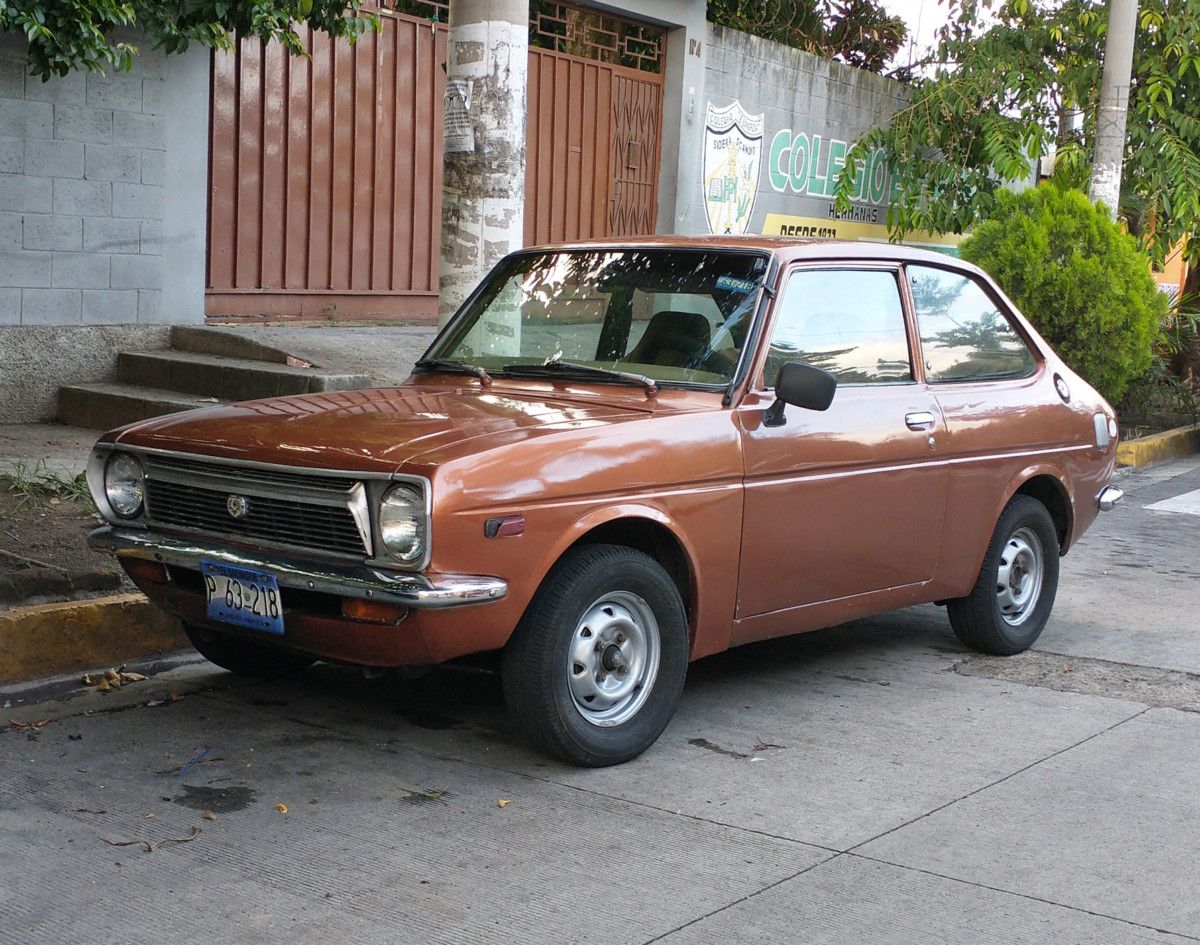
Here’s a curious face I hadn’t forgotten, and that I had been hoping to find these past few years: that of a ’69-’70 Toyota 1000, a model that went by the Publica name in its native Japan. After ages, here it was, in the metal, on a worn working example still roaming the streets of San Salvador. A battered yet-useful survivor from the days when Toyota began to make serious inroads in South America with products such as this, along with the 1964 Corona and 1966 Corolla.

The Publica has been covered a few times at CC, though the early third generation –with its distinctive face– is just making its first appearance on these pages. As some may recall, the Publica was Toyota’s response to Japan’s MITI desire to develop a “people’s car”, and created to meet several of the requirements MITI had envisioned for the project (All covered in more detail by Tatra87, over HERE).

Launched in 1961 in Japan as a low-cost, no-frills proposal, the Publica P10 was Toyota’s smallest and most accessible offering at the time. Arranged in conventional, unadventurous front-engine rear wheel drive format, it was powered by an air-cooled 697cc engine that provided about 28HP. Takers for the spartan early P10s were few, and Toyota quickly worked to turn the model into a less prosaic proposal. New options and accessories were added, improving sales, though not quite turning into a hit at home.
Still, the project taught Toyota several lessons on market assessment, which were put to better use in the defining 1964 Corona T40 and 1966 E10 Corolla.

Concurrently, as a previous Don Andreina post mentioned, Toyota had eschewed the rest of the local industry’s practice of hiring foreign firms to handle their styling needs. Instead, Toyota sent a number of their designers to properly learn the trade in the US and Italy. The result of those efforts was quickly felt, especially on the 1966 Corolla; a balanced, well sorted and pleasing design that had little to fault in regards of looks, with a very Italian feel to my eye. Style-wise, a more than competitive and accomplished offering in the JDM and international market.

Regardless of the Publica not fully meeting sales expectations, numbers were sufficient for the model to stay around. The P20 second generation debuted in 1966, being a rather evolutionary update of the earlier model with further accoutrements. The model got a more significant rethinking with the P30 generation in 1969, basically turning into a “junior” Corolla; something that can be appreciated on this profile shot. A pleasant, and overall, clean, purposefully crafted shape.

Now the face, on the other hand… It’s somewhat of an acquired taste and feels grafted on what’s an otherwise clean styling job. Still, Japan was in the early stages of developing its design ethos and looked for inspiration everywhere, arbitrarily, in its search for its own selves. Small, sometimes incongruous touches that come up again and again in their designs from this era.

I had to run this face through Aaron S. and Peter Wilding, trying to narrow down what it reminded me of. My first thought was early 1960s MoPar…

… close, but not quite.

Then, the Taunus 12M came into the conversation and… Perhaps? A Teutonic face via Ford’s German subsidiary? If so, inadvertently, Toyota had somehow managed to put together, in car form, the old Japan/Italy/Germany axis.

Curious styling flourishes aside, Japan’s designs proved they were marketable and, along low-cost, good assembly and above-average reliability, found acceptance. Regardless of the early P30’s peculiar little face, at least in Latin America, they were well received and have a devoted following to this day.

The P30 was the first Publica sent to international markets in significant numbers, sold generally under the Toyota 1000 name. By this point, the P30 was benefiting from Toyota’s industrial capacity; while a 790cc air-cooled mill was the entry-level option in its native Japan, elsewhere choices included water-cooled powerplants in 993cc, 1,077cc, and 1,166cc displacements; all which gave the car its 1000 moniker. A 2-speed Toyopet auto was offered in Japan, but in most places, a 4-speed manual was the norm.

And if you wonder about today’s find tail lights, they ain’t original; they come from a Datsun Sunny pickup.

This is what the rear should look like. Yep, that does feel much better.

The profile shot shows the Publica’s cab-rearward arrangement, along with its tiny trunk. A design compromise that dated to the model’s inception; the one way Toyota found to keep a spacious enough cabin while keeping the tried front-powered RWD powertrain layout they felt comfortable with at the time.
The P30 would get a significant restyle for 1972-1978 that would bring a more palatable front end, along with a somewhat curious shrunken fastback shape (Hey, can’t iron all the quirks at once, you know?).

An alternative Starlet Publica model featuring a unique coupe bodywork would appear in 1973 (above), slightly larger and with plusher fittings, and carrying a more youthful vibe. It apparently sold better in its native land, and thus, the Publica name was put to rest, with the P designation remaining alive in the now just plain Starlet P60 of 1978; a line still sticking to RWD, but with updated hatchback practicality.

Regardless of the P60 Starlet’s arrival, the P30 lived on in pickup form until 1988 (with a 1.2L engine in later years), and those are still easily found doing hard work around the globe. As for these early ones, they’re hard to come by. Not sure how I feel about this face after all these years, but looks aside, most buyers liked what they got and they’re relevant leftovers from Toyota’s international early days.
Related CC Reading
CC For Sale: 1968 Toyota Publica (P20) Deluxe – Not Cheap, But Certainly Exclusive
Curbside Classic: 1972-1978 Toyota 1000 (Publica P30) – Going In Circles
CC Capsule: 1977 Toyota Publica (KP50) Van Deluxe – A Bit Of Grime For Change






Interesting looking .
I remember ‘bondo buckets’ like this from my time in Guatemala, C.A. .
-Nate
Grill also looks a little bit like a Ford Falcon.
Was my thought as well. A “Falcon” grill that got wet and shrunk.
Terrific find! It never fails to amaze me what’s still on the streets down your way.
As to the grille, Toyota clearly had a thing for backward leaning convex grilles, the Corona’s being the prime example. It does have a bit of 1962 Dodge vibe to it.
I think the Yaris carries the P chassis code to this day.
Wow. I had never seen exact model and grill arrangement that I can recall. And it is memorable. It gives me generic Eastern Europe vibes (just the grill). A GAZ-24 that got punched in the face?
How about the 1960 Mercury? It’s got a concave grill with vertical bars and odd headlight spacing.