
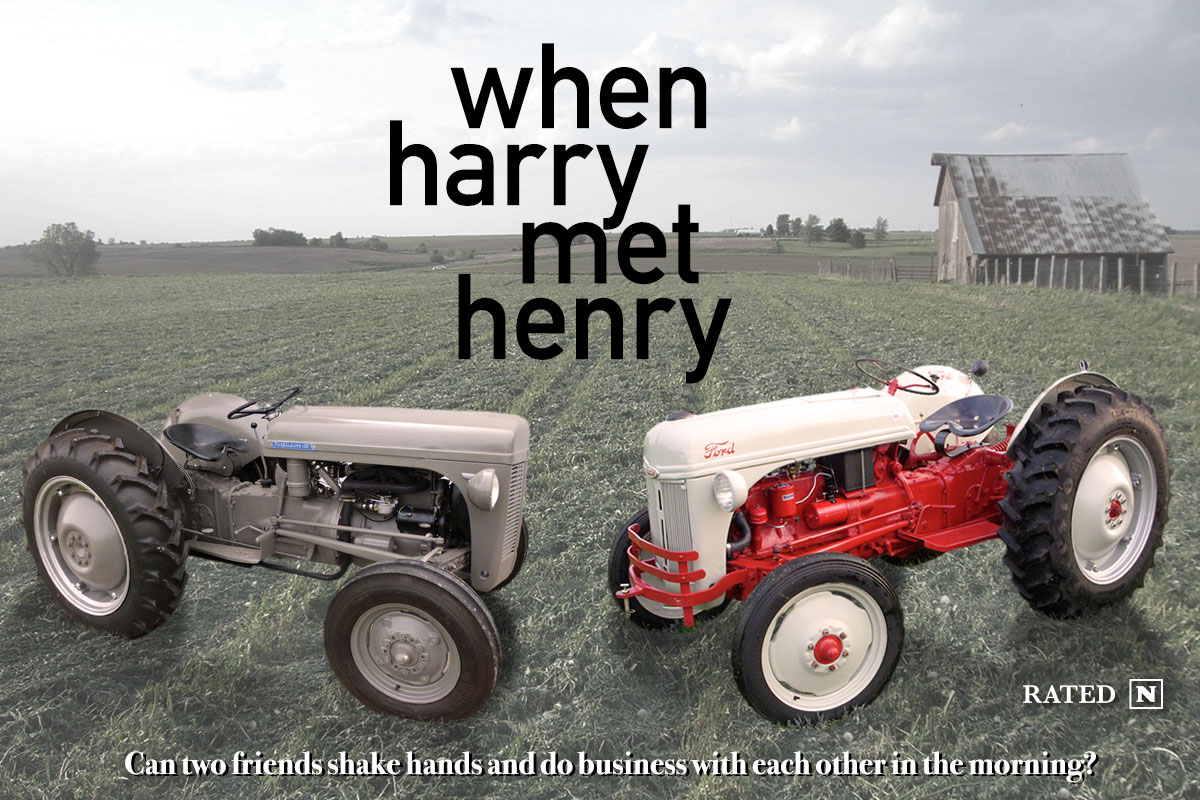
(first posted 2/21/2015) Two men, both of Irish descent, both christened Henry at birth and both raised by a mother named Mary. Each fathered a single child. Raised in rural, agricultural areas, they were both considered to be mechanical geniuses. One was an agnostic and the other believed in reincarnation. Both were involved in aviation and each raced automobiles under the numbers “99” or “999.” Neither could read blueprints well and both hated horses.
Dear readers: This story takes a while to tell, so you might want to grab a cuppa before you start…

Henry George (“Harry”) Ferguson was born November 4, 1884, on his parents’ farm in County Down (Northern Ireland). Harry was fourth of eleven children and was raised in a strict Plymouth Brethren home. Stopping school at age 14, he found himself ill-suited to the rigors of work on the family farm, being of small stature. Constant clashes with his father over religious and other matters led him to plan to emigrate to Canada in 1902, at age 18, but his older brother Joe instead talked him into working in his motor and cycle shop in Belfast. Harry, a bit full of himself, promptly crashed the first automobile he ever drove (along with its owner) right through a shop window.

Early driving skills notwithstanding, Harry quickly became known for his talent with engines, and took up motorcycle racing as a way to promote the business, soon earning himself the nickname “The Mad Mechanic.” Fascinated with the exploits of the Wright brothers, he attended air shows in Reims and Blackpool with friend and future employee John Williams, where they took measurements off various aircraft. He subsequently built an aeroplane in 1908 and managed a flight of 130 yards on December 31, 1909, becoming the first Irishman to take to the air. Harry’s aviation exploits came to an end in 1913 upon his marriage to Maureen Watson, daughter of another strict Plymouth Brethren family (who looked somewhat unfavorably on the match).
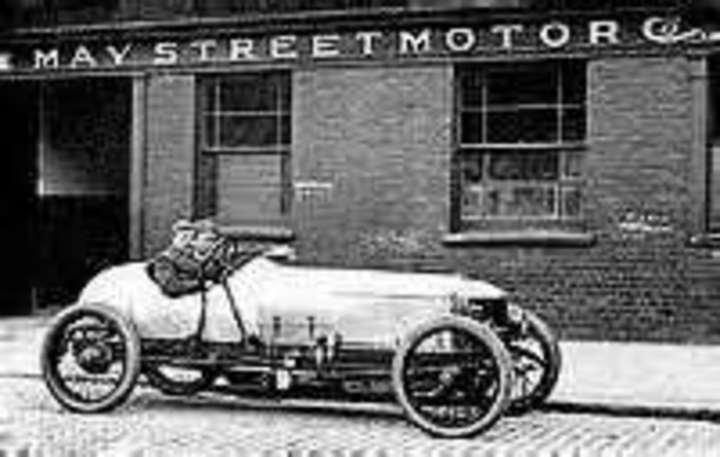
After friction with his brother Joe over a girl (and perhaps jealousy over Harry’s growing fame), Harry left and opened his own business, in Belfast, in 1911, initially called May Street Motors and renamed in 1914 to Harry Ferguson, Ltd. He employed his friend John as well as a talented engineer named Willie Sands, who would become Harry’s right-hand man for decades. Marques offered included the British Vauxhall and French Darracq motorcars. Perhaps seeking new thrills after having given up aviating, Harry also involved himself in gun-running for the Ulster Volunteer Force (an anti-Catholic organization) in 1913-14, which finally earned him begrudging respect from Maureen’s Protestant parents.

Harry’s first business involvement with tractors (a conjunction of the phrase “traction motors”) came when, with The Great War looming, the Irish Board of Agriculture appointed him to oversee tractor maintenance and records for all of Ireland as part of the effort to rapidly increase food production. Harry started selling Waterloo Boy Model N tractors imported from Iowa, USA and offered in Britain as the “Overtime.” John Williams had joined the RFC, so it was left to Harry and Willie to perform tractor and plowing demonstrations as part of the educational efforts they made with Irish farmers.

In the course of the demonstration tours, Ferguson, who already had several patents under his belt, realized that there were numerous drawbacks to the practice of using tractors as a motorized horse substitute for drawbar (pulled) implements. Ferguson felt the main problem was not with the tractor, but rather with the heavy and crude plows of the day. With Sands, he set about to create a lightweight “wheel-less plow,” which could be easily raised and lowered by a system of linkages and springs, making it much easier to maneuver around the field.

Ferguson’s two-bottom (two-row) Belfast Plow was patented in late 1917, and was designed to be attached to a Ford Model T with an Eros Tractor Conversion, one of over forty-five conversion kits available on the market. Stepping back for a moment, at the start of WWI, it was estimated there were 500 tractors in all of Britain. The need for rapid increases in food production through mechanization meant many more were needed, which now brings us to take a closer look at Henry Ford…

Born in 1863 of Irish immigrants on a farm in Greenfield Village, Michigan, Henry had seven siblings. Henry’s father, William, was a quiet-spoken Episcopalian who expected his son to take over the farm, but who also soon recognized Henry’s technical ability. Henry, who detested the grinding farm work, was constantly tinkering and studying anything mechanical, and with his father’s blessing left for Detroit in 1879, at age 16. He would marry Clara Bryant in 1888. After joining Edison Illuminating Company in 1891, he eventually had the time and money in 1896 to develop his first gasoline-engine automobile, the Quadricycle. His first business venture was the Detroit Automobile Company, formed in 1899. The company only lasted a brief time, as the cars they produced were expensive but not of high quality. After building and successfully fielding a racing car in 1901, Ford started a new venture, the Henry Ford Company but, in 1902, when Henry Leland was brought in by the stockholders as a consultant, Ford departed and the company was renamed Cadillac Automobile Company.

Ford then built several famous race cars including the “999” that Barney Oldfield drove to victory that same year. Ford, along with an old friend, then formed a new partnership called Ford & Malcomson, Ltd., where he set about designing an inexpensive auto. A contract was signed with John and Horace E. Dodge for $160,000 in parts, and when the Dodge brothers demanded payment for the first shipment, Ford had to scramble to bring in new investors. The company was reincorporated as Ford Motor Company on June 16, 1903. Oldfield continued to set records with Ford’s racers and made the brand famous around the USA.

Ford rapidly improved his offerings over the next few years, working his way through the alphabet with new models. The Model T was introduced in October, 1908, and by 1918, represented 50% of the auto population in America. Ford aggressively drove the cost of the Model T down to the point where the ‘ordinary man’ could afford one, and increased worker’s wages to $5/day in order to reduce turnover. At odds with Ford Motor Company stockholders over expansion of the company and how profits would be distributed, Henry announced he was leaving to “pursue other interests,” and created a new company in 1917 called “Henry Ford and Son,” where he could have full control over all company and manufacturing decisions. His primary purpose in creating the company, however, seemed to be to intimidate Ford Motor Company stockholders (the Dodge Brothers in particular) to sell out to Ford, a ploy which ultimately was successful.

Ford had been experimenting with a number of tractor prototypes, the latest of which utilized a frameless design (pioneered by the 1913 Wallis Cub) in which the cast iron engine block, transmission and rear axle housing formed the structure of the tractor. Ford of Britain’s head, Percival Perry, was aware of these developments and in 1917, purchased land in Cork, Ireland for the production of tractors. A pair of prototypes were shipped over and demonstrated to the Royal Agricultural Society, who were impressed. Subsequent developments resulted in the determination that Britain’s capabilities (diverted as they were to war production) were simply not up to the task of tractor production at that time.

Still in need of tractors, the British Ministry of Munitions (M.O.M.) began negotiations to have Ford produce 6,000 tractors for export at their Dearborn plant, a number subsequently raised to 7,000 units by an additional order from Canada. The first tractors sent over in November 1917 were simply known as the M.O.M. tractor (named after the purchaser) and used a 20 hp four-cylinder engine similar to that in the Model T. Ford’s engineers made continual improvements and changes, and, seeing opportunity for a bit of free publicity, Ford began stenciling “Henry Ford and Son”, eventually condensed to “Fordson”, across the radiator.

With pricing for the improved Fordson Model F lower than most car/tractor conversions, Harry Ferguson effectively lost the market for his Belfast plow. He quickly revised the hitch design such that remaining production could be used with the Fordson and then started work on a completely new design that would link the plow (or other implement) to the tractor in a way that effectively made them one unit.

The biggest problem Ferguson had observed with the Fordson (and other tractors, to a lesser extent) was that they were notorious for “rearing up” when the plow struck a rock or root – with the machine no longer able to move forward, tractive power instantly became rotational power and in less than two seconds, the tractor would flip backwards about the rear axle, crushing the operator (horses knew better and would simply stop pulling). It was suggested by one wag that Ford should attach a placard to the tractor that read “Prepare to meet thy God.” Ford would eventually offer to all Fordson owners a free set of extended fenders that acted like wheelie bars. Ford tried other arrangements to mitigate the problem such as trip springs on the plow and ignition cut-outs, but farmers continued to die needlessly.

Ferguson experimented with a number of configurations for his new plow hitch design, settling on a mechanical linkage consisting of two parallel bars that formed a semi-rigid arrangement between the tractor and plow that prevented the tractor flipping backwards when an obstruction was hit. The linkages were designed to pull the plow down to its working depth, and improved traction came by shifting the weight of the plow and forces involved to the tractor. When Ford’s Charles Sorenson came to Cork in 1917 to discuss setting up UK production of the Fordson, Ferguson and Sands secured a meeting and presented the new plow design to him. Ferguson’s natural salesmanship won the day, and Sorenson committed to support development of the plow (something he later said he regretted!).

Development proceeded, and in 1920, Ferguson, accompanied by Sands, traveled to Dearborn for his first meeting with Ford. Ferguson was interested in having Ford manufacture the plow in return for royalties, but Ford misunderstood his intentions and offered Harry a job instead. When Ferguson refused several escalating offers, Ford, somewhat annoyed at this point, offered to buy the patent rights. Ferguson again refused – the two stubborn Irishmen had met each other’s match and they parted company with a grudging respect for each other.

Ford had moved tractor production to the new River Rouge plant in 1920, and Fordson branded tractors would be made there through 1928 and in the UK through 1952, with a total of 1,227,694 units of all models of Fordsons produced. Meanwhile, Ferguson was left to find someone to manufacture his new plow. The Roderick Lean Company of Mansfield, Ohio was initially engaged, but went bankrupt in 1924. An arrangement was eventually made with brothers Eber and George Sherman and the Ferguson-Sherman, Inc. company was formed.

During this time, Sands, who had since left to start his own business, was rehired to solve a problem where their Duplex Hitch plow would not make furrows of constant draft (depth). Sands came up with the idea of a linkage that would adjust the depth the plow in the soil based on its angular relationship with the tractor, solving the problem. Eventually, a third point of attachment was added for stability and a patent was awarded for the “three-point linkage,” known as the Ferguson System, in 1928.

Interestingly, the initial design had two arms on top and one below, which proved to be somewhat unstable. Ferguson reversed the arrangement, then developed a hydraulic system to raise and lower the implement (photo of the prototype shows the first hydraulic unit in the original “upside down” configuration). By this time, several companies were showing interest in manufacturing the system, including Allis-Chalmers, Rushton, Ransomes, Rover, and Morris Motor Co., which was of the greatest interest to Ferguson. The depression of the late 1920s-1930s unfortunately put the kibosh on any agreement, however.

Undeterred, in 1932 Ferguson set about to design his own tractor from his Belfast factory. Lightness was pursued doggedly, with components being sourced from both the USA (18 hp Hercules engine) and the UK (gears, transmission and steering from David Brown Co.). The resulting prototype (which looked much like a 4/5 scale Fordson F) weighed in at 1,640 lb., utilized a single plate clutch and three-speed transmission, independent (differential) brakes and of course, an improved Ferguson System hitch. Painted all-black, it had almost all the elements of a modern tractor. Ferguson sought a local Irish company to manufacture the “Black,” but finding none went to David Brown and, in 1936, formed an agreement to build tractors with Brown in charge of manufacturing and Ferguson responsible for sales.

An improvement over the Black prototype, about 1,200 Ferguson-Brown Type A tractors were produced. Weight was up to 1,850 lb., horsepower was up to 20 and the color was changed to battleship grey. Four implements were offered, including a a two-bottom plow, and every tractor included a Ferguson spanner – Ferguson insisted on using just two nut and bolt sizes wherever possible. Unfortunately, the tractor was a bit of a dog and did not sell well, especially considering the updated 27 hp Fordson Model N could be had for £140, where the Type A cost £224. Brown began pressing to manufacture a larger tractor, but Ferguson demurred, preferring to lower the price to stimulate sales. As Brown assembled a team to design their own larger tractor, Ferguson crated up tractor Serial No. 722 along with a range of implements, and headed to America, determined to meet again with Henry Ford.

Ferguson arrived at Fair Lane in September, 1938 with John Williams and the Sherman brothers in tow. Ford was away for a few days inspecting mines in the Upper Peninsula, so Ferguson used the time to ready every detail to perfection. When Ford returned, a demonstration was set up in a roped-off section of Clara Ford’s garden. After Ferguson’s operator demonstrated a two-bottom plow on an uphill section, Ford called for the estate’s Allis-Chalmers B and Fordson tractors to be brought around for comparison. Where the Ferguson had no trouble pulling the same size plow uphill, the other two tractors slipped and lost traction. Ford then called for the demonstration to be moved across the road to Deer Field, which had heavier soil. Again, the Ferguson excelled.

A table and chairs were brought out from the house, and Ferguson used a model to explain his Ferguson System hitch to Ford and to press the point that a safe, light, mass-produced tractor would be within reach of even the smallest farmer, and what’s more, could completely replace the 19 million or so horses still used on farms.
Both men were idealists and interested in making life easier on farmers – Ford offered to buy the patents outright.
Ferguson replied, “Mr. Ford, you haven’t got enough money to buy my patents. They are not for sale to you or anyone at any price.”
Ford: “Well, you need me as much as I need you, so what do you suggest?”
Ferguson responded, “A gentleman’s agreement. You stake your resources and reputation on this idea, and I’ll stake a lifetime of design and invention.”
Ford agreed; “It’s a good idea – you trust me, and I’ll trust you.”
And with that, they stood and shook hands – Ferguson would be the only man with whom Ford ever went into partnership – Ford manufacturing and selling the tractors to Ferguson’s company, which then handled distribution and sales.
The ‘handshake agreement’ covered five main points:
- Ferguson would have total control of design and engineering.
- Ford would be responsible for manufacturing.
- Ferguson could sell the tractor wherever and however he wanted.
- The Ferguson System tractor would eventually be built in the UK.
- And finally, the agreement could be terminated at any time by either party.
When Ferguson returned to the UK, it wasn’t long before Brown showed their new, larger tractor design to the stockholders. Ferguson cried “Foul!” and indicated he wanted out of the agreement, to which the people at Brown were only happy to agree. Ferguson would then move to America in early 1939, where he could be close at hand for the development of the new tractor.

Note that Ford had not been sitting idle after stopping US Fordson production in 1928. A number of prototype tractors had been developed – many of which were failures – and nothing had surfaced that could be turned into a runaway success. Upon the agreement, however, things quickly got into high gear, and over US $12 million was invested in the development of the new Ford-Ferguson tractor. Charles Sorenson and his team were largely responsible for the engineering of the tractor, although key components and intellectual property (obviously including the Ferguson System) were contributed by Ferguson’s team. Ford’s chief of styling, Eugene Gregorie (also responsible for the 1936 Lincoln Zephyr and 1939 Lincoln Continental), provided input for the Art Deco appearance of the new tractor (possibly with additional input from Edsel Ford).

The result after a feverish six months of activity was the Ford 9N with Ferguson System, introduced on June 29, 1939. The “9N” designation is taken from the year of introduction (‘39) and the internal project code (“N” = ‘tractor’). An article in the July 3, 1939 edition of Time magazine was effusive in its praise: “The tractor is as simple as a motorcar, can be maintained by any farm hand, operated by any schoolboy. It will plow, harrow, drag a seeder, pull a wagon better than any tractor ever made, far better than a horse which is, as Thomas Edison said, ‘the poorest motor ever built.’ That inventor Ferguson will go down in history with Edison, Alexander Graham Bell and the Wright brothers.”

Early production units incorporated a painted cast aluminium hood and steering column due to stamped steel parts not yet being ready (the rare early grills have horizontal slats vs. later steel grills that sport vertical slats). The example in the photograph carries serial number 16 and has been highly polished, which, while not original, looks sharp. Originally priced at $585 (the going rate at the time for a good team of plow horses, harness and ten acres of land), this spotless survivor sold at a 2012 Mecum auction for $29,500!

Ford insisted the tractor’s overall dimensions allow 14 of them to be loaded in a railroad box car for efficient shipping, and parts were incorporated from existing Ford vehicles to keep production costs low and make servicing inexpensive. The 9N’s chief designer, Harold Brock, was quoted as saying, “Our competition was not other tractor brands. We felt our competition, at least back in 1938, was the horse.”

The 9N’s L-head (side valve) 120 c.i.d. sleeved four-cylinder gasoline engine made 24 hp and was largely derived from Ford’s 239 cid flathead V8 engine – both being machined on the same production line. It shared many parts with its parent engine, including pistons, rods and bearings. As the engine block, oil pan and transmission case formed the “frame,” they were beefed up accordingly, while the differential, rear axle gears and rear brakes were all standard Ford truck parts. Standard as-shipped weight was 2,340 lbs.

By 1942, the 9N had 20 percent of the US tractor market despite selling for about $100 more than a Farmall Model A. The Ferguson System was initially unpopular, as farmers could not use their existing implements. However, America’s entry into WWII created a need for increased food production, and tractor sales rose accordingly. War shortages temporarily halted production in 1942, but Ferguson persuaded President Roosevelt to attend a tractor demonstration, where FDR ended up purchasing a tractor and implements for his Hyde Park farm and guaranteed availability of materials to Ford so they could continue producing tractors.
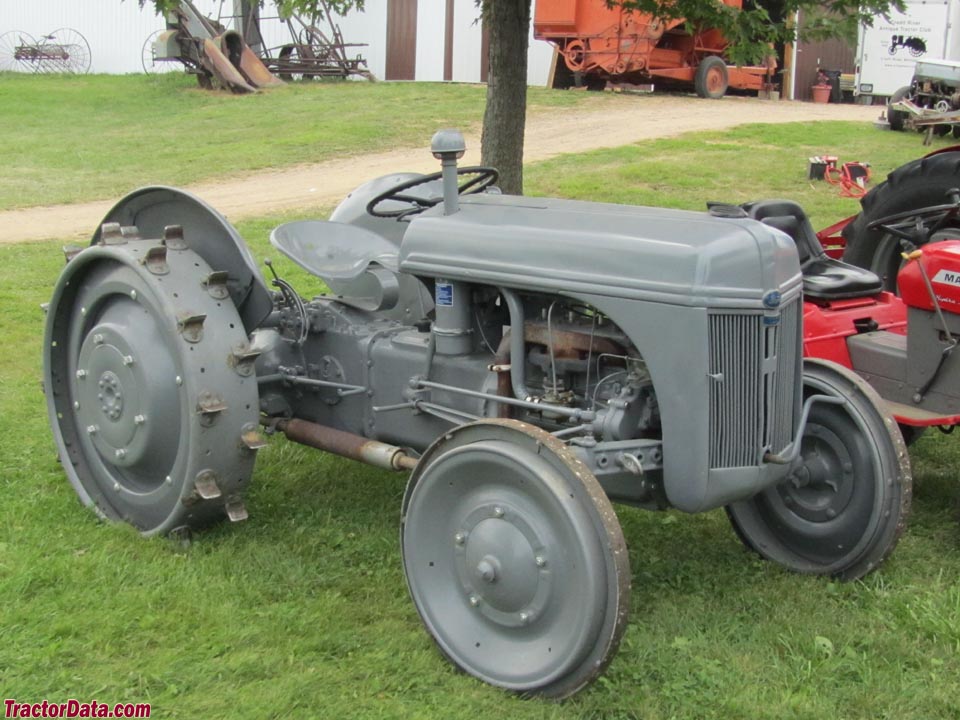
Numerous small changes and improvements had been made to the 9N, and with over 99,000 units sold, Ford re-introduced the tractor in 1942 as the 2N. Changing the name got Ford around wartime price controls, allowing him to raise the price to $1,120 (which Ferguson in turn had to begrudgingly pass along to his customers). Wartime shortages resulted in a number of 2Ns being produced with steel wheels and magneto ignitions with hand cranks. As material availability improved, later units reverted to rubber tires and battery ignition and starters.

The 9N/2N did their part for the war effort both on the home front (farming) and on the front lines, working on aircraft carriers and land-based airfields as the BNO-40 aircraft tug, of which about 10,000 were manufactured from 1942-44 (they are rare today). Cast iron plate around the front and rear, and more than 1,000 pounds of cast iron weights over the front and rear axles, brought the weight up to 7,250 lb. Four 6.50×20 rear tires, hydraulic brakes, an emergency brake and a few other modifications (such as a brass fuel-filler cap to prevent sparks) completed the conversion.

On the home front, 1941-42 Ford ½- and ¾-ton pickup trucks as well as panel and sedan deliveries were offered with a modified 9N engine as an alternate powerplant. In non-governed form, it made about 30 hp compared to 60 for the 136 cid (2.2l) V8 it replaced as Ford’s economy offering. The lack of horsepower was made up for by torque similar to the V8 (85 lb./ft. at 1,000 RPM), but these were not barn burners by any stretch of the imagination. Few buyers opted for the engine, which was removed from the options list after 1942.

Finally, about 4,500 modified 9N engines (rated at around 40 hp) went to war in early WWII “GP” model Jeeps manufactured by Ford.

Edsel Ford succeeded his father as CEO of Ford in 1919, but Henry continued to have a heavy hand in operations. When Edsel died in 1943, Henry came back to run the company, but by this time was in a poor mental state; after forcing his long-time friend Sorenson out in 1944 (perhaps somewhat fueled by jealousy over Charles’ fame), Henry himself died, in 1947, at age 83. FoMoCo was by now largely being run in a very heavy-handed manner by Harry Bennett, and it was only through an coup led by Edsel’s widow that he was removed and Henry Ford II installed as President.

Ferguson, meanwhile, had dissolved his partnership with the Sherman brothers in 1941, and had been actively shopping around 9N blueprints in hopes of finding someone to manufacture an improved version of the tractor in the UK. Ford UK had been unable to start 9N production before the war started, and now expressed little interest in producing the 2N there, post-war (in conflict with one of the points of the ‘handshake agreement’); they instead introduced the E-27N Fordson, with a 30 hp engine. Enter Standard Motor Company, which at this time had an empty 1 million sq. ft. ‘shadow factory’ in Coventry that had produced Bristol Aero engines during WWII. Managing Director Sir John Black was familiar with Ferguson’s dilemma, and set up a meeting in late 1945 at which Ferguson and Black agreed that Standard would have the rights to manufacture Ferguson tractors in the UK – in fact, anywhere except the Americas and Philippines – and Ferguson would have full control of design, development, sales and service.

The result was the Ferguson TE-20 (TE = Tractor England, 20 = a calculated hp rating based on displacement), with the first unit rolling off the line on July 6, 1946. Improvements over the 9N/2N included a four-speed transmission, grouped left and right brake pedals, hinged hood for easier service and a US-sourced Continental Z-120 OHV gasoline engine making about 22 bhp. In 1947, the Continental began to be replaced by the 24 hp wet-liner engine Standard had developed for the Vanguard car, which became the sole powerplant by July 1948. Only 315 units were produced the first year, but production of the “Fergie” quickly ramped up with 20,578 units made in 1947 and 56,877 in 1948. A total of 517,651 TE-20s would be manufactured by 1956, when the model was discontinued.

Back at Ford Motor Company, Henry II had his hands full sorting out the tangled mess it was in after his father’s death, and he soon realized that Ford had been loosing money (est. $25 million) on the 9N/2N tractors. Ferguson, on the other hand, had been doing quite well with his sales organization, netting US $4.3 million in 1946.
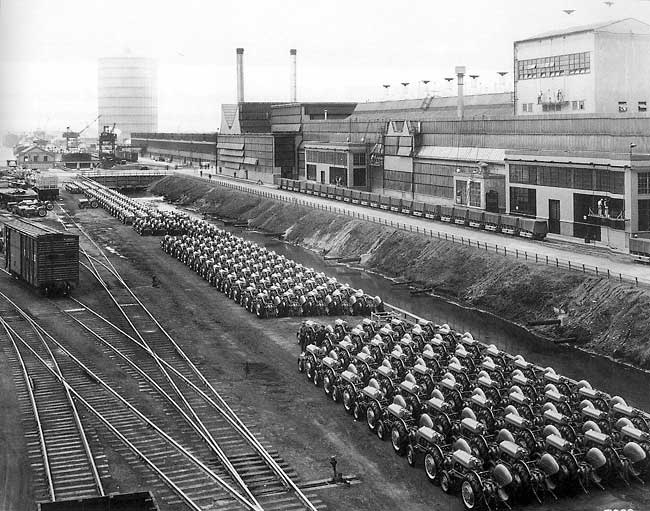
One of the first changes Henry II made was to move 2N production from the River Rouge plant to Highland Park, where a closer eye could be kept on production costs. He also had little appetite for Ford continuing to produce a tractor to be sold at a loss to Ferguson’s separate sales organization – especially with Ferguson now producing a virtual knock-off of the 9N in the UK. Henry II contacted Ferguson and proposed they either end the selling arrangement or Ford would have to enact a stiff price increase. When Ferguson demurred, Ford notified him in November 1946 that they would no longer supply tractors to his company as of June 30, 1947, and had his own team of engineers start on a redesign of the 2N. The Dec. 2, 1946, issue of Time reported, “In 1939 a shy, taciturn Irish inventor named Harry Ferguson made a deal with a shy, talkative inventor named Henry Ford… Last week young Henry Ford II announced that the seven-year deal was off. Neither Ford nor Ferguson gave a reason for the split.”

About the same time the first TE-20s were rolling off the line in Coventry, Dearborn Motors, Inc. was created as Ford’s new dealership system, selling and servicing Ford tractors along with a new line of proprietary implements – a number of Ferguson’s dealers immediately signed with Ford as a result. Ferguson, who now had implements but no tractors to sell in the US, undertook construction of a new tractor factory in Southfield, Michigan, not far from Ford’s Dearborn facilities. Until the factory produced its first tractor on October 11, 1948, over 25,000 tractors were imported from Coventry to the USA and Canada and sold as the Ferguson TO-20 (TO = Tractor Overseas). By the end of the year, production was up to about 100 tractors a day and by 1954, about 140,000 TO-20 tractors had been built.

Backing up for a moment, three weeks after the June 30, 1947 cutoff date, Ford demonstrated the new 8N to 300 guests at Ford’s Deer Lake Farms. 197,128 2Ns had been produced to this point, putting it in the top ten sellers of all time in the US. The new 8N offered a four-speed transmission, draft control and a few more horsepower, in addition to sporting a cheerful new red and light-grey paint scheme that would earn it the nickname “red belly.” Missing from the grille was the Ferguson System badge that had adorned all previous 9N and 2N tractors, although the Ferguson System itself was still very much intact (along with Ferguson’s patents).

Ferguson was undergoing health treatments in Switzerland at the time, but by November 1947 was well enough to travel to America. After having a look at the new 8N, he filed suit in January 1948 under American antitrust laws, claiming Ford had monopolized the market, and demanded three times the value of Ford’s business plus patent infringement on every 8N tractor already sold, for a total of $251,111,000 plus legal fees.
Depositions got underway in July, and over the next three months, 11,000 pages of evidence were recorded from Ferguson. In mid-1949, Ford’s legal team unsuccessfully filed that several of Ferguson’s patents were actually invented by Willie Sands, to which Ferguson replied, “stealing another man’s invention is one of the foulest things a man could do.”
Henry II then traveled to England late in the year to see if he could work out differences with Ferguson, but, no agreement being reached, returned home to begin giving his own deposition. By the fall of 1950, it looked like things were ready to go to trial, but proceedings continued to drag out, and it became obvious it would be many more months before the case went to the courtroom. By 1951, the TO-20 had become quite popular and Ferguson’s sales in the USA were around $65 million – the court subsequently dismissed the antitrust part of the claim, as it was clear Ford had no monopoly.

Finally, in April 1952, the two parties settled out of court with Ford paying Ferguson $9.25 million for unauthorized use of his patents and promising to change its tractor design to remove any possible further infringements. Many of Ferguson’s patents were set to expire shortly anyway, leaving Ferguson feeling Ford had drawn out the legal process on purpose. Later that year, Ferguson began shopping his company (but not the Coventry plant) to Massey-Harris.

Talks went back and forth, and Harry suddenly offered to sell all his agricultural businesses for $16 million, to which Massey-Harris President James Duncan immediately agreed. It subsequently was discovered Ferguson had interests in France worth another $1 million, but Duncan was at the limit of what he could offer. Ferguson suggested they settle the matter with a coin toss, which he lost. The coin was later mounted on a silver cigar box engraved with “The $1,000,000 Coin” and the inscription, “To our friend and partner Harry Ferguson, a gallant sportsman.” The merger of Massey-Harris and Harry Ferguson Ltd. became official as Massey-Harris-Ferguson on Aug. 17, 1953, and the company would shorten the name to Massey Ferguson in 1958. AGCO purchased the North American distribution rights to Massey Ferguson in 1993.

Ferguson would keep inventing until the end of his life, last focusing on the design of a four-wheel drive car, which he felt would improve safety. Once again, Harry found difficulties locating a company interested in building his design, so to promote the concept, he created the P99 “Climax” Formula 1 car in 1960, which would go on to have the distinction of being the last front-engine car to win at Formula 1. Ferguson did not live to see Stirling Moss drive the car to victory in 1963, having been found dead in his home of a barbiturate overdose in 1960, at age 76.

Ford would sell a total of 524,076 8N tractors in the prosperous post-war years, making it the top-selling tractor model of all time in the US. A completely redesigned “Golden Jubilee” NAA tractor that did not infringe on Ferguson patents would be introduced in 1953 with a 134 c.i.d. 32hp OHV engine and “live” hydraulics, and Ford would continue improving and expanding its line of tractors for many years; the final tractor model to carry the Ford name (that I am aware of) would be the 170 hp Ford 8830 last built around 1993.

The “red belly” would get one last hurrah in 2009, when New Holland introduced the “retro” 50hp Boomer 8N, based on their compact utility line of tractors. Not a big seller, it was discontinued in 2011.
Final Thoughts

These two men (who both had their flaws) were similar in so many ways, and were ultimately just what each other needed at that moment in history. The Ferguson System design is used on the vast majority of farm tractors today, and while accidents still happen, one can make a strong argument that thousands of lives have been saved by this one invention. Certainly, the productivity of farming was vastly improved by these series of tractors. Both ‘Fergies’ and ‘Red Bellies’ are warmly loved in their respective homelands, and many of them survive today, easing the burden of those who till the soil each season.
Author’s Note

My father purchased a 1952 Ford 8N when I was about 12 years old and rebuilt the engine in our back yard. He put me to work at age 14 breaking and discing three acres of ground, plus mowing our 12-acre farmette. He sold the tractor a few years later when I was sixteen.

A quarter-century later, I bought a 1950 8N prior to purchasing our farm here in the Middle West. After a few years, I, too, rebuilt my 8N, which seems to be happy working hard year-round.

I’ve been wanting to write this story for quite some time, and it turned into a bit more of a novel than I anticipated… it’s likely I munged a detail here or there (and sources sometime disagreed on dates, etc.), so feel free to correct or shed additional light in the comments.
Sources
Ford N Series Tractors Originality Guide (Peterson, Jr./Beemer, MBI Publishing Company, 1997)
Harry Ferguson: Mechanical Genius (Brooks, Farm Collector – www.farmcollector.com)
Harry Ferguson (www.ritchiewiki.com)
From the Tractor Seat – MOM Tractors (Missy, www.ford-fordson.org)
Harry Ferguson Legacy – Brief Life Summary (harry.lin02.servers.tc)
Ulster History Circle – Henry George (Harry) Ferguson (www.ulsterhistory.co.uk)
Vintage Ford Tractors (Pripps/Moreland, Voyageur Press, 1997)
Heritage Moment: Ford Begins Tractor Production at the Rouge (@FordOnline – www.at-ford.com)
Harry Ferguson – The Man and The Machine (Yesterday’s Tractor Co. – www.yesterdaystractors.com)
The Big Book of Ford Tractors (Brock/Pripps/Moreland, Voyageur Press, 2006)
1939-’49 Ford-Ferguson 9N (McNessor, Hemmings – www.hemmings.com)
Fix That Ford – Ford 9N & 2N Tractor Parts (www.fixthatford.com)
Ford N-Series tractor (Wikipedia, en.wikipedia.org)
Wessels Living History Farm – Farming in the 1940s (www.livinghistoryfarm.org)
Origins of the Modern Tractor (Dingley Dell – tractorblogger.blogspot.com)
The Ford Ferguson Tractor (Moore, Farm Collector – – www.farmcollector.com)
The Forgotten History of Automaker Tractors (Wojdyla, Jalopnik – jalopnik.com)
Henry Ford: 150th birthday of a controversial American icon (www.readthespirit.com)
Ford 9N, etc. (TractorData – www.tractordata.com)
Ford 9N, 2N, 8N Forum (Yesterday’s Tractor Co. – www.yesterdaystractors.com)
1940-1941 Ford Half-Ton Pickup (How Stuff Works – auto.howstuffworks.com)
1941 Ford Pickup (Donnelly, Hemmings – www.hemmings.com)
Early Ford V-8 Club Forum (The Early Ford V8 Club of America – www.earlyfordv8.org)
1943 Ford Ferguson 9N Airplane Tug (Estrella WarBirds Museum – www.ewarbirds.org)
Ferguson20build (ferguson20build.com)
Grey Ferguson Tractors Pool (www.flickr.com)
The Ford-Ferguson Story – Short Version (Daley, N History Forum – www.ntractorclub.com)
Ferguson Family Museum (www.ferguson-museum.co.uk)
Ferguson System Principal and Theory of Operation (Yesterday’s Tractor Co. – www.yesterdaystractors.com)
Three-point Hitch (www.ritchiewiki.com)
Three-point hitch (Wikipedia, en.wikipedia.org)
Three-Point Hitch (TractorData – www.tractordata.com)
Ferguson-Brown Type A Tractor 1936 (Vintage Tractors – tractordata.co.uk)
Beyond the Model T: The Other Ventures of Henry Ford (Bryan, Wayne State University Press, 1990, 1997)
Fordson tractor (Wikipedia, en.wikipedia.org)
Ministry of Munitions Tractor (Moore, Farm Collector – www.farmcollector.com)
The Field Guide to Ford Tractors (Pripps/Morland, Voyageur Press, 2007)
The REAL Fordson (Heald, Gas Engine Magazine – www.gasenginemagazine.com)
Fordson Tractors, ca. 1917 (National Film Preservation Foundation – www.filmpreservation.org)
Time Magazine Archives (content.time.com)
Four-wheel drive in Formula One (Wikipedia, en.wikipedia.org)
Tractor Production Numbers (www.antiquetractors.com/Research/prodnum.htm)
Danger In The Fields: Tractor Rollovers (Gehlhausen, www.tractorlaw.com)
Economic History of Tractors in the United States (White, Economic History Association – eh.net)
Traumatic Injuries in Agriculture (National Ag Safety Database – nasdonline.org)
Farm Safety (U.S. Department of Labor – ehs.okstate.edu)
Ferguson TE20 (Wikipedia, en.wikipedia.org)
Ferguson tractor serial numbers (www.oldengine.org)























Great read thanks, a friend of mine has a 47 Ferguson one of the first with a Standard engine it still uses the Continental bellhousing #1600 or so he also has and uses a Fordson Dexta diesel which is a near mirror image of the later Ferguson 35 which he also has some of for comparism Ive looked, Ford got around those patents ok and kept making tractors, 57 35hp in front the 47 in back with incorrect red bonnet the 47 is unrestored but complete and running well.
There was all sorts of modifications available for the Ford 8N/9N tractor. I’ve seen bench seats and offset steering wheels. I’ve seen flathead V8 motors installed. I’ve seen full fenders front and rear. I’ve seen 8 speed transmissions. I’ve seen small race-car-like bolt-on windshields and front bumpers.
With the Fergy you can swap the cylinder head twin carbs and manifolds dizzy etc from a TR2/3 Triumph sports car but having driven a 35 Fergy as fast as it will go a souped up one would be scary in the braking and steering departments but yeah Ive seen a few V8 conversions done too.
Perhaps the ultimate 8N mods…..
http://www.oldfordtractors.com/funk.htm
well, I saw one pic at your link with a bench seat but no offset steering wheel. I cannot find any pics on the internet of an 8N with a full set of fenders. I like the 6 cylinder conversion. I do not remember seeing that before.
Here you go. These were aftermarket “orchard special” kits to prevent the tires from damaging low hanging fruit.
I find it necessary to point out that orchard tractors later became factory options, usually a Standard or Low Utility with an orchard cowling. One of the largest and (given my preference for the New Generation) the most handsome was the JD 3020.
I had heard that the TR2/3 engine was basically a tractor engine. Looks like that turns out to be true. Ed did a terrific job with this easy to read history lesson. Very well done.
I could write a whole ‘nother long article just on N Series implements, accessories and mods! Marv Baumann (link) is well known in Ford “N” circles – he’s done around ten engine swaps in the 8N, including a turbine-powered N. Funk conversions were popular back in the day, as were flathead V8 conversions – a number of kits were available to enable both.
“I could write a whole ‘nother long article just on N Series implements, accessories and mods! ”
I wish you would.
I am especially interested in the mods that make the ford N appear more car-like and road-worthy at speed in inclement weather. LIke I stated earlier, I’ve seen ’em with front bumpers, a bench seat, windshield, and full fenders.
My Ferguson owning friend has quite a few accessories implements and other stuff for his tractors one of the wrecks he intends to scrap has a rotary hoe transmission which will be saved he has a couple of NZ designed fixes for the hydraulics too
The first wheeled vehicle to reach the South Pole was a Ferguson tractor driven by Kiwi Sir Ed Hillary, his convoy was fitted with track kits and rudimentry cabs.
As a small clarification, the idea of the “Formula Ferguson” 4WD car was not actually Harry Ferguson’s, although he did agree to bankroll the project in 1950 and was enthusiastic about it. The concept came from former racing drivers Tony Rolt and Freddie Dixon, who went to Ferguson and convinced him to help them develop the idea. After Ferguson died, his successor, Tony Sheldon, eventually decided the project wasn’t going anywhere and sold the research company to GKN around 1970–71. (Rolt, incidentally, was co-inventor of the viscous coupling.)
Another automotive tie-in to this story is that one of the engineers involved in developing the transmissions for Ford’s tractors was Howard W. Simpson, who later invented the “Simpson gearset” used in many automatic transmission (including TorqueFlite and the THM).
Ed, what a tremendous piece of work! I had long been curious about the specifics of Ford’s early tractor business, and you have covered it in a definitive way.
My maternal grandfather grew up on a small farm in northwest Ohio. His heart was more into mechanical things than farming, and was quite skilled with machinery. My mother recalls that he had a Fordson tractor in the 30s, which got him out of the horses, which he detested as well. At some point, he replaced the Fordson with an N series Ford, but I’m not sure which one. The N was his sole tractor until he was forcibly retired by poor health at about the age of 56.
Modern farming requires so many vehicle, including tractors and combines that run into six figures. My grandfather did it all with a Ford tractor and a hitch-equipped sedan. 2 tractors and 2 sedans (35 Ford V8 and a 51 Kaiser) got him through his last 20+ years of farming.
It was not uncommon for a farmer to run ~400 acres with a pair of Ns. I plowed down 11 acres of corn stubble a few years ago (putting alfalfa hay back on the field), and it took me two weeks to do it, plowing a few hours every night after work. My rear was quite sore from that steel pan seat (not to mention half-frozen, given I did this in late November) – farming today is a completely different animal. You basically sit in a cab that’s nicer than your luxury pickup, push a button, and let the GPS take over. Personally, I like to smell the freshly turned earth!
Here’s a video I made doing all that plowing: http://youtu.be/etG9mR6O21U
Great video!
My sole correction to your article: definitely worth two cups of coffee. 🙂
Wow, Ed, that was magnificent! This site is what got me interested in tractors in the first place and I’ve really enjoyed seeing the Fords over the last few years in various settings, this article really explained their significance and popularity. Thank you!
A spectacular post, Ed. Answers many questions I’ve had over the years about the Ferguson-Ford connection.
That was excellent. Like most that will read this, I knew nothing about the history of the 2N/8N but was around one in my childhood. Very interesting read–thanks!!
From Gun running for the UVF to having Henry Ford use his Patents, without permission
What can I say..There IS justice in this world after all !!!!!
Ed, my compliments, what an interesting read !
Two of my second cousins run a dairy farm and as long as I can remember they are very loyal Ford tractor owners, although my family and relatives are all Catholics. That needs some explanation….Until roughly the mid seventies Catholic farmers mainly drove (German) Fendts and Protestant farmers drove Fords, due to geografic and historic reasons. From the east (Germany) to the west (North Sea) there’s a river delta in my country. Wide rivers, with just a few bridges to cross back then. South of the rivers was Catholic area, north of them was Protestant area. And the Fendt importer and dealers were down south, while the Ford dealership was up north. So there you go.
Meanwhile this has all changed of course. Although recently I’ve heard of a very strict Protestant farmer who still refuses to buy seeds coming from Catholic growers.
Anyway, my second cousins still have two Fords that still work hard, daily. A 4WD 8000 series and a much older 2WD 4000 series. The smaller one has just a rollbar and steel roof, no full cab. I remember they bought the 8000 series new, that must have been at least 25 years ago. Very neat, bright blue and white and with a roaring 6 cylinder diesel. Especially when it’s pulling a plough through the clay.
New Holland, still blue and white, is a very popular brand right now. New Holland (just like Case and Steyr) belongs to the Fiat Group and uses Fiat powerplant components, known as FPT.
Their yellow combines are also very renowned, I believe these are built in Belgium.
Fascinating side-story, Johannes – thanks for sharing it! Funny how something as simple as geography (a river) can impact how people bought product.
So, it’s kind of like Krebsbach Chevrolet and Bunsen Motors (Ford) in Lake Wobegon.
Here (USA) New Holland is red and yellow, or at least haying equipment is.
I bale with a 1950s New Holland 68 Hayliner (red and yellow once upon a time).
It’s rather fascinating to see that tractor brands all have their own colors, often used many decades in a row.
Say “Ford-blue” and everybody knows exactly which shade of blue you’re talking about. John Deere, Fendt and Deutz-Fahr are all green, yet in the brand’s typical own shade. Although recent Deutz-Fahr tractors have a lighter and brighter shade of green than the old air cooled Deutz tractors.
Hmmm…reading what I just typed it looks like some light case of professional deformation.
The tractors are blue and white, which was a pick up from the later Ford livery. I do like that little retro tractor, though it would be a tight fit in my Brooklyn apartment!
NH’s implements are red and yellow – New Holland is in the middle of Pennsylvania Dutch Country, and they did a big business in manure spreaders, amongst other things – and they could be pulled by tractor or team.
Ed – fantastic article – you’ve filled in a some big gaps in my knowledge, especially on the Ferguson side. One question – after Ford stopped producing Fordsons in the US, I believe they important some each year from Cork for loyal customers and dealers. Is that the case?
Yes, Fordsons were continued to be imported from Cork after 1928, but were limited to 1,500 a month. The Sherman brothers were the leading distributor in the US.
Interesting side-note, a lot of 9/2/8Ns were repainted blue and white after Ford changed the color scheme. The thought is that dealers did this to help resale value on used Ns. My ’50 was blue and white when I bought it (and had at least 4 layers of paint under that!).
Fergusons sent in to the dealers for servicing were often returned with red bonnet and guards after the tie up with Massey any trade ins were repainted so where my Father worked and resold as Massey Fergusons.
I laugh whenever I see a Ford tractor like the one on top. When I was 13, I messed around with a tractor like that at a stable with nobody around.
What a great article–I have a few customers who restore tractors as a hobby maybe I know something they don’t now
Amazing story, thanks for sharing!
Ed, this is a top-notch article. Thank you!
Your top photograph I have seen in the metal on numerous occasions while growing up. My great-uncle had an old Ferguson tractor; it was built in the late ’40s to very early ’50s so I suspect it is one of the TO models.
My father had three Ford tractors while I grew up. I’m not sure of the models, but he kept upgrading from a 3 speed to a 4 speed to the 5 speed he has now had for nearly 30 years. The 5 speed was built in the late ’50s; the previous one was so close to the Ford in the top picture.
The Ferguson is still around in the possession of an uncle who still uses it with some regularity. The resemblance between the two always had me curious and it is only now that I have learned the story about these two terrific tractors.
Well done!
I have to ‘lift the curtain’ and confess the lead image is a photoshop – the 8N and farm are mine (separate photos), but I had to find a Fergie shot from just the right angle to make it work. It’s a play off the movie poster for When Harry Met Sally.
Although my Dad is John Deere salesman and gave me my dyed in the wool enthusiasm for all things John Deere but the extended relatives (who were all quite elderly given that my grandmother was the youngest girl in a large family) had small 40 acre farms that they were working more out of habit in their retirement than a job.
They had a collection of Ford N, Fordson, Farmall, and Allis Chalmers tractors. I appreciate the rugged simplicity of Ford N-series tractors and they are still most likely to be the one I’d buy to have antique tractor around to work hard and admire. Looking at NM Craigslist the N-series aren’t that hard to find.
One of the best resources to use if you’re considering buying an N Series is John Smith’s “Old Ford Tractors” site (link). Like any old vehicle, fresh paint can cover a multitude of sins, and John’s info helps you know what to look for. John lives about 30 minutes from me, and his restored tractors and cars are Pebble Beach level work. I’ve bought a number of parts from him to keep my ’50 8N running.
Wonderful write-up Ed, it fills in some of the engineering pieces I had not known. My fondness for this machine dates back to my first tractor-driving job, driving the hay fork rope to lift bales of hay into my uncle’s and father’s barns during haying season. The Fergusen system on the Ford tractor pulled so far above its weight that Fords outsold other tractors until the first tractor horsepower wars in the mid-fifties. I think everyone should learn how to drive a manual shift vehicle on a Ford Model 8N. They are also quite simple machines and relatively small, so someone who wants to get into the tractor restoring hobby can easily start out on an 8N.
One nice little piece of history I can add is that the original “Fordson” name came about when a small manufacturer had previously used the Ford name for their own, inferior machine, and Henry had to use something different for his own tractor. That other Ford tractor was purchased by a Nebraska legislator, who was so disappointed in its performance than he co-sponsored the bill that authorized the formation of what became the Nebraska Tractor Tests, which have since certified the performance of all tractors sold in this country.
I taught our niece how to drive a manual when she stayed with us over the summer a few years ago, and started her out on the 8N.
Great write-up. My first tractor ride ever was on the back of an N, when I was eight. The following year I started driving it, along with the other tractors at the Yoders’ farm. The N felt like a sports car compared to the big row-crop Farmalls.
The three-speed was a bit limiting; I was crimping hay, and second was too slow for me, so I put it into third (meant for the road only), mighty fast and bumpy, with the crimper bouncing around out back. Mr. Yoder was surprised when I finished so quickly. 🙂
I tried raking hay in fourth on my 8N once and had I had fillings, it would have rattled them out in one pass around the field. Not to mention it knocked all the leaf off the hay (the part you want to keep).
A friend has an 8N with a Sherman “step up” transmission that will do around 22 mph in “high-high” gear. On an 8N, that’s “Ludicrous Speed!”
Excellent and well researched article Ed. Surely business deals with handshakes and coin tosses are a rarity today.
I’m still a bit unclear on how the three point hitch prevents the tractor from rotating back if the plow strikes a rock. Looks like the two lower points are below the centerline of the back axle, and the pulling force would create a moment that would push the front wheels down. But in the case of a rock strike would the upper link go into compression, which would counteract the rest of the overturning moment?
But in the case of a rock strike would the upper link go into compression, which would counteract the rest of the overturning moment?
Correct. The reason the tractor wants to flip over (despite the pulling force being beneath the CG) is that, if the rear wheels have good traction, the force trying to turn them has to go somewhere. When the wheel can’t turn (because, traction), that motion is imparted back through the axle to the tractor itself and it flips. The three point linkage also works to lift weight off the rear wheels when an obstruction is hit (top link in compression as you noted): less traction results and the wheels spin. No flipover. Conversely, the hitch also puts *more* weight on the rear wheels when it is pulling smoothly, which is why you can run a two-bottom plow with a 25hp, 2,400 lb. tractor. 85 ft.lb. torque helps, too!
EDIT – I was going to add that it’s a common safety practice when first moving a tractor in below-freezing weather to back up a foot or so first in case the rear wheels have frozen to the ground (which would potentially cause a flip-over if you tried to go forward first).
Great, thanks.
My farm experience is limited to detassling hybrid corn for a few summers, I’ve never driven a tractor…
You have my sympathy. Not a fun job!
Right at the end of your plowing video you can see the plow “sliding” over a slight obstruction, with the hitch articulating up and the tractor remaining level-maybe that will help people to see how elegantly simple a solution the 3-point hitch was (and thus, so difficult for other manufacturers to find a way around). If the tip of the plow caught an obstruction, the force would be transferred to the top link and push the tractor down. The 8N was small enough that if this happened you would just bog down. Then you would just stop, lift the plow, back up, set the plow back down over the obstruction, and keep going. Drawn plows eventually had a trip mechanism on the tongue of the plow, and later mounted plows had trip mechanisms on each plowshare for this, and even automatic hydraulic re-set mechanisms. Much less jarring. And chances of you breaking a hydraulic line on a drawn plow before you could stop. That was a mess.
The 2N was a notorious flipper in part because the tow bar was relatively high and close to the centerline of the tractor axle-putting it in a good position to allow the tractor to rotate about its axle. Other tractors compensated by attaching their tow bars lower and further back, but they still had to rely totally on the weight of the tractor over the drive wheels to provide traction to a trailing implement. The 3-point hitch converted plow drag into downward pressure over the rear wheels-why you don’t see old Fords with wheel weights, they didn’t need them. One of those win-wins that, when you look at it you think why didn’t I think of that. But that’s why they call it genius-to see a solution that is is right in front of you that other people can’t.
Ed, we need to get you a seat cover and a Heat-Houser for the Ford, so you can go out and plow in the Fall again! The Fordson had a worm drive rear axle that ran hot, so at least your seat was warm; the 8N, not so much.
What a well-researched (and brilliantly edited) article! OK, stupid question–maybe I missed it in the article, but is this the same Ferguson company that supplied 4WD for the Jensen Interceptor FF?
LOL! Yes, on this being the same Ferguson: http://en.wikipedia.org/wiki/Ferguson_Research
I had the exact same thoughts about both the quality of the article and the FF system used in the Jensen Interceptor.
Ferguson’s impact on the automotive industry was impressively far-reaching. I knew about Ferguson/Massey-Ferguson tractors, the Fordson/Ferguson connection, and the Ferguson FF system, but for some reason never connected them to the same person!
And the Ferguson Formula Mustang with full-time AWD and ABS !
http://hooniverse.com/2009/12/14/the-ferguson-mustang-ff-awd-and-a-427/
Speaking of Ferguson four-wheel-drive, perhaps the oddest Ferguson tractor ever, the Ferguson Dual Drive TED40. Although not the handiwork of Mr. Ferguson, it did utilize two of his fine machines.
…same concept, the (Ford) Doe 130, built by Ernest Doe & Sons from the UK.
Fordsons were configured that way back in the 50s with the diesel Super Majors that mid 60s F5000 model is merely an update.
I did some searching on the web. In the fifties farmer George Pryor from Essex (UK) built a “double tractor” based on 2 Fordsons. Ernest Doe & Sons had a Fordson dealership and built an improved version, also based on 2 Fordsons (Power Major), and that one was introduced in 1958. Later they used 2 Fords 5000.
Yup. These are all pretty wild, but I understand that they worked very well in the era before four-wheel-drive tractors were widely available from the manufacturers. Of course the downside was twice as many engines to maintain and higher fuel consumption, although I suspect that relatively cheap gas or diesel back then made that less of an issue than it is today.
That’s right Gene, these were built to gain a lot of power and traction.
As a kid I was always very impressed when I saw a mighty Ford County model. Below one of the last Counties. The ones I saw in the seventies were the older ones, still with the rounded rear fenders, without a cab. Used back then in earth moving.
That’s quite the beast, Johannes.
Taking a turn.
That’s the stuff, Johannes. 😀
My uncles and I are looking at doing this with 2 case dc tractors. i was wondering if you had some detailed pictures of the 2 tractors attachment and such. if you have any information on the details of these
John, I don’t have any detailed information. The tractor is called the Doe 130, built by Ernest Doe & Sons from the UK, as mentioned above.
A bit of Googling / Google Image Search might help you further.
I ran across the TED40 in my reading – fascinating… this article could easily have been three times as long, there’s so many side stories that go along with both Ford and Ferguson.
Proof that farmers are darned resourceful.
Yes; Tony Rolt and Freddy Dixon got Ferguson (one of them knew him, I gather) to set up a research company for them. Rolt and Derek Gardner of Ferguson later invented the viscous coupling, used in many later AWD systems.
Thanks to that small 2009 retro Red Belly tractor I remembered the special 1989 Ford 7810 Silver Jubilee edition. In that year Ford had built tractors in the UK Basildon Essex plant for 25 years.
They made only 500 of them. Not very popular back then, some dealers even repainted them in Ford blue ! Now, of course, this Jubilee edition is a collectors’ item.
I’ve only see such a silver Ford once so far, many years ago. It towed a silage trailer.
Nice! The Boomer 8N is only ‘retro’ tractor ever made, to my knowledge.
I just learned that in the same era as the Boomer 8N, New Holland also had an F480 model. Inspired by the old Fiat 480 model and in the classic Fiat colors: orange, white and brown. It even has some sort of retro-looking seat, just like the Boomer.
Cute little tractor. Used by fruit growers and horticulturists I assume.
Very neat!
It’s only logical that, 25 years later, a Golden Jubilee edition was also introduced.
http://agriculture.newholland.com/uk/en/WNH/whoweare/Pages/Golden_Jubelee.aspx#gallery%5BWebPartZone2_0%5D/1/
(With a nice video !)
As I mentioned above New Holland is all Fiat. I don’t know if CNH machinery is also available with Cummins power in North America.
Neat! No so much ‘retro’ as giving a nod to the 1953 Golden Jubilee… needs one of these badges:
That badge alone is already a collectors’ item ! Really neat.
I went to New Holland’s USA website. I clicked on several big and small farm tractor models and I only saw FPT (Fiat Powertrain Technologies) engines.
So I assume CNH only uses their own powerplant components worldwide. Vertical integration so to say.
There are just a few major global players in farm tractor land. So just like in trucking a few big guys rule the world.
-John Deere.
-AGCO Group (Fendt, Massey Ferguson, Valtra, Challenger).
-CNH Global N.V. (Case IH, New Holland, Steyr).
-SAME Deutz-Fahr (SAME, Deutz-Fahr, Lamborghini, Hürlimann).
So at least the name Ferguson is still on the tractor, unlike Ford, unfortunately.
Really great article with compelling research. I saw all of these names growing up in farm country and you let me link them all. The similarities between the Ford and the International cub at my place are striking. The Ferguson linkage, not at all.
I guess these are free of the ravages of road salt so we will probably see them for years. If you read farm show magazine you can see all sorts of alterations still paying for themselves. The most striking that I remember was a Ford tractor with a Buick V6 (3.8) engine conversion. Probably enough variety there for another article.
Really good job.
Here’s one with a flathead V8, tilt hood, duals and 4WD assist. Probably won’t be doing much plowing, though!
Wonderful article Ed.
When tractors replaced livestock for motive power, it increased the farmers income by at least a third overnight. A 600 acre farm would have 100 acres for pasture to feed the animals during the growing season. Another 100 acres grew the winter feed that was bailed and stored.
Sell off the live stock, now you have the whole 600 acres to plant. This caused a glut of food in the US in the 1920’s and into the ’30s. Of course the price paid the farmer crashed, so he wasn’t doing any better than when he had the animals…but for a short time it was great..
Yes. And now we are at the point where if we tried to return to animals and purely organic crops(like the Amish) there would not be enough arable land to feed all of them and all the people. You have touched one of my nerves. I get sick of the ignorant arrogant do-gooders preaching their perceived superior opinions regarding food and the environment.
My grandfather had an old Ford tractor (I want to say an 8n?) that he passed down to my father. The tractor was equipped with a loader, and was from all accounts a nice compliment to the International Harvester Farm all 656 that we still use. Apparently it was a fairly light little tractor, and actually trying to use loader attachment could prove problematic… My father has a few fun stories about that old tractor! Sadly, by the time I came along, the old Ford had fallen into disrepair, and didn’t run well at all. My clearest memory of it was the year it spent in our repair shop with the engine torn apart. I believe my father finally got tired of working on it, so he sold it to a neighbor down the road. Last I knew the tractor had been fully restored, and the red and gray paint made for quite a looker of a tractor. At least this story has a happy ending, right?
Growing up in suburban Detroit in the late ’70s, I worked Summers on a four-man crew whose job was to take care of all the baseball diamonds in town — about 15 to 20.
On days that followed rain, two guys would divide up the diamonds and go out on successors to the 8N, which were Ford 2000s.
We would loosen up the infield with a Super Gill Pulverizer
Let the wind and sun dry it out for awhile, then go back in the afternoon and smooth it by dragging a grate behind the tractor. There was a real trick to knowing when the infield was too soft to get on, how tight to make the circles while pulverizing, how to avoid standing water and buried base pegs, and so on.
The tractor was great. Fast enough in 4th gear to get from one diamond to another on city streets, 3rd gear for “beating up” the wet ground, 2nd for dragging.
Thirty five years later, I could go back and do the job tomorrow. You never forget the perfect summer job :^)
BTW the other two guys would go around and chalk the 1st and 3rd base lines. On the diamonds the little kids played on, we used to see who could make the lines the straightest without a string line.
Ed, great writeup, you hit home with me. I grew up on a dairy farm in eastern Pennsylvania. Dad started farming with a 1948 Ferguson TO-20. I vaguely remember a Ford N series which he traded in 1960 for a new Ferguson 35 Deluxe which was the main tractor for many years. Both Fergusons were kept throughout his farming tenure until retirement. He added a used International 504 to the fleet in the late 60’s. I grew up riding with him and later learning to drive the 35. The 35 had a silver decal on side of the hood proudly proclaiming The Ferguson System. Dad gave me a brief overview of the system but your article really explains it in depth. Thanks for the memories,
Wow. Just wow. A fascinating story, and well told Ed. Thanks very much for taking this on! A terrific read.
Thanks for the 2N pics you sent so long ago – sorry it took so long to finally use one!
My father had an 8N that was his pride and joy. He even received a monthly 8N newsletter. He passed away 3 weeks ago and the tractor is sitting in the garage next to my 1921 Model T. I guess its mine now, though I don’t really have a use for it. Its funny that he had plenty of money, but he liked his 8N in beat-up (patina’d) condition. Although its mechanically sound, I guess I could restore the cosmetics. That’s a reason to keep it!
This is a great article. I’d heard parts of the story before, but this brought it all together for me. I wish I could have emailed it to my dad, he would have enjoyed it.
Neat story – thanks for sharing. If you decide to use or restore your Dad’s 8N, head over to the Yesterday’s Tractors 9/2/8N Forum (link) and lurk a bit or ask questions.
While I restored my ’50 8N, I borrowed another ’50 from a “real” farming friend who mainly used it to move hay racks around. It was definitely “patinaed!”
My friends tractors are in as used condition only the gold/grey 35 appears restored because it was aquired after it caught fire, One of the few faults Fergy Teas TOs etc had was the fuel tank above the engine, Flat lander farm boys like Harry and Henry clever though they might appear missed a crucial thing called hills and on hills the gas will leak from the filler cap and run down onto the hot exhaust or magneto distributor what ever and boom up she goes Trevor, A fix was locally engineered and fitted to the majority of these machines consisting of light gauge steel angle pieces sweated to the outer edge of the fuel tank which directed fuel drips away from the engine not all tractors were retrofitted especially on flat going like where I currently live though in the region where I grew up almost every Fergy was done due to the hilly going, Mt dad was company secretary of a Fergy & GM dealership his theory was the cost of doing every tractor was poopooed by Henry always the cheapskate he knew of the potential problem through the design deficiencies on the Model A he had to rectify before production but the aftermarket fix was done by the dealers free of charge.
What an excellent, well-written article–even to a city boy like myself!
Ed,
Great story great writing.
+1
Totally understandable to this citykid with uncalloused hands. Totally epic in scope and personal in detail. A thoroughly great read. What an accomplishment Ed.
Ed, thanks for this. I grew up in a rural town in Israel and these – and the slightly later Fords and M-Fs – were everywhere. One of the other schoolkids’ dad had a yellow (industrial) M-F 135 (?) and for a laugh they changed the gearsets so that the thing was capable of a terrifying 35 MPH… The first sportstractor, I suppose. And yes, farming life was very different back then – my grandpa had orange groves and I remember dad’s stories well enough to appreciate what back-breaking work it was (even for those who had a tractor); my father had to give that up after being injured during Israel’s War of Independence – there way no way he could run the groves with his type of injury back then. Nowadays it would be a very different matter, what with all the automation we have…
Thanks, Ed!
I had my “cuppa” and the most interesting and educational read of the day.
Another interesting photo I found researching this article…
I wonder did Fiat build a version of these, or just something very similar?
Fiat launched its very successful 25R tractor in 1951. As far as I know there’s no direct Ford-connection.
I found the photo here:
http://kyronmaanwanhatmasiinat.blogspot.nl/2013/10/fiat-25r-entisointiprojekti.html
GREAT article, Ed. I was always curious about the nuances of the relationship that led to this unique business relationship.
Here’s my 1956 601 that still enjoys working for a living.
When Henry (Junior) said adios to Harry. Must have been frustrating to Harry when over 500,000 were produced between 1947-52…
This article led me down a path that became something of a lifestyle change. I have since rebuilt the engines of two 8Ns, worked a 9N in a number of capacities from plowing to mowing and recently traveled all the way to Florida to rescue a 1950 8N from being sold for scrap. Thanks, Ed!
Awesome! My work here is done… (c:
Terrific article, thank you. My dad bought a worn out 1949 Ferguson TEA 20 in 1974 for our hobby rural property. This poor thing needed an overhaul, as it had excess blowby, low oil pressure, slipping clutch, and rotting wiring. I swear it had never been washed and had years of caked on oil and grease.
I started work on it as a kid, replacing the water pump, engine bearings, and converted it to 12 volt. Later I found the differential gear set was smashed, a mess of broken internal webbing, broken gear teeth and shards of metal. I patched it up best I could and parked it. The tractor needed so much repair it was virtually worthless as-is and beyond my teenage means. I eventually gave it to a friend as a project.
As a kid I enjoyed comparing the Ferguson to a neighbors 8N, as they were obviously identical or so similar in many respects. Years later I bought my own 8N as a restoration project. It’s pleasant because everything one could possibly need, all parts and information are easily available.
Thank you for apiece of history so eruditely presented. As one not familiar with farm equipment, this is quite a comprehensive introduction to two great men in the field.
What a piece of work, Mr Ed. Belated congratulations to you. I knew a bit about Harry Ferguson before, but only vague notions about the link to Fordsons. I just thought they looked similar!
The Fergies were a bit hit here in Oz too, and they’re still very much in use. I attach a link from 2019 to a newspaper in country south-west of the State of New South Wales (an area called the Riverina district, think lots of iririgated fruit production in pretty dry flatlands). Note the numbers still in use on some farms 60 + years on – mind boggling!
One curiosity is the engine in the Fordson being closely related to the V8: I wonder why it’s not crossflow also?
https://www.riverineherald.com.au/lifestyle/2019/03/30/511317/grey-fergies-in-for-the-long-haul
I wonder why it’s not crossflow also?
How could a side-valve (flathead) engine be crossflow? Well, I guess you could call a T head engine crossflow, but those went obsolete pretty early on.
The Ford V8 was decidedly not a crossflow. The exhaust valves and ports were right next to the intakes, but then the exhaust ports snake around the cylinders to the far side of the block, and exit there. The center port is siamised and tunnels through the block between the two middle cylinders, heating them in the process. That in essence is the whole thermal management issue with the Ford flathead V8.
The other two exhaust ports tunnel in front and behind the front and rear cylinders, which doesn’t exactly help matters.
Cadillac had it right, putting the exhaust manifold in the center along with the intake on their fathead V8s. But that made the manifolds a bit complicated too.
Yes, I’ve misunderstood “machined on the same line”: ofcourse the block itself can’t be half the V8 (though it looks like that WAS done in the early ’60’s with the oddball Pontiac Trophy four). And crossflow is indeed the wrong term, as I was thinking of the carb on one side and exhaust on the other in the V8, but the gases hardly flow across the chamber in that engine!
So valves, pistons, cylinders, bore-size (maybe) and probably even the head shared, but not the block itself, and that last is my basic error – forgetting that porting MUST be in the block on a side-valve. Makes sense that all that could be done on the same line.
I’m not an expert but looking at the engine blocks, it’s quite clear that the tractor four is very similar to half a V8, and has the same cylinder spacing and other characteristics. It just doesn’t have the ports that snake around to the other side.
Here’s the tractor block:
Here’s the V8 block.
But it seems you’ve already figured it out: unlike an ohv block, the ports are cast into the flathead block, so clearly they’re different. But it’s not hard to change certain aspects of the casting. And clearly these tow engines are very much related.
The center exhaust port is quite visible in this shot.
I admit to knowing very little of the history of Ford and Ferguson, knowing a little more about Standard and Ferguson.
But what a tale, and what a telling of it. Terrific, and on the re-read list. How did I miss this in 2015?
Thanks Ed – great work.
I enjoyed this article very much. It brings back old memories. I have driven the Ferguson (late 1940’s model), 8N/9N, and the 1953 Jubilee. All were used in farm work when I was about 14 years old. My father purchased the Jubilee in 1953 and I moved it to my acreage in 1980. I thought the emblem would be the Jubilee one but when I looked about a year ago, I was disappointed to find something else and maybe I do not have the Jubilee model. It is a round emblem this the letters 800 at the top, the word Ford in a circle below and below that a wheat head with leaves of the stalk. All of this is within a larger Circle. There must have been different models in 1953. A picture of my tractor is attached. Any comments will be appreciated.
It’s most likely you have one of the earliest of the 850 or 860 models. The 800 series was started in 1954, but it’s possible that a 1953 early delivery happened. Or, you have a Jubilee, and over the years it has acquired an 800 series hood and emblem. Since it has been with you since new, most likely an 800 type. The shifter is the key to figure it out. Jubilee has the standard H pattern with 4 speeds, single throw stick. 800 series 860 uses the vertical gated arced shifter, with R and 1st at the top, and sequential gears both down and forward or back. May have 5 speeds. If the shifter goes up and down in Neutral, that is an 800 tractor.
A very nice novella of the marriage of Ford and Fergie. I have a few tidbits to add. Ferguson was a master engineer and inventor. Many of his patents long expired are used in some form even today. He invented one of the first roadable AWD units, and it was licensed to a French car maker, and also the Jensen auto company. Jensen added the Ferguson transaxle to the Interceptor, and called it the FF. Only produced in RHD versions, it is an iconic model of a more iconic brand. He also helped developed one of the first anti-skid brake systems called the Maxarat, which was taken up by Dunlop UK, after initial design by Fergie. The Maxaret system used on aircraft allowed for much improved safe braking distances and landing weights, on the order of 30% improvement!
As for Ford losing $25M on the 9N/2N production, I have a very hard time believing this. Aside from the Edsel, all the Fords, and Bennet kept a very sharp pencil when costs were involved. It’s highly unlikely that Ford allowed for a loss of $25M repeatedly on their tractor production. Plus, on the engine side, the forged casting for the model T, and the 2N were done in the same casting house, with very little difference between them. Just a heavier side wall block, and some reinforced areas around the bellhousing. The majority of the brake parts, transmission, and even the hydraulic PTO were part of standard truck production for commercial Ford trucks. This is one of those situations where the accountant, when asked ‘how much is 2+2?’ replies: “whatever you want it to be, sir.”
I’ve had my red belly 8N for 36 years. It’s been a long, long time since it drove a 2 bottom plow, and all I ever did was gentleman farming of small patches. I bought an 860 with power steering, a front loader, and live PTO a few years back, and of course, now realize what a primitive little tool the 8N was. Still, the 8N will brush hog the runway verges, and finish mow the runway proper if it isn’t too wet. The 8N always starts on a few turns, it always stops when I push hard on the pedals, and it steers, and drags with no complaint. Make sure the overrunning clutch is free, and it’s relatively safe until a grade is encountered. The early Ford tractors have the same reputation as the J3 Piper Cub. It will ‘just barely kill you’.