

I was originally going to call this “Car Wars IV: Rise of the [Japanese] Machines”.

I am going to admit my bias here: I am not a fan of this automotive era. They don’t call it “Malaise” for nothing. Not that everything was bad; there were bright spots of creativity, quality, and style in cars–as well as in movies, television, art, music, and yes, even fashion!

Let me explain it this way: During the 1970s there was a pervasive sense that “the good old days” were gone, and that old things were better than new things. Modern consumer products were seen as “cheesy”. One could readily see that everything from doorknobs to sewing machines to cars from decades past were more beautiful and more solidly made. Archie and Edith Bunker lamented, “Gee, our old LaSalle ran great!” in a song listing many things they miss about years past, which have been replaced by new things (and attitudes) which they don’t like.

At the time, I personally discovered many examples of this. I was shown how quarters and dimes since 1965 were clad with copper, and no longer made of real silver, as they had been since 1793. A beautiful and hefty 1 oz. gold coin (a “Double Eagle”) had a face value of $20, but was now worth $800 in the inflationary panic that spiked oil prices and led to further economic misery because the dollar was no longer backed by gold. (Now the 1 oz. coin is worth nearly $2000!) On and on it went: Victorian houses and furniture were more charming than “ugly” modern stuff; rock music was awful; morality is disintegrating; Vietnam was a disaster; cities like Newark and the South Bronx were destroyed.
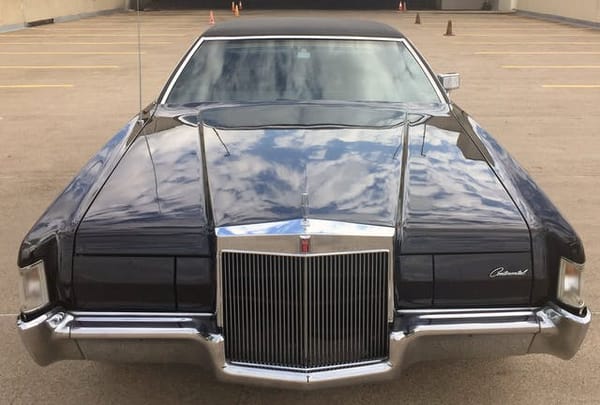
I think this partially explains the emergence of the Great Brougham Epoch. Buyers in the Archie Bunker age demographic felt alienated by the present and fondly looked back to the glory days of the 1920s and ’30s. Hence we have all these imitation classical motifs grafted onto modern bodies–long, creased hoods a la Duesenberg ending in “Rolls Royce” grilles; leather-grain vinyl roofs; wheelcovers that look like spoke wire wheels; wood trim, some of it “carved” (plastic of course!) on dashboards, door panels, even steering wheels and radio knobs. Puffy buttoned upholstery completed the Edwardian yet funky look.

Meanwhile the auto industry was faced with challenges on multiple fronts: a sudden public demand for smaller, more energy efficient cars came at the same time the government was requiring stricter emission standards. The result was half-baked, shrunken, tinny little cars like the Pinto and the Vega–“economy” cars that weren’t all that nice to ride in and had serious mechanical and quality control problems. Everybody was stalling at traffic lights and flooring the accelerator to get more power that wasn’t there because of the new emission controls and the fact that you couldn’t adjust the idle and mixture screws on the carburetor–you know, like you could in the “good old days.”

While Detroit auto executives complained about the demands of the current situation, the Japanese saw an opportunity and ran with it. Yes, Japan–which made those flimsy-looking, toy-like cars with names like “Toyopet” that appeared in little curiosity articles in magazines like Popular Mechanics . . . odd cars that virtually no Americans actually bought. I still don’t know how they did it, but by the mid ’70s the Japanese auto industry was exporting highly refined, stylish, and most of all reliable small economy cars into the U.S. market.

And it was showing up in the pages of Consumer Reports. Wherever you see a Japanese brand (Toyota, Datsun, Subaru, Mazda), things are coming up rosy (rosy red dots, that is.) Meanwhile, many U.S. and European brands are littered with black dots (bad). As the saying goes, “This changes everything!”
So here are the actual charts from Consumer Reports, April 1976 issue. Since this is the 1970s, the age of the Incredible Shrinking Candy Bar (paying more and getting less), CR is only reporting on four model years (1972-75) instead of the customary five or six. You know times are bad when even your friends at Consumer Reports are short-changing you! As a compensation, they are reporting on more makes and models than ever before:

*Click images to expand* Brand names that are well-respected today were making real junk in the ’70s–Audi is one such surprising example. Big GM cars (like Buick) were still of relatively good quality.

Cadillac quality–it’s still there. Chevrolet (except for full-size cars)–lots of bad experiences.

The dreaded Vega! Actually it’s not as bad as some other cars. Engine Mechanical and Body Exterior (rust) are particularly weak points. Dodge (and other Chrysler makes) are starting to go to pot now. 72-73 Darts are still pretty good.

Fiat–predictably bad. Ford Maverick, hailed in 1970 as the most reliable new car is now doing OK, but not great. Here’s a surprise–big 72-75 Fords are holding up quite well.

Japanese effect: Honda and Mazda–looking good. Mercedes-Benz diesel 4–one of the best. Mercedes has trouble with brakes. My ’72 M-B 250 gasoline 6 had brake problems and I had to replace the expensive exhaust system twice. No problems with fuel or ignition. Worst cars of the ’70s: International and Jeep. Those two must have been awful, considering the rest of the field.

Big Mercurys (like big Fords) are one of your best buys. Maybe the suspensions were so soft and the engines so low-revving and smooth that nothing vibrated to pieces. My beloved MGBs are giving owners trouble–particularly electrical systems. Plymouth, like Dodge, is following a similar path downward.

Look at Toyota and Subaru–Wow!! Saab is doing worse than I thought. Volkswagen can’t build air conditioning.

Volvo–another premium brand that wasn’t so great.
How about the dealer experience? Cadillac is the best by far. Also good, Oldsmobile (“The Good Olds Guys”) and BMW. Bad: Jeep, Audi, Porsche, Fiat.


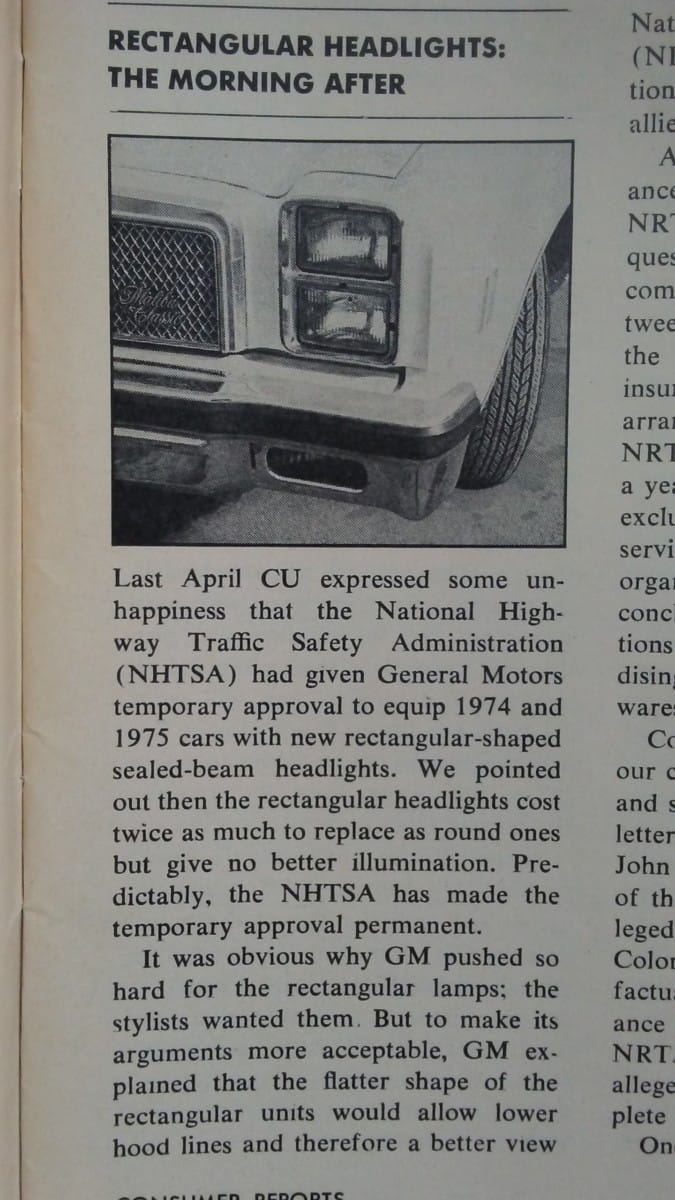
Another dubious ’70s design idea: square headlights. As CR points out, they don’t illuminate better, but cost twice as much. But the stylists wanted them. At least they still have glass lenses.

If your car didn’t have the latest safety feature (an air bag), you could order one by mail from Control Laser Inc. and [probably] install it yourself. Could there be an old car out there with one of these still on it?

CR’s buying advice: Don’t buy sporty cars, luxury coupes, convertibles, hardtops, muscle cars, exotic imports, or cars with lots of options. Also no older cars or orphan makes–exactly the opposite of what the collector car market values!

So that’s the early-to-mid ’70s for you–the good, the bad, and . . . I was going to say, “lots of ugly”, but that would be cruel. I actually like a lot of ’70s stuff–there are many hidden treasures to be discovered.

I remember in 1974 the great Jean Shepherd was leafing through a 1934 Hudson Terraplane brochure, telling us about all the artistic and mechanical wonders described therein, becoming nostalgic in the process. He then makes a prophetic statement that no one living in the ’70s would have believed: “As sickening as the thought is, forty years from now some fool will be writing about the Seventies as an age when men were men and life was lived with reality and style, people were true, morals were steady and high, and good things really mattered.”
Next up: Consumer Reports, April 1982 (1976-81).























This is interesting because it is the era I started paying attention to details like these. It was this era that made mid-60’s cars look so good – I pretty much skipped over the entire malaise era in my car ownership, with one late exception – a 77 New Yorker that kind of reinforced most of my prejudices against 70s cars.
Other than safety engineering (where there were substantial improvements made in the 70s) the cars from the prior decade tended to run better, get better fuel mileage and be made from better materials. If you could get a new 70s US car that didn’t have drivability problems, you were blessed. That period between the cold start and fully warmed up was horrible in many cars, with flat spots and stalls being common.
Brakes were certainly much improved in the 70s, with front disks working their way into virtually everything. I love that my ’74 C10 has front disk, hate that my ’69 F-100 Ranger does not. If it weren’t for the awful brakes and the need to vastly upgrade them, the Ford would be on the road today.
As it sits, with the brake pedal there for looks only, and me unwilling/unable to fix the current system, it’s on the back burner for that reason alone. I can’t see putting hundreds of dollars into fixing the OLD system when in the end, its gotta be upgraded anyway.
Your comments about “All in the Family” made me do some thinking and research. The TV show debuted in 1971. Archie and Edith have a college-aged daughter; let’s assume she’s 20, which means she was born in 1951. In the 1950s people tended to have children at young ages, so let’s assume Archie and Edith were born in 1931.
LaSalle’s existence as a car brand ended in 1940, per Wikipedia. Since the song refers to “*our* old LaSalle”, I want to assume they were already married when they owned it together. So at best, their old LaSalle was a 9-10 year old, used, pre-war car.
Did it really run great by the time they owned it?
You’re making assumptions that aren’t borne out be a certain obvious fact: there’s no way that Edith and Archie were playing characters just barely 40 years old. As a matter of fact, the two actors were born in 1923 and 1924, making them closer to 50 at the start of the series.
Not everyone had children at age 20, actually. In fact, that would have been the exception. The average age of marriage at the time Edith and Archie would have married was 24.3 years for males, and 21.5 for females.
WW2 delayed a lot of marriages. And not everyone had kids instantly.
To back your idea up: IIRC Archie (the character) served in WWII in the infantry.
The casting of age-appropriate, age-looking actors as Archie and Edith was a big point I only really noticed when I saw reruns later, during my college years.
Of course; it’s very obvious. It very much shaped Archie; it’s an essential element of his character. The whole essence of the show was about the WW2 generation in conflict with the boomer generation.
Well, that means Archie and Edith got married at 18 in 1948. That ’40 LaSalle went thru the War rationing and then was most likely traded for a post war car and Archie picked it up for oh…$300?
What was Archie and Edith’s next car cause I can’t see a Lasalle lasting ’til 1971…and what were they driving in 1971?
No car, they lived in Queens.
Thought I deleted this comment. Sorry
Watching All In The Family as a kid, I figured they were in their 50s.
What was Archie and Edith’s next car cause I can’t see a Lasalle lasting ’til 1971…and what were they driving in 1971?
I always thought she was referring to her family’s car when growing up. Even when I was a kid and it was in syndication, I remember assuming that. Weird.
In the show, Archie was a WW2 veteran, having taken schrapnel at Anzio if I recall. The son in law, Mike, was a college student at the time he married Gloria and they lived in the house together with Archie and Edith.
I never thought the song was about Archie and Edith at all. They were sitting at the piano singing as Edith played, a common pastime for that generation, and certainly one they would have grown up with. In that setting Edith would have been playing from an old piece of sheet music of the kind that sold by the bazillions in the 30s and 40s. But it was certainly intended as generational for the Bunkers, and possibly people a decade or so older.
When Cousin Maude made her infamous first appearance, she and Archie got into a screaming match about FDR since she’d been a big supporter of the New Deal and Archie thought FDR had “..ruined America.” So, they were all around voting age in the late 30s/early 40s.
But to circle back to cars, Archie was a cab driver at one point, right? So I wonder if it was a classic Checker or a “Taxi option” from one of the Big 3? Based on NYC street scenes from the early 70s, it might have been either.
Funny how now I look at some 1970s consumer products and wish for THOSE good ole days. If I could buy a new 1970s Maytag washer and dryer, I would without question. Instead, we bought a new Speed Queen classic series washer. Had to wait months for it to come in, but it was worth it. Tired of all the other junk.
I’m surprised Honda and Mazda did so well. Seems earlier Hondas had a penchant for blowing head gaskets, while the less said about the reliability of the rotary, the better.
Our house is full of 1970s stuff that still works. From my Zenith Allegro sound system to the KitchenAid (by Hobart) stand mixer with the original glass bowl that I bought him for Christmas, we use all of it regularly. If the Zenith isn’t blasting Vinyl in the living room, the SoundDesign is in the bedroom. I also use vintage Club Aluminum cookware, Silit stock pot, as well as lots of 1970s vintage utensils my mom bought new but tried to throw out years ago when she “upgraded” (now she wants her old stuff back, too late! Haha). Then I walk outside and get into my 1974 pickup, and it’s like I’m living in a time warp (agaaaaaaaaain!).
Here’s the Zenith Allegro stereo system, not in its current location (it was stuck here temporarily during the Holidays).
I worked as a service writer for a Mazda dealer the last summer before I graduated from university, 1987. The thought of driving a taxi made me go elsewhere for work. The general consensus in the service department was that by 1987, the rotary was quite reliable. The only real problems I saw with them was the nightmare Rube Goldberg catalytic converter system. The advent of fuel injection took care of that.
Even when a rotary needed apex seals, they were easy to replace.
American cars showing up better than I remembered – I guess their quality downfall didn’t hit rock bottom until the ’80s. Those old Ford and Mercury land yachts sure were reliable. I’m surprised Dart and Valiant reliability doesn’t live up to their rep. Even Toyotas have a few black dots – these would mostly be gone in a few years.
What’s a Chevrolet Carryall? Is that a Suburban? I thought “Carryall” had been dropped decades earlier.
Oof – I wish I would have read this before I bought my ’74 Firebird. 🙂 Oddly, CR rated it with a black circle overall, but most of the categories are average. Well, it’s lasted 48 years, so it can’t be too bad.
Yeah my ’74 Chevy pickup got a big nasty black dot for engine! But the original, unrebuilt 250 Inline 6 still runs pretty good, nearly 50 years later. 🤔
Three of the four air cooled Volkswagens did better overall than the two new water cooled cars. I expect more Type 4s had AC, which brought their scores down.
He then makes a prophetic statement that no one living in the ’70s would have believed: “As sickening as the thought is, forty years from now some fool will be writing about the Seventies as an age when men were men and life was lived with reality and style, people were true, morals were steady and high, and good things really mattered.”
Of course it was prophetic, as it is in every age. And it perfectly explains/predicts the great cultural/political divide tearing our country apart. Just yesterday as I was driving home from Port Orford, there was a big lawn sign that said: “I want the America back that I remember”. Or something close to that.
The problem is that humans have the unfortunate tendency to remember the good things and forget the bad. That’s a brilliant evolutionary adaption, but there’s a very big price to pay for it, as a big chunk of our population always seems to want to go back, and resists change. It’s just in the genes.
I must have missed out on those genes, as I tend to advocate for and embrace change, and I see the profound flaws of the past all too clearly.
FWIW, I quite loved the ’70s, except for some questionable fashion trends. Change was in the air, and I happen to like change. So many significant and long-lasting policies were enacted in the 70s, In reality, while the the second half of the 60s fomented change, for the most part they didn’t take effect until the 70s.
Certainly economically, there is a very real transfer of wealth happening, that has been accelerating since the 70s and 80s. Economically, the US and Canada used to have strong middle classes well into the 1970s, and before NAFTA and free trade. Where most people could afford to buy a car, and a home. Today, most Americans live pay cheque to pay cheque. Lower middle class Americans increasingly cannot afford homes. Or food, education, rent/mortgages, or a car.
Both parties in the US are now fully corporate-controlled. With ALL top level politicians millionaires, essentially working for billionaires, and corporate America’s best interests. The US had less than 80 billionaires not that long ago, Today, there are over 600 billionaires. By global standards, the US has two right wing parties.
Home ownership, was one of the last means for individuals to develop wealth in the US. As various studies say the American dream is dead. As education remains somewhat accessible here in Canada, it remains possible for the poor to climb out of poverty.
While the 1970s are no benchmark of cultural or economic achievement, many people lived more secure lives.
An American friend often rants to me how much he hates President Biden.
My reply always, “What’s really changed since to took office?”
Charles G. and David H. Koch spent more than $250 million in 2020.
They are all bought and paid for.
https://www.nytimes.com/2022/04/06/us/politics/republican-donors-rockbridge-network-trump.html
Indeed. Biden is not the friend of the working class, that he claims.
His election campaign was supported by over 100 billionaires. He works hard against the lower incomes.
Sadly, the American people are the most propagandized people in world history. And many believe the lie, when they are told they have the greatest country on Earth. It’s not a left vs. right issue. It has been top vs. the bottom for as long as well have been alive.
You’re essentially violating our no-politics commenting policy. You can discuss general/historical trends, but not specific current politicians/issues.
Why are two Canadians weighing in on our politics? How’s home ownership trending in Canada lately? And in quite a few other countries.
He works hard against the lower incomes.
This is why you have to stop. You’re out of your element and just tossing out simplistic one-dimensional rhetoric. Life and politics is a bit more complex than you make it out to be.
Either stop this comment thread or I will.
When you make general statements that things are much better for most people today, It has to be put into context. And backed with genuine evidence. Which you seemed to ignore with your original comment.
No worries, I won’t pursue this topic.
When you make general statements that things are much better for most people today, It has to be put into context. And backed with genuine evidence. Which you seemed to ignore with your original comment.
WTF? I never made any such statements! I said: I see the profound flaws of the past all too clearly. That doesn’t mean I can’t see the good things of the past either. They’re not mutually exclusive. And you prove my whole point: folks tend to see the past just that way, in a binary way: either as something to improve upon or fix, or to go back to. The reality is invariably more complex and nuanced.
This is the problem in debating you: you’re like a machine that spits out pre-digested one liners at the slightest provocation, without proper context, or any nuance. There’s nothing in my original comment that should have triggered this avalanche of simplistic rhetoric.
Here’s the thing: we’re undoubtedly on the same general side of the political spectrum, but your rhetoric is often disconnected from facts and lacks a broader understanding of how things actually are, how they got that way, how they could change, and the reasons they aren’t all readily changed.
Just spewing out “the wealthy are destroying the countries like the US” is grossly simplistic. And if you can’t understand that fact that Biden/Dems can’t pass progressive agenda items because of the Republicans (and a couple of key moderate Dems), rather than because he’s been bought out by billionaires, than I strongly suggest you expand your horizon of what you read and watch.
End of this comment thread.
I warned you to stop commenting with overt political rhetoric on this thread. I’ve had to trash two of them, and the next step is to take away your commenting privileges.
There was nothing in my original comment to justify veering the discussion to politics. I was commenting on the universal human tendency to see the past with rose colored glasses. That’s a general human trait, not a political analysis or comment. I have zero interest and tolerance for wasting oxygen on useless political “debates” or rhetoric. You’ve wasted way too much of my time today already.
If I want to read about politics, I’ll go to a political blog. Once the back and forth about who is worse takes root, it ruins a website for me. Political bickering is why I left TTAC and have never gone back.
I’m not going to get sucked into a debate about the many things that have changed, bad and good, since the “good old days”. But your statements about home ownership (as well as some other ones) do not correspond to the actual facts. Home ownership percentage was lower in the “golden 60s” than it is now (see chart below).
The number of billionaires is irrelevant, as long as they pay their fair share of the taxes. The fact that there’s so many more of them is a reflection of economic growth and of course inflation.
Although some trends are not ideal, you’re falling for the trap: the good old days were always better in just about ever respect. I’m old enough to have lived in the 70s, and it was a mixed bag. Here’s one: I literally struggled at times to feed myself, after I left home. Food stamps? You had to prove that you had a place to live that had a real stove. Yes; prove it. If not, none for you! As if I couldn’t eat cold food or use a hot plate. Nope…
So at times I reverted to shoplifting food, if necessary.
Today, nobody in America is truly hungry; there’s food everywhere. Too much, so it sometimes seems.
It’s not a question of ‘being sucked into debates’. It’s fact, there is a every growing wealth transfer happening steadily for decades, and wealth inequality is at an all time high.
People like Musk, Bezos and Buffet have been paying a less than 2% tax rate. The wealthy are destroying countries like the US by fully exploiting the working and middle class for profit. And governments now facilitate it.
For increasingly millions of lower income Americans, their struggles are far more challenging now than 40 years ago.
For increasingly millions of lower income Americans, their struggles are far more challenging now than 40 years ago.
Numbers speak louder than words.
Maybe you should check out the Cornett family pictures from 1964 and 1972 also posted at CC today. Do they look like their struggles were less than “millions of lower class Americans” today?
Needing to have a fitted kitchen in order to receive food stamps is just bonkers, like the program is trying to exclude the people who most need it. It reminds me of a brief period when I didn’t have a fixed address and was technically homeless (a few friends took me in). I went to the post office to get a PO box so I could receive mail during this time, and found out the USPS requires proof of a fixed residential mailing address in order to get a PO box. If I had a fixed address, I wouldn’t need a PO box. What’s that about? I managed to get a few bills and such sent to one address to show them to the post office and finally got my box. I haven’t used it in 15 years; weird thing is the government and/or some private entities that deal with demographics seem to think I actually lived at the post office address, which comes up as one of my previous home addresses. I also lived in an apartment around that time and didn’t bother filling out a change of address form. As a result, nobody seems to know I ever lived there.
Exactly. The cultural political divide is just the poors turned against the poors. Those 600 billionaires couldn’t be happier that any “change” by the populous amounts to battling over trivial things like gender pronouns and the second amendment.
I embrace change for the better, but I’m having a hard time seeing the “better” when change is invariably a house of cards for the next political backlash to knock down, or full of unintended negative consequences because solutions to problems all too often try to solve symptoms and not the cause.
CR is helpful when buying appliances and other products, but I’ve never paid much attention to which autos they recommend.
You nail it there. Some people are more attracted to the new, others are more reluctant, or even repelled. But any time someone waxes poetic about older cars, I ask them if they would really like to go back to trying to start a carbureted car in the dead of winter, or to fix a flat tire in the rain or snow.
This posting does help to settle my long-standing question about whether I would have been better off to have gotten a Nova instead of my Vega GT. Apparently the Novas had their problems, too. But then why were the Omegas and Skylarks rated better in so many areas? Another CU mystery.
I think it’s less mysterious and more indicative of CR’s methodological flaws; I’ve squawked about it previously.
Oh, no, no, no, no! No, it certainly wasn’t anything as frivolous as mere styling; it was GM urgently wanting to do their part to improve fuel economy, you see, and those regular old normal old round old headlamps were just too doggone tall, you see. Why, if only they had some lovely wind-cheating low-profile headlamps, just think how much better everything would be! And three nanoseconds after they were approved, GM stacked them one atop the other. As I was saying.
CR was right; NHTSA handled the issue with their favourite pastime: regulatory malpractice (the more things change…): they “temporarily” approved GM’s rectangular headlamp system on an imaginary trial basis, warned the whole auto industry that there was no guarantee they’d make the approval permanent or that if they did, the final permanent approval would be for this same GM system—it could be for some other size or configuration of rectangular headlamp system—and gosh, those arguments by other automakers about this rulemaking giving GM an unfair competitive advantage were kinda cute and all, but unpersuasive. Oh, and as for nighttime seeing, well…ah…yeah, the agency hadn’t not decided that the much-less-efficient rectangular headlamps wouldn’t not unfailingly provide the same performane as the round lamps. Don’t try to understand, you’ll hurt yourself; there’s a lot of math and stuff.
Those lights were so bad that when I had a car with them I would immediately change them our for Bosch H-4 lights.This was especially important on Vancouver Island as there were many places with no street lights.
The problem was more to do with small + rectangular than with what kind of filament arrangement was inside them. Those H4s weren’t (objectively) better than the sealed beams, just differently inadequate—they just felt like they were better because of the increased foreground light. With the sealed beams, your seeing distance is longer but don’t see the pedestrian crossing from the left. With the H4s, you have more spread light across to the left, but your seeing distance is shorter. Pick yer poison!
(I’m not saying you’re out-and-out wrong; stuck with the quad rectangular headlamp system and given the choice between American sealed beams or reputable-brand H4s, I’d pick the H4s just like you did. Fortunately there are more and better choices now than there were back then, even in the old sealed-beam sizes.)
Great retrospective. I used to be amused (and a bit concerned), when I’d read articles on the Chevette, or Omni/Horizon for example, saying they featured the best ever rust protection features for their respective manufacturers. On entry-level cars, no less. lol I wasn’t sure whether to be impressed, or shocked at their efforts to play catch up with their quality control. My dad was meticulous with his car maintenance, because he knew cars in general back then, were not reliable. Before every road trip, he’d always have his car fully inspected by his mechanic. Remember, when people did that? And often disaster would be avoided, with slow leaking tires, or worn belts getting caught.
I liked some of the stylists creativity in the 70s. But the quality control and engineering deficiencies were often glaring, and dreadful disappointments.
I think these charts point to the fact that GM and Ford really wanted to keep the full size cars popular. Anything smaller really didn’t matter. Small was trendy, but not permanent.
All the quality (real or imagined) was put in the full sized offerings. Yes, I know there are exceptions, but, in general, only the large cars mattered.
GM would still be #1 today had the standard, body-on-frame, RWD configuration not been challenged. How dare we introduce safety, fuel efficiency, pollution control upgrades and quality (regardless of size) into the mix! GM and Ford designed the best of the best, as long as it was longer, lower, wider.
Regarding quality in the 1970’s:
I’ve owned a number of cars from the 1970’s.
Purchased new: my 1970 Malibu was average at best. My 1973 Gran Torino really wasn’t much better. My 1977 Buick Skylark was quite a bit better.
Purchased used: my 1976 Pontiac Bonneville Grand Safari was quite good. My 1976 Ford LTD Brougham was EXCEPTIONAL. I’ve also owned four AMC cars from the 1970’s. Other than minor fit and finish items, they were very good cars. Certainly much better than the charts indicate.
My father’s 1970 Country Squire was flawless. So was his ’77 Impala wagon. His 1975 Cherokee was a real lemon.
My point is this: Had GM and Ford really focused on quality on their smaller cars as well as their traditional large ones, things would be different today. They believed that consumers would return to the full size cars after briefly flirting with the novel smaller ones. And as for those pesky imports, they, too, were a passng trend. 🤓😄🤓😄
70s roads here were not really that busy and saw many cars from the 50s and earlier in daily use oil burning tired old heaps were still driven regularly and overhauled in the backyard to be given further life, New cars were becoming more available though waiting lists were still a thing so a lot of people still drove old cars and kept old appliances alive because you could
But right now in 2020 Im daily driving a Hillman from the 60s I pulled it out of storage to give it a run two weeks ago and havent put it back and it does ok turn the key it goes press the brake it stops.
Most interesting, to me, from looking at these charts is that BMW did NOT always build garbage out of the box as might be assumed from today’s offerings; Mercedes-Benz did solid work, and even Cadillacs were still among the better cars then.
Letter to Consumer Reports, April ’76 issue.
“Rust everywhere” on a 2 year old car?
It was a Vega, so that wasn’t exactly unexpected. I remember our neighbor’s 1974 hatchback showing nasty rust spots coming through the pale yellow paint when the car was 2-3 years old.
My biggest impression of this roster of cars is the sheer variety of cars available at the time. This was a time where makes, manufacturers, and brands proliferated, but before the internationalization of brands, and before ‘best” engineering and design practices were somehow agreed upon. Today, it can often be difficult to detect the brand without reading the emblems. Back then, the cars were so distinctly different in so many ways. For those of us of a certain age, think of what a Volvo was like to drive or maintain. A Saab. A Renault. A VW. An MG. Or a Datsun. Each was so different from the others, in meaningful engineering and design ways.
I suppose this line of thinking could be construed as an element of “those were the days” backward thinking. But from what I know of, say, the ‘50s, or the ‘30s, the variety of cars that were truly distinct from each other tended to be much smaller. For every Crosley or Muntz, one never actually saw many of them on the road. And the Fords, the GMs, the Mopars, and the Independents were generally very similar to each other dimensionally and in their mechanical specifications. The dominant automotive version was some huge proportion of the fleet, much higher than that of the most popular cars of the ‘70s (the big American RWD coupes and sedans).
Think of the ‘70s, qualitatively, what you will, but I revel in looking through the roster of cars and thinking about the distinctive elements of so many of them, whether such elements earned them a red dot or a black dot.
Chalk it up to regulations being far more difficult today, and many times when some automaker tries to go out on a limb (Honda Element, 1996 Ford Taurus, Suzuki X90, Pontiac Aztec, Ford Flex, Dodge Magnum, Honda CrossTour, etc), it backfires and scares that manufacturer and everyone else into copying the leaders, which are often the most boring and anonymous cars and crossovers out there.
Now, “different” equates to crying slashes and giant grilles on Toyotas, with overstyled faux premium Hyundais.
While Subaru was well recommended, they had a poor dealer network here in Canada. That, their unusual styling, and limited advertising, hurt their early success. In fact, I recall the British makes were still advertising in Canada as much (or more) than the Japanese makers. At least until the mid 70s. While Datsun seemed to have a greater presence in Central Canada, than Toyota, before 1975 or so. Volvo and M-B probably had the best reputations in Canada, of any manufacturers during this era. Volvo was a significant advertiser as well. I recall seeing many Volvo colour spreads in Time (Canada). The maker with the most dubious reputation was probably Ford. The Ford rust controversy was mainstream news here.
My Dad bought a ’76 DL new, we were in Shelburne, Vt. (not too far from Montreal) at the time. Back then not all Subarus had AWD (in fact, I think they only had one model that was, a wagon) but they were attractive in that they had FWD when it wasn’t exactly common, and the cars that had it were a bit pricey (SAAB, VW Dasher/Golf/Scirocco, Honda Civic and Accord). Datsun had the F10 which people don’t like how it looked, but my Dad rejected for another reason, the vents on the hood looked like last minute engineering change to him, making him wary (we’d had Datsuns before and liked them, though they were RWD). I had a bad experience with a Fiat 128, so Dad stayed away as well.
The DL was OK, but of course it rusted quickly. Also, the hood didn’t latch completely and buckled when it was fairly new, Dad didn’t fix it but used shock cords between the front wheelwell to keep the hood fastened…of course it looked terrible, especially since it wasn’t old enough to be a clunker. My sister inherited it eventually, my brother-in-law wasn’t impressed until Subaru became the car of the US Ski team, and he could get in events free if they drove her car.
My car around this time was a ’74 Datsun 710…not a very common car, it wasn’t very plush, but it got me through my undergraduate years without many issues, and was simple enough for me to learn on (and tolerate my mistakes) to keep it going. The bad part was being a light RWD car it had terrible traction in the winter, being an automatic I had to shift it into neutral at stoplights when cold in the winter to avoid having it crab into another lane
Dot charts make for fascinating reading. In these, both Sube and Honda are rated average to much better than average for their body, when both rusted horribly here in Michigan. The early 70s Civics were recalled for rust repair on Honda’s dime.
I have some much older issues. Before the dot charts, they had tables showing percentage of owners reporting a particular issue that during the year, without dividing the cars by model year. Sign of the times department: they tabulated frequency of ring jobs, valve jobs and engine bearing replacement. Does anyone do those repairs anymore? When my coworkers had clapped out engines, they would buy a salvage engine from a junkyard.
CU while as well intended as presumably Ralph was, was just so far in over there head it’s not even funny. Some of the cars I know well, and used the same parts for some or all of the years, but scored differently. They seem obvious to things being brand new and working better. Others I have to wonder what they were smoking, BMW Bavaria with 11 inch disc brakes all around were rated poor and bad? They had more brake than most pickup trucks of the era. The factory pads might have been short lived, but there’s a lot more to brakes than how fast things wear out. Some they did nail, Audi 100LS while stunning when they came out, very quickly proved themselves to be hand grenade reliable, they were awful. The BMW Bavaria I’m so fond of had a great manual tranny and clutch, but the available auto was about as bad as you could get, yet overall both were in the ok range.
It was like they were throwing darts, it was almost random if they got it right or were laughably wrong.
For CR the rankings are all about what those surveyed reported needing to seek service for. So yeah short lived pads means a trip to the dealer for new pads and thus a problem. And if the dealer sold them new rotors and calipers at the same time then it that a major problem. They are not concerned about the braking performance in these ratings.
The CR data confirms my experiences (and my families and friends) with cars from this time. Get a full sized car with a standard V-8 and automatic. You want better mileage? Get the smallest V-8 with a 2bbl carb like a 307, 318 or 302. Bragging rights over that Big Engine will be accompanied by complaining about how you are always having to fill up and don’t know why. Don’t get the power windows or locks. Fancy, Luxurious or Sporty requires a fancy, luxurious or sporty checkbook. A/C is usually a safe bet until ten years later. Get the rust protection.
The dots chart explain a lot about what Ford products were so ubiquitous in the mid 70s and what Chrysler products were in such decline–bad news about quality and reliability travels fast, even pre-Internet.
Lots of little tidbits to ponder. One that jumps out is the transmission trouble on the Mustang II 4-cylinder–I assume they still had some kinks to work out? Also, I’m struck by the differences between GM’s brands since we always cynically thought they were all the same under the skin. Apparently not.
Ford did a whole lot better than I remember. My father and uncle worked for Ford and it was important to keep my opinions about Ford products to myself. But decades later, I suggested to my uncle who had been bragging about Ford products during the 1970s, that I wouldn’t have wanted any of those cars – was a bit thrown by my insolence. It appears that, as often the case, he was more correct that I was, based upon this contemporary ratings guide.
Yet, I cannot imagine enjoying any Fords until 1978 when the Fox bodies arrived, showing that Ford could make a modern car. To me, the first real Ford I ever wanted during my driving lifetime was the Fox body Fords, like the Mustang and Capri. Even today, when I look back at Torino, LTD, Mustang II, Pinto and Maverick – I cringe.
1978 and 1979 were the only two years when I began to hope the rotten styles, music, politics, and economics were coming to an end. The old manufacturing plants surrounding my neighborhood were closing, punk rock replaced disco and I abandoned South Chicagoland for Colorado.
1970s – anything? No thank you.
When my dad worked at Exxon in the 70s as a section head managing their rotating equipment, they reached out to CR to learn about the statistical method they used to determine the dot ratings. They were looking to learn about best practices. As it turns out, they were very disappointed because they learned there were NO statistical methods – they peered over the data and made their own decision on a subjective basis. Take that for what it is worth! I am an old friend of the Author and we used to chuckle about this when we were young!
Yep. See second half of this comment. The whole thing is “You’ll believe what we say because everyone believes what we say because we’re unbiased because we don’t run ads*”.
*-other than for our own products and services, which um don’t count
I’ve always hated Consumer Reports. So much of it was absolutely subjective. What if I DON’T WANT cupholders in my truck? Anyway, I still love, use and drive my ’73 International 1210. As the author said, seen any ’74 Subarus lately?
I liked Consumer Reports in the 70s and 80s, especially the 70s.
It offered an alternative type of road test and during the late 70s, the best data about fuel consumption. City. Trip. Mixed. Steady-state 40mph, 50mph, 60mph. The 0-60 times were always slower than the car magazines. In my early teens, I figured the drivers were not as good as C/D or R&T. In my later teens, I tried to match the times, using the stopwatch feature of my digital watch.
I liked CR’s practical perspective of the 1970s.
I also figured out, fairly quickly, that CR was not the last word on auto tests. It needed to be interpreted correctly, especially the reliability ratings, which occasionally were 180 degrees out of whack, in my experience. Still, CR auto tests were a good read, and quite useful.
Today’s cars are much better, and much more similar to each other. Perhaps that is why CR offers a lot less objective data and more subjectivity, as well as ‘fluff’ and even more left-wing, pseudo-safety BS than the 1970s, while trying to sound like Car & Driver with terms like “stylish… exciting”.
So, while the past is not always as good as it seems, the 1970s and 80s were much better for CR auto tests than today. IMO.
My ‘68 Nova (307, 4speed, bench seat) bought used was a good car. My ‘68 Falcon (bought used) was okay. My ‘74 Fiat X1/9 (my first new car!) was very good, I just followed the maintenance schedule and that car ended up being one of my faves… 99K troublefree miles before I sold it in ‘80.
My ‘78 Buick Regal Turbo Sport Coupe (bought new) was so bad it steered me toward Honda (‘81 Accord) and after that an ‘84 Camry. Both served our young and growing family well.
I am so pleased to see that my w115 Mercedes 240d was probably the most reliable car in the Consumer Reports guide. In ’74 and ’75, a diesel that didn’t stall, cough, or stutter in driving would be revelation compared to the emission bungled gas engines. Its build quality is impeccable, and even nearly 50 years later, feels like a new car.
I am not surprised CR loved it too though, especially as their main blind spot is rust.
Honda Civic, Subaru, Datsun B210, Vega, and all Ford products were well known for being very rust prone, as was my Mercedes. (ask any w115 owner) Yet, except the Vega, none had big black dots on the body sections. Maybe more people from the sunbelt responded to the surveys than those in the saltbelt?