

We continue our look at the famous automotive dot charts from Consumer Reports magazine. In this issue there are 9 pages of charts covering 162 separate models, 1976-81. If you don’t want to study all that data, I’ll give you the Executive Summary: If a car is Japanese, or a Mercedes, or maybe a Volvo, the dots are almost all red (highly reliable). If it’s anything else, it’s somewhere between mediocre and terrible. But often things are darkest just before the dawn . . .
So here are the charts, with a little commentary. You can click on images to enlarge.

AMC Concord, Hornet, Pacer–ugly is as ugly does. Audi Fox–horrible! Buick (and GM big cars)–pretty good. GM small cars–Yecch!

Cadillac–the lustre is fading. Chevy Monza–really bad!

I see red–must be Japanese (Datsun).

The only good Dodge is a Japanese Dodge (Colt). Dodge Aspen (successor to the very reliable Dart) is a huge disappointment.

Big Fords after 1978 are not nearly as good as what came before. Early Honda Civics have some black marks, but that will change soon.

The gigantic Lincoln Continentals of the ’70s were almost bullet proof–’80 and later, somewhat less so. Mercedes-Benz–Mmmmmm, beautiful!

Big Oldsmobiles thru ’79 (like Buicks) are still pretty reliable (except DIESEL–Engine Mechanical and Fuel System–big black dots.) Any money saved on fuel costs was more than eaten up on expensive repair bills. Just buy the big gasoline V-8–you’ll be better off. And avoid the Olds Omega (and the other GM “X Cars”–they were notoriously bad!

Plymouth Volare–see Dodge Aspen. Toyota Celica embarrasses the rest of the industry.

Other Toyota models (Corolla, Tercel, Corona, Cressida, Pick-Ups) are also exemplary. What is Toyota doing that the others can’t do? It’s hard to believe how bad Volkswagen Dasher and Rabbit are. VW still hasn’t figured out how to make reliable air conditioning. Volvos of this period are apparently decent cars.
In other news . . .

Consumer Reports accurately predicts that by 1985 all cars will have the newly-designed, high-mounted third brake light. This additional light supposedly reduces rear-end collisions by a significant amount. If you can’t wait ’til 1985, you can have one installed on your present car by Firestone dealers in California.
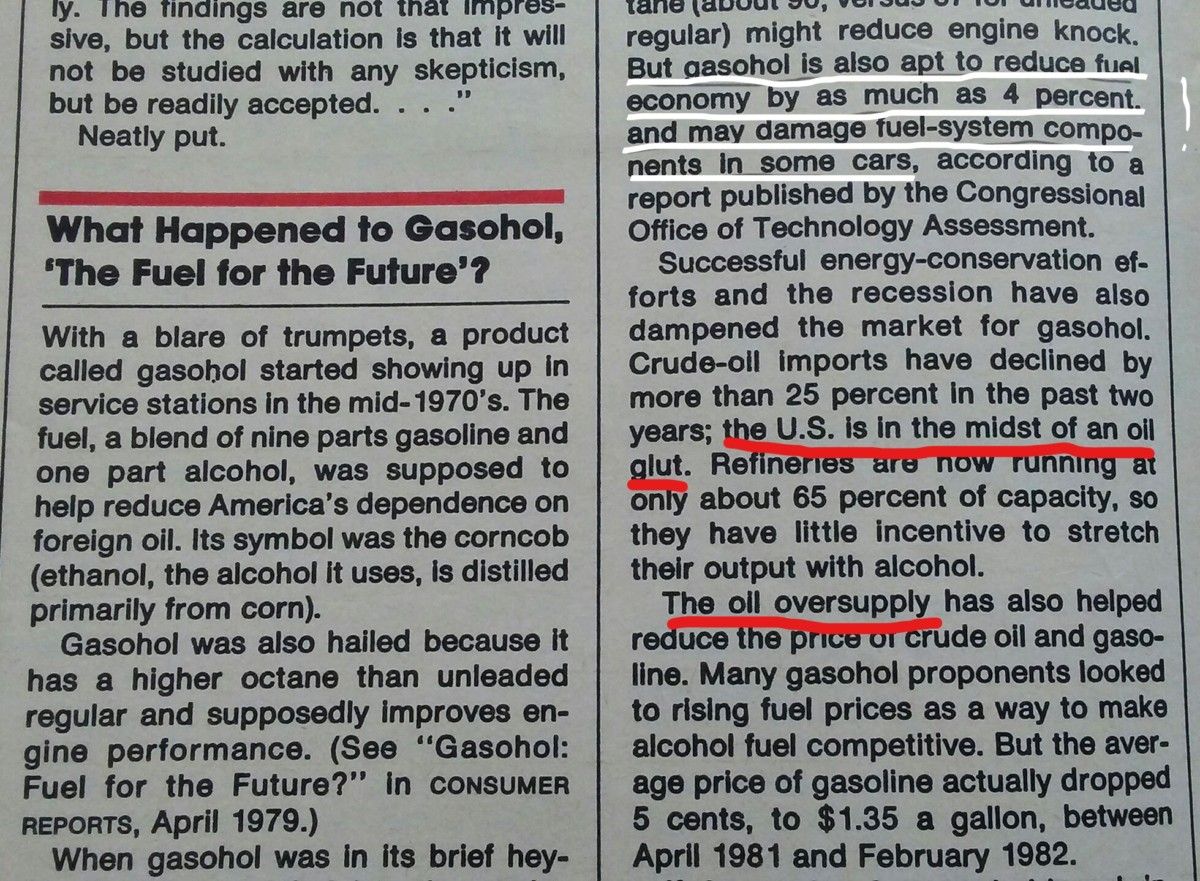
In 1974 and again in 1979-80, America suffered through something called “The Energy Crisis”. Gasoline prices were high, supplies were sporadic, and people had to wait in long lines to fill up. There were “odd & even days” (based on your license plate number), signal flags at stations (“No Gas” or “Some Gas”), and everyone was unhappy about the high prices and the inconvenience.
Part of the news media’s coverage of this event was the idea that “the world is running out of oil.” Ergo, we have to conserve and seek out alternative energy sources. GM was so convinced of this that it was designing new Cadillacs (for the 1985 model year) that were shrunken, front-drive mini-versions (about the same dimensions as the “compact” 1960 Rambler or Comet, or the 1964 Chevelle!) But now it’s 1982, and–there’s an oil glut?! The cognitive dissonance here is just too much to handle!


As it so often happens in human history, in the depths of despair things are happening behind the scenes. As 1983 approaches, oil prices are rapidly dropping, interest rates are falling, the stock market is starting to pick up–and a new automotive design language (both in styling and engine manufacture) is coming into being.
Two of the forerunners are the Audi 5000 and the ’83 Thunderbird and Cougar. The dull, boxy look of the past is being superceded by crisp, minimalist, aerodynamically-inspired lines with a new sleekness and sense of forward motion, inspired by the wind tunnel.

The groundbreaking Ford Taurus and Mercury Sable mainstreamed the new look. Future cars would follow this pattern.

But it wasn’t just about looks. New advances in electronics miniaturization and engine controls resulted in great improvements in fuel economy, lower emissions, easier starting, smoother running, durability, and increased power. This is really the dividing line between “old cars” and “modern cars”. The flawed patchwork attempts of the ’70s to achieve these goals were successfully replaced by these new developments.

And that’s not all! Cars now have better insulation and rubber door seals, they don’t drip nearly as much oil, steering is tighter and more responsive, the cars handle and ride much better, they’re quieter, safer, the dashboards don’t crack, the bodies don’t rust out nearly as much . . . and, perhaps the most important thing, RELIABILITY has greatly improved! Motorists languishing in the miasma of the Malaise would never have dreamed such things were possible within a relatively short period of time.

The next major bombshell just around the corner was the introduction of the Chrysler Corp. “Minivans” in 1984. The size and maneuverability of a car, with the hauling capabilities of a van. A logical evolution of the station wagon that really caught on. Forerunner of the SUV and the CUV.

Put all these post-1982 factors together and you have the modern automotive world: SUVs (and their variations), Trucks and Jeeps (formerly work vehicles, now mainstream), compact sedans, and a few specialty models. All have the smoothed-over, aerodynamic look. All have the mechanical, safety, and fit and finish improvements that have been refined over the past 40 years. All are much more reliable, cleaner, and safer than the cars of 40+ years ago.

And I think Consumer Reports magazine can take some credit for that. Concepts they supported for decades (greater safety, gas economy, quality, freedom from repair) eventually became mainstream. In later years, they showed us graphically how the Japanese cars were so much better than many American and European cars. It was all there (in black and red), and eventually Detroit had to respond. In recent years, the quality gap between American vs. Japanese makes has narrowed considerably.

So if newer cars are so superior, why would anyone bother investing in and driving one of these old beasts? A simple answer might be: artistic beauty, nostalgia, and fun. And those things have value too. There’s nothing like being behind the wheel of one of your favorite classic cars. When ordinary people see an old car, they take notice! It magically brightens their day!

Decades from now, when something like the personal flying car pictured above becomes the norm, nostalgically-minded people will look back at the everyday SUVs and so forth that crowd our highways today. They will long to own and even drive one, if that were possible. They will fondly look back to the “simplicity” of our time, before x, y, and z happened; when you still could do [such and such]. However, we can’t fully appreciate our present age because we’re too close to it.

If the future is a place where “You will own nothing, have no privacy, and you will be happy,” when you want to go somewhere, you’ll simply summon one of these driverless, computer-controlled, government-provided autonomous vehicles. There will be truck-type versions too in case you need to haul anything. So all this talk about individual car brands, styling, power, handling, reliability, etc. will become totally moot.
So when you get up tomorrow, look around and say to yourself, “Wow, I’m living in America [or on planet Earth] in the year 2022! How privileged I am to see this!” And whether you like–or you don’t like–certain future developments, one thing’s for sure: Things will never be the way they are now–ever again!























These CR retrospectives are always interesting, and this one especially because it covers the period when I was really paying attention to things like this. These reinforce my impressions – that bigger stuff by GM and Ford was pretty good but Chryslers were a more iffy proposition. And note how poorly the 76 versions of the sainted Dart and Valiant come off – they were little better than the Aspen and Volare that followed.
Don’t get me started on the gyrations in the oil/fuel markets. It is not well enough understood that the gas lines in the late 70s were quite regional and were largely the result of distribution regulations that were enacted after the 1973 oil embargo. We took a trip to the east coast in 1979 and the lines were beyond belief. We crossed into Canada and all was normal again, just as it was when we returned to the midwest. Jimmy Carter should get more credit than he does for fixing that problem by repealing that regulatory fiasco late in his administration.
Great stuff! Heart of the malaise! Seeing this cover for the first time since I was a young teen 40 years ago, gave me a ‘Whoa!’ moment. And thoughts of listening to Hall & Oates, The Fixx, Men at Work, and Asia, while reading these CR issues.
I was young, and didn’t know any better, so I used to try to defend the domestic industry to my friends at the time. One argument I used then, was domestic cars were typically cheaper than imports. So, people didn’t spend the money, to look after them as carefully. They were more disposable, and lived harder lives. Owners abused them more. One big reason, their ratings stunk. I’d also argue, domestics were more popular in remote and rural regions, where maintenance was harder to come by, and roads and driving conditions worse. These CR reviews were very humbling for fans of the domestic industry at the time. I was a teen, and didn’t know any better.
My dad bought Chryslers, and I remember being particularly embarrassed how poorly the Omni/Horizon fared. Especially against the Colt, and other imports. I forgave the Aspen/Volare some, because they were older technology. And did get better in later model years. But the poor ratings for the O/H, really p*ssed me off. lol They eventually became good choices, but I was expecting better.
The Supra was my dream car. While I often realistically pondered, the Starlet or Charger 2.2 were the cars, I could possibly afford after I left high school.
That particular issue graced the coffee table at Casa de Klein for several years and was surely referenced again when we picked up a 1979 Mazda 626 to replace a 1977 Pontiac Ventura in ’83ish…Why my Dad thought a 2-door coupe would be the best car to replace a four door sedan with two teenagers in the family is beyond me, but I’m glad he did as it became my car a few years later. I guess we did have the VW van at the time as well for longer trips.
CR’s methodology may be questioned and individual cars may be good or bad but this was the best way to see the industry trends in order to get a very good perspective of good bets vs bad ones. To a large extent, it still is, or at least is relied on in great measure by the buying public.
I’d say the organization that has taken a bit of the mantle away from CR in the respect of doing more to change cars than anyone else is now the IIHS, the insurance funded agency that performs crash tests and comes up with new tests and parameters to investigate, absolutely resulting in automakers altering their vehicle designs in numerous ways mainly related to crash safety. Just like CR’s publicity ended up making all cars generally quite reliable, so the IIHS has made the worst car tested today far better than the best one back when they started to say nothing of the 60s, 70s, and 80s.
Great series! As automotive technology got more complex, so apparently did the CR dot charts—this one requires close attention. I’m still fascinated and a little puzzled about how V6 and V8s for the same model had such different results and also how reliability seemed to differ so dramatically under the skins of GM’s look-alike brands. It also makes clear how economy buyers who wanted quality really had to look toward Japanese brands or captive imports–this explains the explosion of Toyotas and Honda in high school and college parking lots in the 80s.
I drive one of those early Chrysler Mini-Vans, a Voyager. I’ll be very interested in what you have to say about them, since I also worked on them from the beginning at Chrysler Dealership.
Rule #1 of statistics is you need an unbiased random sample. CR polled its subscribers therefore violating that cardinal rule.
Observation #1: there was never an explanation of why engine mattered on something like rust or body integrity.
Observation #2: if there was no change in body or engine to a model why would reliability be drastically different year to year. Or why there was a drastic difference of models on same platform or using same engine.
Observation #3: we had a 1980 tercel. There was a recall for that car for severe rust on rear trailing arms yet we see a red half dot for rust that year.
Observation #4: CR never quantified the measurable difference between red, half red, white etc. A black vs red dot could mean 1 fewer reported problem or 100. We don’t know and were never told
A weird thing about subscriber polling, my folks were avid readers / subscribers and to my knowledge, they were never invited to participate. They bought a ’76 LTD new, so they seemed to have the basic credentials needed to participate.
Decades later, I was a subscriber, and bought a few new vehicles. I scoured the website on how I could become a contributor, and could not figure it out.
You’d think there would be banners soliciting contributions.
Interesting question to the CC commentariat: have you ever participated in Consumer Reports polling, and what was your experience? Sounds like a CC question of the day!
My folks subscribed to CR for decades and every year they’d get a fat envelope in the mail from CR asking them to rate a slew of products. Later, as a young adult, I subscribed and always received the same envelope, which I never filled out because I was too busy.
Yes, Roader has the answer — all subscribers got the survey in the mail in the spring. It was up to you to fill it out and mail it back. In the 21st century, the survey could be completed online or by mail — your choice, until a few years ago when CR converted completely to online only. Now you are surveyed each quarter, but the main car reliability questionnaire is still part of the spring survey.
These are all good points. However, they are useful in comparing the CU surveys to a statistically valid survey that tracks and quantifies issues with accuracy and precision. The problem is that the second one did not exist in the real world. Before the internet, this kind of information was *extremely* hard to come by. The CU surveys had their flaws, but they were far better than nothing at all.
Granted, you bring up some valid points. But what I and many others relied on with CR is the fact that they had thousands of data points, which no one else had at the time. It certainly impacted the buying attitudes of my generation (Japanese good, others not so much…but there were actually some not-so-reliable Japanese brands as well…). Of course, the data differences between an Olds and a Buick might be something as simple as age of owners, expectations, and type of ownership usage.
I will say that my immediate family’s experiences played out in-step with CR’s reporting. Our collective Japanese & Korean vehicles have been considerably more reliable than our domestic and European vehicles. Even our elders, those of the Greatest Generation, moved that way with their last vehicle purchases.
Even as a teen reading this, I’d wonder why the solution to rust problems in a Ford Granada was to buy the V-8 engine.
Nevertheless, I’ll give CR credit for identifying general trends and probabilities.
As with anything else, YMMV.
You kind of wonder if the V8 Granada was generally in higher, more expensive trims, and thus more often sold to people of greater means who had the werewithal to be more likely to garage it or clean it more often or pay to Krown it or whatever. Over time that perhaps could manifest itself in less rust issues than the more budget oriented engine configurations.
It’s the rare American that won’t buy as much engine as they can afford in a car 🙂 (I’m kidding if it was unclear).
Or just that the V8 Granada was more Mercedes S-Class-like as advertised and the V8 therefore would be better in that regard as well. (kidding again…)
Six or seven years down the road, the better taken care of car then results in better results during a survey, having nothing to do intrinsically with the car itself but still manifesting itself as a better at that point option in that regard for the used car buyer. (Serious this time)
There is some logic that buyer demographics will affect outcomes, but my suspicion is that with CR polling participants, you probably have a more thoughtful, educated and wealthier cohort, that would treat their Pinto as well as one might their LTD. The Japanese may have sold a lot of lower cost dull appliances as far as Cordoba buyers were concerned, but outcomes were still consistently better in a Corolla.
I inherited a ’77 Mercury Monarch (nee Ford Granada) from my grandfather in ’87. By then the thing was a total rot box, despite the fact that he took care of it and kept it garaged. I’ve never trusted CR’s ratings ever since I noticed that the Mazda Tribute (which was simply a rebadged Ford built in the same exact factory) had appreciably better ratings despite being THE SAME EXACT VEHICLE. The difference in rust ratings between the V6 and V8 Granada is just another example of survey participant bias.
Those black dots shown for the late ’70s Honda Civic and Accord are emblematic of the problems I had with my cars. Failed head gaskets, temperature switches leading to overheating and cracked cylinder heads, etc. It was no bed of roses owning these things in the late ’70s early ’80s. These cars were appealing in many ways when new, but were terribly lacking in durability.
Didn’t these Hondas make Consumer Reports list of used cars to avoid around this time (’83-’84)?
I’ve been reading the Consumer Reports Auto Issues since about 1976. Most American Cars of the the late 1970s and into the mid 1980s weren’t the best in reliability. The CR surveys weren’t perfect but at least they gave a decent indication of the reliability of the systems of a model and year of car. Not perfect by far. One thing I liked about the CU Rating that have since gone by the wayside is the cost index. If you have a car that is maybe not the best in reliability but is cheap to fix, it might be worth it to buy. This was one advantage of many US Cars during this era. I wish they would bring back the cost indoex.
The chart could be reduced to a two-slice pie chart. Toyota = red. Other = black.
How did Toyota achieve all those red dots? I have an inkling. For one year my wife and I went to a single car while she was on the road all day. So I bummed rides or road the bus. One of the guys I rode with had a brand new 1991 Toyota Camry. It was a pretty nice car, although my impression of the “Velour” upholstery was that it was pretty skimpy. The selling price of the car was C$13,000. The owner took it in to the dealer for its first scheduled service at roughly 3,000 miles. The bill was C$1,300 for that normal service, or 10% of the purchase price. I wondered what that entailed, as they could do major disassembly for that. My only thought was that they were correcting all sorts of deficiencies that were never disclosed. So yes, the car is reliable! The service was the key element. Back in the late 70’s one co-worker had the rear differential go out on a nearly new Corolla SR5 hatchback (warranty – new rear axle). A Nissan Stanza required a new 5 speed manual transmission, also under warranty. The VW’s my friends and I drove weren’t perfect. We could all confirm that the VW electrical systems were junk. But the engines, drivetrains, and suspensions had no failures. But the nattering about Toyota/Japanese reliability wouldn’t stop.
Sorry, that just strains credulity. Anywhere the Camry was sold it came with a warranty. So for $1300 to be “repairs” at 3000 miles in 1991 is just not accurate. If your friend got fleeced by a dealer for an oil change for $1300 that’s something else, but in that case what he needs is counseling and someone to buy him a can or two of common sense.
The vast and overwhelming majority of people who ever bought Camrys, especially new ones, anywhere in the world had a great ownership experience of minimal ongoing maintenance and repair costs. That’s not Toyota Fanboi-ism, it’s reality.
But I will point out the big difference between Toyota (all of the Japanese actually) as compared to VW and some of the domestics of the 90s and up – when something went wrong on a Japanese car the maker usually stepped up to the plate and made it right, often WELL beyond the warranty period. VW in North America on the other hand seemed to have instructed its dealers to do whatever it took to try to deny legitimate warranty claims as often as possible, cratering their reputation and there was no shortage of opportunities to do so.
Having bought new and used VWs as well as new and used Toyotas over the years there’s one of those brands I won’t touch anymore and one that is welcome in my garage anytime. I don’t want to give it away but the one we won’t buy again starts with a V. Considering we own two car brands starting with a J that’s saying something…
I agree with you on all points Jim, and my buying experience since the 70s comports with this. I had two Rabbits purchased new, and I have no interest in returning to VW again. Toyotas on the other hand have been bulletproof for the most part, and even when something went wrong (a rare occurrence), they stood behind their products.
The 3 most recent Toyotas I have owned, two Camrys and a Prius, had zero problems over a combined 200,000 miles. The only needed maintenance included fluid, filter, and wiper blade replacements, tires and a few light bulbs (not headlights).
66k miles on a modern vehicle? Well my goodness.
Thats strange my sister had two new Camrys a 90/91 beta tester version of the new wide body world Camry absolutely zero went wrong so she bought an Australian built world type Camry and it needed rack boots @120.000kms that was it nothing else ever failed, They were good cars, Im pulling a window motor from a friends Corolla tomorow an 04 model so even that heavily used item took 17 years to die.
Had a Camry. Left me walking. Toyota dealer “stepped up” and said they had no idea why it kept stalling and refusing to start for hours (usually the next day), nor why it jerked hard on the 2-3 shift. They did tell me it would cost nearly $1k to fix the NSSS that failed later. I declined. This was before internet parts sources, and nobody offered the switch. Every parts store you called, oh that’s dealer-only.
That’s dealer-only. I’ve heard that a lot back in the day regarding Toyota parts. Dealer: oh that’s out of stock, it’s backordered because of high demand. Oh but Toyotas don’t break. This is so unusual, just like last week when you needed something and it was the exact same story.
Had a Tercel SR-5 wagon in high school. Plenty of issues just like any car it’s age/mileage (under 200k). Tried to kill me one day, so, there’s that.
Oh what a (burning, sinking, depressing, anxious) feeling!
I’m glad this era is over. We weren’t stupid back then. Consumer Reports was interesting, but it was only confirming bias.
We knew that big US cars were good and small US cars weren’t. When I started getting new cars in 1980, I expected problems. My expectations were very low for any car back then. What was surprising was getting a car that didn’t have problems. During this era, my respect for Ford grew with my Fairmont, Escort and Cougar. They were trouble free cars. However, during this same era, my respect for GM completely crashed when I had to endure an X-Car and a J-Car. They were awful. I had expected GM to be as good as Ford, but GM fell far short. I expected the Renault/AMC to be good, and it was – but I discovered that this only lasted a couple of years for long-term buyers.
We knew Japanese cars were good. So when the Honda Civic CVCC started going south, it hurt them. We knew that Nissan was a good car, but then that B-210 was a tin can. We paid too much for the Subaru wagon in Colorado, and it was very disappointing in the long run. Yet these cars were better than most US small cars. We didn’t really need Consumer Reports to tell us. There wasn’t much the dots that could have told me.
I bought cars because they were what I could get financed, was available, could be maintained, or had a great dealership. I had great vehicles that were covered in CR black dots, and mediocre service from vehicles covered in CR red dots. I don’t remember a single time that I studied CR to determine my next purchase.
I think one has to be on “the spectrum” to use CR as some kind of a divining tool regarding their vehicle choices. Have fun. Drive them all. Drive a lemon. Drive a plum. Get out of thinking that your vehicle has to be like some kind of appliance.
Fascinating to observe whether models improved significantly (or deteriorated) over the course of their production lives. Reflecting car makers making a concerted effort to improve a car’s quality. All the Chrysler F-Body derived cars, including the 1980 Cordoba, Diplomat, and LeBaron, plus the Aspen and Volare, improved considerably by 1980. To mostly average scores. The Cordoba switching to the smaller platform for 1980. Impressive, given how poorly they used to score. Chrysler had to get their act together as well. In the hands of careful owners, they could be cream puffs. And great buys on the used car market, given their bad earlier reputations, would have lowered resale prices.
Some cars like the Monza, besides poor build quality, and fragile components, appear badly hurt by a buyer demographic that tended to abuse/neglect their cars.
Buyers that carefully seek out reliable brands, are most likely to be prepared to pay more for a better product. And take care of that product. Further helping brand scores like Toyota.
As sports cars, the excellent scores for the RX-7 with their rotaries, and the 280z and 280zx, are particularly impressive.
I’ve done just fine over the years while completely ignoring Consumer Reports.