

Bloated, overweight, slow, wallowing. These are the words often used to describe Ford’s full-size cars of the 1970s. They have been described as being the poster child for the malaise era. If one reads about these big Fords, the general commentary is that these dinosaurs have few redeeming qualities. People today must think that no one in their right mind would have willingly bought a full-size Ford from this era. Yet, these cars actually sold pretty well, right up until they were replaced by the new Panther cars in 1979. So, what gives? Are these cars really that bad?

We’ve beaten the dead horse of disparaging these big Fords, and we here at CC like to look at cars from all different viewpoints. Thanks to Jason Shafer’s excellent post about the model, we know some people have fond memories of these big 70s Fords. Reading his post instantly reminded me of an article on a road test of a 1976 Ford LTD that Patrick Bedard of Car and Driver wrote. His article was an interesting take on things and definitely not taken from the standard viewpoint of most Car and Driver articles. Instead of lambasting the car for its lack of driving dynamics and monstrous size, he focused on the positives of these big Fords and the big American car in general.

Car and Driver was known to be an enthusiast magazine generally preferring well balanced driver’s cars. However, the buff magazines have viewpoints that only align with a small percentage of the population, the car enthusiasts who love cars and love to drive. The buff magazine’s values often differ from the vast majority of the driving public both then and now. Most of the general public buy cars to use as a transportation appliance. How fast it can go from 0-60 and how many G’s it can pull on the skid pad isn’t all that important to parents just trying to shuttle kids around, or Grandpa and Grandma who just want something comfortable to get them to Florida for the winter.

I think that’s why this particular article stood out for me. Patrick Bedard took off his driving enthusiast hat for a moment, and took a look at the 1976 Ford LTD from the perspective of the people who actually purchased these cars. He focuses on what Ford did right on these cars. He describes that these Fords are the ultimate isolation chambers, loaded with (pseudo?) luxury features and comforts. Like many other things in America, these cars were taken to the extreme; these Fords were the big American car taken to the extreme. They had maximum size, maximum luxury, and maximum comfort. Ford quite frankly didn’t give a damn about metrics that weren’t part of the big American car model because they sold lots of them as is with healthy margins.

To really examine these 1970s Fords, we need to go back to its 1965 ancestor. The 1965 Ford was truly an all-new car, and it was a significant shift in Ford’s full-size car design direction. The 1965 Ford had an all new stiff body structure was affixed to a light weight somewhat flexible perimeter chassis. Really, the new body and chassis were essentially a unitized body sitting on two subframes connected by side rails. This was a cheap and easy solution to maximize road isolation. Road isolation had become one of Ford’s top priorities and this new body and chassis design allowed the frame to flex at the torque boxes to absorb road shock before it hit the body structure. Chevrolet had a very similar body and frame design for its 1965 cars, but most agree that 1965 Ford was the leader in its class when it came to a smooth, isolated and quiet ride. Ford continued on this trajectory as the full-size Fords evolved into these big mid-1970s versions, and Ford generally remained the most smooth-riding and quietest cars in its class. In fact, the chassis for the 1971-78 Fords was really just an evolution of the 1965 design.

1965 also marked the year that Ford introduced the LTD. The LTD brought a big blow to the formerly well-established brand hierarchy. These Ford LTDs brought “brougham” luxury to the low price bracket and was a great way to boost profit margins on the high volume Fords. Through the introduction of the Ford LTD, no longer did one have to move up to a more expensive brand to get a luxurious car.

With the success of the LTD, Ford continued to evolve the model into the 1970s with more luxury and isolation. Of course things didn’t execute perfectly according to plan. Bean counters and safety regulations cut back the quality of materials. Plastics would replace formerly steel parts, and plastic wood was lathered on thick. The body structures weren’t as stiff as in the past, but soft springs and shocks helped with that. Ford’s Band-Aid solutions to meeting emission standards resulted in poor driveability, lesser performance and increased fuel consumption. Nevertheless, Ford wasn’t the only American car cutting these corners or facing these regulatory rules. Have you ever compared a 1965 to 1975 Cadillac? If anything, by 1975 these Fords were much closer to being a Cadillac competitor than ever before.

With all of these changes, how well did these ’70s Fords hold up to its founding father? Surprisingly, there isn’t as big of a difference, at least on paper, as one would think. In the chart above you can see the test results comparing this 1976 LTD C/D road tested to Car Life’s road test of a 1965 LTD (I also included a 1970 and 79 LTD). The 1965 LTD was equipped with the 390-4V engine, pumping out 300 gross horsepower compared to the 180 SAE net hp 400-2V in the 1976 car. Yet the acceleration times don’t differ by as much as one would think, especially considering the 1976 car was carrying 500 lbs of extra weight and had steeper differential gears. Fuel economy was somewhat better for the 1965 car, but the 1965 car was noted to have terrible brakes (only the deceleration rate was measured by Car Life). The 1976 LTD had a respectable stopping distance in comparison. Of course, the exterior dimensions had grown considerably by 1976 with little change to interior space and this paper comparison doesn’t show the loss in driveability.

The mid to late 1970’s was a time in automotive history of great change. The Ford LTD was part of the school of the past. The American market was finally starting to accept that luxury didn’t mean bigger is better. More and more people were willing to sacrifice that ultra-smooth isolated ride for some road feel and driving dynamics. GM was the first of the Big Three to make a big move forward with their downsized 1977 B-Bodies. Ford executives eventually realized that the market was moving in that new direction, they were just a little slower and more reluctant to make a big move like GM. So until it could release the more sensibly sized Panther platform 1979 LTD, Ford did its best to appeal to the traditional buyers of these big American cars.

There were still plenty of these traditional buyers unwilling to move to those new-fangled small boxy GM cars. Many people of the Greatest Generation were at the point in their lives where they could treat themselves to that big comfortable luxurious American car. After all, bigger is better had been long ingrained in many of that generation; have you ever seen a Duesenberg or Pierce Arrow? Growing up in harsh conditions with rough riding basic cars sure makes a big floaty car with velour seats, an AM/FM stereo radio, and automatic climate control sound appealing. Rolling down the interstate in what amounted to a rolling living room didn’t sound so bad. For many, these Fords were an affordable way to treat themselves. After years of hard work and sacrifice, they finally had a car that would allow for effortless consumption of those 55 mph speed limit interstate miles with minimal disturbance within the passenger cabin.
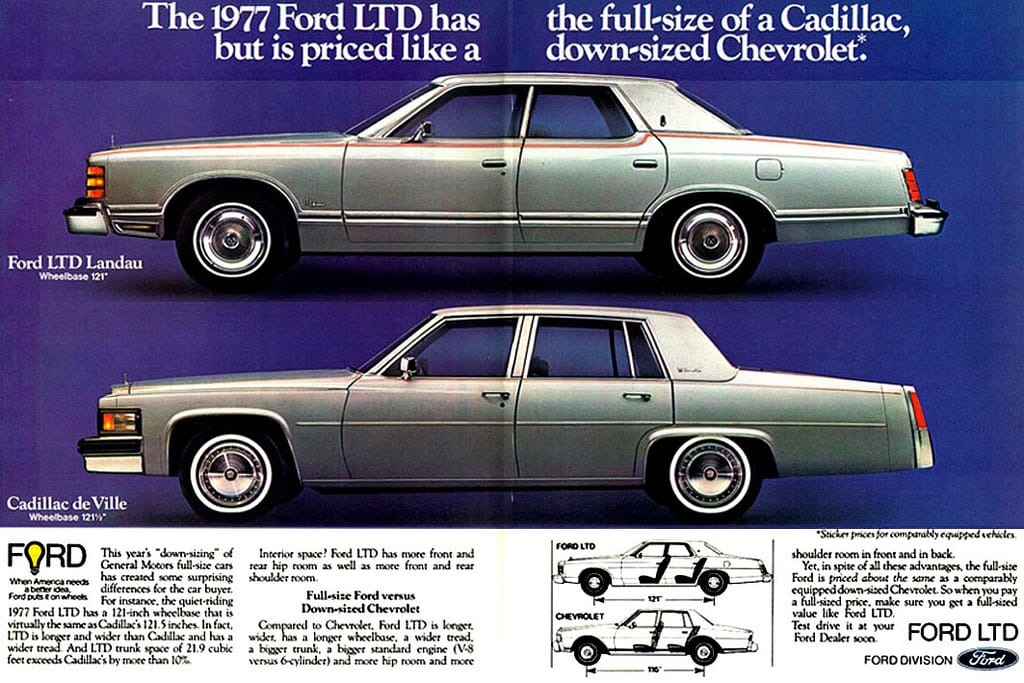
These Fords were the greatest and most exaggerated example of the American dream of owning a big car. Sure the competitors at GM and Chrysler followed suit with their big cars, but Ford was the ticket if this kind of car was your bag.
The Fords had higher quality interiors and a more solid feel than GM’s floppy plastic laden 1971-76 cars, while Chrysler’s cars weren’t even in the game. Yes, the Lincolns of this time had even more brougham luxury, but dollar for dollar, it was hard to beat one of these Fords. If one was car shopping and did so by dollar per pound and bang for the buck, Ford delivered better than anyone else.
No longer did you have to pay Cadillac prices to get the buttery smooth ride, luxurious interior and modern luxury options. Hell, even Bedard admits that most people riding in a Rolls Royce, Mercedes, and an LTD blindfolded would probably pick the LTD. And the LTD will outperform that fancy Rolls and is not far behind the Mercedes in a straight line. Finally, one could fulfill that dream of the big American luxury car and only pay Ford money!

So for a moment, maybe we can do as Bedard describes in the article. Picture yourself back in 1976 cruising in an LTD across the big open skies of the Midwest. Feel those big soft velour seats, tap the steering wheel cruise control buttons to set it at 55 mph, set the automatic climate control to 72 degrees, and point that hood westward. Now we’re living the dream! Ok, maybe I am getting a little carried away. I know these big Fords will never be on an all-time greatest car list of any sort, and despite the perspective I have taken in this article, they aren’t really my cup of tea either. Nonetheless, for many they served as durable and comfortable transportation that they were proud to own, and for that they will always be a good car in my eyes.
A special thanks to Roger628 for providing a digital copy of the Car and Driver article.
Note: a rerun of an older post.























I never understand *Malaise* but IMO FMC was STILL building cars people loved for their size, comfort and isolation from an increasingly hostile world. They were the last of The GREAT AMERICAN LAND YACHTS. As I’ve often commented. It’s HUGE! It guzzles gas! It pollutes the air! It scares the birds! Other cars part like the Red Sea to get out of its way! What’s NOT to love? I’ve been fortunate enough to have owned Crown Victorias, Grand Marquis, and Town Cars, and generally ssuperior to GMs, with the exception of my 89 Fleetwood Brougham DeElegance. My current low mileage 2007 Town Car Signature Limited is the last gasp of traditional American Luxury CARS.
I can’t imagine the pain of having to cruise along at all of 55 MPH. It must have been terribly frustrating.
I can’t say I have a lot of love for these cars. They were huge, heavy conveyances that only really shined when going down a straight Interstate highway. Where I live we don’t have such roads, so the LTD didn’t sell well in Canada. In contrast, the GM B bodies that debuted in 1977 were very popular. They seemed to be right sized.
55 was indeed painful. For a time, at least in New England, we were even down at 50MPH.
Driving my Mom’s 1968 Country Squire to Vermont for skiing day trips seemingly took forever. If you sped up even a bit, say to the near-supersonic approaching 60MPH (gasp), truckers and others would flash lights and blow horns at you.
It wasn’t a pretty time.
I worked for Hertz as a transporter in ’77 and ’78 (mostly drove 1 way rentals the other way, but sometimes picked up cars for other reasons), our home base was the airport in South Burlington.
I’m not the fastest driver, and we were paid by the trip, not by the clock, and I figured that lots of times I was working for less than minimum wage…plus you added in weather, 2 lane roads and searching for the pickup spot (after awhile I got to know most of the ones but there were sometimes new places; I had to pick up a stolen one which wasn’t at a Hertz pickup point for instance).
And we sometimes had equipment issues…like failing alternator, trying to nurse the car running off the battery trying to minimize loads. And several drivers hit deer (was fortunate not to have done so maybe because I was driving a bit slower than some and had more time to react).
But the cars mostly still hadn’t transitioned to economy models…though the engines weren’t great, we still got to drive some of the oldies which seemed to mostly disappear after ’78. I drove an economy car as my regular ride (’74 Datsun 710) but my parents still had a ’73 Ford Country Sedan with the 400 that I drove on occasion, the smooth ride maybe made up some for the slower speed limit (if you weren’t in a hurry). Back then Hertz specialized in Fords, most common were the LTD II and Thunderbird, though Grenadas and (in ’78) Fairmonts though we also had Dodges , some GM, and a couple imports (Datsun 510, Toyota Corolla liftback).
My parents had the Mercury Marquis equivalent of this. It got itself up and going with the largest available engine optioned. And, it was basically a trouble-free car for a number of years.
Having owned a used 71 Custom with a 302 V8, AM radio and not much else, then later a used 75 Custom 500 ex-RCMP highway patrol, I have some good memories.
Mainly the 71 Custom because of the good times tied to it such as the local drive-in theatre in the small town where I worked. The Custom and the 75 Custom 500 both were terrific as long distance cars, nice and cozy and comfortable. The 75 took me to British Columbia during a career move in October, 1977. Over 500 miles in one day. It had the 460 V8 and fuel fill-ups were planned well ahead of time. Overall, these big Fords had their fans and there were plenty of them on the roads. My boss at OK Radio had a 76 Country Squire which I had to take to an event in another town. My gosh, what a beast. But loaded with options including 8-track player.
Yes, most of the Seventies were a bad time for the automotive industry as they struggled with emissions regs and safety starndards. But here we are years later with the big bumper cars now collectable with some people.
I posted early today. Is there something wrong? NO comments?
Oh yes, the great American LTD. Used by the bad guys in so many TV shows!
My memory of these was in 1977 when my uncle was ready to trade out of his 1974 Impala.
Before heading to the Chevy store to see the much improved Chevrolets, a friend told him to go look at an LTD. He was telling my dad about this.
“Ralph”, he said,” all the dealer had was loaded units. And you know I don’t like it need all those fancy things. Tilt wheel? Well I’m the only driver so why? A right hand mirror? I always use the mirror inside the car!”
So, he went to Chevrolet, and ordered a brand new Impala sedan. It had one mirror, cruise control, a stereo, sans his second car with air conditioning.
The wife and I owned a 77 Landau and found it to be very reliable and other than lots of gas, not needing much. I remember reading this article when I was 13!
My father bought a 1975 LTD Landau 2 door, new in 1975. When I asked him why he bought a 2 door after a lifetime of 4 door cars, he said he wanted something “sporty”. ROFL. Go figure. With the coupe having that weird little side window between the front and back side windows, it just looked strange. One of the few cars of that era that actually looked better as a 4 door.
It was a big, comfortable barge, with sluggish performance from the 400. Basically trouble free for the 7 years he had it.
When I worked for the provincial government from 1979 to 1982 one of the cars in our fleet was a 1978 Ford Custom 500 with a 302! We also had a 1979 Chevrolet Bel Air wagon with a 350 and four 1978 Plymouth Furys with 318 4 barrels. The Ford was the most luxurious and comfortable of the bunch but it had no acceleration and no handling and was very thirsty. When the lean burn was running right the Plymouths had the best overall package in terms of acceleration, handling and fuel economy. The Chev didn’t handle quite as well and drank more gas.
The C and D article is a primer on why Detroit stayed with their formula for so long.
Mr. Bedard’s writing is lyrical and just pulls one along. The writers here at CC are solid, but one generally does not see the caliber of writing that was common in car magazines, and in magazines in general, back in the day.
Gee whiz; if I or the other writers at CC had to only write one article per month, we might be able to be a bit more lyrical too. But thanks for the compliment. 🙂
To be clear, I am not criticizing CC writers, who are top of the heap, IMHO. But writing and published writings, in general, pale compared compared to many efforts published in the past.
My problem with this article is that it doesn’t put the LTD into proper context. It was bloated, it floated, much of the exterior and interior details were chintzy, and the very next year the new downsized GM full-size cars made it look (and feel) totally out of date.
There was a reason these full size cars were shrinking in their market share, and by 1976, the big Ford was down to 4%.
Shall we dig up a C/D review of the Mercedes 450SE? Unfortunately I don’t have one handy, but I suspect Bedard was pretty lyrical about that too.
My issue with so many of these C/D reviews was that they were too lyrical (subjective) and not objective enough. But that was the clickbait of its time as it still is today.
I appreciated what Bedard said then and still do today. While they had their flaws, for most people these biggest of cars were an almost inconceivable value, particularly for affordable, safe, and comfortable family transportation. I guarantee that many overseas motorists would have loved to own cars like this had their road systems had been appropriate. Ford, GM, & Mopar, each had their strong and weak points, myself I couldn’t abide the horrible loose and sloppy handling of Dad’s 72 LTD so proceeded to own several Mopar C body and Olds & Buick B & C body cars during this era, and ultimately came down on the side of our ’73 Fury and ’77 Gran fury Brougham for handling and better interior plastics (GM was terrible for this) as our favorite family cars and boat hauler (try that in your 450 SEL). For their intended purpose these cars were absolutely unbeatable, and as I get old (er) I more and more appreciate how special they were, never to be seen again.
According to Lee Iacocca’s 1982 autobiography, Ford’s extended production of the full size platform through 1978 was not intentional.
Ford planned to introduce the downsized Panther platform in 1977, in direct competition with General Motors downsized models. Unfortunately, in 1975, Henry Ford II slashed development spending in a misguided effort to conserve cash. The Panther platform was delayed two years as a result. In retrospect, Ford did an excellent job advertising and promoting their obsolete, oversized LTDs, Marquis and Town Cars to the American consumer, in light of the significantly better General Motors offerings. The concept of super sized ride and value was a hit with those consumers who bought cars by the yard.
My only experience of one of these cars was riding in one at an uncle’s funeral. American Ford cars weren’t sold in Australia in the mid-seventies, only the F150s; the last American LTDs that were sold here (’72?) seemed to wind up in government fleets, condemned to haul politicians around.
I must commend Patrick Bedard for taking off his enthusiast hat for a time. From what I recall of that mourner’s car, I don’t think I could have been as objective/kind. I remember being cramped for footroom; there seemed to be a seat motor hanging down in the way, which was surprising in such a big car, and kind of took the edge off any enjoyment of the car. Though the chauffeur did move the seat forward a bit, and admitted that wasn’t the first time someone had complained. We got talking, and apparently the 400 moved it along nicely when you floored it, but perhaps not as well as six and a half litres ought to.
It brought home to me in a very tangible way just how different the US motoring scene must have been, and how wise they were to let Ford Australia go their own way.
You touched upon one glaring deficiency in these and other makes’ behemoths.
They weren’t as space efficient as they should have been. Especially the 2-door models. Huge cars but cramped in the back.
Rear drive wasn’t an excuse. In fact, both the Panther and Fox platforms went a long way to rectify the problem. Ford even offered a stretched Crown Victoria for taxi use later on.
One reason the GM B bodies were such a hit was that they offered significantly more room than their predecessors and even these Fords. Less was definitely more in this case.
I had my first full-sized Ford in 2003. It was a ’75 500. The lowest optioned version of the LTD for police cars and municipal use. That car, even nearly three decades later, not only got me from A-B more reliably than any of my friends modern grand-ams or SL-1s, and had plenty of room in the back seat for a boy to become a man, I digress.
As for the engine bay, my 75 was equipped with a 351C (Cleveland) stripped out ,made about 275HP. I could fry tires with just flooring the pedal under the weight of that behemoth. The high school parking lot stood no chance and I think all my teachers secretly hated that I drove to school for nearly two years given my parents let me license immediately at 16… Those were the days. After I graduated I saved all my money for a 2001 Escape, a vehicle I drive for another decade with over 230,000 on the odometer when I sold her. I loved the modern new ride after the the 75, but the memories and the stories still told originated in that big baby blue.