

Text by Patrick Bell.
Chevrolet always represented reliability, quality, and value during the 1950’s, and that was reflected in the sales numbers. It was a decade of great change, and today we have a gallery that displays some of those, which go from chrome-teeth grilles at the start, to “bat wings” by decade’s end.
Somebody was a proud owner of a brand new 1957 Bel Air Sport Sedan with V8 power, two tone paint, and an outside mirror. The buyer’s tag was in the right side of the windshield, and it was freshly detailed. On the right edge looks like a 1947-1955 Chevrolet Advanced Design or GMC Blue Chip pickup.

1949 brought the first restyle after WWII and the 1950 model had little change. The lady above was standing by a 1949 Fleetline De Luxe 2 door sedan with a radio, outside mirror, and what appeared to be a Texas license plate from the same year.

The 1951 models were updated with new trim, and featured in this shot was a Styleline De Luxe convertible that was parked on an oil stained road. It was equipped with a radio, outside mirror, and whitewalls, while the fender skirts were standard equipment on the De Luxe models.

Shown here was the other end of the spectrum, a 1952 Styleline Special, the entry level series. It was either a Business Coupe or a Sport Coupe. The Business Coupe was a three passenger with a luggage area in place of the back seat, and the Sport Coupe had a back seat and carried six passengers. The Business Coupe was the least expensive model, while the least expensive six passenger model was the two door sedan which had a longer cabin area. It was quite an array of model choices from the same body.

An image from February of 1962 was showing the new style of the 1953 models with a large house in the background. Along with the restyle were new names for the lower two series (One-Fifty and Two-Ten), and the Bel Air was now a full series.
The one above looks to be a Two-Ten 2 door sedan, the second most popular model of the year.

And a 1954 Two-Ten showing the updated grille, plus a view of the side. This one was either a 2 door sedan or a Club Coupe. The difference was now all inside, with a fancier all vinyl interior in the Club Coupe. There was a $65 price premium, but they sold only about a third as many as the sedan. It was wearing a 1953 Connecticut license plate with a 1954 renewal tab.

One more 1954 model, another Two-Ten 2 door sedan or Club Coupe with a lady in the process of entering or exiting. There may have been a Ford family across the street as I can see a 1946 model through the Chevrolet, and on the left edge may have been a 1951 model.

One look at this face is all it took to see the radical change in the new 1955 models. This one did look new, or at least close to it. It was a Bel Air Beauville wagon, with two tone paint, outside mirror, and a grille guard. In the left background looks like a 1952 Mercury, and in the right background a pale green 1950 Pontiac.

Here was a sharp looking 1956 Bel Air 4 door sedan that was well equipped with V8 power, two tone paint, radio, outside mirror, full wheel covers, and whitewall tires. It looks like the people in the car had been out for a drive on a warm day and stopped to say hello.

This 1956 Two-Ten was at least ten years old in this image as it was wearing a New York license plate that was first used in 1966. It was either a 2 door sedan, or a Delray Club Coupe. And, like the 1954 model, the difference was in the interior style. Six cylinders provided the power, and it had a radio and outside mirror.
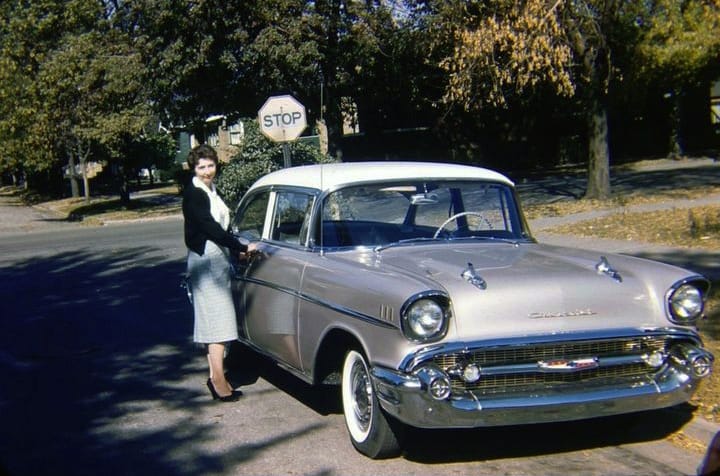
Here was another new looking 1957 Bel Air, this one a 2 door sedan. Whoever ordered this car opted to save a little money by selecting 6 cylinder power, and used the savings for trim options such as full wheel covers and whitewalls, plus a radio to listen to.

The whole gang was out cruising in a top down 1957 Bel Air convertible with V8 power. The popularity of the 1957 models has really grown since they entered the classic age. This one was equipped with full wheel covers to go with the whitewalls, but I don’t see a radio antenna. And I am not sure what the “Basements” sign was referring to. Basement apartments?

All new styling brought the 1958 models into the “longer, lower and wider” era, along with the “gull wing rear fender style” as described in the sales brochure. Shown here was the new Bel Air Impala Sport Coupe, which along with the convertible version was Chevrolet’s new entry that marked General Motor’s Golden Anniversary. The lack of a “V” on the deck lid marks this one as a six cylinder model, which was likely on the rare side. Otherwise it had the typical outside mirror, full wheel covers with whitewalls, plus a California license plate.

The other extreme for 1958 was the entry level Delray series, a name used for just this year as a series. Shown above was a Delray Utility Sedan (no back seat), or 2 door sedan, which were always more popular. It was a 6 cylinder model with a 1967 Texas license plate and no rust. The lady posing with it was dressed for the likely windy winter day.

This 1969 image had a 1958 Brookwood wagon as it’s main feature with a rambler style home in the background. The wagon was V8 powered and had an outside mirror to better deal with those California freeways, plus new style narrow whitewalls to go with the standard hub caps.

Chevrolet for 1959 was “all new all over again” according to the sale brochure, and that point would be hard to argue. The Impala was now the top of the line series, and the Bel Air and Biscayne each got bumped down a notch. Shown here was a Bel Air 2 door sedan with V8 power, full wheel covers, and an Iowa license plate from 1960 or 1962.
Thanks for joining us and have a great day!























That first `57 Chevy appears to have just left the dealership after the papers got signed! Spotless.
The “Basements” sign must have been advertising that the houses in the new development had full basements and not just a slab or crawl space. A nice feature if it stayed dry. Someday I would like to have a basement for all our “stuff” so I can actually park vehicles in our garage, Time is running out.
Know what ya mean; “someday” I’d like to have covered parking and a washer/dryer “in” my space..lol (time pretty much has run out) Ah well.
Why anyone purchased a new Chevy before 1955 has always mystified me?
Fords were faster and superior sustained speeds highway cruisers.
Plymouths were more comfortable and higher quality control cars.
I remember reading a magazine review of the then new 1955 Chevy where the author stated Chevrolet was wanting to shed the image of it being an ‘old folks car’.
The 6 cylinder had been upgraded a couple years before, to full oil pressure lubrication and inserted bearings. The last major manufacturer to do so.
I agree with that. Styling was bland too. Probably brand loyalty?
There’s a lot of people still cruising around in them early 50 Chevys in Cuba seems to be the most popular car that’s a pretty good lifespan
Agreed,. Unfortunately, quality control of late 50’s Ford and Chryslers was notoriously bad, as GM’s improved. Lee Iacocca wrote of having to use clothesline wire to secure the rear doors of a new ’57 Fairlane 500 (new design, car of the year, outsold the aging ’57 Bel Air) when he visited Ford Dealers as a district manager.
Chryslers were straight up rust buckets until the early 60’s.
Amusing but wrong answer from ChatGPT regarding the “Basements” sign near the ’57 Chevy:
Me: “What is the round yellow “Basements” sign in this photo?”
AI: “The “Basements” sign is actually the cursive “Bel Air” emblem on the side of the car — a styling badge used on the 1957 Chevrolet Bel Air. In this photo, the script is partly obscured and blurred, which makes it look like “Basements” at first glance.”
uh, nope. The ’57 Chevy’s tail fins weren’t *that* tall…
Its other guess was more on target –
The “BASEMENTS” sign is most likely a roadside advertising sign for a housing development or home builder promoting houses with basements in a newly built suburban neighborhood.
In the 1950s, especially in expanding North American suburbs, developers often placed temporary signs like:
“Basements”
“Custom Homes”
“Display Homes”
“Lots for Sale”
…to attract buyers driving through new subdivisions. The neighborhood in the photo—with fresh ranch-style homes, young trees, and wide streets—fits that postwar suburban development pattern very well.
So it probably is not the name of a business called “Basements,” but rather a simple promotional sign advertising homes with basement foundations.
There were certainly still lots of houses built in the 1950s that didn’t have basements.
Maybe the sign was foretelling the eventual Name De”Basement” that was about to happen in the next two years to Chevy’s Bel Air model name!
I’ll show myself out now. LOL
Please note that under the word “Basements “ is “2 B???”
2 bath? Certainly not 2 bedrooms as that wouldn’t be a selling point, right?
Chrysler products had a very serious rust problem
First image shows India Ivory over Dusk Pearl, same colors as my ’57 Two Ten two door sedan.
The ’57 in the lede photo is beautiful.
Yes, and look at the size of that steering wheel. Huge.
Power steering was not yet commonly ordered on a Chevy. The leverage of that big wheel helped a lot.
“…that was parked on an oil stained road”
Today, it’s tough to imagine just how leaky, stinky, and trashy so many cars were 70 years ago. I remember billowy oil exhaust pouring out of many cars on the road. I clearly remember how many cars had a raw gas stink. Even “new” cars didn’t completely burn gasoline, meaning that even cars that were tuned, still stunk up the air.
Noise? Mufflers rusting and falling off, holes in mufflers, rattling engines, the road noises were decibels louder than anywhere today. Lead gasoline fumes – remember that?
Houses without A/C, windows opened 24/7, meant growing up surrounded by auto air and noise pollution. My South Chicagoland hometown was never silent. I grew up surrounded by transcontinental freight hurling just over our horizon, lit by overhead cobra lights on I-80, the massive rail tracks over which thousands of heavy diesel trains bellowed through RR crossings, the bell-clanging gates, the deep rumbling of steel mills and industry everywhere.
Every road was covered in oil, every ditch filled with litter, and air that smelled differently depending on the direction of the wind. North or east, you can smell Lake Michigan, from the east, you can smell the International Port and the steel mills, west and you can smell the paint fumes from Sherwin Williams, and south, you could smell the Heights Industrial Park.
Today, we just cannot fathom any of this. Thank you President Nixon’s EPA act establishing Federal pollution standards!
Seeing the picture and description of the 1951 Chevy De Luxe reminded me of a story about my father’s stepdad. He was an arrogant asshole that everyone in the family hated. Around that time he bought a brand new Chevy De Luxe. He was so proud of it and would constantly point out to anyone who would listen that it was a De Luxe. He convinced my grandmother that they should go visit her brother and her sister so he could show it off. The whole time they were there he endlessly harped about his car not just being a Chevy but that it was a De Luxe. From that point on, my grand-uncle would always refer to him in a ridiculing way as “The De Luxe”. The nickname stuck and soon everyone in the family was calling him that behind his back.
Great photos and good eyes on everything, as always!
My hunch on the “Basements” sign is that many ranch homes of that era were built on slabs, and plenty of people-myself included-would want one built over a basement! If these homes were in the midwest, south central tornado-prone areas, that would be a good selling point then and now!
That’s absolutely the obvious answer regarding “Basements”. In northern states they were pretty much necessary due to frost heave, but increasingly not so as one moved further south. So yes, it was a selling point in those areas where it was optional.
Absolutely correct. Blessed to have a dry basement. There are horror stories about northern homes built on slabs. Cracked concrete floors, cold floors in winter, etc. The way to go is to have a crawl space if you don’t want a basement.
Thanx for these fantastic photos .
Yes, a new house with a full basement was a huge thing back then .
-Nate