
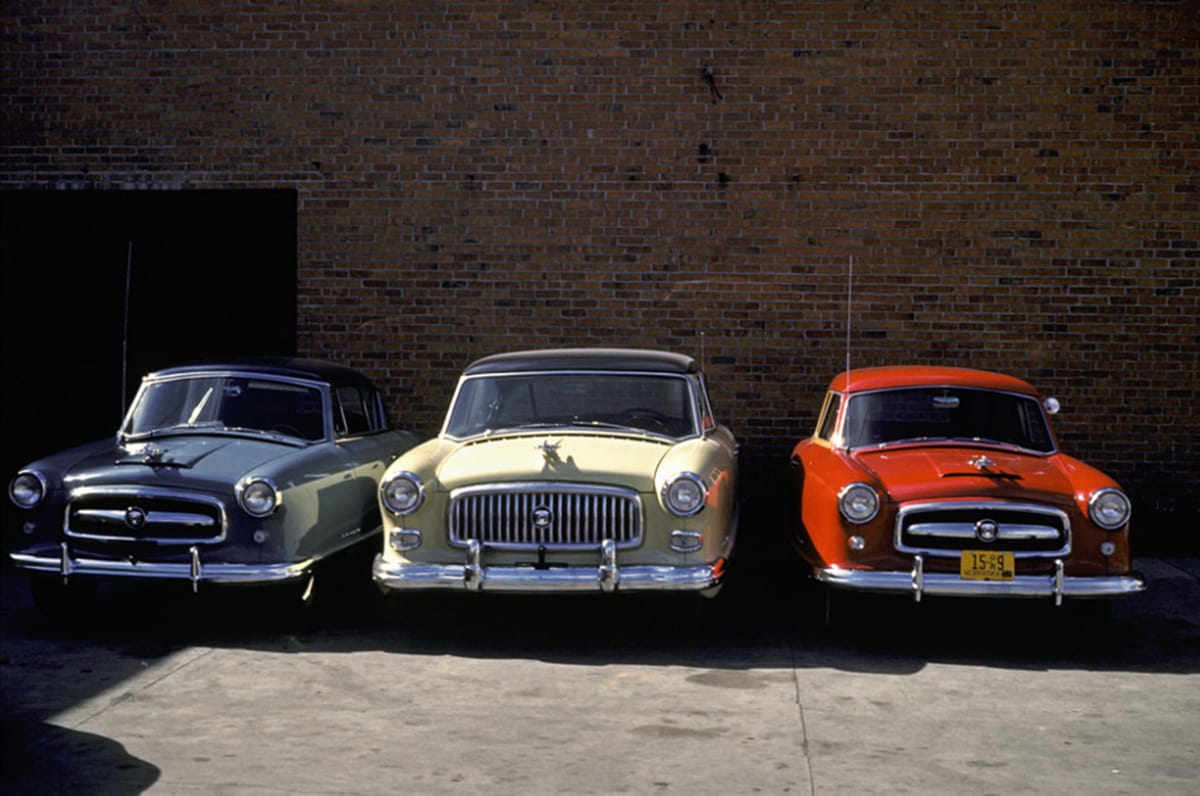
In today’s visit to dealers of the past, can I interest you in some new, colorful, and shiny Nash vehicles? A trio sitting in what looks to be a sales or storage lot in August of 1953 in Nebraska, and looking pretty colorful and attractive in their bright two-tones and glitzy trim.
From left to right, we see a Rambler Custom Country Club two-door hardtop, a four-door Nash Statesman sedan, and another Rambler—the upscale Custom Station Wagon, distinguished by its simulated woodgrain trim. Together, they offer a colorful snapshot of Nash’s 1953 lineup.

The Ramblers are the easier ones to sort out in today’s vintage image, with their smaller size and sharply trimmed looks, befitting their “premium compacts” image. For 1953, they still rode on the 100″ wheelbase they had debuted with in ’50, and still had very rounded looks. However, newer grille chrome surrounds did much to make them look closer to mainstream. Power came via a 184CID inline six for manuals, or 195.6CID six for automatics.
We’ll focus on the ones in today’s photo; the two-door hardtop Custom Country Club was that year’s best selling Rambler, with 16809 sold. Wagons were second in favor, with 10571 Customs and 1114 Suburbans.

Let’s move on to the Statesman in the middle of today’s photo, with styling basically identical to the larger Ambassador. Telling signs, it lacks the small bumperettes that Ambassadors came with, and doesn’t carry that model’s longer schnooz, which would be sticking out.
Nash’s full-size models were largely carryovers for 1953, continuing with the styling introduced the previous year. Under the hood, the company relied on inline-six engines marketed under the evocative “Powerflyte,” “Jetfire,” and “Dual Jetfire” names—cutesy terms intended to mask their tepid performance. Buyers could choose from a 195.6CID six producing 110 HP or a larger 252CID rated at either 120HP or 140HP. You’ll also see a reference to “Le Mans” next to the Dual Jetfire, alluding to the 1950-1953 Nash-Healey LeMans efforts.

You may have also noticed the Pinin Farina name prominently featured in Nash’s 1953 brochure. Not that the Italian styling firm had much to do with their final looks, but they had worked on the updated Nash-Healey and submitted design proposals for the 1952 lineup. Those proposals didn’t make the cut—and, as no known photos survive, we’ll probably never know whether that was a missed opportunity or a wise decision. Still, some elements from those studies are said to have reached the production cars, though any such influence appears to have been very minor.
Regardless of how much styling input Pinin Farina really had, the association itself had value. The name sounded exotic; it added a touch of European sophistication to Nash’s marketing and lent the lineup a Continental flair at a time when anything Italian sounded glamorous and exotic to American buyers. Finally, Battista “Pinin” Farina got some dollars from the whole thing, too.
From today’s perspective it all sounds rather iffy, but all this was pre-internet, and distant places carried a certain mystique that advertisers were more than happy to capitalize on at the time.
Dubious marketing aside, I like these small Ramblers. One thing to remember, these Nash products were pricey. The Rambler 2-door hardtop was $2094, and the Rambler wagon was $2119. The cheapest Statesman was $2144. Those prices were more than a Chevrolet Bel Air hardtop and about the same as a Ford Crestline 8 Victoria hardtop.
Still, can I interest you in one of these three? And which one would you take?
Related CC reading:
1950 Nash Convertible Landau – Adorable, Thrifty But Not Cheap
1950 Nash Rambler Custom Station Wagon – The Original Luxury Compact Turns 75
1953 Nash Statesman – AMC’s DNA























I remember encountering one of the big Nashes on the walk home from school one day – would have been in the late sixties. I knew what it was, though it was the first I had seen. So many details just didn’t look right – not least of all those skirted front fenders. I knew there had to be wheels in under there somewhere. Then there was the goofy windshield shape dictated by the odd cowl design, and the general sense of ‘overweight puffiness’ about the design. Oh, I know the early fifties cars were all curvy, but this seemed more ‘bloated’ than most. Something to do with the radius of the curvature. I think. Other cars of the era seem more ‘taut’.
The Ramblers suffer the same flaws (in my eyes). Generally I don’t find this generation of Nash style appealing. Nice colours though.
My guess is that the dealer these cars belonged to was Solberg-Distel Motors in North Platte. Nebraska license plates were county-coded (even Dealer plates), and “15” was the code for Lincoln County, where North Platte is the principal city. As far as I can tell, Solberg-Distel was the only Nash dealer in the county.
Solberg-Distel appears to have closed in the mid 1950s, and the dealership’s former building was demolished in the 1970s.
Make mine a red ‘Custom Convertible’ (like Lois Lane drove) with the “Dual-Range Hydramatic-drive please .
-Nate
I have a major soft spot for Nashes of this vintage, and as much as I love the Rambler, the big Nashes really speak to me. They were so uncommon on the ground when I was a kid in Iowa in the early ’60s. When I moved back there, a friend of mine had found a real cream puff ’55 Ambassador. What a boat!
Can I have all three?