
Text by Patrick Bell.
Trucks are the feature today with a good gallery showing them in action, whether it was work or play. These were all regular, everyday type vehicles that were common on the roads back in their day, so take some time on this winter day and look them over.
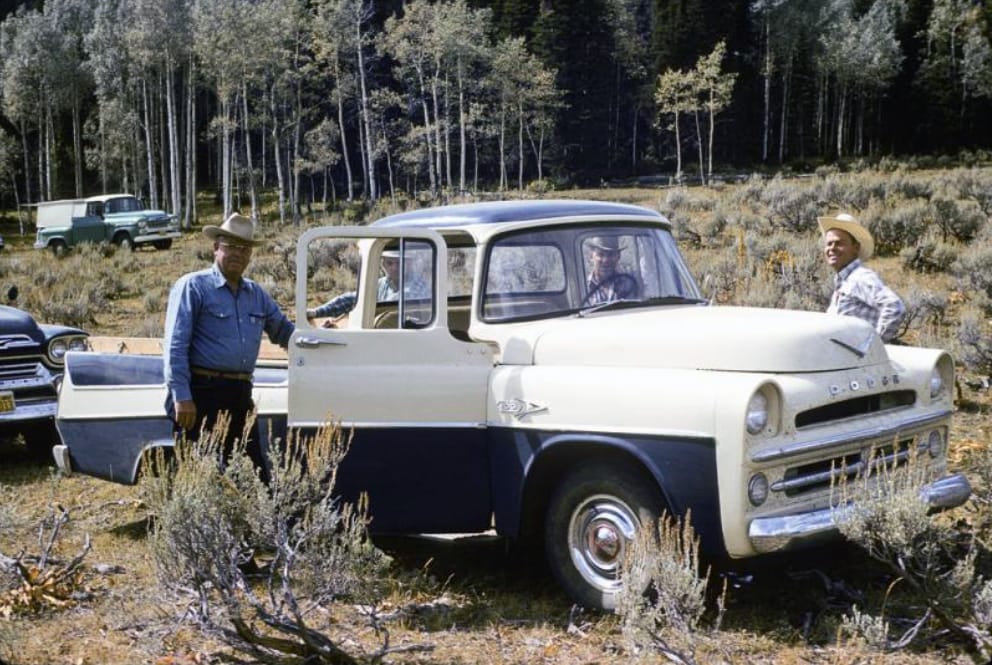
We begin with a few ranchers that were gathered around a rare beast, a 1957 Dodge Sweptside D100, the pickup with tail fins that was one of about 200 made. It was a low volume style experiment that was Dodge’s answer to the Chevrolet Cameo, the first “luxury” pickup that had a bed that was the same width as the cab. Both of them actually used a stepside bed with an outer panel added to achieve the width. Dodge used 1957 2 door station wagon quarter panels, tail lights, and rear bumper. A “Red Ram” 315 cubic inch V8 was standard, which at that time was the largest engine available in a light duty pickup. Neither one of them were a sales success mainly due to the higher price, and less than 1200 Sweptside’s were built in the three years (1957-1959) they were offered. Parked behind it was a V8 powered 1959 Chevrolet Apache with the optional chrome grille and bumper that was wearing a California license plate. In the background was a 1958 or 1959 Chevrolet Apache 31 series Stepside with a camper shell.

Now we are in Alaska, likely in the fall before very much snow had accumulated. A 1951-1953 GMC “New Design” half ton with the Nu-Vue Rear-Corner windows, an aftermarket defroster on the right windshield, and a sign on the door that begins with “STROM” on top, while the lower line was “xxxANKS, ALASKA”, and what appears to be a lightning bolt going through the center. I am going to call the business an electrician, and the town “Fairbanks”. It looks like some new power lines were going up in the background. The truck looked reasonably new, with a few dings, lots of road dirt, and had no snow tires. The gentleman was probably former military as he was wearing military style clothing, and was holding a pistol (Ruger?).

Here is a 1948-1950 Ford F-1 with a tarp roofed bed shell that was towing a horse trailer that appeared to be from Lincoln, Montana. This was Ford’s first post war new truck style that ran through 1952 with a trim refresh in 1951. It was available with six cylinder or V8 power, both of the flathead variety.

There is an Elliot Lake in Ontario, so I will presume that is where this V8 powered 1958 Fargo D300 was from. It was equipped with the “Utiline” (step side) bed as the new “Sweptline” (not to be confused with the Sweptside in the first image) did not arrive until 1959. It also had a tarp covered shell to keep the cargo dry. The man looked like he was ready to hit the road.

A nice looking campground was where this 1958 Chevrolet Apache 32 Deluxe Fleetside long bed was parked. Along with the Deluxe cab it had a slide in camper shell, rear step bumper, and a California license plate. It looked close to new, and beyond it was a tear drop camp trailer.

Another California truck, this time in a parking area overlooking the ocean. A 1962 GMC 1500 (3/4 ton) Custom Wide-Side long bed with a boat riding on top of the camper shell. It was powered by the legendary 305 cubic inch V6, the only engine available. Other equipment were West Coast mirrors, a spotlight, front bumper guards, and a rear step bumper.

The scenery looks like Utah and so does the license plate on this 1966 Ford F-250 Custom Cab Styleside with a camper shell. More than likely it was equipped with the 352 cubic inch V8, although 240 and 300 six cylinder’s were also available. Other equipment were West Coast Mirrors, a tool stowage compartment in the bedside, and a rear step bumper. Plus a Streamline travel trailer with a large air conditioner was in tow.

The whole family was posing with a 1964-1966 Chevrolet C10 (judging by the rear wheel and hubcap) Fleetside long bed with a cabover slide in camper. It also had West Coast mirrors, a clear plastic bug shield, the optional side moldings with painted insert, rear step bumper, and Utah license plates used from 1968-1972. Parked to the right was a 1961 Pontiac Ventura Sports Coupe.

A U.S. Air Force base in a tropical location was the location, with a 1965 or 1966 Dodge D100 Utiline short bed that was in use as a Security Police vehicle. Behind it was a 1966 Ford Country Sedan, also in Police duty. And perhaps a turquoise 1967 or 1968 Ford Mustang on the right edge.

The Jeep Wagoneer was one of the pioneers in its field when it was introduced in late 1962 as a 1963 model. It’s “field” later became known as the Sport Utility Vehicle genre that has replaced the American family sedan. The featured one above was a 1965-1967 model that did not look very old in this image. They were available in 2 or 4 wheel drive, and this one was the latter. It looks like the occupants were waiting for Dad the photographer so they could continue on their journey.

The truck market was growing rapidly in the early 1970’s and both Ford and General Motors had a major redesign for the 1973 model year. They were more car-like than ever before with a wider range of available powertrains and more convenience type options. The one above in this 1976 image was a 1974 Ford F-100 with the Explorer Package. The package was offered in three exclusive colors; Brook Blue Metallic, Parrot Orange, and Viking Red as shown above. Plus a long list of trim items, such as the Bright Low Mount Mirrors, Bumper Guards and Rub Strips, and Bodyside Tape Stripe. This one was purchased at Villa Ford in Orange, California, and appeared to have a camper shell plus a trailer in tow.

The image notes indicate this was taken at Moose River Plains in New York sometime in 1973. On the left was a 1970-1973 Ford Sport Bronco Pickup with a snow plow attachment. It was available in both 6 cylinder and V8 power, and in 1973 for the first time power steering and automatic transmissions were offered. And to the right was a 1973 Chevrolet Cheyenne? C20 with a Phoenix 10 foot cabover camper and a front mounted spare tire. This was a total redesign year that included many new options such as the 454 cubic inch V8.

Dodge introduced the Ramcharger in 1974 as competition for the International Scout, Ford Bronco, and Chevrolet K5 Blazer. It was offered in the U.S. through 1993 in two generations. The one above was an early 1974 model, and had a light bar on top as well as a luggage carrier.
The first units came with doors without the supper window frame (half doors), so when the top was removed it looked like a true convertible. Apparently that did not work too well since halfway through that year they changed to full doors. The removable tops were steel, so I presume that was rust showing in the image.

Another one of the SUV pioneers was the International Travelall that was built from 1953-1975 in four generations. The featured image looks like a grandfather showing a grandson something about the boat on top of his 1971 or 1972 model with the optional Custom exterior trim which included the wood grain panels, and the simulated vinyl roof which was a sprayed on textured finish. He kept his fishing poles on a side mounted gun rack, was set up for trailer towing, and had a King County registered Washington state license plate. The yellow pickup to the left was a 1960-1966 Chevrolet or GMC, and the blue car looks like a mid to late 1960’s full size GM. And on the right edge was a 1970-1972 Ford F-series with the hood open.

Our closing image was a nice view of the mountains in the background with a 1980 GMC K20 Wideside taking a roadside break. It was equipped with 4 wheel drive, a camper shell, bug shield, Below-Eyeline Mirrors, Special Two-Tone Paint, and a rear step bumper. In the left background may have been a 1970’s Dodge Tradesman based motor home.
Thanks for joining us and have a great day!
Note: If you wish to see your vintage photos featured at Curbside Classic, send them to us at [email protected].























Wow ;
So may good memories created from these images, I still prefer a light duty pickup truck for my daily use .
-Nate
Some great shots. My favorite of course is the one that is very similar to one of my own the Travelall. Like mine the featured vehicle is a 1010 series the IFS equipped “1/2 ton” version. Due to the use of the second version of the old Studebaker wheel covers this one is most likely a 1971. The original version of that wheel cover looked like the one below. IH also used the ribbed version w/o the “S” in the center of course and then the ribs were removed to create the version seen today. 1972 brought the new Sombrero style wheel covers that lasted until the Scout II’s demise.
Of course I knew it was from Washington with the first glimpse of those mud flaps as I scrolled down. Those were everywhere back in the day and on rare occasions I’ll see a truck from the 60’s- early 80’s that seem to still have their original set. Another interesting detail is the rectangular tail pipe tip, not something I’ve seen before. The factory tail pipes exited at a 45 degree angle and would be between the kid’s legs and that mud flap. So I’m guessing the owner had the tail pipe(s) modified to prevent melting of those mud flaps.
The Custom exterior package did not include the faux vinyl top and I don’t think that as every offered as a standard option, though if your dealer wanted to make the sale there is a good chance you could get your order sent to the sales processing center where in house upfitting of one offs and options that didn’t play well with the assembly line occurred. But chances are it was done by the dealer or the owner.
That small marker light on the front corner of the roof is another interesting detail that was not a factory option which makes me believe the owner did that himself along with rolling on the faux vinyl top.
The Boat rack is another thing I instantly recognized as I have one built from the same DIY kit, though for the life of me I’m not sure where my boat clamps are, but the rails are ready to go. You purchased the clamps and supplied your own pipe or conduit to fit your needs. It appears he went extra fancy and strong using threaded pipe and a Tee to connect the front and back bars together.
I tried to make out the dealer frame and can’t be certain but maybe it is from Bryant Motors in Renton Wash which stayed in business selling buses until relatively recently. They are now Bryant Mower and Tractor selling Cub Cadet along with other lines.
That ‘rectangular tailpipe’ is the mentioned trailer towing setup
Interesting I hadn’t seen that before, either in the literature or pics. Of course tail pipes of that era didn’t last that long and it is unlikely the local muffler shop would recreate that rectangular tip when time for new mufflers and tail pipes came along.
Thanks for your comments and all the additional information.
If you look close at the image you can see the tailpipe to the left of the young man’s leg. I presume that is what you were pointing out, while ‘phil’ was speaking of the trailer hitch.
My wording could have been more clear, as I did not mean to imply the simulated vinyl roof was part of the Custom exterior trim, but rather an additional option. My favorite research site (oldcarbrochures.org) does not have any information for 1971-1973 models, but in 1974 the original sales brochure shows the simulated vinyl roof as an option, so I presumed it was for the earlier models as well.
Thanks again!
Ah yes, those are Quick-N-Easy gutter racks, which must have been easy to find back in the day but are now expensive as both antique items or reproductions. I found a set of six for cheap on eBay that all needed work, and was able to make them all functional again. One of the plans for this year is to notch and bend some aluminum and weld up a custom rack for my Travelall.
Very interesting. I never owned a GM, Dodge or IH truck, but did spend some time driving a Corvair Greenbriar and my Neighbors IH 2500 with the 305ci V6. I have owned (and still have the 1986) 3 different series Ford pickups.
First, a 1958 F100 that the Scoutmaster of the BSA troop I had been a member of as a boy and later adult leader. He lost the brakes coming into a busy intersection. Frame was bent, and due to the age, truck was totaled. Friend who owned a junkyard had a 1957 ex corps of engineers F100, but no title. No problem, driver’s door was badly rusted and the VIN plate is attached to the back face. Door from 1958 swapped, and I had the title for it. Junkyard sold me a 1957 F100 frame and recorded the stamped in VIN number.
Second, a co-worker at Newport News Shipbuilding had a 1977 F150, 300 six and a C4 automatic he wanted to sell. I had been given an 11 ft slide in camper and was faced with (a) find a frame and bed for the 58 that would carry it. Engine wasn’t a problem, it was a 312 ci 4 barrel with a Borb-Warner T85 3 speed with overdrive. or (b) buy a longer bed pickup. I bought the 1977 F150, 8 ft bed so I bought it. The 300 six could handle the camper, but after I was part way through adding a factory AC system, I found it didn’t have enough manifold vaccum at highway speeds to keep the system in any position other thnan the government mandated Defrost position. Another co-worker had a 1978 F150 that I put a heater core in, he gave me a camper special 390 short block he had acquired. It needed to be bored as the cylinder walls were pitted so I bought a set of .030 over pistons, had the block bored and a set of 1965 390 4 barrel heads rebuilt (I should have had either seat inserts installed or the seats induction hardened due to the lead elimination in gas). We bought a 30′ 5th wheel, truck pulled it fine, stopping it even with it’s brakes adjusted for max voltage was scary. The government mandated asbestos elimnation came about at that time. I destroyed a set of rear brake shoes on that trip!
Third truck was a result of that trip, a 1986 F350 crew cab dual rear wheel pickup, it had the biggest gas engine, the 460 and had orignally been purchased by a local horse breeder. It towed the 5th wheel with no problems, but it has a drinking problem, 10 mpg empty, city or highway and 8 towing the 5th wheel. It now has been converted to EFI and an E4OD transmission, empty highway mileage is now 12.5 mpg so that’s a significant improvement. I bought the truck April 1994 for $4000 and still have it, as I don’t have the trailer any more so it doesn’t get used as much, but, to replace it, last year, I ran the 2024 equivilant truck, F350, crew cab dual rear wheels, tow package, Godzilla 7.3L gas engine, basically as close to what I own, $135,000. Thank you, no, I’ll keep my 1986 non-catalyst truck!
Nice Ford truck history! I like your creativity, especially with the mixed paint jobs on your current truck. A veritable harlequin F350.
Pretty amazing how expensive trucks have become.
I love that 1957 Dodge Sweptside D100
I pick one up today, if I found one in similar condition
Yeah a lot of us would but with only 200 produced in 57 how many you think still survive? I haven’t seen one for quite a few years that I can remember.my dad had a 58 cameo. I always thought the dodges were kind of strange looking. The dodgers were a metal bed and quarter fenders and a cameo was fiberglass boom boom boom
The ’57 Dodge Sweptside is a very remarkable find, even in a vintage photos. I wonder if any have survived.
The yellow GMC at the coast is in a very familiar spot, on Miramar at Half Moon Bay in CA. We have a good friend with a beach house nearby and Stephanie has been house sitting it for quite some years now when they go to their annual vacation to Hawaii. In fact she’s headed down there in a couple of weeks. The ocean has been pounding that section hard in recent years, and it’s a constant battle to keep the road at least partly intact. It’s part of her/our long walks up and down the coast there.
Great tour, thanks so much.. Watching the snow fall outside my kitchen window in Poughkeepsie ny.. six inches so far, supposed to be 12 to 18 before its done…pic I took at its start at 8 am
Super Sleuth did it again with excellent identification of vehicles. I enjoyed the presentation.
Saw one of those “Dodge (truck/cars, or car/trucks) in an old “b/w” , TV show. Found it curious at the time.
Think it may have been a “Highway Patrol”, or “Rt 66”, episode.
The kid in the back of the Wagoneer SUV looks like he’d rather be on his own ATV in the foreground.
Thanks for the wonderful truck pictures. Got some observations on the GMC in Alaska: Why no snow tires? Are the hubcaps and wheel painted gray or just corroded? Looks like the driver side windshield may be missing or is it just the angle? Can’t see the inside rear view mirror? Canvass in the bed covering up a box and something the old timers did in cold country-there is a piece of cardboard in front of the radiator-trying to get a little more heat. Just curious.
Hi JoAnn, thanks for your comments. I will try to answer your questions.
It is hard to say about no snow tires. I don’t think they were common in the early to mid fifties. I grew up in Alaska, and I know my father never bought them until the mid sixties. When the going got tough out came the chains.
The wheels and caps were just dirty, just like the body only more so. Paved roads were few in those days in Alaska, so vehicles seldom were clean.
The windshield is there, the angle was just right to make it look invisible, plus it was the cleanest part of the truck. I don’t think trucks came with an inside mirror then, I know my ’54 Chevrolet did not have one.
Whatever was in the bed may have been for improved traction purposes.
And a good catch on the cardboard, I did not see that. Heaters weren’t very good back in the day. Plus they had two styles; a recirculating and a fresh air. My ’54 had the recirculating style (it was from Washington state), and you could keep the windshield clear or your feet warm, but not both at the same time. The fresh air heaters were much better, but still were primitive by today’s standards.
I hope that helps! Thanks for tuning in!
Really nice pictures. For the record, the 1957 GMC pickups offered the 347 Pontiac V-8 as an option which was also rated at 205 H.P.. The following year the Pontiac increased the displacement to 370 which was deemed too large for light trucks, so for 1958 Pontiac built a special 336 V-8 exculsively for GMC.
And that 336 Pontiac V8 reappeared on the 1963 Tempest/LeMans.
Yes it did! There was a rumor that for a year or so the new ’64 326 was actually still a 336. The 336 in the ‘A’ body ran afoul of GM policy that an intermediate sized car should have no more than 330 cubic inch displacement. What is really strange is that the ’58 GMC 336 had a slightly different bore and stroke than the ’59. The reason was the ’58 used the 370 crankshaft and the ’59 used the 389 crankshaft. The bore was juggeled around to keep the displacement at 336.
I had the Chevy cousin to that ’62 GMC. It had a 292 c.i. straight six and would climb a tree in granny gear.
I too had the pipe roof rack. The advantage was that one could move it from vehicle to vehicle just by adjusting the width along the pipe with a wrench. Of course, that was when cars and trucks had rain gutters.
I’m guessing the granddad is trying to convince the kid to help him hoist the boat on and off.
Very nice collection of older pick ups. Many memories of some of them. The mid-’60’s C10 with slide in over cab camper was a sight that was frequently seen at the time. I don’t doubt the ID as a C10, but that would be a very excessive load on a light duty truck. Likely often done.
The info on the ’74 Ford F-series seems to imply the Explorer package was available only three colors, but I have a friend whose dad owned a secondhand ’74 F-100 with the Explorer package. Factory painted in white, 300 six with a column shift 3-speed, and an aftermarket A/C unit. Aftermarket camper shell over the bed. Sometime in the early ’80s, something in the column shift mechanism broke, and they just left the pickup in their driveway, turning the truck into some sort of defacto storage bin, filling up the bed and can with who knows what. I told my friend that he should get a Hurst floor shifter of some sort, cut a hole in the cab floor for it, and just relocate the shifting to it, but my friend never did. Truck stayed in the driveway for several years. It finally disappeared in the ’90s.