

Text by Patrick Bell.
Chevrolet was America’s favorite car during much of the 20th century, when cars still ruled the roads. Today, we have a good selection of cars from two of the most popular decades for you to view.
Our lead Chevrolet was an Antique White 1973 Camaro, which was close to new, as the window sticker was still in place. It had a 1972-issue Texas license plate and looked quite plain, but the emblem under the “Camaro” nameplate on the fender indicated it had one of the Turbo-Fire 350 cubic inch V8s, two steps above the standard Turbo-Thrift 250 6 cylinder or Turbo-Fire 307 V8. I cannot confirm whether the hub caps were original equipment or not. (Chevrolet did use a baby moon style with a bowtie in the center for 1971 & 1972, but I am not sure about 1973.)

“Nearest to perfection a low-priced car ever came!” claimed the sales brochure for 1960 Impala Sport Sedan. This 4-door hardtop style became known as the “flat top.” It was available in 1959 and 1960 on all full-size GM cars. While visibility was excellent, there was little shade from the sun. This car’s optional equipment included an outside mirror, full wheel covers, and whitewall tires.

The Corvair was introduced in late 1959 as a 1960 model, Chevrolet’s entry in the growing compact car field. This Tuxedo Black 1961 Corvair sedan is a Monza, the top of the line trim series with an all-vinyl bucket seat interior. The very popular Monza coupe debuted late in 1960, with the Monza sedan debuting for 1961. This one had an outside mirror, full wheel covers, and the new style narrow-band whitewall tires.

Chevrolet’s 1962 full-size cars were in the second year of a two-year styling cycle, with a minor facelift and a new roof design for the hardtop Sport Coupe that mimicked a convertible top. This lady was posing with a 1962 Impala Sport Coupe equipped with a Turbo-Fire 283 V8, outside mirror, full wheel covers, whitewall tires (at least one of them scuffed), and a California license plate.

This 1964 Impala Super Sport Coupe was close to new, as it had a 1963 Texas license plate. 1964 was the second year of another two-year cycle. The Impala Super Sport was now its own series, with a bucket seat interior, special trim, and special wheel covers. It was offered with all the available powertrain combinations, which included seven engines and four transmissions, starting with the 3-speed stick shift and Turbo-Thrift six. This one had the popular Turbo-Fire 283 V8. The car hiding behind the Impala looks like a 1962 Mercury Monterey Custom 4-door hardtop.

The midsize Chevrolet Chevelle was introduced for the 1964 model year, with great success. It was reskinned in 1966 and refreshed for 1967. The cream-colored Sport Coupe pictured above was a 1967 Chevelle SS 396, which had special trim, bucket seats, and the Turbo-Jet 396 engine with 325 or 350 horsepower. This one had the optional front disc brakes, which included 15-inch Rally Wheels. The side stripes weren’t factory-issue.

For 1968, the Chevelle was completely redesigned and now had two different wheelbases: 112 inches for 2-door models, 116 inches for 4-doors like the 1968 Malibu 4-door sedan pictured above. This one was the lovely Ash Gold, a popular color. I can’t read the emblems, but there were now six engines and five transmissions to choose from on non-SS models. The standard V8 was now the Turbo-Fire 307. Manual-shift models had GM’s Air Injection Reactor to comply with 1968 federal emissions standards.

Here we have the ever-popular 1969 Camaro Sport Coupe. This one was an early model, since the Turbo-Fire 327 V8 was replaced mid-year by the Turbo-Fire 307. This Camaro was well-equipped, with a vinyl roof, radio, front accent striping, wheel covers, and the Z21 Style Trim Group (which included the fender striping, wheel opening moldings, and simulated louvers on the quarter panels). This one has a whitewall tire on the front, but not on the back.
Other goodies on this used car lot included, from left to right, a Volkswagen Type 1 (just visible at the left), a 1967 Ford Fairlane 500 or 500/XL hardtop with styled steel wheels, a 1967 or 1968 Mercury Cougar, a 1967 Pontiac Catalina or Ventura 4 door sedan, and a 1969 Mercury Cougar (just visible at the right edge of the frame).

The C2 generation of the Chevrolet Corvette, produced between 1963 and 1967, is a favorite of many, including yours truly. This gentleman’s Silver Pearl Corvette Sport Coupe was a 1966, the most popular year of this generation, with 27,720 sold. It had one of the Turbo-Fire 327 engines, with 300 or 350 horsepower, as it lacked the special hood that came with the newly optional Turbo-Jet 427 V8. Four-wheel disc brakes and ventilated wheel covers with simulated knockoff hubs were standard.
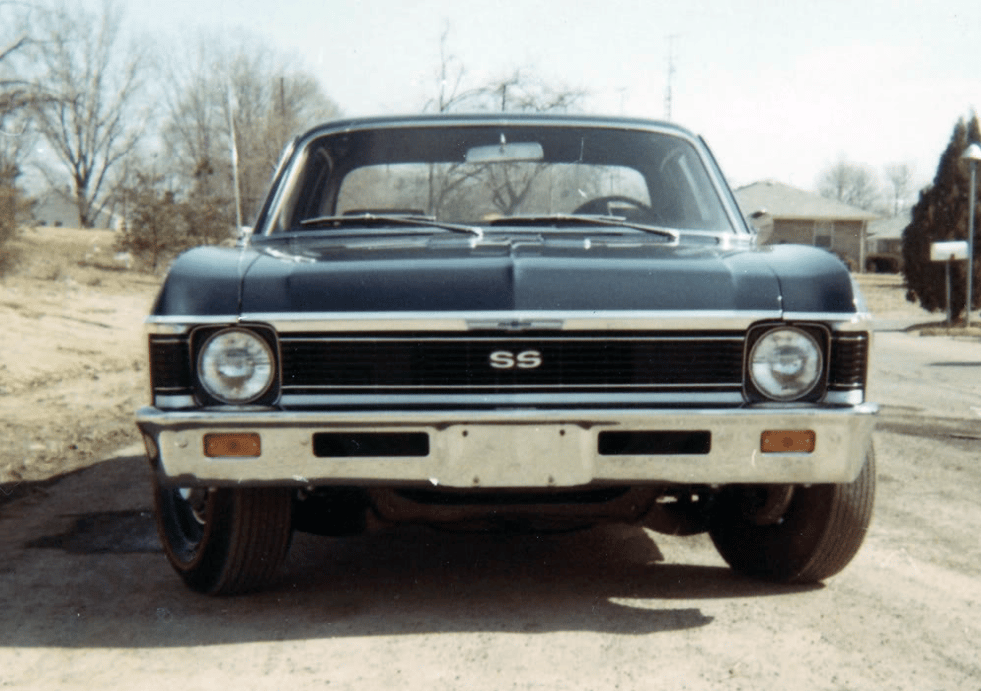
Chevrolet introduced the compact Chevy II/Nova in 1962 as a more conservative alternative to the Corvair. It was completely redesigned for 1968. This one was a 1969 Nova SS Coupe, which came with either the 300 horsepower Turbo-Fire 350 V8 or big-block Turbo-Jet 396 with 350 or 375 horsepower. Total 1969 Nova SS production was 17,654, including 7,209 equipped with the 396.

This white 1965 Impala Super Sport Coupe was parked outside the famed Riviera hotel in Las Vegas. It was covered in graffiti (which says “PEACE,” “Smile your on Candid Camera,” and some things I can’t read), but since it had ribbons on the front bumper and rear wheel, it might have been part of some kind of celebration. The full-size Chevrolet was completely restyled for 1965; this one had a Turbo-Fire 327 V8 with aftermarket tailpipe(s). The red and white car parked behind it was a Metropolitan, but there were several other Chevrolets in the lot, including a maroon 1962, a blue 1967 Impala Sport Sedan (4-door hardtop), and a white over blue 1957 Bel Air 4-door sedan. The white wagon behind the Impala Super Sport was a 1960-1962 Ford Falcon Fordor.

The full-size Chevrolet got another major restyle for 1969. This Frost Lime car was a 1969 Impala Custom Coupe from New Jersey. The standard engine in this model was the Turbo-Fire 327, but five other V8s were optional. There was a choice of five transmissions, including the 3-speed Turbo Hydra-Matic, which was now available with all engines. This one was equipped with bumper guards, a black vinyl roof, and a radio.

For 1971, Chevrolet introduced an all-new subcompact called Vega. With sporty looks and handling, it sold well for a while, but its engine problems and corrosion came back to haunt it later. This hatchback coupe might be either a 1971 or a 1972 model, as few visible changes were made for 1972. It was available with a 140 cubic inch 4-cylinder engine with 90 or 110 horsepower, which could be combined with a 3-speed or 4-speed stick or Powerglide automatic. The semi-automatic Torque-Drive transmission was also available for 1971 only. For some reason, this car is wearing Ford Pinto wheel covers.

For 1970, Chevrolet introduced the popular Monte Carlo, a stylish hardtop based on the Chevelle, but with the longer 116-inch wheelbase of the midsize sedans, giving an extra long hood. The first-generation Monte Carlo was produced from 1970 to 1972 with only minor changes, so this gold car might be from any of the three years. It was equipped with a vinyl roof, deluxe wheel covers, and bumper guards, all extra-cost options. Standard power was a Turbo-Fire 350 V8, with options up to the Turbo-Jet 454.

The full-size Chevrolet kicked off a six-year styling cycle for 1971. This 1973 Caprice Sport Sedan has the new 5-mph front bumper required by federal regulations. For 1973, the Caprice was also available as a 4-door sedan, a 2-door hardtop coupe, an Estate Wagon with simulated woodgrain trim, and a convertible. Engine choices were down to two: the small-block Turbo-Fire 400-2 V8 or the big-block Turbo-Jet 454, both with Turbo Hydra-Matic, which had finally become standard equipment in 1972. This photo was shot in the West Milford, New Jersey area in 1973. The car had what appears to be a New Jersey dealer license plate.

The midsize Chevrolet was supposed to be redesigned for 1972, but a strike delayed the launch of the new “Colonnade” generation to 1973. This photo shows a 1975 Chevelle Malibu Coupe, the entry-level Chevelle. Chevrolet still called it a Colonnade Hardtop Coupe, but the midsize line no longer offered any true hardtops. Its standard powertrain was the 250 cubic inch six and 3-speed manual transmission, but I doubt very many were built that way. Options included two versions of the 350 cubic inch V8, along with the Turbo-Fire 400 and big-block Turbo-Jet 454. Most had Turbo Hydra-Matic. The pictured car appeared very basic, with the only visible options being the full wheel covers and whitewall tires.

The second-generation Monte Carlo also arrived for 1973, with curvy new styling. This gentleman’s car was a 1975 base model, equipped with front bumper guards, whitewall tires on Rally Wheels, body side moldings, and a full vinyl roof. Engine choices for 1975 included two versions of the Turbo-Fire 350 (one available only in California, the Turbo-Fire 400, and the Turbo-Jet 454. This was the last year for the 454. The white car pictured here was registered in King County, Washington, but the reservoir in the background looks more like the eastern part of the state.
Thanks for joining us and to all good day!
Note: If you wish to see your vintage photos featured at Curbside Classic, send them to us at [email protected].























Credit to the Chevy styling studio back then. Car styling was refreshed year by year for most of the line up back then.
Today, a car style can last 3 to 5 years before a face-lift; let alone a re-style.
But think how hard it must’ve been to come up with worthwhile new ideas all the time!
My parents had a ’73 Caprice Classic 4-door with 454. I remember a vacation trip through Canada when the car was new and having folks ask my dad what was up with the (huge) bumpers on the car.
Pics 6 and 9 are taken at the same house but not at the same time. The later picture has a more modern electric meter.
Good catch!
Good eye Polistra!!!
I was more interested in looking at the cars. But now I will look at the whole picture.
“I got a sixty-nine Chevy with a 396
Fuelie heads and a Hurst on the floor
She’s waiting tonight down in the parking lot
Outside the Seven-Eleven store…”
Those were the days!
The 1st pic: very cool looking Camaro. I’d say they were original hub caps, as the couple behind it don’t look like the type to change them.
I’d far rather see a base ’70 to ’73 Camaro like this than all the inevitable RS or SS clones most of these have been turned into, so very rare now!
Even in the 70s I rarely saw a Camaro with baby moon hubcaps. 73 was the last year for the rounded moon style. In 74 they went with the ‘dog dish’ flat hubcap which amazingly could still be had as late as 82 or 83.
In 1969, Chevrolet considered the Nova and Nova SS to be separate models. I choose to believe it’s the same car with different trim levels. Given that, the 1969 Chevrolet Nova “line” has the largest delta of displacement ever offered, from a 153 cubic inch I-4 to a 396 cubic inch V-8. Now that’s a fun fact!
Nice looking group of Automobiles .
-Nate
As a kid in the 80s I always wished for chevy to return to greatness…never happened. Like everyone else who didnt get a truck I gave up wishing and joined team Honda.
Loved the look back.
Extra credit for that Vega with Ford Pinto wheel covers. 🙂
I have to wonder what the story was there!
The building in the background of the first picture is the Fort Worth Art Center, located at 1300 Gendy St. The building is still standing, but it’s hard to recognize since it’s received numerous additions over the years. The Lutheran church in the background is still standing, and looks similar today.
My favorite Corvettes is the C2s and the one pictured is the same age as me. The ‘64 Impala SS has always been my favorite. My uncle on my dad side had a red one with a 327/4 speed which my dad later owned. I loved the Pontiacs( especially the Grand Prix) of that era and still do. I would love another’64 Impala SS before I draw my last breath but if not,oh well.
No question Chevy made some really good looking cars in the 1960s. After my parents divorced Mom’s boyfriend had a new 1960 Chevy Impala convertible that brings back wonderful memories. I had an older cousin who bought a new gold 1965 Impala hardtop but his sister wrecked it late 1966 and he bought a new red 1967 T-Bird four-door Landau. My good friend in high school received a new yellow 1967 Camaro SS/RS for her 16th birthday. Unfortunately a few months later we were in a wreck, she died, I was OK, so I shy away from yellow Camaros. In the late 1960s my Dad borrowed and wrecked both my 1963 & 1966 T-Birds, then gave me a blank check to buy a Chevy at his friends dealership with instructions to not go crazy, meaning no Camaro. So I bought a new 1970 Nova SS 396 which Dad thought was practical until he got the insurance bill after I had already left out of state to college. About the same time Dad bought from his Chevy friend a new 1970 Chevy Caprice two-door hardtop. I came home from college to find he had a new Caprice and wondered why he didn’t buy a Monte Carlo? After all, he had been buying T-Birds for years. But the Caprice was a very nice car.
I currently have a generation five Camaro that I love. That’s my history with Chevy’s.
It was a common practice during the muscle car era to order a car with stock steel wheels because the owner was going to buy wider tires and mag wheels.
Another great group of photos.
There’s some story behind the lede photo. This guy is either a high school principal, or perhaps an executive at the Lumon Corporation who we’re going to learn more about in Severance season 3.
The lady on the hood of the 1962 Impala looks like a lot of fun. I’m just saying.
C2 Corvette man is Kurt Vonnegut in an alternative (quite alternative) universe.
So it goes.
My uncle had a 1974 Chevelle coupe just like the one picture but his is light blue. The car had equipped with the large engine and air conditioning. The car was very reliable but later developed in exhaust, He drove it until 1987, unusual long for the car for that period, he replace with Colt Vista Wagon, he often said that was his most loved car. Before the Chevelle, he had a brand new Chevrolet Vega with manual transmission, his first car in US, the car actually had its engine blown after he was struck in the snow bank at upstate NY on the way to visit my aunt in Quebec City during the 1973 Christmas. When uncle lived in Hong Kong in 1960s and early 1970s, he owned a used Morris 1100 MkII. His later cars were 7th generation Mazda Protégés sedans, Dawood sedan, 2nd generation of Mazda MPV with Ford v6 engine and finally 2nd generation Ford Transit Van. He passed away in 2018.
The white, “65 Impala” looks like our neighbors (next house). Theirs was not a “S/S” though. Make that white “Camaro” dark green, in/out. Would be the neighbor one more house down. No “350” under her hood though. “250 cid”.
Rear passenger side hubcap was gone before the care was a year old.