
Text by Patrick Bell.
Chevrolet’s momentum of the 1950’s carried over to the next decade and into the beginning of the malaise era as well. By then the world had changed and all bets were off. Today we have some samples of their common and popular models from that era to view, so let’s take a peek.
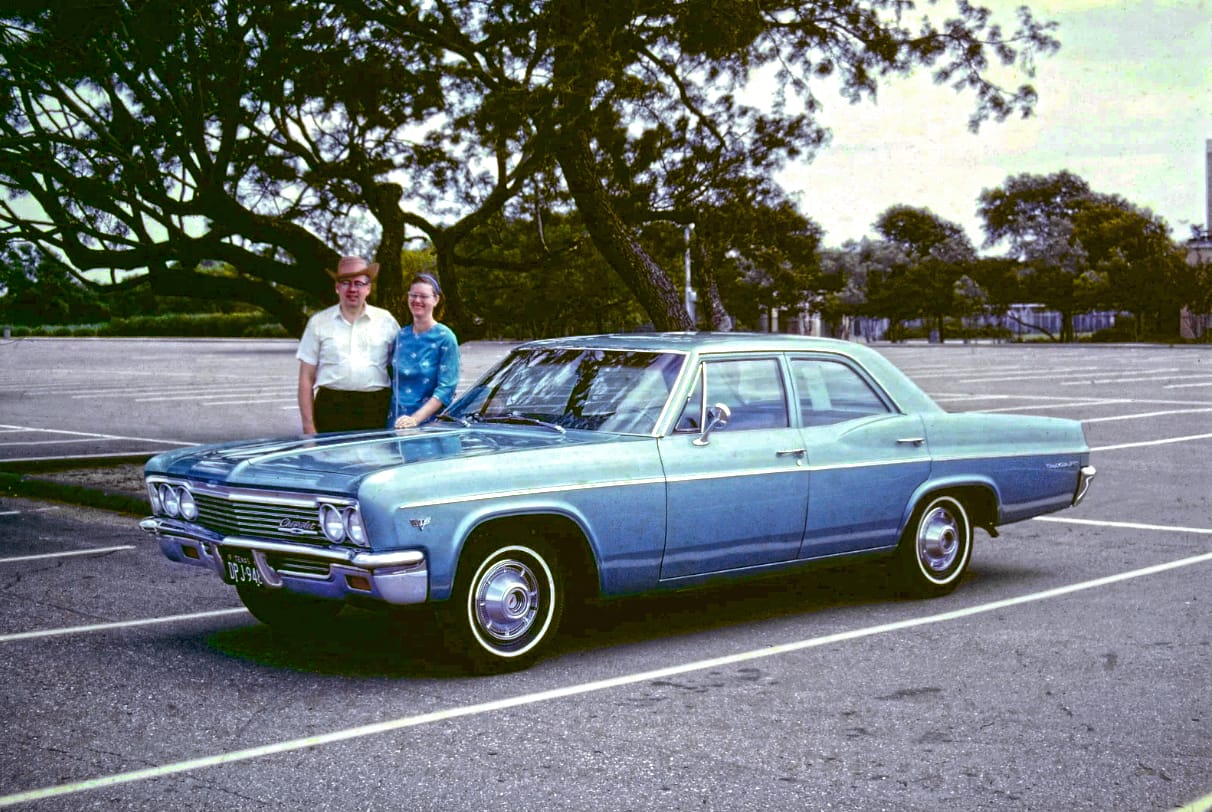
Our lead image was a 1966 Bel Air 4 door sedan that we have seen on several occasions in past features, usually with a camp trailer in tow. It looked new here, with a 1966 Texas license plate and possibly the window sticker still attached. It was nicely equipped with one of the 283 cubic inch Turbo-Fire V8’s that were available, along with a tinted windshield, radio, full wheel covers, and white wall tires.

A bright red 1961 Corvair Monza Club Coupe was looking for a parking space in a Mopar dominant parking lot. The full wheel covers were standard on the Monza, so the only visible option was the white walls. Parked on the other side of it was a 1961 or 1962 Corvair wagon with a roof rack. Wagons were produced only those two years, and sold reasonably well the first year, but not so much the second year, which was the year the Chevy II debuted.

A close to new 1961 Bel Air 2 door sedan was shown here on a fall day. It had the standard 235 ci Hi-Thrift 6 cylinder for power, along with an outside mirror and rear mounted antenna. The license plate appears to be from Missouri with a 1961 sticker and an unusual number. My understanding is they began with the number 1, so this would be the 456th license plate issued that year if my understanding is correct. It would be an easy one to remember.

This 1962 Biscayne 4 door sedan from California along with its Prowler camp trailer companion is another pair we have see in the recent past. It had a Compton dealer’s license frame, and in the power department it was equipped with the 283 Turbo-Fire V8. Other visible options include a tinted windshield and outside mirror.

It looks like Mom and son were waiting for Dad to take a picture so they could continue on with their day in the forest. They were riding in a 1963 Impala Sport Coupe from California which was sporting a new reskin that year. Full wheel covers and a tinted windshield were popular options which this car had, along with a rear mounted antenna. To the right was a 1955 Mercury Montclair Coupe.

Here was a 1964 Impala Sport Coupe that displayed the updated front and rear styling that happened every year on popular models during that era. It also was a California car, and was optioned just like the previous one, and had the 283 Turbo-Fire V8 for power.

Moving to the intermediate size line we have a 1966 Chevelle 300 4 door sedan that looked close to new and had a New York license plate along with another type of plate mounted on the grille. The 300 was the entry level series and was also available in a 2 door sedan. This one had the optional 230 ci Turbo-Thrift 6 with 140 horsepower along with a radio.

And a nice example of the all new restyled 1965 Impala Sport Coupe. It had one of the small block engines (283 or 327 ci), a vinyl roof, Soft Ray tinted glass, as well as the usual other basic options. 1965 was the height of the Impala’s popularity with over a million units sold including the Super Sport models.

Chevrolet’s second compact line (Corvair was the first) was the more conventional Chevy II that was introduced in 1962. The second generation hit the showrooms for the 1966 model year, and the car above was a second year 1967 Chevy II Nova 4 door sedan. It had a Gulf Shores, Alabama souvenir license plate, and that may have been the image location. The car was twelve years old in this image, and the paint looked in nice condition.

The Caprice became the top of the line series in 1966, and this one was a 1967 Caprice Custom Sedan. It had the 327 ci Turbo-Fire V8, plus a vinyl roof, remote control mirror, and fender skirts. The fender lights and special wheel covers were standard on the Caprice. And the lady may have been the “MC” part of the “ACMC” license plate.

1968 brought a restyle to the Chevelle line as seen here in this 1968 Chevelle Malibu Sport Coupe from Oregon. It was nicely equipped with a vinyl roof, radio, bumper guards, and Mag-Style wheel covers. Two 6 cylinder and four V8’s were available on all models except the Super Sport, which had two V8’s of it’s own. This was a very popular generation and remains a favorite today.

The Monte Carlo was Chevrolet’s answer to the personal luxury coupe question. This close to new 1971 model from Ohio shows the trim upgrade over the inaugural 1970 model. It had a vinyl roof, remote control mirror, and the owner had already added a pair of speakers on the package shelf. The Monte Carlo’s had a four inch longer wheel base and nine inch longer overall length than the Malibu coupe, and the standard engine was the 350 ci Turbo-Fire V8. They did well in the marketplace, as they pushed the notion of high quality control, plus it had a Chevrolet price.

Here is a different view of the 1970 Camaro RS we saw recently. It had a vinyl roof and standard hub caps that really made it plain looking, but perhaps the owner planned on buying aftermarket wheels. The 1969 Camaro was the best seller of the first generation, but the new generation did not do that well until the 1978 model year. That likely was caused more by the market than the car.

I can’t help but think this 1971 Impala 4 door sedan from Texas was the replacement for the 1966 Bel Air in the first image. The parking lot and even the parking place look to be the same. This one had two tone paint, a remote control mirror, full wheel covers, double stripe white walls, and the window sticker was still there. The 1971 model was a new restyle that was about the largest and heaviest up to that point, before the next generation was downsized.

A 1975-1977 Camaro was parked close to the curb on a city street. It was red inside and out, had full wheel covers, and a Washington state license plate that was issued in King County, the home of Seattle. Camaro sales had always lagged behind the Mustang until 1977 and 1978 when it outsold the last two years of the Mustang II. That reversed the next year when the new Fox body Mustang debuted. The only other Chevrolet I see was the red K10 pickup with camper shell across the street, and it could have been a GMC.

And we close with a 1977 Malibu Classic Coupe. It had a vinyl roof, bucket seat interior, full wheel covers, and a front license plate that looks like a novelty item. This was the last year of the colonnade generation that began in 1973. The full size Chevrolet’s were downsized this year, and were about the same size and weight as the Malibu, but much more space efficient. The Malibu would get its downsize program the next year.
Thanks for joining us and have a great day!























I think the extra plate on the ’66 Chevelle was a Thruway commuter toll pass, they issued those at least to the mid 1980s and possibly right up to the introduction of EZPass electronic tolling.
As a child car buff, I was obsessed with curb appeal. And this applied to the extra lights at the leading edges of the Caprice’s fenders, in 1967-68. Other cars that had them were the 1967 Imperial, the 1973 Ambassador, and various and sundry Toyotas. The concept had a rebirth with the light bar of the 1986 Mercury Sable. My take? If you read the grille as a human face, the auxiliary lights come off as graying temples, and that’s a positive connotation if you fancy your product as appealing to the Brougham class and carriage trade.
Both Camaros have whitewall tires, a feature that would soon be regarded as inappropriate for sporty cars. Likewise the vinyl roof on the blue one.
What’s going on with the house behind the ’61 Bel Air? It’s like the paint from the wood siding was dripping off it and staining the bricks below.
It’s called efflorescence.
https://brickrestoration.com/7-must-know-facts-about-efflorescence/
The second picture might be called Deadly Sins On Parade. The ’56 Ford is the only car in that scene that hasn’t been described as a Deadly Sin of styling, tech or marketing.
Maybe the ’62 Rambler as well. It may have done absolutely nothing to negate the “stodgy Rambler” image AMC would be running away from for the rest of its’ existence, but it was solid and it sold.
The Monte Carlo only was a value compared to a Grand Prix or a Thunderbird. It was smaller and less roomy than an Impala, but sold for the same price. Sure looked great tho.
Was a deviation of a “Malibu”; would a been smaller than the “Impala”, by default.
The ’61 Chevy Bel Air comes very close to the one my mother owned back in the day. Like this one, it was a 6-cylinder 2-door with outside rearview mirror, blackwalls, and dog dishes. However, it had backup lights but no radio and was turquoise.
More lovely images from my childhood .
-Nate