

Text by Patrick Bell.
American automobiles stood out in the 1950’s for their color palette and liberal use of chrome, and by the end of the decade, subtlety was no longer the point. Two and three-tone paint color combos became a declaration of personal style, something that, along with fins and chrome, defined American cars during that era. For a sample, today’s gallery has a good variety of the cars you would see every day back in those days.
We begin with a 1956 Dodge Custom Royal 4 door sedan that was taking a rest from exploring a back road most likely in the mountains of southern California. This was the upper series Dodge that year followed by the Royal and Coronet. There was no difference on the outside that I am aware of other than the nameplate on the quarter panel. Since you cannot see the nameplate I went by the front seat upholstery style to ID it. Speaking of which, there was a child on that front seat, with Mom outside with her eyes on something. The car was at least seven years old at that time with a California license plate first issued in 1963 and a Jim Souter’s Dodge City frame. Mr. Souter purchased the dealership in Barstow, California in 1962 and owned it for 25 years.

Here was a young lady with a close to new 1953 Chevrolet Two-Ten 2 door sedan with a same year Connecticut license plate. The sign in the background indicates the location was Catskill, so I am going to presume New York, which is about 35 miles from the Connecticut line. The Two-Ten was the middle series of three (One-Fifty and Bel Air), and was the most popular. The 2 door sedan sold over 247,000 units that year and came in second to the 4 door sedan at over 332,000. In the left background was a 1949 Ford.

And another 1953 model from General Motors in the same color with a darker top. This one was a Pontiac Chieftain De Luxe 4 door sedan, the upper series of two for that year. It was equipped with a lighted hood ornament, fender skirts, wheel covers , the Protection Group which included the grille guard and corner guards, and a New Jersey license plate. All Pontiac models for the year were offered in 6 or 8 cylinder engines, both of the inline flathead design. But the 8’s outsold the 6’s by nearly a 10 to 1 margin. Other than the scuffed whitewall it looked close to new.

1955 was a banner year for U.S. auto sales, but the Lincoln was one of the few that had a sales decrease. The design was all new but similar to the old style, the V8 engine was increased to 341 cubic inches, and it received a new “Turbo-Drive” transmission. The featured one was a 1955 Capri Special Custom Coupe, which was the top of the line and the most popular of the year. Second place went to the Capri Special Custom 4 door sedan, and the two of them together amounted to almost 87% of the total sales that year.

A 1955 Nash Rambler Custom 4 door sedan with snow tires was taking a break by the orange groves on a bright, sunny day. It was a pioneer in the compact field, but American’s weren’t quite ready for a compact in the mid fifties. The “Super Flying Scot Engine” was at the heart of the new Rambler according to the sales brochure. It was a 195 cubic inch flathead 6 with 90 gross horsepower. You could also choose Dual-Range Hydra-Matic Drive, and what may have been the best automotive air conditioning system at the time.

A well dressed gentleman was posing with a sharp 1954 Mercury Monterey Special Custom Coupe from California. This was another top of the line best selling model that was in its final year of a three year style cycle. New that year was the overhead valve, Y-block 256 cubic inch V8 with 161 horsepower. The Merc-o-Matic Drive was the popular transmission option to go along with the new motor.
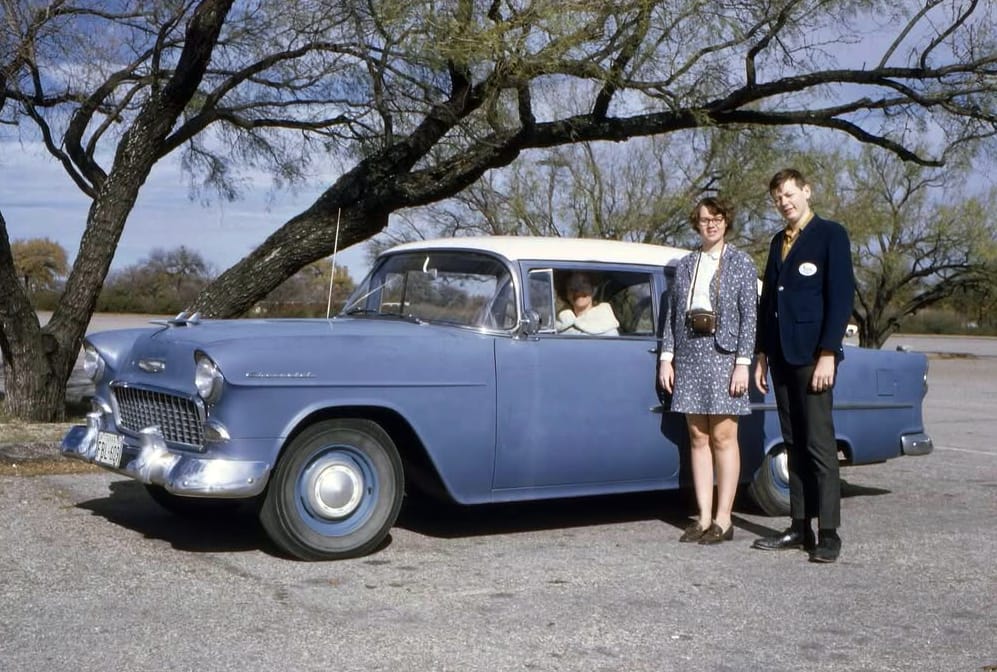
Let’s get back to basics with a 1955 Chevrolet One-Fifty 2 door sedan. The photographer may have completed the second couple, and they looked like they were out taking pictures on a spring day. The car had been around awhile as that Texas license plate was at least a 1967 issue. Overall it looked very good for it’s age. The visible options were the two tone paint, radio, and an aftermarket outside mirror.

The 1955 Pontiac sales brochure touted that “everything was new except the wonderful name”. The one above was a Star Chief Custom Catalina that was the most popular model and the top of the line series. A new overhead valve Strato-Streak 287 V8 engine in three different horsepower ratings was part of the everything new. The six cylinder was dropped and did not return to a full size Pontiac until the downsized year of 1977. The gentleman looks pleased with his car, and has something (movie camera?) on the hood with him.

This was the entry level DeSoto for 1956, a Firedome 4 door sedan with what appears to be an Ohio license plate. It also was the most popular making up nearly 41% of all sales for the year. The “Forward Look” was in it’s second year, and the news was a size increase to the Hemi V8, now at 330 cubic inches and 230 horsepower for the Firedome. Plus a push button selector for the Powerflite automatic transmission.

A well dressed young man was posing beside a 1956 Buick Century 4 door Riviera (hardtop) in a new subdivision. The Century was the second rung in the four step Buick ladder, sharing the shorter 122 inch wheelbase with the junior Special, and the more powerful 255 horsepower version of the 322 cubic inch V8 with the senior Super and Roadmaster series. The new for 1955 4 door Riviera became a sales success in 1956 as the best selling model in all series except the Special, where the 2 door Riviera was most popular.

“Suddenly, it’s 1960”, was the advertising jingle for the 1957 Plymouth and its new “Flight-Sweep Styling”. They were attempting to make you believe it was ahead of its time. Shown above was a V8 powered 1957 Belvedere 4 door hardtop from California, which also looks like the location. It was the top of the line 4 door, but was second in popularity to the Savoy series 4 doors. The V8 was a 301 HyFire with 215 or 235 horsepower versions available. Or you could have chosen the old 230 flathead PowerFlow 6.

Now we are moving up the Chrysler Corporation chain to the DeSoto, where we have a 1957 Firedome 4 door sedan that was about to launch a small boat. The Firedome was the second series of four, sharing the longer 126″ wheelbase with the Fireflite and Adventurer. The only engine available was a 270 horsepower version of the 341 V8. If you wanted more power you had to buy one of the upper series. The one above had the optional dual headlights and an unreadable license plate. However, the boat was registered in Michigan. In the background was a black 1957 Buick Century 2 door Riviera.

The image notes indicate the location was “somewhere near Niagara Falls”. This chrome monster was a close to new looking 1958 Oldsmobile Ninety-Eight Holiday Sedan, the most popular model in the top of the line series. The Ninety-Eight had a four inch longer wheelbase than the Super 88 or Dynamic 88, and the 305 horsepower version of the 371 Rocket V8, with the “J2” Rocket with three carburetors and 312 hp optional.

1958 was the last year for the Chevrolet Bel Air to hold the top of the line series honors. The new Impala was part of the Bel Air line in it’s first year, but would be expanded and take over the top honors in 1959. The featured car was a 1958 Bel Air Sport Sedan, where the young girl was playing hostess, and the woman did not seem too amused. Other news for the year was the new 348 V8 available in Turbo-Thrust form with a 4 barrel carburetor and 250 horsepower, and a Super Turbo-Thrust with three 2 barrel’s and 280 hp.

To close let’s take a drive and look at the snow in a 1959 Dodge Coronet 4 door sedan. The Coronet was the entry level series of three, and this model was the most popular of any that year. Only the Coronet series was available with the 230 Get-Away Six, which was in it’s last year before the Slant Six took over. Six cylinder production amounted to about 10% for the year. A 326 Red Ram V8 was available in the Coronet, while two 361 Ram Fire’s and two 383 D-500’s were available in all series.
Thanks for joining us and to all good day!
Note: If you wish to see your vintage photos featured at Curbside Classic, send them to us at [email protected].























Perhaps it was the film used, but in the first image the `56 Dodge was not a two-tone, but a three-tone! Two shades of green for the body and white for the roof. Popular in `55-`56 on Dodges and Chryslers.
It’s so sad that today the automotive industry has banned beautiful colors, two tones, bright chrome, and produced everything with as much blah dullness as possible. By the way, A/C was not available on a 1955 Nash Rambler.
Yes, factory A/C was available on a 1955 Rambler!
Wonderful identification of these vehicles, Rich! The “Get-A-Way” Six would get you from your driveway garage door to the driveway entrance in no time flat. Them, it went flat. Your history of the options and equipment specifications is terrific, as usual. When there was a plethora of paint colors, police departments could easily identify a crime scene with paint form the offending vehicle. The choices have sorely diminished. I look at the “Chrome Monster” Olds 98 from 1958 and wonder why someone would spend those bucks for this model when they could have bought the next model down and spent the cash on air conditioning. To each his own.
Or maybe save even more and buy the better-looking Pontiac?
car stylist had some flair and choice of color now black white silver are the color of most cars which all look like drops in a strong wind and plastic bumpers ugly describes new thing no art involved
I saw lots of 1955 and 1956 Dodges in wonderful 2 tone and 3 tone colors at my Father’s Dodge-Plymouth dealership when I was growing up. Terrific 2 tone combinations continued through 1959. Just the top or the top and the fins or the top and the fins and the lower part of the sides or just the fins or just the lower part of the sides could be in two tone colors. Not sure how the factory handled that in the days before computers! Starting in 1960 the only 2 tone color combinations available were the top as one color and the rest of the car a second color. In addition, most of the great pastel colors of the mid ’50’s were gone by 1960.
Today we generally have white, a variety of grey and silvers, black and a red. The great colors have, for the most part, disappeared.
The linked video will give an idea of how production scheduling worked before computers. Scroll ahead to 2:35 for a cursory reference to the system used in one Chrysler factory in the 1950s.
Fun. Thanks. Next up three tone cars?
Hopefully, we’ll have another one soon. In case you missed it, here’s last year’s three-tone installment: https://www.curbsideclassic.com/vintage-snapshots-and-photography/vintage-snapshots-cars-from-the-1950s-in-tri-tones-colors-colors-and-colors/
A few summers ago, I ran across a 1953 Pontiac just like the one in the 3rd photo, except the one I saw had a white (Milano Ivory) roof to contrast with the Laurel Green body. Quite a sight, especially the interior with its giant round radio speaker that looked like a 1950s kitchen ventilation fan.
I am glad that two-tone cars are still kind of a thing. Whenever I see one I have the impression (even if it’s mistaken) that whoever is driving it made a conscious decision to choose those colors and that’s so much better to me than thinking that they took whatever beige or gray thing was just sitting on the lot.
Dad shopped for a new 1959 Galaxie 500 two door hardtop in all white. The whole family tagged along as we shopped every Ford dealer in Indianapolis. No one had the combination he wanted…plenty of white lower with different color tops but no all white. I recall one night a sales rep took us to their parking deck to show us one with a white lower and coral top. Mom and Dad said NO so the rep said he’d paint the top white. I recall perfectly Mom’s indignant rejection of that idea. Dad ordered the exact all white car with gold interior from another dealer. He loved that car. It was gorgeous!
That 54 Mercury Monterey Custom has an interesting CA plate. Seven figures with just one letter when everything was six figures. Hmm, go figure.
Now that 57 Firedome is one sharp looking color combination.
The 1958 Chevy Bel Air appears to be a repaint since the interior is blue green but the outside is white and red. I just can’t imagine anyone selecting that combo new.
You could be right, but you could get some weird color combos back in the day. I recall a family friend who had a 1967 Plymouth Fury, new, with an olive green outside and blue interior!
Eeek!
A look @ the red, paint indicates it’s no factory paint job.
Colorful time during the Eisenhower/Nixon administration: 1955 Studebaker President Speedster.
The ’55 Pontiac Star Chief Custom Catalina is the stuff, imo. What a great looking car. The dove gray makes her work. And unlike most, I have a big place in my heart for a ’58 Olds. That’s good jazz, man.
Nice and I too miss the large palette of colors back then .
-Nate
I believe the red and black DeSoto is a 1958, not a 1957. Dual headlights and different taillights.