

Text by Patrick Bell.
Vintage imported automobiles is our theme today, and we have an interesting gallery to view. There is a wide variety here, including some of the very popular imports, some seldom-seen rarities, and some of the in between. As always, your comments are an important part of the process to enhance the information I have given and so others can hear your stories.
Our lead image shows a 1964 or 1965 Opel Kadett A sedan that had seen better days. Besides its matte-black hood, it was missing its front marker lights, and had replacements crudely attached to the grille. The license plate was a US Forces plate issued from the 1960s through 1972 for American military personnel stationed in Okinawa, Japan. This lady may have been the wife of an American servicemember, or perhaps she was an off-duty servicemember herself. The yellow object she was holding on the roof was a bellows-style air pump. The decal in the back window says “TENNESSEE,” which might have been where she was from.

This Italian minicar was a 1959–1962 Autobianchi Bianchina Special coupe, registered in New Hampshire. The Bianchina was based on the Fiat 500, with a rear-mounted, air-cooled 479cc 2-cylinder engine. Specials had two-tone paint and a slightly larger 499cc engine. There were six Bianchina body styles. This version, known as “Trasformabile” in Italy, was called a convertible in the US, but it had fixed side pillars with a folding fabric roof and rear-hinged suicide doors. It was replaced in 1963 by a cabriolet with a full convertible roof. The Bianchina was built through 1970.
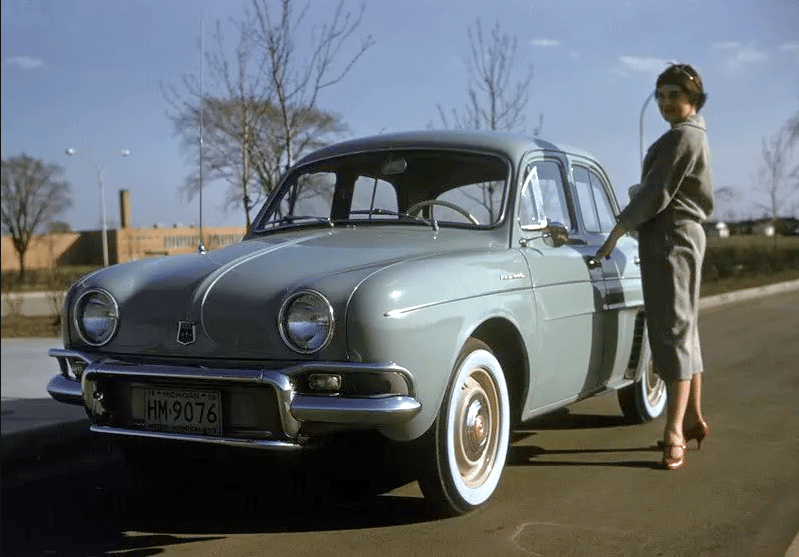
Imported from France, the Renault Dauphine was produced in one generation from 1956 to 1967. It was manufactured at 15 plants in 13 countries, with over two million built. Power came from a rear-mounted water-cooled 845cc four-cylinder with 32 horsepower, with 3-speed manual or semi-automatic transmissions. From 1957 to 1963, the Dauphine helped to make Renault America’s second most popular import make, after Volkswagen. This lady’s Dauphine was an early model with a 1956 Michigan license plate, issued in Washtenaw County, where the seat is Ann Arbor.

This gentleman looked pleased with his Austin-Healey 100-6 sports car. Designed by Donald Healey and built by Austin (which had recently become part of the British Motor Corporation), the 1952-1956 100 used a 2660cc four, but the 1957–1959 100-6 had a slightly longer wheelbase and a 2639cc BMC “C-series” six. The notes for this photo indicate that the pictured car was a 1957 BN4 2+2, an early six-cylinder car with 102 hp and a tiny rear seat. Its front bumper had been removed for a custom touch. My guess is that the massive oil stain on the driveway indicates where the Healey was usually parked. The car behind it in the driveway was a 1955 Chevrolet Two-Ten 2-door sedan with custom tail lights, a “shaved” deck lid (emblems removed), and what appears to have been a 1964-issue Texas license plate.

Here’s one you didn’t often see even when it was new. This 2-door wagon was a 1958 Goliath 1100 Kombi, made by Goliath-Werk (part of Borgward Group) in Bremen, Germany. The 1100 was front-wheel-drive, with a 1093cc water-cooled aluminum “boxer” (horizontally opposed) four with 46 horsepower. Goliath also made two-door sedan, convertible sedan, coupe, and van versions. For 1959, the 1100 got new styling with tail fins and was renamed Hansa 1100 in Germany. (US cars were still called Goliath until 1961.) This rare US 1100 was licensed in California, which was probably also the locale. The car on the street in the background was a 1950-1952 Plymouth 4-door sedan. Tatra87 has written lots more here at CC about the rise and fall of the Borgward Group.

These ladies were posing with a newer and much cleaner example of the 1964-1965 Opel Kadett A. Back then, Opel was GM’s German subsidiary, and the compact Kadett was its most popular model, competing with the Volkswagen and the Ford Taunus 12M (aka Cardinal) in Europe. The Kadett A was built from 1962 to 1965, but it wasn’t imported to the US until 1964. It was sold in the US through Buick dealers. The Kadett had a 993cc four with 46 or 54 horsepower and a 4-speed manual transmission. There were three body styles: the 2-door sedan, a 2-door station wagon (marketed here as the “Car-A-Van”), and this 2-door sport coupe. You can read a vintage road test of the Kadett here on CC.

Opel had a reputation for conservative styling, so they really shook things up when they introduced the Opel GT for 1969. The GT was based on the Opel Kadett B, but it had a totally new 2-seater body that looked like a C3 Corvette, with pop-up headlights. Like the Corvette, the Opel had no rear hatch or trunk opening, so the only way to access the luggage area behind the seats was through the doors. The base engine was the 1077cc four from the Kadett, with 67 horsepower, but most GTs had the optional 1897cc engine, with 102 horsepower. Transmission choices were a 4-speed manual or 3-speed automatic. The GT was made through 1973. You can read a vintage road test of the Opel GT here on CC.

This Connecticut gentleman was clearly an enthusiast who liked his foreign cars in bright red. The one on the left was a 1966-1967 Toyota Corona with aftermarket fog lights. This T40 Corona model was actually the third-generation Corona, but it was the first version to be sold in the US, arriving for 1966 with an 1897cc four and a choice of column-shifted 3-speed, a 4-speed manual, or 2-speed “Toyoglide” automatic. The car on the right was a Series II Fiat 850 Sport Coupe, which was produced from 1968 to 1971. It had a rear-mounted 903cc four with 52 horsepower and a 4-speed manual transmission. The 850 series was also available as a sedan, a Spider (convertible), or a van.

BMC engineer Alec Issigonis designed the Mini as a fuel-efficient small car to compete with German and Italian minicars. The original Mark 1 Mini, built from 1959 to 1967, was sold as both an Austin or a Morris, and was fun to drive as well as economical. The one pictured above was a Minnesota-licensed Mark 1 Mini Cooper, a high-performance Mini developed by race car maker John Cooper. It had a bigger 55 horsepower 997cc engine and front disc brakes. The red car parked behind it was a 1962-1964 Volvo 122S sedan, also wearing a Minnesota license plate.

Considered by many to be the most beautiful car ever built, the Jaguar E-type was produced from 1961-1974 in three series and three body styles: coupe, roadster, and later a 2+2. All Series I E-types used a DOHC six with 265 horsepower. At first, the engine was 3781cc, but in mid-1964, it was bored out to 4235cc, giving the same power, but more torque. Until 1966, a 4-speed manual transmission with optional overdrive was the only transmission, but cars with the 4.2L engine had a new all-synchro gearbox. A automatic became available on the 2+2 in 1966. The yellow car pictured above was a Series 1 coupe from California. The car parked behind it was a white 1964 Oldsmobile Ninety-Eight.

The best-selling, best-known import of this era was the Volkswagen Type 1 sedan, better known as the Beetle. This stylish lady was posing with a close-to-new 1968 or 1969 model with a Florida license plate of the same vintage and an “Autohaus” license bracket. The Beetle’s air-cooled four-cylinder engine was now 1493cc with 53 horsepower. Mostly hidden behind the white VW was a black 1962 Rambler Classic.

Volkswagen’s second passenger car was the stylish Karmann Ghia, introduced in 1955 as a coupe, with a cabriolet following in 1958. This young lady looked like she was waiting to go for a ride in this white cabriolet. The car had the revised taillights adopted for 1960, but no backup lights (added in 1967), so I will call it a 1960-1966 model. It had a single narrow stripe down the center of the car, a faded Valvoline sticker, New York license plates of a type used from 1966-1972, and possibly a parking permit decal on the bumper. The car parked in front might have been a 1964 Pontiac Tempest.

Here we see a 1968-1973 Datsun 510 station wagon with a California license plate, taking a break at the “Cafe Brissa” along the beach. Known in Japan as the Bluebird, the 510 was initially offered in the US in 4-door sedan or wagon form, with a 2-door sedan added in the summer of 1968. The 510 became popular here thanks to its reliable drivetrain, excellent build quality, and nimble handling — sedans had fully independent suspension. (Wagons had a live rear axle.) The US 510 had a 1596cc OHC four and a 4-speed manual or 3-speed automatic transmission. This one had bumper guards and an aftermarket vinyl roof.

Out with the old and in with the new. This yellow-themed photo, taken in Colorado, shows four guys who appeared to have had too much Rocky Mountain High. The car on left was a 1971 or 1972 VW Beetle with later (1977-1981) license plates, while the car on the right was a 1973-1977 Honda Civic, which was beginning to replace the Volkswagen as America’s favorite small car. The Civic was smaller than the Beetle, with front-wheel drive and a water-cooled front engine. It started out with an 1169cc four with 50 horsepower, raised to 1237cc and 52 horsepower for 1974. The 1975 to 1977 cars could also have the 1488cc CVCC engine and an optional 5-speed manual in place of the standard 4-speed or optional 2-speed “Hondamatic.” The third yellow car at the far left might have been a 1980 or 1981 Chevrolet Citation.
Thanks for joining us and have a great day!
Note: If you wish to see your vintage photos featured at Curbside Classic, send them to us at [email protected].























Great collection of photos with the lead one bringing back many memories of my father’s ’65 Kadett. And a friend in high school had a coupe like the white one, which looks like it may well have been the young woman’s first new car.
Love the driveway with the A-H and the ’55 Chevy; nice combo. I cannot ever remember seeing a Goliath in the US.
Am I correct in assuming that the power figures for the Opel GT are SAE horsepower?
In its home country, the corresponding figures were 60 hp (DIN) and 90 hp (DIN). It would be unusual if probably emissions-treated US versions actually delivered more power.
P.S.: The Healey is a real gem. But please, mine with the front bumper.
Yes, those are the SAE gross ratings, which is what were advertised in the U.S. early on; likewise for the Kadett and Goliath.
Great photos, good thing that Austin Healey owner had the reliable 55 Chevy for when he actually needed to arrive at places. That oil stain needs a spill recovery team.
It’s not surprising that the Michigan Dauphine was in Ann Arbor. Since a lot of Michiganders made their livelihoods from the auto industry, foreign cars were deeply shunned throughout the state. Ann Arbor is a college town, home of The University of Michigan. College towns are generally more tolerant of liberal ideas like driving foreign cars.
I read this often, but don’t remember it myself. When did driving an imported car stop being a “liberal” thing? At least from the ’80s onward, I don’t recall driving a Toyota being a political statement; by then people were trading in their Oldsmobiles for Hondas and Toyotas in droves. But maybe imports became mainstream on the left or right coasts where I lived before in the heartland.
Absolutely. I moved to Michigan in 1986 and there were still plenty of folks who looked at you sideways if you drove a Toyota.
The bug in the last photo was a 72. The 71 had two sets of vents on the engine cover the 72 had the vents all the way across the engine cover.
The Opel GT was actually built before the c3 Corvette GM started importing them in 67or 68 and because they were such a big hit in Germany they designed the Corvette to look like the opal so the Corvette is actually a larger clone of the Opel GT
This is not true at all.
The C3 Corvette styling came from the 1965 Mako Shark II show car. The C3 was actually intended to be released in 1967 (which would have been before the Opel GT), but structural issues with the original targa top delayed it a year, and resulted in the now-iconic T-top.
I have had a 1960 Taunus wagon, a 1957 Volvo 444 Sport with split windshield, a 1967 Volvo 122s, and a 1972 Trimuph TR6 among others. I wish I still had them all. I’m shopping for a clean, late 60s MGB now.
The way to differentiate a 1968 from a 1969 Beetle (U.S.) is by the front seats. A designed-in head restraint was added
in 1968 giving an appearance a bit like a nun wearing a habit, especially when viewed from the rear. I believe the ’69 model reduced the dimensions of that area of the seats.
I’d post photos of my parents’ Renault Dauphine, my brother’s Toyota T40 Corona and Volvo 1800S, and my ’68 Saab 95 V4–if I had any.
These pictures are all cool. I had to zoom in on the first picture to prove or disprove that she didn’t look like Jennifer Aniston. The picture of the Renault Dauphine reminded me that my dad had owned one in the ’60s, perhaps with his first wife. I love what looks like a father-daughter shot with the Karmann-Ghia. I also like the picture of the photographer with his Datsun wagon. I’m sure I often look as determined to get my shots.
The Renault Dauphine had the most comfortable bucket seats I can remember in any car.
My parents had a new Renault Dauphine for a very brief period of time around about 1963 -1964. I have only the dimmest memories of it due to the fact that I was very young and that they had it for only about a year. I was never able to get the full story about that car out of them, but apparently the one they had was nothing but trouble and they somehow managed to get out of it and replaced it with … a Simca.
Given that I never took my folks for Francophiles, I have no idea why they went from a Renault to a Simca (which actually never proved to be entirely trouble-free…as I very clearly remember the Simca). And if their goal was inexpensive small car transportation (which I’m pretty much sure that was the goal), then why didn’t they get a VW like just about everyone else with that criteria in the mid-1960s? My suspicion is that the fact that the Simca could be (was) purchased at a Plymouth dealer gave them some comfort…and I’d guess that wherever they got the Renault offered exactly the opposite of comfort. They’d probably have felt the same thing about wherever people bought VWs in Baltimore in 1964.
Great pictures, Rich.
Not a Dauphine, but my Dad bought a new ’68 R10 with Dauphine drivetrain, at Almartin motors in South Burlington, Vt after his used ’59 Beetle was totalled parked in front of our home. I think he might have been at least a temporary Francophile at the time having made several business trips to Corbeil-Essonnes when they were having production problems (my Dad was a semiconductor process engineer since he got his Bachelor’s in Chemistry in 1956). They’d entice him to visit by promising that the cafeteria would make couscous for him which he’d acquired a taste for (not French of course but pretty popular Moroccan dish). It was his 2nd ‘2nd car’ and though it was for commuting to work, it did have 4 doors instead of 2 the Beetle had so a bit better for carrying passengers. And the seats were VERY comfortable. He traded it in in 1974 only weeks before I started driver’s training, so I missed driving it. Remember him carrying a battery charger in the front hood, the car only had about 22k miles on it when he traded it but did have clutch go out and probably went through batteries, not unusual though in Vermont. Quebec province was not far and of course the French influence in Vermont is pretty much always been there.
Dad’s gone now but he took to foreign cars after being in the US Army stationed in Germany in early 50’s, they assigned him Beetles when he needed transportation, guess the Jeeps were in Korea. He actually went back to buying American cars starting in 1980, never again owning a foreign car after a string of them he instead had a pair of Dodges, three Mercury Sables in a row, and ended with a pair of Chevy Impalas with 2006 being his last car (will be 10 years since his passing this January 14th).
Besides aforementioned Beetle, my longtime co-worker owns an NSU Prinz, he inherited from his Father whom I think bought it used for it’s engine hoping to use it in a project for a tractor that never happened. It runs and drives, not sure of the year but maybe a 1960 or pretty close to that.
I’m admittedly terrible at recognizing people or faces, but I definitely recognize cars and license plates. So the red Corona/Fiat owner’s custom plates looked familiar. I presume that Mr. GC there is the same person pictured below, featured in a Snapshot compilation of Buicks a few months ago:
https://www.curbsideclassic.com/vintage-snapshots-and-photography/vintage-snapshots-buick-style-in-the-1950s-1970s/
Good catch!
I am loving this because I grew up with all these and owned or worked on many to boot .
That first battered Opel Kadett could have been one of mine, not shiny but still going strong, I remember the Hot Rodders and factory guys making fun of my saved from the junkyard drivers back then, I was so proud of having made them road worthy again .
I *wish* I’d even found a Bianchini for sale, I dote on tiny cars and don’t find them to be ‘hair shirts’ .
My Dauphine was a red & white ’63 model, it had the odd electric “Ferlic” semi-automatic I was never able to -quite- make work 100 % but that little car cold me on Renaults .
Borgward / Goliath were considered good cars in New England when I was a child .
The Opel GT was a nifty little run about, later 2 liter engines are a bolt in and increase the fun a lot .
In the 1980’s there was a movement to send them back to Germany and I had a buddy who’d convert them to convertibles and made $eriou$ doing so, I was able to find clean un rusted / crashed GT’s in junkyards in So. Cal. for about $250 each .
I still really like the looks of the RT40 Toyota coupes .
Those expen$ive Honda Civics were a total game changer . they were cheap and tinny but the incredible quality plus the amazing fun to drive aspect drop kicked all the other lower tier Imports to the curb .
(the VW in that picture is a ’72)
-Nate
What an interesting collection of cars!
Love the Autobianchi and Dauphine pics. Growing up in college town I saw a lot of Saabs, Volvos, MGs, Sunbeam Tigers, and still remember the sound of a VW Beetles.
I was 10 when the 1973 OPEC embargo happened which changed what folks drove in my neighborhood. By 1975 my dad went from a ‘71 Ford Country Squire to VW Rabbit, the people across the street went from a ‘72 Chrysler Newport to a Datsun 510 their son had a VW Scirocco by the end of the ‘70s my brother had a ‘73 Mercury Capri & T40 Corona, his friend had a Datsun 240Z while my best friend’s dad only drove Peugeots.
That yellow Civic at the end looks just like the car my mother got as a loaner from our Pontiac (and Honda) dealer during service visits around 1974-75. The whole family thought it was a lot of fun! And the light green Dauphine looks just like one owned by some relatives in the mid 1960’s, which I spent some time in during a family visit.
As a product of Washtenaw County Michigan, I know exactly where it is!
Oh, “pioneers”, huh?
Why, I tell ya, all I see is Commies and degenerates and perverts. Traitors, the lot of ’em.
Is that you, Mr. President?
No, he is quoting Telly Savalas from the movie Capricorn
I have had a 1960 Taunus wagon. If you google it, it was just like the blue and white one pictured, a 1957 Volvo 444 Sport with split windshield, a 1967 Volvo 122s, and a 1972 Trimuph TR6 among others. I wish I still had them all. I’m shopping for a clean, late 60s
MGB now.
From England, it amazes me that Europe and Japan managed to palm such rubbish off on you.
At least with the Austin Healey you knew (like Lotus/Alfa/TVR) that you were buying trouble, but worth it for the good times.
But the others in this list: were they really better than your home-grown product?
In the 60s my parents went big, our first imported car was a 1966 Mercedes 250S (W108) bought used in late 68 or early 69. At the other end of size, one family at nursery school had an MG 1100 in dark green, just like my Matchbox car.
Around 1973 a BMW 2000 replaced our Plymouth Valiant and that was their last American car until 1994 when Mom bought a Saturn.