
Text by Patrick Bell.
Studebaker was a long time car maker that faded away in the 1960’s. Their cars were loved by many, but unfortunately by not enough. Today we have a nice variety of models from the post World War II era, a time when survival was their mission.
Our lead image shows a 1947 Commander Regal De Luxe Land Cruiser 4 door sedan with a 1952 Illinois license plate. This was their premium model. It had the optional outside mirror, bumper “Winguards”, and “Glaseal Adverse Weather Lights”, which essentially were fog lamps mounted under the headlamps. The lights in the outer section of the grilles were park lamps and the optional turn signal lamps. It also had the wheel trim rings.
Studebaker was the first manufacturer to debut a new design car after World War II. That came about in 1947, while most if not all the others waited until 1949.

A man was putting the shine to a 1948 Champion Regal De Luxe 4 door sedan with a same year New Jersey license plate.
Studebakers were offered in two series during this era; the entry level Champion with a 112″ wheelbase, and the Commander was 119″ on all models except the top of the line Land Cruiser, which was 123″. Within those two series were two trim levels; De Luxe and Regal De Luxe.

The view from the rear did not change during the 1947-1949 style, so this Commander Regal De Luxe Land Cruiser could have been from any of the three years. It had a California license plate that was used from 1947-1950.
A L-head 6 cylinder in two sizes was used for power, with a 170 cubic inch with 80 horsepower for the Champion models, and a 226 ci with 94 hp for the Commander’s through 1948. 1949 brought a larger 246 ci with 100 hp on the Commander series.

And the famous “Bullet Nose” that was used on the 1950 and 1951 models. This one was a 1950 Commander Regal De Luxe 4 door sedan that was close to new as it had a California license plate style that was last used in 1950. It also had the optional sun visor.
Along with the style refresh came an inch longer wheelbase across the board, and a slight horsepower increase as well.

Here was a 1949-1953 2R series truck with a Wisconsin farm license plate. It appeared to be at work in an orchard. It had a grille guard and aftermarket turn signal lamps on the fenders.
They were offered in half, 3/4, 1, 1.5, and 2 ton capacities, and the passenger car engines were used with the small version in the light duty trucks, and the large in the heavy duty models.

1952 brought a style refresh that eliminated the bullet. Shown above was a 1952 Champion De Luxe or Regal 2 door sedan that had a Washington license plate first used in 1963, and issued in Chelan County where the seat is Wenatchee. It looked good for an over ten year old car.
Big news for 1951 was a 233 ci V8 engine with 120 hp that was the new Commander powerplant. Also new was Studebaker Automatic Drive, their first automatic transmission.

“The new American car with the European look!” This was how Studebaker advertised their radically new 1953 models as seen in this 1953 Commander Starliner Hardtop. The size difference versus the 1952 models was increased in most areas; the wheelbase was 5.5″ longer, overall length 4.5″ longer, width 1/4″ wider, and height 5″ shorter.
I am not sure what kind of event was pictured here as all eyes seemed to be on the man in the Studebaker. All I can ID of the other visible cars were two 1955 models; a Pontiac 4 door sedan on the left edge, and a dark blue Chevrolet in the center right.

A 1953 Commander Regal Starlight Coupe was visiting the Paradise Inn that is located in Mount Rainier National Park in Washington State. The metal tunnel leads to the entrance. The car had a Washington license plate used from 1954-1957 and issued in Pierce County, where the seat is Tacoma. It also had aftermarket rear mud flaps and tailpipe extension.
The new design 1953 models carried over the 1952 power plants and trim series, so this Commander and the previous image were both V8 models. To the left was a 1953 Cadillac with a Washington plate issued in Cowlitz County, where the seat is Kelso.

Moving up to 1955 we can see part of the updated grille on this 1955 Commander Deluxe Ultra Vision 4 door sedan that had a well dressed man posing with it. It looks like it had been around the block a few times with minor damage to the fender and quarter panel in spite of a curb feeler.
There was a period boat and outboard motor on the other side of it, and in the distance may have been a 1960 Plymouth wagon.

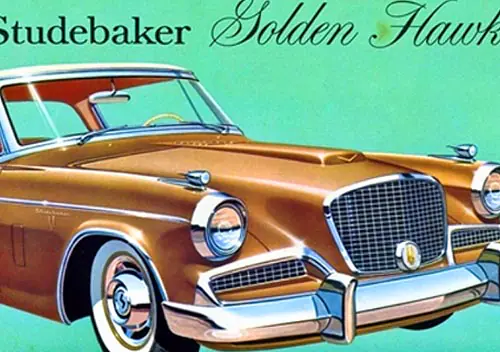
Beginning in the 1956 model year the coupes were named Hawk, and there were four versions; the 6 cylinder Flight, 259 ci V8 Power, 289 ci V8 Sky, and the 352 ci V8 Golden. The one shown here was the top dog 1956 Golden Hawk with the one year only 352 V8. It had a same year Illinois license plate.
To the left was a 1951 Packard 200 Deluxe Club Sedan.

In 1957 and 1958 the Hawks were down to two models, the Silver that was available with a 6 or V8, and the Golden with the 289 V8. The Silver Hawk above could have been either year as there was little if any change.

The 1956 model year also brought a reskin to the sedan models, and here was a nice view of a 1957 President Classic 4 door sedan. The President nameplate was last used in 1942, and was revived as the top of the line series in 1956.
Standard power for the President line was the 289 V8 that was available in two ratings.

The Lark was a new model for 1959 that was considerably smaller than the car in the previous image, with a foot shorter wheelbase, and 31″ less overall length. The front and rear were new and squared off, but the center section was carried over with some modifications and a new instrument panel. The L head 6 cylinder from 1954 was revived, and two versions of the 259 V8 were available.
The featured car was a 1959 Lark VI Deluxe 2 door sedan, the entry level model that had a base list price of $1925.

Here was a 1960 Lark Regal 4 door wagon with a color matched man standing with it. It had a Michigan license plate used from 1973-1975, and may have been part of an old car meet. The four door wagon was a new style for 1960 to go along with the previously available 2 door wagon.
Behind it was a slightly damaged 1969 Chevrolet C10 Fleetside, and I am unsure of the 1930’s car on the right edge.

This one was a 1959 or 1960 Lark VIII Regal 2 door hardtop that was someone’s new used car. It had a buyer’s tag in the window, and dealer information where the license plate belongs. But it did not look brand new.
The “VIII” indicated it was a V8 model, and that nameplate was also on the fender of the 1960 models. Of course a “VI” indicated a six cylinder, so if you could see the nameplate you did not have to guess how many cylinders it had.
Thanks for joining us and have a great day!






Anyone know how the post-war Studebakers compared with the competition? I am inclined to favor them until the ’49 Olds 88.
Here is what the April, 1947 Consumers Reports said:
“Studebaker: Champion and Commander models use same
body shell, with wide but low seats, very good vision,
minimum over-all outside width and height. Riding
qualities and stability are outstandingly good. Slightly
sluggish steering and poor rear-wheel traction on slippery
roads. Champion rates below Plymouth; Commander, be-
tween Pontiac and Oldsmobile.”
There is an similar summary for each car of that year.
Great collection here!
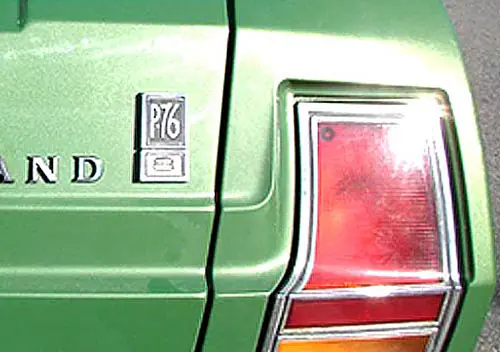
The dealer plate in the final picture is from Rube Tucker Rambler in Corona. The temporary plate is most likely from 1962, based on the number sequence and also the color (California alternated between red, green and black numbers on temporary tags in the 1960s… 1962 was black, as was ’65, but my guess is that this is from ’62).
I can only imagine how polarizing the 1953 Studies looked when new .
-Nate
What’s with the red wheels on a white car?
The ’55 sedan is from later in the model year, built in calendar year 1955 – it had a new curvy “fishbowl” windshield and shorter door glass, which Studebaker considered so crucial in keeping up with GM and Ford’s current look that they couldn’t wait until the 1956 facelift to introduce it. Although the “Ultra Vista” windshield was technically an option, I’m pretty sure it was mandatory on cars built after Jan 1 1955 when the tooling was changed.
Is that massive snow bank in front of the Paradise Inn real? It certainly would block the view from some rooms and prevent escape through the windows if a fire broke out in the corridor.
Studebaker painted some of the wheels on their cars in red back then. This was not an uncommon practice at the time.
That snow bank is very real. The Mount Hood Lodge in Oregon (and other high mountain lodges) typically have snow covering their first story or two in the winter.
The “69”, truck in the pic with the yellow “Lark” looks a bit “run in”. That pic is likely from the “70’s”.
That picture was taken at the former Packard Proving Grounds near Detroit. The structure in the back is the Timing Tower, which stood right on the proving grounds track, which is visible in the background.
By the 1970s, when this picture was taken, the whole site as owned by Ford, and I guess they let a portion be used for a car show, as Patrick noted. Eventually, the site was redeveloped, but the historic lodge on the site was preserved, as well as the timing tower (and an original section of track right in front of it).
The timing tower and preserved track section is visible in this Google StreetView shot as seen from the housing development that now stands where the main portion of the track once was:
https://maps.app.goo.gl/zHxSiF2WjzwYc4Qq9
And they still have classic car meets at the proving grounds every year.
The picture with the Joshua trees; I couldn’t help but think of the movie Them!
The third photo notes “an L head six in two sizes”. This phrasing is a little misleading, as the larger Commander six and the smaller Champion six were two completely unrelated designs. The Commander six was a traditional low-end torquemaker that dated to the mid 30s while the Champion six was a clean-sheet lightweight, high-revving design for the small 1939 Champion. Both of those engines continued in production until the end of the company’s U.S. production, with the Commander six being only in trucks after 1950.
In certain views, the 1957 President was a really good looking car, and the photo you shared captured one of those views.
Thanks for that breakdown, JP. I don’t have the luxury of space in photo captions, so sometimes my descriptions aren’t as concise as I would like. My goal is to give the reader a basic idea in a few words.
Good photo article. I collected three Studebakers from the age of 15 years old. As a art student I loved the 1953 hardtop designs and owned a Champion and a Commander. Then acquired a Lark with 6000 miles. In the early 1970s when I parked the hardtops they tended to attract an admiring crowd. Very beautiful cars that Lee Iococa said helped inspire his version of Studebaker’s “pony car”. Sold them to pay college tuition. Now drive a Plymouth.
I had a 1955 President model. NOT a 56. Loved that car.