

Text by Patrick Bell.
It has been awhile since we had a fin feature and today is as good a time as any. They were primarily a fad of the fifties, but bled into the sixties and never have gone completely away, so let’s take a look.
Our lead image is a 1960 Plymouth from New Jersey, in a view that shows the “stabilizer fins,” which is what Plymouth preferred to call them. It appears to have the 2-door hardtop style of back glass, meaning it was a Belvedere or Fury model. It looked nice and shiny for a seven- or eight-year-old car, going by the 1967 or 1968 Ford Thunderbird taillight visible at the right edge of the photo. In the background looks like a 1949–1952 Plymouth or Dodge 4-door sedan.

Ford went the conservative route in the fin department as you can see in this 1956 Fairlane Town Victoria from California. This was Ford’s first 4-door hardtop model, and it was equipped with either the 292 cubic inch Thunderbird V8 or the 312 cubic inch Thunderbird Special V8. In the driveway next door on the left was a 1957 Fairlane.

Chrysler for 1956 called their fins “high-sweep rear fenders,” with “twin-tower taillights.” The above car was a Windsor six passenger sedan and it was by far the bestselling model of the year. Power was supplied by a 331 cubic inch “Spitfire” V8.

Pontiac also was conservative with their fins in 1957, as seen on the Super Chief 2-door Catalina shown here. The Super Chief was the mid-range series in 1957. It had the 270 horsepower version of the 347 cubic inch “Strato-Streak” V8.

Here we are at the Pan American Worldport at New York International Airport (now John F. Kennedy). The year was 1961, per the two black New York license plates. In the center was one of the more extreme fin examples of the era, a tan 1957 DeSoto Firedome 4-door sedan. It’s at an angle that shows off its “Signal-Tower Taillights.” At the far left was a 1957 Ford Del Rio Ranch Wagon, followed by a 1953 Buick Super convertible with an out-of-state license plate and a sign in the quarter window. At the far right was a 1958 or 1959 Ford Thunderbird convertible.

Cadillac was the originator of the fin movement and took them to the extreme. The car shown above was a 1958 Series Sixty-Two Coupe or Coupe de Ville from California, with several people out playing in the snow.
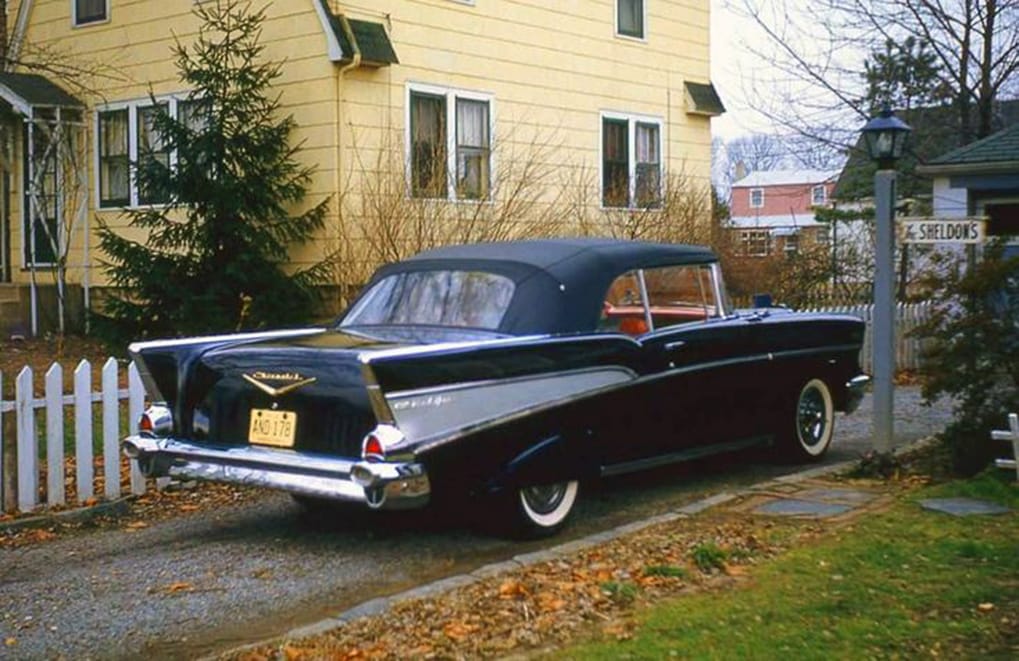
The best known and most loved from the fin era likely is the 1957 Chevrolet Bel Air convertible. The one featured above was V8-powered and had aftermarket fender skirts and wheel covers, plus a great color combination. Its license plate shows that it was from New Jersey.

Oldsmobile went light on the fins for 1958, but heavy on the chrome. They called it “Mobile Look” styling, so I guess it was supposed to look like it was going somewhere. The above car was the entry-level Dynamic 88 Holiday Coupe, which looked close to new. Ahead of it was a 1959 Rambler Super Cross Country wagon showing its fins, which were at the peak for Rambler.

Here was a row of conservative fins, beginning with a 1958 Ford Custom 300 Fordor Sedan and followed by a 1956 Buick Special or Century convertible. On the end was a 1955 Chevrolet Bel Air Sport Coupe.

“Cadillac for 1959 presents a new realm of motoring majesty,” proclaimed the Cadillac sales brochure for this year. The fins were at their height, both literally and figuratively — the tide began to turn the next year. This one was a Series Sixty-Two 6-Window Sedan with what might have been a Florida license plate issued in 1963. Through the Cadillac, you can see the fins of a 1956 Plymouth Custom Suburban 4-door station wagon.

Chevrolet went batty in 1959 with their sideways “bat wing” fins. Nevertheless, this Impala convertible looks very nice in Gothic Gold, and was quite popular, with nearly 66,000 units produced. The car next door, visible at the right, looks like a 1957 Oldsmobile Super 88.

Here’s another view of a 1959 Cadillac Sixty-Two, this time a hardtop coupe with an aftermarket antenna and trailer hitch. You can see the bullet-style taillights and simulated rocket exhaust outlets, where the backup lamps were located. In the background was a 1965 Ford Galaxie 500 2-door hardtop.

Here’s a nice side view of a 1960 Plymouth Belvedere 2-door sedan with its big “stabilizer fins.” They must not have been very effective, as they were gone by the next year.

The 1960 Chevrolet was a face-lifted and toned-down version of the 1959 “bat wing” style, as seen in this 1960 Impala Sport Coupe from Oregon. It was dressed out nicely in red and white, with a rear mounted antenna, full wheel covers, and whitewall tires. But, the deck lid badge shows it was a six-cylinder model, which may have been why the cat in the adjacent space did not seem impressed.

With Plymouth now paired only with Chrysler for 1960, Dodge introduced a new low-price full-size line called Dart. Its fins were the most conservative of the Mopar full-sizers that year, which may have contributed to its popularity. The one pictured above is a 4-door sedan in the entry-level Seneca series. It stood out in its bright red paint, chrome vent visors, and full wheel covers, and it wore a Pennsylvania license plate.

We close with a beautiful fall photograph of a 1960 Chrysler New Yorker 4-door sedan at the Portland Zoo in Portland, Oregon. Although other automakers were toning down their fins, Chrysler did not go along with crowd and increased the fin size in their facelift for this year, only to reduce them for the 1962 model year.
Thanks for joining us and have a great day!
Note: If you wish to see your vintage photos featured at Curbside Classic, send them to us at [email protected].























Can’t forget the ‘59 Dodge…
I was suppose to inherit this car when I got of the age of majority
Great write up, BUT where is 1961 Imperial? Those Fins were actually an inch higher than 59 Cadillac. Virgil was always the FINTASTIC king.
The 1958 Packard gave the 1959 Cadillac a run for the tail fin prize.
https://i0.wp.com/www.curbsideclassic.com/wp-content/uploads/2018/08/IMG_7766.jpg?quality=75
And though I can’t defend either of THOSE fins as having much purpose, the fins on my 1960 Edsel are useful in driving. They show exactly where my rear edges are. It is easy to back up and parallel park using that car’s fins.
I never could accurately parallel park my 1973 Pinto Runabout or any jellybean car because I couldn’t see where the rolled off rear really was.
That these useful edge markers were designed to have a fantasy element is a bonus, not a joke.
The last image has my all-time favorite taillights and a great finish to the graceful fins. Chrysler, IMHO, ruined the look in 1961 with the cheap looking chrome replacement. The 1956 Packard taillights are a close second. That convex/concave shape must have been interesting to draft and to make the molds.
That does look really nice. Looks well thought out and designed rather than a lot that seem just put together all ‘willy-nilly’.
Really, I love em all!
A feature on garage doors versus car generations would be interesting. Swinging doors (as on first pic here), sliding doors, bifold or multifold, up and out with no tracks, up and in with tracks, rollup with tracks.
The 1960 Plymouth Belvedere 2 door, 4th last pic, is wild, its hard to believe it was approved for production by upper management, the fins are as cartoonish as they would ever get. Even the lady doesn’t seem to be taking it seriously.
Its great to see this profile shot of one of the basic models,
Some of the details are fantastic, I’ve always liked the windshields on these, even though it was out of date in the early 60s, it was way better than wrapped windshields from all the other manufacturers, which helped it survive on the Imperial until 1966.
Love that final parting pic, dad had a sky blue 60 Windsor sedan. Highway cruiser. He loved his chryslers… Similar car pic found online, king of the fins…!!!
I still like the understated fins on the ’56 Fords .
-Nate
Watercraft of the era also had fins. The 1957 Glaspar Del Mar sported both tail fins, and the wrapped rear window of a Studebaker as the windshield of the cuddy cabin.