
Text by Patrick Bell.
The hardtop body design was an American idea that quickly became popular and endured for over twenty-five years. The idea was to have the appearance of a convertible with the top in the up position, and then to not have many of the problems associated with a folding cloth top. Today we have many examples from their first decade, a time when every manufacturer had their own versions. Being the fifties, as can be expected, it’s a collection of color and glitz.
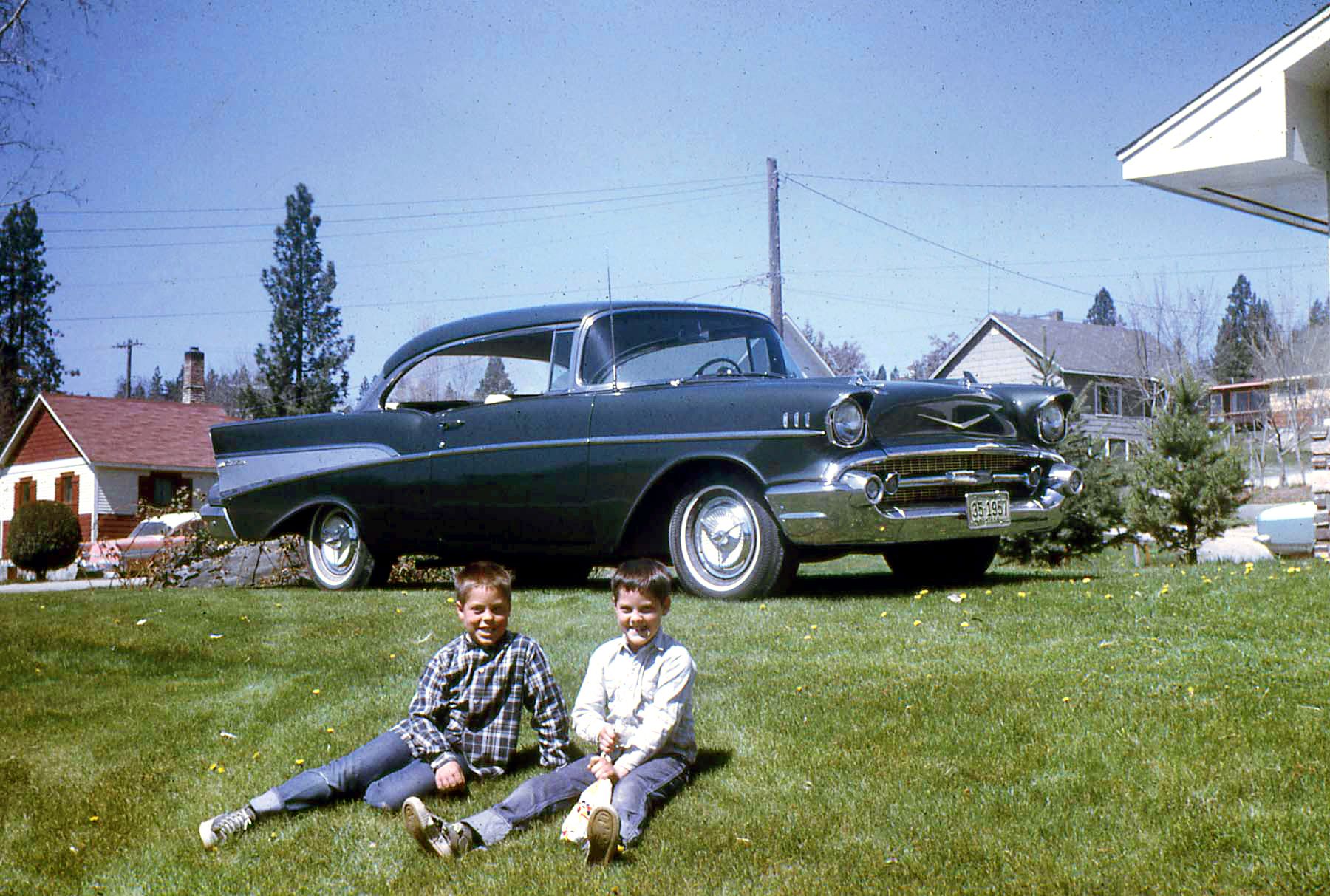
We begin with two boys who were likely cousins or brothers who were posing in front of one of the more popular hardtops through the years, a 1957 Chevrolet Bel Air Sport Coupe that was V8 equipped. This one was a very mild custom, with the “Chevrolet” nameplate shaved from the hood, aftermarket Oldsmobile style spinner wheel covers, and narrow band whitewalls. The license plate was a Montana style used from 1963-1966, and issued in Sanders County, where the seat is Thompson Falls. In the left background was a 1957 Pontiac, and to the right a blue quarter panel possibly of a second gen Chevrolet Corvair.

Here was Ford’s first hardtop, introduced in 1951 as the Victoria. The 239 cubic inch, 100 horsepower flathead V8 was standard equipment, and 1951 was also the first year of the optional Fordomatic Drive.
In the above photo, it appears like they were traveling through a desert, and had a water bag hanging on the hood latch.

Buick offered one of the first hardtop models in 1949, so they were pros by the time this 1953 Super Riviera arrived. The Super was the mid level series, and Riviera was Buick’s name for their hardtops, which was used through 1958. This was also the first year for their overhead valve V8, and it was their Golden Anniversary.
The featured car was close to new in this image as it had a same year Illinois license plate. It was ordered with the standard hub caps with trim rings and blackwall tires, but they did spend some money on a radio and outside mirror.

A stylish lady was posing with a new looking 1953 Studebaker Commander Starliner with what appears to be aftermarket wire wheel covers. This all new style was a radical departure from the “traditional” American car, and was at least a decade ahead of its time. Unfortunately, poor quality control and other problems related to a lack of capital dampened their reception in the marketplace.
The Commander series carried over the 232 ci V8 with 120 hp that was introduced in the 1951 model year.

This 1953 Pontiac Chieftain De Luxe Catalina was ten years old in the above image, but it looked very well taken care of. “Catalina” was Pontiac parlance for hardtop, and it was used until 1959 when the 2 door hardtop became a “Sports Coupe”, and the 4 door a “Vista”, and “Catalina” replaced Chieftain as the entry level series.
The car above had at least one aftermarket spinner wheel cover and a new issue California black license plate. In the background was a Volkswagen Type 2 Transporter with curtains in the windows.

The Buick Century was so named in 1936 because it was the performance model that supposedly would reach 100 miles per hour. The series took a break after WWII, but returned in 1954, where it shared the 122″ wheelbase with the entry level Special, and used the 200 hp Fireball V8 from the larger Roadmaster series.
Shown here was a new looking 1954 Century Riviera. Image notes report this was Springfield, Ohio, and the building looked like a school.

A military man and what was likely his 1955 Ford Fairlane Victoria were posing for a photograph. Perhaps he was highlighting the Thrush Muffler decal in the quarter window. The Fairlane series was new for 1955, and the conventional two tone treatment as shown was unusual on the Fairlanes, as most of them had a two tone body with the colors split by the side molding.
Other Fords in the image were a black 1949 or 1950 Tudor Sedan on the left edge, and a blue 1955 model on the right next to the Volkswagen Type 1, which was the newest car in the image as the big back window indicated it was at least a 1958 model.

Buick simplified their engine selection in 1955 from a different output for each series, to a low output for the base Special, and the same high output for the three upper series. The familiar “Venti-ports” were updated as well. The Special was now the only three holer, while the Century, Super, and Roadmaster all had four holes. Above was a 1955 Century Riviera with two tone paint and lots of curb rash.

Another popular hardtop was and is the 1955 Chevrolet Bel Air Sport Coupe, and many had custom touches similar to the one shown here. The hood ornament and emblem were shaved, as were the quarter panel nameplate and vertical molding. It had 1956 Corvette wheel covers and a custom interior, as well as a 1955 Massachusetts license plate with a 1956 sticker on the upper windshield edge.
Parked behind it was a 1956 Ford Fairlane Country Sedan wagon, and I am not sure about the blue car in the corner. It looked like one of them furrin’ jobs.

You could have your fire three different ways on the new Forward Look DeSoto; Firesweep, Firedome, or Fireflite. And if that wasn’t hot enough, there always was the Adventurer. The featured car was a 1957 Fireflite 4 door Sportsman that looked close to new, but was missing a couple of letters from the hood, and had a ding on the rear door. Sportsman was DeSoto’s name for the hardtop models.
Hardtops of the four door variety were introduced in 1955 by Buick and Oldsmobile, and nearly everybody else followed suit in 1956. They were quite popular, but have not survived as well as the two door models.

Oldsmobile had the best moniker for hardtops; “Holiday”. It was in use the longest as well, from 1949 through 1970. Above was a sharp looking 1957 Oldsmobile Golden Rocket Super 88 Holiday Coupe. It was well protected with aftermarket front mud flaps and clear plastic seat covers. It looks like they could have used some curb feelers.
Across the street was a 1949 or 1950 Chevrolet Fleetline De Luxe 4 door sedan.

Dodge’s version of the 1957 Forward Look was called “Swept-Wing”, and its fins were the most conservative of its brethren. The car shown was a 1957 Custom Royal Lancer 2 door, the top of the line series, with the “Lancer” name denoting a hardtop model. It was used through 1959 and recycled in 1961 for their new compact car. Standard power for the Custom Royal was the Super Red Ram 325 V8 with 260 hp.

Ford’s Fairlane for the 1957 restyle grew into its own model with a two inch longer wheelbase than the base Ford, which was now called the Custom and Custom 300.The featured car was a 1957 Fairlane 500 Town Victoria with a Texas license plate from 1958 or 1960. The car in the background may have been a 1955 Nash.

According to the sales brochure the 1959 Plymouth was “Young and proud and full of go…”. Hmm. The one shown here was a 1959 Fury 2 door hardtop which came standard with the Fury V800 318 ci V8. It was also available in 4 door sedan and hardtop models.

Chevrolet joined the longer, lower, wider, and heavier trend in 1958 as shown in this Bel Air Sport Sedan with V8 power. The Bel Air was in its last year as the senior series, as the new Impala would become its own series and take over for 1959. This one had a 1958 issue Illinois license plate, and obviously someone chose blackwall tires on this top of the line 4 door.

As part of General Motors’ Fiftieth Anniversary celebration, Buick revived the Limited nameplate for a one year only model. It had a host of power accessories as standard equipment, and a base list price that was $221 higher than a Cadillac Sixty-Two Sedan.
The image above may have been the back side of a small dealership. It appeared like the car had been detailed for delivery, and there was a buyer’s tag on the bumper. The car was a 1958 Limited Riviera 4 door, and on the right edge was the corner of a 1956 Cadillac.

1959 brought another restyle to the Chevrolet line, the second in as many years. Not everyone liked the “bat wing” fins, but excess was the style in the latter part of the 1950’s.
Shown here was a 1959 Impala Sport Coupe with V8 power that looked close to new. In the background was another hardtop, a 1957 or 1958 Mercury wagon. From 1957-1960 all Mercury wagons were hardtop design, and from 1957-1959 you could get a two door model as well, which was unique to Mercury.
Thanks for joining us and have a great day!
Note: If you wish to see your vintage photos featured at Curbside Classic, send them to us at [email protected].























Pic 4: Usually a pretty girl distracts your attention from the car. In this case it’s the other way around.
That 55 Chevy also has some teeth removed from the grill another freebie custom trick
Nope….
Nope what???Huey
Im pretty sure that’s not a Thrush Muffler sticker on the ‘55 Ford as the company didn’t start using that name until the mid-Sixties. It’s probably just their inspiration, Woody Woodpecker. I think Thrush was actually Canadian; my sister knew the family that owned the company back in the Seventies in Toronto.
The sticker might be a Clay Smith Cams “Mr. Horsepower” mascot.
While looking up info. on Mr. Horsepower to see when it came into use, I read this paragraph on Wikipedia explaining the taxonomy differences between Mr. Horsepower, Woody Woodpecker and the Thrush logo:
Some people have confused Mr. Horsepower with the cartoon character Woody Woodpecker. The notable points of contrast are that Woody Woodpecker’s beak is curved but smooth on top and bottom, and his head-feathers form a well-contained “V” shape in early iterations or a sprout of sorts in newer iterations. Mr. Horsepower also has a similar appearance to the Thrush Exhaust logo. The Thrush logo has hot pink feathers, no gaps between the teeth and lacks the cigar.
Wiki link: https://en.wikipedia.org/wiki/Mr._Horsepower
You are correct dman
It still amazes me a bit that Detroit tooled up for–and offered–so many body styles–2dr, 4dr, sedan, hardtop, wagon, and then with all the options and colors. Were the hardtops more prone to have wind-rain sealing problems, or is that an unjust concern?
The Studebaker photo is right out of the Audrey Hepburn “Roman Holiday Haircut” era. Oddly enough, just yesterday in LIFE (1955) I saw this Quaker State ad—-automobile, hairstyles, and clothing slightly updated:
If my own 59 Fury had been a 2 door hardtop like the copper one above instead of a 4 door sedan, I might have worked harder at keeping it. It certainly would have been easier to resell!
Those ’53 Loewy coupes were just perfect. They should’ve kept producing them unaltered for a few more years. Even the teeth in the ’54 grilles detracted.
But yet, while I love their simplicity, I also like the balanced excess of those ’58 Limiteds.
In more modern times, calling a Buick both a “Century” and a “Riviera” would be a bit of an oxymoron.
The Century, towards the end, being a watered down Regal (in the W-Body era), while the Riviera being a high dollar PLC.
But as we have discussed here many times, GM has always been all over the place with their model names, name debasement being one of the things at which they excelled.
The “57, Olds” is a “beaut” !
The ’59 Fury two hard top is excellent but I’d be much more interested in the GM Sedan Delivery parked behind it .
-Nate
All the Hudson hardtops were “Hollywoods”. Here’s a 1957 Hornet Hollywood Custom.
That ’58 Buick Limited Riviera looks so awkward. Way too tarted up, especially the chrome gills on the side. What were they thinking?
I think that furrin’ job in the pic with the 55 Chevy is actually a Corvette with a hardtop.