
Text by Patrick Bell.
DeSoto was a medium priced Chrysler Corporation brand that was positioned between Dodge and Chrysler for many years. As was and is often the case, budgets get tight and the model’s individuality fades away, so they become redundant and end up getting the ax. Today we have some examples from their last decade, which was a decade of change.
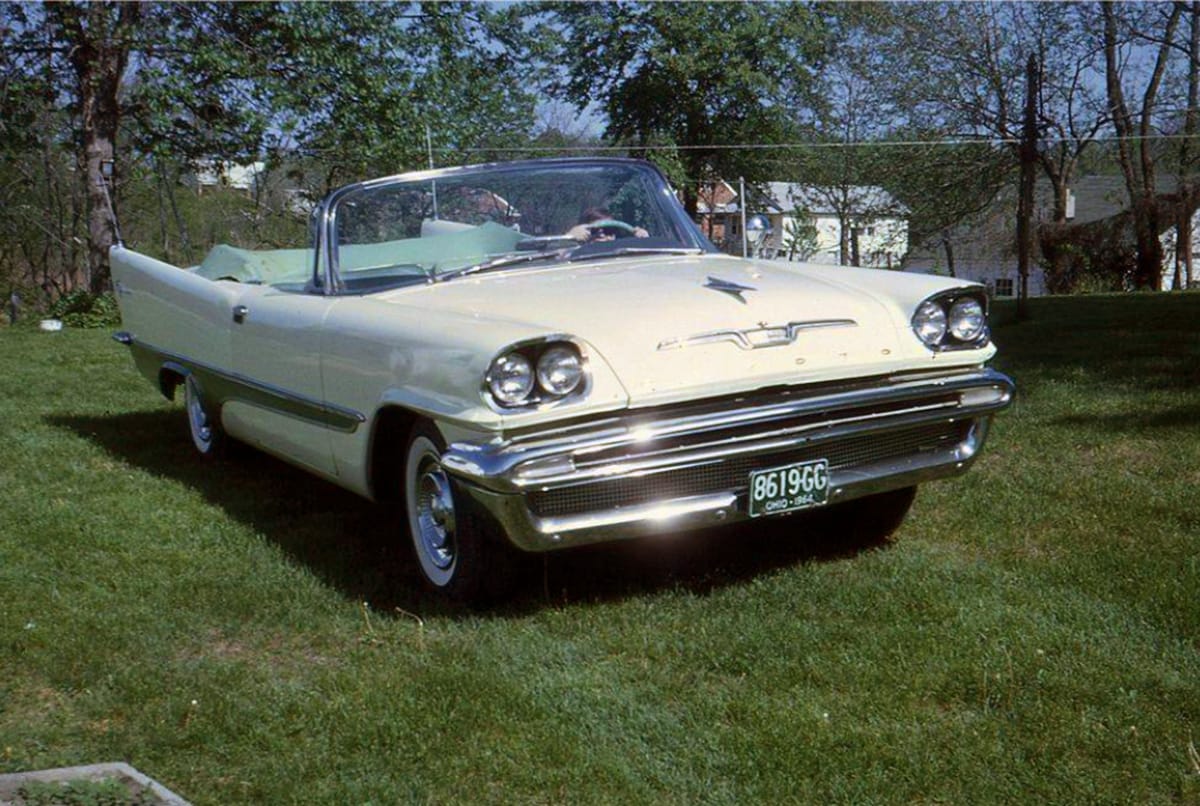
We open with an open DeSoto, a 1957 Firedome with dual rear antennas, outside mirror, two tone paint, and a 1964 issue Ohio license plate. The Firedome was second from the bottom seniority wise on the new Flight Sweep style. There were four in total beginning with the FireSweep, then Firedome, Fireflite, and Adventurer.
The top three series offered convertibles, with the Firedome the most popular but still rare with 1,297 produced. Firedome power came from a 341 cubic inch V8 with a 2 barrel carburetor and 270 horsepower. Look closely and you can see a junior driver at the wheel.
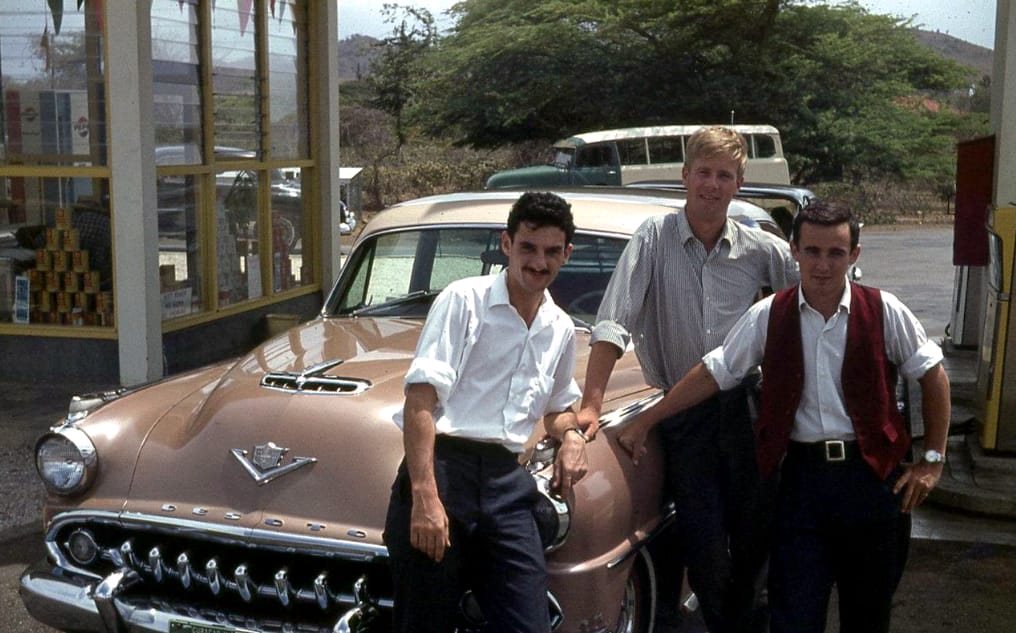
Three dudes were posing at a Shell? station in a warm climate with what appeared to be a 1954 FireDome 4 door sedan with the top edge of an unreadable license plate showing. The running lights and moldings on the fender tops don’t seem to be original as I found no information on them. Perhaps they were a rare option.
The FireDome was the senior series of two in 1953 and 1954, and the junior was the Powermaster. A 276 ci V8 with 170 hp provided power on the FireDome, while the Powermaster made do with a 6 cylinder. The big news for 1954 was DeSoto’s first fully automatic transmission, the PowerFlite. There were two cars in line behind the DeSoto that weren’t showing enough to ID, and in the background on the left was a 1951 Chevrolet Styleline, and to the right looks like a Chevrolet Advance Design or it’s GMC equivalent with a bus body added on.

Here in a parking or dealer lot was a 1953 Fire Dome Club Coupe. This was DeSoto’s silver anniversary, and the new restyle was the first in a two year cycle. The “Air-Vent Hood” scoop was functional, directing cool air to the 276 V8 with 160 hp. Behind it may have been an early 1950’s Dodge Job-Rated truck, and on the other side of it was a 1955 Plymouth Belvedere Club Sedan.
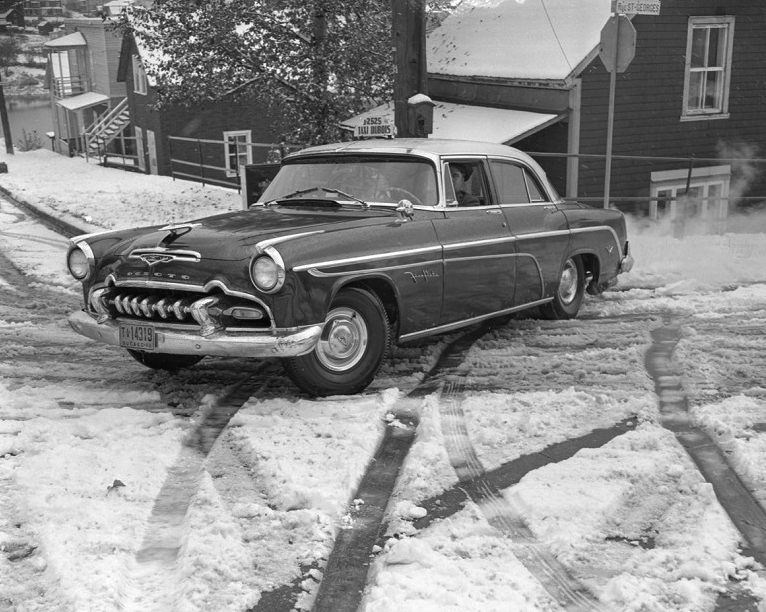
A new restyle came with the 1955 model year along with a new senior series; the Fireflite. The Firedome was bumped down to the junior series, and the Powermaster and six cylinders were discontinued. The V8 was increased to 291 ci, with 185 hp in the Firedome, and 200 hp in the Fireflite. The featured car was a 1955 Fireflite 4 door sedan in taxi service somewhere in Quebec. It looked like he was having trouble getting around in the slushy snow.

This gentleman was posing with a 1955 Firedome Special Coupe or Sportsman 2 door hardtop. The “Special” was a low cost model with a different interior, and the “Sportsman” name was used for the hardtop models. The one above had the moldings for the side two tone, but it appears like it was a solid color. And the amber color park/signal lamp lens was owner added, perhaps to upgrade to the new standard that applied to the 1963 model year.

1956 brought an update to the 1955 style, along with a boost in engine size and horsepower, and a new Push Button Drive Selector for the Powerflite automatic transmission. The series were carried over with an added new body style; the 4 door Sportsman hardtop.
The featured car was a 1956 Fireflite 4 door sedan and the location was the Portland Head Light in Cape Elizabeth, Maine, in an image dated July of 1966. Fireflite power was now a 330 ci V8 with 255 hp, and the Powerflite transmission was standard equipment.

This one was a 1956 Firedome 4 door sedan with two tone paint, a fender mounted mirror, and Oregon license plates. The Firedome engine was also a 330 ci V8, but with a lower output of 230 hp. A three speed manual transmission was standard, with overdrive and the Powerflite optional. I do not recognize the car? on the left.

And a 1956 Firedome Two Door Seville from California that was purchased from Art Frost, a Los Angeles DeSoto/Plymouth/Packard dealer with several locations. The Seville was a lower priced version of the hardtops, both 2 and 4 door. The differences between them and the Firedome Sportsman’s were mainly the interior, with some minor exterior trim as well. And yes, 1956 was the first year Cadillac used the Seville name.

Someone was recording a new car in Florida, a 1957 Fireflite 2 door Sportsman with two tone paint, dual rear mounted antennas, outside mirror, and dual headlights. Power was provided by a 341 ci V8 with 290 hp, and the new Torque-Flite 3 speed automatic transmission was standard.

Here was a 1957 Fireflite 4 door sedan with the standard single headlights. Otherwise, it had two tone paint and an outside mirror.
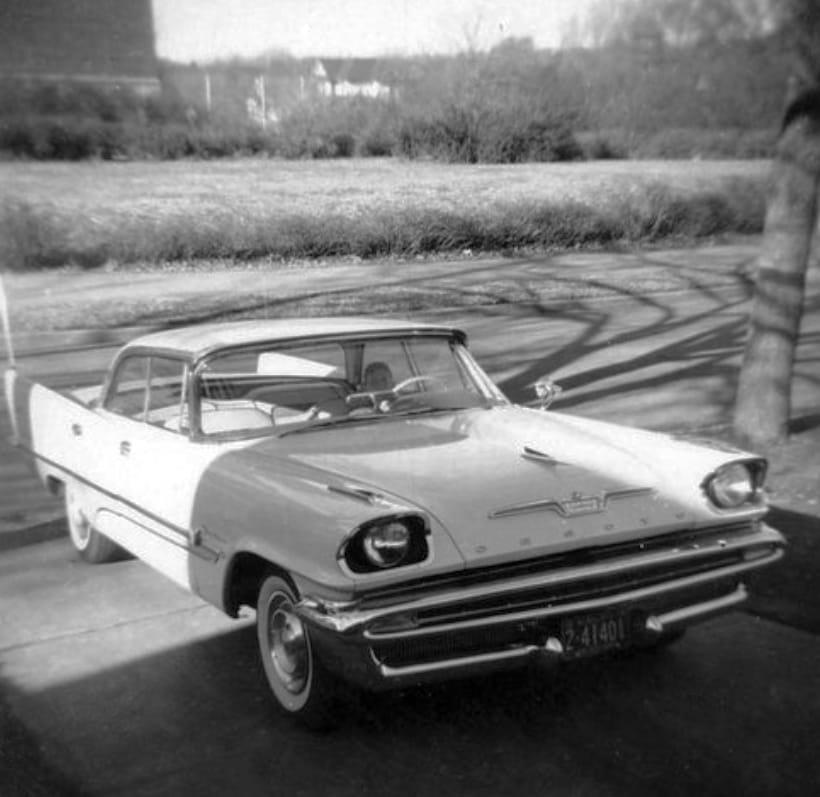
And one more two-eyed 1957 Fireflite, this one a 4 door Sportsman with an unreadable license plate. It was equipped as most of them apparently were, with two tone paint, outside mirror, and dual rear antennas that look like they would be easy to accidentally (or otherwise) break. Plus there was a young man in the car. I can’t tell if he was in the front or back seat.

A facelift was in store for the 1958 models while the big news was all new engines. The car above was a 1958 Firesweep 4 door sedan. The Firesweep was a low priced, entry level series that was available during the 1957 through 1959 model years. It had a four inch shorter wheelbase, unique front end sheet metal in 1957 and 1958, and was based on the Dodge platform. The new Firesweep powerplant was a 350 ci V8 with 280 hp. Transmission choices were a three speed manual and two automatics, the Powerflite and Torque-Flite.

The handwriting was on the wall when the 1960 models arrived. 1958 was a recession year that hurt everyone. Sales were less than 50,000 for the year. 1959 was not a recovery year for DeSoto as sales were even less. 1960 brought a new restyle with even less differences from the Chrysler models. Series were down to two with the Firesweep and Firedome now gone. Body styles were down to three; a 4 door sedan, plus 2 and 4 door hardtops that were available in both series.
The featured car was a 1960 Adventurer 2 door hardtop which had the 383 ci V8 first offered in 1959, in fact it was the lowest output of the three available in 1959 with 305 horsepower. It is easy to wonder why a car like this was in the Mobil Economy Run, but they had several classes of cars based on weight. This car was sponsored/provided by the DeSoto Dealer’s Association of Southern California, and wore a California dealer’s license plate.
Thanks for joining us and have a great day!























I love DeSotos!
The Ohio plate shown was most likely issued in Clermont County, in Southwest Ohio. The picture could have been taken in 1964 or 1965 as Ohio at that time had all vehicle registrations renew in the Spring of the year. Definitely looks like Spring in Ohio. In 1980 the State BMW went to a monthly system by car owner’s birthday month.
I had a ’55 DeS Fireflite – one of many $50 back lot specials I owned while in my 20s. A group of us had a choice to make for a Spring Break trip from Wisconsin to Key West. Take a friend’s Opel Kadett for the gas mileage or my DeSoto for the space. We took the DeS down & back with no problems other than a wheel cylinder leak that developed somewhere in Georgia and was fixed at a surprisingly reasonable cost at an honest roadside Florida garage. To this day, I consider the ’55-’56 one of the most comfortable passenger cabins ever. Ventilation with the pop-up vent was surprisingly effective for a non-AC car in hot weather. By modern standards, the car didn’t go, stop or handle. However once underway, it was a comfortable living room on wheels fully capable of keeping up with any and all turnpike traffic. By the early ’70s when we made the trip, a DeSoto was already a rare sight on the highways. To listen to the comments the car got whenever we stopped for gas, you’d wonder why DeSoto ever failed. Many seemed to remember DeSotos as one of Chrysler’s greatest hits. More than a few commented on how comfortable they remember some past ride in a DeSoto taxi. Perhaps that was the problem. I mean who wants to buy a car with a taxi image for their personal vehicle. Judging by Checker non-taxi sales, it was a pretty small market. 1955 was a banner year for DeSoto sales. 6 years later, it was dead. Amazing how quickly a brand with a fairly decent reputation can die by being out of step with changing times.
You make me remember a couple of trips my mother, sister and I took with my grandma back in the mid 60’s. I always asked why we couldn’t take Grandma’s 55 DeSoto. As you said, the back seat would have seemed like a palace to we kids. But my mother complained that it didn’t have power brakes. And it was in an era when Mom’s 64 Cutlass was much newer and therefore more trustworthy.
1961 was the final year for DeSoto, with production ceasing on November 30, 1960.
No model names for `61, just 2 Door Hardtop with 911 built, and 4 Door Hardtop with 2123 built for a total of 3034.
I delivered a new Buick to a former DeSoto dealer at our Cadillac-Buick dealership in Chicago in the late `80s.
Our owner had turned him over to me for the delivery.
I was introduced to him as a friend of our owner, and DeSoto was mentioned.
Even 25+ years later he was still pissed about how it all went down.
He said they “were forced to take delivery of hideous inbound inventory, after the news of DeSoto’s demise had already gone public.”
He said he and other dealers felt that if the compact Valiant had been introduced as a DeSoto model instead of it’s own make it’s introductory year in `60, it would have brought hundreds of people into their showrooms.
Chrysler making Valiant a Plymouth model in `61 just poured salt on the wound.
Ironically the first gen `61 Dodge Lancer body was marketed as DeSoto Rebel outside of the US.
It was sister car to the Valiant `61/`62.
Which pissed him off even more.
He was part of those who sued Chrysler and said he was in and out of court for years.
I have a beautiful, unrestored ‘55 Firedome Special coupe. Original, except for maintenance and tires. No power anything, and “three on the tree.” But it does sport the optional windshield sunvisor, clock and AM radio, which still works. Wonderful, trouble-free car.
3 on the tree?
Spectacular, Eric !
3 on the tree = steering column mounted 3 speed manual gearshift
That sounds alot like how GM treated our local Oldsmobile dealer. The dealership was very successful and moved a lot of cars in our area until they pulled the plug suddenly. The owner retired and didn’t even try to get another franchise and was temporarily stuck with a nearly new facility.
I’m not going to get political here, but the same thing happened to our Chevy dealership that had been in business since 1955 and a nearby Chrysler Dodge dealership during the 2008 financial downturn.
The same happened to our former general manager who later bought an Olds dealership with a partner.
They were forced by GM to move twice, so they would be part of a new auto mall when it was completed.
They played ball all the way.
They then acquired Pontiac and Isuzu franchises.
Then lost all three. \o/
They considered legal action, but were advised there would be continuances until they were broke.
I know so little about these—and how much they were/weren’t distinctive from corporate kin. Today’s writeup helps a lot!
Photo #3: Is the building perhaps a “Montgomery Ward” warehouse?
Mobil Economy Run: Yes, in addition to absolute-best-mileage winners, there was another metric that factored in weight of car…..some sort of ton-miles per gallon or something; that’s where you might find winners among pretty plus big cars.
David Zornig’s tales from the onetime DeSoto dealer remind me of Ford’s bad relations (and dealer lawsuits) upon pulling the plug on Edsel a year earlier. I can see him carrying a longtime grudge!
Picture #4 (Fireflite taxi in snow) was taken in Quebec – the DeSoto has a Quebec Taxi license plate.
Thanks to the street sign in the background, we can narrow down the location. Seems it was taken in in La Tuque, about 100 mi. north of Trois-Rivières. The intersection looks a bit different now because the house closest to the photo has been demolished, but the then-and-now comparison below shows that the two houses in the background, as well as the topography, match the vintage shot. Plus, the vintage shot shows a body of water in the background, which also matches because there’s a small lake at the bottom of the street (Lac Saint-Louis).
Google StreetView link:
https://maps.app.goo.gl/kpYECNqVkpmUGLeP6
I was going to suggest that also, that a street sign named Rue St. Georges was unlikely to be in Ontario. Great research!
Oops, thanks for the correction, Eric.
I was born a little too late to have been aware of the DeSoto brand. Probably like a lot of my peers, I was introduced to the brand by Howard Cunningham, who really loved his DeSoto.
As a kid I liked to sit in several derelict DeSotos in the way back lot of Towson Dodge when it was located back behind the big Hutzler’s store. A ’53 and ’56, around ’59/60/61? No one want them I guess and the sat for several years. Regardless, DeSoto went on to become (along with Olds) my most favorite of vintage cars, and had several ’58s and ’59s, 2 x 4dr hardtops, 1 x 2 dr hardtop, 1 sedan.
I wish they had produced the stillborn “S-series” ’62 DeSoto that John Samson has shown pictures of, it would have been by far the best looking Mopar of that year imo! (not that it had much competition! lol).
Had a 1952 Desota. Coupe with Hemi engine. Loved everything and was really fast but did not have the torque flite transmission that come out later
My father had a 52 Firedome 8 station wagon until 1961. Loved that car.
I like the toothy grille DeSotos used to have, it made the pre 1955 cars a bit less stodgy, my favourite is the 55 model.
Though I suppose the grille teeth would have looked outdated in the late 50s, still, to me the post 1955 cars lost that special identifier that meant a DeSoto.
The first new car my paternal grandmother ever bought was a red and black 1955 DeSoto 4 door. She made several cross country trips in it and was very happy with that car. She traded it in on a new 1959 DeSoto 4 door, green and white. It’s maiden voyage was a 12000 mile trip from Ohio to Alaska and then back through the Pacific northwest and Yellowstone. In 1961 that DeSoto took her from Ohio through New England, the Atlantic Provinces, and then back through Montreal, Toronto, and Niagara Falls. By 1964 she was ready for a new car and was so disappointed that DeSoto was gone. She ended up buying a 1964 Chrysler Newport.
In the mid 1980s I traded a rusted out Chevy pickup for a 1949 DeSoto 4 door. It had a 6 cylinder engine, fluid drive, and rusted out floorboards. It also had a leaking wheel cylinder so you had to keep filling the brake fluid. It was fun to drive around in that summer. It sat all winter and by spring I wanted to see it gone. I took it to an auto swap meet and ended up selling it for $500.
The car in the snow has a Quebec plate on it and the taxi sign is in French. The license plate has a fleur de lys. Still, deSotos in their day were pretty awesome!
Chrysler had as many brands as GM, but way less volume. I place it at the Oldsmobile level. Brand identity is tough, as DeSoto were once common in taxi fleets, then they took it upmarket, only to be killed by ’58 recession.
Some one needs to give the Little Shaver in the ’57 Firedome a box to sit on =8-) .
I remember all these cars and many more, I used to love twin radio aerials .
I am loving that Advance Design Chevy Jitney Bus .
That Fireflite taxi is a ’56, non ? . Obviously I’m not sharp on DeSotos .
I love seeing those wide white wall tires ! . they’ll never go out of style in my book .
So much lovely style and excess chrome .
-Nate
My first car ride (home from the hospital) was in my folk’s ’55 DeSoto, a turquoise/blue two-tone. I have a picture of the car and I have the dealer’s invoice….but no memory of it, since Dad traded up to a 58 Plymouth Suburban wagon when I was 2. Sometime, I’ll have to find someone who can give me a ride in a ’55!
I like DeSoto, I always felt it was a good answer to Buick in the 50s and 60s! I couldn’t figure out why they fell out of favor with the public!
Is it possible the car that was not identified was the hood of a nash?
Very enjoyable DeSoto photos! I had a 1959 Firedome as a daily and only driver for several years in the early 1970’s. White, of course. Other than frequent brake problems, a solid trooper. I also went through several generators (or their brushes) with the miles that I fed it.
My ’59 Firedome had the entry level first year 383 with a 2-bbl. carburetor. It also had a high compression engine, with 305 hp gross, compared to later lower compression, milder cammed 2-bbl 383’s with 270 hp gross. For a large heavy barge, the fuel mileage was a gentleman’s “C” at about 13-14 mpg.