

Text by Patrick Bell.
It has been awhile since we featured a commercial vehicle gallery. Today we have a nice selection of mostly light-duty vehicles from back in the days when most of the signs and liveries were hand-painted.
We begin today with proof that ice cream sells even on a cloudy and cool day. In our lead photo, a well-worn 1951 Chevrolet Advance Design 3100 ice cream truck was taking care of business for Jack & Jill Ice Cream, a company that got its start in 1929 in Philadelphia. Power was provided by a 216 cubic inch six cylinder with 92 horsepower. This one had the optional cab rear corner windows. It was plying its trade in a new subdivision.

In Australia, “utes” were mainstream family vehicles in some areas, but here, car-based coupe-utilities like the Chevrolet El Camino and Ford Ranchero often served as rolling business signs and light delivery vehicles. This 1959 Ford Ranchero, owned by an auto radiator company in Knoxville, Tennessee, was dressed up with aftermarket fender skirts, full wheel covers, and whitewall tires. The sign painted on the bed said “Radio Dispatched,” so the Ranchero also had a whip antenna for the two-way radio. The standard engines in the 1959 Ranchero were a 223 cubic inch “Mileage Maker Six” and a 292 “Thunderbird” V8. Optional were two “Thunderbird Special” V8s in 332 and 352 cubic inch displacements.

Los Angelenos of a certain vintage will remember the Helms Bakeries coaches that were once “Daily at Your Door.” Based in Culver City, Helms delivered their goods to neighborhoods (but not to stores) across Southern California from 1931 to 1969. There are many memories online of the warm bread and donuts Helms sold. Their delivery vehicles were just as memorable. In the 1930s, founder Paul Helms ordered 148 of these compact vans from the Twin Coach Company of Kent, Ohio (best known for their buses). They were powered by a Hercules inline four-cylinder engine, and had a unique whistle to announce their arrival at each stop. The one above was number 185. The lady customer seemed pleased to be there. (You can read more about the Helms Bakeries coaches in this post.)

Before domestic-made compact vans arrived in the early 1960s, half-ton panel trucks were commonly used as light delivery vehicles. This one, which was used by a clothes-cleaning company in the small town of Teutopolis, Illinois, is a 1947–1950 General Motors model. The emblem on the side of the hood looks to me like it says “GMC,” which would make this truck one of the GMC “New Design” models, but it could also be the more common Chevrolet “Advance Design.”

Volkswagen’s Type 2 panel van was very popular in many parts of the world. This Regina Mellow Mints van had just stopped at the F. T. Wimble & Company print shop somewhere in New Zealand, and some executive-looking gentleman were posing with it. I found that the European company Brekina makes an HO-scale version of a similar mint-green Regina Mints van, which they date to 1960.

This unusual Pennsylvania tour bus was made by the Flxible Company of Ohio, based on a 1946–1948 Buick chassis. Flxible is most remembered today for buses, but they made a variety of vehicles, including ambulance and hearse conversions. This bus appeared to use the same body as the ambulances. Flxible is gone today, but this bus company is still in business, and is now known as Perkiomen Tours.

The truck pictured above was a 1957 GMC “Blue Chip” cab and chassis with a seed and fertilizer applicator mounted on the back. The lettering on the door says it belonged to Colorado Valley Milling Company in Wharton, Texas. In the background, we can also see two green 1958 Chevrolet “Task-Force” Viking or Spartan models on the premises. The car visible at the right edge was a 1953 Ford sedan.

In the 1950s and 1960s, most Jeeps were hard-working vehicles. The insignia on the passenger door of this 1954–1960 Jeep Utility Wagon appears to say “Davis County Sheriff Jeep Patrol.” There is a Davis County in Utah, so that will be my guess for the location. This wagon had nearly bald street tires on the front for some reason, and carried at least three jerrycans (two on the ends of the front bumper and one on the front fender that matches the wagon’s paint). It also had fog lamps and a roof-mounted spotlight. There is lettering on the front bumper that says “WARD.” If this vehicle was in Utah, that might have referred to a ward (congregation) of the Church of Latter-day Saints rather than a person’s name. You can see another Jeep wagon in the same livery in this May 2025 post.

These three airport limousines were operated by “The Gray Line.” I can’t place the location, but they appeared to be arriving at a hotel or resort. There were two 1964 Pontiac Catalina limos with a 1962 Chrysler Newport in between. The integral roof racks of these limos boosted their luggage capacity and may have added some upper body strength. I can’t read the nameplate on the first Catalina fender, but overall, these have the look of a Stageway Coaches build. Stageway merged with Armbruster in 1966 and still operates in Arkansas under the Armbruster/Stageway name.

In the early 1960s, some businesses adopted Corvair 95 Forward Control trucks and panel vans, but this radio camera car for the San Diego Union Evening Tribune (now just called the Union-Tribune) was a 1961 Corvair 700 coupe. The standard 145 cubic inch, 80 horsepower “Turbo-Air 6” was not the most powerful, but it was an economical way to zip around city traffic. I am no camera expert, so maybe someone in the comments can explain what the photographer standing on the roof appeared to be holding a big flash in his right hand on a bright sunny day.

Like many of the mid-20th century independents, International Harvester was ahead of their time in products and design, offering a large 4-door sport-utility vehicle about a dozen years before General Motors offered a similar Suburban. The notes for the above photo indicate that this was a restored 1963 International Travelall rescue ambulance used by the fire department of Victoria, Texas. If the year is correct, the grille is not, as it appears to be a 1965 or 1966 model as far as I can tell.

I don’t recall seeing many snow plows on short-wheelbase half-ton pickups, but I can see how the smaller size would be useful in tight quarters, like clearing snow from the lot of a gas station. This 1966 Chevrolet K10 Fleetside pickup truck was the plow and parts chaser for Paul’s Gulf service station in Jamestown, New York. The 1966 K10 was available with three “High Torque” engines, a choice of 250 or 292 cubic inch sixes or a 283 cubic inch V8. The maroon convertible you can see in the background at the left might have been a 1963 Oldsmobile Cutlass, with a Volkswagen Karmann Ghia above it, heading away.

Mac’s Auto Upholstery is still in business in an old gas station on the old US 101 (now called US 101 Business/Thompson Boulevard) in Ventura, California. The Volkswagen Type 2 panel van above appears to have a backup lamp, so I will guess that it was a 1967 model with wider wheels on the back. 1967 year marked the last for the original Type 2 design that was introduced in 1950. It also was the first year of the 54 horsepower engine.
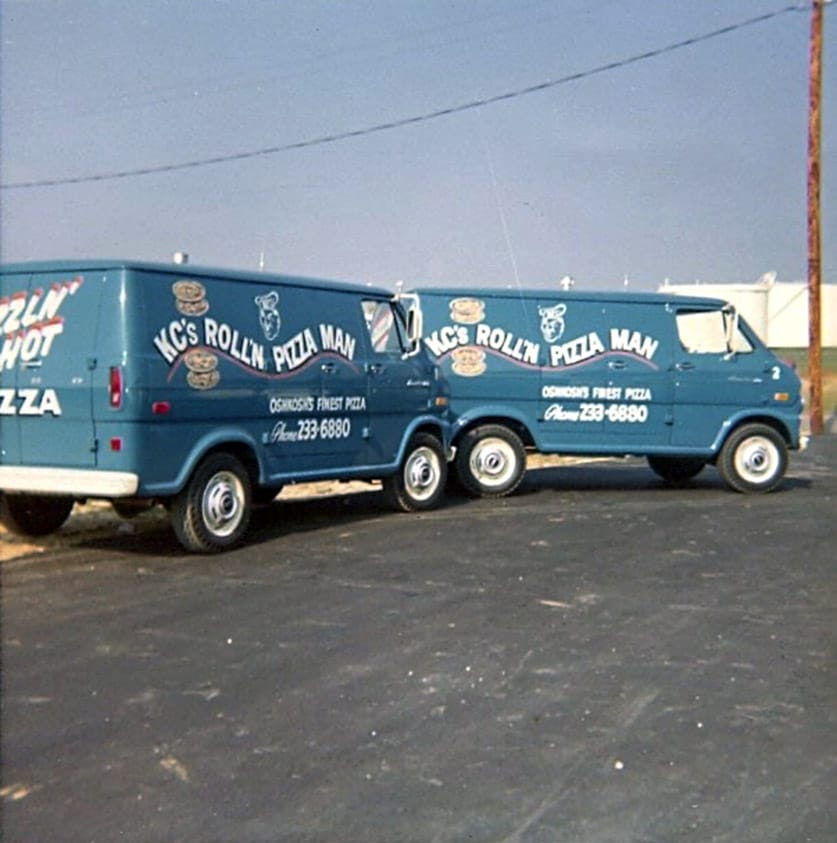
For our final image of the day, let’s get some pizza. These 1970–1974 Ford Econoline E300 Vans were operated by KC’s Roll’n Pizza Man in Oshkosh, Wisconsin. The E300 was the one-ton Econoline van, available with your choice of 240 cubic inch six or 302 V8 engines. These two have the standard side cargo doors rather than the optional Center-Gllide sliding door.
A one-ton van seems like overkill for pizza delivery, but apparently these weren’t just delivery vans: They were outfitted for mobile pizza preparation, with freezers and ovens. The basic pizzas were made at headquarters and frozen. When an order came in, the van cooks would pull a pizza out of the freezer, add the desired toppings, and pop it in the oven, all while the van was driving to the destination.
Thanks for joining us and have a great day!
Note: If you wish to see your vintage photos featured at Curbside Classic, send them to us at [email protected].























All of these bring up memories .
-Nate
Excellent photos again, Rich.
The photographer on his Corvair reminded me of the ’47 Pontiac woodie (& other cars) that Ansel Adams stood on, as he photographed the wild west ……
But, who photographed the photog?
(fender skirts, even!)
When I worked at a Shell service station while in high school in 1974 we had a short wheelbase 4×4 Chevy half ton like the one from Paul’s Auto Repair but painted bright yellow with red lettering to match the shell paint scheme. Ours also had a small tow truck winch in the rear and built in jumper cables. I think it had the 283 and a four speed manual. Although not very big it could go where the big trucks couldn’t and with the four wheel drive it could rescue adventurous motorists from mud holes and snow banks with ease.
There was either a Marathon or Sohio service station on the corner of the major intersection north of where I grew up. In the early 1970’s when I very young – yet paying attention to the world in which I was moving through – there was a “toy-like” tow truck in blue livery that was always parked beside the building. One snowy day when we passed, it was plowing snow from around the pumps. As I grew and began “car-spotting”, I realized it was a Crosley. I’ve never seen another.
Regarding the 1963 International Travelall. Chevrolet (and I assume GMC) had a similar vehicle long before International. It was called the Suburban and it dated back to the mid thirties.
It is true the Chevrolet Suburban dates back to mid-1930s – 1935 IIRC but the caption states International Harvester preceded GM by about a decade with a 4-door utility vehicle. The first factory 4-door Suburbans debuted as 1973 models. The first Suburbans had two doors with a third added in the late 1960s on the passenger side.
First picture reminds me of my middle class neighborhood on the Jersey side of New York. Kids in the street and many clothed in hand me down pants. Either they were long for growth and the legs were cuffed or short, like this one, with ankles exposed. So classic for the 50’s when conserving money.
Two, the San Diego Union caught me as I read that paper. Wish I knew what area this shot was taken in. The camera looks to be a, now classic, Graflex Speed Graphic with flash. Picture is a Crown with a slightly thinner frame only. Did one know that the handles on those flashes are what made the handle for the original light sabers in Star Wars. Became so sought out, to make light sabers, that few of those flashes remain intact. Now as to why in broad daylight?
Only reason I can think of for the flash would be his subject is facing the camera, and the sun is lighting one side of them more than the other, creating a shadow perhaps on their face. The flash would be used to fill in that lighting.
Or it’s just a prop for the photo.
Mopar and I were commenting at the same time 🙂
Yup, the photographer on the Corvair roof is using the flash for “fill-in flash”…something that even the iPhone can do if one is so-inclined to use it that way. The idea is to provide light that “fills in” dark areas (often, faces…I’m guessing perhaps the faces of football players that this photographer may be photographing) of an otherwise brightly lit subject, thereby balancing out the lighting for the whole image.
Flash on a bright, sunny day? Fill flash, most likely, to lighten shadows in an otherwise brightly-lit subject. I did that at times in my film days, with an automatic flash with adjustable light output; it could be pretty subtle. I still do it with a digital SLR and linked flash; it’s easier than ever, because the camera and the flash “talk” to each other.
Now I understand fill flash ever since I took journalism photography in 1974. Back then one needed to calculate what you wanted for feet and f-stop using Flash guide #/f-stop = distance. The bulb usually used in this flash was a GE#31 with a guide number of 60. The photographer is standing on top of a car so probably not that close to whatever the subject was. Using a 2.8 f stop would give you a 21 foot working distance but little depth of field. So naturally my curiosity got the best of me, like it always does, when something either doesn’t look right or something is hard to believe. Serves me well when someone comes into my office and their chief complaint and then description of symptoms don’t seem to jive in my head.
I think that picture was taken at probably Mt. Miguel High School judging from the hill in the back of the picture. I think he is taking a picture of a football game or practice which might explain the flash.
I grew up in Neenah, Wisconsin, just a few miles from Oshkosh and we also had KC’s Roll’n Pizza Man. They weren’t around for very long, but I definitely remember those vans well! Thanks for stirring up some great memories!
That’s an interesting business model that Patrick noted for KC’s Roll’n Pizza Man – cooking the pizzas while the vehicle was en route to its destination. Probably took a good amount of logistics to get the timing down to where the pizza was hot, but not overcooked. I can see this being quite a novelty back in the era before ubiquitous food delivery options.
Kind of takes the Domino’s DXP vehicle up a whole level. I recall that when I first heard about these Domino’s things, I was wishing that they actually contained an oven for cooking the pizzas vs. just keeping them warm. But then again, since most home electric pizza ovens operate at close to 2000W, it makes sense that putting a pizza oven in a moving vehicle isn’t terribly practical.
I wonder what operated the oven in the KC’s van.
I’m not positive about this, but it looks like the New Zealand VW Panel Van photo (in Regina Mellow Mints livery) was taken in Auckland. FT Wimble had several locations, but one was at 99 Federal St. in Auckland, so the address and tenant both match in this photo.
If true, the location was exactly where the Sky Tower is now – so a very different streetscape.
(I can’t locate any other photo confirmation of this block of buildings, so I’m not 100% sure of this.)
Lot of nice pictures. The ice cream truck looks like it has served many customers in it’s time. The 1957 GMC Blue Chip, directly behind the cab is a big General Motors power plant, dressed in white. I’m guessing a Detroit Diesel used to operate the equipment. Whether it’s running a generator or PTO I can’t tell, I can see a housing through the back window of the truck. Wish we could see the rest of what’s on the truck. Thanks.
Hey JoAnn, those trucks are carrying portable grinder/mixers. They come out to your farm, grind your grain and mix in minerals and molasses to make “sweet feed”. There’s probably an auger on the drivers side that would swing out and down for loading, the auger on the curb side would feed into a wagon.
On the side it says “Be wise, economize with Colorado Feeds”
A quick search shows they started in ’48 but are now closed.
Thanks Jim, I had no idea what it was for. Looks like a lot of weight on that truck.
The SWB K-10 might have been small enough for commercial plowing, but it was on the big side for residential plowing. When I was a kid, residential plow trucks were either CJ-5 or Scout, either way with a half cab, so that in the warm months they could be used for parts delivery, jump starts (with an Anderson plug mounted to the bumper), or light home service calls, such as delivering and installing a new battery.
There’s a plumbing company not far from my house and they own a big chunk of land. They never sell off their old vans, just park them “out back”. There are about 4 2nd gen Econoline vans out back, still in livery.
I can see it being on the big side for residential plowing. Side note, according to my ’83 Ranger owners manual, and factory shop manual, a snow plow package was available. Never seen one, but where I live have never seen a snow blower either. We get little to none snow here in NW Oregon.
There’s a good chance that “Ward” on the Jeep Patrol’s front bumper is, in fact, the owner’s name. Looks like the Davis County Jeep Patrol’s commander in the mid 1960s was Delwin Ward, and there were several other Wards who were active with that organization.
Those Jeep Patrols were interesting – really they were Civil Defense-type organizations whose members donated their time and equipment, and could be deputized by the County sheriff as needed. They occasionally participated in search-and-rescue missions for lost hikers, and other backwoods type missions. Most Utah counties, and many others in the west, had these kinds of groups.
The ice cream truck in the lede photo is rocking a neolithic version of the Camry Dent.
I kind of hesitate to ask how he would have gotten that.
Great photos Rich and Patrick!
The Helms company went out of their way to refer to their delivery vehicles as “coaches’; reasonable, since these vehicles were modified small Twin Coach buses. A blurb was made regarding these in a local PBS show called “Things That Aren’t There Anymore, part of a series done by PBS stations around the country; the Los Angeles version was hosted by Ralph Story(R.I.P.), a long time personality on radio and TV, both locally, and on CBS, nationally. This show is on YouTube, as are a number of these shows; Philadelphia had two such shows.
There’ll be an item on the Helms Coaches coming soon.
The photographer on the Corvair reminded me of a country radio station Back in the Sixties that used a Corvair Van set up as a mini-studio.
The van would appear at major events around central and northern Alberta and sometimes the announcer would do live cut-ins or shows connected to a phone line back to the main studio. I don’t know how long CFCW did this or whether over time they bought and converted a larger van by the late Sixties into the Seventies.
I believe that the machine mounted on the ’57 GMC truck owned by the milling company in Texas is a grinder/mixer for livestock feed, complete with it’s own GM power unit. These units were pretty common back in the days of much smaller livestock operations, and the milling company may have furnished and sold the grain for the feed, or they ground and mixed the farmers own home grown grain on site, along with medications, protein supplements, and molasses.
That is exactly right. There was such a business next door to my parents’ business in our small northeast Ohio town. The man who operated it had a similar rig mounted on an 1950s Reo 1-1/2 or 2 ton chassis-cab, although it was powered from a PTO rather than a separate power unit. Every morning he would load up sacks of various animal feed supplements, medications, and pump liquid molasses from a stationary tank in the building into a smaller tank on the truck. He would then drive from farm to farm doing custom feed mixing using the farmers’ own grain supplies. He would return in the evening and back the truck into the building for the night. Interesting that he had purchased the truck from the Reo dealer that had previously occupied my parents’ building. He operated this business well into the 1980s before retiring due to old age. Evidently the market for his services had dried up because no one took the business over. Don’t know what happened to the Reo.
Loving the 59 Ranchero.
The ’46 Buick panel van, serving the Perkiomen Valley Bus Co. (near Philadelphia) was, apparently, photo’d some time since 1963. The Buick is wearing narrow-line whitewalls, which were suddenly ubiquitous in that year.
Most of these shots were likely taken no more than a few years after the vehicles were new, but the Mac’s Auto Upholstery VW van photo was obviously far more recent than that, since no 1967 T1 left the factory with raised-white-letter radial tires, and none were likely to be fitted until decades later. But it’s not too recent either as their phone number has only seven digits (which would rule it out from being from the last 30 years or so in my parts, though there were a few corners of the US where you could dial nearby landline numbers from another landline with only the seven digits until six years ago).
And speaking of phone numbers, apparently you could call Modern Cleaners (GM panel truck) by dialing just three digits.
That photo was taken at the Perkiomen Valley Bus headquarters at 875 Main St. in Pennsburg. Like Patrick noted in the text, the company is still in existence, and it’s also still at the same location. The building’s been replaced, but you can tell its the same location by the houses in the background.
1951 Crosley CD Panel Delivery
In high school in 1969-1970 learned how to use a Speed Graphic. The individual pictured showed my buddy and I how to use one. Some great pictures were taken, and are still taken with them.
The panel truck is a Chevrolet, not a GMC.
Flash during daylight; most commonly would be used to eliminate a shadow(s) from a critical photo / perhaps evidence, where a shadow could be eliminated.
The grille on the restored International Travelall ambulance is definitely from a 1965 model. For the 1966 grille, International extended the horizontal strip of metal in the middle of the grille (where the INTERNATIONAL name was placed) to the outer ends, splitting the vertical razor-bars in two, as shown on the attached advert.