
Text by Patrick Bell.
We are celebrating Studebaker today as the last one rolled off the assembly line in Hamilton, Ontario, sixty years ago this month. There is a good variety of post World War II cars to view, from the company that got its start in 1852.
The 1951 Studebaker was in its second and final year with the unique “Bullet Nose” front end style. It was also the first year for a V8 engine, which was 232 cubic inches with 120 horsepower, the “Studebaker Automatic Drive”, and the one piece windshield was now standard on all body styles. There were three series; Champion 6 cylinder with 5 body styles and 3 trim levels, Commander V8 with 4 body styles and 2 trim levels, and Land Cruiser V8 was only offered in a longer wheelbase 4 door sedan.
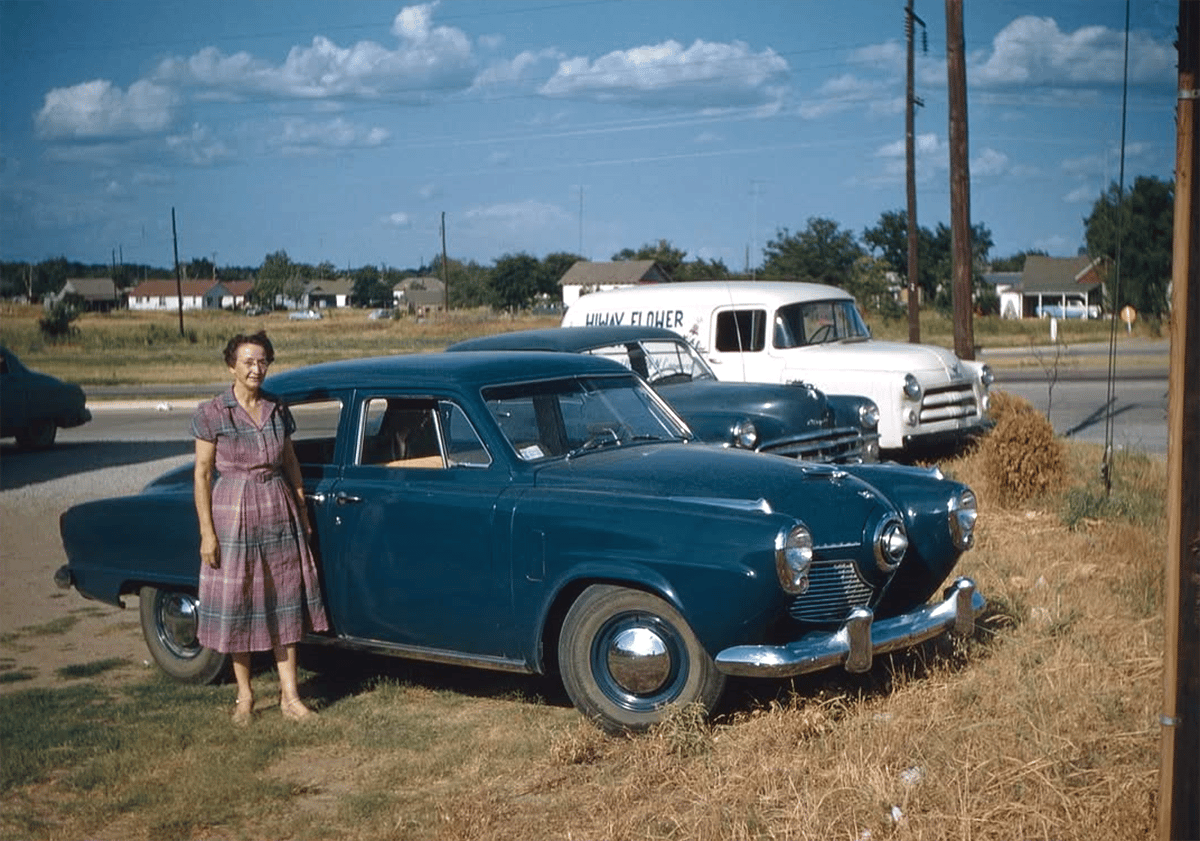
The featured car was a 1951 Commander Regal or State 4 door sedan. The lady was hiding the trim level clue. On the other side of it was a 1950 Chrysler Saratoga or New Yorker, and a late 1954-1956 Dodge Town Panel with V8 power. Parked under the carport in the distance was a 1955 Pontiac 4 door sedan, and on the left edge in the shadow was a 1952 Buick.

1952 brought a style refresh and it was the last version of the 1947 design. The Bullet Nose was gone, and a new 2 door hardtop model joined the family. The California car above was a 1952 Champion Regal Starliner, which was the new 2 door hardtop. It had the 169 cubic inch flathead 6 cylinder, which had been around in that size since 1941.

This one was a 1948 Commander De Luxe 4 door sedan with an unreadable license plate. The upper series had the larger 226 ci 6 cylinder for power with standard or overdrive transmissions. The paint had a nice shine, so it was likely close to new in this image.
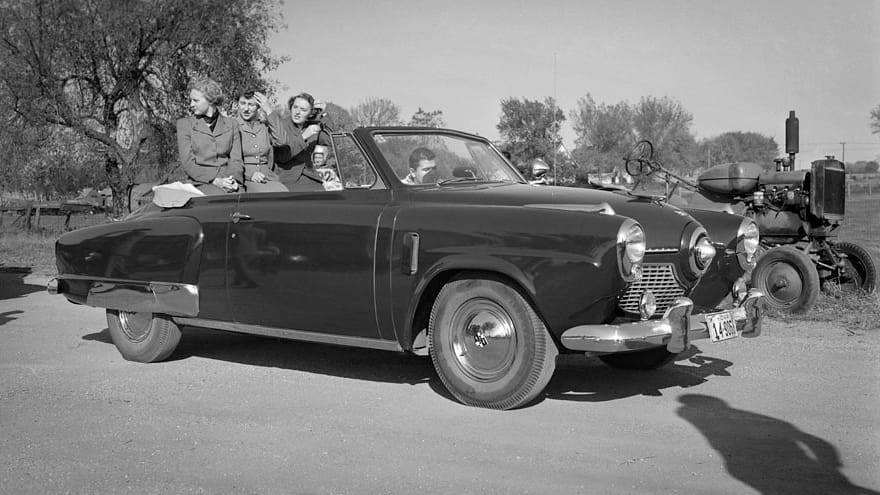
Perhaps it was a football game day as I see a player in the background. This group was traveling in a 1951 Commander State convertible with a spotlight, fog/driving lamps, aftermarket fender skirts and an Iowa license plate. I will leave the tractor ID to someone else.

A 1950 Commander Regal De Luxe 4 door sedan was shown here, with an outside mirror and whitewall tires. The Commander 6 cylinder was now up to 245 ci with 102 hp.

And a 1951 Commander Starlight Coupe from South Carolina all gussied up with chrome side window visors, dual spotlights and mirrors, and a heavy duty grille guard/bumper overrider. It looked well kept for a three year old car.
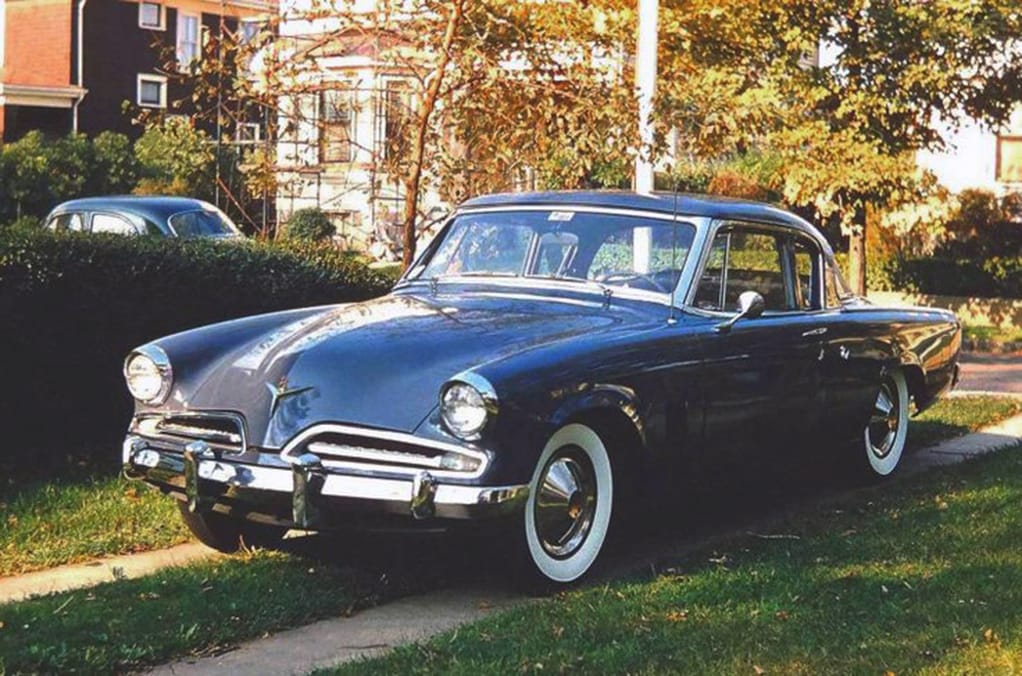
Much has been said and written about the redesigned 1953 Studebaker, but for many reasons sales did not turn out all that well. The series and engines were unchanged, and the convertible was dropped. The featured car was a 1953 Commander Regal Starlight Coupe with the standard V8 power. Options included a radio, outside mirror, full wheel covers, whitewall tires, and a pair of larger bumper guards while the original ones were moved outboard. Parked in the street to the left may have been a 1949-1952 Chevrolet or Pontiac 4 door sedan.
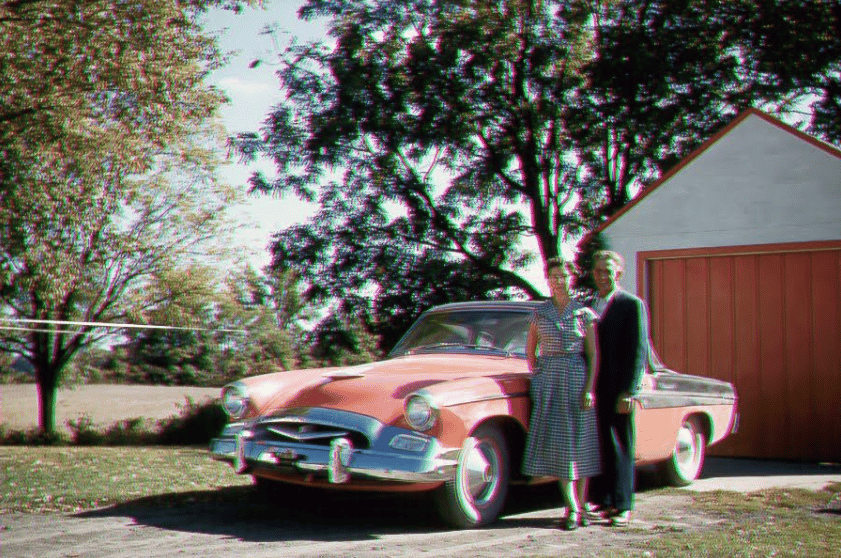
1955 brought some updates aimed at increasing sales, and chrome, bright two tone colors, and horsepower were all selling in the mid 1950’s. The first two were evident in the image above, while the V8 engine was bumped up to 259 ci with three horsepower ratings; 162 for the Commander, 175 for the revived President series that absorbed the Land Cruiser, and 185 that was optional on the President and standard on the new Speedster. The car above was a 1955 President State Coupe.

The sedans and wagons were restyled in 1956, while the coupes were upgraded with a new hood, grille, and other trim, and their new name was the Hawk. For 1957 they also grew some tail fins. A 289 ci version of the V8 came out in 1956 in three horsepower ratings, which were up again in 1957 to 210, 225, and 275. The featured car was a 1957 Silver Hawk, which was available with either the 185 ci 6 cylinder that was upgraded in 1955, or the 210 hp version of the 289 V8.

The Lark was introduced in 1959 as “The New Dimension in Motoring by Studebaker”. It was a compact car that was over two feet shorter than the previous models. It was offered in 2 and 4 door sedans, 2 door hardtop, and a 2 door wagon, in Deluxe and Regal trim. Engine offerings were down to a 90 hp version of the 1954 169 ci 6 cylinder, and 180 and 185 hp versions of the 259 V8.
1960 brought a convertible (the first since 1952), and 4 door wagon to the lineup, plus some very minor trim changes. The car above was a 1960 Lark VI Regal convertible with dual fender mounted mirrors, a radio, and whitewalls.

Studebaker did pursue the taxi market with the new Lark, offering an “Econ-O-Miler” model that their advertising claimed was “designed as a taxi only”. It was available with a 6 or V8, and manual or automatic transmissions.
This image came with a story: “A 1959 Studebaker Lark of the Yellow Cab Company of Springfield, Massachusetts, in 1959. The accompanying note with the original negative stated that the driver is the ‘first licensed lady cabbie’. Not sure if that means Springfield, or Massachusetts, or the USA.”
I did a little research and found other ladies claimed to be first in Massachusetts and the USA (New York City). So the one shown here was likely the first in Springfield.

Our final image today was a 1962 Lark 4 door sedan, which shows the new facelift and longer overall length by about a foot. A new 112 hp overhead valve 6 cylinder of the same size (169 ci) came out in 1961, and that was the motor this car had. And two versions of the 289 V8 were back in some models. This one also had the rare “Skytop” sliding sunroof. I grew up with a wagon version of this car in the same color also with a six cylinder. It died of a rod bearing knock when I was 12.
Thanks for joining us and to all good day!
Note: If you wish to see your vintage photos featured at Curbside Classic, send them to us at [email protected].























As the owner of a 1952 Studebaker Land Cruiser, I am delighted to see all those shiny South Bend-designed Studebakers on my screen.
But that smiling lady in the red sweater had better get off that hood right now.
Those hoods are heavy with simple metal hinges in the rear. Sitting on one could easily shift the left and right seam clearances of that hood. Sitting on fenders or bumpers is stupid, and probably uncomfortable, but it won’t harm the car. She might get away with it this time since half her derriere is on the fender. But this strange photographic tradition of posing on cars is bizarre.
Agree, but pose can look good. This is Candy Moore adorning a Ferrari 365 GTC/4, Beverly Hills, Los Angeles, 1979. She was sprawled across the hood during a photo-shoot for the cover of the Candy-O (1979) album by the band The Cars and the image chosen was second from the right although, when rendered by the artist, some licence was taken. That model and album share a name is said to be a coincidence and despite the threatening look of those stiletto heels, the Rosso Nearco paint apparently survived unscathed.
Iconic sleeve art. Thank you for the history.
That Silver Hawk is a ’58 not ’57 — notice wheelcovers
I believe the tractor in photo #4 is an Allis Chalmers B or C that has lost its sheet metal.
The mystery license plate on Picture #3 (1948 Commander DeLuxe) is a 1949 or ’51 Maryland plate. These plates were unpainted aluminum, though in the photo, the most distinguishing feature is the validation tab in the bottom center. That was an unusual placement for those tabs that Maryland used in those years (the tabs for ’49 and ’51 were black, like int the photo, but for 1950 they were red).
When I was a young lad of three or four a family I knew had one of the “bullet nose” Studebakers, I called them “booger nose” cars. The last picture looks like it might have been a publicity photo tied in with Mr. Ed, the talking horse show. Studebakers were prominently placed in that program. “You have to drive a Lark to believe it.” Mr. Ed says.
The Econo-O-Miler taxicab was the only was to get a long-wheelbase Studebaker sedan in 1959 and 1960. But by the time the ’62 beneath it was made, all Stude sedans used the four-inches-longer wheelbase.
The ’52 hardtop looked strikingly up-to-date for a 1947 design in its last year of production
Yes, the Econ-O-Miler made the 61 Lark Cruiser a cinch. All they needed to do was put a nice interior into the existing long wheelbase taxi.
When I was kid my mother owned a red 1951 bullet-nose Studebaker Champion Starlight Coupe. She bought the car used in 1958, after she married my father, to drive to her job as a teacher. She kept it for about 5 years. Back in those days women had to quit their job if they had a baby and so she quit after I was born. She kept the car for a few years after I was born before selling it because, at that point in time, she and my father really didn’t need a second car. I have memories of my father driving her car and of me standing beside him in the middle of the front seat.
My mother says that shortly after she bought the car she took it to the local Studebaker dealer for some repair work and they gave her a newer, but still used, Studebaker 4-door sedan as a loaner for her to drive to school. A problem with the loaner car was that neither one of the front doors would open and she had to climb over the back of the front seat into the back seat and open one of the back doors to get out of the car. That didn’t really bother her too much, but a group of boys at her school all gathered around the car to point and laugh that they could see her underwear from when she was climbing over the front seat back. (Women teachers were all required to wear skirts or dresses back in those days.)
I personally find that 1953 Studebaker, that didn’t sell well, to be a better looking car than the more dowdy 53 Chevy and Ford.
Yes. I really like that car.
I have a beautiful, unrestored ‘53 Starliner coupe. Mostly original paint, original interior, 34k miles. Stunning looks; nothing could be compared with it.
Love seeing all these studebakers
Based on the fender ornaments present on the car shown in this photo, it confirms that despite the trim level tag (or Emblem) is being blocked from view by the woman present in the photo that this particular car is a State level model & not a Regal which those chrome fender ornaments would not be present on if it had been the lower Regal trim level. If more of the interior details were were able to be seen in the photo, that too would be another indicator, being that the State level would have a more up-level interior than a Regal, but the chrome fender trim confirms which it is on its own. Thanks for sharing this nice photo. Too bad very few cars today would be finished in such a beautiful paint color as is the car in this photo. (I have seen GM Paint some of their smaller SUV’s in some very attractive & unique for today paint colors lately, especially the smaller Chevy SUV’s)
The 1953 Raymond Loewy designed Studebakers were beautiful. Very European looking for an American car company. They should have sold like hotcakes.
I concur – but tastes…
Shame it’s only the earliest years weren’t comprehensively ruined by tinsel additions. Or a catfish mouth in the case of the Packard. Could have been one of those ‘timeless’ cars.
Great seeing these cars in one collection.
Looking good is that 1951 Commander State convertible.
Nice pictures all of them .
I wonder how big the woman sitting on the hood of the Starliner was, she looks tiny .
-Nate