

Studebaker wagons weren’t exactly common even back in the day, particularly when seen against the offerings from the Big Three. So, naturally, the image above caught my eye as soon as I saw it — a 1957-1958 Studebaker Scotsman 2-door wagon, the maker’s low-cost full-size family hauling offering, towing an Avion streamlined trailer down the road with all of 101 hp from its little 185.6 cubic inch flathead six. These folks were taking a leisurely trip for sure.
A Scots…what, you say? Hawks are usually what come to mind when late 1950s Studes are mentioned, but there was more available in the maker’s menu in those days. And while today the Scotsman is basically a forgotten curiosity, its full-size low-cost promise found a niche; about 9,000 Scotsmans (Scotsmen?) were built in ’57 between sedans and wagons, with another 7,860 wagons added in ’58. Not earth-shaking numbers, but business at Stude was dire at the time, and as a niche product, the Scotsman’s subtle sales tremor was welcomed at South Bend.

Much has been written about Studebaker-Packard’s troubled postmerger situation, and the Scotsman was one more desperate play at staying in the black. A sub-line of the company’s full-size Champion line, it sold as a decontented no-frills model: “America’s lowest-priced full-sized cars.” As a product, the Scotsman delivered on its frugality: little to no exterior trim, and inside, low-cost vinyl upholstery, painted cardboard door panels, lots of painted surfaces and other cost-saving measures. As for hardware, power came solely via Stude’s old 101HP inline six, and shifting was by a three of the tree setup.
Say what you will, but the model found acceptance with its lowest-price full-size motoring sales pitch. And as low as the 1957 9K production number sounds, the Scotsman sold beyond the company’s original 4,000 units projection, thus earning a rerun for 1958. In the age of flash, it turned out unexciting sturdy plainness had a public –if packaged accordingly. It’s all been covered in more detail in a previous CC post.
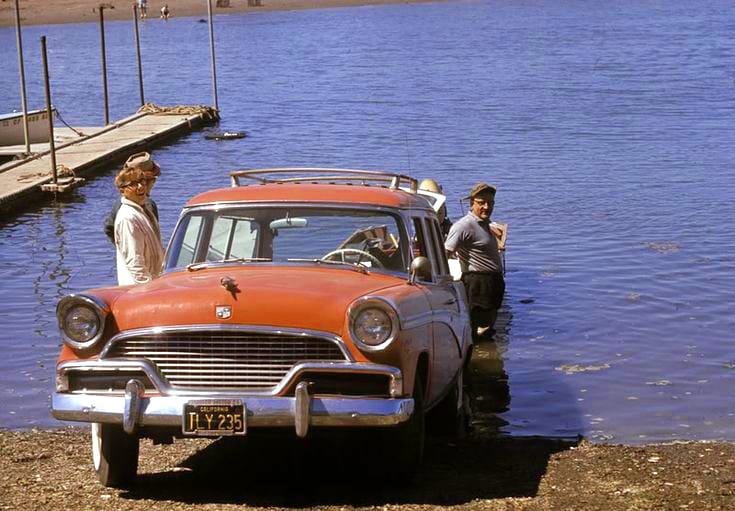
Want a less plain Stude wagon? Let’s move back in time and up the company’s ladder. A 1956 Pinehurst, the maker’s top wagon trim for that year, launching a boat into the water. Studebaker’s brochure touts that “3 Beautiful New Station Wagons” were available for 1956, with “new” doing a good deal of PR work. S-P’s grim financials meant the “new” 1956 line carried lots of 1953 bones underneath, with styling doing the heavy lifting to keep the vehicles mid-fifties modern. From this view, the trick mostly works (quirks are more evident from other angles, as seen earlier on a 4-door Provincial).
When it came to Studebaker’s 1956 wagons, all were two-doors; the Pelham was the entry trim, with the inline six as standard, while the company’s 259CID V8 was offered in the Parkview and Pinehurst; Stude’s conservatively engineered OHV engine from 1951, which Paul covered in detail a while back.
Still, of the whole crop of 1956-1958 Studebaker wagons, the Scotsman was the one that got more converts. And in today’s opening image, a case of economy meets –leisurely– adventure.
Related CC reading:
1957-1958 Studebaker Scotsman: Discount Prices Equal Life Preserver























Interesting juxtaposition of the cheapest American car of its time pulling an Airstream, the famed, pricey luxury trailer.
1957 and 1958 Scotsman wagons are hard to tell apart – the ’58s didn’t get the revised grille, quad headlamps, tail fins, or flatter roof that most Studes go that year. But there is one differentiator: the rectangular vent flap behind the front wheel, a longtime Studebaker feature that was dropped on all models except the Hawk in 1958. I don’t see one on this Scotsman, which would make it a ’58 rather than a ’57.
oops it’s an Avion not an Airstream. Still a nice trailer.
It would be a fair race between the Scottsman towing a vacation loaded travel trailer with a Diesel Westy Vanagon.
Time to resuscitate the story of the film “The Long, Long Trailer”, in which Desi Arnaz and Lucille Ball are traveling with a large trailer that is ostensibly pulled by a Ford. Except in the mountain scenes, where the Ford is replaced with a thinly-disguised Lincoln, because the Ford literally couldn’t pull the trailer up the hills.
Evan—In that movie Lucy & Desi were driving a pale yellow `53 Mercury Monterey cvt., not a Ford. And YES—those mountain scenes pulling the trailer was a ‘doctored’ `53 Lincoln Capri cvt. with the larger OHV V8 doing the pulling.
“Ask the man who owns one !” .
I’m amazed at how well the 1953 basic structure is hidden here .
-Nate
There was a less glamorous reason the car was called a “Scotsman”. At that time, it was not uncommon to call out certain ethnic qualities of nationalities, and the Scots were supposedly the most frugal of all with money. Hollywood had a field day with it, but expressly forbidden today. We didn’t see many Studebakers in Wisconsin, where Rambler was king. It was always a toss up, Ford/GM/Chrysler,,and then Studebaker/Rambler. We had a kindred relationship with the folks from South Bend, they knew what it was like in the shadows of the Big 3. Studebakers were great cars.
I would not like to be behind this car/trailer combo going uphill or interstate highway merging.
All those P-names – Pelham, Pinehurst, Provincial – came into their own in ’57-8 with the extended fins and the back bumper pushed out to meet them and they all became “Parkbench” wagons! (Did anyone actually think of that back then?)
Isn’t it amazing that the first thing I thought when I saw these wagons is that they were AI creations?