

(originally posted 1/19/2012. Updated 12/21/2022 with information from “The Cadillac Frame – A New design Concept For Lower Cars” a paper submitted to the SAE by GM engineers that was provided to me by George Ferencz)
GM’s X-Frame, upon which millions of GM full-size cars sat from the years 1957 through 1964 (Buick Riviera through 1970), has generated plenty of controversy, speculation, and accusations. Since there seems to be no complete survey of the X-Frame—at least any available on the web—let’s lift off all those handsome and finned GM bodies by Fisher, and take a closer look at what’s really under there.

Starting with a real stunner: The X-Frame first appeared in 1957, underpinning the new C-Body Cadillacs and Eldorado Brougham (pictured). It was conceived as a way to facilitate lowering the total vehicle height yet still allowing for reasonable leg room via deep floor wells for the passengers’ feet to drop essentially to the bottom of the car, unimpeded by frame rails. This was not possible with the ladder frames then in almost universal use, except unibodies, of course.

Placing ever-lower bodies on ladder frames created serious negative impacts in interior space efficiency, as Chrysler found out with its Forward-Look 1957 models. Both leg and head room were limited, and the seating position was close to the (high) floor. The solution at Chrysler was to convert their cars to unibodies in 1960, resulting in improved interior metrics, as shown in this comparison graphic. GM considered unibodies, and would use them on their compacts starting in 1960, but dismissed using them on their large cars for a number of reasons, of them being that it would be much more difficult to offer a wide variety of body lengths and styles. For instance, engineering unibodies for the extended length Cadillac 75 limo and commercial chassis would have been very expensive and difficult. Also, it was much easier to “tune” a frame to the corresponding body to minimize noise and maximize comfort. This undoubtedly explains (at least in part) why Chrysler continued with the full frame under the Imperial through 1966.

The 1957 Cadillac Eldorado Brougham was only 55.5″ high, and the other ’57 Cadillacs were also going to be lower than their predecessors, so the Cadillac engineers needed a new solution in regards to the body and frame. The existing ladder-type frame was simply not going to work. The height of ladder frames had already been reduced a few years earlier to allow lower bodies, by utilizing box sections and other stiffeners, but there was no further reduction possible.
Cadillac did build an experimental car in 1950 with something akin to the perimeter frame that would eventually supersede and replace the X-frame, but torsional rigidity was severely compromised. Adding X-members to the frame created the desired rigidity, but then there was the problem with intrusion into the leg room area.
The X-Frame was the result of a number of years of experiments between Cadillac engineers and A. O. Smith Corp., who actually built all of GM’s frames. It combines aspects of two very distinctive frame designs: the backbone frame and the X-braced ladder frame.

The backbone frame originates the 1908 Rover 8 h.p., which used a rigid steel tube as its primary member. Since it had a rigid rear axle, the suspension at the rear was by mounting the body on semi-elliptic springs.

Hans Ledwinka’s revolutionary Tatra T-11 of 1921 (full story here) took the central tube chassis and made it more effective by adding independent rear suspension via swing axles. The strong solid steel tube was the carrying member for the whole car and its (lightweight) body.

The Tatra tube frame evolved into a combination central backbone-platform frame, as seen here in the mid-thirties Tatra 97. Needless to say, a very similar route was also taken by others, including Porsche for the now very-familiar (and similar) VW platform frame. In these, the body was rigidly bolted to the platform, to create essentially a unitized structure from the two halves.
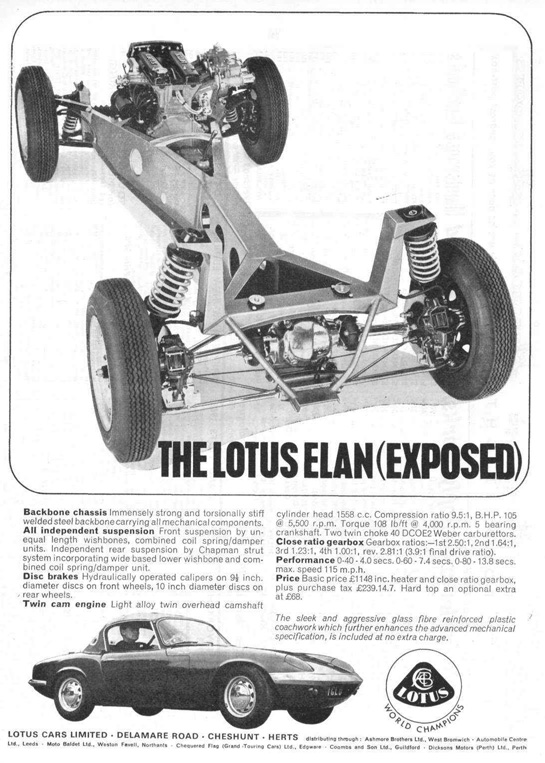
The pure backbone chassis was taken up by others, none more famously so than by Colin Chapman, with his brilliant Lotus Elan. With a very deep central section, which did not create problematic interior intrusion in a sports car, the Elan had unparalleled rigidity, the ultimate goal of any frame/body structure. Rigidity is the only way that a suspension system can be designed to optimize its function.

On the other end of the spectrum sits the ladder frame, here immortalized in the frame rails from a Ford Model T. A certain amount of flex was an intrinsic part of the equation. Its origins are obviously in the heavy timber frames underpinning wagons, but the seminal 1901 Mercedes was perhaps the first to sport something akin to what became this timeless approach to automotive frame building

Jumping ahead about a century, here is a modern ladder frame, as now used in pickups and BOF SUVs. Note: this is quite different than a perimeter frame as used in most American passenger cars. The ladder frame is still very much under the body, and provides almost all of the overall rigidity, unlike a perimeter frame.

The origins of using an X-member to reinforce a ladder-type frame has been credited to the fwd Cord L-29, and this excerpt from its brochure substantiates that claim.

But this 1939 Buick frame shows that its adoption had expanded by then, and for obvious reasons. It undoubtedly increased rigidity, at least in certain planes.

X frame centers were also widely used to stiffen ladder frames as needed, specifically for convertible or commercial car use. This is a sedan frame for a ’57 Chevy.

And here is the center section for the convertible version. It’s important to note that the bodies of BOF (body on frame) cars contribute to varying degrees to the overall vehicle rigidity, which is why convertibles require additional reinforcement to their frames.

The X-Frame that GM came up with involved a very strong center backbone section, which could be built in different lengths to accommodate varying wheelbase lengths. Converible and extended wheelbase frames used thicker steel in the center section as well as some other reinforcements. The 1957 convertible frame weighed somewhat less than the 1956 convertible frame, but had roughly equal torsional rigidity and 100% improved maximum beaming deflection. The non-convertible frames had improved torsional rigidity.

This ’61 Chevy X-frame shows the details of its design and construction. It did result in a somewhat larger central tunnel in the interior, a distinctive feature of all X frame cars and a trade-off for the deep foot wells on either side. Obviously those confined to sit in the center of the seat did not see any advantage.

In order to make the X-Frame work, Fisher Body increased the strength of the rocker sills of the bodies, as well as side-to-side stiffeners in the floor. These can be seen fairly well in this shot of a ’58 Chevy. In essence, GM was transferring a substantial amount of the overall structure’s strength to the body; certainly any side impact resistance that this intrinsically vulnerable design might have had. The issue is not only whether the body sills had enough strength for that purpose in the first place, but these rocker sills were notorious for collecting moisture and rusting prematurely.
But before we discuss the X-Frame’s safety weaknesses, real or perceived, let’s do a survey of what all the GM divisions were doing frame-wise during this period. Contrary to some assumptions, not all the divisions used the X frame, either at all, or at least not during some of the time.
Vehicle design and construction at GM then was almost the exact opposite of today. Now, numerous vehicles (and brands) with distinctly different bodies share a “platform”, generally the key underbody structure, suspension and/or floor platform. Back then, Fisher body engineered a common body to be used by various divisions, but each division engineered its own vehicle otherwise, including the frame, suspension, drive train, etc. It really was ass-backwards; or it certainly came to be so, given how increasingly little folks actually appreciated what went on under the floor, at least very technically speaking. And it was inevitable that GM would eventually centralize these aspects.
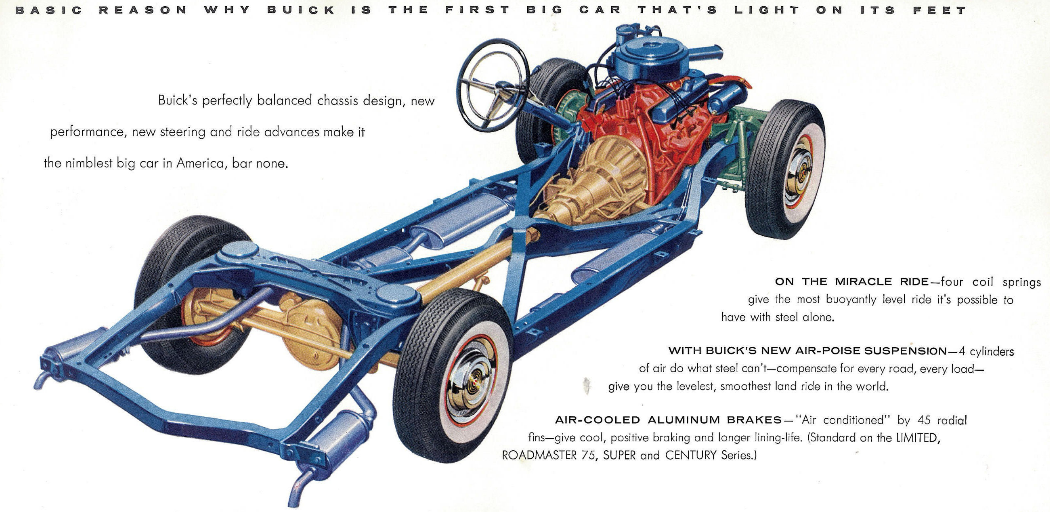
But this was not the case during the X-Frame’s reign. The ’57 and ’58 Buicks, which shared Cadillac’s big C-bodies, did not go with the X-Frame, keeping an X-strengthened ladder frame.

The result was…a high rear floor, right up to the bottom of the cushion. Of course the center tunnel was quite modest.

As a point of comparison, this picture of a ’58 Cadillac rear seat clearly shows the lower floor but larger center tunnel.
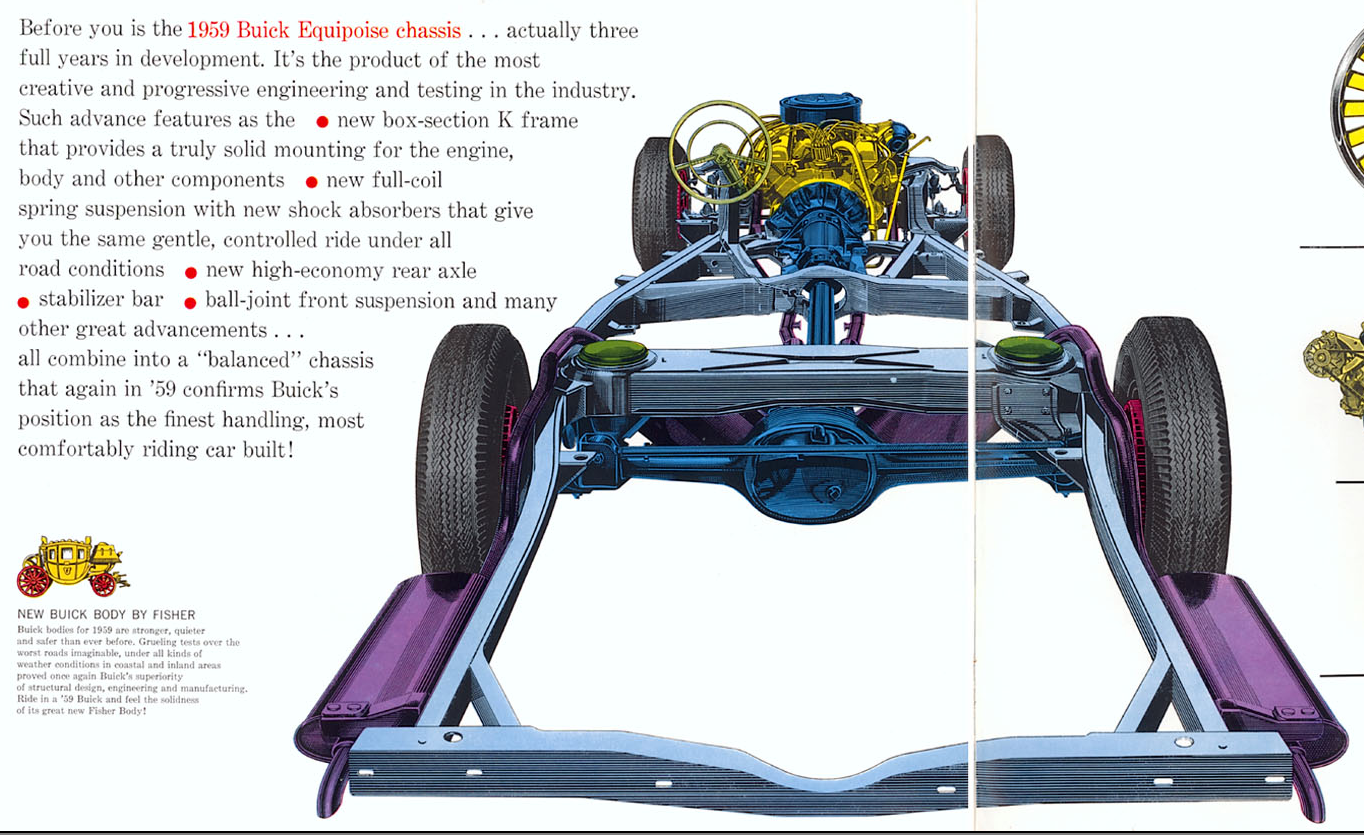
Rather curiously, for 1959 Buick even dropped the X center-reinforcement, going with a modified semi-perimeter frame, with a K-type front section. It looks very similar to Ford’s “cow belly” frame, in that it did offer room for rear seat foot wells, but not for the front seat area, as the frame narrowed down there.
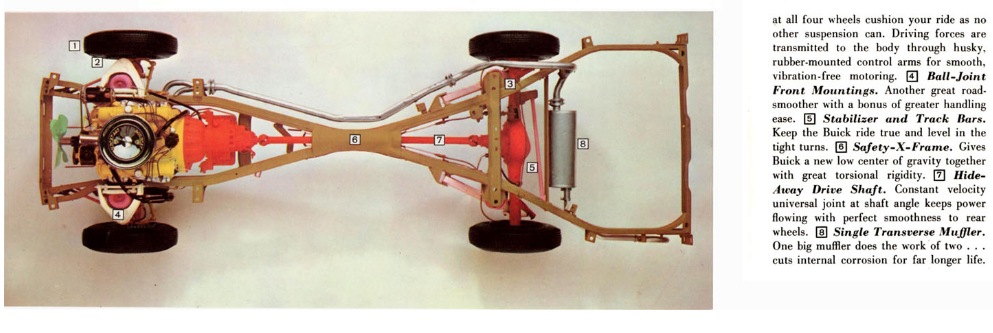
But beginning in 1961, Buick fell in with the X crowd, even touting it as the “Safety-X-Frame”. Full-sized Buicks stayed with the X Frame through 1964.

The Riviera maintained its X-Frame all the way through the 1970 MY. Here’s a 1969 Riviera showing off its skeleton. And for those that live with the false assumption that X Frame cars were intrinsically poor handlers, the Riviera in GS guise was generally highly regarded as one of the most capable handlers in its size class. Even the base Riviera was considered to be quite good in this regard.
The X-Frame was plenty stiff, and the handling of the cars that used it was not due to anything about the frame, but was a matter of suspension geometry and tuning.

Olds was the only member of the GM family to not use the X-Frame at all. The ’57-’58 Olds frame looks quite similar to the same vintage Buick frame.

But for 1959, Olds came up with what is essentially a variation of the X-frame, incorporating wide side rails to do the work that the reinforced body sills were asked to do on the true X-frame cars. These side frame rails (or similar) have been widely adapted to high-performance X-frame cars, creating an overall stronger, more rigid frame. And that came without any sacrifice in the X-frame’s deep floor wells. Call it the improved X-Frame.

The other unique aspect about the ’57 – ’60 Olds chassis is that it had leaf springs in the rear suspension, the only GM full-sized rwd cars to do so during the whole modern era, except for the ’71 – ’76 “clamshell” wagons, which did so for space reasons. The ’57 Cadillac used leaf springs too.

For 1961 through 1964, Oldsmobile used a perimeter ladder frame. Note how much emphasis Olds places on the safety of “Steel Protection All Around”.

The frame Olds used those years (’63 in drawing above)…

very much predicts the frame all the GM full-sized cars went to in 1965 (Riviera excepted). This one is from a ’69 Cadillac. Olds’ reputation for engineering advancements among the GM divisions seems to have gone all the way down to frame design.

Interestingly, Pontiac did not show off its frames in its brochures, unlike the rest of the divisions. John DeLorean, who was then running Pontiac, was an engineer by training, but was also an excellent marketer. He thought GM was generally lacking in modern marketing techniques at the time, and perhaps that explains why Pontiac frames didn’t make it into brochures. Who cared? Folks were much more interested in how they looked, and even how they drove. Pontiac accentuated its very visible Wide Track stance, and left folks guessing about the frames.
But as the above frame spec chart shows, Pontiac followed Chevrolet and Cadillac with X frames for ’58 – ’60, but then went to a perimeter frame for ’61 – ’64 that looks very similar to the ’61 – ’64 Olds frame. (Canadian Pontiacs, essentially Chevrolets under the skin, did keep the X frame for ’61 – ’64)

Chevrolet’s “little brother” relationship to Cadillac was more than skin deep, inasmuch as the two of them were the most consistent users of the X-frame; from ’58 through the ’64 MY, in Chevrolet’s case. Here’s the ’59 version in full display. The ’58 was unique to that MY; the ’59 – ’60 frames were identical, as were the ’61 – ’64 frames.

The ’59 Chevy became famous in 2009 when it was crashed into a new Malibu, and (not surprisingly) fared rather poorly. The X frame played little or no part in that, given all the other aspects that were so different between these cars.
The X-frame is somehwat notorious for rusting, and there is a pretty brisk business in replacement frames, often reinforced. One wouldn’t want to start throwing a Chevy low-rider hydraulically four feet into the air with a rusty frame.
In Ralph Nader’s “Unsafe At Any Speed”, the X-Frame merits some less-than flattering attention. Here’s some excerpts from that:
A case in point is the “X” or “cruciform” type chassis frame. This frame was introduced in 1957, primarily to reduce the problem of restricted headroom and difficult entry into the “low-profile” automobiles that were becoming popular after the mid-fifties. The X frame construction does not have side rails along the passenger compartment, as did most previous conventional frame designs. From the time the cruciform type frame was introduced, it was widely used by General Motors on Chevrolet, Buick, and Cadillac. The Ford Motor Company continued to use frames with side rails, and it was evident that the two companies held strongly different opinions about the two designs.
In the fall of 1959, a photograph of a Chevrolet Impala that was broken in half after striking a tree broadside was widely circulated in newspapers throughout the country. The frame had severed at the intersection of the X. The report of the General Motors investigators who rushed to the scene attributed the severance of the frame to the semi-airborne position of the car as it struck the tree. This had apparently allowed the engine mass to act as the head of a sledge hammer. At the General Motors engineering center in Michigan the conclusion was that “automobiles are not designed to withstand such tremendous lateral forces – this would be extremely uneconomical.”
General Motors spokesmen continued to defend the cruciform type frame as offering substantial resistance to side impacts because of the rocker panel and floor pan underbracing members — even though by 1965 all General Motors models except the Buick Riviera had abandoned the design in favor of the perimeter type. In 1960 the General Motors technical center offered proof that a unitized structure with side rails can also split into two pieces. A picture of a Ford Thunderbird, torn in half after slamming against a telephone pole and tree, was offered as evidence to critics of the X type frame.
This comparison enraged Ford engineers. Fletcher N. Platt, a highly talented research engineer at Ford, retorted that the Thunderbird case involved a telephone guy-wire that had “acted as a knife on the entire body structure.” In contrast, he said, “the Chevrolet that broke in half failed at the center of the X frame after hitting a tree.” Platt said, “The X frame has no advantages from the standpoint of passenger protection. It requires less material to support the four comers of the car, but it is obviously less rigid and provides little lateral [side] protection to the passenger compartment.” He suggests consulting any “‘unbiased’ structural engineer regarding these two designs.” Mr. Platt might not consider Mr. Harry Barr, vice president for engineering of General Motors, qualified for the designation ‘unbiased,’ but Mr. Barr did admit grudgingly, under questioning, that the Oldsmobile perimeter type frame had some advantages over the Chevrolet X type frame in side-impact crashes at speeds of about fifteen miles per hour. Further proof that some General Motors engineers agreed with Ford’s Platt came in the form of an internal memorandum prepared by the Oldsmobile division in 1963 in which the Oldsmobile “guard-beam” frame was described as offering an “extra margin of protection” over the X type frames of Chevrolet, Buick, and Cadillac.
I was unable to find the picture of the broken-in-half ’59 Chevy cited here. Undoubtedly, a side impact, especially against something like a tree or pole, would be the X-frame’s most vulnerable aspect. There are other anecdotal negatives commonly cited on forums, such as cracking of the rear body sills, as well as other minor structural infirmities, especially with advanced age. The two-piece drive-shaft used with the X frame also comes for a lot of hate, especially the weakness of the center bearing, and the joys of replacing it.

But Ford clearly saw a marketing benefit to the X-Frame controversy, and touted their wide perimeter frame as a safety advantage over the X-Frame in their marketing materials, as in this on from 1960.
On the other hand, when a car T-bones another, the bumper and front body mass is almost invariably above the height of the frame side rails, so the resistance to impact is mostly in the body structure itself. It’s hard to make a very compelling argument against the safety of the X-Frame, considering that unibodies obviously don’t have frame side rails either. Passive safety is the result of numerous improvements that have taken place since then, and obviously modern car bodies are vastly stronger and safer.
Our exhaustive look at the X Frame is complete. If you made it this far, you’re now something of an expert. Hopefully, others will add further facts or insights.

Related CC reading:
Tech History: The Perimeter Frame – Body-And-Frame, Not Body-On-Frame























That video with the ’59 was the first thing I thought of when you started saying how weak that frame was in a side impact. However…if you watch the video slowly, the ’59 has no engine or transmission and something’s hinky about how the right front fender just pops off on impact at about 1 minute into the vid not to mention the rust storm. Surely the crushing weight of an iron drivetrain and unrusted body and frame would have added something to how the ’59 performed here.
Not to start a debate here, but I thought that the IIHS and independent witnesses verfied that the ’59 did indeed have an engine and transmission installed during the crash test. It became necessary almost immediately after the video was released, when the fanboys of old-school iron were making that claim, as well as the claim that the ’59 was compromised due to cuts to the body and/or frame, or that it was a rustbucket.
Look carefully at the video. In the slow motion shots you can see the “Blue Flame” six’s air cleaner flying off as the hood deforms.
I don’t know if the ’59 was structurally compromised in any way, but I’m completely confident that today’s cars are safer. Perhaps one day we can get into the time machine and pull a fleet of brand new ’59s off of the assembly line…then, once and for all we can settle the question to the satisfaction of all.
Yeah, the old fan boys went nuts on this. They assume that any old car is ‘indesructible steel’ and new cars are ‘all cheap plastic’. This just from “nostolgic feelings” and they want to relive youth again.
What is most amazing, and disturbing, is that all those so-called fanboys can rattle off for hours about engine sizes, horsepower ratings, camshaft specs, carbureter jet sizes, all to exact detail, but do not appear to know the following cold, hard numbers:
Mild steel: 35,000 pounds per square inch of tensile strength
Ultra High Strength Steel : 110,000 pounds per square inch of tensile strength
Old cars, made before the mid 1990s are made of the weak mild steel, including the frames, X frame of ladder frame.
New cars are made up of up to 5 types of steel, and guess which kind of steel is used around the passenger compartment? So no 50s of 60s car is capable of “slicing through” a new car. The new car passenger compartments will demolish the old car passenger compartments once the crumple zone finishes crumbling. And you know what kind of steel the crumple zone is made of? The same mild steel the whole old car is made of.
Here is a crash test of a 2002 vs 1962 cadillac:
http://www.autoblog.com/2011/11/27/1962-cadillac-vs-2002-cadillac-in-head-on-collision/
You raise a very good point. Crashworthiness was never a primary design criteria a generation or more ago. But now, it is. It only makes sense that when you design the structure so that the occupants are most likely to safely survive a crash, that this will be a much more likely outcome than in an older model.
I did not know the strength ratings of these kinds of steels, and appreciate the info.
Sorry to burst your bubble there, dude. My grandpa was just driving along in his 1958 Lincoln one night. A drunk driver-amazingly-driving a 2006 lincoln-smashed into him. The new driver died. The 5,000 pound unibody frame design of the older lincoln allowed it to shear the entire front end off the car. ;D Just goes to show you that not all newer cars are safer, and not all older cars are unsafe. It’s probably because the newer lincoln only weighs like 3,000 pounds, smaller engine etc.
Sorry to here about your Grandpa’s Lincoln, but at least she did her job of protecting him with honor.
The 1958 Lincolns and T-Birds were built at the then new Wixom plant. The T-Bird front fenders were part of the structure and did not come off.
I believe that was the case with the Lincolns also, but either way, being Ford’s biggest unibody it was sort of experimental and lot of steel was added during testing. After one section of track the quarter panels drooped for instance. The Lincoln ended up weighing about 5,000 pounds and stayed there until 1970.
Notice the Imperial stayed separate frame as Chrysler switched over to unibody construction, at least until they shared platforms in 1968.
uitimate tensile strength and yield strength are two different things…
ultimate tensile strength of steel ranges from:
approx 35ksi for plain old wrought iron(as in old fashioned porch railings)
approx 40ksi for plain old galvanized water pipe in your basement
greater than 300ksi for prestressing cables in prestressed concrete
as high as 500ksi for the very very high tech steels.
The high strength steels are not as advantageous as the numbers indicate. All carbon steels have the same modulus which means the higher strength steels must deflect or deform a greater degree to acheive their higher tension stresses. Additionally, the higher the steel strength, the less reserve strength is available in the yielding portion of the stress strain curve. It is this yielding phenomenon unique to steel that makes steel so valuable as a structural material.
long story short: high strength steels are not as amazing as you might first think they are.
I am sure that some new cars are safer than many older ones, but
I strongly feel that this crash footage is biased,
As it is known that 59-64 Chevys are structurally weak, just go ask any retired collision damage worker who has worked in the 60’s and 70’s on these cars .
The crash organizers knew this fact before planning this footage, why did not they brought in a 53-54 Chevy instead ?
with a 53-54 Chevy this crash could have been a whole other scenario, the Malibu’s passenger compartment could not have survived as it did with the 59.
I would love to know if the Chrysler unibody cars were safer than the frame cars of that era. I think a unibody is going to be a little safer in some collisions because they whole body is stiffer and not just bolted to a frame for stiffness.
@Tomsriv Sadly, that’s unlikely to ever be revealed. The main Chrysler offering at the time, the 300 letter series, is rare af and stupid expensive. The 300G is my dream car, but by the time I’m on my midlife crisis they’ll probably be commanding McLaren F1 prices. The NHTSA would be looking at $120k+ to even get an unrestored rustbucket that wouldn’t come close to a fair test, and destroying one in any condition would likely spark an insane amount of backlash. The later ones, the early 60s designs with the ugly trunk tire wart and the boxy late 60s designs that look little different from the boring emissions yachts of the 70s are more affordable, but that would defeat the purpose. I’m sure their 60s frame architectures are similar to those of the pre-300G letter series, given that Chrysler has never been known for their vast R&D budget or concern for customer safety, but likely not exactly the same. DeSotos from that era can’t really be found outside of museums, and as for Dodge, good luck finding a Coronet or Royal that hasn’t been restomodded to hell and back. Plymouth is the only real possibility I can see, and then you wouldn’t really be doing a fair test of Chrysler platforms because Plymouth was always where Chrysler threw out the trash from their more expensive divisions before they became decontented Dodge rebadges in the late 70s, so of course they’ll crumple like paper regardless.
They used a 1959 since that was the year this organization opened its doors. I wish they had used another 1959 car without an x-frame to see how the 2009 car would have fared.
Assuming the picture loads properly, here is the engine in that 1959 belair after the crash. It is a straight six, you can see the blue painted valve cover.
This may seem hard to believe.. BUT, this ’59 in the video belonged to a friend of mine. In fact, I helped him sell it on my web site. (I have a ’59 Impala and I own a popular 1959 Chevy web site. I was tempted to buy this Belair, but passed.)
When we sold it, the guy from the East coast showed-up with $8,000.00 in cash and a trailer, and took it away. We had no idea it was destined for destruction.
This video has infuriated collector car people all over the world. The car was originally from Georgia, it was a six cylinder model. That red dust that comes out on impact is actually Georgia clay that had accumulated inside the frame rails. The car was not a ball of rust bondo-wagon!
Wow! I knew that couldn’t have been rust. Too bad you didn’t buy it, you would’ve saved it from destruction. A shame they had to wreck a nice car like that.
What’s the name of the popular 59 Chevy website?
If you click on Jim’s name it takes you to jims59.com
I personally saw that 59 Chevy at a car show before it was sold to IIHS and it was as rust free as a typical 2 year old 59 car. It was not a rust bucket. I was saddened to see it sold to be destroyed because it was a nice original 6 cylinder Chevy. Also folks that think new cars are tin boxes, the weight of an average 4 Door Midsize SUV today is near 4000 pounds. Remember these vehicles have all aluminum drive trains which means that the thousand pounds of cast iron in a 1960’s car has been moved into the Body shell.
I just caught this when reading the excerpt from Nader’s book.
“It requires less material to support the four corners of the car,”
Maybe it’s possible that the X frame was just an example of cost engineering and not fashion (low step in height, lower roofline, etc).
I really had to laugh at how Buick was touting the safety of the X frame and Olds was touting the safety of a perimeter frame in 1961.
Wow, great article, Paul! I always thought all the GM divisions used the X frame, but didn’t know about the system by which Fisher supplied the bodies and the divisions engineered everything underneath it uniquely.
40 years ago when in the air force and enjoying my avatar above, a 1964 Chevy Impala SS convertible, 283, 2 bbl, powerglide, when TDY on Okinawa for my second time, I left my car with a buddy for the four months I was gone at our base, Beale AFB in California.
We had planned some “upgrades” to the car. New springs, spec’d for a Chevy 409 wagon. This raised the car about 2″ higher off the ground. This caused a few issues. One, ball joint extensions were needed, no problem. The second? A serious vibration problem with the center U-joint affixed deep in the center of that X frame! This was due to the fact that the geometry had changed. No matter how much I shimmed the bearing, I could never eliminate the vibration completely. This was only apparent when starting from a dead stop, and went away – at least I didn’t notice it anymore – to 10 mph.
That car not only rode like a truck, but looked like it had 4 wheel drive! It did handle a bit better, though.
That was my one regret with that car, as it wasn’t “perfect” in my eyes and mind. Should have just replaced the springs with the proper ones…
The year before (1971), my friend rebuilt the engine and installed a 327, 350 hp cam and dual exhausts with glass packs – full tail pipes, of course. Man, did that car sound and run sweet. Not much off the line, but it would literally take off if you punched it at 50 mph!
Overall, it was a great car and I miss it to this day – X-frame and all!
What a great article. Gotta love the tech stuff!
I still recall a memory of my car-mentor Howard. He recalled a co-worker who bought a new 60 Impala convertible. The employees parked in a gravel lot. Howard recalled that the guy with the Impala had to find a fairly level place to park, or else the doors would not open on the car.
I can also provide a bit more info on Ford Model T and Model A frames. Both were designed to have some measure of flex. On the A in particular (and I would presume on the T as well), the frame members were held together by rivets, and not with welds. A restorer’s guide that I read warned not to weld the frame members, because the welds would either fail or the surrounding metal would likely tear from stresses that the frame was not engineered to take.
My last piece of frame trivia for today involves the 1951 Kaiser, which used a ladder frame with a stiffening X member. The frame, coupled with an unusually large number of body mounting points, made for one of the stiffest structures of any BOF car made at the time.
It is clear that you did a lot of research on this piece, and it is appreciated! An enlightening and informative piece.
This is a great showcase for American engineering talent. While I am sure there was a lot of trial and error and revisions made after field testing practically everything we see in this article was designed by guys using slide rules and mechanical calculators. There were no computers at all until the last of these frames were designed and finite element analysis was years away. Of course, many of the engineers had gotten lots of experience in aircraft work in WWII.
I hope you (or someone) will do a similar article on Chrysler unibodies.
Thanks for a great writeup.
We had a ’60 Impala, a ’64 Buick wagon and later a ’64 Impala in the family, all with the X frame and all with a common riding experience.
The hood and fenders would shake with road imperfections and you would sense and hear that “crash/boom” effect with each bump and pot hole.
In general, it made the body feel like a bucket of bolts, as though the whole thing would collapse with a good jolt.
X frame related or just P’s OS? Who knows. The powertrains, especially the Buick were quite durable though.
I hear this a lot, but I never had any issue with my avatar. The doors never failed to close, never flung open, never binded and the car never rattled. I learned to drive in dad’s 1960 Impala 4 dr. hardtop. Same thing. No muss, no fuss – ever. My second car was a 1961 Bel-Air 2 dr. sedan. No issues there, either. A friend had a 1959 Chevy 4 dr. hardtop. No problems. Dad also had a 1966 Impala 4 dr. hardtop. No issues. I could go on, but I just don’t understand all this about “issues” with the X frame.
Your ’66 doesn’t have an X frame. Title is misleading.
Your comment is interesting to me. I am dredging up long dormant memories of a 63 Cad Fleetwood Sixty Special that I owned back in the late 1970s. I vividly recall what a solid feeling car it was, and am amazed that they could get that kind of stiffness out of the X frame (a design feature that I paid no attention to at the time). The car was getting pretty rusty, however. One day I found a BIG broken-off bolt in the driveway. One of the body-to-frame mounting bolts had broken off from around the middle of the car, probably as a result of jacking up a corner. The car had a noticeable decrease in structural stiffness, and picked up a teeny bit of quiver and squeak when going over rough roads. But it never displayed (at least as I remember it) the doghouse quiver that you describe. (It was my 85 Crown Victoria that suffered from doghouse quiver more than any other I recall.)
One thing about GM cars in the 1950s and 1960s was that divisions still made significant changes to a vehicle even if they shared the basic body with another division.
At one of the Hershey Antique Automobile Club of America (AACA) shows, a 1959 Chevrolet, Buick and Cadillac were all parked in a row, with their hoods open.
You could easily see that, as you climbed the GM price ladder, you also got a car with more bracing and beefier overall construction in those days.
I remember watching the hood and fenders of my parents’ 1976 Oldsmobile Delta 88 Royale four-door hardtop quiver over even minor bumps. This didn’t only happen with cars that had the X-frame.
We had a ’61 Chevy Bel Air as the family car, bought new. It had the X-frame, and I remember the central hump in the floor was huge, both front and rear. It didn’t make sitting in the center position very comfortable.
My brother and I rode in the back and we often climbed over that hump in the course of getting in or out of the car (it was a 2-door sedan like Zackman’s). By the time the car was sold in 1967 (with only 30K miles), part of the hump’s carpeting was worn through to the jute-like backing.
In regard to a perimeter frame providing intrusion resistance in a vehicle-to-vehicle side impact crash, there really wasn’t any, because the front end of the impacting vehicle would hit the lower part of the struck vehicle’s doors and B-pillar. The body would largely be shoved off the frame.
This can be seen in this photo of a Crown Vic after an IIHS side impact test (doors removed after test for better view of structure):
Oldsmobile actually had a TV commercial in ’59 about their frames:
I know it’s been beaten to death, but I think because the engine in the 59 Chevy was a straight six it didn’t strike the Malibu in a corner to corner crash so in effect helped to pull the sheetmetal part of the car through the Malibu.
At any rate it’s no secret that today’s cars are vastly safer. When family members ask me (the family car guy) what a good safe car is I tell them to buy anything made during the last 15 years.
Great article, I had no idea of the whole X frame thing until that crash test came out. I wonder what would’ve happened if they’d used a Lotus Elan?
There are some old crash test videos on YouTube that involve other cars from that era. Even some of the Mopar Unibodies do not fare well in crashes. I think that the biggest problem was that crash safety was not a significant design criterion at the time. Mercedes was about the only one really touting safety in this period of time.
Actually, in ’56, Chevy and Pontiac, were bragging about the “plenum arch” (body section at the firewall) and that, in ’56, in Pontiac, safety was “enginerred in”. Then, of course, the ’56 Ford with “Lifeguard Design” and American Motors’ single unit-body and frame; “safer . . . . stronger.”
The two cars hit corner to corner the engine block is irrelevant the sheet metal on the 59 takes the impact and deforms. The passenger compartment crushes which is what kills people whether belted in or not the doors crush and burst open. These old Chevs werent very strong at all and very weak in crucial places when it comes to occupant safety
Probably the safest recently made car you can buy if you still subscribe to the ‘mass is good’ theory is the last year Crown Victoria or Marquis. Crumple zones, airbags, all the other safety goodies and 4,000 pounds down low to the ground. Someone survived hitting a wall at 90 mph in one recently IIRC. Note I did not say SUV or truck, as handling and resistance to rolling over is important to me.
The Crown Vic may be safe in a frontal crash but not so much in a side impact crash. Check out the IIHS side impact video. Then watch the same test with the Volvo S80 http://www.iihs.org/iihs/ratings/vehicle/v/ford/crown-victoria-4-door-sedan
This is a great article, and another reason why this site is head-and-shoulders above other car sites!
Interestingly, Ford made some hay over the X-frame. In a 1961 issue of Popular Mechanics, a Ford ad shows the frames of the 1961 Ford and Mercury, along with an X-frame, with a transparent line drawing of a car body superimposed over each frame. The car superimposed over the X-frame looks somewhat like a 1961 Chevrolet, although no brand is mentioned. The ad emphasizes that the Ford frame surrounds the entire passenger compartment, while the X-frame doesn’t, and also has more body-mounting points for a quieter ride.
On another thread, jpcavanaugh noted that GM had enough resources to continually “shave” costs and materials out of components until they were just good enough. Thus, the car felt solid on the showroom floor and when it was still new, and rode very well over smooth roads (and the interstate highway system was brand-new in those days), but may not have felt the same over time, or under more extreme conditions. GM had the resources and talent to exploit the advantages of the X-frame work and make it work when the car was brand-new, but it wasn’t necessarily a better solution over the long haul.
Ford, on the other hand, tried unit-body construction on the post-1957 Thunderbirds and Lincolns, but didn’t have the resources to continually shave the car until it was just good-enough. The result was a unit body car that was as strong as a tank, but weighed as much as one, too, despite smaller exterior dimensions. One of the advantages of unit-body construction – lighter weight – was lost.
If you traded your car every 2 years, as many GM owners at that time did, you wouldn’t have cared too much, especially given GM’s obvious talent for making the car much more appealing on the showroom floor than comparable Chryslers, Fords and AMCs.
GM pioneered unitary mass production cars with Opel and Vauxhall in the late 30s and by 1960 only their US cars were BOF making it much easier to make annual model changes. Both GM and Ford by 1960 were expert at unitary cars outside the US Ford with the English Zephyr/Zodiac range which were tough durable well engineered cars and GM with its Holden cars both able to withstand Australian conditions.. My point is this is a brilliantly researched and presented article as usual Paul but it hardly represents the then current cutting edge on body/Chassis technology more an expedient way of being able to constantly update cars easily rather than engineer them properly. A unitary structure is stronger from a chassis tuning and safety angle but hey it was the age of big lazy cars cruisers etc not precision cornering or crash worthyness.
Bryce, couldn’t agree with you more. and I hope to move on to more modern technology in the future! These frames really are old-school. But don’t tell the Panther crowd that!
Looking forward to it.
Growing up in that era, in a GM-owning family, this is a great topic for me. Thanks Paul. Olds and Buick seemed like the engineering innovators back then. The ’39 Buick frame and suspension looks almost like the ’57. I had no idea any mass-produced car had all-coil suspension that early. In the ’50’s and ’60’s, I never liked Olds styling compared to the others, but I can also see that better engineering was underneath.
Wow. this is my favorite article so far. Thanks for shedding some light on this subject. Its also interesting to note the autonomy that each division truly had and the engineering muscle of Oldsmobile.
RIP Olds… Still my favorite dead GM division.
Paul, this is a magnificent article! Thanks for researching it in such detail. I’m intrigued by the combination X/perimeter frame that Oldsmobile developed. Seems like a great way to get a nice low floor without too much safety compromise. (Though in the end, door beams are obviously the way to go.)
I’m amazed to learn how badge engineering got its backwards start. The “quirks” of GM’s structure will never cease to amaze me.
If you look inside the door shell you’d see that the door beams are like a piece of channel iron in most cars, it’s the overall design of the body that will give more strength.
Thanks for this info Paul. I can actually put late 50s to mid 60s Oldsmobiles back on my “own someday” list.
Why does the title say that the X frame lasted “until 1970”? GM’s 1965 full sized cars got full frames.
EDIT *Riviera only had it to 1970. But title assumes that it was in wide use for the later years.
I’ve amended the text in the first sentence to clarify that only the Riviera used the X frame after 1965. But I don’t think I’ll change the title, because technically, it’s correct.
Ok, thanks, I learned something new. Had no idea E body Riv used X frame pre-1971.
Was there a particular reason Buick hung onto the X frame for the Rivieras that long? I guess I always thought that underneath they were structurally the same as other full-size Buicks.
Buick’s design team was late getting the new Riviera (boat tail) design ready for the new “A” body chassis in ’64. By the time they had it worked out, upper management gave them the OK to build it, but on the full-size platform. Thus, the design team had to re-engineer the whole thing. That’s why the ’71 Riviera was so garish! It wasn’t supposed to be so big. They also had to work out the glass bending process to make the back window in one piece. Ever notice how the window has a crease in the middle?
In short, production on the new ‘Riv was delayed to ’71, so the old platform was used until then.
So are you saying that the boat tail design was slated for the 1963-64 intro rather than 1971? I had always heard the Riviera design for 1964 was originally supposed to be the Cadillac Eldorado for that year but Cadillac rejected the design so Buick picked it up?
But along this line of thought, why when GM was being sued by consumers for injuries and deaths due to the tubular X design not having side rails, why did Buick pick up on this chassis frame in 1961-1964 when the other makes were either dropping it or gearing up to? seems like a step backwards?
I don’t know how important it truly is today. With the speed we drive on the interstates, an old car would probably explode with a big impact. I feel though, that I would not want an X frame. I don’t care about the hump so the X reinforced ladder frame might be the best.
I owned a 50 olds. They turned into gas hogs in 56 as far as I am concerned. 49 through 55 were probably the highlights with the 442 being nice as well. Never owned another but admired them a lot except for the gas thing. Glad to see there was a basis for that even if I was ignorant of it.
Excellent article. Keep em coming.
We drove that fast on the interstates then. In fact after many years of improvement, deaths per million miles started going up again in 1960. Lots of interstates were opening then. Lots more power under American hoods. Lots of these X-frames on the road then too. Without the stats we’ll never know whether the X-frames were a factor or not.
Safety going the wrong way got the attention of the public, and safety requirements started with lap belts in 1965.
(Data from National Safety Council, Injury Facts, 1999, graph from davidbarber.org)
Yes speed has increased but was it modern X frame cars killing people or older cars being driven beyond their capabilities causing deaths.
I think the reason for the increase was more mundane – in the early 1960s, the first of the baby boomers were getting their licenses. In some states at that time, the driving age was 14 or 15 years old.
The country had a huge uptick in young, inexperienced drivers behind the wheel of some very powerful cars designed and engineered when crash safety wasn’t even on the radar. The demand for safer cars was the result, and this, combined with better roads, helped reverse the increase in the death rate.
People didn’t keep cars that long in those days. The main reasons for the increases in deaths, according to anything I have read, were drum bakes, bias ply tires, generally unsafe cars and drunk drivers.
People many not remember, but driving around juiced used to be common. I can remember my dad filling up my empty paper cup with beer and sucking on it with a straw while he drove. He was not the only dad I saw doing it, either. Even 25 years ago, at bar break-up time, hundreds of good ole boys would stagger to their cars and trucks and head on, and maybe get to, home.
Distances in Aussie used to be measured in stubbies or cans
Bryce, I really love your comments on this site. Don’t invite me to your house. I’d go in no time. All I need to visit NZ is an excuse.
Drunk driving did play a big role in highway deaths, but the death rate began falling again in the mid-1960s, while the real move to reduce drunk driving didn’t start until the early 1980s, when MADD was formed.
Even in the late 1970s, I can remember people laughing about how they managed to drive home despite being legally drunk. In both high school and college, it wasn’t unheard of for people to drive drunk after a party. The push to change this began around 1983.
geeber:
It almost seemed as if driving drunk – not just drinking itself – was ENCOURAGED back then. It was almost somewhat of a dare to see how trasheD one could get and still make it home to their own driveway, be it a 20 year old college sophomore or a 40 year old father of 2.5 children. ?
Of course a lot of that was going on back then, even into the late ’70s – I never got to inherit a certain ’64 Skylark as a result of just a combination – but that didn’t make it right. People simply didn’t know better! Including expectant mothers who threw ’em back and lit up a pack to two packs per day, on top of passing the bong, not to mention lead in exhaust and paint fumes. Accordingly, the percentage of youngsters placed in ‘Special Ed’ classes skyrocketed between 1970 and 1990!
Hopefully as a species we are emerging from those ‘good old’ stone-age days! If I feel a longing for them, I can shut my eyes and travel ‘back in time’ safely – via the playlists of hundreds of period songs on my iPod. 😉
Was it about 1961 that there were fast light Impalas with a 409? And quicker than later (like 1970) Impalas with more big block horsepower but also about 1000 lbs. heavier?
There was not a wide spread adoption of seat belts until the mid to late 1960’s and no legal requirement to use them in Calif until Jan. 1, 1986. I’m sure that other States were similar.
I have been watching these comments with interest, and as the day has progressed, something hit me. These cars were all over the place when I was a kid growing up i the midwest. Thinking back, I cannot remember anyone being critical of the X frame. I think that part of it was that they were made by GM, which was considered almost devine by a lot of people back then. If GM did it, it must be good.
The only discussion I remember hearing about frames was nagging prejudice against cars that did not have one. I remember more than one person being dismissive of unit construction, because where I was, it was considered as something less than a real car. Unit bodies were viewed with suspicion as somehow less strong and less substantial than BOF cars.
As time passed, there were these X frames that were bad in side collisions, and the 60s Ford rusting perimeter frames which sometimes proved that a “full traditional frame” could be less substantial than a decent Unibody.
I think that one of the reasons people were suspicious of unit-body vehicles was that, once rust did set in, it could quickly destroy the structural integrity of the entire vehicle. Early unit-body vehicles often trapped water on the inside, and the rust started from there, so that by the time it was visible from the outside, major damage had already occurred. Simply patching an exterior panel was not enough.
AMC attempted to address this with its multi-step, deep-dip rust-proofing process in the late 1950s.
With a body-on-frame vehicle, the rust often started on the exterior panels, and thus could be more easily repaired without worrying about whether the entire structure was sound. Even rust on a frame could often be more easily repaired than rust on a unit-body.
Another advantage of frames is crash repair. You can replace the fenders or even the whole frame if needed and save the car. With a unit body it requires a lot more work. That is one reason police stuck with the crown Victoria so long. It was durable and easy to repair.
On unibody Ramblers I have hands on experience having been involved in three serious accidents in the same ’63 Rambler Classic. The first involved a 1950 Chrysler, I drove mine home the Chrysler was towed home. The second involved getting rear ended at 35 mph by a ’60 Chevrolet, again I drove home the other car didn’t. Both cars were totaled but I had my Rambler repaired. But I noticed something about the way the car had crumpled. The whole trunk section bowed downward at the center of the rear wheel wells and they were also bowed outward at the same time. This had probably taken a lot of the force and moved it elsewhere as I had no whiplash. A couple of years later I was rear ended at the same speed driving a ’62 GMC Carryall and suffered severe whiplash. The third one got my old Rambler the death sentence again with a early ’60s Chevrolet. This one was the only accident I had in my life that was my fault. I pulled out in front of the other car and got it in the front part of the left front fender at 30 mph similar angle to the crash in this article. Again no injuries but both cars were done for. Just my accident experience but I have not had another one since 1974 at age 23.
Truly great article. First read about the X-frame when the Malibu v. Malibu vid came out and it’s great to read such a great extrapolation. Knocked another one out of the park, Paul.
I don’t know if the ’59 Buick was lower overall than its GM cousins, but I seem to recall contemporary reviews complaining that headroom and ease of entry had been sacrificed for the sake of a stylishly low roof. (Maybe not specifically Buick; that was a common complaint in that era.) There were probably tradeoffs in that respect.
Worth mentioning as an alternative approach to the lower ride height/adequate headroom challenge is the “cowbelly” frame adopted by Ford for its BOF cars. If I’m remembering correctly, it was introduced on the Continental Mark II for 1956. Instead of pushing the side rails inward, as the GM X-frames did, it bowed them outward, achieving the same effect of allowing the foot wells to sit lower. At least on the Mark II, that approach was quite heavy, which may have been a reason GM went another direction.
In terms of rigidity, when GM returned in a big way to the perimeter frame in ’64 (on the A-bodies) and ’65 (on the B- and C-bodies), the new frames were specifically designed to be flexible, while the body shells were as stiff as possible. The way Car Life described it in its technical analysis of the ’65 big Chevrolets, the idea was to let the frame twist, with rubber bushings at each body mounting point to soak up vibration and harshness. It was kind of like having a unitized body with a full-length, bolt-on subframe. I haven’t seen any comparative bending/torsional rigidity figures, but Car Life claimed when the ’66 Riviera came out that the self-supporting X-frame was stiffer than the contemporary perimeter frame unit.
An interesting comparison, vis-à-vis the semi-unitized approach, was the first Toronado and Eldorado. They shared the RIviera’s shell, but where the Riviera had a separate frame, the Olds and Cadillac were basically unitized, with a long front subframe that extended almost to the rear wheelhouses. Olds engineers said at the time they didn’t think that was quite enough, so the ’71 cars adopted a full perimeter frame. I don’t think it was so much a reversion as an expansion of the already-sizable subframe to full length.
That argument in favor of flexible frames seems to have been around for awhile. I have read that this was a factor in the 53 Studebaker, which was quite willowy. I also recall reading at the time that this was a design factor in the 1971 full sized Ford. Up through 1970, the perimeter framed Ford was quite a rigid vehicle (at least until the rust got the better of it). But the 71 quite shaky. The 71-76 GM B and C bodies were shaky as well.
I like to think that everyone has learned one lesson from this: a flexible structure does nothing but result in a juddering, squeaking, rattling loosey-goosey car that doesn’t ride any better than a stiff one. The day of the car serving as a farm utility vehicle and thus needing to be flexible as it traverses plowed fields (such as a Model T) is long gone.
One of the most significant developments of the past couple of decades has been the rigid body structure, available to all classes of cars. The concept that a rigid structure would best allow the suspension to do its job was known quite a while back, and explains why the Germans (in particular) were such big fans of fully independent suspensions (including swing axles, for better or for worse). Cars like a Porsche 356 feel relatively “modern” precisely for that reason, unlike the polar opposite, the English sports cars of those times.
It took advanced computing power (CAD) to finally bring superior body rigidity to all cars 20-15 years ago. Back then, it took an extreme measure, like the Lotus backbone frame, or the tubular frames of many racing cars in the fifties or sixties, to create that rigidity without CAD.
My article is actually a bit frustrating for me, because there’s not ready information available for what the engineers were shooting for in their efforts.
There’s no question that these BOF cars were compromises in their general body/frame structures, a result of tradition and lack of better knowledge. What Aaron refers to in his description of the ’65 GM frames designed to allow some frame flex, that was undoubtedly a necessary Band-Aid, allowing the rubber mounts to absorb as much of the frame’s flex as possible.
These were all compromised structures, from today’s point of view (except the Elan), but that’s what progress is all about.
I agree with you on the CAD computing. But even without it, the Chrysler Unibody managed to be a pretty rigid structure. I owned several, and they were certainly the “tightest” structurally of anything I owned from that era. The unit T bird of the early 60s was quite tight as well, although the one that I had experience in had become compromised by rust.
That German “engineering” gene seems to have been a good thing, as that rigid structure mindset served them quite well.
I seem to remember that Chrysler was using computers to analyze the unibodies in the early 60’s. Granted they were using punch cards and not “CAD” terminals
“The concept that a rigid structure would best allow the suspension to do its job was known quite a while back… Cars like a Porsche 356 feel relatively “modern” precisely for that reason, unlike the polar opposite, the English sports cars of those times.”
I’m not sure you can tar all old English sports cars with the same brush – the Lotus given as an example of a rigid design was of course English, and the MGB also had a reasonably rigid unibody starting in 1962.
I do agree that structural rigidity has improved all modern cars. 20 years ago there were big differences between how “solid” different makes felt, now they all seem pretty tight – and all are better than anything produced back in the ’90s or earlier. Progress through technology I guess. Now if they could just find a way to deliver the same solid structures without blind spots and excessive weight…
I clearly pointed out the Lotus as an example of superb chassis rigidity. Yes, the MGB was an improvement; I was mostly referring to the older BOF sports cars before it, that still espoused the flexible flyer approach.
I read somewhere that the Elans’ backbone chassis was a Chapman shortcut to allow R+D work on the powertrain and suspension before the production chassis ( spaceframe ? ) had been designed.The previous Lotus, the Elite, used a fibreglass monocoque with no chassis to donate to new-model development. In the event the backbone chassis worked so well they decided to adopt it for production.
Karl Ludvigsen’s excellent book on Chapman says the Lotus R&D dept had built a backbone as a test rig, and when Colin saw it he applied it immediately as a roadgoing chassis.
Great point. I often say that about my saab, which had it’s underbody designed in the mid-80, and it way way too flexibe.
Would be interesting to find someone who can talk about the software available to car designers and how that took off.
Maybe thats why my ’65 Impala wagon was a decent off-road vehicle. We took it on camping trips in open desert. It was much more comfortable on washboard desert trails than the Dodge A-series and Econoline we sometimes used.
Brilliant piece of research, Paul. Just fascinating. All those pictures! You must have a stash of body shop manuals.
I’m glad the X-Files are in such good hands!
Manuals? Thank you google images! Keeps my library small.
People didn’t keep cars that long in those days. The main reasons for the increases in deaths, according to anything I have read, were drum bakes, bias ply tires, generally unsafe cars and drunk drivers.
People many not remember, but driving around juiced used to be common. I can remember my dad filling up my empty paper cup with beer and sucking on it with a straw. He was not the only dad I saw doing it, either. Even 25 years ago, at bar break-up time, hundreds of good ole boys would stagger to their cars and trucks and head on, and maybe get to, home.
“People didn’t keep cars that long in those days.”
True for many – if you got two years out of a new car before rust appeared, you had a keeper! If you found a nice used car like dad’s 1966 Impala in February 1968, you bought it. He did. Man, that was one cool car!
If my father were still alive, he’d probably be needling me over how I can possibly sleep at night, with – heavens! – 72,000 miles on that car I keep driving!
He’d probably turn in his grave to know that I consider it less than halfway to the point where I plan to eventually buy a new one. My last Nissan went almost 200,000 miles with only minor repairs, and probably had at least another 30,000 trouble-free miles in it…and that one was built during the dark, near-bankruptcy days of Nissan, where corners were obviously cut.
I’d like to see an “after” shot of the frame of that crash-test ’59 Chevy. I’ve been thinking that the X frame played a big part in the scary results of that crash.
Due to the offset nature of the crash, forces were concentrated heavily on the left front “horn” of the frame. At the same time, all the mass of the car rearward of the crossing point of the X has plenty of inertia and wants to keep moving straight ahead. Wouldn’t the result be that the X becomes a fulcrum point and the frame wants to fold up there?
That looks like what happened. The passenger compartment gets squeezed on the driver’s side and the floor buckles up under the driver’s side of the seat pushing the driver into the roof. Meanwhile, on the other side of the car, the passenger front fender rotates AWAY from the door — toward the left side of the car — and the gap between the passenger door and the B pillar widens, like it is about to be pulled away.
Great article Paul!
Anyone know how Canadian Pontiacs were built during ’58-’64? I’m guessing since they had a Chevrolet wheelbase to go with their Chevrolet drivetrains, they got Chevy’s X-frames.
Yes, the Canadian Pontiacs rode on X frames. Perhaps I should have put that in the text.
Explains what happened to a friends 61 Pontiac years ago sideways into a pole bananad it, left side was stoved in, right side had a definite curve along it, still a runner but a real bad thumping sound under neath if driven it went for scrap
Intuitively, the X-Frame looks to me like flexibility was desired. I can see adding the X to a perimeter frame doing the opposite. I had a ’76 Eldo in which the body was rusted almost beyond belief. Holes in the rear quarters were handy for disposing empty beer cans… Luckily the beefy open C-section frame could not trap water and kept things together. I even used it to tow a 3,000 boat & trailer with ease but used to wear out the (4 wheel disk) brake pads in a hurry. I’m sure the frame on it extended the full length of the car (I installed the trailer hitch). Was this different on late 60’s Eldos?
(Road) salt kills (cars)
The Cadillac Ranch offers good close-up views of the X-Frame. The back half anyway.
http://en.wikipedia.org/wiki/Cadillac_Ranch
Yes, this is a 1957.. only year they used the triangle shaped rear end. Note where the spare wheel well is located. Almost in the middle of the trunk!
Great piece Paul. “The ’57 and ’58 Buicks, which shared Cadillac’s big C-bodies, did not go with the X frame, keeping an X-strengthened ladder frame. So where did the rear foot wells go? Did the Buick C-Body ride higher than the Cadillac? If I could find overall height specs on both, it might possible to ascertain that.”
Here are some Buick RM 70 / Cad 62 (C-Body) dimensions from the 1957 “Automotive News Almanac,” FYI…
Wheelbase – 70-127.5″ / 62-129.5″
Length – 70-215.3″ / 62-215.9″ / 62 Coupe DV-220.0″ (important when measuring your 1950’s garage!)
Height – 70-59.6″ / 62-59.1″
Width – 70-77.6″ / 62-80.0″
Rear Axle Clearance – 70-6.74″ / 62-6.2″
Headroom (front seat to headliner) – 70-35.8″ / 62-35.0″
Legroom (front floor to front seat back) – 70-43.1″ / 62-45.2″
Too bad they didn’t break out rear head & legroom. Still, conclusions can be drawn.
Tom… The rear floor pans will be different but you can see under this 1957 Buick, the rear part of the X brace is channeled so the recess is not affected and the driveshaft torque tube goes over the X and not through it.
Eric (X-Frame) Huffstutler
Richmond, VA
Very interesting! The picture seems to illustrate the similarity of the Buick rear suspension to the “Truck Arm” rear suspension used for so many years in NASCAR.
Buick had front legroom issues until 1960 from what I understand. But also keep in mind that even though the 1957-1958 did not use the tubular x frame layout, it did convert to it between 1961-1964 and Riviera carried it through 1970. That is a bit of a puzzle when GM was being sued for safety issues concerning the lack of side rails and when Olds, Pontiac, Chevy and Cadillac were switching to perimeter frames, Buick was going backwards with the tubular X design?
Great article, read it with interest!
Here’s a link to one of the newspapers that published the story of the Impala that was cut in half by the tree:
http://newspaperarchive.com/ogden-standard-examiner/1959-11-28/
Alex, the car in the Utah newspaper is actually a Pontiac convertible. The one mentioned in Ralph Nader’s book as a 1959 Chevy Impala is actually a 1958. I have seen the picture and getting a copy soon.
As far as the crash test between that plasticky Malibu and the ’59 Impala, any Chevy of that period would hardly be a shining example of passenger safety… I would be curious how a similar test between a modern Chevy and a late fifties Cadillac or Lincoln would play out. Or even a ’58 Buick with it’s full ladder frame with X member.
I trust either of those cars would plow the Malibu right off the road, and fair far better on impact than that base ’59 Chevy, which was among the least expensive cars one could get from GM at the time. As it is true today, you did get what you paid for in those days.
That would be something like this:
https://youtu.be/O-WYKYrq5FI
In 1952, my old 1939 Chrysler C-23 Royal sedan was a shocker when first jacked up; it had an X-frame! Dad and I even jacked it up on a single jack by the center plate of the X. We always assumed it had been assembled on a frame intended for a convertible (sorry I never took a picture of that).
I was here trying to find out when Oldsmobile used steel crossed protection in the side doors etc. because I was in an accident(on my birthday!) in my ’77 Olds Delta 88 Royale Brougham Coupe hit directly on the driver’s side door head on. A brand new Korean Hyundai slammed full speed into my side slamming the Delta up on the sidewalk hard into a brick wall. Didn’t even crack my power window. I pushed the button and lowered it to see a pile of Korean junk on the side of my Olds. I don’t know how those kids lived! Well I merely drove away with minor sheet metal damage-cosmetic. I’m living testimony to the big Oldsmobiles safety and thank my lucky stars for that wonderful tank-like Car, G ride, red velour plush seats and tough steel frames. I know it had two steel beams in the door also. Any other car and I think I would have been dead or seriously messed up for life. God Bless those huge Oldsmobiles. Aren’t airbags merely balloons?
I believe that the steel beams in the doors came in the 1973 models. I cannot recall, but believe that these were federally mandated.
Yes, they were mandated by NHTSA under motor vehicle safety standard 214. This was a requirement for all vehicles built after Jan 1, 1973, but many had implemented the changes before this occured. Off the top of my head, teh 1970 Chrysler E-bodies had them. Some cars that were redsigned before 1973 but were plan to last past 1973 got them early. The 1971 Torino didn’t have any, while the 1972 Torino did. The Chevelle didn’t get them until the 1973 redesign. I guess GM figured why waste money to retrofit an old body that wouldn’t be around past 1972.
My 70 el camino had side impact beams. My ’71 Riviera has them. I looked through a junkyard about 20 years ago and most all GM cars got them in ’70. The Nova was an exception.
My ’69 Grand Prix had the door impact beams. Double steel corrugated design about 12″ tall that ran the full width of the door. Made servicing glass, regulator or locks/latches a lot more difficult and added quite a bit of weight.
Although I do not have an index in front of me, Special Interest Autos had an excellent write up on GM’s body sharing program title “Body Politics”. It was written regarding the 1950’s vehicles stating that each division used their own engines, frames, suspension set-ups, and exterior panels. S.I.A. was published by Hemming’s and no longer in publication, but they may have an index for the magazine.
SIA became Hemmings Classic Car and is going strong, have every issue since SIA#1. They have index.
I think some important advances in safety were made after 1959 or 1960 as compared against 1966 in the large Oldsmobiles such as added reinforcement inside of the doors and body sides. Also improved door latches that were much more resistant to the doors flying open in a collision. Although the door might have needed to be locked for the safety feature to operate which I think included the ability to resist pulling/stretching force as well as outward force. Also more connection points between body and frame. Maybe shock absorbing steering column and better retention of the windshield glass and frame.
Not to mention seatbelts!
Being a demolition derby builder/driver and watching the crash test of the 09’/59′ Chevys, one test I would give anything to see would be of a 1964-1973 Chrysler Imperial vs one of today’s vehicles. (In the sport of demolition derby, if you were to ask any driver who has been at it for awhile, they will tell you that pre-1971 GMs are regarded as one of the least crashworthy cars out there. In contrast, the 1964-66 full frame and 1967-1973 sub frame Chrysler Imperials are argued to be the strongest vehicle ever built and are outlawed from the sport of demolition derbies around the nation. This would be the true test of old vs new in my opinion.
Spencer, I think Rolls Royce may follow suit as far as strength but yes, I had heard Imperial (even when I use to watch the ABC Wild World of Sports on TV back in the 1960s-70s) they said were so strong and was thinking then about outlawing them in derbies.
Spencer, did they say how the 1974-1975 models held up?
1973 marked the last year of the “class of their own” Imperial. The 1974- 1975 Imperials shared the same platform as the following:
1974-1978 Chrysler Newport & New Yorker (Imperial was renamed the New Yorker Brougham following the discontinuation in 75′.
1974-1975 Monaco
1976-1977 Royal Monaco
1974 Fury
1975-1977 Gran Fury
In demolition derby, the cars listed above are all still highly sought after for the sport. Most notably for their front end strength. However, the complete overall rigidness and crashworthiness of the 1964-1973 Chrysler imperial was never again matched.
Spencer, why did you include 1964-1973? A bit of an odd bracket since the 1964-1966 still had a frame, the same frame under it since 1957. In fact, my ’63 was identical mechanically and underneath as the ’64. In 1967 they went unibody. As massive as the frames were, it was made even stronger under convertibles with the X brace support – sans on the 1967-1968 and there were no convertible models after ’68.
I owned a 1963 LeBaron, 1972 LeBaron, and a 1975 LeBaron. I was not as fond of the 1972 with its slab fuselage sides but it was a heavy feeling car. Mine was all black inside and out. The 1963 was a classic from the beginning and was head turner! I loved the luxury and Art Deco influenced 1975 with the full fender skirts (the 72 had minis) and waterfall grill, hidden headlights, loose cushion leather seats, and mine was all white inside and out. That was fun as it was a hit during the Disco era I was a big part of. I had the ’63 and ’75 at the same time. The ’63 was forest green with white leather.
I can say that in 1969 the Imperial also shared the Newport body and in fact I was going to use the shell of a convertible to make a factory built like Imperial convertible not made then. It would have easily worked swapping the front sub frames and front clip, rear taillight sections, and of course trim and interior. I even made a sketch of one and it would have been a beauty!
Any historians here that can help with information for the book?
Spencer Probably noticed 64 and later Imperials added side guard beams in the doors and rear fenders. My ’66 Imp has wiped out 2 Taurus’s that were stupid enough to run stop signs with the Imp so close I couldn’t avoid them. Both Fords looked like Bananas. From the two of those the stainless upright trim on the right side got a 1/4 inch ding. While stopped in traffic 4 times the Imp has been rear ended, a69 Olds “98”, 71 and 73 Ford LTD’s, and a 69 Mercury marquis went to the wrecking yard, It broke the tail lights on my Imp in each case, I keep a stockpile. A Chevy van bounced off the left side and a BMW off the right, both totaled the scuffs buffed off the Imperial
LRF, side guard beams may have helped but in general, I am here to attest that no matter what people say about the gauge of the steel used, that I swear that the metal used on Imperial was heavier. I remember using a punch tool and hammer on the top side of a front fender of my 1963 to mark a hole to drill for a side mirror that was not ordered from the factory, and it would just bounce off every time with each blow… not making a dent.
C:UsersSayrePictureschrysler imperial.jpg
1964-66 Chrysler Imperial (Read previous post)
I have owned many 1960s Buicks with both X and perimeter frames and I can tell that I had just two front end collisions with an X-frame car that didn’t suffer much from these. It needed two replacement hoods, two replacement front bumpers, two replacement grilles and a new passenger side fender but the frame didn’t bend.
One advantage of X frames over perimeter frames is their resistance to corrosion. The perimeter frames are much more prone to accumulating dirt and salt projections from the tires and they often rust from the inside out. The X frames are much less prone to rust.
where on the x frame would I fine the serial number or vin #
What year and kind of car? I’ll look when you let me know.
http://www.abc12.com/story/26229213/police-identify-lapeer-county-man-killed-in-davison-township-accident
1959 wagon vs new Silverado truck. Head on collision in the real world. New – driver with minor injuries. 59 – driver dead, passenger compartment collapses.
Again, this is NOT a fair comparison. The Silverado weighs around 2,000 pounds more. It sits higher and has a huge high profile front bumper that will hit above the frame of the car.
Then, didn’t anyone catch that this car is a project pieced together? It has a 1959 Pontiac front clip and a 1959 Chevrolet body. That should raise red flags in itself wondering how well they mesh? How sound the car is to swap clips? It has pitted chrome on the bumper so it was weak. And there is no door panels so again, how much rust?
A 1959 Canadian Pontiac front clip is going to bolt right on a Chevy, the chassis is the same, the cowl is the same. Because of Canadian content restrictions, the Canada Pontiacs use the same chassis and drivetrain as a Chevrolet.
A 1959 American Pontiac front clip will probably also bolt on, but Pontiacs have a 6 or 8 inch longer wheelbase depending on model and GM usually put that in the front clips.
One interesting thing – 59-60 Chevrolet have a one piece dashboard shell with the top of it welded into place. It’s the only 59-60 GM done this way as far as I know; at least, the Pontiac has a two piece shell (top is separate) with the top held on by screws and the face/lower bolting on. I presume the others come apart in a similar manner.
In fact, the bottom of the Chevy dash bolts up the same as the other GM cars do, just at the top at the base of the windshield is it welded. It even uses the same extra braces at the sides as others do.
Lacking door panels doesn’t indicate rust, but then again, having been around lots of these that have been through the salt, it’s the rear of the frame that fails, and the front door shells tend to rot less than the rears.
My ’60 Pontiac was hit left front before I got it, enough to have a replacement fender put on it, had a big gob of bondo in the corner of the hood and some in the top of the left door. It drove amazingly well, but I did note a wobble just below 10 MPH that I never figured out. What a great handling car that was, though. From that standpoint, and the power it had, it was perfect.
http://bangshift.com/general-news/last-two-weeks-vintage-car-crashes-massachusetts-reminder-stay-safe-classic/
Full frame 1970 442 did not help in head on – smaller lighter Honda civic destroyed the olds. Once again, even in the smaller new car, the driver walked away. Ultra high strength steel of the new car easily collapsed the passenger compartment of the mild steel old car. Notice how these real world crashes are offset, just like the 1959 vs 2009 test. I do wonder, however what would happen with an old imperial vs a new car. Would be interesting to see how strong they really are in relation to new cars, or not.
I guess you will need to compare the steel used but I can tell you from fact of owning one, the Imperial is a rock solid car. I had a 1963 LeBaron and when I went to drill holes to add a right hand factory side mirror and needed to create pilot holes, it resisted. The hardened steel punch using a hammer just bounced off the top of the fender without a mark! It was like trying to drive a nail into concrete.
I tried that same thing, to add a mirror on a 1970 chevelle about 30 years ago, and ran into the same problem. Drill did not work either. So I assumed the steel on that door was very strong. But it does not mean that car could survive a crash with a car built in the last 10 or 15 years. I wonder what the gage of the Imperial steel is at various points vs that of say, that chevelle. Someone must have that info somewhere. Or is the body of the imperial attached to the frame better that other cars of the day? And yes, I did see the weird thing about the 59 Pontiac front, so we do not know the condition of that pieced together vehicle. And we do not know the speeds of any of the vehicles involved either, including the civic vs 442.. That would be the most important info to find out.
carsarefun… I am sure the gauge info is somewhere. Possibly on the A.M.A. report required to be filed by the manufacturer? I can look at the one for my 1963 Imperial and see but that info may be a bit too technical and too old to find now? Will give it a shot though. In any event they don’t make them like that any more. Not only were these cars solid and heavy but also fast. I also owned a 1969 Buick 225 coupe and could beat a Corvette from a dead stop almost every time!
High strength steel sounds awfully like marketing speak to me, especially considering newer cars take hail damage from splashback and still rapidly rust in salty snowy climates. Not to mention all the teens who effortlessly drill holes into the body to mount wings and junk with Dad’s bargain hardware store brand drill bits. It’s neither stainless nor hardened, it is galvanized now a days but that’s not for strength, it’s still mild steel.
The structural engineering is what kept the Honda in better nick, old cars use very thick sheet metal comparitively but that’s pretty much it. up front the only support for it’s perimeter frame is the bolted on wheeliners and fenders, whose tiny retaining bolts shear pretty damn easily.
Generally speaking, higher strength steels rust faster than lower strength steels…in the absence of rust inhibiting efforts.
It’s not “marketing speak”. And it’s only used in certain strategic locations, like windshield pillars and other critical strength locations on the inner body structure. It’s not used for external sheet metal, for the most part.
It is used to reinforce mainly the cabin area where you want the compartment to not collapse. It works. Rescuers have had to upgrade their cutting and prying tools to more powerful equipment. If it does deform, it takes a lot more power to cut and pull it open to get the people out.
I have a 1963 Chevy Biscayne that I have owned since new….it came with a 283 v8 ..3 speed on column shifter and no options other than a heater/defroster…..it has never seen a winter and was stored from 1970 thru 1998….I dropped a 502/450hp crate motor and muncie m-20 4 sp trans…did sum beefing up of drive train…however the point i am making is that the underside including the X-frame is like new….I realize that if it went thru several Buffalo NY winters …it would turn to a pile of rust…I have seen many in my day…and there are not many X-frame cars left that have not been “babied” and away from salty roads….the Box frame is the way to go…why the X-frame…I’ll never understand why GM did this
The perimeter frames used in 1965 and newer Chevrolets are more prone to rust than X frames. Even the boxed perimeter frames like those in 1965 and newer Buick Wildcats and Electra 225s are more prone to rust because they accumulate dirt that’s projected by the front wheels and they rust from the inside out. I’ve seen (and owned!) many 1965-68 GM cars with thin rotted perimeter frames and good bodies while cars like my 1967 Riviera with an X frame can have a body in poor condition and a frame that’s still rust-free and solid. I completely dismantled two 1967 Riviera rust buckets that had very good X frames and a mostly rust free 1965 Electra that had paper-thin perimeter frame side rails. When I tried to lift the front of the car with a floor jack under the driver side door, the frame crushed like an empty beer can and the rocker panel next to it was solid and rust free.
Jerry, the Tubular Center-X frame your car has was in development as early as 1951 in an attempt to lower the body and profile of the car while maintaining interior floor space. There were pros and cons when it was released but mainly cons due to side impact safety.
The whole X frame design goes way back to around 1902 in various configurations but became popular in 1932 when Chrysler had introduced the “floating power” engine mounts that weakened the frame strength but became an industry standard isolating engine vibration and sound from going through the body. Previously engines were bolted metal to metal directly to the frame at 4 corners or had hard solid rubber blocks.
By the way, I am still collecting data for the book I am writing about X and Cruciform frames. If anyone has early info to share please contact me. Especially right now under trucks and buses and also show/dream cars. Thanks!
Eric
Hi, I have a 1939 2 door chevy sedan, my belt moulding on the door doesn’t line up with the body moulding. There is a 3/16″ difference. The original manual says to shim the hinges but my hinges are concealed. Right now I have loosened the top 3 hinge bolts and the bottom 3 hinge bolts on the body hinge pillars, how do I shim it to raise the door to match the belt moulding? Thank you.
There is the matter of the 1956-7 Continental Mk II which had a perimeter frame with the X member much along the lines of the Olds, but preceeding it. Your many commentors may have suggested it, I have not read all of them. I have hotlinked this to my Facebook blog, ‘Looking Back Racing’ as I had covered this topic there, albeit less exhaustively, in the recent past.
Great article, a concise history with excellent illustrations.
The media sometimes portray the people that lived before us as some sort of ignorant drones (i.e. ‘they just weren’t smart’) while this article shows that there were many people around the world that thought outside the box (and also built things – unlike the great talkers of today).
Regarding the crash demonstration, it has taken decades of focused work to get to the crash safety levels we have today. Just look at the tires and brakes – that 1960 era car probably originally had bias ply tires and drum brakes.
As a guy who designed cars back then pointed out, if you want to understand why the design was a certain way, you need to figure out at least two things – what was the technology back then and what were the tradeoffs? Those designers were not ignorant or stupid, they worked with what they had and the directives they were given.
By the way, why can’t I teleport to work? I mean the idea has been around since the original Star Trek show.
The only problem I see with the X-frame General Motors used is that there is nothing on the side of the frame. I would think it’d be safer if the frame was reinforced with side beams to keep the body from bending and flexing when driving over bumps and undulations in the road.
Excellent write-up! I am familiar with the various Chevrolet frames used over the years but had no idea there was so much diversity across the various GM divisions.
Paul, this is/was an especially rich and detailed column I was happy to re-read today. FWIW, the 1959 Ford brochure talked up the safety of passengers sitting “within the heavy frame side rails.” By 1960, they put it a little more bluntly:
Thanks for that; I just added it to the article. Ford clearly made hay out of the X-Frame’s controversial safety issues.
Paul, I just scrolled down through the article and said to myself, “how did I miss that Ford-brochure image?” I was about to apologize for the duplicate post, before realizing you’d just added it. I’m happy it was useful to you!
This one turned up by accident in Ford’s deluxe brochure for 1961–when the average America was an inch shorter, and 32 pounds slimmer–than nowadays (post it anywhere you’d like):
I’ll just leave this here.
If you google “car wrapped around a tree” you’ll find plenty of identical images featuring cars 50 years newer than that. Cars are safer now a days but they still don’t (and probably never will) cope well with this situation. Wrapping around a tree or pole at speed is not high on the survivability scale, doesn’t matter if it’s X frame, perimeter frame, or monocoque.
Point taken. The amazing thing about this photo was the driver/sole occupant survived. It is a horrific scene in the 1969 film “Highways of Agony” which I was forced to watch in high school driver’s Ed.
When I was in driver’s ed in high school (1995 in my case) they showed us several of the same type of “scare film”. However most of them seemed to date from the 60’s or 70’s. I’m sure at some point the threat of litigation made it impossible to create new ones, plus accidents did tend to be more grisly in the old days.
I wonder if kids in driver’s ed today are still showed those films? Probably not, I’m sure today’s kinder, gentler parents would complain about the traumas inflicted on their more sensitive, more neurotic children! Getting them to stop texting and put their phones down is probably the biggest challenge anyway.
I’m sure one could find photos and video from just the past month every bit as grisly as anything from the 1950s, but fortunately, they are much rarer today. I ran into some photos of accident victims doing a google search a few years ago and it took me a week to get them out of my head. I have not inclination to see anything like that again; they were far more disturbing than anything I remember from driver’s ed or any of the warning films and videos I’ve ever seen. If the cops handed out such photos when they issued tickets for reckless driving, I wonder if it would have a lasting effect on anyone.
If you look closely, you can see blood on the seat of that Chevrolet.
At the Carlisle shows, a regular vendor sells photos of car accidents in the 1940s, 1950s and 1960s. Fortunately, the photos are just of the smashed cars.
I was looking at the photos, and remarked that it was good thing that these were taken after the people had been removed.
He promptly pulled an envelope out from under the table, and opened it. The envelope contained photos of vintage car accidents – with the victims still inside (or outside) of the smashed car.
After looking at two photos, I said, “No thanks,” and walked away. It was not for the faint of heart.
Be very, very thankful for air bags, crumple zones, safety belts, collapsible steering columns, etc.
And my drivers Ed class was at Carlisle High school. The car shows hadn’t really taken off in 1980 though.
Very interesting article, thanks for that!
I’m wondering what the “magic bullet” is that allowed something relatively small, like that Civic, to sustain so little damage while utterly demolishing something larger and heavier like that 442. Is it the high strength steel? Is it the rigorous structural analysis allowed by CAD? Is it a “safety trumps all else” mentality when designing a new car? Or maybe there Is no magic bullet and it’s the cumulative effect of all these advances.
It also makes me wonder about the modern era safety of some cars that were considered paragons of safety in their era, like a W126 S-class or a Volvo 240. Still relatively safe, or does the simple fact that they are mild steel rather than high-strength consign them to the “death trap” category compared to most anything they might be unlucky enough to be involved in an accident with? I used to think that a logical next move from my current Crown Vic could be something like a Volvo 960 or v90 wagon, in that it’s old enough to be inexpensive, but was considered a safe car in its day. Maybe that’s a fool’s errand and even the thought of using something like that as occasional family transport is a sign of a mental deficiency.
I’m wondering what the “magic bullet” is that allowed something relatively small, like that Civic, to sustain so little damage while utterly demolishing something larger and heavier like that 442.
Decades of continual improvements. Sophisticated computer analysis, better materials and the accumulated know-how that can make even a Smart do quite well in head-on crashes against big and heavy cars.
You might want to do some research on your second question. Generally, the newer the design, the safer. Of course, some car/manufacturers were always a bit ahead of the mean at any time.
multiple things:
Modern car: front “subframe” and structure ahead of the firewall is designed to “crumple” in a controlled manner. This both dissipates energy via heat (bending metal rapidly makes it very hot) and reduces the acceleration the occupants feel by spreading the crash “impulse” over a longer period of time.
Old car: Who knows? The front frame horns could just buckle, or punch right into the opposing vehicle. This stuff wasn’t really tested back then.
Modern car: The passenger cage is designed to be as rigid as possible, so once the crumple zones have been, er, crumpled, the colliding vehicle should stop hard at the A-pillar/front of the door aperture. On some modern cars, the driver’s door could still be opened after an offset-frontal crash.
Old car: the passenger cage wasn’t very rigid, so once the colliding vehicle reached the A-pillar/door it just kept crushing the body structure. Note that the instrument panel bolts to the front of the passenger cage, so once that is compromised the driver was about to get a faceful of steering wheel.
Modern car: The power pack (engine/trans) is designed to drop down some and “submarine” under the floorpan to some extent.
Old car: The engine/trans just got pushed back, crushing the firewall and leading edge of the floorpan, which would break the front seat occupants’ legs and push the IP even harder into them.
Modern car: Seats remain firmly bolted to the structure, at least in a collision of any reasonably survivable severity.
Old car: not uncommon for the seat(s) to be torn free from their mounting points, especially if the floorpan is being deformed by the crash.
Modern car: Front and side airbags try to prevent the occupants’ heads from striking any hard surfaces, reducing head, neck, and spinal injuries.
Old car: hope you like your new wheelchair.
The Volvo 940 is “famous” for been demolished in a head on crash with a little Renault Modus here in Europa.
That beeing said, an american BOF, like the GM 77-91 B/C-body will demolish any Volvo 240/740/940 in an head on crash. I have even seen an 78 A-body total a 240 in a head on collision many years ago.
That beeing said, an american BOF, like the GM 77-91 B/C-body will demolish any Volvo 240/740/940 in an head on crash
First of all, the 740 and 940 are totally different cars than the 240. And second, I wouldn’t make assertions like that unless you can back them up. And any one crash isn’t going to tell the full story either; there’s lots of variables. This isn’t like rooting for your favorite football team to demolish another one. 🙂
Well, these old style BOF construction are very very rigid, not saying that’s a good thing in a collision, the point with the new cars is to absorb the forces, an old style american BOF don’t do so much of absorbing, and for it’s time it was regarded as a safe car. For many years in the 80s I remember the Caprice, or other B/C -bodies were the cars (on the statistics) with the least personal injury after a crash.
I’ve seen a Volvo 240 and a Malibu after a crash, the Volvo was totaled, the Malibu was able to drive from it. The 240 was around 1982 (it was Norways best selling car for years and they were everywhere…) and the Malibu an 80 model Wagon. Some years later I saw a 87 Volvo 740 who had run into a 81-82 Caprice (might have been a LeSabre, but a B-body), same story there, but bigger damage to the Volvo.
Like you wrote, there’s a lot of variables, but these collision was about head on, and at relatively low speed.
“Well, these old style BOF construction are very very rigid,”
you cannot say that with any certainty. just because the architecture didn’t have any “crumple zones” doesn’t mean it’s absolutely rigid. A straight frame rail can easily buckle in a collision.
“I’ve seen a Volvo 240 and a Malibu after a crash, the Volvo was totaled, the Malibu was able to drive from it.”
yes, and I’ve seen a Dodge Ram pickup rear-end a Honda Civic, and the Ram was the one totaled. why? because the driver of the Ram braked hard and late, and his truck’s bumper went under the Civic’s.
Also worth noting that the relative amount of damage sustained by a given car doesn’t necessarily mean it’s safer. Often times a car with a properly designed crumple zone will “look” more damaged after a crash, and will in fact be totaled, but the passenger cabin will still be intact and the occupants spared serious injury. This, opposed to a car that “looks” like it took less damage, and might even be driveable, but in which the passenger cabin has been compromised.
The video, on the other hand, is fairly damning. That 940 driver would be all kinds of dead, whereas the driver of the Modus would probably not have been injured.
These rigid(yes they are compared to other cars) BOF cars didn’t have very much crumple zones, a very short one is designed behined the bumper on 73 and newer cars. But the BOF cars will use the other cars crumple zones, and with its frame and weight it will fare ok compared with old school unibodies who collapses entirely (often) in a crash with a modern car.
The safest car is a new, big and heavy car who it not a SUV. If you want to drive an old car and safety is an issue, the oldschool BOF cars with it’s frame and weight is the safest of the old cars, for the most type of a crash, but again, there are a lot of variables.
In the video the Volvo is not very much heavyer than the Modus, and the new car demolish the old unibody Volvo. If the Volvo where a 1975 Lincoln Town car of 2,5 tons BOF construction the car would have been better of, but the passangers? I don’t know.
Keep in mind the seatbelts too. We had an 80 cutlass growing up and I always felt that the rear lap belts would allow my back to bend in half in an accident. I didn’t understand how it could be safe but I was a kid and didn’t question it. In ’88 we got a Volvo 740 and it had rear shoulder belts. I would much rather be in an accident in the Volvo than the cutlass!
Hi, first post. I just found the site and have had a great time reading recent articles and comments and so have decided to wade in on the shallow end. Please forgive my tendency to ramble. :^)
I owned a 240 wagon for a while. Bought with a lot of miles but a service history, typical of cars I buy. It was easy enough to work on, and good thing, it needed attention periodically. Some of the repair bills in the service history were astounding. Another 240 owner described it as understanding the difference between reliable and durable. I did all my own work with the exception of pressing the rear suspension bushings, so I got to know it well.
So I visited various parts yards regularly. On a particular sunny summer day this yielded an unexpected benefit: I visited a yard where a man was working with a lift, moving carcasses around. He stopped and watched as I began picking for whatever it was I needed that day.
As I walked around through the tall grass between cars, I saw some Japanese makes sitting there, some looked like they had come through their accidents with much more aplomb than some of the Volvos, which were pretty smashed.
The man got off the lift while I was examining a particularly nasty 700/900-series Volvo hulk and shaking my head. I turned to him and asked, if Volvo’s are so tough, why do they look like this after an accident?
So he opened the door of the Volvo (yep, it worked, would not have even tried it from appearances), we looked at the footwell. He pointed out how it was largely intact and in normal shape. We went over to one of the Japanese ones, the body looked better, almost like it would be worth fixing, but he pointed out a large intrusion into the front of the footwell, it had collapsed upward and inward pretty far, enough make me shudder a little. The door on that car was sprung and didn’t move far.
We agreed that the accidents probably weren’t the same, but he said in general the safe Euro makes had the best steel and passenger compartment integrity. We walked around and looked at examples of various brands and this held up, despite what the external appearance was.
He told me that Volvo, Saab, Mercedes, BMW, and Audi were the hardest to scrap, he hated cutting them up. While walking around we found a Volvo with its roof cut off and he showed me how the A-pillar was composed of intertwined folds of thick steel. Not much room left for air in that pillar. I realised why my wagon felt like such a heavy solid chunk.
So I looked around, still processing his info, and saw an Audi with its roof severely caved in. I asked why they were so vulnerable up top. He told me the wreck story of that car: It had slid on wet pavement, caught a wheel and ended up on its side on a railroad crossing. The roof had been hit by a train. The driver survived. At the time I was a locomotive engineer, it did look like a coupler had hit the roof. I nodded and thanked him for taking time. They didn’t have the parts I wanted, but I got something even better.
I had just sold a Camry wagon, which was more modern and smooth than the 240. Now I had some food for thought about why selling it might have actually been a good move, beyond indulging my mechanical curiosity about Volvos and wanting a 5-speed.
One new ritual about owning a 240 was meeting other owners. I’d come out of a shopping center and find other Volvos parked around mine. People would come up to me and tell me stories about how their 240 died to save their family’s lives. (One man spun on ice and and hit a bridge abutment backward at 70 and the worst that happened was spilled coffee. He and his family walked away, none of them harmed.) Some would be moved to make an offer, saying that they missed their 240, and they were driving newer models that I envied. They’d forgotten how the driver’s window stopped working at a tollbooth, or how it wouldn’t start on a rainy day. :^)
It was like being a member of a cult. It was probably also a little cheaper than Scientology… if I got my parts used. :^)
Just kidding IPD, I loved you guys!
Nice t’meet you all. Keep up the good work.
You are indeed correct about 240’s. The statements prior to yours about 240’s not being drivable after an accident compared to other vehicles do not tell the whole story. 240’s all had front and real crumple zones, also the engine was designed to be pushed under the firewall in the event of a frontal collision. Side impact door bars, 4 wheel disc brakes, 3 point seat belts, collapsible steering columns, split system brakes allowed braking in the event of any major failure (hard to explain). So yes, the 240 wasn’t drivable… Exactly, it is made to absorb the impact instead of the passengers. They were great cars. Many irritating things like the whole car being built around the blower motor, crummy ceramic Euro fuses (which are the cause of most failures) Flame trap PVC type system, being the ones that stand out. However, once you get these worked out, one will have many, many miles of dependable service. But, IF you don’t, or can’t do your own work, they will cost you a fortune 🙂
I’m all for making cars as safe as possible, but the driver is still the most important factor in avoiding automotive deaths. However, you probably should research whatever you buy, even if it’s from safety icons like Volvo and MB. I can still remember the time Volvo was caught flat footed when their 1980 240-series sedan failed the federal 35 MPH crash test quite badly, while the $3,500 Chevette did quite well. Apparently, Volvo allowed to much slack to build up in their shoulder straps to keep the driver away fro the wheel, while the Chevette’s torturously reclined driving position gave the belts plenty of chance to cushion the blow.
I`m not an expert,but it looks like the X Frame chassis needed more structural interity in the middle ,where the frame was it its narrowest part, but obviously this was a sucessful design because it served GM for many years.
Back in the 1970s, when he was his 20s, my boss at work was seriously injured when he got t-boned in an x frame Chevy. Got pinned between rocker panel and trans tunnel. Spent months in the hospital in traction. He is 60 now,and still feels the effect of it.
I find it amazing that GM Corporate allowed each division to design, develop and produce such an singularly important component as a body frame; being that it was essentially identically-sized variation of sameness that few customers would ever gain an appreciation for. That Fisher Body, a mandated and common resource for all divisions determined the more cosmetically and tangible body hardpoints (with the very visual consequences following on from that) but not the underlying frame as well seems to me to be an artifact left over from the days before the GM brands were collected together. It just seems to be such an obvious area for economy that GM accountants would have quickly zero-ed in on it well before the ’70s. I can understand each division wanting to maintain control over their engines and styling distinctions, but it really surprises me that something as baseline as a car’s frame would retain such a byzantine level of complexity for so long. I guess it also explains why GM held-off going to corporate-wide use of the modern monocoque/unibody for as long as they did poor things. What a waste.
when you own over half of the market, you can justify a lot of different things.
In retrospect, it was a strange state of affairs, especially for the company that essentially invented the annual styling change and focused so much on style to sell cars.
But it was mostly the product of tradition: automakers traditionally quite often didn’t make their own bodies at all, and if they did, it was from a separate operation. They were mostly in the business of building and assembling a chassis; that was the “real car” part of their operation.
Which is of course why the carmakers bought all those body suppliers, like Fisher. But they continued to design and build their own chassis, like they always had.
In retrospect (and I hinted at it in the post) it would have made more sense to standardize the chassis and spend more money on differentiating the bodies. But keep in mind that the bodies quite often really were changed extensively every year or two or so, which was a massive investment. That was a much bigger investment than having each division build their own frames.
Obviously, this all needed to change, and it did, starting in 1964 and 1965, when the A and B-C bodies all got common frames and suspensions.
“Obviously, this all needed to change, and it did…”
My opinion is it changed only because of increased competition.
The whole idea of changing everything every year across all branches of GM and doing so semi-independently of eachother worked well for GM. For awhile. It was probably the most impressive thing GM ever accomplished. It was probably the most powerful marketing ploy ever devised. It was probably the single greatest force in creating the world famous American car culture.
I am not a chevy fan. But I recognize the amazing thing GM accomplished in this time period.
Back to the topic of this thread…the X frame is one of the stupidest things GM ever did in my opinion. I say that with hindsight however. In the heat of the moment, for a temporary solution, maybe it was genius. I don’t know. After all, when it comes right down to it, in the grand scheme of things…every solution is a temporary solution.
Fascinating! If I ever buy a ’58 – 60 GM car, think it will be an Oldsmobile. Despite the Ford’s perimeter frame having better side impact protection, it would be interesting to see how unitized cars such as a 1958 – 60 Lincolns fared in the same side crash tests with a tree. For that matter, Chrysler’s later use of unitized construction from 1967 on. Were these more vulnerable than ladder frames from GM?Or were they reinforced sufficiently for a side impact? Just wondering. . .
I was wondering the same thing about Chrysler’s unit construction.
When looking underneath them, the main structures connecting the front and rear sections together, aside from the floor pan itself, are the door sills, which must have been super strong.
I haven’t looked under a convertible but I suspect they look the same ?
Many early unibody structures put most of their strength in the sills — the MGB and early unitized Jaguars are good examples. It tends to give you sills the size of an Alp, but it does make it easier to create convertibles (or custom bodywork) and helps keep the CG low, I suppose.
Those are not early examples, early would be the Morris Minor or 38/9 Vauxhall 10/12 or even a Velox or a Mk1 Ford Zephyr ans convertibles were created from all those.
I would think the convertible would have to have some kind of additional support. The long time Mopar afficionados here will probably know . . .
After reading this article and studying all the different kinds of frames that the Big Three have utilized, it leaves me imagining solutions to the side impact problem. It’s one thing for a car’s structure to succeed at surviving numerous low speed hits, as in a demolition derby, (Imperials and ’71-’76 GMs as everyone has already discussed), but even these cars don’t have the bracing for a side impact where the B-pillar and mid-section doesn’t bend in a strong, higher speed impact with a tree or a phone pole. Consider the possibilities with the advances of today’s technology. Why not extend the safety cage concept as it is now, to also have a central roll bar that is not only run through the ceiling, but also x-braced through the middle? Think of the lines of a Union Jack flag, but without the central vertical line (horizontal line through mid section would stay). Provided the front seats don’t get shoved into this frame structure during an accident and impale the occupants, and that is trusting someone’s earlier observation that modern day car seats are sufficiently mounted to the floor so as not to come loose – such a frame would at least provide a strong area around the center of the car that would keep the sides from caving in or wrapping around things so easily. In addition, up inside the roof, out of view, could be another frame of this same design, where the legs of the X come to the frame at the A and C pillars; this would meet up in the middle with the structure in the center to create a very strong roof, albeit perhaps making the car taller. The whole energy absorbing concept would go to hell with this scenario without adding additional side crumple zones beyond this Union Jack frame that would either make the car too wide (over 80 inches) or sacrifice shoulder and hip room to a degree. But in a modern vehicle with proportions similar to an Imperial LeBaron or Lincoln Town Car of the early 60’s, it would be interesting. One would imagine that fuel economy might not be so great in a car with all this bracing, though. Perhaps as good as a sherman tank :-p
WoodGrain… I think you answered your own question in part with your closing statement. Weight, Construction Costs, and Fuel Economy. The idea these days is trying to be light and strong. Another problem with adding a X with today’s designs is that there really is no way to do it with a unibody built car. The X was basically eliminated because of floor (leg room) clearance and lowering body profile that also improves center of gravity. A couple of convertibles such as C4 Corvette and the 2000-2005 Thunderbird, used X straps to help with sag and twist but they were not used for impact safety.
1990 Corvette Convertible seen below.
Paul, it’s interesting to see what the patent document (filed 1956, approved 1958) addresses–early on, there’s a discussion relating to the advantages of “unit construction” (which Ford was trying out with Lincoln & T-Bird for 1958):
“It is here proposed to introduce a vehicle construction which approaches the integral body-frame construction without entirely departing from the advantages of having the body and frame remain separate.”
The very curious can see the patent text/drawings here: http://www.google.com/patents/US2864647
Thank you; fascinating reading. It confirms what I have come to understand more and more: that the frames under most modern American cars increasingly became less of what they used to be before 1957 or so, and what they still are for trucks: a structure that can support various (or no bodies), without needing the structural interplay of the body.
Unibody construction was the hot new thing, and GM had already had quite a lot of experience with it in Europe, so developing a hybrid like this makes lots of sense.
A “unibody” is an aircraft monocoque space frame for a car. The concept was applied to houses soon after plywood was invented. Post and beam construction gave way to 2x4s and vertical siding. A modern house under construction is flimsy and fragile and perilously vulnerable to storms until after it is “sheeted”…which means the exterior covering is attached to the 2×4 exterior walls. A post and beam constructed house is as strong in the skeleton phase as it is when completed.
Sally, I know that GM was playing with the idea of going unibody for all Cadillac models except the new 1957 Eldorado Brougham. I think you may be misinterpreting the Patent though as it is for the floor pan design that matches up to the frame. If you look at the floor of a 1957 Cadillac sans interior you ill see the design matches.
A few things to compare with my old 70 C10 Chevy vs. my current 04 Nissan Titan. Steering column on Chevy is attached to steering box mounted about 1 foot back from front bumper, bolted to frame. It did have a type of telescopic column with shear pins to help prevent intrusion to some extant. The steering wheel was steel under hard plastic. The Nissan has a rack and pinon mounted to the firewall behind the engine, and also a universal joint type collapsible column with a padded wheel and 2 stage airbag. Gas tank (steel) in the Chevy was in the cab behind seat. Gas tank (plastic) in Nissan behind frame close to center of truck. Seat belts in Chevy, lap only although it did have threaded anchors for shoulder belts. Nissan 3 point belts for all except lap in front center. Front outboard belts have explosive charge to draw up slack in an accident. Chevy had no headrests. Nissan has 4. Nissan doors have side beams. Chevy has none. Nissan frame has collapsible points to allow crush space. Chevy has solid frame. Nissan has thick A pillars, so thick they can create blind spots. The Chevy pillars are thin, though with better vision as a result. The single cab in the Chevy with only A and B pillar vs. extended cab Nissan with thick A, B, and C pillar would be better in a rollover. The Chevy has 4 wheel drum brakes, the Nissan 4 wheel disc with ABS and EBD. I drove the Chevy 30 years without a major collision. And so far my luck has held out accident wise in the Nissan. I know which one I would want to be in if a major wreck happened. But damn it, I still miss my old Chevy. Thank you Paul for re-posting this well written informative article.
If trucks needed crumple zones, semi trucks and dump trucks would have them too.
Good summary ’67 conti. John, semis are so heavy that they don’t need crumble zones for minor collisions. But I bet you would find the death rate for single vehicle big rig accidents where they leave the road and hit trees or roll to be very high. They cabs are not very strong.
Small trucks are light and need crumble zones.
Until I saw this video, I had thought ALL GM full size car beginning in 1958 to the end of 1964 used the X frame.
When I was a teenager 50 years ago, I had car model kits of a 1957 Chevy, 1958 Chevy, 1964 Chevy, 1966 Chevy Impala SS, and a 1960 Pontiac Bonniville. Those models also had the frame details on the bottom, and from those model kits, I had assumed as a teenager that all GM full size cars from 1958 through 1964 had the x frame.
I also had a similar misnomer about Chrysler, Dodge and Plymouth cars back then.
My dad had a 1961 Desoto, and a 1957 Plymouth station wagon, both of which did not have full frames in which the body was the main part of the frame…I remember seeing that when ever my dad took those cars in for an oil change. From that, I had assumed that ALL Mopar cars went unibody in 1957…I recently saw a Wikipedia article that said all Mopar cars went unibody in 1960, except for the Imperial that went unibody in 1968. As for my dad’s 1957 Plymouth, Chrysler Corporation experimented building the 1957 Plymouth in unibody beginning in May of the 1957 production year (I have no idea if the 1958 and 1959 Plymouths went back to full frame until the 1960 models)…My dad’s ’57 Plymouth wagon was built in May or later in 1957.
This is the first I have ever heard of any sort of Unibody being associated with Chrysler Corp station wagons in 1957. Do you have anything to cite beyond your memory? As rushed as the 1957 models were in development I have a difficult time seeing how they might have worked some major unibody engineering into the schedule, and for a low-production body style, at that.
Just recently saw this article! Up until a few years ago, I assumed that all ’58-’64 full size GM cars used the X Frames! Then, after a little research, I found out that not all used it. This is the best article I’ve seen about this subject and clears up and answers all the questions I had in my mind! Thank You!!!!!!!!!!!!!!!!!!!!!!
I’m curious about the differences that may have existed between X-frames used by GM’s various divisions. Specifically, I recall reading somewhere that the Chevrolet X-frame was not very substantial, whereas the Buick X-frame was surprisingly robust – even though they looked very similar. Does anyone know if that recollection has anything to it? Or were the X-frames essentially the same at all divisions? I know similar debates have occurred over the GM V-8 engines of the 1960’s and early 70’s, and most would agree that each division seems to have developed its own unique engines, where almost nothing was interchangeable.
I found this on Pinterest. It’s safe to say both had engines. Though it’s not dated, the fact that so many guys have hats and ties, pretty safe to say rust should be minimal. Yet the damage to both the Brookwood and the Impala is pretty much the same as on the Bel Air. So I’d say the video is a fair representation of the real world back then.
However safe or unsafe these cars were, I’m sure that with enough bracing in the Fisher body (which, by that time, was not that different from structure a unibody car), the X-frame could have been as safe as any other frame design. But given that its mission was to preserve interior space under a lower roof line, the X-frame seems like a bit of a half-failure, at best. The floor in the front of a 1950 Cadillac looks at least 2 inches higher than the footwells in the rear, and with the roofline already down to 56″ (about the same as most Cadillac sedans from the 1960s to the 2000s, with the ’71-76 models being the lowest at 54.5″) , the front seating area looks a bit cramped from in the photos I’ve seen (although it seems that GM somehow managed to claim 43″ of legroom). Whatever the room in those cars, there would have been a lot more if GM had gone right to a full perimeter frame in 1957, instead of ’65, not to mention the gigantic transmission tunnel. The whole thing seems like a quiet fiasco.
Sorry, I meant to type “floor in the front of a 1959 Cadillac”; must have hit the wrong key. It’s so much easier to spot errors like that when you know that the whole world has already seen them.
Downstate N.Y. here. In the rust belt. Hated to put these cars on the frame contact lift back in the day when I worked at a service station. Bodies sagged. Had trouble opening and closing doors even on cars that were rust free. .
Andrew wrote: “They used a 1959 since that was the year this organization opened its doors.”
So, putting it cynically, this was a publicity stunt to show how much “good” this agency has done since? At least it is funded privately, by insurance companies, not by the Government.
Ehmmmm, when “private funding” is generated by selling a product that customers are government mandated to purchase, the distinction gets blurry.
I didn’t remember so many of the comments dealt with the 1959 Chevy Bel Air vs. 2009 Chevy Malibu frontal offset crash test conducted by the Insurance Institute for Highway Safety.
I retired from the IIHS a little over a year ago after a 40.5-year career with the organization. I witnessed the crash test in September 2009 as the main event of the Institute’s 50th anniversary celebration.
To set the record straight:
Because we were commemorating the 50th anniversary of the Institute’s founding, a 50-year-old car was a must to use in a crash test. The full-size Chevy was chosen because for nearly every year between about 1935 and 1979, the full-size Chevy was America’s most popular car. It was pitted against the most popular Chevy car in 2009, the Malibu (which was a newer design, although smaller and lighter than the old W-body Impala, and in fact, was smaller and lighter than the 1959).
The engine type wasn’t a criterion, but a 4-door sedan was a must because in 1959 as in 2009, that was the most popular body style. (How times have changed just since 2009!) An original, never restored 4-door Bel Air was found with essentially no rust. What you see flying out of the car in the video is dust, not rust. (It’s surprising how much hidden dust collects even in cars that are only a few years old, let alone one that is 50 years old.)
Back to the engine selection, it’s possible that in Chevy’s 1959 4-door sedans, the six may have outsold the V8. People mention Imperials, but other than in 1957 and ’64, they were barely a blip on the sales radar. We didn’t give any consideration to the possibility that the X-frame or inline six engine might affect the test results, but it seems highly unlikely.
I can assure you that the engine remained in the Bel Air for the test. However, we did conduct an earlier practice test using a 1960 Chevy Impala 2-door hardtop in very poor cosmetic condition but with a solid frame and inner structure. (I do not remember if this Impala had a 6 or V8.) We did have to weld in a new driver footwell and bolt in the front seat securely. The car was crashed against a flood-damaged 2009 Malibu. The results were were quite similar to those we saw in the publicized test and gave us the confidence to proceed with the latter.
And lot of discussion revolves around sheet metal thickness, but it’s not the exterior metal that determines a car’s crashworthiness, it’s the engineering of the inner structure that counts, as Paul mentioned in one of his comments. Also worth noting is that the driver dummy in the ’59 Bel Air recorded very high injury measures that likely would have been fatal to an actual person due to 3 factors: extensive crushing of the occupant compartment, severe rearward and upward displacement of the steering wheel and column, and lack of restraints (seat belts and airbags).
I’ve seen the 1959 Chevy crash test countless times. Yes I agree today’s cars are much safer, not only due to the crumple zones, better steel, better design, but also ABS, air bags, and the newer innovations such as lane assist, adaptive cruise, and so on.
I found this video of a 1962 Cadillac being crashed, for those who would want to see more automotive carnage.
https://www.dailymotion.com/video/x3t3or0
Tangent: There are comments from the original thread about the stregth of steel used for these X-frame cars v. modern.
Remember dent pullers? Am I correct in thinking that they’re not such a thing anymore for vehicles with modern crashworthiness compared to the BOF cars I grew up driving?
(I have been lucky enough to not do much in the way of field testing, but if I had to chose between pulling dents cheaply or much more survivable mishaps, I’ll take the latter.)
Wow, so many comments. Didn’t see mentioned that the X frame combines a unibody strength body shell, with a frame, in order to reduce noise, vibration and harshness. The combination together is pretty strong, and the isolated frame absorbs road impacts, noise, drivetrain vibrations, making for a much nicer car. All the compliments about late model cars ignores the fact that new cars all have unacceptable road noise. People probably don’t realize how bad the NVH is with new cars, until they drive an older model car, then jump into a new car and then realize the difference. Not sure how they did it, but even older unibody designs like AMC products and the Willys Aero cars don’t have this road noise like late model cars.
Steel-belted radial tires and stiff springs/sway bars are to blame. There was a mania in the Western world in the 70s that ordinary cars had to corner until your brain pressed against the inside of your skull, and to hell with ride and impact/vibration suppression, a fever which continues on common garden cars to this day.
I drove a RAV4 some years ago as a loaner car and every time it hit a bad bump my butt jumped off the leather seat (which was also hard). Rough bitumen vibrated the cabin. But it cornered. I couldn’t handle the rubber-band transmission either.
Let’s address the rust issue on the IIHS test. Here’s a newspaper report on an Impala and a Brookwood that hit head on. Don’t know exactly when or where, but we can tell from the clothes and the fact that both an Impala and Brookwood of the same year hit head on that it wasn’t too terribly long after production. We see much of the same damage on both that we saw on the Bel Air. I think this should clarify what the issue was for most people.
It’s interesting that Oldsmobile had used ‘improved X-Frame’ since 1933.
Source:
http://www.oldcarbrochures.com/static/NA/Oldsmobile/1933_Oldsmobile/1933%20Oldsmobile%20Brochure/image3.html
Thanks for drawing from the SAE/Cadillac info, Paul–it’s nice when we can precisely know “what were they thinking?” and don’t have to guess. This is a really fine essay!
(Hat-tip unnecessary but appreciated.)
It looks like the front footwells would much higher than the rear, or else have uneven floor under the pedals. We had a ’63 Impala until I was 8, and I don’t remember anything odd about the front floor, but I do remember the door sills being higher than the floor on our ’68 Buick.
Some of the ’57-8 Cadillacs had heating ducts for the rear compartment running through the bottom of the front doors and into the half B pillar. Took them four decades to do that again in the center.
I’m wondering if the complete change to console shift outside of pickups had anything to do with higher crash standards requiring a larger center hump for greater rigidity.
There are currently some EVs that have flat floors front and rear, as well as ICE-powered cars and crossovers with a flat rear floor, so I think not. I’m still confused though as to whether the floors in pre-1965 GM big cars are shaped differently to fit each division’s frame rails; i.e. a perimeter frame car having a distinct ledge at the outskirts, but a smaller center hump than in X-frame cars. The floor pans I’ve seen from this era don’t seem to be all that different from each other.
Don’t most EVs have the batteries in the floor, so they become part of the structure?
My FWD-only DTS has a small center hump in the rear, I guess for the exhaust pipe. It never made sense that when they could finally make the center seat flat and comfortable thanks to FWD, hardly anyone did. They sculpt them all for two occupants.
Pretty sure if my “tricycle” ((Hyundai)) , ans a “59 Chevy” crashed into one another, I’d be the “goner”.
Triumph used an X frame with light outriggers under their Herald/ Spitfire series of cars perhaps under a light car it worked better.
This got me remembering back to an accident my family was involved in 1962, where we were rear ended in a 1956 (?) Ford coupe, as we were stopped, my dad getting ready to make a right turn into our driveway.
The drunk drivers speed was estimated by police at 60 mph.
No seat belts, my mom had just handed my youngest sister (1yr) to my oldest sister (8yr) from the front seat, where my mom was holding her, to the back seat.
I can distinctly remember the impact, and both front doors flying open, and both my parents being launched out the open doors.
The drunk then tried to drive away, and was followed by other people, and I was told years later beat on the guy pretty good.
Us kids, all 4 of us were all ok, my dad was very lucky, thrown clear, but my mom had injuries, her head striking the curb, and was in the hospital around 3 weeks.
I was only 4 at the time, but I can still picture it, its like in slow motion.
I hadn’t thought about that in years.
Absolutely fascinating read, thank you!!! I googled the X-frame because I was consdering the purchase of a GM car of this era, and was pleased to read this history and explanation. Yes, the sacrifice of the 1959 Bel Air against the 2009 Malibu was memorable, but it was hardly surprising for anyone knowledgeable of the history of safety advancements in that interim between the manufacture dates of those vehicles. Personally, I think automobiles are be saddled with TOO much safety equipment that makes drivers feel “invincible” and drive poorly without any consideration of injury or death to themselves. On pet peeve is the size of the A-Pillars on a modern vehicle that seriously block views of traffic, especially at an intersection. I’d rather have a thinner roof pillar to avoid a crash as I am unlikely to flip a car.
But beyond the safety issues, the history is inriguing. I always associatd the X frame with Chevrolet and maybe Cadillac, but assumed all GM divisions used it. The details in this story set the record straight for me. Just a magnificent article for those of use interested in this period of design and engineering from the General.
Phil:
I wonder if the 1964-67 GM ‘A’s were cross frame. I remember riding in the
back of my grandfather’s 64 Skylark 2 door my parents inherited, and noticing
the front bucket seats in front of me either rocking back and forth depending on what we were going over, or even swaying inward toward each other and
outward! Maybe half an inch no more, but noticeable.
Not that those buckets of that time were particularly sturdy themselves –
my father was a tick under six feet and weighed maybe 150, and still the
driver bucket bottomed out under him. I’m over 190, and would probably
sit right through the floor board! lol
Was the X technique rigid enough, compared to box or ladder frame?
Hi . Do you sale or know who sale independante suspension kit for Cadillac De Ville 1957 . My customer want to insatall a 9 inch Ford differential. Thank for your time and excuse my english.Have a good end of day. Jean Desroches