

(first posted 8/5/2011. Updated and expanded 1/22/2019) The Corvair was a revolutionary car, but in quite different ways on each side of the Atlantic (or Pacific). In the US, the Corvair was unprecedented for its rear-engine, the first American mass-production car to adopt a configuration common in Europe since the 1930s and even earlier. But its stylistic design didn’t exactly set Americans agog; the “flying wing” roof had been seen across the 1959 GM line, and the rest of it was perhaps a bit too bland and aseptic for so many Americans weaned on chrome, fins, and long front ends with bold grilles. Its very low height suggested a sporty car, even though the initial 1960 sedan had no real sporting aspirations; that would come a bit later, in the Monza coupe. And undoubtedly, its clean lines were attractive to many American import car buyers, which explains why it sold so well to that contingent.
The Corvair had no real lasting influence on American car styling. Meanwhile, the 1964 Mustang, Ford’s response to the Monza, was largely the design antithesis of the Corvair, and we all know how Americans reacted to that. And its influence on the pony cars and sporty coupes was huge. But the reaction in Europe was almost the polar opposite: the Corvair instigated the biggest design revolution of the modern era, one whose effects are still with us today.

Let’s briefly consider what made the Corvair’s design and styling so unique and influential. Clearly, the key stylistic goal for GM was to absolutely avoid this. Ok; this Austin A30 is a somewhat extreme example, but the problem with small cars was always that as the length was reduced, the proportions became increasingly less attractive.

That wasn’t the case with the VW, which was designed well before long three-box sedans had become the norm. Although its shape was a shorter version of the classic streamliners of the early ’30s like the Tatra, its proportions were balanced. But of course the VW was seen as completely anachronistic in Detroit.

Chevrolet’s solution was to make the proportions of the Corvair as close as possible to that of its full-sized cars. And they succeeded to an extent no one else ever has. The whole “greenhouse” and side windows are extremely close to those of the larger car, as seen here when we enlarge the Corvair to make it as long as the big Chevy. This was a very deliberate optical effect. No one to my knowledge had ever shrunk a large car so successfully and completely.

And of course, something had to give to make that happen since the Corvair was only 180″ long compared to 211″ for the Impala. That something was height: the Corvair was a mere 51.3″ inches tall; that’s exactly the same as the Toyota 86, a modern sports car. It looks even lower in modern traffic.


There was of course a price to pay for that low height: a very low seating position. The seats in the Corvair were mounted very low to the floor, which necessitated a driving position very much like a genuine sports car. That wasn’t exactly space efficient, and the Corvair scored relatively poorly in that regard compared to it main competition. But of course it was precisely what led to it becoming such a successful sporty car in the guise of the Monza; the first of its kind and a direct predecessor to the Mustang and so many other sporty cars to come.

Both the Falcon and Valiant had taller seats and thus a more traditional seating position and better space utilization.

Because the 1959 Studebaker Lark was a last minute rush job carried out in 1958, it was the beneficiary of some advanced styling aspects, thanks to Chrysler and GM. Its front end design was donated by Chrysler’s Virgil Exner, whose son Virgil Jr. was a consultant on the Lark. This was confirmed here. And there’s little doubt in my mind that its strong horizontal accent line and rear end were the result of someone having seen an early Corvair clay. But the end result suffers from the Austin A30 problem: the proportions are far from ideal, as Studebaker was just shortening a 1953 vintage body. Expedient, but hardly groundbreaking overall.
And although many Americans came to embrace the Corvair as a sporty alternative, they were unlikely to appreciate the uniqueness of its proportions and styling since it just looked like a smaller big Chevy, minus the fins and chrome grille. But in Europe, it was a different story.

The Corvair was the smash sensation of the 1959 Paris Auto Show (above), and unleashed a wave of copy-cats on an unprecedented scale. It instantly eclipsed Pininfarina’s influential 1955 Florida coupe as the most significant influence in European design.

To help put it in context, here a shot of a ’60 Corvair (right front) in Paris traffic. It’s easy to see how different its low, wide stance, clean flanks and big car proportions stand out in the traffic there of the times.
To fully grasp the extent of its impact, let’s quickly revisit the major historical design/stylistic themes up to that time.

Prior to the thirties’ aerodynamic revolution, almost all cars had their headlights in a prominent location on both side of the central radiator, the “classic” arrangement.

The streamlined and rear-engined Tatra 77 of 1934 helped usher in a new kind of face, one which the VW Beetle soon made the world’s most recognized.

Its influence would soon spread, even if not in original form, as most American cars by 1941 adopted the wide-set headlights in a modern interpretation of the traditional front end.

During WWII, GM design studios considered many approaches to future post-war cars, including rear-engined cars with radically new front end styling that would have deviated dramatically from the traditional classic approach.

Pininfarina’s 1946 Cisitalia 202 GT resolved the two major design influences, in a harmonious and balanced package that still featured the basic aspects of the classic face happily married with smooth pontoon/aerodynamic styling.

In the end, GM’s new 1948 and 1949 cars came to a very similar resolution, acknowledging how iconic and powerful the classic front end was, especially on a long hood.

Through 1958, every major American car still sported these basic design elements, most of all the prominent high-set, wide-apart headlights, including the dramatically new 1957 Chrysler products. Predicting 1960 turned out to be harder than they thought.

The only major exception in the US was the brief mid-fifties fling with close-set headlights at AMC. By 1958, Rambler headlights were back in their customary place.

It was GM’s grandiose 1959 big-car redesign that finally broke the mold, at least in mass market (along with the ’59 Edsel). Although all the attention if often directed to the wild fins, it was really their front ends that were a lasting radical departure from the norm. No one had done this before, except on show cars. By 1960, almost every American car had lost its high headlights. The face of American cars was changed forever.

And of course, GM stylist Carl Renner’s “flying wing” rear window debuted here too.

Arguably the weakest of GM’s 1959 designs, the Oldsmobile, has a front end that predicts the 1960 Corvair’s. Below that strong horizontal line that dips in the middle, is a relatively flat face, with too much chrome, of course. It’s the work of Irv Rybicki.

He either had a hand in the Corvair’s front end too, or it was just a case of internal copying. Take a good look at it, because we’re about to hop a Constellation and fly to Europe, to see where things were at when the Corvair crashed their party, and all the love children it quickly spawned. But before we do that, let’s keep in mind that in the fifties, automotive design was in a very different state of development, especially in Europe.

The Big Three, led by GM (1952 LeSabre above), invented the concept of in-house design studios, because they could afford it. Independents and most European companies commonly contracted out their design work, or hired freelancers for a specific job. This largely explains why Pininfarina became so influential; it offered a high-class service on a mass scale; unprecedented up to then. And it was largely the Big Three, Pininfarina, and a few smaller design houses that predominated the trends in the industry until well into the sixties, or later.

American design had already exerted its influence in Europe prior to the Corvair, but often in ways that Europeans had mixed feelings about. Fins, gaudy multi-tone paint jobs, chrome…these were imported particularly through the Big Three’s captive European operations, like this German Ford 17M. And although these design trends influenced other European companies, it was Pinifarina who most of all cultivated a distinctly European design language, and one so influential, that it kept American influence in check.

The Peugeot 403 is a typical representative of Pinifarina’s “pontoon” style, very much influenced by his 1946 Cisitalia, which combined the smooth envelope of the thirties’ pure streamliners with classic proportions and enough details to hold the eye.

Pininfarina’s seminal 1955 Florida coupe ushered in a dramatic new roofline, crisp and elegant, to top off its smooth flanks. But its front was still very much in the traditional idiom, and one that would soon grace a whole raft of cars. The Florida’s front end didn’t interest Detroit, who had mostly moved on from that, but its roofline sure did, and soon became the only way to go with coupes for some time. Pick and choose; that’s how the design world works.

By 1960, Pininfarina’s influence in Europe was almost omnipresent, profoundly flavored by the Florida coupe. Slab sides, sharper edges all around, just a hint of fins, but always very prominent headlights with the hood dropping between them, and that Florida C-Pillar, of course.

Compared to this now deeply-rooted design language, the Corvair turned it all on its head. Almost everything was different from the Fiat, except for the models in the same poses. The roof line, which was totally new but a bit too faddy to have long legs, played a secondary role to the Corvair’s other distinct features. That was its unique horizontal belt/character line, which completely encircled the car, like a seam by which the top and bottom halves were joined. This created an overwhelming feeling of horizontality, accentuated by the very flat front trunk and rear hood.
And that face was unlike anything seen before, ever, except for that hard-to-look-at ’59 Olds. And one that did not endear itself to Americans. But it was a face that would revolutionize European design, and not just the obvious rip-offs, but even front-engined designs.

Before we take the grand tour of all of the Corvair’s far-flung progeny, let’s hop a DC-7 back for a brief look at the Corvair’s origins in GM’s design studios. GM’s ill-fated Cadet small car program may not have been a engineering precursor with its front engine and RWD, but it was designed by Ned Nickles, who designed the Corvair along with Carl Renner. An appreciation for a clean line and smooth flanks was on display here. Nickles would go on to head Buick design, and Renner had designed the Chevy Nomad and was the father of that flying wing roof.

The final Corvair design was mostly complete by August of 1957, and GM was rightfully protective of its new baby. Engineering prototypes had a completely different body (above), and were badged as Holdens to throw off the curious competition.

Its noteworthy that what the Europeans saw in Paris was only the four door sedan, as the Corvair coupe didn’t appear until the following spring. So most of the Corvair’s early influence was the sedan, although coupe influences were seen later too. Enough of the Corvair, let’s hop a 707 back and take the grand tour of its progeny, in approximate chronological order of their appearance:

The most blatant copycat was also the first. The NSU Prinz, a complete 1961 restyle of NSU’s little two-cylinder car, was a faithful rip-off of the Corvair. Even the flying wing roof made it here, although slightly blunted.

NSU’s slightly larger four-cylinder 1000/TT continued the theme, or even enhanced it with the Corvair-like quad headlights. Like the Corvair Spyder, the high performance TT/TTS versions were highly capable pocket-rockets.

Perhaps the most surprising example is the Fiat 1300/1500 sedan that appeared in 1961. Given that Pininfarina had designed the larger Fiats, like the 1800 shown earlier in this post, the 1500 appeared with a very Corvair-esque design, albeit in a taller format. But the key Corvair features are quite intact.

The Corvair’s distinctive front has been adapted for a conventional front engine car, but the eyebrows dropping slightly to the flat hood is almost perfectly preserved. Was Pininfarina shocked? Undoubtedly. The Corvair was the first car to upset his apple cart and near hegemony on European design.

Next up: the Simca 1000 of 1962. A brand-new rear engined small car to compete with the similar Renaults, the Simca has a very nice Corvair face facsimile, but doesn’t carry the horizontal line back from there. Still, the overall influence is unmistakable.

The Renault R8 appeared the same year, a major restyle of the very rounded Dauphine. Like the Simca, the Corvair’s influence is strongest in the front end. Hardly a blatant rip-off, but clearly the Corvair had a hand in its tranformation from fifities round to sixties box.

The VW Karman-Ghia 1600L of 1962 was quickly dubbed the VW Monza, for very obvious reasons. It’s one of the fewer Corvair clones that played off the Monza coupe’s very long rear deck.

The most beautiful and faithful homage to the Corvair—thanks to their proportions and low height—was Panhard’s 24 1963 coupes, both in the longer 24 C seen here,

and the 2+2 Model 24 TC. Now that was an exquisite application of creativity to the basic Corvair theme (Panhard History here).

On the other side of the globe, Mazda’s 1963 Familia 800 appeared sporting that distinctive Corvair waist-line bulge and band. And who designed it? None other than a young Giorgetto Giugiaro, working for Bertone at the time. Everyone is getting into the act.

The Familia family also included a handsome little coupe.

Well, it wasn’t only Bertone that got Corvair fever. Already in 1961, Pinifarina’s lovely “Jacqueline” Cadillac Coupe showed perhaps the first dparture from his previously ubiquitious high and stand-alone headlights.

One year later, the Pininfarina 1962 Alfa Romeo 2600 Coupe concept shows the unmistakable influence of the Corvair’s dominant horizontal break line and low headlights. Hardly cribbing in the usual sense, but the change from Pininfarina cars just a year or two earlier is obvious. It should be noted that by this time the firm employed a number of designers, including the American Tom Tjaarda.

And Pininfarina’s work on mainstream cars also reflected their adoption of Corvair principles, as in their design for the Datsun Bluebird/410 of 1964.

The all-new rear-engined Hillman/Sunbeam Imp also debuted in 1963, with a face that Ned Nickles would recognize anywhere.
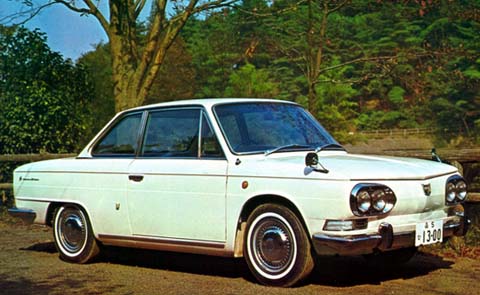
And back in Japan, Hino’s new 1963 Contessa coupe also pays its respects.

Now we come to perhaps on of the most lasting and broadly dispersed influence of the Corvair. BMW’s Neue Klasse of 1964, which started with this 1500 sedan, carrys the Corvair’s front end and belt line quite proudly, if somewhat disguised.

The BMW 2000 Coupe is a bit more unabashed in flaunting its Corvair roots.

The 1602/2002 popularized BMW’s Corvair themes,

especially from the rear.

BMW adopted these design principals wholesale, and made them their own. When BMW speaks of their design DNA, it’s the Corvair they’re referring to.

And since BMW’s horizontal accent line became such an indelible part of almost every subsequent BMW, it was with us through 2003 (if in ever less prominent form), until Chris Bangle finally flamed it away.

Let’s not forget the cute little Peugeot 204, also designed by Pininfarina.

It appeared in 1965, and its rear end is its most faithful aspect.

Since the USSR was always a bit late to design parties, its almost surprising that the ZAZ 966 appeared in only 1966. Vladmir Putin’s beloved little rear-engined sedan carries an air-cooled V4. I suppose they may have more likely bought an NSU to actually crib, but the end result is the same, and very faithful indeed.

This last one may be a bit controversial, but it can not be denied that the Tatra 613 of 1974 (designed by Michelotti) is still paying homage to the Corvair, to some degree or another. Ironic too, that the granddaddy of (semi-modern) rear-engined cars would acknowledge its latest member to the club. The circle is completed.

I was going to leave it at that, but is it too much of stretch to say that the increasingly ubiquitous face of modern cars that predominated the next few decades can all trace their roots back to the Corvair?

The Audi 100 represents typical exponent of the school: a simple horizontal face, with lights planted at each end.

The Ford Taurus of 1986 takes it even further back to the Corvair, lacking a grille altogether. The aero look soon became predominant and overplayed, and soon burnt itself out. It was the same problem the Corvair had in the US back in 1960:

Americans generally prefer a good strong face on their cars and trucks.

Europeans are more willing to still indulge the Corvair’s lasting influence. What was true fifty years ago still has some relevance today.

Postscript: And what did GM adopt for the front of its Corvair successor, the 1971 Vega? The classic 1950’s Pininfarina front end, right down to the egg crate grille. The Corvair’s face was just too…European.
Related: Pininfarina’s Revolutionary Florida: The Most Influential Design Since 1955























Fascinating Paul I can see the Corvair design language all through your examples never really noticed it before even the cut line around a EJ EH holden fits your thesis and the 63-65 PB Vauxhall the baby Opel Cadet Vauxhall Viva of 63 all have this same influence amazing I guess even I can learn something new.
The Ford Taurus is following Fords corporate look of the times it began with the Sierra the spread to the 79 Falcon the was copied for the Taurust they all had a flat metal front and underbumper breathing.
Paul: quite possibly your best effort that I have seen!
While never a fan of the Corvair, there is little I can add beyond a memory of one of the “hot” Mom’s in the neighborhood driving one, this clinic on it’s design and influence surely has roused my interest and appreciation.
Who knew this little car was so influential?
And yes, that ’59 Olds was difficult to look at. (I always thought they appeared sickly.)
My thanks also for including airliners of the era…at a point in time when their design were also quickly evolving.
Thanks; I’ve been wanting to do this piece for a very long time; Stephanie being out of town for the weekend made it possible.
well done Paul! great writeup.
I’m glad you chose to be so productive during your wife’s weekend away… i’m not sure I would have been so consciencious in my wife’s absence!
🙂
A labor of love and it shows. 🙂
Thanks so much for Corvair week, I’m a huge fan.
You know my grandfather was a big part of the corvair ” Bill Frick” this is his granddaughter . He gave us one when they first came out. But was sold later on.
Jenny Frick
👏 Awesome! I was never quite sure if Corvair came first.
I agree. A job well done, extremely well written. I have nothing to add, you got them all, as far as I can see.
“at a point in time when their design were also quickly evolving.”
B-36 First flight : 1949
http://en.wikipedia.org/wiki/B-36
XB-70 First flight : 1964
http://en.wikipedia.org/wiki/B-70_Valkyrie
The Valkyrie weighed half a million pounds and had a top speed greater than Mach 3.
The Valkyrie was delayed several times by politicians. Otherwise it might have flown even sooner. From 400mph to 2000mph in little more than a decade …
In contrast, today the last Boeing airliner to enter “revenue service” (the 777) did so in 1995, 16 years ago …
Paul, I’m simply amazed at this photo essay! This has to be one of your finest pieces ever, bringing your knowledge of European auto history, being an Austrian, and blending that knowledge with American auto design is stunning. I never could have realized how influential the Corvair was when it came out, and I never liked the original style, either. Incredible!
I fear we may never see this execution of beauty and functionality in automobile design again, but I have hope that someday…
EDIT: You keep mentioning the Lockheed “Constellation”! I’ve been hungry for a “Skyside Classic” piece about the most beautiful passenger aircraft ever built, and you’re just the guy to do it justice!
Brilliant! I was a bit thrown by the initial claim at first: in profile the Corvair
doesn’tdidn’t strike me as especially influential of European designs but when I reached that front-on view (15th image) for a moment I was looking right at my grandpa’s Hilman Imp,going back through with that in mind was a real eye opener… thank you!
Incidentally I think the twin headlamped Sunbeam Imp variant was actually badged “Sunbeam Sport” not 100% sure as nobody in the family had one (my aunt had a much loved Singer Chamois coupe Imp variant though…) though Wikipedia backs up my suspicion that it wasn’t marketed as an Imp.
Sunbeam Stilletto?
Almost. Further reading at http://www.imps4ever.info suggests the Stilletto badge applied to the fastback Sunbeam variant, with Sunbeam’s saloon-type variant marketed as the “Sunbeam Imp Sport” (and sold as the “Hillman Imp GT” down under just to confuse matters further)
Gotta love 60s-70s badge engineering!
Many export markets including the USA used the Sunbeam name and not Hillman hence Sunbeam Imp, although I think they used Sunbeam Imp, Imp Sport and Stiletto (coupe) in the UK.
The twin carb etc version in Australia was actually just Hillman GT in advertisements.
I think the Imp is the most Corvair-like of all the cars, closely followed by the NSU’s. Check out the front badge on the early models – very similar to the Corvair one pictured above
I agree, I think it’s the most striking of the resemblances, which is made all the more comical by how tiny the Imp is in comparison… wish I could find a photo of the two together…
I would like you to give credit to the photo of the red Hillman Imp photo. This should be attributed to Simon GP Geoghegan
The credit is right in the photo. We have no control over the images folks upload.
I agree, this is an amazing summary of Corvair design influence. While I was in Vietnam in 1968 I used to see a Mazda model on the streets of Saigon that was heavily influenced by the Corvair and quite an attractive car. Sorry I don’t recall the model and never got a picture of one. Have never seen one of these since that time.
Late 60s Mazda 1800 had a real Corvair look was that it?
A little research reveals that I was thinking of the Mazda 1500 (1967-1974). It has the Corvair belt line around the middle and looks like they chopped the roof off a Corvair and installed it on the Mazda.
Yes, the original Imp had single headlights and the Sunbeam Sport had dual headlights. The Sunbeam Stiletto was the top sports version and traded the lift-up rear window of the Imp for a semi fastback. My Dad was transferred to England in 1970 from Detroit and worked for Chrysler UK from 1970 to 1977. In the summer of 1976, between high school and college, Dad got me an Imp for the summer that had come off a company lease. I had a blast screaming around Warwickshire in the Imp that summer and discovered it would do 80 mph on the motorway up to Birmingham. However, in warm weather, top speed was limited to about 60 mph beacuse it would tend to overheat due to the watercooled rear engine. A fun car to drive, but not particularly safe as the only thing between the driver and a head-on collision was some sheet metal and the gas tank.
Thanks Fred! 🙂 80 mph in an Imp sounds terrifying with hindsight but I can imagine it being a hoot at the time
Mine will ‘cruise’ nicely at 6000rpm in 4th = 90mph, without overheating on a day when was actually overheating at 60-70mph. After a lunch stop I thought I would get a quick blast in before the temp gauge climbed, but it didn’t! I think the water pump was on the way out, so the extra revs helped.
They are as much fun as anything on the road, a real go kart to drive.
I had never considered the Corvair’s influence overseas, and it appears considerable. Thank you for this piece that is both informative and quite well done. Did GM make any serious attempt to sell the Corvair in other markets? I’ll bet I will know by the end of this week.
Not really. American cars were still fairly popular in a few countries, mainly Switzerland, Netherlands, and Sweden. I suspect a few were sold in other countries, but there was no deliberate effort to sell it abroad in substantial numbers. The exchange ratio was brutal back than (fixed rate, high dollar), and GM had Opel and Vauxhall there.
there are no Chevys listed in the UK price guide for 1960 I cant remember Corvairs being in NZ new and its unlikely Holden would have welcomed in house competition in Aussie they werent assembled RHD so its unlikely anyone else got em
It’s nice to see where a US designed car has had so much influence on other builders.
More than once I’ve thought that GM should have sued Auto Union, Hillman and ZAZ for copyright infringement. OTOH, imitation is the sincerest form of flattery.
I had hoped that the Volt would have been a Corvair for the 21st century, but so far it isn’t playing out that way. I guess time will tell…
The Volt’s technical aspects are technically interested, but in terms of its design…well, don’t get me started:
http://www.thetruthaboutcars.com/2008/09/general-motors-deathwatch-197-the-volt-lie/
@Paul: I remember that column now. Although I was referencing the technological aspects more than the styling.
It seems to me many of the Corvair ‘me-toos’ were aping the layout of the mechanicals. I guess if I were Mr. Porsche or (Mr. Tatra), I’d have been ready to sue.
Tatra did sue VW and they won for Porsche borrowing a large part of the design for the Type 1 Beetle.
It was not (the by then nationalised) Tatra who sued VW, but their prewar owners, the Ringhoffer family.
geozinger, as I think Paul mentioned, many of the European cars had rear engines for a decade or two before the Corvair – mind you they were nearly at the tipping point for a wholesale swap to front wheel drive.
Your 2008 TTAC piece was 100% correct as it turned out. I followed a Volt in traffic for awhile recently, and it looks like any other Chevy, a little more slicked back, but constrained by its conventional platform. The hood to windshield break is most telling, comparing the Volt with the Prius. By the way, the 3rd-gen 2010 Prius has that wraparound character line, tilted down and integrated with headlights and taillights. (Here’s the Prius, Volt photo follows.)
Here’s the Volt for comparison. Too bad they’ve forgotten their Corvair heritage. After all the 60’s Electrovair was the Volt’s granddaddy.
Sorry, I’ve got to disagree with both of you. I don’t really want to be argumentative or revisit that post, but here’s what I’m thinking about the design of the two cars:
The (2004) Prius established the shape of a Hybrid car in most people’s minds. I think there’s a certain physical characteristic about the shape of all three of these cars (Prius, Volt, 4 door Insight), in so far as making them as practical as a four door sedan, but aerodynamic enough to not drain the alternate power source and provide good fuel mileage otherwise. Why else would have Honda follow up with the 4 door Insight that looked like a little clone of the Prius?
Whether GM and Honda aped the Prius’s shape in order to riff off it’s established “eco” image or due to an unchangeable scientific rule about aerodynamics can be debated. But it’s clear to me that whatever is put out there will have to be very aerodynamic, in order to use the fuels efficiently.
I’m just speculating, but I imagine there was probably a point in 2008 where some poor b*stard had to tell Bob Lutz that the Volt wasn’t going to look like a Camaro if he expected to do well as an EREV.
@MikePDV: I have to disagree again. I routinely see a Volt traveling in our area, and it stands out quite a bit compared to the everyday cars in the area. Between the bulky shape and all of the LED lights that are on the car, it’s definitely different.
In fact, I had hoped that GM would have seen fit to deal us a hatchback Cruze here in the US, that would have been style even vaguely like the Volt. Not so much to ape the Volt, but to have a decent small hatchback again!
I’m waiting (hoping maybe) to see a Leaf someday in traffic. I will try and record my initial reaction upon seeing one, like I did with the first Prius in 2000 and my first Volt in 2010.
EDIT: Never fails, I think of something else after hitting the publish button:
@Mike PDX, You are right about the Electrovair. GM should have used that bit of history to establish a little more “green” cred for the Volt…
” I routinely see a Volt traveling in our area, and it stands out quite a bit compared to the everyday cars in the area.”
@geozinger: I saw my first Chevy Volt on the road this morning and it had Kentucky plates on it – not dealer plates, either! Silver.
I checked one out while at my Chevy dealer last week while waiting for my oil change and pushed the button on the dash – WOW! that thing lit up like a xmas tree! The first thought that went through my mind if I owned one was: Like on “Apollo 13”, how many amps do all those lights use, and how many can I shut off to extend the range?
Other than that, I thought it was really cool, but it wouldn’t work for me.
The opening statement of that article (“The unveiling of the production version of the Volt will go down in history as one of GM’s final coffin nails.”) is a typical TTAC troll.
[EDIT: woops, I just noticed *you* wrote that!
Well, I’m sure glad you’re sticking to the classics nowadays. :)]
Frankly Paul, your column was the only real reason for TTAC to exist AFAIC. They’re obviously just a bunch of astroturfers and spin artists working for some right-wing wacko org, which makes the name rather hilarious.
It’s a shame really, as they do have some writing talent.
I forgot/never realized how deep the Corvair’s influence ran design wise, I normally think of the last BMW 6 series coupes of the eighties as directly influenced, but it goes beyond that.
And am I the only person that likes the 1959 Oldsmobile? Although I like the rear end more with that “grand stage” beauty panel above the bumper. It looks like you could host “The Ed Sullivan Show” there.
@ And am I the only person that likes the 1959 Oldsmobile?
Answer: Quite possibly 🙂 Actually, I kind of liked the car everywhere but up front. Oldsmobile did the rest of the industry a favor in those early days of quad headlights with a lesson on how NOT to do them. In fairness, though, Olds did it better than the 57 and 58 Lincolns.
Oddly out of all the 1959 GM cars my favorite is the Buick, for as wildly it is styled there’s not too much chrome and the details are crisp and linear. The Pontiac, Caddy and Chevy are still too Harley Earl fussy at the ends to me.
The Olds is the odd duck out, because there’s a moderate use of Chrome and some showy details. It’s just the right amount of glitter, plus out of all the 1959s I think it kept the most design continuity with the rest of the 1950s design (especially the jet exhaust pod style tail lamps). In some ways Oldsmobile used the wide eyed “Barbell” face off and on until the 1990s. The Composite headlamp clusters on the 1992-95 Eighty Eight and last Ninety Eight look amazingly dopey and friendly.
And just to say the exact same face basically came back for the 1967-68 Cutlasses, and nobody calls those ugly…
The Olds isn’t my favorite 1959 GM design, but it isn’t the worst from GM for that year. The Buick takes that dubious honor, in my opinion. The Pontiac comes off best, both in 1959 and 1960.
The best 1959-60 bodystyle from GM, in my opinion, is the four-door hardtop. Very sleek and well-suited to the wider, longer lower body. It’s even more interesting that the basic greenhouse and roofline of that hardtop style translate so well on the much-smaller Corvair.
The roofline of the two-door hardtops looks too small for the rest of the full-size cars. It is not well-suited to the very long decklids GM used those years, particularly on the longer-wheelbase models.
I always thought that Cadillac came off best for the 1960 rehash, with Oldsmobile actually looking worse for 1960 than 1959. It’s the holes in the bumper, the protruding air scoop and the gap in between the headlamps make it look like it has a mild form of retardation. Which is a shame because the rest of the car is so knife sharp.
In 1959 GM products, my favorites would be a tossup between Buick and Cadillac. 59 Buicks look unabashedly sinister. Pontiacs looks good in the front but I don’t like the styling at the rear as much, with the V-shaped fins and bumper “skegs”. 59 Chevies look great from the rear, but not so much from the front. (Put together a car with the front of the Poncho and the back of the Chev and I think you’d have a winner!) I’m least fond of the 59 Olds styling.
Years later, but the 1957 Lincoln was a facelift of the new 1956, and while it probably was commercially appealing at the time, is not at all well regarded now. The 1958 was a whole new car, and while still underappreciated, is totally awesome.
“And am I the only person that likes the 1959 Oldsmobile?”
Hell, no! I don’t care what anyone says, this is drop-dead gorgeous…
Great article! This really puts the Corvair’s enormous influence over modern design into perspective.
My German grandfather had a white NSU Prinz when we visited him in 1964…I was only two-years-old, but I can vaguely remember it. I seem to remember receiving a Corgi-sized diecast of that car when we returned to the states.
For that matter, the Fiat 1300/1500 was a very popular Matchbox model in the late 1960s. It was a pale green color, with a detachable set of luggage in brown. I still have that one in my collection.
Great article! The various Dutch DAFs have always reminded me of the Corvair too, especially the grille-less 44 and 46.
Yes, there were others too…It was getting late last night. The Corvair’s genes can be seen to some degree all over Europe and Japan.
The DAF was a Michelotti design. To my eyes, the Corvair influence is negligible.
Great article! In addition to the early-model Corvairs, the late-model (’65-’69) Corvairs also had some styling influence, most notably the BMW shark-nose styling.
Look for the ZAZ’s boxy beauty in “Cars 2.” It’s a key player in the gang of Lemons that band together, serving as villains.
Wow, Paul, your best ever.
Great job, Paul! Audi still plays with Corvair styling for sure.
Paul, just to comment on your postscript, which was added after I first looked at this article: The Vega styling was supposed to look like a scaled-down Camaro. IMO, you’re really implying that a 1970 Camaro styling was cribbed from the 1955 Pininfarina Florida.
The front end was sort-of generic Pininfarina, as used on many of his cars; but the rest of it wasn’t. But Pininfarina complimented GM on the end result.
The left and right headlight bezels of the original 1960 Corvair are interchangeable …
American influence in Japanese automotive styling was obvious up until the early 1980’s
http://en.wikipedia.org/wiki/File:Mazda121left_02.jpg
Another German Corvair … 7 years after the original.
GM copied VW engineering. VW copied GM styling …
http://en.wikipedia.org/wiki/File:Vw_411_v_sst.jpg
It might be more gen 2 Corvair but, as the BMW 2000 was also brought up, I’d like to add the VW 412 to this list.
Articles like this one are the reason I keep coming back to this site.
I knew that the Corvair had some influence, but no idea it was this pervasive.
Thanks Paul.
paul, thanks for setting the record straight. i always loved the neue class bmw’s. it never occurred to be that they were inspired by american metal.
this site along with ateupwithmotor have given context to automotive design history in a way that extends beyond the conscious understanding of even the people who designed the cars you guys write about.
Thanks for this fascinating article! I always thought the Corvair was just a 3/4 version of a ’59 Chevy, but now I see it’s something entirely different. Who knew how influential the Corvair was? It all makes sense seeing your reference photos. It’s also great seeing European models I had never heard of — especially that Panhard 24. What a looker! Never knew it existed.
The generic abilities of the Corvair beltline got its own colloquial expression in Swedish. It was called “soapbox design”, like it was a box that could be opened in a lower half and an upper half. Was that an international description as well? Is the expression known elswehere?
Speaking of lower and upper half, I’ve always been intrigued by the Pininfarina “bathtub” beltline, as seen on the Berlinetta Boxer, and later on the 308. Like the lower half was a tub with an upper body on top of it. Could one say that this is a continuation of the Corvair theme? Or is that a stretch? That particular beltline was almost lifted straight out for the C4 Corvette.
Awesome. I can’t get enough of this kind of coalescent, long-story-short piece. Super thorough and encyclopedic–but succinct, engaging, and loaded with visual aids. The perfect Automotive Histories article. Maybe I sound a little mushy (it’s 4 am), but thank you for this stuff!
Another Japanese Corvair, albeit front engined and with curved rather than dipped eyebrows was the lovely Prince S40 Gloria of 1962 aka PMC B200 aka PMC Mikado. My uncle had one of the first in NZ. ( image = Wikipedia.)
Beautiful looking car.
Years later again….that 1962 Japanese car also has a whole lot of Ford Falcon in it, like the entire greenhouse.
and the profile shows the flying roof…
There used to be one of these in my home town and it was years before I saw another one
It looks even better from the side. 🙂
Maybe a stretch, but some Corvair themes can be found in the least likely of places: Like a 1963 Chrysler Newport. That chrome-highlighted lowered beltline found its way to Highland Park.
Did you guys ever interview any of the Euro designers you say were influenced by the Corvair?
Awesome article. Just thought I’d mention Pierce Arrow’s contribution to the faired in headlight…a patented design feature
I was just waiting for someone to say that. Yes, I almost included Pierce Arrow for that, and there are other important milestones along the way, but i had to leave off somewhere; it was getting too long anyway.
The 1962 Alfa Romeo 2600 Coupe concept looks a lot like a 1964 Corvette.
A fascinating article. Is there a Pulitzer for automobile writing?
My earliest memories are of 1950’s cars, and I’ve always been dimly aware that something happened to car design in the early 60’s that (for me) took away some of the magic.
Who would have guessed that it could all be summed up by the Florida coupe and the 1959 Chev? Somehow the wide expanse of hood and grille on post-1958 cars always seemed scaleless and ultimately flimsy in appearance, especially with full-sized models growing ever larger.
I’ll leave it to better minds to decide whether it was the best design decision for cars of that size, although the 1963 Pontiac showed again how a more European approach to hood and headlight placement could still work magic on a big car.
It suddenly occurred to mer that maybe the first car to put the headlights on the sides of the grille may have been the 1948 ford F-1 pickup. Could it be so that an 11 year old pickup face (ever more so the early 50’s versions) started this whole design revolution?
Replying to an old post but, the 1948 Morris Minor had headlights next to the grille similar to the 1948 Ford pickup.
the corvair is cool aint it but its not the only american car to set of a million copys the other very influential american car to have imitateors was the mercury with the breezaway rear window ..please please cc do a piece on that cars imitators,lol ie ford classic and anglia,reliant regal,mazda carol bond bug ac invalid car citroen ami..it would be real fun reading,lol
As an owner of a 1960 Corvair, and having spent a couple of years in Europe in the late 70’s, I had seen many of your examples of Corvair influence “in the flesh”, and had marveled at the similarities. Thanks for tying together all of these automobiles and showcasing their Corvair styling influence.
Just read your excellent post recently.
However, the pontoon style was adopted by Mercedes in 1953, and was kept for decades.
Owning a 1960 Corvair 700 recently restored (and loving her), I recognize Corvair’s influence on automobile design (some of the pictures are striking proofs: although I owned a Hilmann/Sunbeam IMP, I never realized how much her body was Corvair inspired!).
From France with my best regards.
Hey! Where is BMW’s other corvair-esque car, the 700 at?
BRILLIANT!
>> the Oldsmobile, has a front end that predicts the 1960 Corvair’s. Below that strong horizontal line that dips in the middle, is a relatively flat face, with too much chrome, of course.
Stainless steel and diecast aluminum, actually.
When stainless steel started to be substituted for chrome plated metal trim brochures and ads started calling it “bright trim”. But “chrome” has continued on as a descriptor for all of it, even if none is actually chrome. When I saw a 1956 Lincoln on a sunny day in the Coney Island Mermaid Parade, no doubt with rechromed bumpers and maybe other bits I realized that nothing dazzles like the real thing.
Dear Paul,
Thank you for this excellent article.
Louis Bionnier, the man who designed Panhard’s 24 series fully admitted that the Corvair was an inspiration for the then new Panhard. .
Actually, when you come to think of it, design that pushed the car forward was actually the Corvair, the Mini and Renault’s 16.
Great article! I especially liked the trivia about the prototype Corvair being badged as a “Holden”.
I’ve always felt like a lonely acolyte trying to point out to other enthusiasts how first-gen Corvair styling went around the world in the early ’60s. My wife and a couple of our kids drive small BMWs!
And the Monza coupe, picking up on ’58 T-Bird interior themes, started the sporty small American car trend: Tempest LeMans, Buick Skylark, Ford Falcon Futura and Sprint, Barracuda, Mustang and the other ponycars, GTO and the other big-engine intermediates.
Heck, my ’64 Sting Ray had a beltline running all the way around the car, at least ’til I put on big flares to accommodate foot-wide rubber. Peter Brock and Larry Shinoda were working on that shape from about ’57 on, first for Bill Mitchell’s personal racer on an SS chassis which became the Sting Ray dream car, and later for the production Corvette.
Thanks for putting all those pictures together!
And of course, the Corvair was the subject of the book, Unsafe at Any Speed” which made Ralph Nader famous and ushered in much needed safety regulations.
While I like the styling of the early Corvair, from 1960 to 1964, I like the suspension design of the later Corvair, from 1965 to 1969. It’s a shame that Chevrolet wanted to discontinue the Corvair when they did. I believe the problem was marketing. The Corvair was marketed towards American cars by other makers, Ford and Chrysler, when they should’ve marketed it for buyers of Volkswagen and Porsche, other rear-engined cars. I believe that’s what killed the Corvair, not Ralph Nader and his book, Unsafe at Any Speed.
Paul, I wonder if you might do a follow up article to this one about the lasting influence of the Corvair’s design in the form of BMW’s 1970s products.
The BMW 2002 seems to me to be the prettiest and most lasting copy of the Corvair, but the first BMW 3-Series (e21: 320i, etc.) seems to have taken the design language of the 2002 and the Corvair, and tweeked it to create a european sedan design that influences sports sedans even today.
When I look at the Corvair, the component of the design that looks the least modern is the high hood, low trunk look that the BMW 2002 shared. But the BMW 320i raised the trunk, lowered the hood and moved the visual mass of the greenhouse toward the rear of the car, creating the wedge shape that remains popular even today in Cadillacs and many other sports sedans.
That shift of the greenhouse back and up worked its way through major manufacturers including Mercedes, some Lexus’s, some Audi’s, most Infiniti’s, and Cadillac’s starting with the 2004 CTS.
Your knowledge on the subject could make for a great read!
Matt: BMW adopted certain Corvair design cues as their own, and maintained some of them well into the 80s. But the evolution of their proportions, as you outline in your comment, is not really attributable to the Corvair.
Longer front ends, rear-set passenger compartments and shorter and higher trunks were of course popularized most of all by the Mustang, but these were classic features that the Mustang reprises.
And in Europe, there were of course numerous sports/GT cars with those proportions, which the Mustang aped. So it’s not so easy to say what brought on those changes exactly, except that it was the way design evolution was heading, and for a long time. It still hasn’t quite ended, actually.
So I’m not sure how I would act on your suggestion. It gets very difficult weaving all the influences into the common evolution of design. Re-reading this article makes me aware of its limitations, as it was by necessity on overview, and not a comprehensive analysis.
Thank you Paul, that helps actually. The wedge was and is a trend rather than a revolution.
These seem Corvair influenced, so this thread seemed to most logical place to post…
Does anybody know what these are? The general “feel” seems early to mid 70s to me. Momentarily seen in a Listerine ad of all places. They were so generic looking that I almost just let them go by. And then I noticed the three-lug wheels and melted the pause and rewind buttons. AFAIK, the vast majority of three-lug wheels were used for smallish French cars. I googled some of the more obvious candidates, (Renault, Citroen, Simca, Peugeot, Panhard) but my knowledge of European models which likely never made it to the US is slim to say the least.
Three-point belts, stamped steel steering wheel spokes…
Minimal ornamentation, simple chrome bumpers, and a broad C pillar.
Curious. Can you post the link to the actual Listerine tvc?
https://youtu.be/_c60F8E3h9A
I took the photos from the ad paused on my TV. But there’s not much more to be seen. They’re only on the screen for a total of about four seconds, and only from that side and a detail-free closeup through the windshield.
I’m stumped. It seems like a cross between the 65 Corvair, German Ford P7 and Renault 12. Though it looks Euro, my guess is South American.
Found it. Ford Corcel Coupe from Brazil. The sedan is derived from the Renault 12 body.
Asked to answered in 3 hours, 2 minutes… In the middle of the night. 😀 Somewhere on the internet there’s someone who knows what you’re trying to find.
I saw some Opel influence in there too. And since I know even less about South American cars than ones from the continent I’d never have been able to find that, even if I’d looked. (what do you search? 1975 coupe South America?) And the French connection was correct.
And now I’m wondering where the ad was shot.
Checked my analogue copies of World Cars Catalogue in the South American section.
It looks like a US tvc; the budgets on those tend to be quite high so I think what we have here is an art director who knows cars and had the opportunity to demonstrate that knowledge. It could quite easily have been a couple of Mavericks for example, but if you can use a more oblique model, why not?
It gets funnier. I just googled the model now that I know what it is, and CC did a story on them a year ago…
http://www.curbsideclassic.com/curbside-classics-american/curbside-classic-1969-ford-corcel-gt-the-confusing-history-of-a-multinational-brazilian-classic/
I would have jumped in sooner last night with an answer, but I’ve been intensely busy. By the time I got to this thread again last night, Don had figured it out.
But it’s a very curious thing, to use these Corcels in a current ad. I’m going to run it as a post.
(Paul, btw, I didn’t get any e-mail notifications from this, even though I checked the box on each post. Is that something you can check under the hood, or is it something set wrong on my end?)
Umm, that’s not something I really know about. Sorry.
Did you see the post I did on this commercial? http://www.curbsideclassic.com/blog/tv-ads-and-videos/cctv-ad-the-most-obscure-automotive-placement-in-a-modern-commercial/
I saw the other post. Didn’t really seem to be anything for me to add…
Another random Corvair post…
TCM has scheduled for the early morning (2:41AM PDT – 19 minutes) Sunday July 24 something called “The Corvair In Action”. Released 1960.
“In 1960, technicians provide information about the arrival of the brand new Chevrolet Corvair, which ‘delivers the goods as no other compact car can’. ”
Based on the date and the description, I assume it’s a pre-release promotional short put out by Chevrolet. Might be interesting. Might be lame. Might be both. Set your DVR
Now on YouTube.
– I never noticed it before but the VW Type 3 Karmann-Ghia really does look like a Corvair coupe as Virgil Exner might’ve drawn it.
– Or for that matter, how much the Tatra 613 looks like a thirdgen Corvair would’ve. Chop about a foot out of the wheelbase, all at the back-seaters expense (can’t have it roomier back there than an Impala, and in the early ’70s any “small” Chevy would’ve been a coupe-first design production), add in GM’s new for ’75 quad square sealed-beam headlights, some Vega GT wheels, and some other mid-’70s Chevy parts bin items and you’re there.
Regarding the Tatra 613, the author erred by accrediting the design to Michelotti. It was a Vignale design.
Glad to see this repost for the 1st time! I recall that Corvair was quite a shock to me when it came out fall of ’59 . And the ’59 low headlight revolution as well, I always liked the ’60 Dodges that year, it was one of the last holdouts, and even as a kid I guess I was something of a traditionalist.
I see Stingray influence also in that ’62 Alfa 2600 coupe, to a rather large degree. Chevy design and Bill Mitchell in general were pretty influential all over back then.
Or maybe the Alfa influenced the Stingray, although the show-car Stingray may have preceded the Alfa.
It was interesting to read this again. I had never thought about it until just now, but it could be argued that the 59 Studebaker Lark made some half-steps in the direction that the Corvair really slammed home.
The pronounced chrome line that goes all around the car (interrupted only by the more classic style of grille) is one such place. The Lark had to deal with some pre-existing sheetmetal contours, and gave that line some twists and turns in the back half, but it could be argued that the basics of the idea are there.
Likewise, the Lark brought the headlights down low at the same time as the style-leaders at GM. Really, the Lark is almost a cross between the GM and the Virgil Exner schools of compact styling, sort of a middle ground. Which is pretty amazing for a broke backwater of a company trying to scrounge a new model out of leftover pieces.
For some reason I can’t get a picture to upload. Oh well, everybody knows what a 59-60 Lark looks like.
Here a comparison of the Lark with the Corvair. The Lark had sime styling elements that were new, thanks to some help from Chrysler and GM, but its proportions suffer due to its height. This body did date back to 1953, of course, and sits on a frame. Pretty good lipstick job on a pig. 🙂
I just added a bit on the Lark.
Yes, starting with a clean sheet of paper and a real budget can make all the difference. 🙂
Among other things (those bumpers are pathetic) the Lark has a skinny panel between the doors. This kind of construction dates back to prewar times. The 1949 Fords and GM had eliminated this bit, but not Chrysler cars. They did in 1953. These are just a couple of real world symptoms of what was going on at Studebaker. Everything was coming up short starting around 1950 and continued to the end.
Agreed abut the Lark. I almost brought it into the added discussion about the Corvair’s styling, but ran out of steam last night. Next update. 🙂
I did discuss these issues in my Lark CC. Because the Lark was styled in such haste, just some 6 months before it went into production, it benefited from some leaks coming out of both Chrysler and GM. It’s been confirmed that its front end was leaked by Papa Exner to Virgil Jr., who was working as a consultant at Studebaker at the time:
http://www.curbsideclassic.com/blog/automotive-history-why-the-1959-studebaker-lark-front-end-looked-so-much-like-the-1960-valiant-front-end-it-was-stolen/
And although there’s no proof, unlike the Lark’s front end design, I am quite sure someone leaked the Corvair’s design too, as there’s just too much similarity in that horizontal line both cars have. Studebaker bought in a bunch of guys to pinch hit on that rushed Lark styling job, and I bet one of them had seen what Chevy was doing with the Corvair.
The problem with the Lark of course is that it suffers a bit from the Austin A30 problem: because it’s tall too, it ended up looking pretty stubby. It has some good styling features, but the basic proportions are hardly ideal. No one would have created them from scratch in 1959.
It almost looks like the Audax Hillman Minx with those shorter overhangs, but then again, that was a compressed version of the Loewy ’53 original anyway. Not pirated, of course, like Pininfarina the Loewy Design wasn’t above reworking its themes.
Loewy had nothing to do with the Lark. That was overseen by Duncan McRae, brought in as a consultant.
I’ve looked this over a bit and am unconvinced that the Corvair (or drawings/prototypes thereof) influenced the Lark directly. As JPC noted above, all Studebaker sedans since 1953 had a slightly drooping crease stamped into the fenders and doors, and this largely dictated how the side trim had to look. Originally this ended in a downward scoop in the rear door (or rear fender of two-doors) but this was eliminated in 1956. Still, since they never redesigned both the front fender and front door the same year, they couldn’t get rid of that crease. Instead, the chrome trim changed almost every year, and I find it rather amusing to track how the trim (or should I say, disguise) of this crease changed from one year to the next, as well as up and down the trim levels for a given year. Anyway, by 1956 they already were using the same basic chrome accents in the same places as would be used on the Lark (as in pic below), which means it was in place by the fall of 1955, likely well before anyone at Studebaker knew what the Corvair would look like.
What did change on the ’59 Lark trim from ’56 was that the chrome accents now wrapped around over the headlights as well as across the deck lid in back, encircling most of the body. The front trim above the headlights and front-side treatment resembles a very toned down version of the Valiant’s trim, and we know they did see the Valiant in advance. Note though that the trim doesn’t extend above the grille (or non-grille) as in the Corvair. In back, the taillights look very much like the Valiant’s too. The one styling element I see on both the Corvair and Lark but not the Valiant is the chrome strip across the trunk lid, but it’s a distinctly different shape in the Lark than it is on the Corvair, and it’s not covering a pronounced ridge. I sense that the designers just thought it would look good to connect the trim pieces above the taillights together, in part because it would make the narrow car look wider. If Studebaker did incorporate any ideas gleaned from sneak peeks at GM into the Lark’s hind end, I see way more ’59 Buick than ’60 Corvair.
You make some good points. But in the end what seals it for me is the way the back trim of the Lark highlights a distinct cove under it. There is no way that anyone could look at a 56 Stude and imagine the top half being a separate removable piece. The Lark sort of does, although as you note the central “seam” that separates the bottom from the top breaks at the grille and has some more visual interest to it than the unbroken straight line of the Corvair.
(For some reason I cannot get a picture to attach to comments in this thread).
It’s purely conjecture on my part about any influence of the Corvair on the Lark. No one else has ever brought it up (as far as I know).
A number of young designers were hired to help out with the Lark styling job, and most of them came from the Big 3. We know about the Valiant’s front end. It seems very plausible that one of these guys had been exposed to the Corvair’s very distinctive (and unusual) horizontal dividing line, especially the way it worked at the rear.
But it’s possible they came up with that on their own. Maybe something in the air in 1958, or the water?
This article is even better the second time around.
Nice to read it again. I did not notice any reference to the NSU Ro 80 in the article nor the comments.
Claus Luthe styled the NSU Prinz, the NSU Ro 80 and went to BMW after that. The Prinz had the perfect bath tub rim all the way around. For the Ro 80 he reduced the rim to a crease that also went all the way around. It dipped down towards the nose. The crease was even present in the headlamp lenses. This crease in the lens was not compatible with halogen lights and was dropped for that reason.
Other than the Wankel engine, I would be love to have one of those today. A few decades ago I saw one parked on the street in front of the San Francisco DMV. It was already old and super rare, but amazing.
I only recently became aware that the Ro80 was ever sold in the US. I’ve never seen one.
Even more similar to the Corvair is the Ro80’s successor, the VW K70
The K70 was not the successor to the Ro80, it was a smaller companion model.
It wasn’t just styling. The Type 4 and bus engine from the early-70s was laid out like a Corvair engine, moving the oil cooler from above the #3 cylinder to the back of the engine and using o-ringed push rod tubes (which leaked like the Corvair’s.)
And yet today we have the Smarts and and related Renault Twingos with rear engines.
Great article, and I could be wrong but does that DC7 have turboprops instead of piston pounders?
The DC3 could be outfitted with turboprops but never knew that was done with the DC7.
It’s an artist’s rendering, and not a very accurate one. No turbo DC-7.
The DC-3s were converted in much more recent years, as it’s still a practical bush freighter.
What an epic study – in line with the top-notch work on B-Body Chryslers. When I was younger I recall seeing images of the Hillman/Sunbeam Imp and recognizing the face immediately. The belt line based connections to other cars, especially to BMWs, was one I hadn’t noticed but now see clearly.
Have there been any other designs since the Corvair that impacted so many other stylists around the world? I’m thinking of the original VW Golf/Rabbit (early Chrysler minivans always resembled expanded Golfs to me). Maybe that’s a whole separate topic/post.
The Golf clearly was very influential. As to others, I’d have to ponder that a bit.
The Pininfarina Aerodynamica from 1967 was extremely influential. Not just the obvious imitators like the Citroen CX/GS and Rover 3500, but also a host of others, if not so blatantly. It was the aerodynamic shape of the future, and we can see its influence in the Prius and so many others.
As for GM identifying the early Corvair’s as Holdens, the dashboard looks like it was designed with easy RHD conversion in mind.
Back in the ’70’s, when describing the European Type 3 Karmann Ghia, I would say, its the one that looks like a Corvair. Great fun reading this expanded PN classic once again.
Interesting point about the RHD possibilities. I would also note that in 55-56 and again in 59-60 the dash in the standard Chevy was more or less symmetrical too. And then there was the Corvette.
The Holden ruse was just pure and simply a way to throw off the press/spies.
I don’t believe the symmetrical dash was there to ease a RHD version. There’s nothing to suggest that the Corvair was going to have any kind of significant export volume, as GM had its own captive companies. The Corvair did sell a bit better than the average American car in a few countries in Europe, but only for a year or so until its novelty wore off.
The symmetrical dash design was a stylistic theme that had been used in quite a few cars before, including big Chevys as JPC points out. Others too. The ’61 Continental had a symmetrical dash. It was a thing at this time.
I’ve read elsewhere that the “Holden” badging wasn’t just to throw off competitors and spies, but also GM’s own upper management that wasn’t on board with the Corvair project early in its development. Supposedly even internal memos regarding the car were to be written using Holden letterhead. True?
I’m not aware of that. I don’t see how upper management couldn’t have been aware of it. It was to be GM’s key compact to fight the imports for 1960. And its body (Y body) was to be shared with the B-O-P compacts, so that intrinsically required corporate coordination.
It was a popular design, I was thinking of the ’61-’63 T-Bird’s dash design as well. Likely just following trends of the time, as you say.
I’m sorry but I have to. Also this is identical to the one I had in the 2000’s. The best MidMod interior ever. The original 1960 Falcon was a much cheaper more rounded version of the same idea, with the instruments also in a pod.
This is the 1963 version of the Falcon with a different face on the instrument pod, anticipating the rebodied 1964 version. The optional (!) padded dash makes the comparison to the Lincoln more obvious. Also a Sprint with that cool die cast chrome console.
Two of those cars turned my head – the Taurus, because is so closely holds to the styling of my ’90 wagon…and that beautiful red 1970s Audi 100 LS. My mom owned one, a 1971 model. I remember driving that car to New London, Conn. from West Springfield, Mass. with my brother riding shotgun. I never drove a faster I-4 vehicle. That car was something else, and actually had real wood in the dash. Its weak point was inboard front disc brakes which required complete disassembly of the drivetrain to get at those buggers. Jones Porsche-VW-Audi in Springfield charged almost $600 for a brake job on this car in 1974. When the second brake job in six years loomed, Dad said “enough already!” and Mom settled for a Mercedes-Benz 300D.
He and she should have kept the Audi. Meanwhile, I still was driving the 1965 Ambassador 4DR sedan that was handed down to me in high school when Mom got the Audi…I kept that Rambler until 1982 when I scored on a 1965 Ambassador 990 convertible. Dad glared at me everytime I came to visit in those Ramblers. 😀
Not being too big a nitpicker, but the two links to a CC about the Pininfarina Florida are dead. It is easy enough to find images for illustration, but as always, it would be great to read what a CC item had to say.
The very first article I ever read on CC, after seeing a reference on BAT. Created a daily habit. I hardly ever look at BAT, these days.
“its rear-engine, the first American mass-production car to adopt a configuration”
There was a second?
There was the Pontiac Fiero, although some might argue that was actually mid-engined.
This article still holds up brilliantly, Paul.
I remember in 1983, at the introduction of the Renault/AMC Alliance, being reminded of the Corvair and it’s styling. It wasn’t for all of the usually mentioned styling flourishes already mentioned but for one that hasn’t been. The rear wheel wells on the four door had a built in semi skirt but the coupes and convertible didn’t. The Corvair did it in 1960 and 23 years later AMC used the same trick to great effect. It really gave the 4 doors a look all of their own.
I went with my father and mother to BAHER CHEVROLET in Hermosa Beach CA when the Corvair came out. There was a line to go for a test ride – the salesman would take a full car load around a few blocks (only he drove it).
Little did I know that one would be my first car – gotten from my cousin’s husband, The front emblem had been removed with of one the custom grills put on it that were available aftermarket. More than once, it would spit off its fan belt,
At the high school I went to, there would be a couple rows of Corvairs, I the only 1960 4 door 700 sedan with the rest newer Monza coupes.
My father’s car was totaled – since being the bread winner he taking the Corvair for his commute,
I have a ’67 BMW 2000CS. I have always been amused by the fact that BMW did not continue the Corvair-inspired 360 degree chrome wraparound to the rear decklid. It simply is not there. So the chrome is roughly only 300 degrees around the car.
In my imagination, Hoffmeister, BMWs lead designer at the time, called in his trim guy, and said, “Gee Fritz, we ran out of money for the chrome, the interior guys needed some extra, so do you mind if we leave the trim off the decklid?” Fritz must not have been happy…
I’m with Fritz on this one; it always looks a bit unfinished from the rear. But overall, a wonderfully integrated design. Currell
About the Pininfarina 1962 Alfa Romeo 2600 Coupe concept :
we can definitely see this horizontal line surrounding the body but what is also obvious is the fender bulge and the hood like the C2 Corvette Stingray which debuted 1 year … later.
There are even these flaps above the headlights which also suggest the rotating headlight housing of the c2. Were Larry Shinoda and Tony Lapine roaming European car shows in 1962? This would be surprising given how long it took at the time to completely redesign a generation of cars. Still intriguing.
The Renault R8 was never influenced by the Corsair. it was simply a blatant copy of the Tipo 103 Alfa Romeo, albeit rear engined. It was also super aerodynamic with a CD of only .32
To compare a R8 to a Corsair is really stretching it a bit far.
See the similarity between the R8 and the Tipo 103?
The 103 prototype wasn’t built until 1960. The Corvair came out in 1959. I can well imagine that there’s a connection.