

(first posted in 2011) So just whose idea was that? Along with the business coupe and the Ranchero/El Camino utility pickups, the large two door station wagon ranks right up there in the Pantheon of American car oddities. One can even make a pretty good argument that it towers above them, given its questionable heritage and utility. The business coupe’s origins go back to the earliest coupes, like the Model T, when roadsters and two-passenger coupes were were common. And the utilities were just an update on those same coupes and roadsters with little beds grafted onto them, the pickup’s precursor. But for about a dozen years or so, Detroit graced Americans with something they had no idea they needed: the two door wagon.

Before WW2, the station wagon was primarily a commercially-oriented vehicle, and given its intended role in hauling large numbers of people and their cargo, always with four doors (or more, like this handsome LaSalle) . A two-door wagon? It’s possible that someone will prove me wrong and show me that a production two door wagon existed before WW2. Station wagons then were almost always built by outside contractors, using plenty of wood, and at least four doors. And almost all of them were registered as commercial vehicles, given their commercial chassis underpinnings and typical role. But like so many things automotive and otherwise, the post war era unleashed big changes.

Ironically, it all started with the maker of that WW2 icon, the Jeep. Desperate for a new market, Willys brought out their quite revolutionary all-steel wagon in 1946 (the wood grain is painted on). Given that this was not intended to directly compete directly with the existing station wagon market, and rode on a substantially shorter wheelbase, two doors certainly made sense.

The Willys was also significantly shorter, and not available as a three-row wagon. Rightfully, it could be called a compact wagon, and was available with a four or six. In a world of strictly genuine-wood four-door wagons, the Willys was a true revolutionary.

Plymouth clearly was heavily influenced by the Willys wagon, and introduced their own all-steel two-door wagon in 1949. This marked the first all-steel wagon by the Big Three, and was made right on the same assembly lines as the sedans. The Plymouth two-door wagon sat on the smaller 111″ wheelbase of the junior P 17 Plymouths, which only came in two doors variants anyway. The larger P 18 series had a traditional woody four door wagon, so both bases were covered. The Plymouth wagon was a big hit, and given its rugged construction, could still be seen in its role of hauling families well into the sixties.
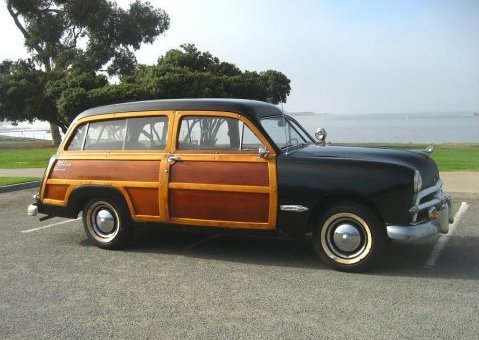
Ford really jumped into the two-door wagon pool with both feet in 1949. Unlike Plymouth, Ford only had two-door wagons for their 1949 – 1951 models, including the nine-passenger Country Squire. In a bit of an odd twist, Ford kept the traditional wood construction. Might as well be sure you’re going to float after taking that plunge.

The logic of building a two-door three-row wagon, with the third row still facing forward, would be mighty difficult to muster in today’s obesity-challenged world. Folks still knew how to bend and clamber.

And there they are, all happily ensconced, including adults in the third row. Well, the Ford certainly was a nice looking wagon, until the lacquer peeled off the wood and it started to fade and rot.

Chevrolet went the other way, offering only four door wagons. These tall wagons were quite roomy too, although maybe not quite so as is depicted in the ever-unfaithful renderings of the time. Makes it look like a bus in there.

Ford added four door wagons by 1952, and kept both body styles in production. But Chevrolet held out until 1955, when the Handyman low-level two door wagons were introduced,

as well as the very upscale Nomad (CC here), which had its own unique sheet metal. Suddenly, the questionable identity of the two-door wagon became really fragmented, populating the very low and high end of the station wagon pecking order. With the Nomad, the idea of the wagon as a sporty, upscale vehicle took hold, but its life as a two-door was quite short, ending after the 1957 model. But its influence would be felt to some degree or another throughout the rest of the station wagon’s tenure.

Ford responded to the Nomad with their 1956 Parklane, but it was really just a gussied up two-door Ranch wagon.

Plymouth didn’t bother, and the two-door wagons were just the typical bottom of the barrel variety.

Although with the all-new 1957 models, the low end Plymouth wagons can hardly be called lack-luster. In fact, they’re quite dramatic. But I can’t recall seeing one in the flesh, rotted or just just spongy. Big Plymouth and Dodge wagons of the time were popular with big families, but they mostly stuck to the four door versions.

Mercury was notoriously flamboyant in the 1957 – 1959 era, and they fielded not just a two-door wagon, but a two-door hardtop wagon! Now we’re really starting to make sense! Unless I’ve really blown it, Mercury was the only one to do so. Well somebody just had to.

That made me wonder if Edsel got to share that body shell too. No such luck; instead they had to make do with the lowly Ford Ranch Wagon body, and a name that would really resonate today: Edsel Roundup, guaranteed to kill something.

The big-bodied Big Three cars of this period rightfully marked the end of the whole foolish exercise. It’s not like most folks couldn’t afford the extra eighty bucks to get you that second set of doors. But with a wave of new compacts about to make the scene, giant finned two-door wagons suddenly just seemed ridiculous. 1960 marked the last year for the big Chevy Brookwood two-door.
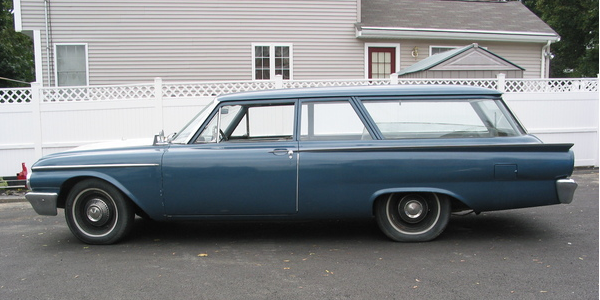
Ford lasted one year longer, with this quite rare 1961 two-door Ranch Wagon.
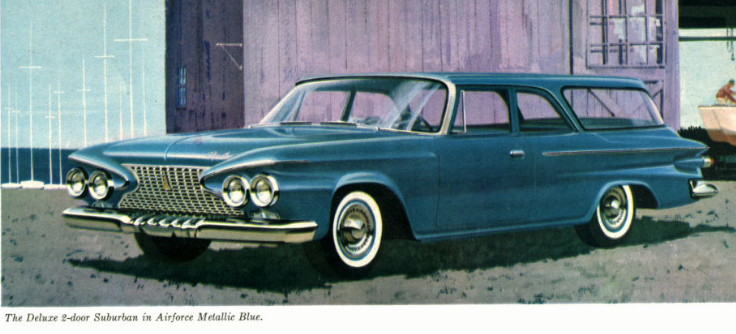
And Plymouth also bowed out after 1961. Any of these later year two-door wagons are hot commodities now. But what about the independents? Where they true to their name, and stayed out of the two-door wagon mania?

One can excuse the compact little Rambler, especially since all the bigger Rambler wagons were exclusively four doors, and it was so damn cute anyway.

Studebaker didn’t even enter the wagon market until 1954, and then only with a two-door. But a four door came along a couple of years later.

And Studebaker took the whole stripper concept to its ultimate and most starkly naked extreme. In 1957, the Scotsman sedan and wagon were devoid of every possible amenity, including chrome-plated hub caps. Even wasting color film on publicity shots would have been all wrong with this el-cheapo special. And just try using that name today.

The 1959 Lark may have been promoted as a thrifty compact, but it had the same basic Studebaker body, minus the goofy front end. And the whole Scotsman austerity theme was out, as this ad makes quite clear. Small doesn’t have to be spartan. Especially when small is in.
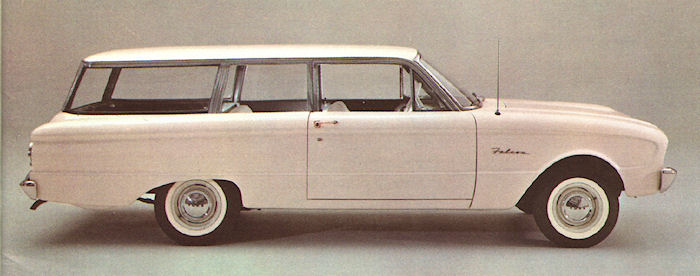
The new 1960 compacts took different approaches to their wagons. Falcon (and Comet), fielded both versions, to great success. The Valiant stuck to four doors only.

I shouldn’t really show it here, because it was such an ugly duckling. No wonder the Falcon wagon totally creamed it. And good luck try finding one of these early Valiant wagons today.

And the Corvair joined the compact wagon party in 1961 with four door wagons only too. Given that the Chevy II was due the following year, having two compact four door wagons made no sense. Chevy should have made a Nomad-ish Corvair wagon, as a companion to the sporty Monza coupe. Unlike the total dud Lakewood wagon, that could well have been a hit.
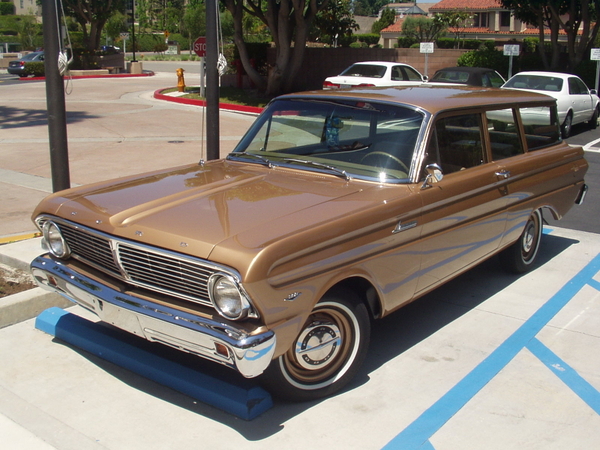
So now we get to the end of the story. What was the last two-door wagon standing? Well two actually. The Falcon’s last year for that body style was 1965, which was really just an updated 1960. How’d you like to have that one, with a 289 and stick shift?

But it was Chevy that revived the two door again, as a fresh new body style of the all-new 1964 Chevelle. It had a very obvious Nomad-inspired side window treatment and B-pillar, but was available only as a low-trim Chevelle 300.

Why Chevrolet bothered to tool this up, when none of the other competing intermediates were offering a two-door wagon might be hard to fathom, except for the fact that the new El Camino shared much of its body structure, minus the roof. But having done so, why they didn’t offer it as a sporty Nomad is even harder comprehend. Can you imagine what a cult status a ’65 Malibu Nomad SS 396 would have?

Needless to say, these ’64 – ’65 Chevelle 300 two-door wagons have pretty much all been appropriated by the go-fast crowd, for obvious reasons. And who can blame them, since Chevy missed out on such an opportunity to revive the Nomad.

One last speculation: why didn’t John DeLorean appropriate the Chevelle two-door wagon body for Pontiac, and turn it into a GTO shooting brake? Sounds like it just needs to be done; at least on photoshop. Any volunteers?

There would be precedence, of course, as Pontiac got their sticky fingers on the original Nomad.
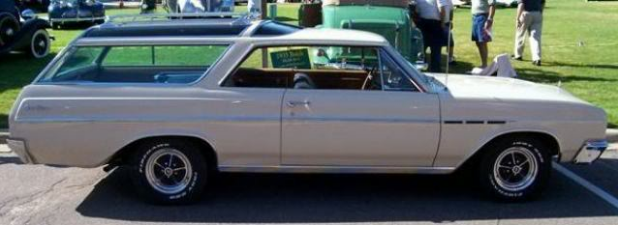
Someone’s gone and done it the 1964 Buick Sportwagon, and that’s not a photoshop. Maybe we’ll leave it at that, since this Sportwagon makes as much or more sense then most of the production two-door wagons. Let’s face it, the lasting impact of the two door wagon was hardly its utility, but as a plaything and oddity. And if you’re going to play, might as well make a sport of it.























And don’t forget that VW tried this with their Fox…
I purposely left out subcompact American cars (Vega, Pinto) and all imports. Their excuse was relatively better.
Thank you Mr. Niedermeyer for the wonderful piece on the history of American two-door wagons, with great illustrations and photos and your inimitable text.
I’ve been ogling cars since my 1950’s boyhood and it was a lot of fun to revisit that time on your site.
I’d like to do a piece on the history of the naming of American car models. Some model names struck gold and became enduring symbols of glamor or popularity — Continental, Roadmaster, Bel Air, Impala, El Dorado, Imperial, Mustang, Galaxie, Skyliner, Starfire. Some potent names like Buick Firedome were forgotten, and other names ought to be added to the lame list (Parisienne comes to mind). Biscayne was bottom line Chevy, but what if it had been a hardtop convertible that only came in azure or white…
You could spend all day writing down all the good, bad, nutty, odd, fun, evocative, politically incorrect, presumptuous, grasping, and deluded names of American car models.
Best to you
You’d like to do a piece on car names? Wonderful subject. Send it to us via the Contact form (on the top menu bar) or curbsdieclassic(at)gmail.com. Look forward to it.
Paul
Buick straight eights were “Fireball” (the engine, not the car). It was Desoto that had a Firedome car model from 1952 to 1959, probably a reference to the hemi V8 (although it was gone after 1957).
Paul, great article! I swore, online I saw a 1961 or 1962 orange 2 door GM full size model. I believe it was a Chevy or Pontiac. I know because the fins were basically gone and the front vent window/sail panels had the rounded bottom which was only found on the big GM 61 and 62’s.
Growing up in the 60s, many parents insisted on 2 door cars before child-proof rear locks.
back in the 1960’s a friend of mine had a 64/65 falcon 2 door panel car
it was so cool…..
I don’t remember if it was an aftermarket where someone took out the glass and then metaled it in….
Those Falcon panel wagons were factory-made by Ford. I’ve seen a few of them.
Great article. I am a fan of station wagons in general and the two door wagons are also interesting. I think it is fair to say that wagons have moved upmarket with the Caddy CTS V and euro models from Audi, VW, Mercedes and the lincoln MKT/Ford Flex being a fairly common sight everywhere. I wish Jaguar would bring their magnificent XF wagon over from the U.K. It is so sharp looking. 2door and upmarket wagons really do provide the perfect combination of utility and carlike comfort for the slight tradeoff of taking longer to heat or cool the cabin and a slight increase in noise level.
Had one!, in RED. Great car, bought used and never gave me a problem. Always liked wagons, especially two-door after growing up in a station wagon family. And because of that influence, two-door hatchback cars have always been my favorite as well.
And before the Fox, the VW 411 and 412,
Of course it makes sense to leave out of this article the Pinto and Vega, and really, any car that was available only as a 2-door.
The interesting thing about the Fox and 411/412 is that both were available as 4-door sedans, but as wagons only as 2-door models.
And before that, the Squareback.
Isn’t the original 1936 cĥevy suburban a 2 door wagon, as the coupes, sedans, suburban and even pickups all shared the same bodystyle
My goodness, all those are beautiful. That Valiant? Holy cow! I’d love to see one of those in the flesh and examine it up close!
Pontiac had their “Nomad” version as well, the Safari, with three times the chrome as the Chevy and probably twice as much as the Buick.
That 1964 Chevelle REALLY floats my boat, though. To own one of those…the possibilities!
Can you imagine the hoops you’d have to jump thru to locate a ‘bubble’ rear window on one of those sleds?
What an eyesore!
Re: Valiant? Me too! I was one of apparently few people who liked the quirkyness of the 1962 Dodge (had one, a Polara 500!) and the 60-62 Valiant, especially the wagon. Could picture that wagon, with a 225 slant six hyperpack and a 4 speed. No THAT would be really rare! Certainly be the only one on cruise night.
My wife drives a MINI Clubman, which is sort of a two-door wagon…except there’s that extra half-door on the passenger side for the rear seat occupants.
I don’t think I’ve ever seen a Chevy Brookwood. Wagons just weren’t made in the same volume as the sedans, and then probably had a lower survival rate from heavy use over the years.
I remember a school friends family had a 60 Chev wagon full of rust by the time it was 5 years old very rare car out here though
First Chevy wagon I remember seeing was a big ’64 cruising around Warragul when I was in my teens. They weren’t assembled here, so someone must’ve been pretty motivated to import one, unless it was specially ordered from one of the capital city GM dealers who dealt in low volume imports. Come to think of it, that’s the only one I’ve seen.
My dad bought a 1959 Chevrolet Brookwood SW new in 1959. It was the first car he bought new in his life(at age 36) and it was the biggest POS he had ever bought. It was gone 4 years later, replaced by the only other new car he bough new, a 1963 Rambler Classic which eventually became mine. We also owned a 1959 Rambler Cross Country SW which was purchased in 1961 to replace my mother’s 1950 Studebaker Champion. I much preferred the ’59 Rambler to the ’59 Chevrolet.
There was also the Vega Kammback, Pinto Wagon and Volkswagen Squareback Sedan. But they were all too small to be four-doors anyway.
Zacknam, my parents owned a 1960 Valiant wagon back in the late 60’s. It was the second car and my mom loved it. Basic, unexciting stuff for a young boy dreaming of Tri-Fives, Camaros and ‘Vettes…but I recall it being a reliable car.
If I was a Ford guy, I’d own either a ’49 Woody or a ’55-’56 Parklane.
I once had a chance to own a ’59 Plymouth 2-door wagon…milk-white and rust-free. Would’ve been a lot of fun with a 440 and a 4-speed…oohhh.
Someday I’ll get to re-doing the ’57 Chevy 210 Handyman sitting in the corner of the garage. Amazing how life gets in the way but I digress…after I finish the house and the ’68 C-10 pickup…
Paul, thanks for this look at one of my all-time fave body styles.
To Chas: I’m glad that someone besides me had the lobotomy. After losing 6 months to a badly broken leg I have fixed the tractor and the 57 210 wagon is now in the “get ready” slot. I actually had made it street ready and drove it for 4-5 years until the price of gas became ridiculous about 4 years ago. Now that I am retired it’s time to enjoy it again.
May have to invest in an updated transmission with overdrive to make it work in todays world but I can see it and a trailer replacing the s10 that mostly sits in the driveway.
I always thought a three door would have worked better. They did it in the early suburban and not all vans were sliding door. Some (I remember the ford) had a regular opening door on the passenger side. I think it would have been a good answer but car companies seemingly never cared if an idea was good. Just that it would sell.
“Let’s face it, the lasting impact of the two door wagon was hardly its utility, but as a plaything and oddity.”
The 2 door wagons did indeed make sense, before the LTD-ification of station wagons.
ISTR that back in the day these were used a lot by tradesmen, along with vans, sedan deliveries, and pickups. The D3 themselves rendered the truck-like 2 door wagons irrelevant when their wagons got bigger and softer, making them unsuitable for light truck duty.
Also back before child-proof locks lots of families felt a 2-door was safer, and in those days of humongous doors and slimmer humans the inconvenience was actually minimal. Remember when front passengers simply leaned forward while pulling the seatback, creating a large opening through which one could actually easily enter without requiring yogi-like skills? There really was a method to the madness of gargantuan old American cars — they were extremely convenient, comfortable, and useful. That’s why now so many Americans have trucks.
Awesome writing and pics though, nice read!
Note that I said “lasting”.
Oh I know you did, I just have a hard time letting go. 🙂
Yogi-like skills 🙂 Carrying a pic-a-nic basket?
I know, you meant yoga, but that made me laugh
Fun fact: a yogi is a practitioner of yoga.
So although it looks screwy, he’s actually right!
I recall a time when parents of small kids liked 2 doors, which prevented a kid from opening a rear door accidentally. This was before car seats, obviously. Maybe this is why everyone thought that the 2 door wagon would be popular too.
Although it was never produced, I have always liked the Plymouth Plainsman, a show car done by Chrysler in 1955 and shown in 1956. I understand that the car still exists. I can see a bit of the Plainsman roof treatment in that Valiant wagon, (which I absolutely love, by the way).
Conestoga Wagon as inspiration?
Conestoga was actually the name of that 54 2 door Studebaker wagon – from one of the companies that actually built the original conestogas.
I see the Plainsman is currently on eBay.
“I recall a time when parents of small kids liked 2 doors, which prevented a kid from opening a rear door accidentally. This was before car seats, obviously. Maybe this is why everyone thought that the 2 door wagon would be popular too.”
I know this was the case in my home. My parents only had two-door cars when I we kids were little, they felt it was an important safety feature in a time when there wasn’t much done about safety. There is no reason to believe this idea didn’t translate to station wagons as well
I think that when the folks at Ford saw the Plainsman, they said, “Hey, let’s take that roof, turn it around, and put it on a Mercury!”
The Scotsman. Ugh.
The only ethnicity I’ll joke about is my own, so let me propose a Guido edition of the 3-series coupe for the “Jersey Shore” crowd. 🙂
My Cheapskate 1950’s Dad was considering a Scotsman. I don’t remember if I bitched audibly but I was certainly thinking “pleeeeeaase noooooooooooo”. I still remember that gray plastic Tupperware grille. I thought almost the same way about base model Big 3 cars – why display your obvious cheapness for all to see? Black rubber around the windshield, rear window or both, dog dish hubcaps etc. Today you have to know the visual differences between for example a base model Subaru and the top one to identify them.
Oh, I just remembered the postwar Crosley wagon produced into the early 1950s. Again, way too small for a 4 door.
I have had two 2-door wagons- a ’74 VW 412 and a ’78 Austin Allegro, both in a sort of “discharge yellow” colour. It should be remembered that in the ’70s, child seats weren’t really needed, and I can agree that a 2 door was considered safer, based on wives tales of the generation who would have had children at the time. For what its worth, it seems that most stylists were allowed more freedom with 2 door wagons than with other cars in the lineup, and some can almost look sporty- OK not a type 4, but think Reliant Scimtar, Lancia Beta HPE, or even Volvo p1800ES.
These cars were popular in the UK long after they should have been dead. Indeed, I remember Ford Escorts came as 2 door estates up until the early 90s. The main drawback is not having to clamber in and out, but rather the child abuse/maltreatment of putting a child on a sticky vinyl seat in a glass oven with a window that’s permanently glued in- or if they’re lucky, pivots out two inches in order to allow the cool air to flow better over the parents and blow the cigarette smoke into the rear of the car. The parents often respond to complaints from the peanut gallery with a sense of malevolent dismissiveness that in my present role as a social worker would have me getting the paperwork for Termination of Parental Rights in order*.
I’ve seen positive statements about the styling of the Vega Kammback and its Monzish siblings, but those were NOT from people who had to endure the rear seat of these things as children.
* much of this also applies to parents who purchased ANY 2 door car for their family, or those horrid ’78-85 GM mid-sizes with the little excuse of a flap for a window in the rear. I know these have their fans on here, but I’m sure none had to ride in the back of a stripper malibu in a humid midwestern summer without air because the crappy v6 couldn’t turn the compressor without overheating the engine.
Is it any surprise that the decline of 2 door wagons coincided with government’s embracing the UN declaration on the rights of the child?
Somehow I think your remembrances of 2-door wagons might be fodder for a session with a therapist as well as for CC. 😉
good lord, I am having bad flashbacks here of being a kid riding in the back seat of Dad’s un-airconditioned 1970 Maverick. If I get lung cancer it will be from the secondhand smoke that got concentrated in the back of that passenger compartment. Opening the flip-out rear window did nothing to improve the interior air quality but did asdd about 30 decibels to the ambient sound level.
Just like my years of captivity in the back of my Dad’s 72 Mark IV. He was about a 3 pack a day guy in those years. The back window on the Mark IV slid straight back into the C-pillar, rather than down into the quarter panel. Unfortunately, with the opera window there, the window had about an inch or two of travel. Same result as your Maverick – lots of noise, very little effect, and it increased the chance of a facefull of ashes that Dad flicked out of the front part of the long side window. Good times.
A lot of parents in the day took off the door handles of the rear doors of a four door. Only openable from the outside. As far as ventilation the best system in cooler weather was front and rear wing windows. I miss them so much, open both the front and rear(if equipped) and you had the best flow through ventilation in the world. Much better than today IMO. Of course 455 air conditioning was what most people had(4 windows down at 55 or whatever speed you were going). And I survived not seeing a seat belt until I was 12 years old.
What’s odd to me is that US manufacturers weren’t using child safety locks on rear doors during this period, particularly on wagons. Apparently they were invented in 1948. I once had a 1961 Humber Super Snipe which was equipped with them.
“Discharge yellow” – no thank you. Bet that wasn’t the factory name!
My Uncle had one of those Ford 2-door woodys, but a 1950. Unfortunately he had to store it outside and it was deteriorating faster than he could fix it so he gave up and sold it.
This was in Calgary about 1989 and although you can buy the wood kit for them now, even if you could at that time it would have been beyond his budget
As an aside I endured non A/C Vega hatchback, VW beetles and 2-door Ramblers as a kid, mostly because of the percieved safety advantage of kids not being able to open the doors. I survived just fine, but we didn’t live in Phoenix AZ either. Can’t imagine what that would have been like..
Nice write up. I suppose some of the early shooting brakes from Europe could have been considered two door station wagons. Probably all coach built as well. An oddity themselves they were mostly used by wealthy hunters not family hauling.
The Allard P2 Safari Station wagon was built by the factory I believe in the 50s.
I’m suprised the Scotsman had chrome bumpers.
The Plymouth Suburbans had to be added to my list. I’ll admit I didn’t even know they existed until now and now I must have one!
Having a few drops of Scotland coursing thru my veins, hilarious they called the austere model the “Scotsman”.
And that ’55 Nomad is stunning. The Audi Avant of it’s era.
A great read after a long day…
When I was an impressionable young boy my neighbor had a 1959 Chevrolet Biscayne, six cylinder three on the tree.
The engine was called the Thriftmaster six, and it sported a tartan plaid background for the nameplate that covered the top of the valve cover.
I don’t know if earlier or later models included the plaid background.
Some of the GMC V6 engines of the early ’60s had plaid valve covers.
In my experience, Scots tend to be too laid-back to complain about racism. The ones I know would quite enjoy the dig at their stereotype.
But I still wouldn’t use Scotsman as a model name (or engine name) these days.
Does anyone still bother to give engines names?
I too didn’t know the 2-door Plymouth wagons existed until a couple years ago when I stumbled across one on one of the Mopar websites. The red one in the pics below is divine, it was my laptop wallpaper for a long time. Ahh, dreams are free!
I noticed the Scotsman’s extravagant chrome bumper, too. That guy sure was loose with his money, deciding not to delete the chrome bumper for the painted bumper credit. IIRC, the chrome bumper delete credit was one of the few options available on that model. Amazingly, the Scotsman actually sold better than anticipated.
I just purchased a 1958 Scotsman with chrome and a 259 V8. A project, but a fun one.
Congratulations. And good luck! You have your work cut out for you.
I remember that flat step behind the rear bumper making it obvious that the station wagon body was designed for a shorter car and they didn’t have money to make a longer one to fit the new finny fenders, just creating useless extra length.
Somebody already mentioned Crosley, so I’ll just whine that that “Buick” is a LaSalle.
My favorite 2 door wagon: the Volvo P1800!… but the Falcon is really nice!
Don’t forget the Corvette “wagon” kit from the early 1970’s!
Or on the Solstice. Still no space in it but it sure is interesting.
You’ve got to be kidding! That’s one I haven’t heard of…
Add to it the 1978 Firebird Trans Am Kammback.
And the mysterious ’65-’66 Mustang station wagon :
My father-in-law had a 1950 Ford wagon, four kids, and a lake place in the country. The wagon was a good fit for that lifestyle. I ended up parting it out after he got in a minor front-end wreck with it; it had a big Mercury rear end in it, for all I know all the Ford wagons did. Which reminds me, Mercury wagons were also two-door woodies in the 1949-1951 era. My shop teacher had a yellow 51, sparkling clean every time I saw it.
Some commercial radio outfit in Tacoma had a fleet of 1957 and 1958 Plymouth 2-door wagons to run parts, and some of them ended up at my neighborhood wrecking yard after their tour of duty was completed. These were six-cylinder, three-speed cars with only a heater, and on top of that were light gray. They were long-wheelbase though and could probably haul lots of stuff if it wasn’t too heavy. The 57-59 Mopar wagons were all built on a long wheelbase – I suspect so that the stampings could be used for the Chrysler wagons – and had their own fin designs and taillights. This oddity wasn’t restricted to the 2-doors though.
I’m surprised that no one has pointed out that the 8 door woodie wagon in the 2nd picture is not a Buick, but a LaSalle.
My 2 door wagon experience is limted to the brown Pinto Squire I would carpool to kindergarten in.
I always did think that the 2 door wagon was an odd thing, though it was kinda cool, I would like to have a cheapie 59 Chevy 2 door wagon as a cool parts runner. the 2 door wagons fade away went along with the loss of its similar body mate, the passenger car based sedan delivery.
Oops; fixed.
Thanks a lot Paul!!! Just when I thought I was over my Wagon phase, now you’ve got me wanting another one.
I’m guessing the ’64-’65 Chevelle two-door wagons shared doors and some of their other body panels with the El Camino. Maybe that’s the reason they existed—to spread out the tooling costs of a lower-volume model?
Perhaps, I guess the tolling costs was completely payed in 1966. The El Camino continued on its own for 1966 after they dropped the 2-door wagon…However some folks created some interesting “what if?” about what if Chevrolet continued the production of the 2-door wagon for 1966 and 1967
http://www.jalopyjournal.com/forum/showthread.php?p=4130450
http://www.chevelles.com/wagons/66wagon.html
Speaking of “what if?”, I spotted at http://flymall.org/blog/?p=207 and http://auto.howstuffworks.com/chevrolet-camaro-and-pontiac-firebird-concept-cars.htm some pictures of proposed Camaro wagons, there the 2nd-gen proposed Kammback Camaro but there was also some ideas for a 1st-gen Camaro wagon as well and the 3rd-gen http://auto.howstuffworks.com/chevrolet-camaro-and-pontiac-firebird-concept-cars1.htm
In Brazil, the Chevrolet Opala (a Brazilian 1966 Opel Rekord adapted for the Brazilian market sold from 1968 to 1992) got a 2-door wagon in 1975 named Opala Caravan until it was replaced by the Omega around 1991 or 1992. I spotted a commercial on Youtube showing a 1981 model http://www.youtube.com/watch?v=gdaMuvuk66M
Those links, especially the first one, are awesome! I love it when people do mash-ups of different years/models etc, takes a lot of skill to get it right. The Thunderbird Vista wagon is fantastic!
Thanks so much for enlightening my evening!
You’re welcome! 🙂
Here more links to more “what if?” then I saw like the 1958 Nomad and Safari that should had been 🙂
http://www.whatifcars.com/gallery/What-If-Cars/58_Impala_Nomad
http://www.whatifcars.com/gallery/What-If-Cars/58_Pont_Safari
a Corvair Nomad
http://www.whatifcars.com/gallery/What-If-Cars/60_corvair_nomad
A while ago, I did my own attempts of “what if?” then I sketched like a 1966 2-door Ford Falcon wagon
http://fav.me/d33qraz
and a 1959 Chevy Nomad who continued the spirit of the 1955-57 models
http://fav.me/d1oj6h7
And there was 2 Nomad concepts showed in 1999 and 2004
http://www.seriouswheels.com/cars/top-1999-Chevrolet-Nomad-Concept.htm
http://www.supercars.net/cars/2736.html
Excellent, all very interesting, thanks! Oddly, I too was wondering what a ’66 Falcon wagon would look like in 2-door form… Though my all-time favourite “wonder-what-it’d-look-like” Falcon would have to be an Australian XA/B/C ’72-79 Falcon wagon turned into a 2-door using the coupe/ute/van front doors…
Actually, that’s a point: the uniquely Australian Ford/Holden panel vans were effectively 4-door wagons with no rear doors, ute (ie pickup) panels aft of the front doors, and a tall roof, like the one below. And the panelvans already had the long swoopy coupe front doors, so would be ideal for dropping the much lower 4-door-wagon roof onto… My sister and brother-in-law own an XB van identical to the one pictured below, except theirs is blue. Being a 302 V8 GS though, their’s is far too rare to contemplate a roof swap!
XB was the best looking Falcon a genuine GS is rare but many many lookalikes were about in OZ I used to run a GS wagon in bright yellow ex Hertz rent a car 302 C4 twin system sounded good but not much power would be worth big bucks now.
Agreed, the XB is my favourite ever Falcon – the bonnet shape is awesome! I saw an XB GT bonnet hung on a wall once, looked incredible! My sister’s GS 302 has the twin exhausts, sounds fantastic, but it’s certainly more noise than action… It’s been in our family since 1980, still has its full-on customised interior like so many of the panel vans of the late 70s. Was stolen in 2002 and recovered undamaged 18 months later (that’s a story in itself), so it’s now stored in a locked shed with a guard-dog…
I had a Holden HQ drive in van full velour interior $500 at Berri ford dealer they were worth nothing in the 80s great travelling cars though. Wide open throttle in a Falcon the tank wont do 2 hours but the sound is awesome.
the passenger: excellent point about the El camino. I think you’re on to something there.
Sorry, Chevelle wagon doors do not interchange. The window frames are rounded on El Camino and squared off on the 2 door wagon. I have owned both cars over the years.
Would there be any connection with the two door wagon type bodies used on light trucks like the Suburban and Carryall? Given the Jeep’s origins, I could see Willys deciding to go two door like a samller Power Wagon Carryall, or just not wanting to tool up for an extra set of doors.
Not a GTO, but I spotted a customized 1962 2-door Pontiac wagon with Grand Prix trim and bucket seats http://www.jalopyjournal.com/forum/showthread.php?t=380606
However I spotted a ’64 GTO in stages of wagon conversion at
http://www.hubgarage.com/mygarage/MnHotRod/blogs/16991
and Hot Wheels released a toy car of a ’66 GTO wagon
http://www.hotwheels.com/cars/custom-1966-gto-wagon
And there was also some customized Mustang wagons, including one green ‘Stang wagon who did the cover of Car & Driver.
I just love three door wagons, I grew up in them (2 different Taunus 17m’s, and one Escort) And I really miss them today. They look awesome, and they have some practical sides, if you’re not going to put adults in the back that is…. But then, when I grew up there were no rear facing child seats, or even seatbelts in the back (my dad added seatbelts after my little brother was born though)
Other than the Ford Ranchwagons pretty much none of these made it to Aotearoa from the states though all the English 2 door wagons were popular here often as in the Vauxhall Vivas case being sold with only a drivers seat the rest being optional so as to qualify as a commercial vehicle for finance and tax purposes.
Amazing what one can find on Google images.
COOL
I have one ( sort of )
And Revell just used the Caprice kit to make this one.
I agree, I’d Love to see an as new Loaded Plymouth Valiant wagon With The Cats Eye Taillights….. Make mine in Pink or Turquiose please. If It has Power Windows Im In Heavan. If It Leakls Ill keep it inside.
I must say that the 60 Plymouth wagon at the top of this article actually looks good to me. I am generally not keen on the 60 Plymouth because of the weird trim line that wraps around the front wheelwell instead of continuing along the body, and the tall but truncated fins at the back. The wagon roofline actually looks good with those fins, and the lack of 2-tone paint doesn’t draw attention to the front.
That’s why it’s there. My favorite one of the bunch. I’ll take one!
“Before WW2, the station wagon was primarily a commercially-oriented vehicle, and given its intended role in hauling large numbers of people and their cargo, always with four doors.”
This was the case in Australia where they were often called “service cars” and were regularly used by private carriers serving local towns and surrounding districts.
Here’s a picture from around 1930 showing three “service car”s belonging to Richers All Green Tourist Service. Foreground car is a 1927 Cadillac of American design with an extended body, car in the centre is a 1927 Studebaker sedan, American- built with an extended body also. Rear vehicle is unidentified. Even though they are strictly station wagons, they look like early SUVs.
Hudson 7 seaters had that role in NZ for many years
There have been a few Ford Mustang shooting brake style wagon conversions made – though not by Ford Mo Co. The ones I’ve seen online look custom. Strange Ford never offered a wagon version though its obvious it never would have looked as good as the fastback.
I did a photoshop of a newer Mustang in the same vein.
An episode of “The Rockford Files” had a female con artist driving a Firebird/Trans Am converted to a shooting brake. The GTO wagon is a great idea, but I like the notion of a 1867 442 Vista Cruiser even more.
http://www.autoweek.com/article/20111003/CARNEWS/111009978
That was the Type-K concept. These were never produced, althought there were elements within Pontiac mangagement who really wanted to.
GM finagled an appearance on the Rockford Files, since they were a part sponsor of the show. It wasn;’t the first time either. There was an another episode where Jim borrows Rocky’s “loaner truck” and it appeared to be a pre-production version of a GMC-“Street-Coupe” pickup.
Pontiac did it again in ’85 with a Trans Am conversion kit:
Regarding pony cars as wagons: There were a few show cars around that were pony cars. I remember a first generation Mustang with a wagon greenhouse, and there was a late 70’s Trans Am with a similar roofline. IIRC, it was an actual GM show car, not some one off made by a body man.
There was the late 80’s Trans Am hatches that were wagon rooflines, but those are very rare, and I don’t remember the origin right now. They were similar in concept to the Nissan Pulsar of about the same timeframe, with the hatchback/sportback thing going on.
Even as far back as the early 80’s, I can remember people grafting GTO noses to LeMans wagons or 442 noses to Cutlass Supreme wagons. When I had my 442 there was a guy in the other part of the township who done just that.
It seems to me I read somewhere about a Pontiac engineer who had made a GTO or Grand Am wagon in the early 70’s (when the Grand Am nameplate really was special). I don’t recall what happened to the car. It may have been in Collectible Automobile…
I spotted some pictures of the Grand Am wagon prototype at http://www.abodysite.com/gawagon.html
Regarding pony cars as wagons: There were a few show cars around that were pony cars. I remember a first generation Mustang with a wagon greenhouse, and there was a late 70’s Trans Am with a similar roofline. IIRC, it was an actual GM show car, not some one off made by a body man.
There was the late 80’s Trans Am hatches that were wagon rooflines, but those are very rare, and I don’t remember the origin right now. They were similar in concept to the Nissan Pulsar of about the same timeframe, with the hatchback/sportback thing going on.
Even as far back as the early 80’s, I can remember people grafting GTO noses to LeMans wagons or 442 noses to Cutlass Supreme wagons. When I had my 442 there was a guy in the other part of the township who done just that.
It seems to me I read somewhere about a Pontiac engineer who had made a GTO or Grand Am wagon in the early 70’s (when the Grand Am nameplate really was special). I don’t recall what happened to the car. It may have been in Collectible Automobile… I’d have to search through my old issues…
As Btrig noted, the two-door had practical value to tradesmen and delivery types…in fact, the “sedan delivery” was exactly that, a two-door wagon with steel panels in place of windows. A two-door wagon would be a cheaply-produced hybrid of a sedan-delivery and a family car.
And it would make perfect sense, if one had a brood of young’uns and was worried about one of them playing with door latches. In those pre-computer days, devices that locked passenger doors from the driver’s seat were limited to a few luxury brands. And “childproof locks” were, to most children, a challenge…for a few minutes (I know; been there, done that!)
I’ve always thought the two-door wagon to be the second-most versatile carbody style…the first being a full-size van. Cargo space is enclosed and out of the weather; but it’s THERE. The body, without all those doors, has more structural integrity. And, from my emotional reaction, it makes a wagon less of a “family car” – for a young buck with toys but no family.
“if one had a brood of young’uns and was worried about one of them playing with door latches”
Bingo! Dad bought a 1959 Chevy Brookwood 2-door, like the 1960 pictured, just for that reason.
Called a Panel Van out here
Pretty sure, but now questioning my memory… that I have seen, on and around the streets of Eugene, a 1970/71 Ford Torino 2 door wagon. And a “woodie”, at that. Owned by a young musician. A big ride, for sure, but technically a mid-size offering.
If you did, it was a custom build.
I can say that with confidence. Had a Ford dealer around the corner where I grew up…and in 1970-71, I was vitally interested in cars.
I wonder if it was a Ranchero Squire with a topper.
They made Mercury Comet 2-door wagons from 1960-1963. I just read the article on them in an old issue of Collectible Automobile. They’ve got to be thin on the ground now.
Do you recall what issue that article was in? It would help a lot.
I spotted some pictures taken by someone who customized a 1972 Buick Estate wagon into a 2-door hardtop wagon
http://www.stationwagonforums.com/forums/showthread.php?t=6408
Just imagine what if GM offered a 2-door hardtop wagon with a clamshell. The best of 2 world I guess. 😉
Now that’s an awesome idea and project! I’m glad I’m not the only person fascinated by these mash-ups!
Have now just finished reading that entire forum about the 72 Buick hardtop wagon – 4hrs it took, but wow, incredibly interesting (to me anyway!). Actually, now you’ve pointed me in that direction, the whole stationwagonforums site is awesome!
I somehow missed this post the first time around. So, I just HAD to read all 73 pages of that forum thread. There went much of my afternoon! I hope he finishes this car. It was going along really well until sometime in September 2011 when it got significantly damaged in a hailstorm. It looked absolutely gorgeous.
My Dad’s cousins used to take 60s wagons and cut both the frames and bodys to make two door wagons. Why? Cause they were farm boys with welders, torches, a shop and too much time on their hands, lol. Wish I had gotten to see some of their creations.
I built that 65 sport wagon it looks all factory I have also built a 66 chevelle factory twodoorwagon a 69 chevelle twodoorwagon a 64 with a sportwagon roof a 66 cutlass twodoorwagon wagons are my favorite ride and they are most peoples last ride
I drove a 2-door wagon; a 1957 (Canadian Meteor) a slightly changed over a 57 Ford. As a government surveyor, of course all our vehicles were the cheapest available, like only a driver sunvisor…
Anyway coming down a steep mountain grade I had to brake to reduce my speed as a necessity and all my stuff behind slammed into the folding seat back. Great I was belted in however it was not needed as the cargo held me against the steering wheel. Ever try to steer a loaded station wagon load pushing in your back while coming down a winding mountain road? When finally level and stopped I was able to force my way out. They supplied me a four door with a FIXED front seat that would not fold. I hated these 2-door jobs.
We had a 59 Plymouth wagon when i was a little kit, no carpets, no radio, my mother loved that car. My dad replaced it with a 63 Valiant . I would love to find one.
I’ve always loved that style of Valiant wagon. Probably can’t be found now; but that’s for the best, since I’d like to stick a 440 or 426 in it, about where the rear seat is supposed to be.
My 3 siblings and I, all pre-teens, loved the dark green ’50 Ford woody that showed up in our driveway one day. I distinctly recall that the 2-door feature was the determining factor in our parents’ purchasing decision – the ADULTS would be in control of opening and closing any doors with this mob of kids aboard!
One great feature was the little “hallway” than ran alongside the middle seat to get to the back. It was slightly inclined, and my smallest brother and smaller sister took great pleasure in amusing themselves by marching up and down it endlessly, yo-yo-ing between the middle and back seats during longish trips.
The third seat was the “premium” position for us kids to fight over (it was farthest away from the adults…). Being the largest and quickest of the siblings, I was usually able to scurry there first to claim my “command post” for most voyages.
Since the 3rd seat was behind the back seat position of mundane passenger cars, we kids referred to it as the “backer-acker” seat.
That wagon earned its keep as a work horse vehicle, carrying all six of us, complete with tents, sleeping bags and cooking gear (a major portion of it on a roof rack) on several memorable camping trips in the Northeast States.
Its replacement was a ’55 Ford Ranchwagon, another 2-door, which continued the tradition by carrying us on camping trips that ultimately took us from coast to coast. We kids were not so thrilled by lack of a 3rd seat – no hallway to negotiate and one of us had to lie on TOP of all the camping gear that was packed into the rear space in order to streamline down the size of the roof mounted gear.
Here’s a GTO Safari, aka “MAD GOAT” 😉
I have Two 2Dr Wagons. The ’62 Falcon is far too ugly to post, but the ’53 Ranch wagon is my favorite.
Oh to get my hands on that 61 Ford wagon, what a sharp looking vehicle and with a little tweeking, it could be a real awesome ride. But one of my all time favorite cars is the 59 Mercury two door hard top wagon. I’ve only seen one in the flesh although I’ve run across a number of the 57 and 58’s. Naturally the 59 is the rarest one with the lowest production numbers. I’d even give up my 69 Chevy C20 for one. Really enjoyed the article, definitely one of my all time favorite body styles. Ever consider doing one on the Australian Ford Ute? Really awesome cars, wish more of them had made it over here.
“Edsel Roundup, guaranteed to kill something.” – LMAO!
I’m puzzled, this article is dated October 27, 2013 but comments go back to January?!
It’s a re-run. Like TV. I need some time off on weekends once in a while, and we have lots of great older articles in the archives. Would it help if I noted that at the head of the article?
I just realized that I’m replying to comments that are years old.
I have to admit the appeal of a 2 door wagon has always been a mystery to me. All the sportiness of a station wagon combined with the utility of a 2 door sedan. Worst of both worlds. At least that’s how I see them.
They do look damn cool as tow vehicles for racing teams. A nomad pulling a trailer with a race car – much cooler look than a 4 door wagon (though much less actual utility). Somehow I doubt that making cool looking tow cars was Detroit’s objective.
I would note that in the ’50s many police departments were using 2 door squad cars. Maybe in that era people just didn’t feel a need for 4 doors and maybe the 2 door wagon existed simply because the market was still sorting out what was wanted and what wasn’t.
When I was 12 years old in 1956 my father replaced the 49 Kaiser with a 2 door Ford Ranch Wagon. I believe it was termed a Custom rather than a Customline because it only had the chrome side trim on the front half of the car, no chrome strip going the full length as did the Customline. Thus it was a few dollars cheaper. The reason he bought a station wagon was because we had moved to the country and there was no garbage service. That meant we had to haul our garbage to the official county dump rather than having it picked up. I just realized that back in that day there were (at least as I remember it) no plastic garbage bags in this country. You simply put your trash in grocery bags and then in the garbage cans. So my dad figured he needed a car tall enough to haul his steel garbage cans to the dump once a week. The reason he bought a a 2 door wagon was simple; it was the cheapest one available. He could have gone slightly cheaper and bought the 6 cyl version but this 12 year old was greatly relieved to find a new Ford wagon with a 3 speed stick and a Thunderbird V-8 under the hood in the driveway when he returned from YMCA camp in July of 1956. The reason for this choice was that we lived 2.5 miles outside of town and on top of a very steep mountain. The mountain was never a problem for the Thunderbird V-8, winter or summer. I was only four years away from a driver’s license and our 4 acre property was big enough for me to get some time behind the wheel immediately. Matter of fact, a year later I backed the wagon into a stout apple tree with the tailgate window open (that means straight out in line with the roof). The tailgate window ended up shoved into the roof a few inches as I was moving right along. I did not get into trouble actually. Our insurance man came over and told my dad he was lucky as his son had taken off the front porch of his house! Since I was driving on our own property the insurance paid to get the car fixed. The fact that the car only had two doors was never a problem as it was very roomy, easy to enter and exit for a 12 year old boy and 16 year old girl who were the normal back seat passengers. We had the car for 7 years and it was a pretty good car except for the usual Pennsylvania rust issues. I was constantly working on the rust and we had the bottom half repaired by a body shop after the first 4 years. I think it started rusting after the first two winters.
“When I was 12 years old in 1956 my father replaced the 49 Kaiser with a 2 door Ford Ranch Wagon. I believe it was termed a Custom rather than a Customline because it only had the chrome side trim on the front half of the car, no chrome strip going the full length as did the Customline. Thus it was a few dollars cheaper.”
Between 1955 and 1968, Ford’s full-size station wagons were not marketed as part of Ford’s normal model lineup. They were considered to be completely separate series from the regular models, and didn’t always line up directly with the non-wagon models. For most of this period, there were typically three trim levels. There was a fair amount of model name shuffling in the early years (some of these names had been in use even earlier, before the wagons became separate models), but Ford eventually settled on Ranch Wagon, Country Sedan and Country Squire. I believe that the Ranch Wagon name originally denoted the two-door wagons, with the Custom Ranch occupying the middle trim level, a step up from the base Ranch. As with all wagons, the Ranch name would later become four-door only.
Two door wagons: I love ’em – especially the ’57 – ’59 Mercurys.
My mother drove a ’55 Plaza Suburban for about three years. The car was purchased new at Belvidere Motors in Illinois. It was light blue with a white top and I served my time in the back of it.
The ’57 Dodge Suburban two door wagon shared with (or contributed to) the Dodge Sweptside pickup the finned quarter panels. That was a cheap (and visually poorly integrated) way for Mopar to address in the market place the much better looking Chevrolet Cameo.
A full size (sort of) two door wagon not mentioned was the Packard Henney from the early ’50s. The short wheelbase Henney funeral coach/service car conversion was a two door and, like most Henneys, looked very professional.
I nominate for the most unique and stylish sleeper of 1958: the Mercury Voyager with the 430 cu. in. MEL Super Marauder six pack rated at 400 hp.
Those boat anchors had nowhere near 400 HP, I’m afraid.
I’m not sure what your heartburn is with the 400/430 number, as oppossed to other hi-po offerings for 1958: Chevy’s 290/283, Chrysler’s 380/392 and Caddy’s 365/365. None of those will ever be confused for post ’72 net hp ratings, but the Super Marauder is at least as credible as the others. See: http://www.curbsideclassic.com/blog/lincolns-two-barrel-carb-mel-430-engine-taming-the-thirsty-beast/; http://www.youtube.com/watch?v=YJtxpvSR1iw; http://www.ford-mel-engine.com/viewtopic.php?f=2&t=503
I’ll take the 57 Plymouth… That is a striking car. I remember having Corgi of one of these.. it was a favorite then too…
That little ’54 Studebaker looks like a Saab.
If I’m not mistaken, the Scotsman came with cardboard door inserts standard.
I think that’s really interesting that Mercury had the only two-door hardtop wagon, especially coming from the same division that gave us the only modern day four-door convertible.
I’m not really into Hot Rods, however I can picture that Edsel Roundup with wheel tubs, slicks and a blower sticking thru the hood.
“Plymouth…introduced their own all-steel two-door wagon in 1949. This marked the first all-steel wagon by the Big Three….The Plymouth two-door wagon sat on the smaller 111″ wheelbase of the junior P 17 Plymouths, which only came in two doors variants anyway. The larger P 18 series had a traditional woody four door wagon, so both bases were covered…Ford really jumped into the two-door wagon pool with both feet in 1949. Unlike Plymouth, Ford only had two-door wagons for their 1949 – 1951 models, including the nine-passenger Country Squire.”
While Plymouth initially kept a four-door wagon in the lineup, it was a traditional woody wagon, as stated above. This made it fairly large and expensive for a Plymouth, and I don’t think it sold in large numbers (IINM, it was built off of the same body as that used for the larger, more upscale Chrysler products). IIRC, Chrysler then replaced the four-door woody wagon with a steel-bodied four-door wagon wagon midway through the 1950 model year. When that happened, the Plymouth version was not carried over (again, it was really intended for the larger, more upscale Chrysler brands; in contemporary GM terms, the steel-bodied Chrysler wagon was a B- or C-body, not an A-body), leaving Plymouth with just the smaller two-door wagon. So throughout this period, Plymouth never really had a four-door wagon that was mainstream for its price segment. For that matter, even the two-door wasn’t really mainstream, being built off of the short, almost “compact” 111-inch wheelbase. Once Chevrolet’s steel-bodied wagon was on the market, the Plymouth paled in comparison, as the Chevy not only was a four-door but was also a normal full-size car for the low-priced segment. Plymouth didn’t have a normal-sized steel-bodied two-door wagon until 1953, and didn’t have a steel-bodied four-door until 1955.
Dodge did not get the two-door steel-bodied wagon in 1949. Perhaps it was meant to be a Plymouth exclusive, or the short wheelbase wagon was felt to be too small for Dodge’s price segment (like Plymouth, Dodge had a short-wheelbase series during this period, although it used a longer wheelbase than Plymouth’s). IIRC, Dodge initially kept the four-door woody, then switched to the four-door steel body that appeared midway through the 1950 model year. That wagon body was on the large and expensive side even for Dodge, though, so when Chrysler finally introduced a steel-bodied two-door wagon body suitable for its more downscale brands in 1953 (in contemporary GM terms, its A-body), Dodge replaced the oversized four-door with the smaller two-door, and went two-door only for the next few years. Like Plymouth, Dodge finally got a “right-sized” steel-bodied four-door wagon in 1955.
To sum all of this up: Chrysler had a two-door steel-bodied wagon on the market midway through the 1949 model year, and a four-door steel-bodied wagon on the market midway through the 1950 model year. The former was built off of a body type that was unusually small for the time (almost a “compact”), however, while the latter was available only on a larger body intended for more upscale brands. Chrysler didn’t have a steel-bodied two-door wagon of normal size for low-to-medium priced brands until 1953, and didn’t have a steel-bodied four-door wagon of normal size for low-to-medium priced brands until 1955.
Perhaps the rarest 2-door wagon ever–from Harold and Maude.
awesome
I had no idea Studebaker made a 2-door wagon. Too bad that body style didn’t stick around until the Packard merger, they could’ve done a pretty mean Packardbaker Nomad-type thing with the supercharged V8.
IINM, the Studebaker two-door wagon actually lasted all the way to the end of full-size Studebaker production in 1958 (Paul has a picture of a ’57 in the article). Similar to the other manufacturers discussed in the article, even after a four-door wagon was introduced, the two-door wagon continued to be sold alongside the four-door wagon for a time.
It probably never ocurred to S-P to sell a Packard two-door wagon. It had to be apparent by ’57 that in an environment where both two- and four-door models were offered, the two-doors weren’t going to be big sellers. Where available, the two-doors also tended to be restricted to low-to-medium priced brands (the most upscale GM brand that ever sold two-door wagons was Pontiac, the most upscale Chrysler brand, Dodge). The unique 1957-59 Mercury two-door hardtop wagon was probably the most upscale American two-door wagon ever produced.
Packard merged with Studebaker around 1950, the Curtis Wright company bought them, and dropped the Packard from the lineup. Last Packard rolled off the Detroit line in 1966. A Caribbean styled wagon would have been sweet.
http://www.history.com/this-day-in-history/last-packard-produced
The S-P merger took place in 1954. Curtiss Wright did not buy the company, but was brought in on a management contract that ran from 1956-59. Given lead times, the decision to stop Packard production in Detroit must have been made well before the C-W contract, probably shortly after the merger. The fact that they had the Studebaker-based Packard tooled up and ready to build in the second half of 1956 suggests that the big Packard’s fate was sealed no matter what.
Blue ’64 Chevelle wagon? Gimme! That would be a sweet ride for someone like myself, who wants both sportiness and the practicality of a hauler.
Missed out on a chance to own a real nice ’65 Sportwagon a few years back (albeit with more doors). Still regret that one a little.
Close enough?
How about a wagon that you’d think would look really odd, but really doesn’t…
Ferrari 456GT Venice 4-door wagon
While they seem an oddity now, the two door station wagon was popular primarily because it was the least expensive station wagon families could buy in that period. For the customer for whom maximum seating capacity and utility at the lowest entry price was their primary consideration, it was the ultimate bargain. In small towns and rural area, they were ubiquitous. As one would expect, they were used, abused and driven into the ground and junked without a thought, that’s why they’re rare now.
Of the comments on the ’49-’54 Dodge station wagon type availability, one caveat needs note. For ’53, both Plymouth and Dodge shared a new body series and Dodge fielded only a two door wagon for ’53. Then for 1954 Dodge added a four door Sierra station wagon with body sourced from Ionia Body Company stretching and modifying the basic two door wagon shell. Only 1,300 were built according to The Standard Catalog of American Cars 1946-75 edited by Gunnell. Finding one to feature as a Curbsite Classic would be a real coup.
Enjoying this page. Some of these old creations are truly artistic while others make you go, “WHAT were they thinking???”
Anyway, does anyone have any idea what this is a pic of? I’m thinking late 40’s to mid-50’s American make. Thanks in advance.
It’s the same wagon that is shown in the fifth picture in the article, the Plymouth all-steel wagon, which appeared first in 1949. It was a very important car, because it was the first all-steel station wagon by the Big Three. I’m not sure of the exact year of the one you show, but it looks like a ’59 or ’50, as best as I can tell.
That was quick! (Thanks!) You’re right, it does appear to be a flavor of the Plymouth all-steel wagon. The side-chrome and the hood ornament (barely visible in my photo) seem to indicate this.
BTW, did you really mean “’59 or ’50,” or did you intend “’49 or ’50”? I ask only because models 10 years apart don’t often tend to look similar.
Fat-finger typo; ’49 or ’50.
Thanks!
Jay Leno’s 1950 Plymouth Suburban – https://m.youtube.com/watch?v=ngOWkb2cM-k
I own the 60 Plymouth in the opening photo. They made about 5500 of these, so they were not as rare as hens teeth. The Plymouth’s rusted quickly, and were not considered pretty, so I’m sure only a small percentage survived.
I’ve had it since 1989 when I bought it for $500. I picked it up just before getting married and still got married anyway (she passed the test – we are still together). I actually used to drive it to the park-n-ride back in the day, but it’s a hobby car now. Paint is mostly original. It as originally a slant 6 3-speed on the tree. Its currently got a high-compression ’66 383 and 4 speed with 3.91 sure grip.
You’re a lucky guy. It’s the coolest and she’s set up right!
I’m a Chrysler guy, but am I the only one who thinx the ’61 Ford full-size 2dr. wgn. is the most perfectly austere, clean looking one of the bunch?
I had a ’54 Ford Ranch Wagon – Ranch Wagons were 2-door wagons only. Had the
ohv 6 (the V-8 was still a flathead in ’54) and had lots of room under the hood. 2-door
wagons were considered Very Cool in the Surf Culture, thanks to the popularity of the
’49 – ’51 Ford wagons. Somehow a 4-door wagon, like the Estate Wagon fake – woody,
just wasn’t Cool, had to be 2-doors. (Panels were considered Very Cool)
The Ranch Wagon had it’s own nice western-theme seat covers, etc Surprised to
find came with bigger brakes, clutch, lower gearing, heavy-duty springs, higher ground
clearance, etc. Meant for ranches not for shopping centers? Mine came with some
hay inside, totally original too: good to restore. My only car for 2 years in the late ’80’s, Colonial White and Ford’s Turquoisey/light green. A sweet surf wagon & rare.
HAPPY TO HAVE COME ACROSS THIS SIGHT – THANKS! Lu.
Hesitate to comment but IIRC the Ford V8 was a flathead in 53 and ohv in 54. I think this might not apply to trucks but I remember the cars very well. Export models still came with flatheads in 54 according to some Australian commenters. Owned several of the 53s but not any 54s. Seemed strange to me that the engines changed for 54 but the body style basically did not.
Canadian Fords, Meteors, Mercurys, and Monarchs didn’t get the Y block until 1955.
Paul,
Is this site still active? I just discovered it while looking around for a reasonably priced mid fifties wagon. A really interesting read for sure. I am retired from 20 some years as a contributing writer/ photographer for most of the street rod/ custom mags. I did a column for Custom Rodder for several years titled “Stylines”, in which I did commentary, advice, etc, along with providing concept/ project suggestions illustrated through Photoshop, a lot of which addressed the two door wagon body style. If you are interested, I’d love to drop a bunch of “Phantom” wagons on you for your reader’s enjoyment.
Thanks,
Dave Hill, Pueblo, Colorado.
Yes it is. I didn’t notice your comment until now, though. You can reach me at [email protected]
I hope Dave saw your comment and followed-up. That would be cool to see for Wagon Week.
This is my 1972 Fiat 128 2 door wagon. I think the last year for this car was 76 or maybe 77.
As a kid I remember my dad looking for a 57 Chevy wagon; it was about l959. We had a 52 Plymouth wagon to trade-in. He wanted a two door as he always had an eye for things that looked clean and neat. He found and bought a 57 210 wagon (there were no Bel Air 2 doors – only Nomads, 210’s or 150’s). It was turquoise and white. It was the power pack version. It had a 283 with 3 on the tree, overdrive and dual exhaust. I remember him pushing (or pulling) the overdrive lever and feeling it kick in after a pregnant pause. Many memories were made with this familymobile. I know he wanted a Nomad but took this one instead. About two weeks later a yellow and white Nomad showed up on a local dealers lot. He and I went and looked at it. I know he was hurting but in hindsight both were amazing. How I wish I had kept the wagon.
I have recently become the owner of a factory COPO 2 door 1965 Chevy ll 2 door station wagon, ordered by the Air Force as a runway hatch, have great plans for it. My wife and I flew to Minneapolis and picked it up, we drove it back to Ca. in the S.F. bay area. car got a lot of attention at each stop on the way back.
Randy, I’m a bit stunned by that two door Chevy II wagon of yours. I find it remarkable that Chevrolet would spend the money to tool up a 2 door wagon for just the Air Force.
I’d love to do a post on your car. Could you send more pictures, and any documentation? curbsideclassic(at)gmail.com
would be happy to, will only allow me to download 1 picture at a time, where can I send multiple pictures?
Thanks
Randy Thompson
Castro Valley, Ca.
Damn that’s impressive!
You got my envy.
Randy do you still on that two-door 65 wagon I owned the car before you got it from Andy car come from Tennessee and the guy got it from Florida like that towards a Air Force Base
Paul ebay listing # 281260886410, dated 2-10-14, will take several pictures tomorrow for you.
Randy Thompson
Randy, that is AWESOME. My dad had a four door Chevy II wagon when I was a kid and I have developed a profound fondness for 2 door wagons. This is one of the best I’ve ever seen. Truly a rare bird!
AMC was making two-door versions of the full-size Jeep Cherokee, at least into the mid-1970s. It also produced a two-door Pacer wagon variant in the same time frame. When the Cherokee was re-created in 1990s, a two-door was again available.
http://www.cargurus.com/Cars/1976-Jeep-Cherokee-Overview-c6781http://www.pinterest.com/pin/183662491027855679/
http://springfield.craigslist.org/cto/4514558542.html
(April 2015) Aha! I see someone thought of the Pacer “wagon” already:
found this little gem of an article several years later. very nice piece! three pieces of two-door info – my grandparents owned a pair of those gawd-awful UGLY valiants in the early 70s. a coupe and a wagon. I considered and declined to buy a 2-door ’58 yeoman back in ’92. hadn’t seen one before; haven’t seen one since. friend of a neighbor showed up in late 70s with a vette that was customized with a wagon roofline. very odd. purists still hate him.
great article.
-j
What about the Chevy Vega Wagon?
– definitely two-doors
Well, we’re talking about cars that were generally also available as four door wagons too. When it comes to sub-compacts, there were scads of two-door wagons: Vega, Pinto, VW squareback, Corolla, and lots of other little Japanese and import wagons. But invariably, there were only two-door wagon versions of them made.
As of late, Aston Martin has produced Shooting Brake two door wagons in very small numbers in the 1990s, and lately, a gorgeous Virage Centennial showcar by Zagato from 2014.
I really like the idea of a 2 door wagon…but that’s because I go for cars that are destined to wind up as hotrods. If only the Dodge Magnum was a 2 door or at least had Element/RX-8 style ‘clamshell’ doors. Im not alone, it would seem:
http://s21.photobucket.com/user/infurnoASH/media/Concept%20Cars/Magnum.jpg.html
How about a micro 2 door wagon From Fiat quite a rare car this is the only one Ive ever seen.
Good write up. So many models of two door wagons I’ve never seen before.
I was reminded of a two door wagon I came across in a rural area not so far from my home. In rather good condition, complete with some rust. If I had th dollars at the time it c oils have been mine.
The current wagon craze among collectors has me on the lookout for a good one, not too old though. My budget stretches only so far.
I still own this Saab 95 two door wagon.
I bought this this Willys All Steel Utility Wagon just after this picture was taken.
Naturally, I love this one!
Great article Paul. Always wanted but never got a 2 dr wagon. For you Woody fans in the southwest the San Diego Woody show is Sept 19th at Moonlight Beach in Encinitas. A great show, at a great location.
Drugs are bad, someone at Ford was doing drugs….Don’t do drugs kids….
I actually had one of the cruise’n wagons. It made sense for anyone that wanted a panel delivery type of vehicle or a quasi mini van. In the mid 70’s it was not uncommon for a typical full sized van conversion to get any where from 12 to 18 mpg average. The pinto and chevy vega could get over 25mpg. I saw both van wagons used as Bakery delivery, caterer wagon and flower delivery. A local architect also had a pinto cruise’n wagon as his work vehicle. It would haul a transom and such with no problem. Ford offered the CW as a surfer van or as a plain commercial type van.
Sometimes, a two door wagon is all you need.
What about the Chevy Blazers and Ford Broncos and the like? What about all there little brothers the S10 Blazers and the Bronco IIs and the Explorers? Body on frame construction and rear wheel drive in some cases. They were just as impractical. I remember having to climb into the back of my father’s 1987 S10 Blazer and even as a teenager it was difficult.
> One last speculation: why didn’t John DeLorean appropriate the Chevelle two-door wagon body for Pontiac, and turn it into a GTO shooting brake?
Rumor has it that there were a small number of 1972 GTO wagons (not 2-door but regular 4-doors) built on the line in 1972. There is disagreement as to whether these were true GTOs with badging as such, or Tempest wagons ordered with the “Endura” plastic front end.
I was visiting a small resto shop last Saturday and the owner was working on one of these that a customer brought up from the southern US. I didn’t get to see any badging, interior or engine, as the car was partially disassembled and covered with dropsheets for the bodywork, but he claimed it to be a real GTO.
According to Pontiac and GTO sites, those wagons are “unofficial”.
Sort of like someone I know who said they have a “1972 Monte Carlo SS”. But after talking more, he said it was ‘like one that could have been’.
Thanks for posting this (again) Paul. I have always loved wagons!
When our family got too large for Dad’s ’54 Buick Super Riviera, he traded it for a ’57 Studebaker Scotsman. I remember Mom asking him if he was crazy. Our’s had chromed wheel covers and a radio, but it also had the single stylized letter S on the hood. So, apparently the original buyer of that car insisted the dealer add those two options. I did not like the fact that it had only two side doors. At least the rear seat side windows slid open. There were two things I liked about that car. To me, the front resembled that of the ’57 Chevy, and the tail lights looked like they could have come off a ’55 Buick. I knew of only one other two door wagon in town, and it was a ’57 Chevy. I think the two door feature of our Studebaker was an added bonus for keeping us kids under control. Dad said that his real reason for buying that wagon was that while it was equal in quality to the others, he paid a third less than the price of any of the popular big three wagons.
One morning, three years later, I woke up to find a sharp looking 1960 Ford 4 door Ranch Wagon in the driveway. It had two toned paint. It was Meadowvale Green with a Corinthian White roof. It rode on wide white wall tires and had those beautiful cone shaped full wheel covers. It seemed so strange to me how, back then, some folks would buy the base model, yet add some nice extra cost items. I guess it made sense if the options you wanted most were still extra cost items on the more expensive Country Sedan. But, at that time, to an eight year old car guy like me, when your Dad bought a car with two toned paint and white walls, it meant that you were moving up in the world.
Until a couple of years ago, I was not aware that in 1957, Ford build an upscale 2 door wagon called the Del Rio to go up against the Chevy Nomad. I was very surprised to read that it was much more popular than the Nomad. The production numbers I’ve seen are 46,105 Del Rois versus 6,103 Nomads. I’ve never seen a Del Rio, but after seeing the pictures, if I could have one ’57 Ford, that would be it.
I love this site. For just such as this.
Thanks!
Z3 Coupe would be considered a 2 door wagon, right?
It’s more often considered to be like a shooting brake. I am not sure if U.S. bound Z3 had any rear seat.
Thanks for the informative page. I have owned 3 of those 54 Conestogas. I have always been a fan the 2 door wagon. VW also had the squareback from the late 60’s:
http://www.vwvortex.com/wp-content/uploads/2014/08/squareback-fotd.jpg
and the 411/412 models into the mid 70’s:
https://upload.wikimedia.org/wikipedia/commons/8/85/Vw_411_h_sst.jpg
Chevy also had the panel wagon/sedan devery as far back 1939:
http://www.rasloto.com/gallery/chevy/39chevy-p-145X.jpg
http://www.rasloto.com/gallery/chevy/40chevy-sd-181X.jpg
I think the reason two door wagons came to be was that sedan delivery bodystyles were already being produced. So, the basic bones just needed glass and some interior trim and a seat. It added what is called “incremental sales” today. When ford lauuched the original Econoline/Falcon van and cab forward pickup along with chevy and its corvair/Greenbriar van and pickup I think those were the last nails in the coffin for the 2door wagon and sedan delivery.
Here is a nice example of the 1977 Chevrolet Vega Estate wagon, along with the 1978 Mercury Bobcat Squire wagon. I think they are both quaint.
Cost. That was the prime factor in the design of these vehicles. Designed to appeal to professionals and tradesman, they usually had the smallest displacement engines and manual transmissions(anyone recall 3on the tree shifters?) that were pure business and no frills work oriented. The mini wagons you posted images of were very popular with both small families and business that needed versatility and economy. the current Ford C Max and Kia Soul are modern iterations of this formula. I dont see any of them as being quaint. They are rational designs for their time.
Old Wagons have become super desirable now and bring big bucks.
I purchased this car when I was 19 for $125.00. A lot of money for a kid in 1969. fell in love with it at the age of 11. People who owned it lived only a couple of blocks away. It was solid as a rock with a little over 62,000 miles. A lot of work and many changes since that time. Sorry. Picture quality is poor. Had several offers over a period of some 46 years. Been one of my life’s passions. Guess someone will inherit it from my estate when I’m beyond caring.
I researched Volvo’s neat sporty 2 door “shooting brake”, the P1800 ES, from the 1970’s. I knew they reinvented this concept as of late – the C30, but I did not know that they had a 2-door wagon before the 1800, the PV445 (or “Duett”)! Here is a photo of all three.
Lancia Beta HPE.
Hi all! My wife shoot a very odd car on the road today and I just wanted to find a manufacturer/model, to no avail 🙁 May be anyone recognized this ? Not sure if it’s a “wagon”, but it certainly looks like one!
Matra Simca Rancho.
http://www.curbsideclassic.com/blog/1977-matra-rancho-the-worlds-first-cuv/
AMAZING ! Thanks, Don!
Dont forget the fastest of them all!
Saab 95 two stroke with Erik “On the Roof” Karlsson behind the steering wheel, here at The Monte Carlo Rally 1961, took a fifth place that year. The reason for driving the 95 instead of the 96 was that the 95 had a 4 speed gearbox while the 96 still had the 3 speed as only option.
Another pic:
The Saab 95 was made from 1959 to 1978!
Eric “On The Roof” Karlsson, The Saab 95/96 fit him very well -like a snug fit tuxedo.
both Ford Pinto and Chevy Vega had 2 door compact wagons with anemic four cylinder engines.
That’s me and my sister trying to claw our way out of the back of our new 1960 Chevrolet Brookwood 2-door station wagon. I remember it having an all-steel interior and everything getting hot to the touch. My older brother and sister would get high by dangling their feet out the rear crank-down window at high speed and smelling the exhaust fumes. With no power steering and a column-mounted manual stick-shift, my mother complained at the time it was like driving a truck. (She preferred her snappy 1960 Oldsmobile Rocket 88 convertible.)
Another favorite of some: the “J series” Jeeps (Wagoneers from ’63, the ’70s era Cherokees), and the later small Cherokees, all as two door wagons.
I have a 2 door Chevy Biscayne Wagon. Looks real Did Chevy make a 2 door wagon. I know in 1959 Chevy COPO built 55 2 door wagons for the Navy
There were “regular” two-door Chevy wagons from 1955 to 1960, as well as the Nomad from 1955 to 1957.
I don’t think I’ve ever commented on this article. One thought is that prior to “childproof” locks a two door car helped keep the kids securely in the back seat.
On a trivia note, the Ford Pinto and Chevy Vega wagons were also two door and the last of their line in the US, although they were subcompact rather than intermediate or full size. Outside the US the two door wagon hung on for some time. The Opel Kadett and Ford Escort were available as a two door wagon until the late 1980s as was the Brazilian VW Voyage, sold as the Fox in the US and probably the last two door wagon sold in the US. The VW Squareback was also two door.
My dad, a thrifty guy if there ever was one, bought a new 1957 Ford Ranch Wagon. Its list of options included……..a heater/defroster. That’s it! Only lasted a year or so, it started to overheat regularly.
Australia was never afflicted with the 2Dr Ford Escort wagons, and I can’t think of a wagon that was available in both 2 & 4 dr forms here. VW Type 3 and the Holden Gemini wagons are the other 2 dr wagons that come to mind.
This is a conversion from a Holden FE panel van/sedan delivery. Allegedly ‘factory’
Many years ago I saw one which used the genuine rear side windows, which had a slight wrap around to the D pillar. With full Special level chome trim & two tone, it looked more factory than this one.
We got the 2-door Escorts in NZ. The Datsun 120Y and E30+E79 (1975-87) Toyota Corolla were also offered here as 2- or 4-door wagons, not sure about Australia?
Good catch re the 120Y & Corolla. I can’t remember, and they were never cars I took notice off.
A Tudor wagon was just the thing for families with small children. My father had a ’56 Ford Deluxe Ranch wagon. 3 children, all under 10. Before when it was possible to easily disengage the door handles, my dad removed the handle on one side of his 4 door Nash Ambassador. I, being the oldest, always sat on the side with the operating handle. Recall another time riding in the back seat our cousin’s ’51 Mercury with one of the suicide doors suddenly coming open – fortunately not at speed. The Ford was relatively safe, deep dish steering wheel and all. We all liked it.
So, was there a “Coupe” two-door wagon made ever? i.e. no B-pillar ?
Just the 1957-59 Mercury, as mentioned in the article.
No one wanted to create and corner the mass production hearse market? Too small?
When the engine was done, 2 door wagons converted quite well into 3 door trailers.
OK, I’ reaching, but when you comment on a post this old, it can be hard to find something new to add.
Photo in Nelson NV – something about the desert encourages the imagination.
Adding up the total production for the 1955-’57 Nomads and Safaris as follows:
1955: 6,103 + 3,760 = 9,863
1956: 7,886 + 4,042 = 11,928
1957: 6,103 + 1,292 = 7,395
Total 20,093 + 9,094 = 29,186
It appears as if the Fisher plan was to produce only 30,000 units of that body shell, to be apportioned two-third Chevrolet, one-third Pontiac, plus enough collision service replacement parts to the following four-five years those cars would be repaired. As such, that was very low volume for a major producer, likely accomplished with lower volume tooling dies.
An even more odd twist in the two door wagon saga; one was the basis for a one-year wonder four door wagon: 1953-’54 Plymouth/Dodge two door wagon body shells and other components were shipped to Ionia Body Co. to build into the 1954 Dodge Sierra four door station wagons. Only 1,300 were built. Available as a six at $2,694 or V8 at $2,935, they were the most expensive Dodges that year.
For the heck of it, a few more two-doors in period photos:
The Mazda 1200 or 1300 was offered in Australia in both 2 and 4 door wagon versions.
I used to believe the Toyota Corolla E10 was offered here as a 4 door wagon in addition to the 2 door wagon, buI later realised any 4 door wagains (and 4 door sedans, for that matter) were private imports.