
(first posted 1/17/2012) The arrival of the new compacts by the Big Three in 1960 was the beginning of a major new era. The race for sales also turned into a literal race, when NASCAR created a new Compact Sedan Class and invited the Little Three to Daytona for the 1960 races. All three accepted, and quickly developed “speed kits” or such, to be sold by dealers in order to homologate the cars.
Chrysler not only took the challenge more seriously than the other two, they also were starting with a significantly more powerful motor, the new 170 cubic inch slant six. The Valiants took the top seven finishing posts, the winning car averaging 122.282 mph on the banked oval. A Falcon came in eighth, and the top Corvair in ninth. Zora Arkus Duntov was not happy that day.
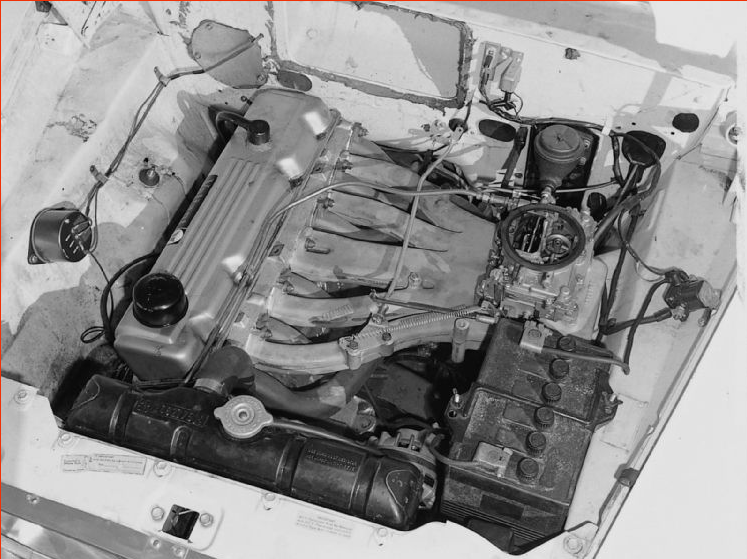 image source: performancemopars.com
The base 170 inch slant six was the most powerful of the the new 1960 compacts, but it also had the greatest performance potential due to its excellent breathing characteristics. Chrysler’s performance division quickly exploited that with the Hyperpak, a $400 option that included a very long-runner aluminum intake manifold topped by a Carter AFB four-barrel carb, that had took advantage of the resonant ram effect to boost torque at 4500 rpm, perfect for powering out of corners.
 image source: allpar.com
A number of other performance parts were included too, and resulting engine was rated at 148 hp by the factory. It’s generally accepted that it produced somewhat more than that on race day, considering the 130 mph top speed that the Valiants pulled, running at some 6600 rpm.

The winning Valiant driven by Marvin Panch also averaged 88.134 on the road-course race.

Here’s a shot of a Valiant passing two Corvairs and a Falcon.

A couple of Falcons drafting in order to both increase their speed. It wasn’t enough though. The Ford “speed kit” included a number of performance items for the 144 inch six as well as chassis parts, but didn’t have the extensive development time and budget that Chrysler invested into the Valiant program.

The Corvair program suffered from the same limitations. Duntov said there wasn’t enough time to do a proper four-carb setup on the Corvair engine, which is what it needed, and eventually got, for production versions too. This picture clearly shows how the rear-engine Corvair is “working” its rear tire, in a classic mild oversteer pose. Needless to say, the Corvairs were treated to a full suspension upgrade, including the front sway bar and rear anti-camber spring that was left off the production 1960 Corvairs.

In 1961, the Tempest also got into the act, with its half-of-a-V8 slant four, and all the performance parts that would also fit on the Super Duty V8s. And a Lark showed up in 1961, presumably with the V8? But NASCAR pulled the plug on the series after a couple of years, and six cylinder performance efforts by the factories soon went into terminal slumber, with a few exceptions.
 image source by moparperformance.com
More on the NASCAR series here at persh.com
More on the Hyperpak six at allpar.com























Hot Six… Love It.
Real car racing that tuned slant6 was revived late in the model run for the Pacer in OZ but with 225 cubes. 1960 saw New Zealands first touring car championship won by HJ Heasley in a Humber 80 in a high state of tune.
It is always heartwarming to see when the funny looking fat kid is also a natural athlete. 🙂
Seriously, the Valiant had so many advantages baked in. First, Chrysler had to use the same basic six in both the Valiant and in the big Plymouth and Dodge, so it was always going to have more displacement. The Falcon and Corvair engines were intended for small car applications only, and did not “compromise” in their design. Turns out that compromise was a good thing, for once.
Also, the engine’s slant with the long intakes (that could be made longer) made for incredible breathing. Finally, the Mopar torsion bar setup was a good handler right out of the box, so I can only imagine what it could become with modifications.
This is a neat piece – somehow these compact races never made it into my memory banks. Thanks for sharing it with us.
The flimsy construction of the Falcon wouldnt help its cause either
the falcon was not any flimsier than the mopar, you dont know what you talking about. ive owned two of them.
Actually, the Falcon was very flimsy, so much so that in Australia they literally fell apart on their less smooth roads.
See “Foul Can” as the junk was known.
I can confirm that. Dad was a commercial traveller, and had to have the front end of his ’62 completely rebuilt in ’65. The Falcon was designed for smooth American roads, which we didn’t have here. The ’67 that replaced it was a much more solid car and could stand the kind of use Aussies took for granted.
totally different falcon in Oz
Never agree with Bryce on Falcon stuff but he is right on this one.
The first Falcon’s front end can be correctly described as fragile or delicate.
” Finally, the Mopar torsion bar setup was a good handler right out of the box, so I can only imagine what it could become with modifications. ”
Quite well indeed thank you very much,… Even without a front, or a rear, sway bar, drop the early Valiants about an inch and a half, replace all the rubber components with polyurethane, wind on as much positive caster as you can ( between 2 and 3 degrees, depending on manufacturing tolerances), factory Toe In setting, and 1/4 degree Negative Camber, with 7″ wide rims and 215/70 tyres.
Then enjoy picking on GTi’s in corners 🙂
Rick Ehrenberg approves.
The introductory ’60 Corvair, especially, had no chance. For that first year, the only engine offered was a 140-cube, 80 HP, low compression powerplant that really had no ambitions beyond grocery-getting duties. I’m not even sure when the four-speed manual was added to the option list; I think at the very start the only manual box available was a three speed.
I’ve known about these races before but this is the first time I have read that the Corvairs were equipped with a front sway bar and a camber compensating spring in back (making them basically the same as ’64 showroom models).
Depending on which source you believe, the four-speed was either introduced at the very end of the 1960 model year, or at the very start of the 1961 model year. I’m inclined to believe that a limited number of four-speed pilot cars were built in the spring of ’60, but the four-speed did not become officially available until the ’61s appeared. Similarly, the Monza – and the 95-horsepower engine – appeared in the spring of ’60.
None of this is terribly surprising, given that the Corvair was originally intended to compete with the VW. There was a certain austerity to the first Corvairs, and Chevrolet noticed that buyers tended to load them up with options, a s that auto show attendees responded well to custom Corvairs On display.
Interestingly, some sources report that Chevrolet had initially planned to offer the Corvair with Powerglide as its sole transmission, but that was abandoned in order to offer a lower base price. That might also explain why a four-speed was an afterthought, particularly if the three-speed was rushed into the original production plans.
At least the early Corvairs could beat the pants off of the Volvos that were visible at the start of the race, before all the new US compacts drove away from them.
I own a 1960 Corvair with factory 4 speed, a 4 door no less. Not sure sequence of production
My Father often commented that, after spending a long, slow year driving an automatic transmission 1960 Ford Falcon (my Mother’s choice, not his) their used 1960 Plymouth Valiant “felt like an Atlas booster rocket” firing when he stomped it to merge into expressway traffic.
Even Mom, who usually did not notice speed, commented that their Valiant was “quite peppy” compared to her beloved Falcon.
Not just more power but a three speed Torqueflite instead of a two speed Fordomatic.
Truly the Mopar had a superior powertrain in every way possible.
The top photo seems to show them running the banking the wrong direction. I had no idea that any configuration of Daytona had ever been run clockwise.
Oddly, they did, and even mentioned it in the linked article.
Yes, clockwise in the first year E.D. Martin hit the wall entering the tri-oval in his Ferrari. Big fire but he survived and they changed direction of the track after that. Pontiac Tempest had Corvair transaxle so rearward with a flexible drive shaft.
Double front swaybars on a 71 Valiant and wide wheels turn it into a great corner carver no body roll.
I love hot sixes. V-8 performance is usually disappointing and I like marching to a different drummer and saving a bit on gas.
you must be building g.m. motors, as they are disapointing, with their flat cams and cracking heads.
Racing a first year Corvair must have been quite a challenge, with the 140 cubic inch 80 HP engine and absolutely no suspension mods, at least assuming the homologation rules of this series required stuff like that to be available for production. And do those cars even have basic roll bars?
These Corvairs also benefited from a complete “heavy- duty package” which included engine mods and a full suspension upgrade. They probably had some 125-130 hp, just guessing. Duntov did put some effort into them, even if he couldn’t engineer the four-carb setup.
Just a wilder cam and a proper low-restriction exhaust undoubtedly allowed the Corvair engine to rev and make some power. That 80 hp base engine was rated at 3600 rpm.
Some owners of four-carb Corvairs would argue that GM never did engineer the setup . . . .
Oh how different things might have turned out if Ed Cole would have included that camber compensating spring as standard in the ’60 Corvair. President Gore may even have owned one.
President Gore–a relatively Green car for our enviro-president.
Brilliant!
Instead, the Corvair ultimately made Bush Pres. We know how that turned out….
Always fun to go back in time and read one’s own comments on these rerun stories. When you republished this, did you add to the body of the story the part about the suspension upgrades? Because I didn’t recall seeing that the first time around, as comparing my new and old comments suggests. Either that or I’m just getting senile.
Neat. I don’t know if I have forgotten or if I never knew. I missed a big slice of the sixties by being overseas. I get a kick out of running across pieces like this.
I wonder what if anything Ford and GM got out of their respective engines. Admittedly the 98hp 1961 Flat 6 in a Monza with a 4 speed was good for 14 second 0-60 times (and probably a low 90mph top speed) and could have been a hoot to drive, but the poor Falcon with the wheezy albuterol needing 144….. sigh
Anyways, Go Go Valiant. The look like a Barrel of Monkeys escaped out their on the track. Although, in ’62, it would have been interesting to see what a 4 barrel equipped Special with the Fireball V6 could do.
See my comment above. All three companies made substantial modifications to their respective engines to allow them to rev and breathe, and create considerably more power than stock. Its just that the Valiant had both a head start, and Chrysler spent mush more on the hyperpak development then Ford or Chevy did.
I’m sure the Falcon and Corvair ran well above 100-110 mph too. The Falcon engine was wailing at 6500 rpm; that’s way beyond the stock 4000 rpm.
Surely the Falcons had the 170 pursuit engine?I cant access persh .com
The 170 wasn’t built until 1961. These was the very first efforts by the factories to increase the performance in their new sixes. Ford put on multiple carbs, headers, racing cam, valve-train improvements, etc… all the usual stuff. But there never was a “Pursuit 170” or any kind of hi-po six actually sold by Ford. As soon as the little 221 V8 came along in 1962, all the attention went to it, and sixes were relegated to just one-barrel economy-mobiles.
Except for the Corvair and Pontiac OHC six, Detroit really shunned the idea of a higher-performance six. They were so invested in the V8 image.
After the first energy crisis, Chrysler did engineer a two-barrel 225 slant six, with a split exhaust too. Fans rave about them, although they were still very mildly tuned.
Aha that explains it over her we got no V8 falcons untill 66 with the 289 but pusuit badging was used on 6s if I ever see one Ill shoot it but Falcons pre 69/70 are extremely rare live
In Australia, Ford advertised the 170 as the Pursuit 170 and the 200 as Super Pursuit 200 — trade names, rather than performance kits. (They had the same ratings as their U.S. counterparts, and were probably more or less the same engines.) I assume that’s what Bryce was talking about.
In the seventies, Ford Australia did offer an interesting high(er) power version of the 250, with a 2V carburetor. It rated 170 gross horsepower, compared to 170 hp for the standard 1V unit. If I remember correctly, it was introduced on the XY Falcon, but dropped at some point during the run of the XB.
Yeah it was only a bigger engine even those 2Vs were kinda rare.
I also thought the Falcon six was designed for low-cost, with the intake manifold and head being the same casting, which essentially nixed the potential to improve breathing.
The Pursuit engine was so named in Australia because it had supposedly been developed for police pursuit duties. The later 200 was the Super Pursuit.
I wonder how many 225/2Vs were actually built considering that for a while they were making the 318 a no-extra-cost option on Darts/Valiants because they couldn’t make enough Slants to meet demand.
well on the street it was called a 289 v8 271 horse option, you did not waist time with six cylinders, if you read the article the falcons were right behind the mopars and ahead of all corvairs, i do like the barrel of monkey comment, that was a funny statement, they probably did look like that. yea it would have been neat to see what pontiac could have done
If we are talking about 1960-61, there was no 289. It was sixes for everybody in this class. The Falcon did not get a V8 until (I believe) mid 1963, and even then it was the little 260.
As for the Falcon being “right behind” the Valiant, I suppose a Falcon finishing 8th behind 7 Valiants is “right behind” in only the most relaxed sense of the words.
Now this is stock car racing. Not today where the cars have very little in common with its roadgoing brethren. Back then normal cars do feature rear wheel drive and carburettors, like Nascar cars today, though not neccessarily tube frame chassis.
I would have loved to hear those races! There is something about the sound of a hopped up six shooter that makes me stop and take notice. (Really, after a while V8s on Flowmasters get a bit boring..)
A buddy of mine had a 72 Duster with a 225 that he upgraded to a 2bbl with headers and 2 1/4″ duals that was seriously peppy. If it had a looser converter and shorter gearing I think it would have given a 318 car a run for it’s money.
Very cool indeed. I am a fan of the leaning tower of power.
If you look on Hemmings blog there’s some poor schmuck selling a pro built 472 Hemi with a very tired looking 68 Barracuda. I figured that if the guy had put the money into the car instead of building a cool looking but virtually unusable engine he’d be enjoying it on the street rather than selling it at a loss.
Would have been very nice with one of these engines in it, but you’ll never see the burger flipping guy in the commercial saying “Is that a slant six?….Sweet!”
Love the 265 cube Hemi the ultimate Mopar 6 in E49 spec it put out serious grunt
That is one awesome engine. I wish us Americans got it;(
I know from my ex-cop car 1976 Dart that the A-body cars can be made to handle. It had a heavier-than-stock front swaybar, a rear swaybar (it was the only A-body car ever to be factory-equipped with one) tucked up behind the axle where it belonged, 14×6-inch wheels (that doesn’t sound big nowadays but compared to 13×4-inch….) with 225 (iirc) Michelin tires that almost stuck out of the fenders at the tops. I’m here to tell you that that car would corner flat and without drama at very respectable speeds. A slant-six car would also have had a more even weight distribution than the cop car did.
OK, I give up. I’ve been looking at that top picture for a couple of days now, wondering what to say. What can I say other than it just makes me laugh!
Probably one of the most ridiculous racing photos I’ve ever seen. Boy, those Valiants were ugly! My aunt had one, perforated cardboard headliner and all – did have A/C, though…
My Uncle, when I was small, had a ’62 Dodge Lancer. I thought the quirky styling was kinda neat, better looking than the ’60 or ’61 Valiant our neighbors ’round the corner had. Even as a small child, I equated the stamped steel “spare tire appliqué” as either a toilet seat, or a concentric circle that should’ve read ‘That’s All, Folks!’ rather than “Valiant” !!
A period correct speed kit would be cool on my 1961 Falcon. Did 170 equipped 1961 Falcons fare better in this series?
Yes. And the Falcons did better in 1961 as a consequence.
And there are places that still have some of that stuff, or similar. Here’s the forum with answers to anything to with the Ford small six performance: http://fordsix.com/forum/viewforum.php?f=1&sid=e714c811b0ead647be6f912b90ff31c7
The attached picture is of a Bill Stroppe tuned Falcon six, but it was not used quite like that.
The Falcon six has huge amount of performance potential, and the parts are available, from a mild hop-up, to 300 hp.
As an aside…I’m amazed that so little is said, anywhere, about Pontiac’s Slant 4 Tempest engine. For a unique design like that one to come and go so quickly, with so little notice…
Sure, it had to have been a shaker. But with the big displacement, there must have been some power there. And to engineering Luddites like me, the relative simplicity of the Four has its appeal.
Curious.
The V8 Studebaker Larks (a trio) occurred in 1960, a result of Holman-Moody temporarily having no Ford business. Reason was the AMA industry wide ban on racing by the big three. The Larks were the V8 version since their flathead six was a joke. They had success at Sebring, finishing second and fourth to a pair of Jag sedans in the supporting race, and winning an SCCA enduro called “Little LeMans” at Lime Rock. Apparently the point was made, and they were abandoned in 1961 as a result most likely of having had their 259 inch V8 ruled an unfair advantage.
The 144-170 inch Ford six was burdened with a log intake cast into the head, with no easy way to get a carburetor swap OR equal distribution to the end cylinders. The bigger Ford six 223 or 240/300 was not conceived so poorly. That said, it did have seven main bearings from the start, and a really short stroke. Once it became a 200 and finally a 250 the Australians embarked on a development program. It initially got a crossflow head. Then an overhead cam. Eventually it got a double cam four valve head (the so called Barra engine) and turbocharger forty years after the bottom end was conceived. Well, it had to evolve, because the Australian only “hemi” MoPar inline six of 264 inches and triple DCOE Weber carbs would apparently pull better than a strong V8.
The E 49 was faster to 100mph than Fords GTHO Falcon then there was the Centura Hemi, Australias fastest accelerating car in stock form at one point, those hemis were great engines and even blowing smoke will keep running a long time.
The rest of the car just disintegrates around them. Considering how many were around new, VH-on Valiants never seemed to last long on the street; must’ve been something wrong in the body engineering.
True Old Pete, the problem was there were too many different models . The development dollars were spread way too thin on the VH range which meant body quality, especially rust protection, was not as good as the previous models.
The one bright spot to come from it was the Charger however.
Even the Hemi sixes whilst being very powerful were not quite as durable or smooth as the slant six.
Don’t know why things went all quiet in 62 thru 64 aside from Corvettes and Cobras, but by the time of the Mustang and Barracuda/Dart the idea of Trans Am racing had occurred to the SCCA. The golden age of manufacturer racing culminated in 1967-71 with Mustang, Camaro, Javelin, and sometimes later body Barracuda, Charger, Firebird, and Cougar on track with a separate class for Alfa Romeo, Datsun (Nissan) 510, Porsche, and occasionally BMW all dukeing it out on road courses. Those were still door slammer cars built from stock and looked readily convertible back to street usable configuration. Insurmountable problem in funding the twin brands Ford/Mercury and Plymouth/Dodge was how to win a championship while splitting the podium finishes across two brands. Final end came about from Uncle Sam’s pollution mandates that killed all performance in production cars for the decade of the seventies and beyond.
This is the only shot I can find of the Holman-Moody Lark.
That just looks – wrong, somehow.
am very interested if more info on the Studebaker Larks. can be reached at [email protected] or phone 845 214 5188 Thanks in advance
The slant four Pontiac Tempest was an awful car. Worst brakes of any modern car, not even fit for the Corvair with its reverse weight distribution. The engine pulsations shredded the nylon toothed cam gear drive. The transaxle guaranteed a rotten shift linkage and being Corvair derived was undoubtedly marginal and with ill chosen ratios. GM had a penchant for spending a lot on new concepts and then thrifting the little things that were needed to satisfy the customer perception or longevity/durability and safety.
1960 saw the beginnings of Australias great race Bathurst, it began at Phillip Island in Victoria and was for stock standard cars
The first winner was a Vauxhall Cresta yep 2.2 L 6, 3speed column shift and drum brakes it was in second behind the leading Mecedes 220 and the Benz crashed. I,d imagine Fords feeble Falcon would have been entered in that Zephyrs did well on race tracks both sides of the Tasman Falcons not really until the XR. The race cars that won for Ford in Aussie was the MK1 Cortina it was faster than the Falcon around a circuit it stopped and steered properly too.
Do we know where the Tempest placed?
Not even a fair fight with that little Corvair, but I don’t suppose a Chevy II would’ve done much better.
GREAT history and article!!!
As a lifetime I-6 lover , I enjoyed this article greatly , the comments too .
-Nate
Is it not funny how Ford and Chevy always get their way on the Nascar circuit and it is still going on when Dodge got back in and Brad showed them what a Dodge was capable of doing by winning the championship after just being back on the track just a few years. And lo and behold their not racing again huh sounds rigged to me and Ive not watched a race since !
What ticks me off the worse was the fact they dropped a brand of car born and bred in the United States of America for a car from Japan. What’s wrong with this picture people and how soon Petty enterprises forgot how they got their reputation and money !
And it has been going on since the 1960s. Wake up !..
It’s a shame the series couldn’t have continued, I understand Ford & Chev got the huff because the Valiants kept winning. It could have evolved with Ford putting the 221 V8 in the Falcon, a 225 hyperpack slant, the Tempest & 215 alloy V8s in the Olds & Buicks. Chev could have run with the inline 6 Chevy 11s instead of the horrible Corvair.
Would have been a fun, economical race series with better handling than the big NASCARs.
It was unfair to the Corvairs, I actually felt bad for the drivers of them.
Slant sixes whizzing by at >6000 rpm? That, I’d love to hear! Has anyone located any video of this racing series?
Yes. See the next comment. Plus I just inserted it at the top of the post.
Thanks, Paul! 🙂
My street 170 (1963) would pull 6500 RPM with no problem with a good set of points properly set up. Stock points were marginal at 5500. Mild mods put 206HP to the rear wheels on the dyno. Kinda doggy off the line – but fun to drive. On c70 13s with the bars cranked down and ‘cuda shocks it cornered like it was on rails too.
206 hp to the rear wheels? I call bs.
162 ft lbs lb at 6500 rpm on the chassis dyno. Couldn’t pull the skin off a ripe banana under about 3600 rpm but 60 in low, 90 in second and bury the speedo in drive. High 14s and 87 in the quarter at Toronto International back in ’71
I know this is WAY late – but my ’63 170 Valiant would wind out to 6500 with a good set of points. Regular points floated at about 5800 but back then Blue Streak had a performance set available that didn’t float at 7000 on the distributor machine.
Aha!–a short newsreel clip (I hadn’t realized the run around the oval totaled only 50 miles): https://www.youtube.com/watch?v=OvnMmh5EijM
Wonderful! I just inserted into the post. Thanks!
*Always* happy to find something of interest, Paul.
Excellent sleuthing, as always, Sally!
Thanks! 🙂
A 4 Jan. 1960 Sports Illustrated article about compact racing elsewhere (Denver, Sebring) just preceding the Daytona event–the Valiants already making an impression at Sebring: https://www.si.com/vault/1960/01/04/582359/a-second-look-at-the-compact-cars
If the Tempest were allowed for 1961, I wonder why the Buick Special/Skylark and Oldsmobile F-85/Cutlass weren’t there, as well. Likewise, why’d Pontiac use the Trophy-4 instead of the Buick 215 V8 which was also available in the 1961 Tempest? Seems really strange since the series had already ran the year before the Tempest was released so Pontiac would know what they were up against.
OTOH, maybe GM didn’t want to take a chance on the lowly six-cylinder Valiant beating not only their star compact Corvair but their upmarket, V8-powered senior compacts, too. And Ford wasn’t going to have anything remotely competitive in the Falcon until the 1963 260 V8, as well as knowing that their ‘sporty’ car ambitions would soon be switching over to the upcoming Mustang. And then there’s the whole GM ban on racing which was happening about this time frame, too.
I guess it was a foregone conclusion that 1962 was going to be another, boring, nothing-but-Valiant scenario so NASCAR just decided to give up on the whole thing.
The likely explanation is that Bunkie Knudsen was pushing Pontiac as an exciting performance brand and Olds and Buick weren’t going that way.
the second car I owned was a 63 Fairlane 500 2 door sedan with the 221 v8
and the godawful 2 speed automatic god was that car slow as mud
It would have a fun car to hot rod if you knew how and I sure didn’t !
Sixties mopars sure had some faults but by god you always got a decent automatic
even in a 200 dollar slant six savoy !
The slant six for 1960 big Dodges and Plymouths was the 225 ci, where the Valiant started life with the 170 ci. The RG 225 was the raised block version of the 170 G.
I knew a guy who raced an early Valiant for a number of years in the 60’s. I asked him why he wouldn’t have used the 225, and he said the shorter stroke on the 170 would rev better and was suited to the SCCA road circuits they were driving. As the bow-tie and oval competition started bending the rules later in the 60’s, he slipped in a 340 so he could keep them, in his rear view mirror.
Funny story-years ago I was driving my ’63 LeBaron to the Mopar Nationals in Ohio. The driver of a Dodge Dart next to me at a light said he wished he had my 413 in his car. Asked him if his was a slant and he responded “Yea, Hillside Hemi..”
Hi who is the guy you knew that raced scca with the slant 6 170?? Thanks Dan
Hi Can you tell me who the guy was that ran the slant 6 in scca ? Really would like to know. Thanks
I had both 170 and 225 Slant sixes, and I never had a 225 over about 5200 RPM vs the 170 EASILY pulling 6500. That extra inch of stroke was a killer.
We didnt see the 170 here Aussie Valiants were 225s only but all ran on 14 inch rims which would have given longer gearing, mind you they didnt really appear in NZ until the AP5 of 63 but were revered from then on, not quite Vauxhall 6 fast but they got along ok.
I can remember going to a car show at the old Norfolk VA Arena, my dad took several of us then teenage boys. I remember watching a movie of the NASCAR compacts, and one in particular, 43jr. The announcer was talking about how good this young driver, Richard Petty would probably be as good as his father. This was 1962, and I remember watching the footage, drooling over the new 1962 fuel injected 327 Corvette and seeing funny little roadster in the corner, well roped off and the trailer outside with COBRA on it. Saw the new OHV Studebaker 6 too. When I decided whether to take over the payments on Dad’s year old Falcon 2dr with a 260 and 3 speed or buy something on my own, I went to a number of the dealers in Norfolk, drove a 1964 Chevelle with the 230 6 and PowerGlide, sounded like I was in a beer can, a 1962 Valiant with the 225 6 and Torqueflite. If I could have gotten the financing (real hard at 19) I would have bought it, it drove nicely, plenty of pep, I was sort of hoping to find a Hyper-Pack one!
We (my son and I) later owned one of the Duntov inspired, Yenko tweaked 1965 Corvair Corsas, 4 carbs, Otto OT20 cam and .030 over. He embarrassed a few Mustangs with that car.
In the early 70’s my dad brought home a 71 Lancer for me to use for college. It burned oil like mad and I pulled the engine and replaced it with a junkyard 170. The oil eater was a 225 and turned out to be all aluminum. I thought it might have been a homologate for NASCAR. Does anyone know?
Aluminum open-deck block with integral iron cylinder sleeves; iron head. Not a homologation special; Chrysler put about 50,000 of them in production cars between the 1961 and early 1963 model years. They were commendably sturdy given the tricky job of sealing an iron head to an aluminum block and six freestanding cylinder barrels with a copper-and-asbestos gasket, and the tendency at that time to run straight water in the cooling system except in winter. My ’62 Lancer had one as original equipment, and at the height of my fixation I had five of those engines—the other four found within a 50-mile radius of Denver in the early-mid 1990s.
Would it be presumptuous of me to ask if you’ve seen this article?
https://wildaboutcarsonline.com/members/AardvarkPublisherAttachments/9990392081064/1961-05_CL_1961_Chrysler_Aluminum_Slant_Six_Expo_1-6.pdf
This was another series where the Stude Lark was shut out because of its status as a tweener. It couldn’t compete with the other compacts with its antiquated flathead six, but it would knock the stuffings out of them with its 259 V8, and was therefore not allowed because it would have an unfair advantage. And of course, the V8 Lark would be no more competitive with the big boys in NASCAR than the Lark 6 would have been with the compacts.
aeropagitica above made a comment back in 2012 about how Holman & Moody prepared 3 Lark V8s to race at a stock car prequel to the main event at Sebring and finished 2nd and 4th to a pair of Jaguars that ran 1st & 3rd. Those cars were the only ones with a chance that day in the December, 1959 race.
The Jags had 4 speed transmissions and disc brakes, which were an advantage on the road course, but the 3-speed V8 Larks had about 5 mph on the Jags on the long straights – one of the Larks was supposedly timed at 138 mph on a straightaway.
The Valiants did poorly in that race – the best Valiant in the top 10 finishers was 9th place, 4 laps down from the winning Jag. A pair of Duntov-prepared Corvairs did better here, coming in 6th and 10th. But not as good as the Volvos that finished 5th and 7th. One Falcon finished 8th. I wonder if Duntov’s full involvement and a lack of such attention from the Chrysler teams made the difference.
There is an interesting article that Sports Illustrated did at the time, which is about the only place I have ever seen this series covered. https://vault.si.com/vault/1960/01/04/a-second-look-at-the-compact-cars . You have to go to the original format to see the chart with the results, both overall and by classes.
I wonder if Duntov’s full involvement and a lack of such attention from the Chrysler teams made the difference.
Undoubtedly. The article states clearly that the two Valiants were showroom stock entered by two freelancers. No Hyperpak, almost certainly. That seals the deal.
Preparation for racing is essential; the more, the better. That explains the Larks’ success; they were prepped by pros.
Thhe Corvairs were entered by local dealers, and Duntov input appears to have been limited, mainly to increasing negative camber and installing racing tires. There were no significant engine changes at this point; that happened later, at the NASCAR races.
All three (Valiant, Corvair and Falcon) got much more serious prepping for the NACAR races then in these first two events. Ford developed a full hi-po three-carb kit, comparable to the Hyperpak that Chrysler developed for the Valiant. Ford came extremely close to releasing that hi-po kit as a dealer-installed option, but pulled the plug at the last minute. I have an old article on it somewhere; I’ll reprint it at some point. It was rated at 127 hp, IIRC.
Meanwhile, there was only so much (little, actually) that Duntov could do with the Corvair, given GM’s no-racing policy at the time.
Ah hah. This answers the questions that were pinging around in my head regarding where the Lark was in all of this… and quite possibly towards essplaining why Studebaker seemed to mostly stick to the salt flats when trying to cultivate a performance image for the Avanti, its R1-R4 power-plants, the “Super” packages for Larks and Hawks, and so on.
Not too common to run into a car where the first step above the base engine doubles your horsepower, but the 2 barrel 259 with single exhaust was 180 horsepower- exactly twice that of the flathead wheezer.
Hot Rod magazine published a road test of the hyperpak Valiant; i managed to find it once online, but I’ve been unable to find it again. My memory says 0-60 in 7.0 sec, 129 mph top speed, that it could wind to 60 in 1st gear and 100 in 2nd. If anyone can find that article, please publish it.
HR’s archives are all now online; I checked through all of the 1960 and 1961 issues; no test of a Hyperpak Valiant.
Maybe you can find it:
https://www.motortrend.com/hotrod-archive/
Well maybe it was another magazine, maybe Car Life, R &T, or another one that’s no longer publishing. As I said, I did find it once but have not located it again. I’m pretty certain about the numbers I remember being close to what were reported.
There’s this Motor Life article, but it doesn’t have actual recorded performance times, just estimates:
https://wildaboutcarsonline.com/members/AardvarkPublisherAttachments/9990606017754/1960-07_ML_1960_Valiant_Performance_Mods_1-4.pdf
Here’s from Cars, July ’61:
Another bit of memory from my longstanding interest in this engine. I remember it being written that the race engine actually put out 196 hp but the kit for consumers was only 148 hp. To further confuse matters, I believe there was a 225 cube version of the hyperpak available at one point, and it was rated at 196 hp. T’would be nice to have the original engineers around to clarify.
196 was the advertised/claimed horsepower rating of the 225 engine with ‘the’ Hyper Pak kit; 148 was for the 170.
@Daniel — note comment above, if you haven’t.
Which one?
Where I asked if, given your interest in the Slant Six, you had read this article: https://wildaboutcarsonline.com/members/AardvarkPublisherAttachments/9990392081064/1961-05_CL_1961_Chrysler_Aluminum_Slant_Six_Expo_1-6.pdf
Missed that comment, sorry. No, I hadn’t seen that particular distillation, but I have all the factory and SAE material it was based on, and more besides. Over my years in the hobby, I had five of those aluminum 225s; I described some of my antics with them in my COAL series. Really neat engine!
Duane: the Chrysler factory-prepped race cars in 1960 differed from the Hyperpak sold by the dealers. The race cars had higher compression, and were tweaked in a number of ways by Petty, who prepped them for racing. Their power output was quoted at both 197 and 204, or something like that. They revved higher, to 7000 rpm, whereas the Hyperpak was tuned to peak at 6000 rpm.
That’s probably where you got that 196 number from.
Very well, I thought it worth asking.
Certainly was! It was quite a feat of engineering and those engines worked out surprisingly well, given the open deck; the iron head, and the gasket technology and maintenance practices of the time.
I wonder if you might have this in mind. I’ve got a copy somewhere, unless I sold it off.
Definitely not the article I remember. That one seems to be the Aussie hemi six.
No, it’s an American magazine with an article on hopping up the Slant-6. When it was published, the Hemi-6 was a decade in the future, on the other side of the planet.
1963 170 automatic valiant – 60 in low, 90 in second and bury the 120MPH speedo in third. All factory parts but rejetted, re-curved, decked, and the valve lash tightened up.
While we are grabbing around at performance numbers, keep in mind the scope of the Hyper Pak kit was, ah, variable. The over-the-counter Hyper Pak kit got you everything you see here (for around $430, which is around $4,300 today). The Hyper Pak as reportedly installed in certain racing vehicles for certain races also included other stuff, like high-compression pistons.
No, I don’t know how that worked in terms of the homologation rules.
Here we are 14 years later, and this Valiant is for sale in Troy, NY. It’s exactly the same V 200 model in white with red interior, black walls and no trim rings that my dad was assigned as a company car when he worked for a St. Regis Paper Company as a bag packaging salesman.
I remember when he brought it home, he pointed out the curved corners of the rear seat to me, a 10-year-old kid. I was fascinated by Virgil Exner’s classic car touches and thought it was the coolest car I ever saw. I must say now that at age 76, the ’60 Valiant occupies a strange and wondering place in my heart. I recognize claims that it is an ugly car, but there’s something about it that attracts me to it, like a homely but loyal and lovable English bulldog.
Dad also said that the neighbors borrowed the Valiant to go grocery shopping after a really bad snowstorm in eastern Massachusetts, where we lived. Apparently, it was really great in the snow.
In the 90s I owned a 1961 Lancer two-door post and it is still one of my favorite collector cars. It was so balanced between the 170-6, the push button torqueflite, and the suspension, which was perfectly tuned. The car wasn’t fast, but it would cruise effortlessly on the highway and track straight and true.
The compact car trial with my dad’s company went for only one year and they returned to standard size cars in 1962. Dad got a powder blue 62 Belvedere with a 318.
If anyone wants to make a tribute to Marvin Panch’s winning Valiant from 1961, this car would be a good starting point.