

(first posted 3/3/2011) Curbside Classic takes you back to 1971 for a virtual comparison test of six small cars, based (and partly borrowed) from a C/D test.
There it is, a golden yellow Vega, seductive and infinitely irresistible, hanging from the tree of automotive disappointment. Its serpent maker found plenty of smitten takers (especially among the motor press), because the bitter truth imparted upon biting the bait was apparently in a time-release potion: “The best handling car ever sold in America” (Road &Track). Winner of Motor Trend’s 1971 COTY. C/D readers voted it the best economy car three years in a row. It won this 1971 C/D six small car comparison. And yet it went on to be the maker’s perhaps biggest Deadly Sin along with the Citation. So much promise; such a letdown.

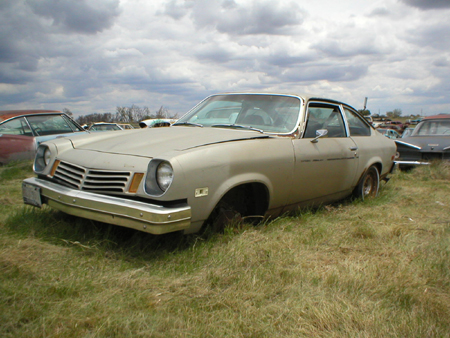
I (mentally) bit too, having spent idle hours in 1971 with a Vega brochure specifying a yellow Kammback GT exactly like this one. But sure enough, the sweetness of that first bite evaporated all too quickly: the apple was rotten at the (engine) core. The Vega was GM’s Watergate/Waterloo, the beginning of its inevitable end. And yet here I am forty years later, totally smitten and thinking how fun it would be to tool around in another one of my seductive youthful loves.

Let’s step into our time machine. It’s 1971, we’re wearing bell-bottoms, and want desperately to love the Vega as much as we love peace. Its coming was hyped by GM for years as nothing less than the reinvention of the small car, GM’s version of the Apollo moon shot. Sound familiar?
Now we haven’t bitten into the apple of knowledge yet; we’re just sniffing around the delicious edges of the Bill Mitchell styled mini-Camaro to try to understand what all the hoopla, awards and press accolades were all about. Or was GM delivering its press cars with a big baggie of Acapulco Gold in the glove box? Oops; the Vega doesn’t have a glove box, as well as a few other components normally taken for granted, thanks to GM’s ever-diligent bean counters.

GM’s corporate styling was still at the top of their game in 1971. But there sure was a lot of borrowing going on here, although to good effect. The basic Vega sedan was a blatant rip-off of the lovely Fiat 124 Coupe (upper photo).

The hatchback coupe’s roofline was heavily cribbed from the Ferrari 365 GT 2+2. The Kammback wagon owed more than a hat-tip to the Reliant Scimitar shooting brake. And of course, the Vega’s egg-crate grille front end was a re-do of GM’s own excellent ’55 Chevy, which in turn was of course cribbed from various Pininfarina Ferraris.

The real question was why Chevy wanted such a low-slung, “sporty” car with terrible space utilization. The charming Kammback was really more of a shooting brake than a proper wagon; hardly in the image of GM’s big wagons, or such practical competitors as the Datsun 510 wagon, which actually had the luxury and practicality of four doors!

GM’s President Ed Cole, a former engineer and father of the Chevy V8 and Corvair, gave the development of the XP-887 “import killer” to a corporate development group. And then he forced the half-baked results on a reluctant John Z. DeLorean, General Manager of Chevrolet. The “not invented here” maxim maximized, especially as regards the engine. Chevy’s Engine Group already had a conventional small four banger on the drawing table. But the corporate skunk works had grander (“cheaper” in GM-speak) things in mind.

GM had dropped a mint on a huge aluminum foundry operation to build the Corvair engine. And the ill-fated Corvair died in 1969. See where this is going? The Vega will have an aluminum block because…”it’s 51 lbs lighter than the pedestrian and dead-reliable Chevy II four block”. Right. Well, an aluminum head on the Chevy block would have offset the (are you ready for it?) cast-iron head on top of the Vega aluminum block. GM was determined to turn small car engine design upside down, literally. Oh well, Pontiac’s cast-iron four (“Iron Duke”), a revised and updated Chevy II 153 four, ended up replacing the ill-starred Vega engine anyway.

Since the dawn of the twentieth century, light but soft aluminum has been used for engine blocks along with durable iron cylinder sleeves. That solution would have cost Chevy exactly $8 per engine. They were planning to build millions of them. And cheapness is the mother of malfunction. So GM and Reynolds Aluminum came up with the idea to incorporate 17% silicon in the alloy, and devised a way to etch the top molecules of aluminum from the cylinder bore surface to expose the hard silicon, and voila! An eight dollars saved is an eight dollars earned!

Actually, this was only one part of the Vega engine problems. Mercedes and Porsche went on to perfect this process, and now it’s ubiquitous. It was the other shortcuts that really made it so, like cheap self-destructing valve guides, an undersized cooling system, a small oil pan, etc. Overheating, or oil consumption from the bad valve guides meant that the less-forgiving cooling system or limited oil capacity conspired with the fragile open-deck block, which then blew up, figuratively and literally. But that won’t be happening on a mass scale until 1973 or so, unless you’re one of the unlucky early adopters of Vega maladies.
The Vega’s engine was unusual in other ways too. It had a long stroke and big displacement (2.3 liters) for a four, and was tuned for low specific output (90 gross, 80 net hp) at a lazy 4400 rpm. The result was a big flat torque curve: 136 lb/ft of torque at 2400 rpm, more than double the Simca’s. GM wanted the Vega to have that lazy V8 feel, the secret to blowing those pesky, buzzy imports off the freeway. The result was more agricultural than V8, or in 1971 terminology, bad vibrations. Balance shafts would have broken GM’s profit targets. As did the lack of them, although that alone would not have solved all the Vega’s problems.

One of the Vega’s earliest problems was its seemingly inexplicable tendency to explode mufflers. In a classic Rube Goldbergian way, severe engine vibration caused a carburetor bolt to loosen, causing the carb cover to jump up and down, causing the accelerator pump to pump, causing raw gas to flow down those less-than stellarly-sealed silicon bores, causing gas to puddle in the exhaust, causing said explosions, causing Vega owners to abandon their ride in mid traffic and duck for cover behind the nearest Pinto whose own explosive tendencies weren’t yet common knowledge.
But the torque was there, and Americans love deep-fried torque with their pork. Who wants to shift when you’ve got a tenderloin sandwich in one hand and a milkshake in the other while cruising I-70? GM had your number(s): the combination of an extremely long 2.53-to-1 axle ratio resulted in 2600 rpm at seventy mph. Relaxed cruising indeed, and a masking of the Vega’s “disturbingly loud when revved” thrashing sounds.
But wait, you enthusiasts hoping for a mini Z28 or BMW 2002 beater, it gets worse. The standard Vega transmission is a three-speed stick, with ratios so wide that combined with that long axle it “feels more like a 6-speed with first, third and fifth gears missing. It always seems like you are starting in second, and the gaps between the gears are not valleys, but canyons”. I have an alternate description: a two-speed stick with a long overdrive. Either way, not very sporty, considering the Vega’s sporty styling. GM was sending mixed messages.

But the GM engineer’s unorthodox thinking worked, after a fashion. The Vega was the second fastest in the C/D test after the wheel-spinning Gremlin, with a then timely 12.2 seconds in the 0-60. Good thing they didn’t test the automatic. Hooked up to the ancient two-speed Powerglide, forward thrust was truly glacial. I know; a good friend was a very early Vega adopter/burn victim. I drove it. It really sucked. It felt like it was dragging a sledge behind it. That was all the bite of the apple I needed to feel like retching, and I began my personal GM Death Watch right then and there.
Handling (and cute looks, on the pre-safety bumper versions) was always the Vega’s one dynamic strong point: “Handling is very good with mild understeer and tolerant breakaway characteristics. The biggest surprise is the steering, which is light and accurate…the Vega is quick and nimble”. And that’s the base Vega; the GT got an up-rated suspension. But it still had nothing on GM’s own Opel 1900/Manta, which is what GM should have just based the Vega on altogether.

C/D’s un-GT sedan version garnered heavy criticism for its interior: Klutzy hard plastic moldings and an instrument panel with nothing more than a horizontal speedometer. The floor is wall-to-wall black rubber, and all the controls required exceptionally long travel. The missing glove box. And the Pinto has a bigger back seat than the considerably bigger and heavier Vega. GM’s bean counters were all over it. But despite the cost-cutting, the Vega was not cheap; in fact it cost a full 15% more than the other competitors, and weighed some 400 lbs more. Satisfying American’s lazy highway cruising habits came at a price, as it always has.

The truth is, this comparison is all wrong given the Vega’s price point. It should have been compared to the Datsun 510, Toyota Corona, and the VW 1600 Type 3. And a nicely optioned GT wagon like this one would have put it right in BMW 1602/2002 territory. The outcomes would have been all-too different.
From this 1971 comparison and vantage point, it’s pretty obvious to see how the future played out. But the Vega’s self-destructive tendencies weren’t the only reason for its demise. Once the Corolla got a bigger engine and a five speed, it ran circles around the Vega and Pinto. The VW Beetle soon died, to be replaced by the brilliant Simca-inspired Golf/Rabbit. The relatively reliable Pinto soldiered/moldered along, until eventually replaced by the Simca/Golf-inspired FWD Escort. Chrysler jumped into the fray with the Simca-derived Omni-Horizon. And the Gremlin just became an historical oddity.
The real winners in this comparison: the Simca 1204’s DNA, which is now ubiquitous; and the Corolla, for figuring out how to satisfy Americans’ small-car hunger without the heartburn.
The Vega had a decent sales start. But its biggest sales year was 1974, when it hit the top-ten seller list thanks to the energy crisis as well as the top of the national shit list thanks to mass engine crises. In 1975, sales plummeted, and by 1977 “amnesia Vegatitus acute” became a new national mental health epidemic. By then, the Vega was anything but cute.

All the more reason why just finding this gem of an early Vega GT Kammback was the really big win of this shoot-out. In fact, stumbling across it became the green light for this whole 1971 CC comparo, despite knowing I’d never find a Simca. I’d seen the nose of this yellow Vega in an old garage downtown some years ago.

And suddenly, there it was, sitting in front of a hand-made artisanal broom company. What a perfect setting; and where else but in Eugene? Well, witches need wheels too, to go buy their brooms. And the Vega certainly was cursed from the get-go. (Update: I forgot; Stephanie has one of their brooms; it really is quite the well-made thing; it’s still going strong in 2018)
And this one, the first non hot-rodded V8 Vega I’ve seen in maybe a decade, is exactly the color and configuration that got my juices going while mentally masturbating with a Vega brochure in 1971: optional two-barrel 110 (gross) hp engine, four-speed stick, and that GT instrument panel with full gauges. Only the lovely GT wheels are MIA.

And this gem is (was) for sale! The owner is reducing her carbon-footprint and going all-broom all the time. And it actually runs, on its original (although possibly sleeved) engine. The serpent is still at work; the apple is more tempting now than ever. And the irony is not just in my (cylinder) head: driving a GM car, the very one that brought the company down, yet a car no one under thirty-five recognizes in this terminally PC town of bikes, brooms, old Volvos and W123’s is a delicious thought. I’ll just put a “powered by Biodiesel” sticker on it, ‘cause it sure shakes and quivers like an old Mercedes 240 Diesel. Or maybe convert it to an EV and put “Volt” badges on it. Mmm; delicious!


Another great read. On an unrelated note for Paul. I saw this picture and thought you might get a kick out of it. http://tinyurl.com/4ffbqnm
That’s just impossibly perfect. As first glance it looks like an elaborate diorama. I’m not entirely conviced it’s not. Looks to be about 1963.
this is great… where is this? Definitely not the states, right? On a side note: that is that guy in the VW hauling the motorboat thinking? It looks like a page from a Richard Scary book!!!!!
LOVE that picture. So reminds me of the annual invasion of Germans into Tirol and on into Italy to go camping at Lake Garda or the sea shore. Do you know which particular pass this is?
Until the Brenner Pass bridge/freeway was built in ’63 (I think), it was an endless traffic jam in August.
One more thing: in the early fifties, on the very steepest passes, you could sometimes see old and very under-powered car going up in reverse(!), if first gear wouldn’t make it, because reverse was always geared even lower than first. What a sight. And I assure you, that 36hp VW Type 2 with the boat was crawling mighty slow. I have related stories to tell…Thanks for making my morning!
I am fairly sure this is in Switzerland, judging by the flag on the left pole. If the other flag is a cantonal flag, as I suspect, this is probably in Uri, as the only other Swiss canton with a yellow flag is Schaffhausen, which has no major mountain passes. My guess is that this photo was taken somewhere on the northern side of the Saint Gotthard pass, one of the major Alpine crossings.
Edit: just looked it up on Google maps and it seems that my guess is right: This looks a lot like the section of the old Swiss highway Nr. 2 (Gotthardstrasse) north of the Teufelsbrücke (Devil’s bridge). However, the restaurant seems not to have survived.
Ugh!!!! how embarrassing!!! the fIag was smack dab in the middle of the picture and I missed! thanks CSI!
I just found it on a random Tumbler page with no annotation. It looks like csi.ch has done some research and has come up with a plausible answer!
The longer I look at that pic, the cooler it gets. Know of any more like it?
(Paul, do you agree with my date estimate?)
The two youngest cars I can reliably date are the VW Type 3 Variant (Squareback) from 1961 and that Ford 17M P3 (white with the red top) sitting next to the restaurant, also from 1961. The baby blue car half-way down the serpentine look like a British Ford Consul Classic, also new in 1961.
So, given the lead time, I would have to say 1962, at the earliest.
The compressed URL just gives me a error.
I actually saved this years back; here is the original image:
There was also a second one taken further up the pass:
When I clicked on the tiny URL, I got the error message like this:
This XML file does not appear to have any style information associated with it. The document tree is shown below.
AccessDeniedRequest has expired
2011-03-04T08:06:20Z
2018-01-13T22:52:40Z
FF0F971B06B2431B
SwLMmGIsQgzZyNs38e9GW6Jm8dqqsJBdB1ImC5a9pPc9SGEiDMip8+Xyq5Q00gClvI3qUYYuLYc=
Perhaps this link has expired?
OMG what a heap, considering the cars GM produced in this size elsewhere by Opel, Vauxhall, Holden what the hell was Chevvy thinking, Both Opel and Vauxhall had OHC engines that went well at least Lotus were happy with Vauxhalls Victor they ditched the Ford Kent in favour of it. Makes you wonder the size of the backhanders given to those magazines.
A friend on mine bought a new 1974 hatchback back in the day. He sold it a year later when a GM mechanic told him it wouldn’t last 60k miles. Id like to drive one just to be able to say I have.
Drove the “Monza”, a “Vega” continuation. I actually was a fun one to drive.Uncomfortable for long distance though.
Man! Was like sitting on the ground.
Heater was good at fighting the wstrn PA winters.
If you want to see an unbelievable, completely unmolested Vega, there is one in the inventory at Duffys.com. I ran across it on my websurfing about a month ago. It is a stunning red Kammback. Probably the only one left in the country!
Briefly dated someone who had a “white out/red inside” Kammback. Was a 74 or 75. Never drove it but found it a good ride in general.
They had a garage; still had the car in “1981” or so.
Bell bottoms? Ahem…by that time, we called them “flares”, thank-you! After all, no one really wanted to look like Sonny & Cher. I really liked the Vegas when they came out and when I seriously considered re-enlisting in the Air Force (for about 5 minutes), I would’ve then bought a new car, and the Kammback wagon was #2 on the list, after the Nova. A friend had a metallic brown Vega GT and it was nice for as long as he had it. Later, when the Cosworth Vegas came out in 1975, I checked those out, too. Glad I never bougth one. Ironically, my wife, before I met her, looked at the Vega, too, but bought he 1970 Mustang convertible instead. Good choice for her and later for me! Good concept, poor execution. Any wonder why Toyota, Datsun and Honda were so sucessful?
Great writing – i’m glad I just found this site!
HAve you considered going to other wierd towns like Austin, Boulder, etc. and doing walking tours and writing about their curbside classics?
I still keep finding more here, and I have a large backlog, but if I find myself in one of those towns, I will. I could spend several lifetimes writing CCs in Portland alone; it’s chock-full.
Paul…
In an alternate universe where Chevrolet still does all the right things like they did up until 1970 in our world…there were rumors of a small import fighter called the ‘Vega’, but it was never released to the public after the first trial pre-production runs revealed severe flaws. Anxious for something to compete with the Pinto, .GM rebadged the Opel GT & sold it as the 1971 Chevrolet Chevette GT. Marketed as the baby ‘Vette for the up and coming Green eco-conscious Boomer, it sold by the millions when the 1st oil crisis hit due to the 1.1 liter engine’s 40 mpg highway rating. Still being made today and the most successful small American car, the Chevette GT is widely known as the vehicle that kept Chevrolet alive until the release of the downsized Monte Carlo, Malibu and Caprice in 1975. Chevrolet later released an Isuzu sourced RWD compact as the Vega in 1978.
If only…..
Welcome to my fantasy world! Ahhh, yes, it would have been sooo nice! What if, indeed…
Remember, the first 800 (approx) Vegas ever built had to adhere to VERY STRICT quality control regulations set by The Man, John Z. Delorean himself, that The General eliminated due to the fact that the idiotic, corporate, bean-counters thought it wasn’t worth it to invest in making sure the Vega was a good-looking, fun-to-drive, well-built, and reliable car.
I rented one of those Powerglide ’72 Vegas for a week in Las Vegas. Starting out from a light it was wind, wind, wind, then thud when it shifted to Drive. The thing had air conditioning too, and when the compressor cut in it was like you drove into molasses. Ugh!
Later when I had my V8 4-speed 1975 Monza fastback, it was hard to remember that it was built on the same platform.
If only it had the 250 strait 6 under the hood. A 1st gen heavier camaro with it & the ironically indestructible powerglide accelerates very briskly with 3:07 gears in back.
Growing up in the shadow of Lordstown, we had dozens of Vegas in town. So many stories, I’d have to start my own blog to tell them all. Growing up, I liked the hatch version the best, and one of my brother’s friends had a blue GT with the 4 speed that was fun to drive. But, rust and the engine issues killed that car fast enough. Another friend in high school had one, but he being 6’8″ tall, we had to reinstall the drivers seat about a foot behind where it would normally sit. It too died of rust and antifreeze. Another friend’s brother rescued a sedan before rust made it too structurally unsound to drive. He welded in a full roll cage and a small block and took it bracket racing. He did pretty well with it, too.
But in reality, we would have been better off with a heavily disguised Opel (like the Chevette) instead of the NIMBY special we ended up with.
***I’m on a roll today, first a Pinto Crusing Wagon then this :-)*** perusing one of my favorite old iron sites I found a 77 wagon with a claimed 52k original. Wow, 50k more than they usually ran! – then again it could be on its 2nd or 3rd engine… If the yellow one is not for sale / sold, here is you chance! BTW, I’m not shilling for that site – just thought I’d pass this along.
http://www.autabuy.com/Vehicles/Details.cfm?VID=403275&Year=1977&Make=CHEVROLET&Model=VEGA
They might be junk but they sure are pretty. The early (Canada only for early ones) Pontiac Astres are really nice too. The Kammback is particularly nice. I saw a beater condition mid 70s Vega actually moving under its own power (with stock engine no less) about five years back.
You know…looking back…the seventies were really scary times.
For small cars and oil crisis I agree. It was certainly a great decade if you liked big cars, music, TV shows and many well built appliances even if the colors were a bit strange by today’s standards.
Yeah ! The Seventies, the decade that taste forgot.
IMHO, Vega is #1,2,3,4 and 5 Deadly Sin!
It was meant for younger buyers, and once burned, they went import and never came back. Losing the huge Boomer Generation was first strike in GM losing half its business.
Exactly! That’s what absolutely AMAZES me with debacles such as the Vega and Chevette – younger buyers, naive and on tight budgets, are a whole lot easier to fleece; but they have a lifetime ahead of them with which to carry their memories. And with mindless, soulless ripoff projects like this one, the young products of a Chevy family, or a Pontiac family, or whatever…angrily turn their backs on those brands and the parent companies, forever.
A new tradition is started; and it doesn’t involve the alleged “all-American” brands.
And the tradition keeps on. The kids ripped off with these things are, some of them, grandparents now. And THEIR kids don’t know what it is to own a crude, overpriced, shoddy American car. Probably why, as Paul said a few weeks back, the grandkids think owning a plain-jane four-door Dodge sedan is such a rush…because NOBODY has anything like that!
I’ve said it a million times, and here again: GM deserved what happened to it. That, and much, much more.
You mean the current Avenger?
Had a friend in 1975 who had a brownish/copper coloured Vega (1973 model?) that had a 4 speed. It was much faster than the Pintos and much better looking, IMO. After 3 years the car needed some body work along the rocker panel area. Just had it done with a black stripe rather than try to match the paint.
I really thought it wasn’t a bad car especially since it was a manual. Southern Ontario was pretty rough on all of the car bodies back then. 3rd party rust control was just getting into action around then. And it was needed! LOL
It looks like Alfa Romeo also cribbed hate roofline from the ferrari 365 GT 2+2 in the Alfasud and Alfetta GTV coupe! GASP!
Hey, I am really enjoying your website. I have always thought the Vega’s looked nice. Even today, when I see them about town, I remark on how well proportioned they are. I did enjoy driving one around Oahu (literally) in 1979. It had tape on the windshield to stop the leak. I remember my father, at 5’6″, scrunched in the back seat…
I read about the Vega and Pinto in Car Life when they were being introduced. The discussion of the Vega engine was interesting. The author applauded the design of the head. It seemed that the
” (are you ready for it?) cast-iron head on top of the Vega aluminum block. A world first too, I assume.”
was a good idea. The stiffness of the cast iron would allow the valves to operate more smoothly. Subsequently considerable criticism has been leveled at GM blaming the Silicon Aluminum cylinder walls or the cooling problems caused by the cast iron head/aluminum block when the valve guides were the worst feature. Still I found it fascinating to read about the Rambler 196 cubic inch in line 6 cylinder of 1961-64. AMC made an aluminum block version of this engine with a cast iron head. It too suffered from considerable problems, some of which stemmed from the difference in head/block materials. I thought it fascinating that in 10 years two car companies based in the same city could make the same unusual decision vis a vis head/block materials and fail in the same way. Was no one at GM paying attention to the AMC experience?
“Was no one at GM paying attention to the AMC experience?”
They were but they thought they were smarter!
I remember back in the late-’70’s a buddy of mine worked in the parts department at the local Chevy store and a standard joke of his was, whenever a customer would come in and ask for “a tune up set for a Vega”, he’d turn around and yell loudly to a nonexistent person supposedly at his beck and call in the back stockroom – “Points, plugs, cap, rotor, condenser and *engine block* for a Vega!”, much to the horror of the customer! The Vega could have been a half-decent car – (at least by the standards of the era, such as they were, anyway!) and cost Chevy a bunch less money, if they had simply used the 3-liter version of the old 2.5 L cast iron Chevy II four-banger, that. even to this day, (2012) is still in production by GM in Mexico and sold worldwide by GM as a marine engine. The 3-liter version of the old Chevy II 4-banger is bulletproof – hence it’s wide and continued use in marine conversions, is hugely torquey for it’s size – and has half again more horsepower than the
base Vega 4-banger had. And if people wanted more power – and/or complained that the ’62 Chevy II-based pushrod 4-banger, even in upgraded 3-liter form – was an “old” or “obsolete” engine design. not suitable for the “swinging, high-tech 70’s” , Chevy could have, for a whole lot less money than they spent on their reputation ruining “liner-less aluminum block” Vega engine program, simply tooled up an optional DOHC – mufti-valve aluminum head to fit the “old” 3-liter block – something akin to the head they later used on the short-lived, exotic and expensive Cosworth-Vega – and offered it as a ‘high-tech, top of the line, high performance option for those who wanted it.
Of course, we are now waiting to see what Don Draper and his people are going to do with the XP-887.
I was 15 yrs old (in 1978) when my dad and I went to look at a ’71 hatchback in that same yellow color. The owner let it go for $75 dollars because the engine didn’t run. We had it towed home where it sat idle until we could find a “donor” engine for my first car. We found a ’72 GT version that at least ran but had some body damage for $200 in the local paper. We transplanted the engine and that was my first car when I turned 16. Just like your first girl friend, your first car hold a special place in your heart. I had a lot of fun in that car even though it was very tempramental. It burned oil like no tomorrow and we nicknnamed it the “crop duster” for the periodic large plumes of blue smoke that emitted from the tail pipe. I had to replace the clutch cable (yes, cable) more than once and carried a screw driver with me which I used to short the electrical terminals together with on the starter motor when turning the ignition key would not start the car! Lol. I wouldn’t mind driving one today just to see how it drives, Ah – memories…
This is one of your searingly funnier essays and dead-on, as usual. I guess that means I’m done working for the day.
What a turd. This must be the last functioning one of these automotive maggots staining the landscape. Chevy sold nearly 400k of these piles in the first year and by 1973 the number was over 427,000 sold. Where are they all? Most rusted to oblivion long before their 5th birthday. The rest met their deserved demise at the hands of incresingly careless subsequent owners. These crummy turkeys, as well as the equally appalling Chevette, were just typical shitbox small cars GM stamped out cheap & fast to foist on the unsuspecting so they could spend their time and development dollars on their true mission; to put Cadillac repicas in every garage in America! Yet GM was mystified by why imports ate into their market share. So clueless! It took GM almost losing their ass & requiring government bail-out money to FINALLY wake up and start building world-class cars. We should have had a car as good as the Cruze 20 years ago from a company as big, rich & brilliant as GM! Better late than never, I suppose. Too bad Pontiac and Oldsmobile were unfortunate casualties of gross General Mismanagement!
The Chevy Vega.Probably the best reason for buying a decent used car.Somethings not right when the engine goes in two years, and the rust starts as soon as you leave the dealer. Was Neil Young singing about the Vega in “Rust never sleeps”?
A 1972 Chevy Vega Kammback wagon was the first new car given away on “The Price Is Right”, when Bob Barker debuted as the host that summer. A contestant won the car by getting all four numbers right on the Chevy (before the second prize and the “piggy bank”) in the “Any Number pricing game – just a little over $2,700.
Used to rush the block and a half , home, from school to watch “Price is Right”!!
One Vega I would still unabashedly pay top dollar for should one ever come my way. Yenko Stinger.
RE: the Yenko Stinger-I remember reading in either the January or February(I think)issue of Car & Driver about Don Yenko’s attempt to sell a turbocharged version of the Vega he had developed. He had developed it and was ready to sell it when he discovered the EPA was demanding it would have to pass a 50K
durability test before he could sell it; if I remember correctly by ’71 or ’72 all cars sold in the U.S. had to pass such a test. Apparently Yenko abandoned the project after learning of this requirement; given what a POS the ‘Vega engine turned out to be, that was probably a blessing in disguise. I once owned a Vega, it turned out to be almost the worst car I ever owned, surpassed only the terrible X-cars ( I had one of those also-I made some terrible automotive choices in my life).
I lusted for that 124 coupe. Who wouldn’t? Thank the witches I chose the 2 door 510. The Cosworth might have tipped the balance, but I dearly loved that 510.
Here’s a Vega!
I know I’m really late to the game but if anyone’s interested here’s a great video of what the Vega should have been: https://youtu.be/nRmaoh5MDyE?list=PLz9w_RLSrLOvDq0_I3-WdO_TW2vp73Jh_
All these years later, this car still tries to seduce me with its beauty. While I was never that crazy about the slow-selling coupe, the hatchback and wagons were just gorgeous little cars.
I am trying to remember if I ever rode in one. Perhaps once, my high school latin teacher took us out to an italian restaurant for lunch one day, and I rode in hers. My only memory of that car was the obtrusive engine vibrations and the environment of black plastic everywhere.
A neighbor kid across the street had a gold 73 hatch in maybe 1977 or 78. I will never forget the HUGE gaping rust holes everywhere on the body. And the fact that he had to get it towed away to get rid of it. A 4-5 year old car.
Our neighbors had a pale yellow 1974 hatchback. Even with the 5-mph safety bumpers, the car had decent styling. But within three years, large rust spots had broken through the paint on each side of the car. I can still remember the rust-colored “streaks” that were below each spot, which were about the size of a silver dollar.
Our church pastor later bought a brand-new 1976 coupe in a light metallic red color. I was best friends with his daughter, and rode in it several times.
I don’t remember that Vega being a particularly unreliable car by late 1970s standards – and Chevrolet had apparently licked the rust problem by 1976 – but the engine still gave it a very unrefined “feel.”
Ditto. My friends and family owned VWs, Renaults, 510s, Corollas, and lots of Pintos. I rode in those and worked on them. Absolutely nobody owned a Vega. I don’t think I’ve ever been close to a Vega, let alone rode in it. Strange for such a common car.
My mother owned a ’73 hatchback in the Gulden’s Mustard gold color as pictured above with the Fiat 124. It had a 4 speed, and pretty much nothing else. It was prone to inexplicable shutdowns in traffic, requiring us to pull off the road and wait it out or let it cool down until it would start again and we could continue on. It was replaced in ’75 by a 262 V8 powered Monza 2+2. The Vega was most coveted for its excellent behavior in snow or bad weather, but it was equally despised for its chronic unreliability. I doubt it had 20k miles on it when it was traded off for next to nothing. During those years we spent a lot of time borrowing my grandparents cars, either a ’70 Toyota Corona or a ’69 Chrysler Newport, as my grandfather was constantly concerned that we’d be killed in the Vega due to its unannounced shutdowns.
A year or so back I found an identical Vega Hatchback on Ebay in original condition with 24k miles on it. I jokingly forwarded a link to my mother on Facebook in case she wanted to pony up the $7000!! asking price out of nostalgia. That post, in addition to garnering a scathing response from Mom, sparked a tirade from no less than a dozen people who’d owned or known Vegas, all of them deriding it as the worst car they’d ever owned.
The Vega was like the pretty girl you couldn’t wait to get to know, only to later find yourself itching and/or oozing in places you’d never want to.
One thing GM did better than ANYONE else, from the ’50’s through the ’90’s, was styling. GM cars were always more attractive than their competitors and the Vega was no exception. Far lovelier than the lumpy Pinto. The Pinto had awkward lumps and disconnected lines where the Vega had graceful, elegant curves, and the Japanese cars of the era were really hideous.
Who, I wonder, was buying these in 1973/1974 after the disaster had come to light? They not only had engine problems, but also rusted to death very quickly. It did not take long for the Vega’s faults to become apparent. Who still bought the thing?
GM curiously repeated the iron head/aluminum block disaster with the Cadillac HT4100, an engine which was unreliable, poorly made, complicated, and WEAKER than the Buick 3.8 V6.
“Who still bought the thing?”
You underestimate the Cult of GM of the 1970s. It went like this: “Only GM makes decent cars. Fords are deficient, and Chryslers are so bad that only brain-damaged people buy them. AMC? You’re kidding, right? None of those little foreign crap cars are real cars. If you get a bad GM car, it’s pure fluke, because all the rest are great. GM is the biggest corporation in the world for a reason. ”
I am exaggerating of course, but back then it took practically an act of Congress to get a GM owner to walk away and try something else. Think Toyota buyers in the present day.
I was going to suggest that Citation should be ahead of the Vega until I read this. The Vega, if it didn’t outright kill GM’s reputation overnight, certainly put a huge dent in it. Really, the only way GM survived these kinds of debacles is that news traveled much slower back then. That’s really why it gets the number two DS spot.
My understanding is that the DS order is random, not in order from deadliest to least. The Riviera is not the worst, but I think the Vega should be right up there.
Savage, none of the rags ever spoke about the Vega’s lack of reliability. For years, until about 75. Trying to save journalistic face for being such unmitigated whores for GM.
Sort of a “bad news” blackout on the Vega, unless one really searched.
Small companies sprouted up with the sole purpose of putting aluminum sleeves in the Vega engine.
At least the HT4100 had a decent lubrication system, unlike the crankshaft breaking, rod knocking Buick V-6
I see that just about everyone has a Vega story, and they all seem to end badly. Mine was our neighbors – their good car was always a well equipped full-size Chevy coupe that got the single garage. He drove the economy car. For a long time, that was a 1963 Studebaker Lark sedan.
The rusty but trusty Stude was traded for one of the first Vegas. A good looking yellow hatch (I think yellow was possibly the most popular color on the early cars). Contrary to their normal habits of holding a car for about 8 years, the Vega was gone in ’75 in favor of a new Chevy Monza. I recall the Vega had notable rust, I imagine it gave them the usual mechanical problems.
The Monza hung around for several years. Another case of GM needing a do over to get it right.
When a former Studebaker owner complains about rust, you know something’s wrong. 🙂
Funny that your neighbors also traded the Vega for a Monza. Goes to show JPC’s comment above is based in truth. Funny thing is that in ’75 if you were looking for a car in this class your choices were still limited to a Vega descendant (Monza) the original primary competition (Pinto) or the also-ran Gremlin. My father was not yet ready to even contemplate the possibility of a Japanese import (“You’ll never be able to find parts for it.”), so the Monza was by default the logical successor. By the early 80’s that mentality had shifted, but in the ’70’s it was essentially GM or Ford if you wanted a small car from a “Major Player” with extensive (theoretical) dealer support, and if you weren’t a “Ford Family” you were either trading up to an intermediate GM or you were likely driving a Monza or Sunbird. In retrospect it almost seems masochistic the way the average consumer kept drinking the Kool Aid, but there was 50 years of conditioning to keep that momentum going….for just a few more years, anyway.
I thought about addressing that Vega / Monza trade, but wanted to keep the comment pithy. As mentioned, the neighbors also had a succession of pleasantly optioned full-size Chevy coupes that worked very well for them. They were retired from education careers, and working part time when they bought the Vega – so they were older folks with a long history of happy GM ownership. They gave Chevy a big bye in ’75. They bought the Monza and a very well equipped Caprice coupe the same year.
I cannot understand why anyone in 1971 would have bought one of these when they could have marched over to the Toyota dealer and bought a Corona Mark II, with it’s silky smooth and dead nuts reliable 8R-C engine and slick shifting 4 speed, probably for less money than the Vega. And while the early Japanese cars are tremendous rusters, I would bet the Vega rusted out quicker. A Deadly Sin indeed.
Trouble was, in many markets the local Toyota dealer was 500 miles away. But, no small number of people in Southern California did exactly as you suggested.
As Dave B notes, in 1971, many areas, particularly outside the major urban centers, simply did not have a conveniently located dealer that sold Toyotas (or Datsuns or Hondas).
I drove a 1977 Honda Civic CVCC hatchback to college in the early 1980s. Even then, the nearest Honda dealer was 22 miles away, and in the early 1980s, many people simply were not willing to drive that far to buy a car, let alone get it serviced. And local independent mechanics were reluctant to work on foreign cars, aside from a VW Beetle, Squareback or Karmann-Ghia.
Also note that the early experiences with Japanese cars weren’t uniformly positive. Our neighbor bought a used, very clean mid-1960s Datsun sedan for his daughter. It simply would not start if the temperature was below freezing. That wasn’t much of a problem in sunny southern California, but it was in south-central Pennsylvania.
Japanese cars didn’t enjoy the good reputation in the early 1970s that they do today.
A lot of mainstream buyers at the time didn’t see the Japanese imports as primary daily drivers, but more as experimental second car candidates. My WWII veteran Grandfather was an early adopter, having bought both ’68 and ’71 Coronas, but they were secondary “around town” cars, viewed as cheap disposable appliances to fill a gap. They were never seen as vehicles suitable for primary use. In fact when Chrysler finally came out with the Horizon he bought one as a second car and (despite an ownership experience not half as trouble-free as the Toyotas) never bothered with imports again.
I’m guessing that for a large cross section of young buyers from traditionally domestic-owning families the imports were seen as “Weird Little Cars”. The familiar brands, bought from familiar dealerships were really the only viable options for these people. Despite the counter-culturalism the Boomer generation represents in hindsight, a great majority of them were a lot more “American Mainstream” than the Woodstock/Haight-Ashbury imagery would imply.
Dad’s 78 Subaru DL was considered a “Weird Little Car”. He bought it out of protest after being treated like dirt by the Chevy and Ford dealers when looking at the Chevette and Fairmont.
I can see the Weird Little Car angle. But having owned a 1970 Mark II, it was decidedly not a Weird Little Car. It felt more domestic than some domestics, and was certainly screwed together better. And given how many of the original ’69-72s were still around even in the mid ’80s I reckon many people were pleasantly surprised when they took the plunge. Having a Toyota dealer here in Portland since the early ’60s surely helped. I even nicknamed it my Toyota Chevelle!
…when they could have marched over to the Toyota dealer and bought a Corona Mark II…
Maybe in Los Angeles or Bay Area, but not the ‘fly over’ states in ’71. Only large cities at that. Toyotas didn’t become common in Chicago until after ’74.
Exactly suzulight! I bought a 71 Toyota Corona after high school in 73 to commute to college. The 8RC was smooth and powerful. It was dependable and comfortable. I shopped around looking at Pintos, test drove the Plymouth Cricket, and a “Millionth Vega” edition that I nearly fell for. It was orange and a hatchback with special decals and striping. Dodged a bullet by buying the Corona with 30K miles. It was light years ahead of domestic compacts.
I remember my girlfriend laughing when I mentioned a Toyota to her in 1971 (we were Juniors in High School) – she said “They’re so little and cute! My brother says they have the same size tires as the forklift he’s driving”. It would be a few more years before anybody took the Japanese seriously.
There’s a Vega parked just south of the intersection of Hwy 36 and Hwy 126 in Mapleton, OR. It’s just a bit over an hour west of Eugene. I usually pass that way at night so I haven’t snapped pictures of it.
A friend of my parent’s had one of these when they first came out, a manual-shift model. It was the car my Dad learned to drive on as the friend gave him driving lessons (Dad was about 30 when he learned to drive). The friend got rid of it 2 years later because of all the troubles and the early rust starting already. He traded it for a Plymouth Valiant and never looked back.
These cars looked nice but were complete junk. You can only drive so many customers away before you don’t have any customers anymore. GM never learned this lesson.
The kid across the street from us bought one of these. He was the son of a guy who owned an auto shop in another part of town, so he was learning the craft from his dad (incidentally, the same guy who owned the green boat-tailed Riviera I spoke of last week, but I digress as usual… sorry. ;o).
He bought this orange and black Vega GT (I forget the year but want to say 75 or 76 considering my age at the time) and immediately yanked out the inline 4 and dropped a 350 V8 in it. This was the start of many customizing nightmares this dude would face. He worked on that car every weekend, running it very loudly in the driveway trying to get it just right, much to the chagrin of all the neighbors (including my parents). He fought with that thing for about a year or two and then finally gave up on it. I saw it on a trailer, or up on jack stands much more than I ever saw it driving around.
Perhaps he only drove it a quarter of a mile at a time. He DID have REALLY wide tires on the back. (LOL)
I said plenty about my Vega experience in my COAL from earlier this year. I can only add that the only time my Vega left me stranded was my fault, I installed an after-market oil pressure gauge and the plastic fitting kept blowing loose. Of course I got rid of mine before the rust started so I was spared watching it oxidize before my eyes. The Vega could have been a lot better but, even so, it was still a better car than the contemporary Pinto, at least IMHO.
The Vega’s reputation probably limited sales after the oil embargo took place. Had the Vega been a good car, with better fuel economy, it should have been a hot seller. As it is the Honda Civic got about 10 more MPG.
A theory on why the Vega ended up having so many mechanical issues may have to do with GM using an innovative new way to transport the cars via rail. It was called Vert-A-Pac and by loading the Vegas vertically, nose-down, along the sides of the rail car, they were able to double the capacity of cars shipped, effectively halving shipping costs.
The problems came up when some genius decided that, in addition to loading up the Vegas vertically, they should also be shipped with all fluids completely topped off. I wonder if this is what was ultimately behind the small coolant capacity, i.e., they had to keep the coolant volume low to keep it from spilling out during shipment.
It’s worth noting that, once Vega production ended, so, too, did the Vert-A-Pac rail shipment method. AFAIK, it was the only time this type of autorack was used.
Wow, that had make for some interesting issues.
Considering how bloody low these cars were, and the design and comfort compromises that come with that, I wonder if the car was designed to some extent with this shipping method in mind.
I recall the original K cars were as stubby as they were due to shipping considerations. Shipping can factor into design.
Contents shaken, but not stirred……..
Lets not beat up the engineers for this. The engineering departments were loaded with talent. The engineered did all they could given the budget and management constraints they faced.
Yeah, yeah more dumping on the Vega. Well I Iiked my 74 GT thank you despite some of the issues that arose from time to time. I’m sure had I bought a base model my experience would have been very different.
As Former Saturn Owner has stated engineers were restrained in what they could build into the Vega. John DeLorean confirms that in his book.
I had a dark Green 72 in my Driver’s Ed class. I didn’t think it was too bad at the time but the engine was loud.
Side note: the 2 door sedan had better legroom than the hatchback Vega, by about 3 inches.
My only Vega memory was helping a then-girlfriend by adjusting the valves on hers; this was in 1976, and I remember being surprised that a 3-yr-old car (even in Great Lakes territory) could be showing that much rust already.
The picture is inconsequential–just something I’ve saved and might as well drop off here…
This photo reminds me of my favorite Vega anecdote. Apparently, there wasn’t much quality control on the Lordstown plant assembly line but there was a crew at the end of the line that would take Vegas that needed some ‘touch-up’ work and get them into good enough shape to ship to the dealer.
Well, the guys on the line decided to designate a specific Vega that, while technically assembled, would be the absolutely worst built Vega, ever. When this one Vega got to the end of the line, the quality crew didn’t know what to do with it since it was so bad, it would take too long to be completely rebuilt. So, it was parked outside the plant somewhere, where it, evidently, sat for a very long time.
These days the Lordstown plant turns out the Chevy Cruze, which the recently issued Consumer Reports reliability poll found to be the most reliable car in its class, ahead of even the Toyota Corolla. Who’d have thunk the same plant that belched out the Vega would someday turn out the most reliable economy car sold in America?
Yeah, it’s a shame that GM had to learn the long, hard way how to run Lordstown. One of the biggest issues with the brand-new Lordstown plant (it was built specifically for the Vega) was how fast the assembly line was designed to run, giving workers 36 seconds per task, as opposed to the customary minute. Then, GM cut staffing of the assembly teams from the original four workers to three. On top of raising the ire of the UAW members that actually had to put the cars together, it was just one more thing that contributed to the Vega’s already questionable design issues.
That’s the tragedy of “Late Blooming” QC; even if they keep it up, they’ll have to wait for another generation of buyers who have no memories of past follies, or else hope that the current quality leaders stumble enough to draw attention to alternatives.
For my part, I know well that Ford & GM have had some winners of late, but they’ve also had enough losers to keep me wary.
That’s the car wash bay @ Cormier Chevrolet in Long Beach, Ca. I worked there as a lot kid in the summer of ’74. That pic must’ve been taken the year prior (all the ’73 Malibu’s facing the San Diego frwy up top).
“If you need a hand at buying a Chevy today, come on down to discount land, Cormier Chevrolet.”
Whenever I see 1984 to 1987 Honda Civic Hatchback I think the styling was influenced by the Chevy Vega Kammback.
From 1984 to 1987 I worked for a computer graphics company headquartered outside Minneapolis, MN. One July I traveled from NY for a user group meeting. I had a boss who owned 2 cars, a 1974 Vega (why I’m writing this reply) and a restored 1966 Mustang convertible. I was planning the spend the weekend sightseeing after the meeting. My boss said if I did a project he would let me use his car for the weekend. That was good news. I was expecting and happy to get the Vega. Boy was I surprised to get the Mustang for the weekend. It turns out that it is common to take a car off the road if you are not using it. He took the Vega off the road all summer.
ANY surviving Vega should be encased in a block of Lucite. Then it should be put on display at any car museum with a collection of crap cars.
I still use a Vega every day commuting in Houston and get around 30 MPG doing it. Put in an adequate radiator and keep the oil in good shape and I have found them to be quite reliable, good handling, great looking cars that are wonderfully simple. Last time I touched the inside of a Vega engine was a valve job in the late ’90’s on my 400,000 mile ’71 Vega.
Pics please! Heck, Paul may want a full article – he’s had a (non-monetary) bounty out for as much as a SIGHTING of a running, non-V8-converted/non-Cosworth Vega for a while now, an owner’s report would be amazing.
It’s incredible that they didn’t simply bring in the Opel Manta from Germany. Similarly sized, drop dead gorgeous styling and well proven mechanicals. Engines went from 1.2 ohv to 1.6 and 1.9 CIH.
They did, sold @ Buick dealers. The dollar had crashed and burned, so they were losing money on every single car. The Manta was replaced by the Skyhawk in ’75ish.
The Manta and 1900 (Ascona) lasted through 1975 in Buick dealers. They were replaced by an Isuzu-built variation of the Opel Kadett for 1976 – officially called the Buick Opel by Isuzu. These were imported through 1979.
Regarding Vert-A-Pac, the ultimate in “design for shipping” in the automotive field has to be the Crosleys that are about as long and tall as a modern subcompact hatchback, but startlingly narrow since they were built to fit two-abreast in a railroad *boxcar*.
But the Vega was built low because that was the fashion at the time (like wearing an onion on your belt…); the hatchback coupe was 2″ lower (50″) than the 2-door sedan and wagon.
Pinto wagons were also 52″ not counting roof rack, the Pinto sedan and Runabout were 50″ tall as well. I’m 90% sure that makes the Ford Pinto the lowest car ever marketed as a sedan.
Great write up. I’m sure everyone had had a “what was I thinking (WWIT)” year. For me, it was 1974. I came back stateside from a two year stint in Switzerland, where I had just sold a ’73 2002 because it wasn’t US spec. (WWIT #1). My folks suggested I pick up a Volvo 142 in Gothenburg and bring it back. Aw heck no, I thought, not enough time to get packed and do that too (WWIT #2). My cousin had just had a baby, and a new Vista Cruiser to haul her offspring around in. That left her mint ’69 Grand Prix parked and virtually unsaleable- 400 V8’s were victims of the first gas scare. $600 and a strong detail later, I had the Grand Prix looking like brand new. It was a great car- until some drunk T-Boned it in Manhattan Beach.
Now I’m a month out from moving to Portland, and no car. Could’ve waited until I got there, and passed on the sales tax and Calif emissions, but nooo… (WWIT #3). I settled on a Celica GT, but two problems. First, they were scarce, and lime green seemed to be the only color available for immediate delivery (waiting list for the rest). Second, $4000 plus T&L, dealers wouldn’t even discuss discounts. Ouch. I was working at a Chevy dealership that summer, so I picked up a loaded Vega GT Hatchback for about 3 grand. (WWIT #4). Maroon with Black interior, A/C, cute as all heck. Only took a matter of months to realize I had the prettiest steaming pile on Campus. Two engines and 26,000 miles later, I offed the Vega and picked up a beautiful ’69 Malibu coupe from a widow in Eugene. But that was ’75 already, and I’d worked through that awful car year called 1974.
LOL, what a saga! My memories of 1974 were better, my first new car purchase… a Fiat X1/9, which replaced my ‘68 307 4 speed Nova. It was an adjustment as far as power – not that 200 hp in the Nova was much – but that X made me change my thinking about what was fun in a car… light, great handling, open air and fully engaging.
The car I bought after the Malibu was a used ’73 Fiat 124 Spider. When it ran, it was the most fun you could have with 4 wheels. Unfortunately, it spent quite a bit of time over at the Fiat dealership. The car finally caught fire going up Broadway in Portland (with me in it!), and I’ve sworn off of Fiats since.
The two good parts of the story is that I had kept the Malibu, so I still had a reliable DD. And I bought a new CJ5 Jeep afterwards, which turned into the reason I met my wife. She ‘fessed up years later she wanted to meet the boy that drove the white Jeep and see if he’d take her out wheeling in it. All’s well that ends well.
Kismet. My 6 years 99K miles of ’74 Fiat ownership saw nothing more than tires and, amazingly, one brake job, other than recommended maintenance… Key was timing belt replacement as spec’d. A great car, and a ton of wonderful memories.
Funny, well-written post! It took me back to November ‘73, my bro-in-Law’s new Vega Wagon and our trip from SoCal to Springville, Utah for some pheasant hunting. It seemed like a fairly nice car at the time. That car replaced his ‘69 Roadrunner…
In 1973 I had a roommate in college whose parents bought him a new Vega GT hatch. It was dark green with white stripes. Nice looking car though it was becoming increasingly troublesome as the year went on. My Vega of choice is the early Panel Express.
In 1973-74 I had my ‘dream job’ at Norm’s Sunoco in Fremont, Ohio, as a 17 year old. I remember a Vega owner/customer. (This was before self-serve gas stations, and when everyone got ‘full-service’.) I’d check the oil, and the (at most) 2-3 year old, 25k mile Vega was almost always ‘low’. I recall the fenders were rusting. And by the time I went off to college after the summer of ’74, that car was no longer running. I also remember what I think was GM’s first use of the silly rubber ‘plug’ for an oil cap. (Probably saved 3 cents per car). And the much vaunted “50,000 mile air cleaner” assembly where you had to replace the whole thing. Given how long these cars lasted, they could have advertised “will last the life of the car!”
For good reason here in Qc we named the Véga and his canadian pontiac sibling : Déga & Désastre , meaning Damage & Disaster . ” Proudly ” produce at Ste-Thérese GM plant during 1973-74 to supplement the 400,000 units coming from the Lordstown plant. So , Chevrolet planned for an additional 150,000 Vegas a year be produced in its St. Therese, Québec facility.
Pretty goddamn grim time to be in the market for a small car, when this was the, um, »koff« “best”.
I’ve seen a few period Mopar promo films comparing the Duster and Valiant to the Vega. The Vega wasn’t really all that much cheaper. The gas mileage on a Powerglide Vega can’t be that good can it? I might have to agree with the Mopar propaganda films on this one. The Valiant is the better value over Vega.
Let’s be honest- almost anything was a better value than a Vega. But this also illustrates why it’s best to take the car guru’s advice with a grain of salt. That same year, Car & Driver did a comparison of six little supercoupes. Number 1, by a hair, was the Opel Manta, followed by the Mazda RX-2. Presumably, this was before they realized the Mazda’s primary moving parts had the same shape… and durability… of a Dorito. The Capri came in 3rd, only later did we realize what a truly wonderful little car it was. And the Celica came in 4th. Knowing then what we know now, that would have been a no-brainer 1st or 2nd place.
Also interesting, the Vega was the most expensive car in the group, by a pretty fair amount.
https://www.curbsideclassic.com/vintage-review/vintage-comparison-test-1971-super-coupes-car-and-driver-evaluates-a-new-class-of-small-sporty-cars/
This particular comparison was actually pretty upfront about the Vega’s shortcomings, about which the editors were not exactly thrilled. (This didn’t include reliability, but at the time of writing, it was too early to tell.) They noted that it was the most expensive, that it had weirdly spaced gearing, that it wasn’t especially well-furnished, etc., but they said that it won because it was the only one of the rivals that could pass as an all-around car, capable of both city economy and endurable highway trips. So, it wasn’t that they were blind to its immediate faults, just that all of these cars required some uncomfortable compromises.
From a dynamic standpoint, the Celica’s position in the supercoupe rankings was about right. The RX-2 edged out the Capri on account of being a bunch faster, albeit quite thirsty. (C/D ran an RX-2 in SCCA competition with considerable success, enough that they got it effectively banned, so as a performer, it had plenty to recommend it.)
One thing I appreciated about C/D in ye olden days is that they were usually clear about what the priorities of their comparison tests were supposed to be. This one, for instance, was about economy cars — note that the Vega is not a four-speed GT, which would have driven better but been even more expensive.
My dad had a Capri back in the 80’s. He still talks about that car every once in awhile. Apparently that car could shake a tailfeather if you felt the urge.
The Vega wagon even got a mention in Bloom County. Apologies for the poor quality, but this was the only one I could find:
One more Bloom County, 1982:
Lewis Grizzard (or possibly Dave Barry) wrote about leaving his Vega with the keys in it in a strip mall parking lot in the bad part of town. He’d hide around the corner with a set of jumper cables in case a would-be thief couldn’t get it started. He’s also talk about how his Vega had more miles up and down on the mechanic’s lift than it did going forward or backward.
Here is a link to a November 1971 head-to-head Vega v. Pinto 15,000 mile comparison test.
https://s3.amazonaws.com/amv-prod-cad-assets/files/chevrolet-vega-vs-ford-pintochevrolet-vega-versus-ford-pinto-long-term-comparo-nov-1971.pdf
I find it fascinating reading. C&D weren’t particularly impressed with either car, and their comments about the quality of American car engineering, build-quality, and dealer service are well worth noting.
If you don’t choose to read the whole article, just note that the Vega engine was so rough (engineered that way) that it shook the carburetor loose from the intake, even though GM loctited to bolts at the factory, and the Pinto came with a camshaft 10 degrees out of phase…and neither of two dealerships caught it, despite a TSB from Ford.
It doesn’t take much of crystal ball to see why the Japanese car invasion was bound to happen, regardless of gasoline prices.
My only Vega memory is a 1976-77 girlfriend’s car, which also looked pretty sharp. Under the hood I remember the rubber oil-fill plug in the valve cover, and that it had (like the early Pinto engine) mechanical lifters.
Here’s another test I just turned up: Popular Mechanics, March 1971. Makes me wish I could drive in a spanking-new 1600cc early Pinto to see what it was like:
The original 2300 (up through 1975) had mechanical lifters that were adjusted by turning a tapered screw in the valve. IIRC, it gave 0.003″ adjustment for every full turn of the screw (to keep the flat against the valve stem). The Dura-Built engines starting in 1976 had hydraulic lifters.
Anyone recall the film “The Paper Chase” ? Lindsay Wagner drove a I believe a 1973 Vega wagon as Kingsfield’s daughter.
Everything in this article is true, and then some. I had the misfortune to buy one of these clunkers the first night they came out for sale. It was a red hatchback with upgraded interior, and was essentially the GT without the badging. It was somewhat of a rare build and had the 2 speed powerglide. Little did I know until later, my car had been damaged in transport from the factory. Vegas were shipped in Boxcar type rail cars that the sides unfolded and the cars were backed into the sides of the cars, then chainbindered to the walls nose down. mine had the binders break in shipment dropping it on it’s nose. I should have taken that as a forewarning of my problems,, as if it wasn’t in the dealers for engine work, it was in a body shop from every idiot in Portland, Oregon using it for a pinball bumper. First problem I had was with the carburetor linkage falling off in rush hour traffic, jamming the engine to redline. At least the attachment bolt didn’t fall off so I was able to put it back together.Next was the air filter. It was advertised as never needing replacement for 40,000 miles. Longest I ever had one last was maybe 12,000 if it wasn’t totally plugged up by then with carbon, and oil. Bad thing was it was expensive to replace as it was a sealed until like an oil filter. I finally modified one by prying it apart so the element inside could be replaced like a real car’s air filter. Next problem was oil consumption. Not from the reasons as described in the article, but from leaking front and rear oil seals. this wouldn’t have been a problem if GM had used conventional oil seals, but like everything else on the Vega, they didn’t. The oil seals were done with Silicone sealant, and GM for the longest time didn’t have enough to take care of the cars they had sold, and instead allocated all the silicone sealant to the factory to build more of these monstrosities. The final straw for me was when I had a problem with my car on the way home from Reno, Nevada to Portland, and I was run out of one dealer then insulted at the next one 40 miles away. The first dealer was in Weed, California, and they threatened to call the cops on me if I didn’t get my car off their lot. (it was still under warranty). The next dealer, in Yreka did take and put the car up on a lift to find out the problem was a broken weld on the Torque Convertor Shield, but when I drove it in , the Owner of the dealership was talking to a prospective customer, and said, ” Look at that dumb kid . Buys a nice car and tears it up”. I turned to him and ripped him a new asshole over that remark. Admittedly I did look very young, looking like a fifteen year old even though I was 21. I told him I bought the Vega thinking it was an economy car, but it had been anything but. I also told him if I wanted a performance car I would’ve bought a Corvette ( yes, I did make the kind of money back then to be able to afford one). I turned to his customer, and told him, “Mr., if this is the type of guy you are buying a car from, I’d go across the street to the Ford Dealer”. My complaints went so far as to GM’s Regional Offices, where they said ,” If you wanted a Chevrolet, you should have bought an Impala”. The sticker price for my POS was over $3500.00 ( more than most impalas of the time).
Needless to say, I bought another vehicle within six months only this time I bought a Datsun pickup. I sold the Vega for less than was owing on it just to get it out of my driveway the next year.
‘s Here in Totonto somebody drove a restored (or very well preserved) Pontiac Astre coupe in the late 90s until about 2004 and parked it daily in the lot where a McDonalds corporate office is located at Wynford Dr & Concord Pl. It was a 70’s dark orange with a racing stripe along the side. The Pontiac grille treatment looked less dated than the Chevy’s. It was a cute and attractive car for it’s day.
I don;t remember there being a lot of these cars even when I first visited Toronto in 1978 as a child. To my recollection they were significantly outnumbered by Commets, Mavericks, Dusters Pinto’s, Bobcats and Gremlins so for me it was more of a novelty than nostalgia.
There may not have been many Vega wagons here in T.O., but there were zillions of coupes. Many Pintos too. The Pontiac Astre was less common, but I had an SIL who had one. It leaked all manner of vehicular fluids everywhere it meandered, and was given up at five years old in a condition more fitting a 15 year old beaten up wreck.
All of which is not to say there weren’t kagillions of Dusters, Novas, Mavericks, Comets too. Gremlins were pretty scarce even then.
I’m just a bit too young to remember these cars when they were disappointing new cars – I, and my age cohorts, only remember when they were disappointing used cars.
I bet for the first few months after they first came out in the market, they were really neat!
They were still good looking though, you know, all the places that weren’t rusted through yet in the Chicago weather. Never did get a ride in one however – the few times I got an offer – the cars wouldn’t start. Sad.
Pintos – yeah – plenty of experience with those. Same with Gremlins. And Monzas. But as for Vegas, their reputation preceded them by 1975 and it seemed that they were off the roads pretty quickly.
Yeah, the “after 75’s”supposedly had waay less motor issues, too too may fit/finish issues.
Forget now if it was them, thinking the “p/s” pumps were notorious for failure too. H’mm.
Around this time Road & Track did a comparison test of 5 economy sedans, including the Vega. They said the Vega’s trunk was reasonably large but “the tackiest we have seen in a long time.”
They summed up each car with 2 or 3 adjectives. The cars, from best to worst:
1. Toyota Corona: quiet, comfortable, and strong.
2. Datsun 510: roomy, capable, and entertaining.
3. Vega: able and roadable but crude.
4. Ford Pinto: mediocre but cute.
5. VW bug: durable but antiquated.
” Oh well, Pontiac’s cast-iron four (“Iron Duke”), a revised and updated Chevy II 153 four, ended up replacing the ill-starred Vega engine anyway.”
I thought we’ve debunked this since this post was originally written.
We’ve debunked the common myth that it’s not.
The chronology: GM Brazil gets tooling to build the Chevy 153 four and 230 six. In order to make the four less buzzy, they increase the bore to 4″ and decrease the stroke to 3″, making it the 151.
Pontiac gets the nod to build a simple four as an Vega 2300 antidote. You think they’re going to start with a clean sheet of paper. Of course not. They make some changes to the Chevy four block, design a new head (for improved emissions) and use the Brazilian Chevy bore and stroke. But the block is just an updated and revised Chevy 153, which explains why a Chevy 153 crankshaft will drop right in, to increase the stroke and displacement.
Sure, Pontiac naturally found a few internal components that they could share with their “new” 301, which had the same bore and stroke. But the Iron Duke is not “a half” of the 301, since the critical bore spacing in the ID block is still the same as the Chevy, whereas the 301 used the Pontiac V8 bore spacing.
Ultimately, it’s all about engine transfer lines; the extremely expensive machines that do all the milling and boring on blocks. Pontiac already had a Chevy-spec transfer line for inline engines from when they built the 215 and the OHC 230/250, which were of course all Chevy based. So they obviously wanted to reuse that equipment, hence the Chevy-based block for the Iron Duke.
If anyone has links to good videos showing how major engine parts are actually manufactured and assembled, I’d love to see them.
The reason the Vega is a Deadly Sin is not so much due to its poor engineering, it’s simply that it was a bad car from the world’s largest and foremost auto manufacturer, and they built and sold a whole lot of them.
In looking through the company’s long and storied history (specifically, Chevrolet), in order to find the last truly dismal product, you have to go all the way back to the 1923 Series-M Copper-Cooled Chevrolet. Even then, only 759 of those were ever built (and GM had planned on spitting out something like 50k), and of those 759, only 100 made it into customer’s hands. They were so bad, all but two of them were recalled and destroyed. A whole lot more Vegas made it out the door.
Seemed a golden marketing opportunity for aftermarket companies offering enlarged radiators, rustproofing packages, performance and handling kits, given so many time bombs were on the road.
In the CUV era, it’s hard to fathom why GM had to make their small cars (actually, all of them) so low in height. A higher proportion of Americans were shorter, slimmer, and bendier back then, but you’d think someone would have tried a different formula, besides the freaky AMC Pacer.
The Thingy.
Listen – it whispers: “You may call me Adolf”.
Retrospec articles like this focus on the negative, but ignore all the happy customers who actually were pleased with their cars, such as the Vega, Olds diesel, Corvair. The negative vibe gets all the attention.
Happy customers? Largely only in the honeymoon period, shortly after buying these cars, like the people in those Popular Mechanics owners’ surveys.
I was very happy with my new 1975 VW Rabbit until 3.5 months after purchase when it wouldn’t start one fine morning. This was the start of long list of problems….
Happy customers? Please tell me this was sarcasm.