

(first posted 9/6/2011) This car made me embarrassed to be a newly minted American in the fall of 1960. We had just arrived for the unveiling of Detroit’s spectacular new 1961 models, and I was in car hog-heaven. In my rambles to car dealers, the Rambler-purveyor was last, in part because of its location. But when I finally made it, and laid my eyes on the new 1961 American, I felt betrayed. It was all wrong: the proportions didn’t work, its wheels were too big–the rear ones weren’t even centered in their openings–and the greenhouse was way too skinny in relation to the lower half of the car. If Tonka Trucks had made cars, this is what I might have expected. And if things weren’t bad enough, then I opened the hood. I was not proud to be an American that day.

America was the land of dream cars come true, but this one was a bad dream. I’d never encountered a car with such bizarrely disconnected upper and lower halves.

It was as if there were aircraft-carrier runways on both sides of the greenhouse. I really struggled with this, especially after having spent a nice long session at the Chevrolet-Buick-Cadillac dealer, with their bumper-crop of delights that year.

How could they call this an “all-new” car?

Well, when I saw a on “old” 1960 sitting next to the “all-new” 1961 out in the lot, my seven-year old brain tumbled to the reality of “reskinning”.

These two were a lot more alike than Rambler was trying to let on.
 image courtesy flickriver/jacksnell
As out of date as the 1960 looked, given that it was just a slightly refreshed version of the Ur-Rambler of 1950, it still worked a lot better for me than the “all-new” one. Bathtubs are a timeless design.

The original Rambler’s bathtub style had lots of tumblehome, but it was in the form of a graceful arc, not the square-hipped blockiness of its successor. That also did nothing for its interior dimensions either.

While the ten years from 1950 to 1960 brought significant increases in interior space, even for the new compacts that arrived in 1960, the Rambler was stuck inside its obsolete unibody structure, regardless of how well (or not) AMC designers were trying to hide it from the outside. This is a pretty cozy car; undoubtedly the smallest interior of any American car of the period. A Corvair feels spacious in comparison.

And I liked the earlier simple but elegant dashboard better too, despite knowing it was “old”. Given kids’ predilection for everything new, this new Rambler was creating a serious dilemma for me.

The rear seat was no better; narrow in width, due to the intrusion of those large wheel wells. This was very anachronistic for modern cars by then. In fact, the Rambler’s basic architecture reminds one more of a prewar car, in the relationship of the body to its chassis. I had a classmate whose dad drove a ’59 or ’60, and this back seat brings back the snug memories of it. When they bought a ’64 Biscayne, it felt twice at least twice as wide.

In fact, the American just isn’t very American, but something you’d expect to find in the Auto-Parade of 1961 from some European country, and chuckle to yourself about its funny looks, while thinking “that would never fly in America”.
Well, the American didn’t exactly fly in America; let’s say it walked. And sometimes, that’s good enough. It was a pragmatic decision by George Romney to revive the American in 1958, as a low-end compact below the mainstay Rambler line. He knew the Lark was coming, as well as a raft of new compacts from the Big Three. What was there to lose? Nothing, really, and as the cheapest American car in its time, it sold reasonably well, enough to warrant this refresh for 1961.
By then, the Falcon had dominated its class, and the American’s sales dawdled along, about as fast as it drove along. What was I just saying about walking?
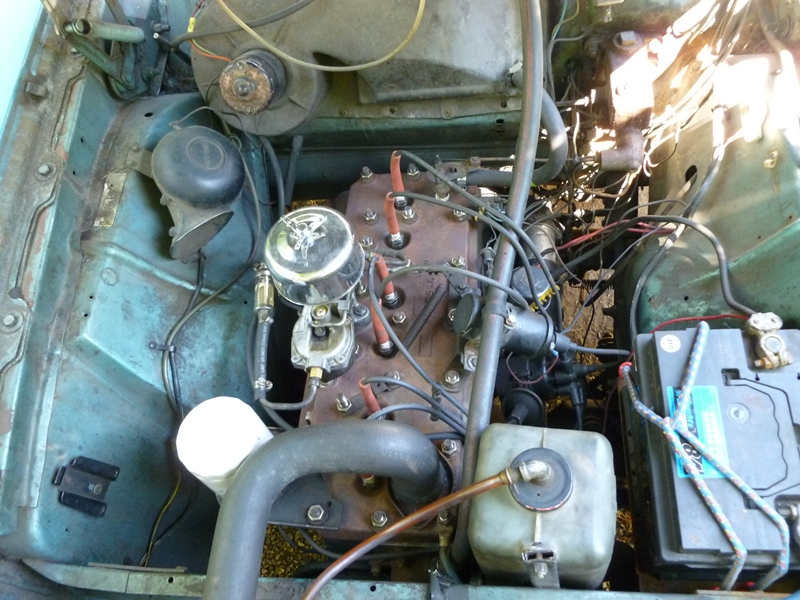
Yes, when I lifted the hood on that “all-new” American in the dealer showroom, I just about decided to head back to Austria. There, down in the bowels of its snug little engine compartment sat a flat head six. So much for “all-new”. As a kid, I knew I was looking at 1920’s or 1930’s state of the art. This was, by far, the last flat head in an American car.

I might have been dismayed then by the primitive little 195.6 cubic inch long-stroke six that made all of 90 (gross) hp, maybe about 75 or 78 in today’s net ratings. But now, I revel in its simple visual delights. No, the jet age had not yet arrived under the American’s hood, where its flat head six lumbered on through 1965.

No, that’s not a stock air cleaner on that little carb. These sturdy-enough mills preferred to spend their lives chugging along at between 1000 and 2500 rpm. Anything much above that felt strained already.

This Rambler is best enjoyed (visually) as a humorous time capsule, as are its many details. Like the trademark finely-ribbed aluminum window frames: a better solution. Even if they did eventually get old.

The American’s odd shape in the big picture results in many curious little snippets, like the his door handle at the far end of that side protrusion. I could go on…

The truth is, I’ve come full circle, and love this little ugly American, with its too-narrow track and all. And of course, I’m not the only one. Its owner is a young woman, who recently picked it up. It’s madly cool now; even more so than all the more prolific old Falcons young folks are driving now. A wide-hipped boxy Rambler American: it doesn’t get much hipper than that, literally.

As I stood there staring at this American, reflecting on my fifty years of feelings about its boxy body, something kept tugging at me: there actually is another car out there that it reminded me of. I’d had the feeling before, but couldn’t quite place it. Suddenly, it popped into my head. Of course, the Volvo pulled it off a lot better.


Finally. A reason to love the Studebaker Lark! Really, you have to give the AMC designers credit. As hard as it was to modernize the ’53 Stude, it must have been much, much harder to do so to the 1950 Rambler.
The sedans seem to have taken the facelift better than the 2 door. The less said about that greenhouse the better.
But Rambler at least got the engine right. I think that it was 1961 when Studebaker tried the ohv conversion to the old Champion 6 that was less than successful.
I wonder if any contemporary road tests compared these two, either in 1960 or 61. It would be interesting reading.
Dec. ’58, not ’60 or ’61, but close. http://goo.gl/LCkAo
Thanks. An enjoyable read. Later in the magazine is an article about what’s new with Edsel, Mercury and Lincoln for 1959.
What a fascinating read. Many thanks for the link. Interesting to note they measured visibility of the road ahead – that would be an interesting statistic for many cars!
JP, good point that Studebaker stylists had a much easier job updating the 1953 Studebaker body. The Lark looked more modern than the American even though it carried over door sheetmetal.
For 1961 the American came with either the standard 196 cid L-head or an overhead valve version. I don’t recall the latter having the problems that plagued Studebaker’s new OHV six.
I’m only talking about the cast-iron six. Justpassinthru writes below about problems with the aluminum-block version of that engine, which for 1961 was available on the larger Classic models as an extra-cost option. Aluminum blocks were trendy at that time because they held out the promise of less nose-heavy front ends.
I vaguely remember Dad using the garden hose to put out an under-hood fire on our American (I was maybe 5 or 6). I think the slightly used ’68 Country Squire LTD wagon showed up shortly thereafter…
Here it is:
The Rambler Americam was the first car I drove. The only thing I really remember about it was a collision with a never before seen Toyota. The Toyota swiped my car on the right headlight area doing about $35 in damage. The Toyota was totaled. Made me a fan of the little tank!
Supposedly George Romney told the stylists to modernize the American, but they weren’t to change the car’s basic structure, and they weren’t to spend much money doing it. If I recall correctly, the 1961 model boosted sales over the 1960 model, which is amazing when you consider that it was less attractive and there was a brief recession in 1961. The rear wheel, in particular, looks as though it does not fit properly with the body.
Yep, if the rear wheels were moved back so as to be centered in their openings they wouldn’t have intruded into the back seat so much.
It looks like a childs rendition of a Cortina
My thoughts too!
I’m still sure I read a Bill Vance article that clearly link a designer associated with the Studebaker Rambler American, with the later by one year Ford Cortina mkI.
AMC clearly did not learn this lesson because they repeated that mistake 15 years later. The Pacer’s rear seat similarly sits between the wheel wells, erasing much of the potential advantage of the wide body.
Those door handles always looked to me like they came from a Kelvinator fridge.
Nash Kelvinator they probably did.
I actually own a N-K fridge, and can confirm they did not, at least, not from the late 40s model of refrigerator… (c:
My brother has a Kelvinator fridge and the interior light has the same lens and trim ring as our ’63 Classic 660. Dont forget that GM (Frigidaire) and Ford (Philco) also made home appliances. Ford even made TV’s.
I wonder whether GM or Ford used fridge parts in their cars, LOL?
I can’t see how nothing but old widows that used to buy Plymouth Cambridges drove these. I can’t see how functional they would be at Freeway speeds without being uncomfortable with sustaining 60-65mph.
I see plenty of Falcons, Corvairs, Valiants and even a stray Lark or two on the Freeway (more likely a Lark VIII) and they aren’t necessarily banished to the far right lane doing 50 in modern traffic. They can at least keep up with a 240D. I’ve yet to see an American on the freeway….
They’d trundle along at that speed ok. It still had almost three times the horsepower of a VW Beetle at the time (36 hp), and the VW would cruise at 68 mph all day long, on level ground.
The American was the cheapest American car; sold to quite a few young families needing basic transportation. They were pretty common in Iowa City at the time; university town with lots of young families. Roomier than a Beetle by a fair shot too.
I always forget the power of Overdrive, which these had as an option right? And they got Borg Warner 3 speed automatics as options too, right?
Right on the 3-speed BW automatic (with the lightweight aluminum T-35 debuting in 1962.) These weren’t advanced cars, but you could get PS and PB and AC starting in ’61, plus reclining seats and a cute convertible. The Ford Falcon offered none of those, plus as ancient at the little flathead 6 was, it would easily outrun the Falcon’s 144 CID ohv engine, and get better MPG’s doing it. Look at the Pure Oil Economy Run results from ’61 and ’62 and you’ll see that this re-skinned car performed surprisingly well!
The engine might have put out much the same power as the Falcon, but it was much larger as well as being a long-stroke design, so I suspect it might be torquier.
Some perspective, I live in central Maine. You refer to the “freeway” which we call the “Interstate”. There is only one around here and it is I95. It wasn’t opened until 1965 or 66 I believe. So when this car was built “freeway” travel was not the issue that it would be today.
The greenhouse and sidestripe look stolen from the MK1 Cortina even the rear lights grille the whole car looks cortina with the proportions stretched and mangled
I dont recall ever seeing one of these in the wild but no doubt NZ having a starved car supply back then some did exist this POS didnt compare well with anything I read th PS article it had the same HP as a Zephyr but a Zephyr looks good and has more room. OMG a sidevalve I thought only the Ford popular retained this 1920s feature so late in the century, according to PS it coukld reach 60mph so you could take it on a highway but I already have a car from this era that is better styled more modern mechanically and better put together.
Harley Davidson were still making (and winning races on dirt tracks and tarmac with )flatheads til 1969!
Although obviously these predated the Mk1 Cortina by a good two years.
So the Cortina was a Rambler done right!
It had “side crumple zones”
Ugh, the Volvo 240. Growing up in Maine in the 70s-80s I had the same feelings about them that Paul had for Ramblers in 61. And those Volvos weren’t cheap…
That Volvo at the end is a 144. MUCH better looking than the American, thought they were fugly as a kid, and time has not helped…
I would jump all over this if it was the 2 door HT version! I’ve often considered getting one as a fun summertime commuter…its probably good that I haven’t found one because my 70 mile a day round trip isn’t what one of these deserves!
In addition to the hardtop there was a cute convertible version.
Yeah, cute in the sense that bunny slippers are cute.
At least it removes the jarring, eye-drawing horrific matchup of the 1950 greenhouse with the erzatz-modern cubist body!
Yeah…I think a convertible would be the way to go with that car. An Austin Powers swinger-machine, what?
there was a cute convertible version
The convert works a lot better with the top down. One has been showing up at the meet here, though it had a for sale sign on it last summer. Same red color as your pic, but with the groove on the side painted white. You can see part of it behind the newer American with the 401 in it in the pic.
The convertible just underlines the fact that the sedan’s roof design was all wrong. A vertical B pillar and thicker C pillar would improve it out of sight.
I saw a lot of these when I was a kid. Partly because we owned a Rambler, a 1962 Classic 400, and it spent a LOT of time in the shop.
And partly because the Rambler dealer, later the Renault-Jeep dealer, was two blocks away from my childhood home…and home for a considerable part of my young-adulthood in the early 1980s.
Say what you want about the flathead 6. And you’d be right…but up one rung on the model ladder, there was the Classic…with the broiler-foil six – and a bigger failure in aluminum could not be imagined. Our own, had an oil leak…IN THE BLOCK, with a porous defective casting. It was replaced with an iron-block six…being as how I was, at the time, six years old, I don’t recall if the replacement was the 232. I don’t believe, however, that AMC paid for it, over and above having engines readily available for all the disgruntled customers.
So yeah…by default, the flathead six wins.
This car’s proportions are awkward, agreed…but the wagon wore them better. Fact is, I always thought a 2-door wagon would make a nice counterculture ride.
It must have been embarrassing to be a dealer flogging these things to an innocent populace who no doubt were excited at the prospect of a brand new car to show off in their driveway.Its a sad inditment that the best engine in the 6 range was an ancient design and the dealers actually stocked replacement engines thats unheard of almost BMC quality.
Ah…you misconstru, Bryce. It wasn’t the flathead six that was failing – it was the new-in-1961 196 OHC six which kept failing.
http://www.oocities.org/dr_rambler/history.html
AMC had many, many problems in the years 1954-1979; but one of its biggest was created with the 1961-62 boom years: They overbuilt but underengineered their products. They were prone to rust; to poor assembly quality; to engine and automatic-transmission problems.
Not all of that was completely their fault. Salt as a melting agent on the roadways was still relatively new – it became commonplace in the early 1950s. It took some years for problems to show up; and many more for even the big companies to address the corrosion issues. The automatic transmission problems were that of AMC’s supplier, Borg-Warner; the product was inferior (I can attest to that on TWO different examples, fifteen years apart). The aluminum six was new technology, released by a company which didn’t even have the resources to BUILD it (the block was cast by Doehler-Jarvis), much less engineer it properly. It was, literally, beta field-testing by the consumer – and the tests failed and consumers were very, very angry.
One more step down the latter for a company which could ill afford it.
Interesting link did Chevrolet not hear about this failure as they repeated it with the Vega with similar results
See, GM had its own problems with aluminum-block engines — the Buick and Oldsmobile 3.5-liter of the same time was also troublesome.
However, the issues with the Vega block were really not the same thing. There, the trouble was not so much with the block manufacture as with the linerless bore surfaces, exacerbated in the Vega’s case by marginal cooling capacity and oil supply. Both the Rambler and the Buick/Olds engine had cast-in iron cylinder liners, so whatever the engines’ other problems, that wasn’t one of them.
Overhead valve, rather, not overhead cam. I think part of the issue was that the aluminum block was die-cast, much like the early Buick/Olds aluminum V-8s of the same time. Die-casting something that complex was a real challenge for contemporary metallurgy and it gave GM fits as well. (It’s notable that when Rover bought the rights to the Buick engine, one of the first things they did was to redesign the block for sand casting; I gather that there was no one in England at the time who felt comfortable die-casting an aluminum cylinder block and Rover didn’t want to chance it.)
Rootes did for the Imp engine, in fact they adapted the sand-cast Coventry Climax do die casting with cast-in iron liners. Of course the blocks then had to be sent to Coventry for machining before coming back as an engine to go into the cars.
One other thought: By the time the troubles on our Rambler became obvious, AMC had completely rebodied their cars; had replaced the broiler-foil mill with the now-legendary series of sixes (culminating in the 4.0 Jeep engine, now deeply missed) and had started to phase out the “Rambler” name. They made big mistakes; they blew it – and they knew they had. Later AMCs were unrecognizable in comparison to Ramblers of those years; and little was shared, other than the B-W auto transmission. Those stayed around until 1972, to be replaced by TorqueFlite transmissions.
So, it probably wasn’t out-and-out fraud. Later AMCs were better built…I can attest, as I had a 1972 Gremlin in 1987. Good car, other than the lo-buck three-speed manual, which went out and sealed the car’s fate.
I see the 63 Valiant’s styling owing alot to these American’s
That’s a Virgil Exner original, exc for the vertical blades on the rear fenders ordered by Elwood Engel at the last minute. Any resemblance to another car probably is a coincidence. Virgil was defiantly original–to his detriment, at the end.
I had a chance to buy one of these (in Kelvinator White) for $400 when I was in high school 30 years ago. I test drove it and it strained (as in gas pedal flat on the floor) to go up moderate 3 or 4% inclines that my 1600cc Karmann Ghia just required a little more throttle to conquer. The extra body weight+slushbox+terrible aerodynamics just killed it. It even had the same six as pictured in the article. It was pleasant enough on the straight and level. The guy also had a 318 ’66 Coronet for about the same price, but it had a lot of trouble starting and every body panel was a different color – I drove off feeling grateful for the condition of my Ghia.
Sure, the 1961 American doesn’t look as graceful as its predecessor. But then — as now — buyers tended to gravitate to new sheetmetal. American sales increased for 1961 even in a down market. As a point of comparison, Studebaker Lark sales fell sharply.
At any rate, the pre-1961 American was soooooo ugly that it just begged on bent knee for a redesign. Only a reskinning could possibly do the trick.
AMC historian Patrick Foster has described the 1961 American as “a real beauty, a jewel of a small car.” I’d instead call it remarkably amateurish — even for the time. No wonder chief designer Ed Anderson wasn’t given the promotion he longed for.
One has to consider what Anderson had as a starting point, and how much money he was given for the job. Could Bill Mitchell have done much better with those considerable constraints?
Anderson was given a clean sheet of paper, and a reasonable budget, for the 1963 Classic and Ambassador, and the results were quite good.
Bill Mitchell isn’t the ideal example because he was an admitted big car kind of guy.
But, yes, I do think Anderson could have done much better in pretty basic ways. For example, why did he choose to accentuate the “shrunken head” look of the greenhouse with radically squared-off fender shoulders instead of a more tapered design, a la the 1963-66 Valiant? Did someone accidentally shift the drafting paper, thereby throwing off the proportions for the wheel well cutouts? And who on earth thought it was a good idea to square off the c-pillar, thereby making the back windows of the two door way too long? None of these beginner’s mistakes were necessitated by the old body’s inner panels.
The 1963 wasn’t a bad design but it had weaknesses that required costly fixes later on. The body’s teardrop shape was unusually pronounced for the time, which put Rambler at a disadvantage versus other mid-sized cars regarding rear leg room and luggage capacity. The “shaver” front end lacked continuity with previous Ramblers, and the overly tall cowl was quickly ruled obsolete by GM’s 1964 mid-sized cars.
“Bill Mitchell isn’t the ideal example because he was an admitted big car kind of guy.”
Wasn’t he the guy who said designing a small car was like tailoring for a dwarf? If so, it reflects on his personal limitations and mind-set. Plenty of designers are great at doing small cars. It’s just that most of them happen to be Italian, and probably would equally have problems designing a Mitchell-era big car.
Despite its Volvo-ish sensibilities, the wagon is the worst model of this series from a space efficiency standpoint. As the second and third photos of the coupe show, the rear greenhouse on the coupe, although tapering in, was still wider than the decklid opening. In order to build a wagon on the cheap, using the same rear quarters as the coupe and a tailgate that obviously makes use of part of the decklid stamping, AMC had to pull the greenhouse even farther in, making it ridiculously narrow.
Amateurish is being kind thats truly pathetic I can see why it was cheap being roomier than a VW is no recomendation these must have been hard to sell to sighted sheeple
Like Paul I enjoy these cars for their quirkiness. There were a few in the wrecking yards during my teens and I too was fascinated by the flathead 6.
I can’t imagine buying one new, but as a $3k collector car these have a place in the old car hobby. Anyone who complains about Hemi Cuda and A/FX altered wheelbase drag cars being out of reach, here is your ideal ride. Somehow it already looks like the wheelbase was altered (or maybe that it should have been and it wasn’t).
I’ve seen some of these Ramblers very heavily rodded and for sale, but even though you can put $80k into your 61 American project it’s still worth about $3k..
The Rambler American – U.S. Trabant!
I used to see these often, but the Rambler Classic was much more numerous. In fact, my best friend in the mid-60’s – his dad owned one!
That was my first thought looking at the top pic. What a dog.
Beauty! My sister bought one of these new from the factory when she was teaching in St.
Catharine’s Ontario. My dad bought it from her when she got married in ’65 replacing his ’51 Dodge Regent. It ran like a top until the flat 6 finally collapsed a few years later.
Visual appeal endorsed by East German Stasi
Didn’t some British wag say of it that it looked like “a ruddy ordinance vehicle” ?
That was my first thought also……
“Richard A. Teague, chief designer of AMC’s Javelin, recently commented that, “I remember my first visit to American Motors, I arrived with an English designer, both of us considering whether we wanted to work there. The first thing they showed us was the clay model for the forthcoming 1961 Rambler American. ‘My God, Dick,’ said my English colleague ‘it looks like a ruddy ordnance vehicle.’ ”
I agree with that opinion. This was Edmund Anderson’s creation – and it’s clear why Dick Teague was soon thereafter selected VP of Design.
And since we’re talking AMC, nice article here on the Javelin:
http://www.javelinamx.com/javhome/articles/ca87-jav.htm
FWIW, the all-new 1963 Classic and Ambassador were also Anderson’s work; his last. And he did a pretty decent job with them. Teague’s first assignment at AMC was the 1964 America, essentially adapting Anderson’s ’63 Classic body, narrowing and shortening it, and giving it some new design features.
https://www.curbsideclassic.com/curbside-classics-american/curbside-classic-1963-rambler-classic-660-ed-andersons-departing-farewell-is-a-classic-as-well-as-motor-trends-coty/
Thanks Paul, yes I agree, the 63 Classic and Ambassador were much more aesthetically pleasing designs. I actually think the late 50s “clean-up” of the early 50s Rambler American was very good looking given it’s origins – clever work by Mr Andersen.
‘My God, Dick,’ ‘it looks like a ruddy ordnance vehicle.’ (In an English accent.) Recalling his quote makes me laugh every time I encounter a cracker-box Rambler American! My area was lousy with these ungainly little boxes everywhere when I was a kid, we had a number of highly successful Rambler dealers within twenty miles.
I still like the Rambler front better than the 2011 Mazda smilely face.
Somebody is still flogging one of these–a four-door, I think–around my neck of the woods (suburban New Orleans). I see it once every couple of months. It looks like it was painted Navy style–with a mop–about twenty years ago. No matter; you have to respect a fifty-year-old daily driver no matter what it looks like.
There was nothing cute about these things.
When I was 3 or 4 in the late Sixties I remember seeing a red and white one pull into our driveway. It belonged to friends of our family, and I thought it was the ugliest thing on wheels. Nice people, ugly car. I’d take our ’67 Beaumont any time. Years later, I saw an American convertible in a used-car lot that looked like it had been through more than a few owners. My opinion of then hasn’t changed much.
My grandmother had a 1961 2dr sedan American in seafoam green with a white top. I remember it had auto and I think that was the only option. I was only six when she traded it in on a new 1967 Dodge Coronet 440 2dr hardtop with a 318 V8 with the two tone blue interior. I was impressed.
I’m a champion for the underdog,I like Edsels and follow 2 crap soccer teams but I’d take a Falcon or big British Ford or Vauxhall over this.It really is yesterday’s dinner warmed up
Please more Jeeps for AMC week! AMC contributed a lot with Jeep and you have covered the Renault-ness of the XJ Cherokee. How about some history on the AMC 232, 258, etc. Or a Jeep ZJ Grand Cherokee would be cool.
Well, how about a Jeep Week some time? The subject deserves more time than we have room for this week, so this will likely be the only Jeep post this week. Sorry.
I find the Volvo 240 rather attractive. The ’61 American reminds me more of the later godawful Bertone Coupe.
It’s so square it’s hip…
Nice!
My sister bought one of these brand new in ’61, during her first year of teaching in st. Catharines Ontario. Unfortunately she didn’t have a driver’s license, so my dad had to take a bus from Flin Flon to drive her home for the summer, a trip of about 1800 miles. The car last until ’68 when it up and died a sudden death.
I love the ’63 hardtop and at least appreciate the others as a curiosity, although even the HT roof can only do so much to hide the extremely weird relationship between this car’s upper and lower parts. The best looking body style was the convertible, but only with the top down. I also agree that the earlier American dash looked better and more upscale, but this one isn’t a bad design either.
I do have to admit that there was never another car that more accurately fit all the Rambler stereotypes, most of which are negative stereotypes. Everything about it screams offbeat and cheap, and I might not have the same enthusiasm for them had I actually been around when they were new. When I think about them, I forget their dumpy, bland reality and they all look like the car pictured below – which comes from a site that has lots of detailed information on hot rodding the Nash OHV six and the ’61-’63 American chassis: http://www.wps.com/AMC/1963-Rambler-American/
I’m glad my dad got the restyled 64 American,a much better looking car. With the earlier American, they could have styled it like the Classics ,using the same doors and windows, like they did with the 64 , 65 and 66 Americans and Classics. For starters, they could have turned the grill upside down on the 61 American, to give it a big smile, like the Valiant and the Lark.
When I was a young child, my father (who preferred Cadillac coupes and Buick Rivieras), warned me if the Russians won the cold war and invaded America, all our cars would look like Ramblers.
Needless to say, I was horrified.
Perhaps the worst-looking of the ’61-’63 Ramblers is the two-door wagon with its hodgepodge of variously-angled roof pillars.
When I was a kid a very miserly neighbor traded in his ’57 Plymouth Plaza with zero options for a ’62 American with zero options. I was about 11 years old at the time and as appalled by this shitbox as Paul N. was. In ’67 he traded the American in on a new Falcon wagon, again with zero options. He died at a relatively young age in ’69. A few months later his long sufferings wife traded the Falcon in on a new Ford Country Squire, loaded with A/C, the 390 and lots of options.
Apparently it was a case of life after death: after her miserly hubby died, she had a life, and intended to live it to the max.
Those huge rear side windows that are nearly the size of the front windows, along with the thin B- and C-pillars, is what fouls-up the roof design more than anything else. As mentioned earlier, the convertible with the top down is nowhere near as bad looking.
In fact, the rear windows are so big, I really suspect it’s by design, as in, all that glass area is an illusion that makes the narrow rear seat seem much larger than it really is, like covering the wall of a small room with mirrors.
They may be retro-cool now but I still think they’re butt ugly. The amazing thing is that AMC sold ANY of these things in the 1969-63 era considering all the new snazzy compacts recently introduced to the market by the Big Three, and even Stude’s ancient Lark was more attractive!
One good thing the Rambler flat head has over the later 232 and 258s is you never have cracked, warped and leaking intake and exhaust manifolds. The latter l’ve repaired so many of. The flat head dating to the early 50s has no external intake or exhaust manifolds.?
I too, find these oddly attractive in their styling. Not enough to want to buy or own one, but I can see the appeal. Part of the retro appeal of them is that there’s not many around anymore (much like most of the basic transportation cars through the years), and the “loser mobile” status that the car had for decades has been subverted by hipsters, driving it to be ironic. The high belt line/ short greenhouse and smaller windows actually predict a similar trend in newer cars of the last little while. The Falcon had a much airier and more upright greenhouse; same thing with the Nova, so the styling did have some uniqueness for the time.
I also agree that the rear wheels have always looked weird as they are pushed too far forward in the wheel well.
I’ve owned two of these ages ago, back when they were just common used cars – a ’61 4-door sedan and ’62 2-door. Both had the flathead six and three-on-the-tree manual transmission. They were reliable cheap wheels and not much else. Underpowered, clumsy handling, slow steering, lousy brakes. (Though the ’62 did have dual circuit master cylinder.) On the plus side they were economical to run and easy to work on.
Yeah, they were ugly, but when looking for minimum cost transportation one tended to overlook that. AMC sold a lot of these (by their standards) to people looking for low-buck new cars and they stuck around like road cockroaches for years afterwards, moving on to cheaper and cheaper owners.
BTW, if it hasn’t been mentioned, the featured car on the TV show “3rd Rock From the Sun” was a 1962 American convertible driven by the aliens. Stylish!
I agree that it is hipster-chic to own one now, but is that driven by irony, or is is just that folks who consider themselves outsiders may be attracted to outsider art? Those whose tastes are already outside the norm would be drawn to these, to the low-buck, less than stylish offerings, rather than the flashier, more stylish models that appealed to the masses. I doubt that hipsters drink Pabst Blue Ribbon because it tastes good, but they seem to like it. When you are a contrarian, you make your choices using a different set of criteria than most.
“…land of dreams…”
A belated happy 4th of July to our southern neighbours.
I can definitely see hints of Mk1 Ford cortina in that Rambler
I believe that you could have one of those with the iron ohv 196 if you asked nicely. A classic case of making do with what you have.
I always thought that Toyota had the 2 door American on the brain when they designed their 2 door Echo.
My mother had a white 61 with a blue interior. It had a fatal flaw. HORRIBLE engine mounts. Twice the engine slide forward and the fan cut the radiator. Terrible experiences. Other than that, it was a decent transportation car.,