

(first posted 8/3/2011) Mirror, mirror on the wall, who is the fairest Pontiac of them all? Pontiac’s golden decade, starting in 1963, has plenty of contenders. The ’63 full-size Pontiacs, headed up by the mile-stone Grand Prix shocked and revolutionized the whole industry. Some love the swashbuckling and hippy ’65 GP, or the even the more voluptuous ’67. The midsized Le Mans and GTO has its fans, as does the ’71 Firebird . But the ’69 Grand Prix may well be the one, for sheer dramatic effect, proportions, and its more restrained size.

Like (almost) all of my CCs, this was not a staged shot in any way. I was driving out West 11th, in the late afternoon, when I saw the GP. I was pretty anxious about how low the sun was already, because I’ve had trouble with that before, especially with dark cars. But as I stood facing that six-foot long hood, and saw how the low light and shadows were playing in its folds, suddenly a dreamy ’69 GP print ad appeared in my mind’s eye, the one you’re looking at here. It had been forty one years since I saw it in Time or Life, but Pontiac’s ads rendered by the team of Art Fitzpatrick (the cars) and Van Kaufman (backgrounds) tend to leave an indelible impression. I moved around until my mental picture corresponded what I saw in my camera, and hoped they were close.

The ’69 GP was a major departure for Pontiac, since it had always been the standard bearer of the full-size line. But the big GM B-Body’s ever-bulging hips and interminable overhangs took their biggest toll on the GP. The Mustang had redefined the sporty coupe on a drastically smaller scale, and mega-sized sporty-personal luxury coupes just weren’t cutting it anymore.
But rather than toss all that grand name equity overboard, a whole new approach was taken, and one with a decidedly Mustangian flavor. Take the bread and butter intermediate coupe body, but hang the longest hood this side of a Duesenberg on its front. Well, that was obviously in someone’s mind, given that the GP now sported the Model J and SJ monikers. What had worked so well in transforming the Falcon into the Mustang would be taken up a notch. And perhaps for the first time in a decade, GM actually created a new niche in the market, by using Ford’s playbook.

Brilliant, in defining the very shape and concept that would take the whole market by storm: the mid-sized and affordable personal luxury coupe. The Olds Cutlass soon latched onto it and rode it to the very top for what seemed like forever. The GP also anticipated the demise of the full size car, or at least their leading role as trend-setters and glamor-mobiles. Increasingly, full size cars became more sedan-focused, as the big coupes became irrelevant. Which makes sense, given how huge they were becoming, especially after 1971. Pontiac saw this in advance, and their move with the GP signaled a coming corporate-wide shift to “mid-sized” coupes as the standard-bearers and as the big sellers.

There’s always a price to pay, and in this case it was the interior. It’s virtually indistinguishable from a pedestrian Le Mans coupe of the same vintage. The big, old GPs came with buckets, console and those magnificent chrome-plated altars of a dash. Well, those were all being sacrificed on the altar of bean-counting anyway. The high quality interiors with the buckets and console had once been such an integral part of what defined a GP.
The sixties marked a big shift by GM and the rest of the US industry in de-contenting luxury cars to keep their cost down and dramatically boost volume (and profits). In the process, they lost their exclusivity, and opened the doors for the imports. Buckets and console, along with pretty much all the other goodies, were on the long option list. The 428 HO would be a good one to check off.

The ’69 GP’s price and sales stats tells this tale: its starting price, $3,866 ($22,460, adjusted) was lower than the inflation adjusted price of its full-size predecessor, but not by nearly as much as it was cheaper to build. Let’s not forget that this is a Le Mans coupe with rhinoplasty and a new C pillar. Sales exploded, to over 112k, four times its bloated ’67 predecessor. Profit margins undoubtedly increased by at least that amount too.
The ’69 GP’s use of the 118″ mid-size platform did come with a price: it had to share the body shell with Chevrolet, for their new Monte Carlo. Pontiac did get the first year for itself, as a reward for its efforts. But sales dipped in 1970 and for the rest of this body style through 1972, probably because of the MC, and competition from the growing field.

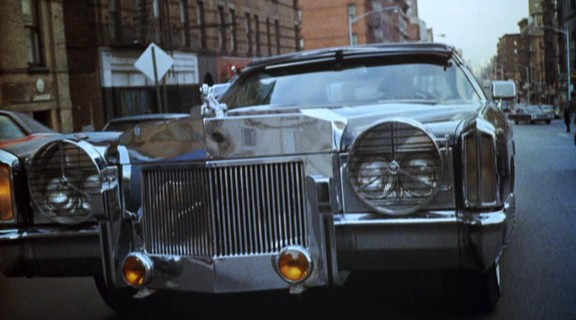
Speaking of 1971, there are some who probably like the refreshed face of the ‘71 – ’72 GP even more than the original. With its single headlights and more “classic” grille, it unfortunately became the prototype for all those garish seventies “Super Fly” customs and pimp-mobiles, like the Bugazzi. That’s where this handsome coupe starts lose it for me; it and the Lincoln Mark III shared the same proportions and details that were too obvious retro with their exaggerated long hoods, classic grilles, vinyl tops, and other affectations. The 1963 Grand Prix was a true a trail-blazer; and the ’69 rightfully a pioneer of the new market niche, and a trend-setter for a garish decade (or two) of coupes to come.



Those cars had one of the coolest door handle designs ever. In 1969 our next door neighbor had one in Royal Blue Metallic with a White roof and interior which is always my mental image of this generation Grand Prix. It made a sharp contrast with my parent’s Mercedes 250S and the across the street neighbors VW Squareback.
Was this design used on the ’71-78 Toronado too? They look similar. Did any other car use them?
No. Toronado was an E body, along with stablemates Cadillac Eldorado and Buick Riviera. Pontiac Grand Prix was a G body until 1973, when they were folded into A bodies. Monte Carlo by Chevrolet shared that platform, along with Buick Regal and Oldsmobile Cutlass.
Wonderful writeup of a car that I have not thought about enough over the years. I have been re-reading John DeLorean’s book “On A Clear Day You Can See General Motors”. He led the Pontiac Motor Division from the mid 60s until 1969 when he was transferred to Chevrolet. DeLorean was proud of this car and of the Division’s efforts to bring it about. He had a pretty smooth-running operation at Pontiac in those years, much of which he attributed to how divisional leadership listened to the Dealers about what would sell and what wouldn’t.
This car may represent the last new passenger car market segment that GM identified and was successful in. Probably because it was one of the last products that was conceived, designed and built by one of the Divisions and not by a centralized GM.
I always loved those Pontiac mag wheels with the “PMD” in the hubs. And I second slow_joe_crow on the door handles.
I don’t remember from seeing these in person, and I can’t tell from the pics, what’s special about the door handles?
I’ve always liked the door handles on Corvettes that were on the top of the fender, and you just push down with the end of your fingers, the ones on some 50’s Imperials where you push on a pad at the end with your thumb and the handle pops into your hand, and the handles on “bullet-bird” T-birds that are integrated into the stainless trim.
Always wanted to read DeLorean’s book but can’t find a copy. My dad had it once, but he lent it to someone and they threw it out instead of returning it. 🙁
Door handles are the kind that you push in with your thumb and the handle pops into your palm to pull.
I got my copy of the DeLorean book via Amazon.com. Actually, I suggested the idea to my kids for a father’s day present and they ordered it there. A hardcover, even! Definitely worth reading. The “centralization sclerosis” was in full swing at GM in the late 60s. DeLorean seems to have been fighting it then and losing and eventually quit.
Thanks for the tip. I would recommend Dewar’s book “A Savage Factory”. It was a very entertaining read about the crazy worklife at a Ford transmission plant in the 1970s.
‘On a Clear Day You Can See General Motors’ should be taken with a grain of salt. In fact, there are other, unauthorized biographies of Delorean that, when read along with his book, paint a much broader, more accurate picture of the man. In short, while brilliant and charismatic in the sixties, his unbridled GM success was his ultimate undoing, eventually bringing his flaws to the forefront (primarily his vanity).
Oh, this is probably my favorite American car design of all time. My Dad had a ’72 (single-headlight) Model J with the 400 ci engine and auto on the floor. Loved looking out over that long hood. Big twin pipes made it very ballsy. A total macho machine for sure. This one is in great shape, although the column-shifted automatic is kind of strange….
http://i24.photobucket.com/albums/c30/ddibiase/WebpagePics/72GrandPrix.jpg
Dan D
One of Pontiac’s most successful merchandising/product planning efforts, but far from my favorite sixties Pontiac. A lot of late-sixties and seventies styling is really not to my taste at all, and this is a prime example; I much, much prefer the pre-1965 GPs.
I second that, I think Pontiac Styling became rather baroque after 1967. I can tolerate the fender skirts on the 1965-66 Bonnevilles, even if that made them less sporting to the eye, but the Full Size Pontiacs jumped the shark in ’67, and the A bodies were the least pretty out of the lot from ’68.
The hips that sprouted on the 1963 models ended up benefiting the C Body Deuce & A Quarter and Delmont/Delta Eighty Eight the most in my eyes between 1967-70. I’d take the original, dechromed 1962 or the 1964 Grand Prix over this, or I would have forked over the extra $2000 for a Buick Riviera, which was in it’s last year of not being overtly baroque.
Not bad, but I have a soft spot for the ’65 Parisienne Custom Sport w/ fender skirts.
http://www.flickr.com/photos/carphotosbyrichard/4956354753/
@smelter rat…..Nice 65, and a very nice GP. However,to this old Poncho dude,nothing comes close to a 63 Parisienne convertible.
Nice car show
There are so many candidates for the first “personal luxury coupe”, this post is spot on for giving the GP the prize for defining the midsize personal luxury coupe. My Lincoln bias puts me at arguing that the Continental Mark II is the real first personal luxury coupe. Well maybe Mr. Niedermeyer put it best in his CC to the first Lincoln Continental as the real first personal luxury coupe. I always thought the proper order should be : Mark I-Mark II-4 seater T-Bird-Riviera-Big GP-Eldorado-Mark III-Small GP- the rest of the Personal Luxury Coupe Onslaught. The 60’s Eldorado is really a Cadillac Mark II with FWD, thats why the Marks did better; for once the Lincoln was the genuine article and the Caddy was the knock-off. It is fascinating how these original retro cars borrowed classic motifs across marque lines- the Imperial and the Cutlass and later Grand Prix would all sport split waterfall grilles like the original Lincoln Continental, side vents as abstracted Dussenberg pipes, hexagonal wheelcovers and how many times has the coffin nosed Cord been riffed as a front end from Lincoln’s early 70’s power dome to the Dodge Magnum & Mirada. That first picture is an amazing match to that advertising, what a great eye.
I’d say Cadillac Sixty Special – Lincoln Continental – Continental Mark II – Square Bird – 1962-63 Pontiac Grand Prix – Buick Riviera – Oldsmobile Toronado/E-body Cadillac Eldorado – Lincoln Continental Mark III – ’69 Grand Prix – Chevrolet Monte Carlo – Chrysler Cordoba – downsized 1977 Thunderbird (in sales terms, one of the most successful of any of these cars) – Lincoln Continental Mark V.
I would be curious how much the Pontiac studio was aware of the Continental Mark III before it came out. Dave Ash, who was the lead designer of the Mark III, said in a 1985 interview that it was really Iacocca who insisted on the neo-classical theme, and that Gene Bordinat, Ford’s chief stylist, only went along with it because Iacocca (and later Henry Ford II) loved it. Ash said that if he’d suggested it without Iacocca’s support, everyone would have thought he was nuts. Certainly, neither the 1966-67 Riviera, Toronado, or Eldorado was particularly retro.
I suppose the 60 special counts for its aesthetics but it is a four door, so it should get points docked for that. I really argue the Mark II because it was purposely designed as a close coupled 2 rows of seats coupe. The 60 special and the first Lincoln Continentals were repurposed/modified lesser brethren.
If I recall correctly, the original 60 Special was considered unique because it offered handsome, cutting-edge styling with a custom-body look in a luxury package that was designed to be driven by the owner.
Throughout most of the 1930s, the true luxury market had been defined by the huge, custom-bodied, multi-cylinder cars that were too cumbersome for many people – particularly women and the elderly – to drive. Hence, the use of chauffeurs, who were usually young or maybe middle-age men. They had the strength to drive one of those monsters, which featured a long wheelbase, very heavy curb weight and no power steering.
The 60 Special could be considered a “personal” luxury car in the sense that it offered the distinction and style of the custom-bodied cars, but it could be driven by virtually anyone who could drive a car. You didn’t need a chauffeur to drive it.
Studebaker Gran Turismo Hawk?
Re: Studebaker GT Hawk, it might have done better if the company wasn’t on its deathbed when it came out, coupled with styling that, while not bad, was just another rehash of the old Loewy Starliner. It was a ground-breaking classic in 1953 but, ten years later, had gotten quite stale, despite Studebaker’s solid efforts at keeping it updated and modern on a nearly non-existent budget.
Ironically, the GT Hawk had a target market that was exploited dramatically by the original Mustang just a few years later with new, hip long hood, short deck styling. In another irony, the GT Hawk was actually quite close to what Henry Ford II had envisioned for the Mustang, i.e., a sporty, ‘mini-Thunderbird’ (which Hank the Deuce would eventually get with the ’67 Cougar). It makes one wonder what influence the failure of the GT Hawk in the marketplace might have had in the way the Mustang was developed.
In short, the GT Hawk wasn’t really in the same realm of personal luxury as the ’69 GP because it was smaller, didn’t have the long hood styling, and aspired to be more of a ‘sporty’ personal car like the Mustang. And it was being built and sold by a company that everyone knew was going to disappear in a few, short years.
In the words of Maxwell Smart, “Missed it by ‘that’ much…”.
Responding to an old comment here but, the 66 Toronado was very retro yet very contemporary. The comparisons to the coffin nosed Cord were often discussed.
I’d say the unintentional dad of the mass market personal coupe was the 1953 Studebaker Starlight/Starliner coupes. They weren’t as roomy (I think) as the Sedans and offered sleeker styling than the Sedan/Wagon line up.
Sure they didn’t initially play up the “Personal Luxury” aspect, but by 1956, you can’t say the Golden Hawk wasn’t starting to be marketed that way, with a price decidedly in upper Oldsmobile/Buick Century range and a Packard V8.
In concept, I would agree, but if you look at the Hawk’s sales figures, the “mass market” part becomes a little harder to justify. The ’53 “Loewy Coupe” Starlight/Starliner sold reasonably well, but the Hawk (whatever its hue), not so much.
Incidentally, I think the term personal car was largely coined by Ford for the 1955 T-Bird, mostly because they didn’t want to insist too hard that it was a sports car.
I think you can safely call the 1953-55 Loewy coupes the first mass-produced personal coupes. These were not limited-production halo cars like, say, the Eldorado or Caribbean.
Like the 1970s Cutlass Supreme coupe, the Loewy coupes shared nameplates and design cues with the sedans and wagons. However, the coupes had virtually all-new sheetmetal, a lower cowl, and they were sold for their style. In 1955 Studebaker bragged that it was the largest producer of “sports cars.”
As a car nut it is surprising to me that I am happy enough with my current daily driver, a 99 Intrepid, Which I guess was Dodge successful answer to the Grand Prix.
I Remember My 5th grade teacher Ms. Mustachio, picking me up in one on the way home from school, because she had a parent teacher mtng at our House. It was Mid Size to Me compared to my Mother’s 63 Marimba Red Gran Prix.
Mom would later pass on the 73 Gran Prix, and instead was happy to get a budget fitting Mark lV sibling, Thunderbird. That was a Spectucular choice at the time looking back, it was 100 % a Continental at half the price. or was it closer in price?
Then A Grand Prix Offered a Tremendous Value when compared to the Thunderbirds and sold in much greater volumes, starting with the 1969 model year, over 100,000 a year many times.
Yeah, that is a favorite GM car from the sixties. I vividly remember Henry N. Manney’s test of this one in Road and Track as it came out.
Quote (from my memory):”Even Henry N. Manney’s wife says it isn’t all bad”.
Love these cars, but another I like is the 1973 Pontiac Grand Am,
hope Paul finds one someday to feature.
I remember my cousins and I (the boys anyway) all thought that series Grand Am was cool, never mind that it was another Colonnade variation. (C’mon, I was about 5-6 years old, what did I know?)
1969 Pontiac Grand Prix
Early 70s Lincoln Mark
First Generation Cadillac Eldorado/Oldsmobile Toronado
First year Riviera
That to me is a list of cars that a man could show up to a first date in (as long as the car is well kept) and not make any apologize unless he’s just picked up a memeber of PETA/WWF/Siera Club. Hell with my lady we might not make it out of the driveway.
That reminds me of an episode of that 70’s show when Hyde has borrowed Jackie’s Dad’s Lincoln Continental ( A grey Continental town car)and after having been left alone at the dance goes up to a pretty blonde. He askes her something to the effect has she ever seen the back seat of a Lincoln Continental? She replies Yes. He then says Wanna see the back seat of this one? She says Sure, why not.
Best Pontiac ever? I’d have to go with the ’63 GP…it was fresh and completely different at it’s launch and I liked the lean, muscular stance. The same reasons the Boeing 757 is my favorite commercial plane.
Though in high school a friend did have one of these ’69’s with a magnificent pearl white finish with the white buckets interior. He was rather fastidious and drove it carefully and didn’t allow anyone to smoke in it…rare and off putting in the mid to late ’70’s.
I remember it being smooth but not excessively wallowing…a great cruising car, albeit a non smoking cruising car!
I too fell in love with the GP at first sight. Until the proud owner popped the hood. The motor sat some four or five feet back from the front bumper? Form has to follow function. It was always the most tarted up whore at the party for me after that.
I know other cars did similar things, (dare they be called crumple zones?) Camaro, Firebirds, all the Lincoln Marks, Caddies, guess this is why I still have an aversion of women with breast expansions.
Nice car I like the 4 light front and the general style What a shame personal coupe gave way to personal barge. Pretty much the end of the line for aspirational Merican cars once the fat sporty look became popular with you guys we got our fast cars where they werent watered down and fed so often, cruising at 70mph on gravel is normal in some parts of the world cars that can do that are good to buy they last well and drive ok especially on tar I like good handling on gravel roads kinda cars and softly sprung land yachts dont work those struggle to stay on a bumpy tar road at 70 if you need to make lots of land miles fast luxobarge is a slow tiring way to go
I think the 1st-gen Eldo, Riviera and Toronado trump all the others, although I have a lot of nostalgia for the early 70s Marks. (But as with the Grand Am, I was a kid and the hidden headlights and spare-tire hump said “cool”, not “schlocky” as they would now.)
I saw a ’72 or ’73 Toronado in traffic the other day and it’s still an impressive, if humongous by modern standards, car…it’s still a shame what happened to Oldsmobile.
’65 Bonneville for me. So clean and elegant. I built an AMT model of this car back then, dark metallic blue. Wish I had it today.
I like these, as well, both this and the similar ’66. I ran into one on the street two years ago, and trying to photograph it made me conscious of the complexity of its body shapes. Jack Humbert, who was chief of the Pontiac studio at the time, apparently made sure his team sweated the details on stuff like that, and it really paid off.
That time period saw some particularly complex curves, and the Grand Prix exemplified the look. It’s hard to find a flat surface anywhere, e.g., the back end has both a vertical “V” as well as a horizontal “W” shape.
The designers did a great job with design details, such as the lovely taper to the front bumper and the much-copied ribbed taillights. I think the 1966 lost some of the 65’s styling nuance.
It’s amazingly graceful for what is, in reality, a very large car. Someone in Harrisburg apparently has a fetish for 1965 Pontiacs – he has three beaters that are still daily drivers. They still look sharp, even with all of the dents, rust and faded paint.
I like the 1965 model front, with the fender that looks as though it is “peeling back” from the headlight housing. In 1966, Pontiac made the leading edge of the front fender flush with the headlight housing, and it looks less dramatic.
In many ways, 1965-66 was a peak period for GM styling. I don’t believe there is one ugly or awkward car in the bunch. Probably the least attractive car during these two years was the 1965 Chevy II, which was a facelifted version of a design that debuted for 1962. But even that one received a very handsome new body for 1966.
You are about dead on…but what about 1969? Ooooh, those full-sized Pontiacs just looked so muscular and took the Coke-bottle thing to new highs.
I totally agree those mid 60’s coke bottle fendered Poncho’s epitimize the best of Pontiac and 1960’s mid price styling to me. I prefer them over this Grand Prix(although I appreciate it Id just rather have a Mark III). Especially the 2 dr hardtops with the sloping fastback roofs. Every one scrambled to tack stacked headlights, the coke bottle fender and the swoopy roof on to their cars. All the low and mid pricers aimed for Pontiac territory-Dodge “Monaco” Chevrolet “Monte Carlo” and where is the most famous Grand Prix held? Plymouth and Ford would jump on the stacked headlights bandwagon. Mid 60’s Pontiacs were style leaders.
Had two AMT models that I used in a Demolition Derby with a friend…A 1965 Grand Prix and a 1966 Bonneville. Wish I still had those…and my life-sized 1969 Grand Prix Model SJ bought used in 1977 when I was 20. It had 83000 cream-puff miles…I quickly made a change to that cream puff thing. Damn, it had the 428 HO, and it’s a wonder I’m still here to type this after 6 months of dogging and drinking. How did i drive that car tipsy and live to tell about it? Oh, those younger, ignorant days.
in the early 70s I biult a model of every ponycar and vette, and one other car; the 69 GP… it had ski racks on top of the vinyl roof!
As for persoanl luxury coupes, my ’90 Olds Trofeo was the best daily beater Ive used…
This will sound crazy but the red bonnie that MikePDX posted is actually literally mine! Love the 65 bonnie. The Catalinas (and Gp) is most like a Bonneville fit for reality (it’s about a foot or so shorter, mainly rear deck length) but when it came time for me to buy my classic there was no question – I wanted un-reality! Beautiful machines!
It`s been re issued, but its definately not 1.99 anymore.
Grandfather had identical car to the red 65 Bonneville convertible MikePDX posted, except it was beige with a white top. I enjoyed riding in it, and driving it with the top down after he passed in 1971. It was still like brand new. This 69 GP is a beautiful car, the only thing I’m not thrilled about is the ‘beak’. GM did a good job of hiding it’s Monte Carlo shell that would appear in 1970. I really like the 70-72 Monte Carlo. My favorites of 60’s Pontiac’s are of course, 65-66 Bonneville, 65-67 GTO and 67-69 Firebird. This example is a great find, and the photo matching the ad is perfect.
Me and Car Buddy Zach crossed the country in his 71 Catalina, in 1995. To my eye that Cat stole this GPs schnoz. And the GP looks like a 67 Eldo around the c pillar. In 69 I think I would have gone with a Charger. In 63 it would have been GP…or Riv…ok both.
I still remember the first time I saw one in the summer of 69. It was love at first sight. I looked for months for a model of the 69 GP and finally found one. I painted it dark green like the first one I saw. Never saw many 69-72 GPs here in East Tennessee so I was never able to get an up-close look. It’s still my #1 dream car probably because it was always so elusive. I did eventually buy a 72 Monte Carlo but it never drove the GP from my wish list. It just seemed to be a pale imitation of the car I really wanted. Thanks Paul for reminding me of what I always considered to be the ultimate 60’s American car design.
The 69 GP doesn’t really do it for me. As far as Pontiacs go, I’d opt for a 68 GTO. That car had a nice font end, at least until they started flirting with hide-away headlights. Also think the 68 Firebird is a beauty. Th 68 GP has a big nose which reminds me too much of a Ford product.
Love the color of that ’65 GP in the link in the writeup: Iris Mist. It seems like every GM division offered a variation on metallic lavender at one time or another in the early 60s. Chevy had Evening Orchid, Buick had Camelot Rose, Olds had Antique Rose, and Cadillac had Briar Rose.
My first post the other day disappeared and is orbiting Jupiter, so I’ll try again:
The design is clean, but after the 1967 full-size GM’s, I lost interest, as they got too bloated and became barges. I went mid-size to compact. my favorite Poncho of all time has to be the 1966-67 Tempest/GTO. To me , that was the epitome of Pontiac design, especially that gorgeous split grille.
The pictured example? Nice, but I prefer the 1970-72 Monte Carlos. A bit smaller and more manageable.
This car’s one redeeming quality? One guess!
My high school auto shop teacher had a 65 Cat with 389/auto, and the cool ‘reverb ‘ rear speaker. This was in the late 70’s, by then even these cars were returning to iron oxide in my area of Northeast Ohio.
I was something of a teacher’s pet back then, mostly because I knew if I was a “good kid”, I’d be able to borrow his Cat to go on the morning run to the local donut shop. That 389 was pretty powerful beast back in malaise 1979.
I like the 69 GP, but it’s far from my favorite Pontiac. I still have to go with the late series Formula Firebirds/Trans Ams from 1975-1981.
You know what does it for me on these cars? That extra wheelbase added to make the front wheels so far away from the base of the windshield and passenger compartment. I don’t know what it is, but any car with that ratio I tend to love. The ’76 Seville is another one where the front end got stretched in front of the windshield really just for looks, and I adore it too.
Personally, I prefer the ’63 Gran Prix; it’s wonderfully understated. The ’69 looks simply like a parody.
All the late 60s GM luxury coupes we stunning, clean lines and each brand had its own identify, how times changed.
When these were new, I was 8 and disappointed they stopped using the big car body for the GP. I was a fan of the ‘sporty big cars’ then. But, the affordable personal coupes were a huge business in the 70’s.
So much so that former full size car owners switched to them. Neighbors traded in a 71 Impala for an 82 Cutlass Sup, and my dad loved his 70 Monte Carlo compared to the big cop cars he drove at work.
I had two GPS. First whenI got home from Nam I bought a Model J with the high output 428, power steering and brakes, radio. It was a dream to drive.Second one was 1970 with the 455 and 4 speed trans, no ac just the power steering and brakes and the 8 track. It to was also a dream. I had it for a few years and sold it to a fellow here in Ohio that raced Pontiacs. he had for 5 years and sold it.If I has known that it was 1 of 329 GPS with the 4 speed I would have it today.I got the VW craze for awhile, a 52 split, 2 56 ovals and 67 single cab. I still want another GP, often bidding on Ebay. I will have another one somedsay for sure
Of course customers could specify the strato bucket seats and a center console (in this case, canted towards the driver and mostly concealed from the front seat passenger). The absence of chrome and hard steel panels in the dashboard was more due to safety regulations that mandated safer dashboards removing any possible impaling protrusions with added padding to cushion the impact of a body crashing headfirst into the dash area. To say that car makers “cheaped-out” is perhaps a half truth at best.
Hey Paul! Look what I found was for sale online at a place that doesn’t look to be too far from you?A 1969 Pontiac Grand Prix! This is it:
http://www.cars-on-line.com/51525.html
I bought my first 69 GP J type in1977 at 17 for $500.00. It had an orange peeled hugger orange paint job,with a 400 auto ,276 gears which made it damn fast. Ugly but i loved the thing. Got my 2nd one in 1980, Green SJ with a 428 . My wife over hotrodded it while i was at work and burnt 3 valves(and yes I was pissed),hasn’t ran since but I still have it,but not the wife. I got the better deal. hope to restore it someday. Still would rather have it than a lot of the new cars around. Anyone that never drive a highly modified 69 GP , in its prime doesn’t know what their missing GREAT CAR.
My second car I bought as a junoir in high school 1977, 1969 G.P. Model J – 400 V8 4bl – 3 speed turbo-hyramatic Warkwick Blue with a dark blue vinal top – dark blue interior fully loaded, power widows,pwr. seats, pwr. door locks, tilt str. wheel, a.c., power trunk, and antenna in the window. It had 89,000 miles and I bought it off the original owner for $600.00 cash! This car was sweet, the interior was mint, and it ran awesome. The paint was a little faded, but no real rust, so it looked good. It handled great and drove really smooth. I had it for a few months before I ever really mashed the gas pedal on it, and man was I surprised! I really think this was the fastest car I ever owned, and would love to have her back now! That interior was like being in the cockpit of an airplane, and was so fun to drive. I shure would like to buy on again.
Why doesn’t anyone EVER acknowledge the 1962 Grand Prix? IMHO it looks better than the ’63. I liked those weird curled-up taillights on the Bonneville and the little parentheses on the Catalina, but the GP did it best withe the metallic parentheses and the hidden louvered taillights. I was only 5 when the 1962 came out, but I remember seeing them and loving them. The 1964s with their “banana” taillights were ultra-cool, too. And that GP had metal bananas and louvered lights, which actually went thru 1967 if I am not mistaken. I was old enough then to pay real attention. So you can leave the styling and features of the pre-1969s alone and let them be the full-sized haulin’ ass cars they were.
Most beautiful Pontiac ever? Thats debatable, but it is a nice car. Never really cared or the “toupe” vinyl roof.It would look better with a full vinyl roof, or better still no vinyl roof at all. Very clean style that got monkeyed around with too much until the all new `73s appeared.However, I`ll still take one.
Don’t know if it’s the most beautiful Pontiac, either, but the ’69 GP is likely in the top five of just about anyone’s list. It was the right car at the right time. Delorean might have been too hip for GM, but his ability to read the market was second only to Iacocca.
There was a 1962 Grand Prix. But in 1961 Oldsmobile had the Starfire convertible, which is probably where the Grand Prix idea came from. Also Buick had the Wildcat, also probably based on the Starfire idea, in 1962. I don’t really see the 63 Pontiacs as hugely different from the 62 models. If what you are getting at is the minimal trim on the 63 Grand Prix, then I counter with the 63 Riviera, which does not have a lot of trim on it either.
But the 1969 Grand Prix was a big change for the Grand Prix, moving off the full size platform onto a midsize. Styling was more of less good, but I don’t quite like the front end. But for what the Grand Prix was, this is the right size. The 71 Riviera would have been so much better in this sized body.
I concur with the above posts in that the ’63 GP is kind of overrated. [Don’t shoot!] It was not a unique body shell like the same year Rivs, and was a Catalina with different trim and concave rear window.
While I like the 63’s, the 62 and 64 are virtaully the same car, a customized Catalina coupe.
A buddy of mine had a used ’72 version of this car. It was the quietest car I have ever ridden in. We could cruise the Texas highways at 75+ and all you could hear is the A/C fan. He sold it for twice what he paid for it in the early eighties.
Having grown up with Pontiacs, I was introduced to the grand prix at age 11, when my Father purchased for my mother a Midnight Blue ’63 grand prix in the autumn of 1962. he traded off her 61 Corvair coupe (Which she never warmed up to) thus began a tradition of Mom having a new Grand Prix every other year, always in a shade of blue. the 63 became a 65 then a 67 followed by a 69. Mom kept her steel blue 69, until 73, when she began wheeling a then new 73 Grand Prix. In once again, a shade of Blue. This was kept until 78 when she followed dad into Buick ownership, a new Regal, In a sky blue, She returned to the Grand Prix in 1981, followed by 84, and finally 1987. This was the last car she owned kept until after dad died in 98 when she sold her car in favor of dads 91 LeSabre (Which I inherited upon her passing and now sits with my other vehicles. Still a dependable DD. It’s is a metallic blue, of course. Every GP was a shade of blue. ranging from Powder to Midnight.
The 1966 Pontiac GTO is the fairest Pontic of all
I owned three of these over the years, and every one had the driver-oriented shifter and console cockpit. I cannot recall seeing one with this configuration.
There were a few in this configuration, but they`re very rare. If memory serves, I recall seeing a `70with the split bench front seat at Alpine Pontiac, a long closed dealer in Brooklyn, NY.
My 8th grade teacher had a brand new ’70 GP in hugger orange, which i believe Pontiac called carosoule red, and rumor had it that his wife was an ex Playboy bunny! When the ’69 came out i thought it might be the most impressive car ever. Now in retrospect our neighbors ’63 GP in seafoam green with parchment interior and soft ray tinted glass was arguably the best looking Pontiac ever.
The 1963 Pontiac GP remains by far my favorite…I love its appearance, everything simply worked together to produce a beautiful automobile. The 1969 by comparison looks like a parody of the concept.
Yeah 66 GTO would have to be my pick as well, nothing really better defines Pontiac in the 60s than that car, inside and out. Split grille, stacked headlights, louvered taillights and tripower, check, check, ckeck and MF’n check!
The 69 Grand Prix is indeed a beautiful design though, but it trended towards the Olds/Buick end of the spectrum, it doesn’t have that distinctive Pontiacness most of the memorable models from the 60s had. Ultimately this car was the opening act of Pontiac’s confusing 70s act, that alone kinda sours it for me.
The ’66 LeMans/Tempest coupes were the same basic car body, though, as the GTO’s.
And? The devil is in the details and the grilles, the taillights, the scoops, the interior and of course the motor are the tailored suit on that basic and already attractive body. A nice enough package on top of an existing bodyshell can be just as distinctive as a truly bespoke body like the GP.
That is the point. The tails were same on the LeMans, and buckets could be ordered on LeMans, too.
One can take any ’60s LeMans/Tempest 2 door and ‘clone’ a GTO. But, taking a ’65 Falcon and trying to ‘clone’ a Mustang is near impossible.
GTO was a performance trim level of existing mid size car line. Not a ‘specialty coupe’.
it is interesting how the biggest trends of the 60s…the pony car, the muscle car, and the personal sport/luxury coupe…have all ended up being combined into the modern Challenger, Mustang, and Camaro.
Many years ago, I worked with a gentleman (Elmer) who had exactly the same car. The car perfectly complemented his rogue persona. He also had enormous hands of which I saw a middle finger every time he drove by.
nice car, I prefer the double headlight versions of the 1969-70 over the single headlight versions of the 1971-72, plus I also liked the powertrain of the 1969-70 models better as well, nice car although I seem to see the 1971-72 GP’s more yet they weren’t as high in production as the 1969’s
Absolutely the most exciting car of 1969. A trend-setter that could be considered the first car of the seventies. I love the SJ leather interior.
The Grand Prix was a terrific car all the way through the sixties. I think the original 62 is the most beautiful, followed closely by the 63. To my eyes, the 62 Pontiac had a certain elegance that was missing in 1963. And, after 1963, the GP seemed to get a little bulkier with every restyle until it was reborn in 1969.
Actually, it’s a scaled down 67 Eldo. Same roofline. Same front fender treatment. Same vestigial tail fins. Same oblong wheel arches.
I really have it in for Bill Mitchell. He saved all the really nice styling for the expensive rides. There really wasn’t anything in the Chevy line that appealed to me at all.
Sorry, but as beautiful as the ’69 GP is, for me it’s the ’61 Ventura Coupe or nothing for a sixties Poncho.
Way back when I went to the 1969 Chicago Auto Show with my dad. I was but a lad of 6 but remember quite a bit of it. My most important task (to me anyway 😀 ) was to get any and all of the brochures I could carry 🙂 . I couldn’t tell you anything about any of those brochures except one… that ’69 Pontiac brochure. That Grand Prix pose blew me away back then, and still blows me away now. Maybe that’s why I’m such a huge fan of ’69 and ’70 Grand Prix’s…
I was around that same age when my parents owned a ’70 Model J, 400 4-barrel/Turbo 400, in Sierra Yellow with brown vinyl roof. I remember that wrap-around dash and brown interior with the Morrokide interior of Strato bucket seats and console with the neat Rally Sports Shifter that had the woodgrain knob and “GP” logo on the top button and the door panels. This GP had the basic options including air, AM radio with windshield antenna, plus Rally II wheels and cruise control. Sadly it was totaled in a bad accident and then replaced by a ’73 Pontiac Catalina 4-door (Valencia Gold with beige vinyl roof) that had a 400 2-barrel which was no slouch but, unlike the ’70 engine, could run on leaded regular or unleaded gas. Those “Ultra High Compression” Pontiac V8s of 1970 and earlier demanded leaded premium or super-premium fuel, which became extinct by the late 70s/early 80s as stations replaced the “leaded gasoline with real guts” with either super unleaded or diesel fuel.
I loved my dad’s 69 silver Grand Prix with black vinyl roof. The massive hood, the front design with that beautiful nose, and sitting behind the beautiful dashboard that flowed into the console were all awesome!
However, this car not being picked as Motor Trend’s Car of the Year (instead of the 69 Road Runner) was a horrible mistake.
Runner up is the 63 Grand Prix…..I remember the chromed dashboard and it was the first car I ever saw bucket seats (I was 9).
Lastly, I vote on the 65 full-sized Pontiacs as the best of the best…..I too have models of them. They are still around at hobby stores but at around $25-27 each!!!!
Motor Trend was real good at screwing up their shill ‘Car of the Year’ award. It was pretty much just rotated among the manufacturers with little regard as to whether the vehicle warranted the award or not. Aside from the ’69 GP not getting it, the case could be made for the ’69 Lincoln Mk III, as well.
The biggest issue was they had just awarded the 1968 GTO as the previous Car of the Year when, in fact, it should have been the Roadrunner in its inaugural year. As innovative as the rubber Endura front bumper was, the Roadrunner was a much bigger phenomenon in 1968 and the primary reason it ‘won’ the next year in 1969.
Ironically, one of the Car of the Year awards that gets most heavily ridiculed, the 1971 Vega, was one of the few times they got it right. As bad as the Vega turned out to be, it was actually quite innovative for the time. IOW, in typical GM fashion, the idea was sound, but the execution was as piss-poor as was humanly possible.
Was the ’68 Road Runner a mid year model? It would have missed the first round of COTY nominations, if so.
No, the Road Runner coupe was introduced at the beginning of the model year. The hardtop and Super Bee were mid-year introductions.
There are all sorts of categories or labels to affix to cars, but “the fairest Pontiac of them all” the 1969 Pontiac Grand Prix certainly is in my book. I still recall going to look at new cars in September of each year with my Dad, and this car ranks as one of my all-time favorites. It was a mayor change in style, for the good. The cockpit-like instrument panel greatly appealed to me. And, like with so many cars, certain colors really set the car off better than others. By the way, doing a GIS for 1969 Pontiac Grand Prix results in pictures of many, many beauties.
Anyway, I consider this sort of a landmark design. It preceded some very popular cars which followed, such as Monte Carlo and Cordoba.
Notice the interior pic of a notchback bench seat and column shifter. The greatest majority of ’69 GPs (and 70-72s) were built with Strato bucket seats and integrated center console slanted toward the driver, which was the standard equipment interior with this generation of Grands Prix, as with the full-sized models that preceded it. All early 1969 GPs came with the Strato buckets and console as the only interior offering – with standard cloth and Morrokide vinyl or all-Morrokide, or a custom interior with leather upholstery at extra cost. The bench seat returned in mid-’69 (around March or April) as a no-cost option and cars so equipped got a dashboard glovebox not present in the buckets/console cars. The bench was only offered with the standard trim in 69-70, cloth and Morrokide or all-Morrokide. To me, there was never any sense for a bench seat to be offered in this generation of GPs as it was a sporty/luxury performance car designed for 4-5 passengers. The bench seat and column shifter just didn’t fit the image. For those who needed a bench seat and more passenger and cargo space, Pontiac already had plenty of other cars including the Catalina, Bonneville, Tempest, Le Mans and both full-sized and mid-sized Safari wagons which filled the bill.
Wow, this brings back memories. My parents got divorced around summer of 70 and around ’72, my father bought a silver Model J, 400 4-barrel/Turbo 400 with the Morrokide vinyl Strato bucket seats and integrated center console slanted toward the driver. This was totally out of character for him and quite an amazing car for me as I approached 17. He took me and a couple of friends on a road tour visiting colleges in New York state. As I recall he was driving, smoking his pipe and talking about the historical sites we passed, while my friends all wished we had our pipes. Ahh, the 70’s. A couple of months later after I was accepted into Postdam, I got the Grand Prix to drive up for orientation. We lived on Long Island so this was a 8 hour or so drive. After Orientation we drove up to Montreal and I’m pretty sure took it up to 100 where their kilometer limit might have made us think 100mph was ok. When we got home, the engine was making a clicking sound. My father asked if we had driven it fast or abused it in any way. I stumbled that we had gone around 80. Immediately I got his “ohhh Paul…” disapproval which was about a mad as he ever got. 80 to him was outrageous. He brought the car in and some exhaust manifold bolts had loosed up. Simple tightening and it was good to go. The only other problem that car had was stalling if you drove through a puddle. Not sure what was going on there, but he always claimed I was driving too fast through the puddles. One time I drove it into Manhattan (“why can’t you take the train?”) and on the way home the alternator failed in Queens on Queens Boulevard – Route 25. I drove it for awhile hoping to make it home with the alternator light on, but it was night and fairly quickly the battery drained down. I must have known it was going to stall and I pulled into the closest car repair place in Queens. Being from the Island, leaving a car in Queens wasn’t a good plan. I forget how we got home, but the alternator was replaced and everything was fine after another “ohh Paul”….
No car I’ve ever driven since had the macho look and guts of that car. My friends thought the interior looked like a spaceship with the center console and everything sloping toward the driver. And that exhaust note. That was sweet. After that he bought a mid 70’s Nova and later had the same thing in an Oldsmobile with the Chevy engine, but that’s another story…
This particular car has no console and buckets but many GPs of this vintage did. Actually the interior of the 69-72 GPs was very nice and very unlike the Lemans. The dash wrapped around the driver like a cockpit. This car created the personal luxury segment so popular on the 1970s.
Just the same as going back to the 1st time i saw this original post…
OMG, that lead photo. that car. don’t know about you, but seriously… i could just sit here and stare at it for days. gorgeous.
I have always been a fan of these. I’m not alone.
https://www.dailymotion.com/video/x2ef04u
I have always preferred the 1963 Gran Prix to the 1969. The ’63 was far more understated and attractive in my opinion. The ’69 looks like a parody of it.
Beautiful car. Just in case anyone wants one just like it, I recently spotted this one for sale in Mississippi.
https://www.facebook.com/marketplace/item/307065970503250/
It’s close but the FB car doesn’t have a vinyl roof but does have buckets and a console. And I’m a little puzzled by the ‘GT’. I thought early Grand Prix were all either a ‘J’ or ‘SJ’.
Still a very nice car, though.
I’d not seen the GP commercial in the dailymotion link above. I wonder if Pontiac was able to pay him by giving him the car? Yeah, right.
When I first saw the 69 GP in an ad I thought it was the ugliest car I’d ever seen. After seeing it in real life I was sold. Too bad I couldn’t afford it at the time.
As Frank would sing “That’s life”.
Paul, you mental picture was really acute: the angle you chose for a “dreamy” picture couldn’t be closer to the “indelible” one in your mind—held there for forty-one years !
You have the dope on who created that ad image. Is it your understanding that the car itself must be a minimally-massaged photo, rather than a from-scratch painting ? There is clearly no messing with proportions or details; your photo makes that clear. I guess the Pontiac publicity people found the car to represent itself very nicely, thank you, with no fudging ?
S
If anyone is interested. I have a garage kept forest green ’69 GP with many extra parts in the Woodstock Georgia area. Would be a reasonably easy restoration car.