

Curbside Classics takes you back to 1971 for a virtual comparison test of six small cars, based (and partly borrowed) from a C/D test. First posted here in 2011.
Few cars are more polarizing than the Pinto. Commonly derided for its exploding gas tank and general crappiness, other folks found it to be cheap, fairly reliable transportation with a variable fun quotient, depending on its configuration. Sometimes cars develop their reputations later in life, but the underdeveloped Pinto was pretty much an open book right from the beginning. A children’s book, at that. The Pinto should have been called the Foal; it was a baby car.

Although its incendiary qualities weren’t yet recognized, C/D‘s editors were very disappointed with its Lego-car structural integrity and build quality. “We can see it reviving all those terrible old Ford (Model T) jokes, like ‘What time is it when one Ford follows another Ford down the road? (answer: ‘tin after tin’)”. Actually, the Model T was made out of very high quality steel, so the joke is more than a bit ironic.
Ford’s quest to keep weight and price low, (and possibly a rushed timeline) contributed to the tin can effect. “Whenever you hit a bump, the steering wheel whips around in your hands and the whole car rattles and rustles like a burlap bag full of tin cups. Self destruction seems only moments away.” As in when a GM X-body with locked rear brakes plows into that cute ass-end with its vulnerable gas tank .

I guess I was too young in 1971 to fully grasp the Pinto’s structural deficiencies. I was too busy grasping the steering wheel and stick shift of a 2-liter, 4-speed version through the narrow, snaking, river-hugging Jones Falls Road. Of all the Fords I was being paid as a seventeen-year old dealership car jockey to shuttle to the distant body shop down this road. That particular Pinto configuration was the most fun (the Mach1 Mustang had it beat except on the tightest of curves). Apparently I wasn’t the only one to appreciate the Pinto’s handling qualities:
“The rack-and-pinion steering and the shifter for the four-speed transmission are light and direct and the whole car bites into corners as though it knew what it was about.” Helps explain why the Pinto had a successful career as an SCCA Class B racer. Although not with the venerable “Kent” 1.6-liter pushrod engine that was in C/D‘s test Pinto. If they had tested the optional German OHC 2.0 version, the Pinto might well have moved up a notch in the rankings. The British engine was a noisy and gutless little lump, despite its pedigree in past (and future) Euro-Fordmobiles. In this version it made all of 75 (gross) horsepower, resulting in a very un-frisky zero-to-sixty time of fifteen seconds, only a hair quicker than the venerable slug bug.

But it wasn’t just the acceleration; the Pinto with the 1.6 engine failed in the key freeway cruising test: it was a buzz-bomb. Detroit had (mostly correctly) identified the imports’ one major weakness: unpleasant cruising on the freeways at higher speeds. The tiny engines long favored in Europe and Japan due to their different conditions were not conducive to the American way of driving.
That’s why Detroit responded with six-cylinder compacts in 1960. But they defined a new larger “compact” class, rather than competing directly with the smaller imports. And now, with the import wave turning into a tsunami, Ford and GM were determined to take them head-on. And quiet comfortable freeway cruising was the one chink in the imports’ armor they sought to capitalize on.

The Gremlin sure excelled in that particular category. Unfortunately it was the only one. In just about every other dynamic aspect, it was an epic fail. But Ford was starting with a clean sheet. But they should have just left the 1.6 back in old Blighty, and started with the 2.0 as standard. Damn bean counters.
My memory of driving dozens of new Pintos off the transporter trucks tells me that well over two-thirds or more 1971s had the 2.0, although more of those came with the three-speed automatic. That combination was still as much of a drag as was the (brief) GF who had one of those. Too much moaning and not enough action.
Mercifully, the 1.6 disappeared after 1973. But the Pinto’s sporting qualities also started to evaporate about then too. De-smogged motors, despite their growth in displacement, became duller. Automatics became more common. Power steering, too. A substantial structural upgrade coinciding with the Pinto-based Mustang II but added weight. And Ford slathered on the sound-deadening insulation to mitigate those tin-can reverberations. In its later years, the Pinto became terminally boring, if freeway compliant.

With a ten-year production run, the Pinto outlasted its cross-town competitor, the Chevy Vega. And after the omnipresent VW, it’s the most common of these six cars in Eugene today; I had to choose from among three (update: at least a half dozen or more) Pintos I’ve shot. This red example is particularly rare though, for all you Pinto-philes. The “Runabout” hatchback became available halfway through the first 1971 model year. And by 1972, the glass portion of the hatch doubled in size.
This particular Pinto speaks to me in the most sympathetic way possible (for a Pinto), and not just because of its relative rarity. It has that just-right balance of patina, freshness, and historical accuracy, right down to the vintage aftermarket wheels. Very unlike this late stage evolution (that’s a factory-direct Pinto Cruising Wagon). You younger folks (thankfully) don’t know what you were missing. The seventies started out on a high note, but . . . .
Tell me one specific model Detroit car that got better looking with age? (update: I’ve come to admit there were some exception’s to this rule). Designers spend years developing and styling a new car, just to start mucking it up in year two or three. And the government’s ridiculous five-mile bumpers didn’t help either. But this first-year Pinto is still frisky and as cute as a baby, even after almost four decades. Not bad for a tin can.


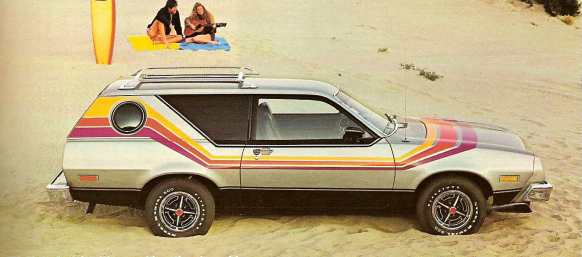
I had a 79 Pinto ESS. It was supposed to be Ford’s idea to compete with the Golf maybe, I really don’t know. But it was a nicely equpped car, it came with everything, including a full rack of gauges, a/c, ps pb sunroof, full glass hatchback, ‘styled’ steel wheels and the 2.3 Lima and a 4 speed tranny. Mine was silver with blackouts not unlike the ‘cruiser’ version of the Pinto wagon mentioned in the post. There were other color schemes too. For the times, it wasn’t a bad car, but certainly not a 320i, either. Mine was fairly zippy, but it leaked oil from the rear main seal, and had other minor maintenance issues. I ignored the rear main leak too long, and spun the cam bearings. I had a racer friend replace the cam & bearings, we threw on a header and bigger two barrel and intake, and voila, slightly faster Pinto. At one time Pintos had their own classification in SCCA, and Racer Brown was a great place to get the go faster parts. By the time this car was built, the whole fire issue had been settled and my car had a big piece of foam behind the gas tank and ahead of the rear bumper. The car had pretty decent sound proofing, and true to form, was not a bad freeway cruiser. The car was a lot better than the earlier versions, but still not as nice as the contemporary Chevy Monza. You could get a V6 or even a SBC in one of those and go quick right out the box. And the fuel mileage wasn’t that much worse. I liked the one I had, but frankly, I don’t want another one. The 304 Gremmy from last week would be more fun.
One of my friends from high school had a Pinto, his brother had a 428 SCJ ’68 Mustang, and another brother had a ’73 Mach 1 with a 302 (they liked Fords, obviously). Well, the ’68 got wrapped around a tree and the motor & tranny was transplanted into the Mach. The 302 was put into the Pinto along with it’s C4 automatic. It was fast, about as fast as the Mach that weighed 1000 pounds heavier, but was scary to ride in – I was convinced it was falling apart every time I rode in it. But it was fast.
I had a neighbor years ago who ran a cheapo corner car dealership. They were mostly crap cars on their way to the junkyard, but every so often he’d get something half-decent at the auction. One day he shows up with a Pinto that someone stuffed a 302 & automatic into. Unfortunately, there was not a lot of attention to detail and the swap was pretty primitive. But, like your friend’s Pinto, it was damned fast. It also had extremely scary handling: with the V8 in front it was an understeering pig, and the original brakes were way too undersized to handle the speed the 302 could generate. I did a lap of our small town with that thing and was very glad to get back to our neighborhood, as I did not want to risk my life any further. My neighbor sold that car for about $2500 (this was in 1986), so for once he made a tidy profit.
Had a green one with the 2.0L. Added a Crane Cams Kit and header, that made for a nice raspy staccato to the exhaust note and it beat most imports at stoplights and canyon roads. Drove that car without mercy for 80,000 miles and only broke shifter handles. Didn’t notice the rattles drowned out by the Monza Pipe and Led Zeppelin.
From the right angle, in the right color, and with the right wheels… this isnt a bad looking car. I can see the European influence, its better looking than the Mustang II that was based on it, the shorter length fits the style better. We had one when I was kid for a beater daily driver, I dont remember it being any crappier than the 78 Caddy that replaced it…
Not a bad looking car. A family that lives in the crappy little apartments at the bottom of the hill from my rental has a pinto just like this one that Paul shot, with the edition of the stylsh yellow, red, and blue 6 in wide tape stripe down each side. It is their one and only daily driver.
Those five trim strips on the hatch look aftermarket, but they were standard on the ’71 Runabout. In ’72 it got a bigger rear window, as Paul said, and the trim went away. The wagon came standard with the front disc brakes and the 2.0 motor.
Those trim strips look ridiculous! The only advantage to the original Pinto runabout hatch is that it sort of covers whatever is rattling around in the wayback. The full glass hid nothing — but it sure looked a heck of a lot better. The all-glass hatches in the last couple years looked even better.
I wonder if those trim strips were added in an attempt to (help) differentiate the 2 door Pinto from the 3 door?
Half assed suggestion of a luggage rack, because it’s the cargo version donchaknow. Of course, if the way back already is full and you’re strapping stuff to the outside, you’ll pop a wheelie.
Some thoughts on the Pinto: When I was in the USAF, the officers in my outfit/office were all in competition with one another as far as “keeping up with the Joneses” went. One bought a new 1971 Pinto, soon, others bought them as well. A sergeant who heli-arced my window guide bracket on my ’64 Chevy’s driver’s door window owned Corvettes and his good history rewarded him with unusually low insurance rates. When another bracket broke on my car, I went to him and he had a new Pinto. I asked why? Well, it all came crashing down on him one evening and he got into a race with the CHP at speeds up to 150 mph (he had an LT1, and it was fast)! He eventually stopped and that was the end of the ‘Vettes for him, hence the Pinto! He gave me a ride in it and it wasn’t a ‘Vette, that’s for sure! The passenger seat wasn’t adjustable on his model, either. Decent enough for the times, I suppose, but in California, the Toyotas were simply better cars, as another friend of mine had a nice yellow 1971 Corolla 2 dr. wagon to prove it.
I had a ’72 wagon, with fake woodgrain on the sides. I paid $650.00 for it in 1982.
Don’t remember how long I kept it, but I loved the gas mileage at that time. One time when I was working in New York I looked at a new 1974, with all of the pollution ad-ons
the car ran like crap, even the salesman admitted it.
I had a ’72 that I bought in ’77 for $300 to use as a work car. It was the 2.0 with A/T. When I say work car,I don’t mean a commuter. I had gotten a job with an RCA auto radio wholesaler,and was doing dealer installs.I beat the living hell out of that car,as much as 120 miles a day,in NYC and suburbs. It never once left me stranded,got 30 mpg,and no one ever paid the slightest bit of attention to it!
That very original red ’71 looks to have its original license plates on it too. Hurrah for Oregon! I like the beanhole mags on the car too, very emblematic of the time.
Actually, I’m pretty sure those are Ford factory rims from a Mustang II or later year Pinto, ’74 or thereabouts. My sister drove a ’74 Pinto “Sport” (or some such name), loaded with even a sunroof, and it had these rims on it. The factory center hubs are missing on these. IIRC when issued with a Mustang II they had the prancing horse on a red background, and on the Pinto there were two concentric silver circles on the red background.
Now, THAT’s useless trivia for you.
The Pinto could be a reliable if primitive little beast, and it would be a lot better remembered if Ford had extended the “frame rails” to which the rear axle attached, all the way to the back of the car. There was a gap of approximately a foot between them and the sheetmetal transom panel to which the rear bumper attached. When hit hard from behind, this area just collapsed and drove the gas tank into the rear axle. Ford unwittingly corrected that error for 1974, when the rails were extended all the way to the rear in order to hold up the much heavier 5mph bumpers mandated that year.
Allegedly the design flaw was due to Iacocca’s demand that the engineers design a car that would be “2,000 lbs. for $2,000”, just as the original Mustang had been “2,500 lbs. for $2,500”. Sometimes you can’t go to the well twice.
When I was in S. California in 1986, I was amazed at all the early Pintos still running around the freeways. Here in Midwest, all the pre-78’s were rusted to the ground by then.
But, what I didn’t see there were any Vegas. Looks like even in rust-free CA, they were junked early.
It never fails – write about a Pinto, get a million Pinto stories. These cars were as common as pennies back in the day. I even had one, a poop-brown ’75. I loved that car beyond all reason. Damn. Now even I’ve told my Pinto story.
I too had one, a Baby Blue 72. 2.0/4 spd. with a dark blue interior. It was not a Runabout, so it seemed more solid. It also had a manual crank factory metal sunroof.
It was about 8 years old at the time. I was working in downtown LA, going to school at LACC and living in Hollywood. It wasn’t much at the stop light Grand Prix, consistently being beat out by the “extra” right lane “no parking 6AM-9AM” cheaters. But a fun car non-the-less.
(After that I had a new 82 5.0 HO Capri………I would intentionally shut down those cheaters! Fun especially when it was some snot nosed new BMW lol)
Medium Blue Metallic ’73 with a white interior, a 2.0 liter with a four-speed. Only option an AM radio. I thought it was just fine…until a lady in a ’67 Ambassador ran a red light in front of it.
I drove a 1971 pinto for years. It was a very
Reliable car. However the structural integrity
Was awful. I used many rolls of duck tape
I used staps to keep the doors closed. The
Dash fell all over the place
I remember test driving a used Pinto —late 70’s — and all I can recall was the loud and incessant pinging on acceleration. Not unusual for the 70’s but this one had it in spades.
The Ford Focus was the last link to the Ford Pinto lineage along with the various iterations of the Ford Escort.
The Hatchback was first shown at the Chicago Auto Show on Feb. 20, 1971 and went on sale nationwide on Feb. 25Th.
That red Pinto is a decent-looking little car. The inside looks pretty grotty, though. Could use a wee bit o’TLC.
If given a choice of driving one of the three sub-compacts of the early ’70s — Pinto, Vega or Gremlin — for a year I wonder which one most in-the-know posters on here would choose? I honestly don’t know ~enough~ about any of them to make an intelligent choice. (That is, if there is indeed an intelligent choice to be made! I reckon all 3 cars could well be junky deathtraps . . . ).
My ’75 Pinto had the 2.3 in it and it was entirely acceptable on the freeway, at least in the double-nickel days when I had it. Really, in the 80s, a 2.3-powered, gas-tank-fixed Pinto was a reasonable used car.
”right down to the vintage aftermarket wheels” : not sure about that . I remenber those wheels as a factory option with some Maverick grabber model & with Mustang 2.
I had several early Pinto experiences. Two friends in high school each had one. A 1.6 4 speed and a 2.0 4 speed, both in that same shade of medium metallic blue that Ford painted 2/3 of their cars in 1971-73. The kid with the 1.6 in the family bought a green 73 2.0/stick. I got flung around a lot of corners in all three of those. I remember them as fun, flingable little cars.
In a 1971 or 72 family trip to Disney world my stepmom thought it would be fun to rent a Pinto. This one was a white automatic trunkback with green interior and was a horrible choce for a family of 4 with luggage. Even from the back seat I could feel the poor thing laboring to get up to speed.
Starting in 1974 the Pinto turned into a complete slug (as did the Maverick) and remained one until the end of its days. But those early ones could be rewarding in the right circumstances.
I got a new yellow ’72 2.0 4-speed sedan, replacing my ’63 VW Bug. I was crazy about the Pinto the first year, for its engine, transmission, handling and styling. Low slung and fast for the time, certainly a lot more fun than the Bug.
It took four of us on a weekend trip from Boston to Montreal. My friends were barely speaking to me after hours in those horrible little back seats.
Over time its tin can nature became more apparent. The whole thing felt like it was put together with sheet metal screws. I had a chronic overheating problem that I finally traced to an unmarked one-way ball valve in a vacuum line that I had put back in backwards after a tuneup. Then the rust started appearing. I had a co-worker with a ’71 who was seeing holes in the doors after just five years in Boston.
Replaced mine after five years with one of the ’77 Civic CVCC 5-speeds we were all driving then. Overall I have happy but far from perfect memories of my Pinto.
We are in another period of cheap gas and thus no fanaticism about “why can’t America make more/better/etc small cars?” or “we need to force drivers into smaller cars”.
With so many buying CUV’SUV, and does it matter anymore? Even in EU, more UV’s are selling. Also, safety concerns, who needs cars like these 71 sub compacts?
It’s a question of who wants small cars, not who needs them. Those of us who live in older neighborhoods and cities love the ability to thread down narrow streets and the easy parking. Then there are those of us who love the handling and speed and general tossability a small car can easily provide.
I adore my Fiat 500e, not just because it’s electric, but for all those advantages. My wife is crazy about her Mini Cooper.
Joseph Dennis posted a fine little CC Outtake on this subject here.
The commercially successful (as in sales numbers) S- and CUVs in the EU are either sub-compact or compact. Example below, the Peugeot 3008.
Anything bigger (D-segment and up) is still a sedan or wagon.
The wheels? Look like “period” Ansen or Cragers to me, DEFINITELY NOT Ford wheels.
I had a baby blue 76 hatchback with the 2.3 and automatic transmission, no options, except (?) for the am radio, styled steel wheels, and whitewall tires. With that powertrain and those heavy bumpers, it felt like the car weighed over 3,000 lbs. All that weight “killed” fuel mileage. Actually a pretty solid feeling car, but even new it was the bare minimum as far as wheeled transportation goes. Should have bought a Capri, instead.
I guess I’ll jump in, too. I still believe the original gas tank setup was built to Federal standards and had no worse collision/death rate than its competitors, but posterity doesn’t seem to want to see it that way.
My gently-used 1980 wagon (no wood) with the 2.3/4speed was the most satisfying car I’d owned until then, being dead reliable (even coldest winter starts), spacious enough, good on gas, and fun to row through the gears. It’d seem low & tiny in today’s traffic, but I didn’t think a thing of it then, making many cross-country trips.
The 2.3 was a more “Americanized” engine, and served in lots of Fords after the Pinto’s demise. The 302 transplants sounded scary, and so I had my dreams of getting some speed parts, even if the car always remained 100% stock:
http://www.esslingeracing.com
Dumb thought: I had the car until 1991, and it might have been my last car with whitewall tires (which suddenly sounds like a fun QOTD).
I still try to image teenage Paul driving so many Fords–however briefly–at his dealership job. It’s always fun when you remind us of these!
My first car was a ’74 Pinto Runabout with a 2.0L and a stick. Loved the way the little car handled! Like the ’71 pictured mine was red and I put a set of those exact wheels on it too. Lated I had two almost identical ’73 2’0L stick Runabouts. Love Pintos, someday I’d like to find a ’72 2.0L stick Runabout to play around with 🙂 .
Well I have always liked the 71-72 Pinto. Since I had my 68 Cougar, and a company car, gas wasn’t an issue for me. However, my brother got a new 72 3 door dark green Pinto with the 2.0L and 4 speed. It was a nice handling car and with his engine mods a very fast car in the end.
My mother had a 72 Pinto wagon with the 2.0L and automatic. That car was a dog and required shaming Ford and getting the regional rep involved to work on the car. It disappeared in 1974 for a new Audi 100. The Pinto wagon did impress me with the space inside so when I needed to buy my first new car in 1980, no more company cars through undergrad and Cougar resting in the garage, I bought a 1980 Civic wagon with 5 speed.
I had a Country Squire wagon with a 2.0 / auto. I worked with the original owner, it was having valve guide problems and he was worried sick. He had ordered a new F150 at the local dealer, I told him the day his truck came in, I’d drive him up to the dealership and give him $400 for the pinto. I pulled the head, had it done up by a cylinder head shop and drove the car a couple years before selling it to my sister. It was a good commuter car, not too exciting.
,
What I remember about the Pinto: a high school classmate had a new ’71 basic Pinto. One day it was parked on the street outside our school, and several of us tried to pick the thing up and put it on the sidewalk (and almost succeeded!).
One of the first cars I ever drove was my Grandmother’s 71 Pinto. It was pretty much identical to the photo here. I always liked that car, and still think it’s a good looking car to this day.
Does anyone know the story behind this Pinto Wagon?
Wow, a four door Pinto wagon. No, I don’t know the story. Replying because I’m not sure people took note. I’ve never seen a four door Pinto, any Pinto.
Another pic
Pinto, as with almost all early/mid 70s Fords had a sometimes fatal problem with automatic transmissions rolling out of park. I knew of a teacher crushed by her automatic Pinto.
Ford would have gone out of business except the Feds stepped in & let an adhesive warning sticker applied to the dash “solve” the problem.
Terrible body integrity & window winders coming off in your hand.
Some Pinto engines suffered when driven long distances at highway speeds.
Rust & the exploding gas tanks also.
Gremlin (esp. with power steering) was a better overall choice among the American cars on this list.
I bought a used ’71 1.6L/4spd HB Pinto in 1975. We lived in the L.A. area at the time. Was it a great car? NO….but with the small English drive train in it, it was acceptable, even running LA freeways, at the time. It carried the 3 of us all over the basin…….reliably.
In retrospect it was, for my wallet, a far better sub compact than the PO$ I made the mistake of replacing it with: a new ’76 Chevy Chevette. That was THE worst so-called car I ever had. One thing after another failed or broke leaving us relying on my ’56 Chevy 150 “street rod”.
I finally unloaded the “SHOVette” for a “bullet proof”, new ’79 6 banger/3 spd Nova coupe when we moved to Indiana. Within 3 months a nu short block went in the Nova’s engine bay! Yup…GM “quality”………..DFO
Not to single Ford out, but a lot of older cars left a lot to be desired when it came to safety. One of the most popular collector cars, the first gen Mustang also has some gas tank safety issues. The gas tank doubles as the trunk floor, which leaves a big opening for gas to possibly spray inside the trunk in the event of a serious rear end collision. The back seat is only seperated from the trunk by a paper panel covering a sheet metal opening. There’s also not a lot of steel in the structure backing up the rear bumper.
In my ’70 Mustang coupe, I noticed that the spare tire was positioned between the rear tail lamp panel and the right side wheel house. I hoped that it would help absorb and redirect energy in a crash. A good idea to keep the full size spare in that location. I also installed a thick sheet metal panel behind the rear seat back. I’d also considered adding additional steel panels to seal off the quarter panels in front of the wheel housings. In ’71 Ford adopted the standard location of the fuel tank beneath a steel trunk floor. A much better idea that was in line with how most manufacturers built their cars.
As a guy that rode motorcycles for over 35 years, I was not paranoid about safety, but I believe that it is important to take reasonable measures.
Our daughter is driving a 23 year old car. But it has lots of airbags, ABS, plus decent active safety with 4 wheel disks, good radial tires, etc. When I started driving I’m not sure there was a huge difference in safety, other than seatbelts and collapsible steering columns, between a new car and a 23 year old car from 1949. I wouldn’t want my daughter in a Pinto today. But 40 years ago I had several girlfriends that had Pinto’s (plus one or two guy friends) and never thought once about safety.
The trunk floor/gas tank thing is something inherited (at least conceptually) from the first-generation Falcon, resulting from McNamara’s very aggressive weight-reduction program. The original Falcon was roughly the dimensions of a modern D-segment sedan, but weighed less than an ’80s Corolla, which is commendable in certain respects but obviously not great for structural rigidity, safety, or durability (as the Australians found out with their early XK Falcon).
I wouldn’t assume a full-size spare tire would be an enhancement to safety unless it was specifically designed for that purpose, which is probably unlikely. In a rear-end crash, there would be a danger of it becoming a projectile, which is potentially bad.
Consumer Reports tested a Toyota Corona in the early 1970s, and mentioned that the gas tank also served as the trunk floor.
Perfect car for playing the eight track of April Wine’s Greatest Hits.
A buddy drove a 71 or 72 Pinto as a delivery car. It was just about new when he took the job, but a few months later the car had all sorts of maladies. Loose body panels, rattles all over the place, a dash seemingly ready to crash to the floor at any moment, a gearshift lever that was impossible to tell what gear if was in (4 speed), seat brackets that seemed destined to give way.
From there, the car got no respect, and was beaten like a dead mule. I think they got 30,000 miles out of it, if that, before it gave up permanently.
I bought a ‘71 in ‘83 for $400. It was a CO rust free car 2.0 C4. I took it home and it wouldn’t restart. Bought a Hanes manual and carb rebuild kit voila a good fun car that was terrible in snow. Years later I would check CA Pinto’s for sale and ended up buying a super clean ‘73 2.0 C4 in 2020. I don’t quite get the weak body structure criticism. The doors and body integrity is like a little car from the sixties all good gauge steel. Anyhoo, I am building a mild roller cam 302 for this as the car drives great, just needs torque to keep up with the demands of modern traffic.
Pic of my gold Pinto in my ge-rage
Had a ’71 Pinto wagon as a cheap commuter car to save on gas in the early ’80s, stuck good Vredestein radials on it and with the 2.0 and rack & pinion it was fun to toss around once it got up to speed. Hit hard it the rear by a kid paying too much attention to his GF while I was stopped for a light, it didn’t blow up but it did total it. 🙁
Here’s my take today on the Pinto’s. I owned two of them. 71 Pinto 2dr sedan 2.0L engine 4speed trans. Best fuel mileage I ever got was 31 mpg at 65 mph sandwiched between two North American Van Lines semis. I had rejetted the carb and changed the cam timing. Otherwise mileage was 23-26 at best, 21-22 when I bought it. Then I bought a 72 wagon with the same drive train. Made similar mods and maybe got 26 mpg if I was really careful.
Now I drive a 2018 F150 XLT SuperCrew 3.5L EcoBoost 10 speed 4×4 6.5ft box Max Tow.
I get just as good fuel mileage and a lot more fun to drive and probably over twice the weight and frontal area of the Pintos. We’ve come a long ways, Baby.