

(first posted 11/7/2012) The first-generation Taurus went on sale exactly three hundred and sixty-four days before I was born, so it’s not as though I can draw on my memory. But since I did spend my entire post-secondary education writing research papers on such subjects as the transformation of Germans into Nazis, and how working-class women spent their leisure time in early-20th century New York City, why not tackle the story of the Taurus, one of the most important cars of the whole postwar era?

The fantastic thing about primary and secondary historical documents is that they can transport you right back into the shoes of the figures and ideas of a particular era. The great works of such design will make you aware of the context surrounding a particular event–so much so, you feel as if you actually lived through them. This is what makes Eric Taub’s Taurus: The Making Of The Car That Saved Ford such an essential read with regard to our purposes. And make no mistake: Although I will use other sources, and offer an independent analysis of the Taurus instead of simply reviewing that piece of work, I consider his book the Bible on this particular subject.

So where do we begin? Let’s first assess Ford’s situation at the end of the ’70s. The company was making bloated and highly inferior products, losing market share to increasingly savvy Japanese automakers and profusely bleeding cash. If something didn’t change soon at Dearborn, the lights were going to go out permanently.
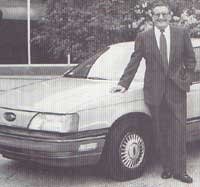
Enter Team Taurus. Actually, Taurus wasn’t yet the actual project name, but the same seeds were being planted right from the get-go. Lew Veraldi, a Ford engineering expert largely responsible for the success of the European Fiesta, was given charge of the Sigma program, the progenitor of Team Taurus. With the support of newly installed CEO Phil Caldwell, Veraldi was given virtually free rein to create a product that would reverse the company’s journey toward Valhalla.

In truth, Ford’s march into the dark was so real that the $3.2 billion devoted to developing the Taurus sedan was literally the last money available to spend. Clearly, this was a long-term project: Sigma was started in 1979; the first serious engineering efforts, albeit preliminary, finally began in 1980.

It really is striking to see how much freedom Team Taurus was given as they created their vehicle, notably in the wake of the cancelled Mini/max project that would have led to Ford’s development of the first American minivan. Only a few things were set in stone, primarily that the car’s size must fall squarely within the midsize class, and that it would be driven by the front wheels.
Aside from that, the path to creating what became the Taurus essentially allowed every member of the team to throw away the book on conventional car design. But they didn’t just throw out the old book and create a new one; Team Taurus leaped from paperback to Amazon Kindle.
With the Taurus, virtually every aspect of creating a car from scratch was collaborative. The previous structure of separate departments was abandoned in favor of a Taurus-dedicated group–and ‘dedicated’ quickly became the operative word, despite some initial apprehension.

With Ford bigwigs Don Peterson and Phil Caldwell supporting their project, Team Taurus went on a fact- finding mission. They wanted to see firsthand what it would take to make a high-quality car capable of running with the best vehicles from Europe and Japan. You might recently have heard the term “World Class” thrown around to describe the 2012 Ford Focus and 2013 Ford Fusion/Mondeo, but these guys had adopted the same concept long before, during the first Reagan administration.

Exterior styling was among the first ways in which they wanted to distinguish their vehicle. Thus did designer Jack Telnack go to work, eventually creating concepts that made the Ford LTD look like something from the Paleozoic Era. Interestingly, the Ford design studio in Turin, Italy, also was working on some initial sketches.
But the virtues of this game changer had to be more than skin deep. Before long, Veraldi had assembled a whole host of comparison vehicles for evaluation, among them the Opel Senator, Audi 100, Toyota Cressida and BMW 528e.
The team also wanted to know what was going on in the minds of potential buyers, not in terms of listening to the unwashed masses, but taking and considering their comments within the proper context. Understanding how the customer intended to use the car was a priority–so much so that opinions regarding handling and looks were generally taken with a grain of salt.

This process led Team Taurus to explore ways to make the entire car work toward providing maximum usefulness to its owner. A dashboard cockpit that’s tilted toward the driver, but still keeps controls within the front-passenger’s reach? Check. Window switches and buttons designed to let you know what they worked, sight unseen? Yup. Makes today’s MyFordTouch nomenclature sound that much more ironic.

The same philosophy of innovation also guided engine development; in no way was that more evident than in the creation of the new “Vulcan” 3.0-liter V6. And yes, I know that the engine was probably a shout out to the Roman god of iron, since it featured an iron block and head, but the Spock analogy works. I’ll tell you why.

Its because the freakin’ designers were asked to make the engine look more aesthetically pleasing to Joe six-pack. The end result produced clearly labeled windshield fluid reservoirs, color-coded dipsticks and an attractive intake manifold. Everything Spock stood for was rooted in logic; i.e., Kirk was an attractive guy chasing alien females while trying to charm enemies into not blowing up the Enterprise. What I’m saying vis-a-vis the Taurus is that Spock was the engine and Kirk was the exterior. Also, Spock’s guiding mantra was “Live long and prosper” — which the engine certainly did, thanks to the sheer number of durability tests the company put it through. In fact, that engine would go on to power future Ford vehicles until 2008. And it was all due to Team Taurus realizing what needed to be done.

The last remaining hurdle in relation to the car itself involved nailing down the futuristic design and then confirming that it would be well received. The latter involved conducting numerous focus groups and listening to what Americans had to say, but Team Taurus’s masterstroke was not taking their comments at face value (most folks were shocked and thought the design too radical), but instead using their crystal ball to (correctly) predict that eventually most people would like the styling. Their thinking was validated at the 1981 Frankfurt Auto Show, which clearly signaled a worldwide shift towards aero styling. This time, Ford’s designers were part of that movement, and not copiers of their overseas counterparts.

But Ford also needed to copy their more successful competitors in other ways. Their assembly quality was about as reliable as Lindsay Lohan or Amanda Bynes, and workers had pretty much no control over their surroundings; whatever went wrong on the line stayed that way. Team Taurus changed that completely, empowering the UAW workers to stop the line if something looked wrong, and listening to their ideas to improve the assembly process. In addition, the Atlanta and Chicago plants that would produce the Taurus were completely modernized.

At some point, the extensive rethinking of every facet of car design and production must end so that the focus can be shifted toward the date when the car would actually be available at Ford dealerships.

Now, literally, came the name game. Originally, the Taurus name was not to have survived beyond the project stage. In fact, Ford’s ad agency, J. Walter Thompson, had made a list of names and submitted their top three for recommendation: In descending order, they were Integra, Orion and Optima. If that isn’t sufficiently mind-blowing for you, consider some of the rejected names that made the semi-finals: Aerostar; Forte; Genesis; Lucerne; Lumina; Spectra; and last, but certainly not least, Tiara. In a parallel universe, perhaps Ford introduced a highly successful mid-size sedan named for an object worn regularly on the heads of girls in the Sailor Moon animated series. Fortunately, the Taurus name polled higher than any other proposed and the team kept it.

Next in line: Finally informing the public of the imminent arrival of the future of the American automobile; in this area too, Team Taurus would rewrite the book. While there were occasional leaks to the auto rags, there would be a single event, in January 1985, that would blow open the doors and officially introduce the 1986 Taurus and Sable–and one that would rival any star-studded event at the MGM studios. After all, the vehicles were the stars.

But the problem was that there were no vehicles to display. Both Chuck Gumushian, the head of the launch program, and Lew Veraldi wanted fully working vehicles for the event, even at the cost of a cool $6 million. That sum paid for one completed version each of Taurus and Sable sedans and wagons, as well as display cutouts of their engines.
And thus did the show go on. It was a huge event that attracted the greatest-ever number of people to show up at an automotive press conference. There were space-age videos and futuristic motifs, all specifically designed to enthrall the audience until the Team Taurus members took the podium. The ultimate result was a huge success. The audience was thrilled by the new cars, all of which they could walk right up to and get a hands-on experience. For Team Taurus, the hits kept on coming.
And it didn’t stop there. The press tour for the cars visited the very people involved in their actual production, not only those at the assembly plants, but suppliers as well. The team members spoke directly with them all, right down to the folks manufacturing even the smallest parts. Not surprisingly, the result was greatly boosted morale across the board.

Despite the juggernaut of success that was the Taurus’s development, problems occasionally surfaced. Incorrect metal dies were used to benchmark the parts for the doors, windshields and trim parts. The actual production vehicles turned out did not have the same level of quality as those built for the MGM spectacle. Because of this, the initial sale date was pushed back to the first quarter of 1986, but later advanced by launch guru Gumushian to December 26th, 1985. (In truth, Ford wanted the Taurus to be eligible for Motor Trend’s Car of the Year award, and to encourage customers with holiday time-off to stroll in and create some viral buzz.)

From this point on, the rest of the Taurus story is pretty much common knowledge. The car was an immediate success despite some teething problems that slipped past the quality control team. For the U.S., it was a revelation that one of the Big Three could still create something worth buying. The Taurus was the first modern mid-size, mainstream sedan, and it sounded the death knell for the full-size market.
It was also quite a shock to the competing automakers: GM had to redo its GM-10 program, which they deemed too similar-looking; Chrysler had no sedan nearly as competitive; and, for the first time in a while, the Japanese had fallen behind in vehicle design.
So what were the lasting effects of the Taurus? Among them were a highly contented 1992 Camry, the new LH program from Chrysler and ultimately, the ovoid 1996 Taurus/Sable redesign. After reviewing the story of the generation-one Taurus, I’m much more sympathetic to the DN101 team responsible for our beloved ovoids. They had literally years less time to develop their car, faced hostility from Ford’s top brass, and inherited the emotional baggage of Veraldi’s magnum opus. Then there was the advanced intel they were getting about their competitors; the team pretty much flew into a collective rage upon realizing how much the LH program was copying from the Ford formula, which is something I forgot to mention in my previous CC.

So I’ll leave the CC commentariat with a question I think is worth discussing. If the Taurus was designed to be a World-Class car, why wasn’t it? Veraldi came from Europe after successfully heading up the Fiesta program. Italian design studios were involved with early sketches of the Taurus exterior, and the end product was a car that clearly could have made it to Europe and other markets. There was a sedan and a wagon, and even three engine choices available at launch, including one that paired a four-cylinder engine with a manual transmission. That said, why did it take Ford until 2012 to make a sedan designed to be sold in both North America and Europe? I’m looking forward to your input.

[curbside photos by PN]


An excellent informative write-up, thank you. We never got this shape Taurus in New Zealand. We did get the ovoid one, which was a bit of a disaster. Partly that was because the RWD Australian Falcon had a large loyal customer base, and partly because of the ovoid Taurus’ looks. But this earlier Taurus looked fantastic at the time, and still looks fairly current I think – and that Mercury lightbar front end is awesome!. The ovoid one may have bombed here in the 90s, but it’s fascinating wondering if this great-looking first edition Taurus might have actually succeeded here…
Seen and been in my share of Tauruses, and have never seen one with digital gauges.
Did they actually sell/make any?
During the first few years, it was not that uncommon to see some really loaded up Taurii. I worked with a guy who leased a black 87 with the digital dash, leather, moonroof, alloys, and all the rest of the toys. It was a really, really nice car. Another co-worker bought a white MT-5 with the 4 cylinder/5 speed, that was equipped with air and an am/fm radio, and that was about it, right down to the crank windows. Same car, two completely different experiences riding around in them.
Some early Taurii also had this feature called the “Instaclear” front windshield, which as the name sort of implies, was essentially a front defroster like those every car has on the rear window now. Apparently it was a disaster, as the models with the feature installed had especially brittle windshields that constantly broke, but this is all anecdotal information, so take it with a grain of salt.
I remember those – they were also found in Panther cars. I saw one recently, you could tell them by the copper-ish hue of the windshield glass. There was a thin metallic film embedded between the glass layers. According to Wiki, they are still sold in some cars in Europe, but never really took off here. It is my understanding that they were horribly expensive to replace. There was not a high take rate, and I would bet that the insurance industry balked at replacements.
I never saw one of those, but I remember the write-up in Popular Mechanics when the option first came up for the Lincoln.
I’ve often wondered about it. Now, in the railroad industry…conductive windshield glass has been around for decades. It’s mildly tinted, gray and not gold…it conducts 74 volts across and gets easily warm enough to melt ice and snow and even keep dry in drizzle. In fact, if a thermatic control fails or is not adjusted properly, the glass can get hot enough to melt the windshield wiper blade.
And it’s not only “safety glass” – It complies with FRA Part 223 glazing standards, which makes it nearly bulletproof.
I’m sure the glass is expensive, but even at four-figures, it would merit consideration – from me, and I think other car owners.
I remember the windshields.
The InstaClear also reflected radar signals and rendered radar detectors ineffective (unless it’s wired-in with a separate behind-the-grille sensor unit).
I suspect if a radar detector couldn’t work through the InstaClear, that EZ-Pass and other toll transponders (which we didn’t have in 1986) won’t work either.
That’s still an issue…EZ Pass had lists of cars that need exterior toll passes.
I remember being trained on Ford’s 1st version of the quick defrost option. I think (don’t quote me), it came out on ’73 or ’74 T-birds. Supposedly the system was a knockoff of a Boeing system used on 747s. I never actually had to work on one, but I do remember that cars so equipped had a 2nd alternator and stiff wiring harness that complicated under hood work on other jobs. Hopefully the system was simplified by the time it made it to the Taurus.
Without taking a refresher course tight now, it seems like the second alternator was dedicated to defrost work and of a rather high voltage.
Maybe 90V or 120V, something like that.
The high-voltage job looked basically like a common 12V side-terminal Ford alternator.
InstaClear technology did come from the aviation industry. It consisted of a gold film laminated inside the windshield that was heated electrically. It eliminated the conventional defroster. It worked well, but gold is expensive, of course, and the film could be damaged by sun exposure. In our Cessna 414 fleet, the wiring to the film tore too often. Since it couldn’t be repaired, the whole windshield had to be replaced.
The MT5s were weird but are now highly sought after! My best friend owned one that looked like a GL but said MT5 and it was loaded, yet you could get ones that looked like SHOs (bright window surrounds vs. black like most Taurii) but with a L underbody.
Did you ever see a Taurus with just an AM radio? The ’86 came base with the AM and actually AM/FM was optional. By ’88, the AM/FM (4 knobs) were standard.
I’ve seen very few digidash Tauruses but I have seen them. A low-mileage example with red, blue, or green interior & the digidash would be a welcome addition to the fleet.
I know I’m a bit late, but one of my dad’s friends had one with a digital dash. A brown 1987 LX Sedan. Back in the early years, up until 1998 actually, LX was the top of the line model as far as luxury went. SHO more top of the line for performance. Still, when I was a kid, the Taurus LX and Sable LS were nicer cars than most around.
We drove the ’87 Sedan several times. Ironically, at this time we had a beige 1986 Sable LS Wagon, that often required a lot of repairs to the electrical system. The Taurus LX sedan was our loaner at these times, as my dad’s friend who owned it was also the mechanic who often worked on the Sable. He would allow us the privilege of using the Taurus during repair time.
The Sable LS Wagon was gold with beige leather. Car had good looks and low miles, but sadly, spent many years in a barn in Michigan. Rodents and age must have taken their toll on the wiring on that car beacuse it was the most glitchy, electronically unreliable car we had at the time for a while.
A/C would work when it wanted to, wipers and heat also had malfunctions. Cut off on my mom in the middle of the intersection of Mississippi and Havana in Aurora, CO. After that, she was gone sadly. I really liked the looks, but she was not reliable. Even so, the Taurus and Sable have been a staple of my family’s automotive collections for a long time now.
We have owned an ’86 Sable LS Wagon (Vulcan), ’92 Taurus GL Sedan (3.8 Essex), ’93 Taurus GL Wagon (Vulcan), ’97 Taurus GL Sedan (Vulcan), and most recently my mom acquired a 2004 SES Sedan with 70k on the Duratec engine. Nice cars for everyday, commuter type duties. I do have a soft spot for them. Although I also have a soft spot for the Camry. I have been driving a 1992 Camry V6 LE for quite some time now. 182k, still runs like a dream with strict maintenance.
…..As for the 1987 Taurus LX with the digital dash, I remember she was quite stunning. Me and my brother both thought the digital dash was cool and kind of unique. We had never seen anything like that in our previous family haulers, which had usually been Caprice Classic wagons from circa 1983 up to this point. The Taurus Sedan had darker brown paint with a taupe colored lower trim. All bells and whistles, including the sunroof, cornering lights, and I recall a much nicer, rich gray velour upholstery in the upper end models. GL fabrics were always fairly chintzy (Which IMO, got worse for 2004-2007.), when compared to that of an LX.
The Sable was fairly high-end, with leather and such, but no digital dash sadly. The only one we owned for such a short period of time (11 months). The Sable LS wagon actually caught fire shortly after my father sold it. The guy who bought it came back and complained. Nothing ever came of it…
I sometimes long for the days when these were literally everywhere! They were definitely a hallmark of the road for their time.
Around 1995, My dad was good friends with a guy who filpped cars on the side. He bought an ’86 Sable LS Wagon in champagne color with tan leather interior. This Sable wagon had low miles due to being stored in a Michigan barn by its only previous owner. However, it had electrical gremlins, possibly from sitting for a long time and possibly being disturbed by mice chewing wires. Any who, the car spent its fair share of time in for repairs.
During those repairs, They would usually lend my parents a 1988 Taurus LX Sedan, which I liked a tad more than the sable. It was a dark charcoal color with a gray velour interior. It did have the digital dash which I thought was just awesome as a ten year old. When we would return to our Sable, with its Analog gauges, I felt like it wasnt the visual feast that the digital cluster was.
Also, several early Sable and Taurus sedans and wagons from 1985/86 did not have three point seatbelts for the outboard rear seats. They were lap only. I believe by the end of 1986 they went three point in the sedan and wagon.
I spent a lot of time with these cars. My first car was a 1992 Taurus GL sedan with the 3.8 Essex. My mom currently has what would be the sixth Taurus in the family. I have always had a soft spot for these cars. Ford had a winning formula in those days. Even now with the newest gen 2 being 22 years old, the 1986-95 Taurus and Sable remain one of my favorite designs of a sedan or wagon.
In the early days of the Taurus, they were so futuristic that they could transcend income demographics. Many people sought these cars, even people who traditionally wouldn’t have even considered a Ford.
Transmission issues aside, these cars offered quite an advanced level of comfort and style for the times they came from. I only look back on my Taurus and Sable memories with fondness. They were an effort that made a lasting impression.
It was a little sad to be in a Taurus after the year 1999, as they so obviously began their decontenting rampage, But when I drive the Taurus after I drive my Camry, I would still say that the Taurus offers a far better suspension that seems to be more durable and longer lasting. Usually when Camry shocks go, the car bounces badly. I have never experienced this in the Taurus.
Of course, both cars have some great characteristics when it comes to the driving experience. Just my two cents for the day 🙂
From a European perspective the Taurus isn’t nearly as revolutionary as it seems it was in the US. Ford had already released the (still-more “aero”) Sierra here in ’82 and given Europe our own little revolution. By ’86 the Taurus would have looked pretty unremarkable on European roads.
That said it didn’t take until 2012 for Ford to design a “world car” saloon/sedan – the ’93 Mondeo/Countour just wasn’t especially successful at that game (did fine here, flopped there as I I understand it?) It’ll be interesting to see if the new Mondeo/Fusion pulls the trick off better…
The only question I have is…can you be so sure about that? I think the styling would have done pretty well across the pond. I mean, the first-gen Sable looks like something that could have been made by Renault or Peugot. And what about the wagon?
The only thing about the Taurus that might not have made it successful in Europe was its size. I do believe it was quite larger than the Sierra, and probably would not have achieved comparable gas mileage. But thats just my opinion.
😀 You can never be sure about this sort of speculation but I stand by my opinion that it wouldn’t have made anything like the kind of impact here as it clearly did there.
You’re right that the styling certainly wouldn’t have looked out of place here, but that wasn’t my point: the Taurus’ success in the States seems in no small part due to its having been ahead of the competition, and by mid 80s European standards it just isn’t a revolutionary design, it would have been keeping pace with/following the competition.
As for success – the (startlingly similar) ’85 European Granada/Scorpio didn’t do especially well, in fact – allowing for a very unsuccessful facelift in the early 90s it was the last vehicle in that class that Ford made and sold here. European buyers the time were shifting away from mainstream marque cars of that size (the same way US buyers seem to have been shifting from “full” to “mid” size, only your “mid” was our “full” then) with growth being either in better packaged, smaller family cars like the Sierra, or to more prestigious marques’ like BMW and Audi.
Quite why Ford (given the dire straits they were in) developed the Taurus and Granada/Scorpio separately is baffling to me. When you look at the overlap between the end products (especially their near identical styling) it seems like unnecessary duplication, especially in light of the whole Merkur farce!
None of which is intended to detract from the Taurus’ evident status in US auto history of course, only to illustrate why it’s unsurprising from a European perspective that they didn’t try selling it here.
Ah, good reply. I think it might have been a size thing…the Taurus was quite a bit bigger than a Scorpio, right? Maybe it the fully loaded LX models could have been sold as an upmarket vehicle, in reverse fashion to the Merkur debacle here, but like you state, who knows.
Also, I don’t ever remember the Ford Contour being marketed as a world class car here, like the Taurus was. Again, it was a size thing, with the European import sliding in between the Escort (which was pretty popular) and 1996 Taurus, BOTH of which could be cheaper than Contour. And with gas prices the way they were, I don’t think they ever had a chance over here.
Please learn the diff between sale and sell
The size alone would have been a big obstacle; back the European cars were generally a fair bit smaller, and narrower. Perhaps a narrow-body version, like the narrow Camrys Toyota has built for years in Japan.
far be it from me to correct Paul, but such info as I can find suggests they were pretty similar sized. I could only find dimensions for the ’94 facelift of the Scorpio but memory says it wasn’t significantly bigger than the ’85 model (just WAY uglier):
’94 Scorpio dimensions:
Wheelbase – 109.1 in (2,770 mm)
Length – 190.0 in (4,825 mm)
or 190.0 in (4,826 mm) (estate/wagon)
Width – 69.3 in (1,760 mm)
Height – 54.6 in (1,388 mm)
or 56.8 in (1,442 mm) (estate/wagon)
’86 Taurus dimensions:
Wheelbase – 106.0 in (2,692 mm)
Length – 188.4 in (4,785 mm)
or 191.9 in (4,874 mm) (estate/wagon)
Width – 70.8 in (1,798 mm)
Height – 54.3 in (1,379 mm)
or 55.1 in (1,400 mm) (estate/wagon)
via Wikipedia. So not a lot in it with the Euro Ford a little longer & taller but the Stateside Ford a little wider.
Like I said – staggeringly similar end products in a lot of ways, just that the Taurus was a “mid-size” in one market while the Scorpio was seen as “large”in the other
I should have looked up the stats before I shot that one off. Thanks.
The most important reason was undoubtedly that Ford of Europe was still heavily invested in the RWD platform that underpinned both the Sierra and Granada/Scorpio (and they shared most of their underpinnings). It would have taken a another huge investment (and risk) to break that up into two distinct lines, and the resulting loss of economies of scale would have been a big problem.
Perhaps if the two entities had worked together to create two different sized FWD platforms, a mid-compact one for the Sierra and the Tempo, and a Taurus for the Granada/Scorpio, it might have worked, But this was long before the “One Ford” era.
I figured the FWD/RWD difference was probably the crucial one…
Another fun “what if” would have had Dearborn and Cologne working together in the late 70s to develop the Sierra on a modern FWD platform with an eye on also developing it for use as an American mid-sizer and a large Euro – though as you say, the late 70s were a long way before “one Ford”, not to mention the required level of forward thinking being unprecedented!
… Come to think of it, isn’t that where we are now? With the 2013 Mondeo/Fusion being a development of the 2007 Mondeo.
Agreed. The Tempo/Sierra should’ve been one and the same. And the same with the Taurus/Scorpio. Considering how much alike those cars were in concept, it’s mindboggling they didn’t share any componentry. The Sierra was rwd, the Scorpio was built on an extended Sierra platform. While both the Tempo and the Taurus was fwd.
Ford Europe should’ve gone the whole way, considering the Sierra was such a rash departure from their conservative thinking in the first place. But Ford has globally much product overlap in r&d. It’s like when Ford US alternates between Mazda and Ford Europe when it comes to oursourcing their mid-line lineup.
Wasn’t the Ford Scorpio, assuming it is the one sold here as the Merkur Scorpio, RWD? If so, that might be why…thhe Taurus mandate from the start was wrong-wheel drive.
They were sold in Europe, but they didn’t sell like hot cakes. Were I live you could get the Mercury Sable variation with 3.8 v6 in saloon or wagon form. It was already larger than the early Scorpios. The Scorpio is E-segment: upper mid-range. I think the Taurus/Sable was positioned as a mid-range car in the US. 3.8 liter volume is huge for European standards. Certainly in the mid-range class. A dashboard without tunnel and front seats that look like a bench? No Euro E-segment offering had that. It represents American taste. There will be more reasons it was not well suited for Europe. It was also a pretty expensive car. Twice as expensive as the average European mid-range Sierra. Scorpios 2.9i Ghia were about the same money. They were also not present on every corner, but more popular still.
I can say from my own experience with a new 86 Taurus MT-5…….it got great gas mileage! Mine was pretty well equipped: PW, A/C, Touring wheels & suspension,cornering lights. I even added a power moonroof.
Revised EPA figures (now lower) says 21/29. I remember getting 35 in ideal conditions.
http://www.fueleconomy.gov/feg/PowerSearch.do?action=noform&path=1&year1=1987&year2=1987&make=Ford&model=Taurus&srchtyp=ymm
When it was new it was DRAMATICALLY new. I bought mine the first month they went on sale. A woman in Beverly Hills stopped me to ask what kind of car it was…..it did look especially sleek in black. I also liked the pinstripping, it gave it a finished look. It was so advanced looking they used it in Robo Cop for a future cop car. Although the Aero ‘Bird and Tempo preceded it, it was the complete package……..a sleeker cheaper American Audi 5000.
question tim..
how come those MT5s look different than other MT5s that look like GLs? (i.e the MT5 you have has body colored B and C pillars, yet some do not). Is your MT5 a special version?
Same deal with the wagons. Some of the early ’86s had black B pillars like the Sable, yet most don’t…
I do know early Taurii had black grilles, including this SHO prototype!
In 1986 only they had a option called “exterior accent group”. I have all the 86-95 sales brochures and the 86 is the only one that shows it. Here is what it included. Read description no. 3.
I agree on the European perspective. Also, there was a product overlap. The Taurus/Sable was imported as a captive import into Sweden during those years Ford didn’t have a large european wagon on its own. The Granada wagon had been a big seller, but with the Scorpio, they had none. The problem is, the Taurus wagon wasn’t particularely suited to European needs. It only came with a V6 and auto, where the Granada had a multitude of engine and trim options from a 2-litre four cylinder and up.
Parents to a friend of mine actually had a Sable wagon. I remember it as slow and sluggish, and that the speedometer ended at some 130 km/h. If you wanted a big wagon, you bought a Volvo or Peugeot or Citroen or a Ford Granada. If you wanted something posh, you upgraded to a Mercedes.The Taurus fell in between, it was neither posh nor particularely suited to European needs.
Americana has always sold in Europe, but only that which the Europeans didn’t do any better. It’s the same problems the Americans have with captive imports, but in reverse. Why buy something rarer and more expensive and not particularely good, when there are better and less expensive options available on the homefront?
One thing to bear in mind is that in spite of the Taurus being very inventive, it also was very traditional. It was a very successful reinvention of the wheel. But from a European perspecitve, it also was a quite large traditional American car. It simply didn’t have anything the Eurpeans didn’t do any better…
Great writeup on one of the most significant cars of modern times. Even now I am struck by how perfect the lines are on the original Taurus. You have captured what a monumental task Ford had in developing the car, and we all know how successful it was.
I still recall my first encounter with one (an 86 Sable, actually). My car-mentor Howard bought one of the early Sables, it must have been in the early spring of 1986. I have two vivid memories about the car. First, how well designed everything under the hood seemed to be, with everything allowed to be touched by “civilians” colored in bright yellow.
Second, I remember the seamless interplay between the fairly torquey V6 and the 4 speed auto transaxle. Everyone must remember that we had spent about 12 years driving cars with deeply flawed powertrains due to steep learning curves with emissions and CAFE regs. This was the first decently sized U.S. car built since the early 70s that did not make you think about how much nicer it could be if only they had done this or that differently. My mother had bought an 85 Crown Vic with the 5.slow and the miserable AOD. Within the first 30 seconds underway in the Sable, I thought “Mom bought a car 6 months too soon.”
I recommended a Taurus for my father, based on reviews alone. It was the only time he solicited my advice on a car, and he was very happy with it. It more than fulfilled my expectations when I drove it: unlike anything from a US manufacturer to date. And yes, the power train worked extremely well indeed; very seamless and smooth. All-round a very satisfying and pleasant car to drive.
Very informative article, Ed. Great job!
I can only offer my personal perspective to your question about appeal. In the Summer of ’86, I went car shopping with my dad. Puberty had hit and I could not get into the back seat of their ’83 Reliant without my knees being well placed in the seat back. So we went to the Ford dealer.
As a point of reference, my dad was 42 at the time.
He looked at two different cars – a lightly used ’85 Crown Vic with about 3500 miles and a new Sable wagon. He was split and saw advantages both ways. He then brought my mother (aged 39) to get her opinion. She drove the Crown Vic and liked it. She sat down in the Sable (it was on the showroom floor) and did not like it. Why? She said if they were going to spend roughly the same amount for either car, she preferred to have something substantial to show for it. She also said she wanted something comfortable to sit in, which the Sable was not. She’s not a showy gal, but that’s simply the mindset she had.
I’ve driven every generation of Taurus, with oodles of the 2nd, 3rd, and 4th Generation (1994 to 2005 model years). For that time and place, what you bought depended upon what you wanted.
This illustrates a problem – a deeply-ingrained one.
Crisis pushed Ford out of its comfort zone, of chrome-slathered Broughams…and into the work required to develop a serious, functional and interesting automobile.
Success allowed them to retreat back into their world of corporate politics and scant attention to product. Which raises the question: WHY does management at Ford, as well as at GM and other major American companies…constantly slide into bad habits unknown in Japan?
I won’t say Europe is inert; but in Europe, at least, the lower margins seem to keep managers on their toes. But success there seems as toxic…witness the Daimler spectacle, which continues today with mediocre overpriced cars which cost more to maintain than they’re worth once used.
Great questions! Ford had a real car guy in Don Peterson and under his watch came the Mustang SVO, the earlier TBird Turbo Coupe. With the departure of Peterson came Red Poling and the SUV craze. Building hundreds of thousands of Ford Explorers must have further fed their crack addiction of heavy weight, old fashion engineered trucks and SUV’s like the Expedition and later the Excursion. Keeping the cash register overflowing with greenbacks through these sales clouded their vision of maintaining their car division. Remember, this was the era when some of these Ford execs seriously considered killing the rear drive Mustang for the fwd Ford Probe! Jacques Nasser’s watch included designing thinner roof pillars in the Explorer and the Firestone tire blow out scandal; both resulted in significant deaths to more then a few drivers and passengers of these vehicles. So, in my opinion, it was the SUV, thanks to the Ford Explorer, that was responsible for almost killing Ford, with many kudos to the American infatuation with childrens soccer practice and big, thirsty SUV’s.
Great article by Ed!
You really can’t fault them for building what people wanted and making loads of money in the process. Their problem was that they didn’t use that money to bolster their other lines.
I don’t get the current infactuation with CUVs. At least Explorers used to be a real truck. Now all you get for your CUV premium is a high seating position. Many I just don’t see the point.
I remember a few years ago somebody at Ford said “we didn’t lose the family car market, we walked away from it, but we’ve learned our lesson” or something along those lines. A few months later they canceled the Freestar/Windstar. Now they (and GM) literally sell nothing I’d give serious consideration to for replacing our current family minivan. Their CUVs sacrifice way too much space and versatility and do it at a higher cost. Some lessons don’t stick for long I guess.
The Freestar was barely competitive when it was introduced.
Ford needed to start from scratch to build a competitive minivan, and simply did not have the money to do it at that time.
Getting the new Fusion out, and starting work on a new Focus, were more important to the company’s bottom line.
Yet they later had the money for the awful and senseless Flex? I don’t buy that argument.
When the Windstar was introduced it was competitive, in fact I seem to recall it winning a Car & Driver comparison. They didn’t keep it current though, and the Freestar wasn’t a big enough update. In other words, they walked away from a family market segment, something they claimed they wouldn’t do again. Empty rhetoric from talking heads evidently.
The Windstar was competitive for precisely one year – 1995, when Chrysler was still selling the 3 door minivan that went back to 1991 (or 1984, however we are counting.) But in 1996, Chrysler’s Gen3 minivan hit the showrooms with 4 doors, and the Windstar was history. And anyone who has ever thought the Mopar 4 speed transaxle was bad never owned an early Windstar.
The Windstar/Freestar was simply awful as were the GM minivans at that time. It may be a boring segment but the segment leaders — Sienna, Odyssey and Voyager — are all excellent products with stellar reputations.
There is no point having an entry in this class if you aren’t willing to bring your A game.
The Flex styling may not be for everyone but it has been an outstanding, high margin product for Ford.
The Flex may be a high margin success for now, but my point is they are losing the family market once again. In the long term, I don’t think it’s a successful strategy to completely replace practical vehicles with overpriced image-mobiles. After all that is the same strategy that almost sunk all three domestics just a few years ago.
Besides, as an owner of an 05 Grand Caravan, I can assure you that other than the gimmicky stow-and-go, that van was not all that competitive with the best at that point. Certainly not “A-Game”. Its best redeeming quality was its price when bought used, which of course now works against me. Yet Chrysler saw the importance of keeping it around with an update, and it continues to be a success for them. Heck, even Nissan has kept their quirky van alive even though it has never been a success. They must see long-term value to do so.
Minivans are just one part of the “family market.” Like it or not, many people – especially women – do not want to be seen in a minivan. I hear this from my wife all the time. She flatly refused to consider ANY minivan, but would consider an Explorer or a Pilot or even a CR-V.
The family market consists of:
1. mid-sized sedans (Accord, Fusion, Camry, Malibu);
2. minivans;
3. mid-size crossovers (Explorer, Grand Cherokee, Highlander, Pilot, Traverse);
4. compact crossovers (Escape, CR-V and RAV-4).
Ford has a good presence in three of those four categories.
The Flex has sold well in California, traditionally a tough market for the domestics to crack. If I recall correctly, its buyers have a higher-than-average income compared to buyers of other Fords, as well as the other domestic manufacturers.
The Flex may not sell in large numbers, but it is appealing to the type of buyers who traditionally have shunned domestic vehicles. It has also received very good reviews (better, in fact, than the new Explorer). So I’d hardly call it a failure.
I didn’t call it a failure, I called it awful, which is my personal opinion. Not just the styling, but for what it is.
Ford completely removed themselves from the minivan market and replaced it with a vehicle that competes with two of their own existing vehicles in the SUV/CUV market (Explorer and Edge). I don’t think that’s a good long-term strategy.
I worded my earlier post poorly, I realize there is more to the family market than minivans. But they are a good portion of it and Ford walked away from it…immediately after saying they learned their lesson with family cars. The reason I’m so frustrated is because I like to support the domestics. But if I had to replace my van today it would be a Toyota or maybe a Honda. Chryslers have too little legroom for me and CUVs are just image-mobiles, as silly as a Hummer IMO. If you need a truck, buy a truck. Not a pretend truck. /rant off
To be fair, the 2000’s and beyond have seen the Japanese companies do the same exact things. Look no further than the current Civic, barely redesigned Camry, and long-in-the-tooth Corolla. The difference today being that baby boomers still have vivid memories of their poor quality Big Three cars, and are willing to plunk their cash down quite readily for an Accord or CR-V.
Jeez JPT, I hate to argue with another NE Ohio boy, but I think you’re not seeing the whole picture with regards to Japanese automakers… You wrote “WHY does management at Ford, as well as at GM and other major American companies…constantly slide into bad habits unknown in Japan?”. But ignoring the fact that the Japanese makers do have bad habits, and in light of the announcement yesterday that Suzuki is leaving the US market, I don’t think there’s a US lock on dumb moves.
There’s only really the two companies that do well consistently, and even they have their foibles. Ask anyone who’s keeping score about the engine sludging (Toyota), the over-estimation of HP figures (Mazda, Honda, Toyota), the overly optomistic odometers (Honda), fragile transmissions (Honda), body corrosion issues (all)… And yes, some of these STILL reoccur. Their management isn’t as monolithic as some would like to believe…
The headlong rush into the US market in the 1980’s by many of these smaller players (who longed to separate from their US partners) was initially a good idea. But the domestic makers have unique advantages and the other import players had their own set of strengths, too. Now with Suzuki’s withdrawal, all eyes are on Mitsubishi to see what it will do.
We’ve seen rather interesting decisions made in the wake of Soichiro Honda’s passing, many agree the company isn’t what it once was. Models seem muddled and marketed poorly. Mistake.
Recently, the younger Toyoda vowed to make his company’s cars more “interesting”, clearly acknowledging that his family’s company can no longer rely only on ‘quality’ to sell cars globally. Mistake.
Daimler Benz (just for comparison’s sake) travails in the last 10 -15 years are far more fascinating, and have managed to seriously dent their once golden reputation here in the US. Mistake.
How all of these folks recover from these will be great stories for us to tell our grandchildren.
geozinger:
I stand corrected. In fact I would add to that, the Nissan saga is one of near-competence constantly undercut by their own top management. They needed Renault’s adult supervision as much as Renault needed Nissan to school them in quality.
I know the Nissan story well; and the Suzuki affair sounds like another tragedy in the making. Honda, as well…has tarnished its halo.
But, over the last fifty years…they haven’t been as consistently stupid as our own auto execs.
Good points. I know when I was growing up in the 80’s Midwest Japanese cars were not taken very seriously. They were generally regarded as cramped rustbuckets. Up until the mid 80’s (and with me being 6’4″), there was a lot more truth than rumor in that assertion. And their dealer network was very limited. Compared to the Big Three, the dealer network STILL stinks.
I’ve had a Civic and a 4Runner, and while each was fine, they weren’t anything special and each had some serious faults. I now buy want I want, not what some magazine says is best. Life is much more enjoyable that way.
NEO rocks! Well, except for the Browns. I know a Niedermeyer where I live, geozinger. 🙂
“…constantly slide into bad habits unknown in Japan?”
The dummying down of the Camry? The general cheapening of quality of their trucks? Engine sludge? Tie rod ends? $48 Million in fines? http://www.nytimes.com/2010/12/21/business/economy/21toyota.html?_r=0
Maybe you don’t know how they operate. It’s their secret society. They just hide #@@! better.
“…constantly slide into bad habits unknown in Japan?”
You’re kidding, right?
Unknown? In Japan? Like Toyota’s BIGGEST EVER $48 million fine for avoiding recalls? Engine sludge? Rusting frames? Tie rod ends? The cheapening of the entire model line? Unintended acceleration?
That kind of blanket statement about Japan’s auto industry was common in the 80s, naive now. Even Consumer Reports doesn’t give Toyota/Honda an automatic pass anymore.
Unintended acceleration was an American phenomenon, nobody elses Toyotas suffered from it
A few additional points about the story of the Taurus I’d like to make:
1. The Taurus name was decided by Lew Veraldi and one other guy because both their wives had that astrological sign. Thats it. It just stuck, and thats why we have it today.
2. The headlamps were a big deal, and Ford got U.S. regulators to allow designs beyond the sealed beam types. Otherwise we would have had a much uglier sedan.
3. In reading both Eric Taub and Mary Walton’s stories about the Taurus, it is really striking just how much of an afterthought the Sable was to everyone involved. The Taurus always came first. This is probably why I wasn’t surprised when the news came down in 2010 about the end of Mercury. Oh, and by the way, the top brass at Ford considered shutting the brand down in the early 1990s, but were too afraid because they thought losing those customers would damage Ford’s reputation.
Another point to make:
As you now know, I like to base my titles off of songs. This one being part of Dexys Midnight Runners’ “Come On Eileen.” Only it wasn’t their version that I initially heard, but this one by the third-wave ska group Save Ferris: http://www.youtube.com/watch?v=HCzWPBR30Nk
Its all very 90’s, and a very cherished part of my youth, even if it isn’t the original.
I love the Save Ferris cover! The Dexy’s Midnight Runners original was what sprang instantly to mind reading your title though – the original is more a part of my youth I guess. Either way a cracking tune.
+1
Another thought. This was the car that up-ended the Chevy v. Ford war that had raged since the 1920s. As recently as 1982-85, Chevy was outproducing Ford by 300-500K vehicles annually. In fact, Oldsmobile out-produced Ford in 1985. But the Taurus was the car that made Ford a leader instead of a follower. After a few years of closely-fought sales figures, Ford would pull away, and by 1994 would almost double Chevy’s production.
Compare an early loaded Taurus to an 86-87 Buick Century. The Ford felt more substantial and like a more expensive car, while the Buick felt cut-rate. The A body would turn out to be the more durable car (primarily due to the transmissions) but more and more, cars like the Taurus made Ford Division a genuine contender against GM’s upper level brands.
even in Taub’s book they said the A-body Celebs were “flimsy” in the door panels.
The A-bodies were more rugged than the Tauri, but not as “substantial.” That’s the best way to put it.
Accord was a force to be reckoned with but I think it upped the level in ’98 when it had the V6. The Taurus came out in ’96 (DN101) but then the Camry upended it with its 3.0 V6 and 5 speed on the CE, and then came the Accord EX V6 or DX V6 5 speed.
By ’01-02, those generations of Camcords lost their appeal for me.
One of my co-workers bought a new 1986 Taurus. It had all the bells and whistles. During the first year of ownership it spent about half of it in the shop with driveline problems. The second year she was driving a Toyota.
Yeah, the initial ones has big quality control issues, unfortunately. My 1989 Taurus wagon, even though it was nearing the end of its life (stay tuned for a future COAL) was still extremely durable. The difference a couple of years makes can be significant sometimes.
The AXOD transmission in particular was prone to early failures until Ford got all the bugs out around 1995. Beside the fact that all of the first gens are now 20+ years old; that may be one reason I have only seen 2 or 3 still on the road in the past year.
This is a great write-up. I didn’t know the back-story of the Taurus before. So it sounds like Ford had the same kind of approach when designing the Taurus that GM had with Saturn: new platform, new drivetrain, new materials, a cross-disciplinary design team, more autonomy on the assembly line to fix problems, etc.
Kudos to Ed on this write up. When reminiscing about the Taurus there are two stories to tell, the one about the car and the one about the cross functional development approach.
I had the chance to talk with someone who was on the team when the car came out. I was quite young and wondered how Ford could develop a car so different from anything that came before. He explained the process Ed outlined in the article. I was fascinated not just by the styling and dynamic performance but also the high quality detail, like a full length release bar under the front seats to slide them, standard trunk net on the LX trim, etc.
The team was dissolved after the car launched and he predicted what would happen next, which was that these nice touches would be deleted in future models years by the deeply ingrained bean counter mentality at the company. With no empowered “car guy” person or group like Team Taurus to stop it that’s exactly what happened.
The Japanese used (and still use) a Kaisen approach which means continuous improvement. They believe success comes from making the best product you possibly can while the American mentality was more along the lines of cost cutting your way to a fatter profit margin.
It’s pretty simple math that even if you could increase your margin by 10-20% your area profit will plummet below where it was if sales fall even a fraction from the cost cutting, which happens when your competitors instead focus on making better cars. The demand side of the equation is always the most important.
All of the carmakers; including the Japanese, began to decontent their cars starting in the mid-1990s in response to consumer backlash at the high price of new automobiles. Many regard the 1991–1996 Toyota Camry as the best; it was decontented for 1997 and the price lowered; Ford did not do the same with the ovid Taurus of 1996-1999; but aimed instead to match the Camry; and that hurt sales along with the ovid styling.
I actually think the high-water mark for Camry was ’97-01..the ’92-96 were very good and the ’97-01 were the penultimate versions.
Even the stripper models (am/fm, stick, crank ups) had the same durability baked into them that the yuppie models did. That’s what appealed to many.
Taurus 1gen had the same deal. I’d love to see a Taurus with an AM radio only. They came that way in ’86.
Stubs in an actual ash tray. Quaint.
Now smokers seem to keep their arm out the window at all times in a fruitless exercise of minimizing the odor (?) or mess ashes can leave.
Interesting read of a car I never really was interested in. And for some reason I am always amazed at the youth participating on this board.
The rear seat in my ’89 Camaro still bears the hole left by a cigarette butt flicked out the window of a vehicle two cars up & one car over from me while driving in heavy traffic– it caught air & I watched it sail through the passenger’s side open T-top: there was no way to avoid it.
It’s nice to know her ashtray stayed all nice & clean. Not.
I grew up in the US and my parents had an ’87 Taurus wagon. It easily marked the end of the Stalinist-Baroque era of car design and heralded the computer age. Sure the Audi 5000 was more modern, and indeed it did improve on Ford’s ability to drive through garage doors, but it wasn’t aimed at the same ‘class’ of people. The Taurus was a bit of the future for everyone, not just yuppies who could afford the eye watering car payments and infernal, frequent, and poorly completed repairs by arrogant dealers.
Now, the Taurus was revolutionary in the US as mentioned before because it was reasonably fast for the time, didn’t stall, surge or have the other drivability problems of smog era carb cars, and was quite well made actually.
In the summer of ’87, my parents traded their ’83 Aries on the Taurus L wagon at a small town Ford dealer 20 miles from Kansas City. My parents couldn’t wait to be done with the payments on the Aries, as it was one of those cars that would stall, surge, die, dump water into the floorboard from the airconditioner (or reverse turbo as anyone who has driven a smog era 4 cylinder with AC would call it) and its myriad of problems.
The Taurus was a revelation- roomy, with cool rear facing seats, spongy vinyl on the doors (which is the same material used on Mercedes w124 door panels I learned later), and it looked cool from the aerodynamic door handles to the flush taillamps. I still think the mk1 Taurus was one of the few cars that looked better as a wagon than the sedan.
My memories, are jaded however by the fact that I ate an entire bag of Starburst and two cans of orange soda before the 20 mile drive back to KC. After picking up my grandma, we went to Furr’s cafeteria. While waiting in the queue, I felt distinctly green, and asked to use the toilet. My mom said no, so- well, I became unwell, and the sneezeguards served a purpose for which they were probably not intended. Needless to say the queue went down dramatically as others nearby found themselves less than hungry.
Now, you could imaging my parents humiliation and then anxiety about having to somehow transport me home without risking a similar incident in the 20 mile old Taurus! I felt much better, however, and we made it home without incident, new car smell remaining intact.
That Taurus transported us around the US on five road trips to every state except Alaska and Hawaii without breaking down over the next few years, and sadly ended our usual vacation memories of visiting random Dodge/Chrysler dealers when the Aries decided to malaise itself.
Later, it became my hand-me-down car in ’95 when my mk1 Jetta finally succumbed to VWitis and served me well during my first jaunt as a student in Colorado.
We sold it in 1997 with 120k miles on it looking just as pristine as when it was new, and driving just as silkily smooth as when new as well. Had Ford not ruined the Taurus with ovals and the 3.8 gasket-o-matic and spent their development money instead on making a better Taurus rather than the Windstar and Exploder, today’s streetscape might be totally different.
That was a great read!
Brilliant!
perhaps kids have an uncanny unconscious instinct for this with new cars – or at any rate your story reminds me of a similar incident involving my little sister, a kilo of green jelly caterpillars and Mum’s (then) brand new Volvo 480 LE…
Worth it just for “reverse turbo”….great comment!
I see a lot of evolution in the design of the Taurus. Look closely at the LTD, T-bird and Tempo. The 1983 LTD eased in the rounded off aero look in Ford sedans while the T-bird took a huge step. The 1984 Tempo took round and aero to whole new level for sedans, It was commonly referred to as the Jelly Bean when introduced.
Look at the front fender of a Tempo or T-bird and you’ll see a lot of similarity to that of the Taurus, particularly how it meets the A pillar and door. The “aircraft style doors” were on the T-bird and Tempo first. The roof line is a logical evolution of the LTD and Tempo. The rear end design also shared many cues with the Tempo.
Of course the Taurus was the first to be able to take advantage of aero headlights and the no-grille grille was a big step.
The rest of the car did take some huge steps from it’s Fox body predecessors which of course was a larger part of it’s reason for success that the styling.
Taurus was as important in 1986 as the ’55 Chevy was in its day…or the 2013 Fusion is to right now.
This is yet another reason why we have a GM Deadly Sin series…the tables had turned not just because of Ford’s superior design process at that time, but also because of the contrast to the General’s ruthless and cynical cost-and-corner cutting that made it pretty embarrassing to be a Chevy fanboy in those days.
One drive in a Celebrity…and then a Taurus…was all it took for me to appreciate what Ford had accomplished. From fit-and-finish to road feel…it was like comparing a high school football team with the NFL. I didn’t want it to be that way…but it was, and would it be fair to say that it took GM 20 years to catch up? My mother-in-law’s ’99 Grand Prix was a huge improvement on its 1980’s FWD counterpart but still felt inferior compared to a Gen I Taurus.
At least GM is back in the game now and building some desirable vehicles while Ford still continues to build on the legacy they established with the original Taurus.
I wouldn’t portray Ford’s record as one of continuous progress since the debut of the first Taurus.
After the triumph of that Taurus, Ford seemed to lose its way, and didn’t really get back on track in the passenger-car segment until it worked the bugs out of the first Focus, and then rolled out the first Fusion.
See I thought my ’86 Pontiac 6000-STE was a step up in quality in 1999 from an ’86 Taurus. I looked at both and was steered away from the Fords by many people when I was looking to replace my elderly ’76 Chevelle.
I worked in autoparts in the mid ’90s and I remember those early Bulls were kind of a nightmare to fix and keep running. I do remember selling more than a few power steering pressure hoses that wrapped around the engine in the most convoluted way possible, got to be that I had the part number memorized. Most of them by the time I was interested in them were really steeped in beaterdom.
My Pontiac was not a reliable car either, nowhere near as reliable as the 76 was, as it needed an engine at 90,000 miles, a steering rack (GM’s famous lack of assist cold), a front end, and because I was learning how to convert R-12 cars to R-134, several A/C compressors.
You are probably right about long term quality- my parents were keen to dump the Taurus after 100K miles because they (probably rightly) believed that every part was engineered to last exactly that long. However, where Ford scored over GM and Chrysler was on INITIAL quality- the fit, feel, and early (under 75K) reliability was very good. Knowing that the average owner only keeps their car for 5 years before trading it, they rightly- and perhaps cynically knew exactly where to pinch pennies without making it look and feel like a tupperware penalty box. After all, Ford didn’t make any money if you kept your Taurus for ten years instead of buying two in that time. If you wanted a 20 year car, you spent 40% more and got a Volvo. Ford felt that if you had a Taurus that gave you five years of very good service, you’d probably buy another.
Toyota learned this too, as they recognised that by making the ’92 Camry to near Lexus standards. However, they went overboard and ‘wasted’ money by undervaluing their enginering- even if the less tangible reputational benefits probably sold their cars for years after they became more cost-engineered.
The GM and Chrysler stuff really wasn’t much better the Taurus in the 1980s, and, in some cases, worse.
By about 1991 or so, however, the GM front-wheel-drive cars were pretty well sorted out, while the Taurus was plagued with the head-gasket munching 3.8 V-6. GM’s problem was that its cars were less refined and still not as reliable as comparable Toyotas and Hondas. By 1991, a J-Car or A-body was reasonably reliable, but both lagged behind comparable Hondas and Toyotas in reliability and refinement.
And, in the 1980s, most people still thought that a car was used up by 100,000 miles. My parents owned Oldsmobiles, and they religiously traded when the odometer neared the 100,000 mile mark.
The idea that cars could last for 150-200,000 trouble-free miles didn’t reall take hold until the mid-1990s, when Hondas and Toyotas began racking up some impressive mileage.
I had always been impressed with the original Taurus/Sable and ended up buying an ’87 Sable after driving it and an Audi 5000 on a 120 mile trip. I had alwayd liked the way the Audi drove–tight handling, controlled ride, very German–and much to my surprise the Sable actually was better, so much so that I bought the Sable. It drove like no other domestic car at the time.
Too bad about the early quality issues and they all seemed to rust worse than their competition because they were the cars that showed the U.S. auto industry could compete with the Japanese……when they wanted too……for a little while at least……..until they went back their old habits.
Quality in my new ’87 Vulcan V6 Sable was good in the eight years I drove it. Its only significant expense was a leak in the power steering’s stainless steel tubing assembly.
My mistake was falling for the dealer’s service policy, which didn’t seem too costly when bundled into the monthly payment. Like most such deals, things like tires and hoses are excluded. It turned out the fine print specifically ID’d that rigid tubing assembly as a “hose” and they didn’t pay. I’m the one who got hosed.
Otherwise that Sable was one of my favorite cars ever.
I have always loved the sales job on the maintenance contracts. First, they tell you what a great car it is and how it is so much more reliable than all of the others. Then you go down the hall to the next guy who tells you all the things that can break and how expensive they are to fix. They tried to sell me one on my Honda Fit. I told them that that was why I was buying a Honda.
Oh brother. Don’t get me started on the “F&I guy” at the dealerships. They can be horrid, because after all the time you spend negotiating the price of the car, then you have to deal with them. F&I is a total profit center person with a quota – and I think around 30% of the profits come out of selling those maintenance contracts and other stuff.
I had a pretty terrible experience with the F&I guy selling a Honda Care contract to my wife – I absolutely said no, the guy kept arguing with me (saying it’s a new model, lots of electronics, you will face potential big bills). I said hey, it’s a Civic, we bought that because it’s reliable and has a solid reputation. My wife folded because she couldn’t take my arguing with the finance guy. I was sooo angry that I vowed to cancel it as soon as I can. And I did, and complained to the sales rep who sold us the car in the first place. He admitted that others had complained about the finance guy too.
I remember buying my Camry when the F&I woman cited the high theft rates of the Camry to try to sell me an alarm system on the car. I politely declined and she didn’t press me further.
I was driving a company car Tempo when the Taurus came out. My first impression was that the Taurus looked like the lovechild of a Tempo and an Audi 5000.
The Taurus was the first ‘grown up’ car I ever lusted after. Well, maybe after the 1984 revision of the Audi 5000. I had been reading the car mags back in the day and was anticipating the release of the car. It was the first time I can remember being that excited over a car that didn’t have V8 this or Turbo that…
I was already upside down in car payments and was not able to buy one anytime soon. I did get my fix, when a friend scored a job as a traveling sales person for a medical supplies company, her first company car was a brand new Taurus with a cell phone! I had been in the revised Audi and thought it a spaceship, but the Taurus was even better. She let me drive the car on several occasions, and it drove very well. I was convinced that Ford had produced a world-class car. The styling was futuristic, even the wagon variant looked good, for once! When the SHO was released, I seriously considered selling off my 86 5.0L, but Fate intervened and the arrival of my first daughter would change all of my plans.
I would never own one, but I had access to dozens over the years. The originals remain my favorite, the revised one that came out in 1990 was OK, too. You could see by then the beancounting was taking over. The ovoid Taurus was an over-reach, but the later versions are pretty solid cars, if uninspiring. Good cars for my now college-age daughters. Funny how that worked out.
I thought it was a mistake for Ford to rename the 500 the Taurus, as the original Taurus was never the top of the line model. The 500/Taurus remake cribbed so many styling details from the 1965-1966 Galaxie (at least to me)
they should have just called it that. This would have allowed them to call what is now the Fusion the Taurus, which seems to fit in with the original mission of the Taurus.
When I was selling cars in the early 90’s, a man came in with a relatively recent Taurus, he wanted to trade it for a pickup truck. I asked him how many miles he had on his car, and he said that “Henry’s Bull had 275,000 miles on it”. I thought to myself this guy’s lying or drunk. Neither one, he’d bought the car from a traveling salesperson and he also had an epic commute, from 45 miles south of Atlanta into the city every day. With that series of circumstances, I could see how you could rack up some serious mileage on a six year old car. When asked about the car, he related that the car had given him no major troubles at all, but was worried that at 275,000 miles that it might be wearing out soon… Ya think?
I’ve never forgotten that term: Henry’s Bull. I use it everytime I see a first gen Taurus.
I don’t know, I liked the 500/Taurus. I’ve never actually driven one, but I’ve been in one several times. Roomy, good visibility and ride, almost exactly what I would look for in a family car. The Fusion is a bit small and low for me, and the new Taurus is rather small inside considering its large exterior.
In my eyes, Ford seems to be missing the mark a lot lately. Improved quality and performance isn’t everything, but it does seem to sell cars for them. They just don’t offer much right now that as a family man I have much interest in.
A former co worker had a first gen 500, at that time I had recently gotten an
Epsilon body (Uglibu) Malibu. From the outside, they were both squared rigged machines and roughly the same size, but the 500 was a fair amount larger on the inside than the ‘Bu.
Both cars had good visibility, and decent sized trunks, but the advantage went to the 500 in that respect. The only real advantage the Uglibu had over the 500 was the fact that it was slightly smaller (and lighter) and even though it had an older tech engine, it had almost the same amount of HP and was actually quicker.
It would be a toss up between the two for me. In our time with the Uglibu, it was mechanically perfect, other than the typical GM rattles and squeaks, nothing really ever went wrong with it. It had good fuel mileage (I thought) for a V6 car and I really liked the size and manuverability of the car. The 500 was bigger, quieter and felt more serene. But the 2006 model was a tad underpowered and fuel mileage wasn’t all that great IMO. But it was big and you could stuff plenty of overweight co-workers in there on our way to the lunch buffet.
Truly, I thought that the 500 should have been called the Galaxie and what is now the Fusion should be called the Taurus. I think it would make more sense. Or maybe I shouldn’t apply 1986 model hierarchy to 2012 vehicles…
When the Taurus came out I had owned Volvo’s, Alfa’s, a Civic, a Vega GT, a Scirocco and a few other cars, and had driven a lot of RWD and FWD American cars from ’60’s Cadillac to Pinto, Fairmont, K-Car and X-Body rentals. I will never forget the first time I rented and drove a Taurus on a business trip. It really DID seem revolutionary, and my colleagues, none of them really car guys (though one owned a BMW 528e), also seemed amazed by it …. and not just the styling, but the road feel, handling and roominess as well. Because everyone asked to drive it, something I don’t remember happening with LTD II’s or Plymouth Reliants on other trips with the same guys. And I think it instantly made the Audi 5000 look sedate by comparison.
Nice cars, especially those with the square rear window. The only bug ever found in the Mexican version (I think it was the same version as the US) was a wrongful automatic transmission. Other than that, they were superb cars with decent mileage and comfort, good looks and performance. And yes, the write-up is most illustrative and nice to read!
Did they ever actually build any of the base models with the black plastic slat grille? I’ve never seen one in person.
The 1990 Taurus Police Package had the black plastic grill; and I am thinking some of the MT5, which the Police Package was based on; had them as well.
The police package “grille” was painted not left raw, Certainly it could have been black if that was what the purchaser wanted. MT-5 used the same “grille” as regular Tauruii.
Original prototype at Chicago had a body-colored grille! And whitewalls!
This is from Popular Mechanics.
SHO prototype 🙂
The Ford Taurus was exported in small numbers to Europe; I recall there are a few registered in the UK still; and one was recently spotted in Norway.
The Gen 3 Taurus was also exported to South America, Australia, and Japan. There was a single line in Atlanta that was devoted to the Euro-spec RHD version.
It did not sell well in Australia in part because it was FWD; most Aussies preferred a RWD car. But, it did sell well in Japan; the wagon version in particular. So well that Toyota supposively complained to the Japanese government; they then passed a law that the fuel tanks had to be increased from 15 gallons to 18 gallons. Ford engineers determined this couldn’t be done; and the line was closed down instead. This is from a former worker on the RHD line as related to him by a Ford engineer.
Here is a Gen 2 wagon in Japan; I found the image on the web. I don’t know if the Gen 1 was imported into Japan. Notice that the Japan Taurus wagons did not have a roof rack. There is also a paper model of the Japanese Taurus wagon on the web; I “Americanized” it to represent my wagon in my Taurus diecast lineup.
Well as the owner of a last of the line 88 MT-5’s, I can say that after 24 years they do need a lot of things replaced, but then they are good for another 20! I love mine.
Why do some MT5s have body-colored B pillars, but others are black?
(i.e. some look like SHOs sans body kit).
Model year change?
you should go beat the Honda/Toyota owners and become a 1,000,000 Mile Taurus! 🙂 And, with a 5 speed, you have less wear on your brakes b/c the clutch takes care of it.
And let’s not forget about the fantastically trouble prone tranny’s in those early Taurus and Sables, brake issues and electrical maladies. Those cars were FAR from perfect. Toyota, Honda and Nissan were reaping the rewards of knowing how to construct vehicles with pride and care.
This write-up is awesome!!!!
====I gotta tell ya I’ve had two of them Fords during my stay in the U.S. between 2004-2012. A ’91 Taurus GL Station Wagon and ====a 01.86 Taurus LX;-))) Unfortunately I had to sell it before I went back to Poland to take care of my grandpa with a heart stimulator.
Those cars [Taurus & Sable] have some serious rust issues, but other than that ===it was just some usual stuff ===leakin power steering, starter solenoid, water pump. No big deal. It’s still my favourite car. I like ’em 2nd Generation Tauris too ===however you can tell Ford wanted to save some money on that ugly arse plastic interior….
Seriously, I was drivin a ’86 and it was a completelly different car, how it feels from behind the wheel, it just has that “something” to it. 2nd Generation ain’t. It just feels cheap like some Eastern European Car ===a Wartburg 353;-))))) Since 1993 there’s no more imitated wood-grain accents, cornering lamps, two-tone paint schemes.
Correct me if I’m wrong.
Here’s some pics:
:::1986 C.O.T.Y. Sticker
http://img837.imageshack.us/img837/1508/caroftheyear.jpg
:::01.86 Dig Dash
http://img824.imageshack.us/img824/6386/dscf0663dh.jpg
:::01.86 Taurus
http://img9.imageshack.us/img9/7564/dscf1152sk6.jpg
::::1991 Taurus Wagon
http://img545.imageshack.us/img545/1120/cooltaurus.jpg
::::’91 Interior
http://img843.imageshack.us/img843/4205/minidscf0001.jpg
Did anyone notice that the actual Curbside Classic car isn’t a 1986 Taurus, but a 1989, 1990 or 1991?
Actually it’s a 90 or 91. The 89’s kept the 86-88 steering wheel design. It’s also a GL.
Wonderful article on a very important car in the automobile marketplace. Here is the second book, CAR; A Drama of the American Workplace, by Mary Walton (1997).
I remember when these came out and also remember thinking they were hideous. My dad and I thought that these and the revised caprice for ’91 were the worst looking cars on the market.
That being said, understanding the huge technical and quality improvement achieved by Ford makes me like these cars much better and I actually like the styling now.
I also really liked the ovoid Taurus when it came out, but I can see how it was a relative failure in the market.
I just watched the commercial. Laughing so hard. Taurus for us. it’s like FUBU (for us by us). TAFU (Taurus for us). HAHAHAHAHA!
Does anyone else remember the “IIL” that was part of the rear defroster on wagons (definitely on the 1992-1995, not sure about the earlier ones)? What did that stand for?
(Image from ford-taurus.org)
I think the “IIL” in the bottom of the Taurus wagon rear window is a series of electrical contact/solder points for the rear window defroster that happen to be formed like the letters I, I, and L. I’m pretty sure they’re not supposed to stand for anything.
It did not stand for anything. It was part of the power supply wiring to the rear wiper motor. The electrical conductors were printed onto the glass along with the defroster grid. The wide spots provided a pad to attach connectors. If the connectors fell off, you could actually solder to the pad. I had a light blue 1992 Sable wagon like the one in the upper right photo and I had to solder one of the connectors for the defroster grid when it fell off.
Thanks, Yoshi and G. Poon!
In late 1985, I talked Dad (a long-time Mercury man who owned a string of top-end big Mercs) into buying a 1986 Sable to replace the ’84 Topaz that he hated (that car was Mom’s idea). He bought a loaded, light-blue metallic Sable LS wagon. Dad, being retired, drove the Sable on a bunch of long trips and he loved that car so much that he replaced it four years later with another near-identical car. He thought the full-width front light bar was amazingly cool. Both cars were pretty reliable. I drove the ’86 several times and was impressed by the combination of ride and handling – a far cry from the soggy-handling big boats that he drove before the Topaz.
I’m from a Ford Family, so fully partisan about these, but I do remember the debut, and there being nothing quite like these so “reachable” to so many buyers (Audi serving a more exclusive audience.) Though it took me a little while to get used to the styling, I still like the original design as much as any that followed.
Our 1990 wagon was our first new car; I’d say Taurus’s teething was over, and the car ate up the miles and was 100% reliable, 3.8 and all. Me being past 35 then, it was plenty exciting; my (college) students can’t seem to resist getting a new car soon after graduation, if they’ve landed any sort of a decent job.
As in every Taurus thread, I always concede the presence of plenty of Gen3 ovoid distaste on CC, but I *still* think posterity will be kind to them in the longer term. (Marky Mark 2015 posted the Mary Walton book that’s all about that redesign.)
I was just thinking yesterday how rare it’s become to see a 1st-gen Taurus that doesn’t look like it’s been through a war of some kind. Saw one that was only moderately tired a few weeks ago and it was worth a photo. And all the 1st-gen Sables seem to have disappeared by this point. Shame, I loved them as a kid (I was 6 when the Taurus debuted) and still find them good-looking cars.
I’m sure there are some nice ones squirreled away, but in the future at car shows, I wonder how common it will be to see one that isn’t an SHO?
Awful looking car. The car that wrecked automotive styling for years. Though the oval taurus was even worse. They all had issues with transmission, motor mounts, steering lines, 3.8 head gaskets, steering racks.. anyone would be better off financially buying a bigger, better made more comfortable crown vic. They also had the awful headlights that got cataracts so bad you could not drive it at night. It was such a brand box just about none are left.
Ugly and unreliable. Totally inferior to a crown vic
Exactly what does WORLD CLASS mean anyway.Have seen it applied to many products/individuals.
Great cars. We had a white 1989 wagon and a green 1995 SHO (company car). No issues with either car. (Kept the SHO several years longer than our fleet manager cared for). Eventually replaced the wagon with a Villager in 1993… four kids and a retriever were getting tight in a wagon.
I distinctly recall when the Sables first starting showing up on the road the nighttime look of their unique illuminated grille, if you will.
But… I don’t recall the unique lighting much after the initial splash.
Did the first cars have a brighter light that was later toned down? Or did it just “bland in” and later become invisible, so to speak?
Anybody else recall the bright lighting?
Wife had a ’91 Sable wagon with the Vulcan mill. Great all around car, pleasure to drive. Had the usual ills – air conditioner controls, power steering line. Remember polishing the headlights with toothpaste to help restore the light output. The center lights used the same type of plastic that clouded and yellowed. Center bulbs were only about the size of a side marker bulb – halogen, much more expensive and as I recall a unique application. I think there were 5 or so in the illuminated grille. Too expensive to replace after 15 years so, I just spread out the ones that still worked. Wish I still had it for around town.
The fact that these were introduced for the 1986 model year and everything else American that was out at the time was extremely dated in comparison was a huge plus for Ford. GM and Chrysler had nothing to compare them to, and the public went wild for them. I personally thought they were the closest thing you could get to a foreign car at the time, yet still have some of the comfort and luxury touches of an American brand too. My Aunt Rhoda had a black 1987 LX that was loaded with every single option they made, even a moonroof. She loved that car and drove it well over 150k miles until it rusted out and was somewhat embarassing to look at.
I also had a good friend in college that was moving from R.I. to Pennsylvania in 1991. She asked me to drive down with her to help her move, and I gladly agreed. When I found out what we were driving down there, I was surprised to see it was her grandparent’s ’86 silver GL wagon. It was filled to the rim with stuff, and I can clearly recall that it felt very underpowered. On a positive note, I remember that 100k mile wagon being nimble and comfortable and overall a great road car that ate the miles up beautifully. It really surprised me and I could see why these cars were so well-loved by their owners. In fact, her grandparents loved that car so much they replaced it with two more Tauri after it! The ironic thing is they liked the original one the best. “There was something about that car” her grandmother often said, and I think I know what she meant. There was a certain feeling in that car, a quality that seemed to diminish with the successor models.
My parents had a red ’90 GL wagon with velour interior. Currant Red. Solid, W124-like quality. They got a ’94 GL wagon, medium blue, that didn’t have as many options. Felt cheap and tinny. Otherwise, same wagon (Vulcan 3.0 and AX4N).
There was something about our ’90 the later one didn’t have!
The Taurus and Sable had a hearty appetite for transmissions. I had a new 87 Taurus that went through 3 transmissions; “thankfully” all under warranty. I ended up aborting my relationship with the Taurus and went the Toyota route in a new Camry. I’ll never drive anything else but a Toyota.
The Taurus and Sable had a hearty appetite for transmissions. I had a new 87 Taurus that went through 3 transmissions; “thankfully” all under warranty. I ended up aborting my relationship with the Taurus and went the Toyota route in a new Camry. I’ll never drive anything else but a Toyota.
The left sketch looks like the Pontiac Grand Prix Cyclops.
Do we have ‘bots’ here at CC??? I see identical comments posted two minutes apart from two different members with similar names (blandly normal and first name only) a couple of posts up. Is Toyota sending out automated responses designed to enhance their rep?
Hello, is there any chance I could get a list of source from this article I am interested in writing a paper on this topic.
Thanks!
My dad ordered the 86 Mercury Sable GS in a silver blue with a digital dash. It had powered windows and some other options, but not fully loaded. The dealer ordered the car in error without the digital dash. They had to order a new one. He finally got it. I remember my mom picking us up from the movies one time and my friends were in awe with the dash.
It turns out the non-digital model was purchased by a man my dad used to work with. We saw him in the parking lot at the grocery store. What were the chances and talked about the cars and circumstances.
The reason this car saved Ford was because it was a success. Yet, looking a few years earlier, we can see that Ford broke the traditional mold it was caught in, with the Fox body cars. From 1978, Ford started began focusing on efficient designs over sculpted bloated designs they used throughout the 1970s. The Fairmont was very much a “Square One” vehicle in that it was a bare three-box design with little overhang and weight. That new way of thinking carried Ford for the next several years in that we see the new purposeful Panther design, the new Ford Ranger, the new Escort and finally, the new AeroBird which signalled how Ford saw auto design for the rest of the 20th century.
When the Aerobird arrived, it was quite a revelation. The overly squared earlier Fox Thunderbird/Cougar showed that you just couldn’t take the Brougham touches from the previous generation and just put it onto a Fairmont. The Lincoln Mark VI also failed similarly on the larger Panther body. A new design langugage was needed. Ford put the Aerobody on the old Fox TBird, but this time, it was a sensation.
Ford gambled with the $3 B Taurus. It could have instead taken the stretch Fox body used for the Fox-body LTD and do what it did with the Fox-body T-Bird and put an Aerobody LTD on it. That would have been cheaper and probably a success. Fortunately, Ford created new engines and FWD for the Fox-body LTD replacement, coupled with the new Aerobody design used with the Taurus/Sable. Yet the Taurus/Sable could have been an evolutionary design for its first generation and still use the Fox body – and I think gotten away with it until 1990.
I remember being wowed by the first year Mercury Sable – in white. It was monochromatic, which was still a new look. Unlike earlier Mercury vehicles, the Sable was not ornate or covered in chrome. This was quite the surprise at the time, because the Aerobody Cougar looked more formal than its T-Bird stablemate. Yet the Sable outdid the Taurus regarding the smooth Aero look with its single light bar front end and C-pillar-less back light treatment. The Sable looked amazing.
I like a lot of what you have written, but the attached photo of a white Sable includes a hood ornament.
Why would anyone do that to a Sable? As far as I remember, it was never a production feature.
YUK – didn’t see that!
NO – never had it in production.
You know, with a few decades’ hindsight, I feel like the Taurus had less long term impact on Ford than it seemed at the time. And I agree it seemed amazing in 1986. I remember driving an early rental in 1986 and was blown away. So design execution was good, but I don’t think it was a leader in any market trends. The TBird and then Tempo (not to mention Audi 5000) did the aero thing. The K Car and GM A Body had already mainstreamed front wheel drive, and those cars along with the Camry were already redefining the “full size family sedan” category as no longer requiring body-on-frame or RWD, or even a wheelbase greater than 110”. In many ways the Taurus just held open the door for the Camcord boom. Plus, the Taurus suffered a few blows including the ovoid restyle and the name change to 500 and Freestyle, which while not quite deadly sins, did a lot to erase its legacy.
I think the Explorer and the Escape, plus of course the F Series trucks, have had a much bigger long term impact on Ford and influence on the industry as a whole.
It makes sense how long the Taurus was in development. Ford couldn’t help but leak design elements into other vehicles in the process. Like the Tempo looked like a small Taurus. And the Mustang SVO shared a very similar looking nose. The 84-85 SVO is pretty much what the Taurus nose would have looked like had Ford not gotten the green light on composite headlights. But I wonder why it was supposedly such a big deal with the Taurus. The 85 1/2 Escort and 86 Tempo got composite headlights. The Pontiac Grand Am SE and 6000 STE also did for 86.
Yes, I think the fact that hundreds of thousands of Camrys and Accords are still manufactured each year, while Ford is out of the car business, except for Mustang, shows that Taurus had little long term impact for Ford. My father had an 87 Taurus LX and his final car was a 93 Taurus GL, which I inherited after my mother died in 2001. The 87 was a more refined than the 93 (admittedly a lower trim), and the 93’s Vulcan had the refinement of a 4 cylinder and the fuel economy barely better than the 5.0 in my Crown Victoria. My father traded the 87 in because the air conditioning never worked, a necessity in the Deep South where we lived. I kept the 93 until 2004 when I traded it for a 2004 Crown Victoria.
“Yes, I think the fact that hundreds of thousands of Camrys and Accords are still manufactured each year, while Ford is out of the car business, except for Mustang, shows that Taurus had little long term impact for Ford.”
I disagree. The Camry and Accord aren’t manufactured in the hundreds of thousands a year anymore. The Camry sold 66k last year, the Accord even less, the Accord is no longer even in the Top 10 in sales anymore. While better positioned than the Americans, they are still not immune to the sedan apocalypse. I think the writing is on the wall for these sedans, they will either be discontinued or turn into crossovers like the Corolla Cross.
https://www.curbsideclassic.com/blog/cc-newsstand/cc-newsstand-first-quarter-2023-sales-figures-for-the-us-and-japan-quite-insightful/
The Taurus was hugely influential for it’s time. it sent all others back to the drawing board, including the boxy (at the time) Accord and Camry. Ford’s failure was not with introducing the Taurus, but their inability to replicate the success of the first Taurus.
Saying it had no lasting success is like saying the Wright Flyer was insignificant because no airline flies around in piston engine biplanes anymore. Without the Taurus, there would be no Ford.
The Camry and Accord aren’t manufactured in the hundreds of thousands a year anymore. The Camry sold 66k last year
Please don’t spew garbage “stats” here. Camry sold 295k units in 2022 and was #5; the Accord still sold 155k. Those are quite significant numbers. And there is currently an uptick in sedan sales. It appears a growing number of younger buyers don’t want to buy Mommy’s CUV.
I did not mean to spew garbage “stats”. I got the number from the link included. I mistook quarter for year. I apologize for not reading more closely.
I still stand by belief that CUVs will kill off the few remaining sedans left in the US market. There only only two sedans left in the top 10, the Tesla Model 3 and the Camry. The Accord, Civic, Corolla and obviously the Taurus are no longer top sellers. Paul mentioned a sales increase in sedans recently. The question is this a blip or the start of a new trend? I believe it to be a blip caused by the less insane sticker mark-ups on sedans vs CUVs.
I like sedans and hope they stick around. Maybe Paul is right, the current generation might look at CUVs the same way the last generation looked at minivans, and the generation before that looked at station wagons. Time will tell if the Camry is the start of a new trend, or simply the last remaining dinosaur.
Toyota Camry is being discontinued in its home country, Japan.
https://www.autoblog.com/2023/03/24/toyota-camry-discontinued-in-japan/
Quote from article: “Today the reason for the Camry’s demise is a bit more obvious. If you guessed SUVs, you’d be correct, according to the Nikkei.”
I understand that Ford thought this car’s lousy headlamps were the bestest ever in the whole wide world; that was Ford being Ford.
What I’ve never understood is if Ford were so damn near broke; if developing these cars emptied the piggybank, how in the screaming yellow zonkers did they justify doing it so the Sable—which looked like it shared all body panels with the Taurus—actually sharing none of them? Talk about a giant waste of money!
The expensive parts of a new unibody are all under the surface skin, which is cheap. It’s the whole inner body structure, especially the cowl structure and the doors and such that are expensive. And of course the whole chassis and drive train were all the same.
Surface cosmetics are cheap and easy. GM/Fisher Body perfected that back in the ’30s.
Alright. Still seems like a pointless waste; what did they do (that could readily be seen or appreciated by buyers or drivers) with the Sable-only body panels that they couldn’t’ve done with Taurus/Sable ones?
They built the last Mercury ever to be distinctive enough from its’ Ford Division counterpart to be seen as properly aspirational to a non-fogey demographic, that’s what they did with it.
I wouldn’t be surprised if there were a few tricks in the body dies, particularly on things like the wagon rear quarters where the only difference was the Taurus had an extra groove stamped in and the Sable didn’t.
But they didn’t, though; that’s my point.
I cover my experience with a 1987 Taurus MT-5 in my next Cars of a Lifetime episode. Stay tuned!
Quite a story! Ford did it first for 1986 with the Taurus/Sable then Chrysler Corp did it in 1992 with the LH Cars. Look at Ford/ Lincoln today. Hardly anything with style. There needs to be a design change of direction at Ford motor Company again. If something isn’t done, Lincoln will be toast.