

another CC is photobombing in the background
(first posted 8/11/2011) Everybody wants a Ferrari, at least at some point in their life. Once most of us get old enough to realize what’s really entailed in making that become a reality, we either forget it and move on, or get a job on Wall Street and actually do what it takes to make it happen. Well, there are two other options: be born in the right family, or just fake it. That last option has considerable scope in how that’s carried out, as body-kitted Fieros and Corvettes make all too obvious.
But how about a genuine Italian Pininfarina-designed GT Cabriolet? In this case, one that just happens to conveniently have all its Fiat badges removed? And with its engine transplant, makes rather Dino-esque sounds, and goes like stink? Now that may well be worth the effort that’s in this one, even if it didn’t fool me. But then I wasn’t exactly the intended target of this ruse.

I understand the temptation, and if this is what it takes to keep a Fiat 1500 on the road, so be it. At least it didn’t have a Ferrari badge across the back or the prancing horse on its flanks (at least not yet). But the first words out of its proud owner were: “Ferrari 250”. Well, contained within a sentence, with a question mark at the end. The exact phrasing is lost now, but its intent was clear: to make sure I knew what it looked like, and to ascertain whether I knew if it was the real McCoy or not. My response of “Yes, nice Fiat 1500” was probably the last thing he expected. Sorry, but I was utterly thrilled to find a genuine Fiat 1500 Cabrio, and probably more surprised by it then if it really had been a 250 GT. The Fiats are probably rarer at this point.

Before we explore the history of this little bambino Ferrari, let’s go ahead and take a look at what the Fiat’s owner was hoping to convey. There’s more than a bit of casual resemblance, eh? How nice, considering that the 250 family is perhaps the most classic of all the Ferraris, and the Pininfarina Cabriolet among of the best of that bunch. Actually, they’re all the best.

One of a series of production cars that appeared in 1959, the 250 GT Cabriolet has serious credentials, racing and stylistically. Let’s focus on the latter, since we’re talking Italian suits here. It reflects the classic Pininfarina era as well, right after his breakthrough into the really big time, just after his revolutionary Florida coupe. Suddenly Pininfarina suits were everywhere, on all kinds of cars, from tiny kei-cars in Japan to Cadillac concepts.

But the master had already been tailoring at least three long-time clients since the early fifties: Ferrari, Peugeot, and Fiat. And the particular Pinin-model suit that graced the Fiat 1500 and 250 GT also graced the Peugeot 404 Cabriolet/Coupe. OK, I’m not suggesting that someone is likely to mistake the somewhat taller four-seat 404 Cabrio for the 250, but for the Fiat 1500, quite possibly,

especially from the rear, where the two are virtually identical (404 above). And all three share that distinctive kicked-up hip, and a fair number of other details. Pininfarina knew how to get the most out his current theme, and if it was shared around the world, all the better, for him. Don’t we all want to spread our genes to the corners of the world? Today that would be impossible, which probably explains the demise of that legendary carrozzeria (and the others). Safe design means keeping the Italian lovers at bay.

Well it was a particularly nice set of lines that traveled so far and well; one of the best by the master. And if the Dino had come along earlier, this would have been the perfect place for its engine.
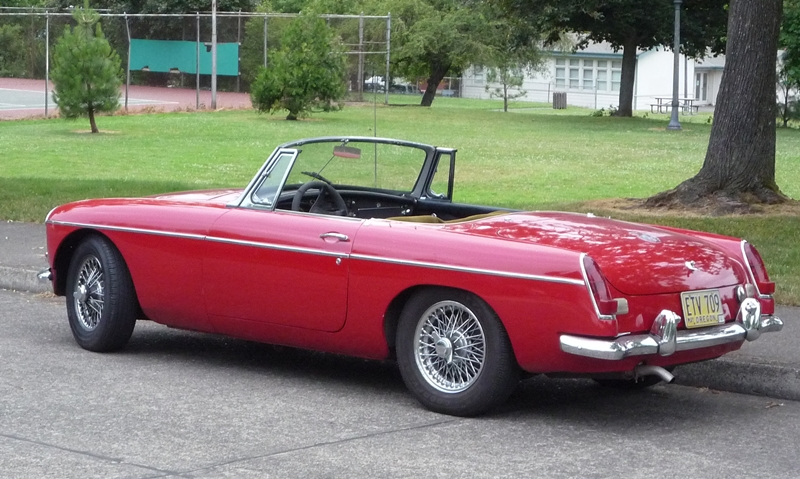
So what about the Fiat 1500 itself? It’s a car that’s quickly getting lost in sands of time. There was a time when it was fairly popular, especially in California, although certainly not like the madly successful MGB, which also shares a family resemblance from the rear, thanks to Pinin’s contract with BMC.
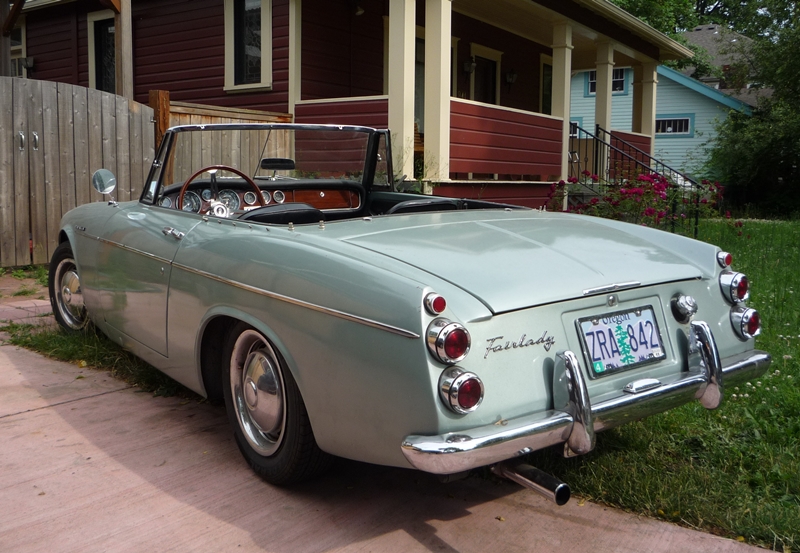
The Fiat may well have been the best looking of the class which included the Triumph TRs and the Datsun 1600/2000/Fairlady (also a Pininfarina client), along with a few others, but it just never took off in the way its successor did, the truly superb 124 Sport Spider (CC here). Why?
Oddly enough, in part because Fiat didn’t have the right engine at the right time, both for the 1500, and its predecessor, the 1200. Sports cars hopefully are more than just a pretty suit, which probably explains how hoary roadsters like the early TRs became so popular.

Fiat’s first crack at the fast-growing sports car market in the fifties was the 1200, which arrived in 1957, based on the popular Fiat 1100 platform. This was not a Pininfarina design, as if that wasn’t all-too obvious. An in-house design by Fabio Rapi, it was trying way too hard to look American, and ended up looking like an amusement park kiddie-ride-mobile. With 53 hp, it probably wasn’t much faster.

Too stubby and bulbous, with overwrought details, including that very badly cribbed vertical chrome strip on the hips à la Cadillac. An Allante, three decades too soon (oops; that was a Pininfarina).

Pininfarina did make a coupe version a year or two later, which improved on it by some measure, and foreshadowed the second generation Cabrio. And when it came time to design the 1200’s successor, the job was Pininfarina’s anyway, as he was now designing the whole Fiat family.

The result was the Fiat 1200 of 1959, which had some different front end details than our featured later version, restyled in 1963. But it still sat on the same basic platform as the earlier 1200, even though all of its stubbiness was now lost to the accentuated sweep of horizontality. A much more grown-up looking car indeed, despite being virtually the same size. What wasn’t lost was its little 1221 cc pushrod four.

“Taming the mountains, racing the wind” might make good ad copy, but “Eating the competition’s dust” would have been more accurate. With 53 hp, the Fiat’s competitors in the all-important US sports car market were leaving the elegant Fiat 1200 in their dust. Something had to be done.

Fiat turned to O.S.C.A., the Maserati brothers’ small sports-racing boutique. Their delicious 1500 (above) was a different animal altogether, and had a race-bred DOHC alloy four.

Fiat ponied up, and a detuned 80 hp 1500S model was born, also known as the Fiat-OSCA. But just like the painful lesson MG learned with its ambitious Twin-Cam MGA, the Fiat-OSCA was now too expensive for the heart of the market, and ended up being built in small numbers. A later 1600S version with over 90 hp succeeded it, both included four wheel disc brakes, larger wheels and tires, and other upgraded kit. More of an Alfa competitor, but still more expensive.

No, that’s not what our featured bread-and-butter 1500 (once) had. The regular 1500 came along in 1961, and used a pushrod four cylinder version of the Fiat 1800/2100 six cylinder. With all of 67 hp, it was an improvement, and had an actual five-speed gear box, but it was hardly a hot-blooded Italian. When the new MGB appeared in 1962 with its 1800 cc engine and 90 hp, the Fiat was relegated (again) to looking better than it went. Hence the advertising: pay no attention to what is under that hood.

Yes, the Fiat’s “second best shape in Italy” campaign might also have been a play on its similarities to the Ferrari 250, but something even more obvious was chosen to represent “the best”, at least in the ads.

So it should come as no surprise that this yellow Fiat has something other than the original mill under its second best shaped hood. And what might that be? I guessed wrong, and I probably should have known better. I imagined a modern DOHC four there, perhaps a later Fiat unit, or? I was also prepared for the worst.

It turns out to be a fairly logical and pragmatic choice: a 2.8 L Cologne Ford V6, courtesy of a Capri. A very compact motor, it can fit almost anywhere. And this one has been thoroughly massaged: head work, cam, headers, and a Holley four barrel that’s almost as big as the engine. The owner estimates it puts out about 185-200 hp, not much less than the Ferrari’s 240 hp.
Not bad, for a car that weighed about 2000 lbs. Well, that’s before the V6 went in, which does have more mass than the original four. Enough so, that the owner says that the additional heft can be felt up there, and he wishes he could have implanted it a bit further rearward. But the Fiat has a very unusual steering gear, as can be seen by that linkage across the firewall. It would have had to be completely torn out and replaced with a modern rack and pinion steering to do that.

The interior is a work in progress, and a genuine Nardi wheel would look good here, but then this is very much a budget project that started out fifteen years ago with a tired old Fiat found in someone’s garage. That shifter works a five speed from a Ranger truck.

The 1600S Fiat-OSCA had some nicer touches all around, including the interior with larger gauges. Very much an Italian upper-middle class Ferrari indeed. With an emblem swap on that Nardi wheel, one really would be easily fooled.

Here’s the real thing, by way of comparison.

Having long given up hope of finding a Fiat 1500 in the wild, I’m in no position to criticize, but those wheels aren’t doing much to enhance the boy-Ferrari look, at least not in the vintage idiom. They are exotic: the owner thinks they might be the only set of wheels from a Renault Clio turbo/Williams in this fair land. And it took some custom made spacers to make them work. I know; some genuine Borrani wires would have been exorbitant. Maybe something else might have worked a bit better, perhaps the ever-popular minilite type wheels. Obviously, some vintage Italian Cromodora alloys would be just right. To each their own wheels.

The sounds that emit from the big exhaust is impressive; obviously nothing like that fabric-being-torn wail a genuine Ferrari V12 like the 3 liter 250 GT so forcefully dominates its surroundings with. More like the “junior Ferrari” Dino, since both of them share a 60 degree V6. Yes, there’s a certain aural resemblance to that raspy beast (CC here), except that the Ford does its song an octave or two lower. The Dino hit its high notes at 8000 rpm; I doubt the Ford goes much past 6000.

But it snarls impressively, as its owner cranks it up and readies for take off. He tells me he’s on the hunt for a 1600S rear end, which has slightly higher (lower numerical) gearing and a limited slip differential. The potent and front-heavy Ford V6 likes to spin those Yokohamas all too easily. In case he thinks I don’t believe him, he makes a noisy getaway blast, with plenty of smoking rubber as he grabs a few gears zooming down 30mph-zone Willamette Street. The woman he was visiting stands next to me as we watch his display, and utters the inevitable: “boys and their toys”. In this case, toy Ferraris. Or maybe she was convinced it was the real thing.


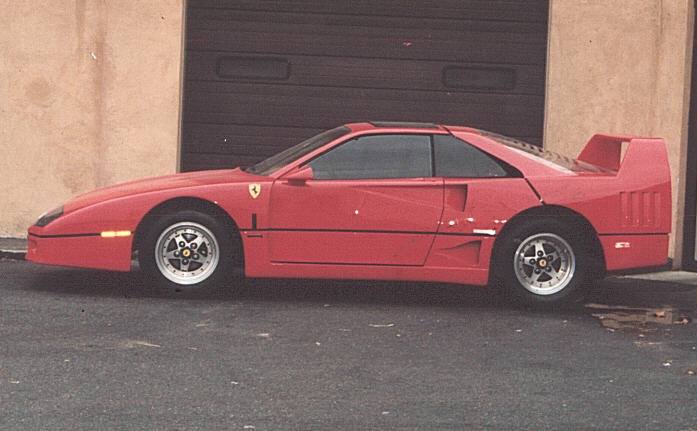
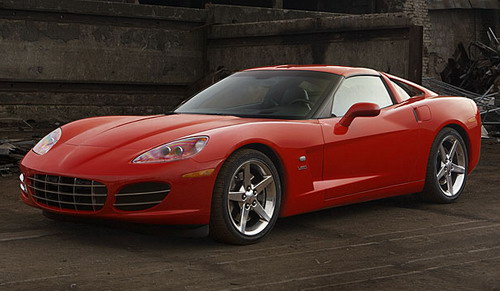
Nice car the Peugeot version has 404 sedan tailights as a giveaway Those little V6 Zephyr motors go in anywhere a popular swap for lightweight cars and this one has the good looks that needs some more power than Fiat had on offer I guess this would have used the Fiat 1500 Crusader motor originally very slow hardly befitting the looks
I am quite sure that I have never seen one of these. What a great read on a delightful little roadster! I will confess a little sadness at the owner’s need to convert to the pedestrian Ford powertrain, but I am sure that it will be a lot easier to maintain (and is certainly faster).
I have always admired the lines on convertible roadsters of this era. The proportions on these cars were just right. They have a classic look that never looks wrong.
That was a really good story about the Fiat. I hate to admit this though, but am I the only person who saw the Checker wagon (Superba?) in the background?
I sure hope not. It’s a former CC car, owned by an elderly couple who bought it new. http://www.thetruthaboutcars.com/2010/04/curbside-classic-1967-checker-marathon/
I saw the Checker and went back and reread the CC Ive never seen a Checker in the wild
I have. But I’ve never seen the station wagon version in the wild.
Nope. I was just cruising the comments to see if anyone else was going to comment on it. Fiat might be interesting but the checker is desirable IMO.
I remember seeing a few of these running around Los Angeles in the late 70’s… but the Fiat 1500 was never at pretty… or as technologically advanced… as the 124 Spider…
Very cool little ride! Yet another car I either never knew about or forgot about.
Why those wheels though?
Yeah, those wheels look very wrong to me. Beautiful car though.
I know. I have no memory of this car whatsoever.
Fabulous! My first thought was Ferrari too. Bella, bella.
I’ve loved and followed the Fiat 850 and 124 Spiders since we got an 850 Spider when I was a kid. Never knew of the 1500 Cabrio. They must not have made it to the Northeast, or else they rusted away in 10 minutes like other Fiats. Thanks very much for a thorough in-depth history of this car and its cousins.
Speaking of which, what exactly is the difference between a cabriolet and a spider? Just language? Why was the Fiat 1500 a Cabrio and the later Fiats were Spiders?
Cabriolet just means convertible. Spyder/spider at one time implied a sports car with very little weather protection, like a true roadster. But the name became corrupted, because it sounded good.
The Fiat 1200/1500 was called Cabriolet in Europe, but the American ad agency obviously thought Spider sounded sexier. Both were used, until Spider took over. I’ve added Spider to the title, since that’s what it was more often called in the US.
Cabriolet usually meant the windows stayed up when the top went down like the sardine can rolltop Fiats or Morris Minor ragtops not a true convertable roof
Then what was the spyder? A ragtop that did not have glass side windows? In America that was called a phaeton.
A phaeton was a four door roadster. Or a roadster with a full size rear seat. A good illustration is the Jaguar XK 120. It came in three body styles. The coupe, a two door hardtop two seater. The cabriolet, a two door, two seater with a folding top (ala baby buggy), and glass windows that would roll down, In Jaguar’s case it also had quarter vent windows.
The roadster or OTS in Jaguar speak, had side curtains, no quarter vent windows (no side or rear glazing at all), the top had to be assembled as it came with a frame that you assembled in situ before attaching the canvas top.
In 1962 I bought my first English car magazine, “Motor”. I think I got it at W. H. Smith in Toronto. There was a full page ad for the Austin Healey 3000, announcing that it was now available as a convertible. I found this confusing, because as far as I knew they had always been convertibles. At the time I did not understand the difference between a roadster and a convertible. What it meant was that the Healey was now available with a folding top and roll up windows.
Imagine yourself as a high school junior in the downhome environs of Nashville, Tennessee. You’re about to buy your first car, anything you want as long as you “keep it under a thousand.” At the first used car lot, you find two imported convertibles. Do you take the one with the sleek lines and forward-tipping cowl, which opens to expose the whole front end like a racing car? Or do you take the slightly dumpy-looking one, because it has a real five-speed transmission?
I made my choice, which is why I’ll never qualify for the Triumph Spitfire Owners & Ex-Owners Club. Too bad there isn’t even a club for this forgotten car.
Even in bright red with the top down, I never associated my cabriolet with any Ferrari. I’d driven little else than my mother’s Mustang, and the Fiat felt similar, just smaller and handier. Not very fast, but no problem– it was way faster than the 50cc Harley-Davidson Italian mo-ped import I’d been riding previously.
But it was ’68, with Hendrix on the radio, the top down and my first gal… Nobody ever had a better first car, I’d suppose, than my Cabriolet.
I’m still around, but where did all the cabriolets go? Thanks for reviving the memory of this unique car!
“Nobody ever had a better first car, I’d suppose, than my Cabriolet.”
My first car was a 1965 Fiat 1500 Cabriolet.
Red, of course.
I wish that I still had it.
What a fantastic find. Being a fan of odd balls I think I’d rather see one of these over the Ferrari any day. The engine swap isn’t a bad as such especially given the size of the engine compartment but I think the owner could have done better on the wheels even given the Fiat’s less common bolt pattern. There is a Fiat-OSCA around here locally but I haven’t had the good fortune to see it for myself yet.
My wife owned a ’95 Fiat Barchetta for a while. Very nice car, but really just a two seater Fiat Punto with fancy red paint. But it did drive the assholes crazy. Particularly in France. They would try to push her off the road, the socialist bastards.
The few times I drove it got the same bull. With the top down they would scream insults at her. Forced her to trade it in for a yellow Mini. Thinking she was just a dumb blond she never got bothered again. We learned never to buy a sheep in wolf’s clothing.
I’ve witnessed road rage here in the US but I don’t recall seeing people being screamed at or being pushed off the road because someone is driving a particular car. Is this typical behaviour in Europe or parts of Europe?
I have a little more time for reminiscing about this car, but the memories have faded. Mostly, I remember my admiration for the convertible, er, a Cabriolet top. Perhaps the distinction between the two is, a cabriolet has a top that really works? My Fiat’s top was truly impressive. I could raise it simply by reaching back over my right shoulder, pulling upwards and clicking two latches shut at the windshield header. It wasn’t the thick, plush top seen on today’s luxury convertibles, but it was tight, taut and never leaked.
The five-speed was a rarity in its day. I especially enjoyed the shift into top gear, if I remembered to be careful not to overshoot and rap my knuckles on the dashboard ashtray. It was a wide pattern that strayed well into the passenger’s knee range, but my girlfriend didn’t mind.
I kept the Fiat for almost two years. It was generally reliable, but was leaking oil as I prepared to go off to college. Instead of doing a seal job for $150, I sold it and bought a 10-speed as I entered a carless campus life. So on I went, unaware I was walking away from a near-Ferrari. Ah, well…
I’m very happy that we have a former owner to share their experiences. That’s an important part of CC, but I had very low expectations that an ex-owner would read this today.
Thanks for sharing; it really helps put it in perspective,
Actually, I guy I worked with in the late seventies in LA had one, and I remember looking it over several times, but it wasn’t a runner (like quite a few others in his collection).
Do you still have your TTS? I had one back in the early 1980s, ran like a scalded cat until the back carb developed a fuel line leak, and raw gas dropped down onto the starter motor — foooomfffhhh! It went up in a blaze of glory.
Also had a 2-cylinder Prinz coupe, and 2 Spyder Wankel roadsters.
And I guess I should add a couple of 1959 Fiat 1200 Spiders as well, I found them in a 2-car garage near Wash DC, bought them for $100/pair. They had been sitting unused, with 1965 license plates. He & his wife stopped driving them when the local Fiat dealer closed. They looked great, but were slugs on the road. 0 to 60 in a couple of minutes!
My first car was a red 1964 Fiat 1500 that I bought for $525 in 1976. I drove it for three years while going to college. Great car with suprisingly few mechanical issues. I echo the comment about the top. I put on a replacement top and and it was very easy to open and close while sitting at a stoplight. I did break the transmission (my fault) so sold it to a buddy for $125. Best $400 I ever invested in a car.
Hi,
Nice to see this thread…I have an even more look a like car, built in 23 pcs I’ve heard.
It’s an Abarth 1600 Allemano Coupe with a 1600cc OSCA engine with a touch of Abarth, gives 96 hp and runs very nice.
Regards,
Fredrik from Sweden
Very nice! What a rare car. Congratulations.
Here is a photo from side.
/ Fredrik
Very nice car do not forget to Peugeot
Hi… I just happened on this thread while searching for info about the 1964 Fiat 1500 “Spider”. There is one for sale not too far from me. Looks fairly well restored. Price seems a bit high, but hard to get a fix on value of one of these. does the group here feel this would be a wise purchase or would my hard earned $$ be better spent on something else?
I’d take the Fiat any day over the Ferrari.
I suppose there is a resemblance to the Ferrari 250GT, but to my eyes there is an equally strong resemblance to the Volkswagen Type 3 notchback.
The taillights for sure!
I don’t believe it- only yesterday I photographed one in Israel, and only about an hour ago I uploaded it on Flickr:
Nice! Love it.
Ever rarer I saw that V6 engine in its original form parked close by roadside someone is selling a MK4 Ford Zodiac only a couple of miles away going back for cohort shots later (hope it didnt sell overnight).
I’ve never seen one of these even though we had a Fiat dealership in the town I grew up (Norwalk, CT). Beautiful car. My initial reaction was a bit of MGB at the rear (tail lights very similar to early Bs). What a bizarre steering linkage… never seen anything like that either….
Nice little car, but those wheels, ugh. Convex spokes are never a good look, they look like they were taken off a locomotive.
Lovely little car, poor wheel choice. I do agree that minilites might be a better choice, if the owner doesn’t want to pony up for wires. Though the OEM wheels w/polished caps aren’t a bad choice either.
I must say I slightly prefer the 1959-62 version of this car before the grille rework, because the older design has a very “smiley” grille. Happy car, happy driver, no?
I own three of these Fiats, a 1200, 1500 & 1500s (OSCA) it has been a love & hate relationship with them over the years….although now it’s more love!
I agree the wheels should go…and a little detailing would make this yellow Fiat a very special car, I painted my 1500 the same yellow back in the 70’s, wasn’t the best choice of colour.
Don’t know if the 1200/1300/1500 range shares the 124’s 4×98 mm bolt circle, but if so, 14×6″ Maserati BiTurbo wheels (http://home.earthlink.net/~fiat850/mira/biturbos/mbt5.jpg) would be a great option, and taller sidewall tires (maybe 185.70 or so) would be more period-correct. Ran a set on my 124 Spider years ago.
When I was in college (early 70s) I was in the habit of buying cars for a hundred dollars and selling them when the tires were bald. I had little money, but just after getting a student loan I saw an ad in the Nashville Tennessean for a 1963 Fiat Cabriolet with 33,000 miles. I wasn’t sure what that was, but the man who answered the phone told me it was a convertible and I took a chance and drove the 40 miles from Murfreesboro to Nashville to look at it. The Fiat (white with red interior) was pristine and I didn’t quibble about the $450 asking price. The man told me he was selling because he didn’t want his son was coming of driving age and he didn’t want him to have it because it was too fast.
The Fiat was a conversation piece; people were always asking me if it was a Ferrari (the article here explains why). It got 30 mpg and would cruise at 100 mph on the interstate with the manual choke pulled out so I wouldn’t have to push on the gas pedal, early cruise control! I could put the top down or up with one hand from the driver’s seat, and it was down whenever the temperature was above 40 F. The trunk was cavernous.
I drove the wheels off that Fiat. I once drove the 380 miles from Murfreesboro to Pikeville Kentucky with my sister, my spouse, two poodles, our luggage, and 350 hardback books my father-in-law had just had published in Nashville. It was books to the windowsills and we kept the windows up so they wouldn’t fly away, but the car did great– and so did it when I towed an full-sized upright piano in a U-Haul trailer.
The Fiat actually saved my life. I was driving to work in Nashville and a middle-aged man in a Mercury Cougar pulled around a turning school bus onto the four-lane and stopped. I was less than a hundred feet away going 50 mph and our eyes were locked and it was one of those I’m dead and you’re dead and we both know it moments but I was young with fast reflexes and I flicked my wrist to the left and the Cabriolet leaped over a lane instantly and I missed him by a good two feet. If I had been in a Ford with power steering I wouldn’t be telling this tale today.
I hated to sell it, but even with having purchased a parts car it just sort of gave up the ghost at 180,000 miles or so. Suddenly it needed a clutch, tires, front end work, a new top, the seats reupholstered, the engine was leaking, and it had acquired a big dent. I sold it for $350 to two young men who wanted to restore it. I hope it’s still out there.
I drive a Mazda Miata today because of that Cabriolet. I still drive the top down in all weather, and even with bad shoulders I can still put it up or down while stopped at a traffic light.
1963 Fiat Cabriolet 1500. Best. Car. Ever.
Thanks for adding your Fiat Cab story. Enjoyed it.
It’s great to hear from another who was motoring a 1500 Cabby around Music City at about the same time! When I came back to Nashville in 1975, I chose an even rarer ride: an NSU 1000TT.
I haven’t owned a convertible since. Out here in Denver, if it’s warm enough to go topless, the sun can be unbearable. Nights are too cold, mostly. My favorite miles in the Cabriolet came on summer evenings, when you could be warm in the fresh air, surrounded by a passing thunderstorms, in no hurry to go noplace in particular, with just a couple of D-cup-sized VDO gauges telling you all you needed to know.
I wish I could see a Miata as a Cabriolet replacement, but it’s too darn small. Feels like half the interior volume of the Fiat, and a quarter of the trunk space. Styling dictates a low windshield, which cuts off barely above my eye level. The Fiat was a more upright design, with a generous windshield. A Grand Tourer, not a roadster.
Fiat 600. http://www.autootpadkidi.rs
I had one of these, probably a 1500, in 1969, when I was in college. I traded a gun I had bought for $50 for it, not running. I got it half running and blew it up on the third day. I saw the only other Fiat in Tucson, and gave my address to the owner, hoping he would buy it for parts. My radiator was stolen the next day! I sold the rest for $75 to a kid whose dad owned a junk yard.
It was cool.
I too spied the Checker wagon in the background. I honestly thought those wheels were repurposed space saver spare alloys wheels from a modern…Audi? Some mfgr. uses a wheel just like that. They look like cheap plastic wheel covers and do the car no favors. especially in black! But, it’s his car and he must like them.
The Fiat looks more like the Peugeot 404 to me