

After seeing Chevrolet last week, and a snippet of Ford earlier this week, let’s continue our journey with Dodge. As with Chevrolet, this is far from being comprehensive and brochures were found at oldcarbrochures.com. To clarify intentions, the aim is to highlight cars sold in Australia that shared a body shell with cars sold in the United States and Canada.
So let’s get started. And, yes, this is a Dodge, a Phoenix 400 to be exact.

Before we jump too far, we need to discuss Austral Motors, the company whose name is printed in this brochure. The successor to Austral Carriage Works, which was located at 51 Adelaide Street in Brisbane, it evolved into Austral Motors shortly after World War I. Becoming the sole provider for Dodge Brothers cars in Queensland, they would later have a second branch in Spring Hill.

The Austral Motors Building was constructed in the 1920s and still stands at 95 Boundary Street.
Further research about Austral Motors itself is proving to be a challenge, aided in part by a dealer in Brisbane using the Austral name.

Whether these 1940 cars were built in the United States, Canada, or imported for assembly in Australia is hard to ascertain. However, less uncertainty exists in the newer cars as we shall soon see. These Dodges were pretty much replicas of what was sold in the United States with the brochures of both countries using the illustration of this red Dodge having an ambiguous steering wheel location.

The exaggeration of automobile dimensions from around this time seems to be a universal phenomenon.

Fast forwarding to 1959, we see the Forward Look was being imported to Australia. This is a fascinating thing as this is identical to a North American 1959 Dodge however, at this same time, the Chrysler Royal being sold in Australia was wearing awkward updates on a body that was used as the 1953 Plymouth in North America and preceded the Forward Look.

By this point the importer was Chrysler Australia Limited based in Adelaide. Chrysler Australia Limited had been formed in 1935 as a consortium of eighteen distributors. Early in their existence Chrysler Australia assembled North American Chrysler branded cars which is likely how the 1940 Dodge was assembled.
In 1958 and 1959 Chrysler Australia imported Dodge Custom Royals, Plymouth Belevderes, and DeSoto Firesweeps from the United States in knockdown form and assembled them in Adelaide.
In viewing this particular brochure, its pretty obvious Chrysler Australia wanted to offer an appealing car as all these Dodges had the 361 cubic inch V8 along with the Torqueflite transmission. No flathead straight-sixes nor three-on-the-trees here.

Like the Dodge, the DeSoto received the 361 V8.
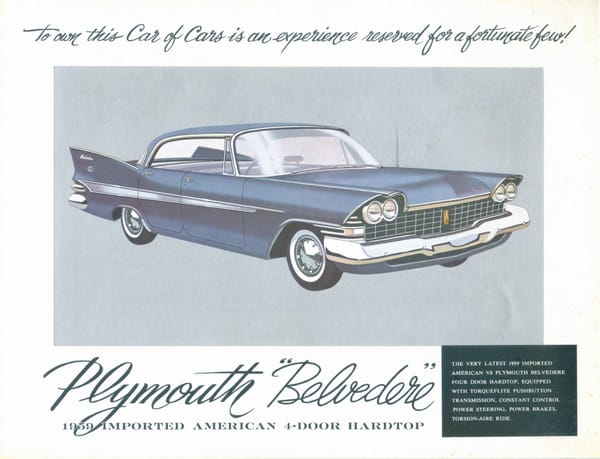
The Plymouths were powered by a 318 and the brochure was explicit in stating only a few would be imported, much more than was the Dodge or DeSoto pamphlets.

For 1960 Chrysler Australia consolidated the Plymouth/Dodge/DeSoto models down into the Dodge Phoenix.

All were powered by a 318. Of delightful note here is the trunk capacity is 29.4 cubic feet – with the spare tire in position.

The 1962 Dodge Phoenix was identical to what was offered in North America, downsizing and all.

While not necessarily wanting to go into great detail for every year, the 1963 is being included due to this picture of its hind quarters. The amber lenses on the trunk lid are obviously tacked on but do not have the mind-numbing shock that Chevrolet incorporated onto a few of their Australian offerings during this time period, particularly the 1966 models.

Here is where things start to get fun for those in the Northern Hemisphere and it was quietly alluded to with the lead picture. Chrysler Australia would produce the full-sized Dodge Phoenix until 1973. Beginning in 1965, and lasting until the end, the body shell and front end used were identified as being Plymouth items of the same year in North America.
In other words, 1965 Australian Dodge = 1965 North American Plymouth and so on. The bodies would reflect directly by year until 1971.

One interesting item of note is the Australian Dodge emphasized the interior appointments, as well they should have. This is a great looking interior and this picture comprised one-quarter of the brochure.

Conversely, this is the interior of the 1966 North American Dodge. It’s rather hum-drum in comparison. But at least it’s showing an interior shot; Plymouth only had a thumbnail picture for 1966 so one can only surmise they didn’t want to talk about it.

This picture of the 1967 Phoenix reveals two things. First, the 318, which had been around since 1960, had been replaced by the 383 cubic inch V8. Second, the amber on the tail lights was much better incorporated, looking much more organic.

This second picture from 1967 gives the best shot of the instrument panel so far.

For comparison, here is the 1967 North American Fury.

This brings us back to 1969, the year of the car in our lead photo. This was the first year of the fuselage style, this car being known as the Plymouth Fury elsewhere in the world. However, in Australia, they went a different direction with the car now being called the Phoenix 400. Why 400?

Only 400 were going to be made, with each having its unique identifying number on the dashboard. Exclusivity was the goal, and to further achieve that goal, buyers were offered the choice of a 318 or 383 to propel themselves.
Of course, the laws in Australia being enacted at that time requiring substantial domestic content likely also played a factor. That, and choosing to import 400 units could have been comparable to what had been the case anyway.

How many of these remain intact? Enough, it seems. An image search for the Phoenix 400 reveals cars in all different conditions, so while the survival rate appears to be good they still aren’t plentiful. However, percentage wise, one could easily argue their survival rate in Australia is much better than of their cousins in North America.























Nice article – I didn’t know about these vehicles being in Australia. Thank you!
Oddly, the 1966-68 versions appear to have Imperial seats. Versions before and after are some type of locally sourced products.
Whether GM, FoMoco or Mopar, these US-shelled full sizers were built to a formula.
CKD kits with (usually) locally sourced interiors and hard bits (mirrors etc) with a sprinkling of hand-me-down US parts, an example being the ’65 Dodge instrument cluster used from ’65 to ’68. Also, very limited options. Forget about power windows or in-dash AC. You want AC? Prepare to have your knees knocked.
While I couldn’t find anything this explicit for Chrysler products, this goes along with what I did find in regard to AMC products exported to AU. Headlights, seats, carpet, hoses, etc. were all locally sourced.
That is pretty universal for CKD assembly operations; soft trim and stuff that is universal or easy to make is sourced locally.
GM likewise chose either the Chevy or Pontiac dash for all divisions’ B-bodies in right-hand-drive in the first year of a new bodyshell and stuck with it for the entire run. They just didn’t do enough volume in RHD to justify the expense of updates and differentiation.
That dash in the ’67 Phoenix seems to be unique to the Aussie version. The (awesome) gauge cluster may be from the ’65-66 US Dodges, but the “crash pad”, knobs, and buttons are unique (though identically placed). As noted below, Canadian Dodges from this time looked like American models on the outside, but used Plymouth interiors despite being LWD. So no cool huge speedometer.
Cool article!
Since the most of the pictured Australian Dodges are built with US Plymouth body panels, could they be considered “Plodges” – possibly even built from CKD kits of Canadian origin? In Canada, wasn’t there a version of the 318 with a displacement of 313? If so, I wonder if any 313s made it to Australia?
Would the 6 cylinder engines on the D14 & D15 spec sheets been the famous Hemi six?
Couldn’t help but notice… it looks like the shift lever pictured in Phoenix 400 # 284 is sporting a 12DNRP unlike its PRND21 cousin from the US?
Shift lever pictured in Phoenix 400 # 284 is sporting a 12DNRP unlike its PRND21 cousin from the US?
That is “correct” sequence for the right-hand-drive system. You use your left hand to shift down from P to other gears and vice versa. (See the red circles I placed in the photo below.)
Mirror-flipping the stalks and ignition lock on the steering column for RHD is very rare. Usually, the manufacturers would save money by sliding entire steering column over to the right without swapping the column shift, stalks, or ignition locks. In some instances, the functions of stalks are swapped (i.e. turn signal indicators and wipers).
General Motors was too cheap to redesign the steering column for the right-hand-drive version of Chevrolet Suburban to be sold in Australia as Holden Suburban. So everything on the steering column remains the same as in LHD version.
See the photo for comparison.
That’s more like an S-10 dash than any dash found in the full-size GMT400 in LHD.
Yes, the dashboard is from right-hand-drive 1995-2001 Blazer and stretched on the left to fit the wider Suburban. This “bizarre” approach was derided by media and public for excessive squeaking and rattling.
Why “bizarre”? Quigley 4×4 had converted the Silverado/Tahoe/Suburban to RHD with its custom mirror-flip dashboards for a few years prior to the introduction of Holden Suburban. Quigley dashboard was of high quality and better screwed together than modified Blazer dashboard.
Had General Motors stuck with Quigley for Holden version, Suburban might have better success in Australia and elsewhere.
It might be bizarre, but it makes sense*; Quigley = “NIH” (not invented here)…
* that is, makes sense from a Big 3 perspective.
Thanks!
The 12DNRP just adds to the alternate universe coolness of these Australian Dodges.
This article reminded me that my first freeway driving experience was in a ‘69 Plymouth 4 door sedan back around 1977. I always thought the ‘69 grille was one of the best of the fuselage Plymouths. It sure looks great on the featured Dodge Phoenix!
Also looks like the windshield arms look like ” clappers ” in the 67 s dashboard picture
In the American version they are parallel wipers
Wow, I had not noticed that but you are right. The illustration of the outside of the 65 shows the same thing, totally unlike the American version.
Did the US market 1940 Dodges have the “Scotch dynamite engine” or was that feature only for Australian customers?
Yes, Dodge advertising used the “Scotch dynamite” designation in US advertising for their totally unremarkable L-head engine.
“The exaggeration of automobile dimensions from around this time seems to be a universal phenomenon.”
This is so true of the illustrations back in the day.
And the picture just after that quote looks like a fictitious car featured here some time ago…
I was surprised to see that the 1969 model at the top still had a 6 volt system.
But the 1960 Dodge Phoenix is 12-volt!
The 6 volt spec sheet is for the 1940 Dodge, I think. L head engine and 16″ air wheel tyres, whatever the heck those are (tubeless, or just pneumatic?).
By 1940, “Airwheel” was a Goodyear advertising term for their (relatively) large, low pressure tire. Not really anything special.
The original 1929 Airwheels look a tad unusual.
http://theoldmotor.com/?p=148646
That would explain it. 🙂
It didn’t; it had a 12v system.
DE-PE-NDBLE
Weird: ndble
Never mind. Clicked on the image and it wasn’t dashes, it was a weird font.
I thought the exact same thing. And that font is doubly weird since it’s only the ‘E’ that has an elongated middle prong. I wonder whose brilliant idea that might have been.
With everything backwards on the dash, I wonder if anyone was ever tempted to call it a E G D O D?
Those mashups of American Plymouths and Dodges give me a case of cognitive dissonance.
An E G D O D might be interesting. After all, nobody has ever seen a dodo, let alone their eggs….
The Phoenix 400 name amused me because MOPAR introduced their 383 bored out to a 400 B engine shortly shortly thereafter
Thanks for highlighting these, Jason. Although Chrysler imported some of the US 1959 models, I don’t recall seeing any back in the day. But I came across this a few years back at a rod run passing through my town. While not a fan of things that stick through hoods, this does have a certain appeal.
Continuing on the theme of Big Mopars seen in Small Country Towns, this one turned up at the local car show last year. I’ve never seen one before.
Reading the specification page, the Australian ’40 Dodge D15 was a bit of Mopar mix and match, perhaps more American Plymouth than Dodge. The D15 wheelbase was the 117″ of the Plymouth, the engine spec’s convert to the longer stroke 210 ci Plymouth PT105 Commercial chassis engine of their trucks.
The Richards body came with leather upholstery standard, cloth upholstery available. While the Richards body looks similar, the rear roof/trunk sheet metal is different from the U. S. product.
Continuing on the theme of Big Mopars seen in Small Country Towns, this ’60 Plymouth sedan turned up at the local car show last year. I’ve never seen one before.
I can believe you never saw one before Pete, I found upon moving to OZ American cars to be very rare in all makes and models after them being common in New Zealand and the cars I did see didnt quite match the cars I was used to, the strange orange indicator lights weirded me out too especially the one under the bat wings on 59/60 Chevys.
Big Mopars seen in Small Country Towns, part 3. The neighbours over the road had visitors come to stay for a few weeks, who brought this beauty. It sounded as good as it looks. Pretty sure they didn’t originally come in metallic purple though, and I’m sure it would’ve had a vinyl roof once. The wheels date it, but I can live with them. And there’s those accessory orange indicators set into the bumper below the taillights…..
A better shot of the indicators, for our lighting expert.
I guess I’m a sucker for the fuselage bodies. That’s one fine looking car. And the paint resembles the old MoPar Plumb Crazy. I wont get into it but we reprobates always called that color something far less nice.
Oh go on, go into it. Use symbols if you must.
Cheers, mate! Those lenses got a great deal of use. They were used at the front of the US ’65 Dart and the Canadian ’65 Valiant Custom, and at the rear of the Australian VC (’66) Valiant and sundry other Australian models, apparently including this what you’ve shown here. They’re not godawful in this application, but rather than futzing with a whole different bumper bar and separate lamp housings, etc, they really ought to have just made a 3-colour, 2-chamber taillamp.
(though come to think of it, a different bumper bar was probably needed anyhow for the Australian licence plate)
Now thats how to do a 4 door, no vent windows, no fixed rear 1/4 glass, and no B pillar. Glorious.
Oh, ain’t it though!
In Canada in the mid ’60s the C body Plymouths & Dodges both used the US Plymouth interiors including the dashes.
This makes the Australian Plymouth bodied Dodges with Dodge dashes seem even odder.
I would have guessed that for Commonwealth reasons that Australian Mopars would have been sourced through Canada, but perhaps not.
I’ll just leave this here. It’s not quite on-topic, but it’s, ah, topic-adjacent.
Wow, never seen a Chrysler Royal hearse before. What a way to go.
I think it is interesting that in 58/59 the Plymouth was a hardtop while the more upmarket (in the US) Dodge and DeSoto versions were sedans.
In 1967, with the introduction of the Hardtop option, you got the 383 engine standard, while the sedans had the 318, it continued this way until the end of production.
I read at Allpar that one of those ’59 Firesweeps was destroyed in Mad Max. Aw. There would only have been a very small number of them. However, by the late ’70’s, old Yank Tanks were worth scrap money. In fact, by then, even fairly recent big-engined locals had crashed in value due to the petrol costs.
The Australian Phoenix needed a posher interior than the US Plymouth because by then there was the locally made Valiant Regal, with V8 if you liked. The Dodge being pricier, it got a lot of the furniture from the Regal, plus a bit more. It had to.
I have always loved the fuselage Phoenix for its, well, fuselageness, well before I ever knew that’s what it was. But by ’71, ofcourse, we were making our own locally-designed fuselage Valiant, which was universally seen itself as a bit overdimensional (and sold accordingly). And with the upscale (and absurdly named) Chrysler by Chrylser range topper – which even had standard under-dash A/C, no less – there was no need for an even bigger car, so the Phoenix went to god. Presumably through the special wide door.
Despite my love for the car, even now I wouldn’t buy one if had the readies. As was so commonly thought in their day, it’s still just too bloody big, even for use as a toy. In truth, in a different and more diffident Australia, all these lovely Chryco barges from the Royal onwards were seen as slightly absurd extravangances.
Some screenshots from IMCDB. It was the car that attempted to infiltrate the compound and got torched by the flamethrowers, and later bulldozed out of the way by the Mack.
One other bit of trivia is that from 1967 assembly of the Phoenixes was transferred to the ex-Rootes Group factory in Port Melbourne, which had extra capacity. In the volume sense, not as in space – they had to sequence Hillmans between Dodges on the line as there was not enough room to have two in a row!
The ‘before’ shot. Note the rust – they didn’t start with nice cars.
This close-up of the underside is interesting – a spring-over conversion and a bit of scaffolding to lift the body.
The pre-65 models were B-bodies so they could still be very viable dailies. The 65-68s are only roughly 100mm wider than a 2018 camry so they’re not too bad to park. But the real issue is the length – 5.4 metres…it’s longer than a 2025 ford ranger.
But given the recent proliferation of silverados and ram 1500s, who knows if new developments will have costco-sized parking spaces…
There was also one of the DeSotos in the early Peter Weir film The Cars that ate Paris. The tail fins were used as battering rams to disable an FJ, but it didn’t seem to hurt the big Mopar much.
And singer Johnny O’keefe famously ploughed a 59 Belevedere into a gravel truck, he survived, but was never the same. The Plym was toast.
1968 was always my favorite model year of the various Mopar fuselage permutations.
The later fuselage Phoenixes came as a post sedan with the 318 or a hardtop with the 383.
Very interesting info on the Aussie Dodge Phoenix! Thank you👌