

While I haven’t written either one into my COAL series yet, my current automotive stable consists of a 1997 Mazda Miata roadster and a 2024 Royal Enfield Bullet 350. Neither is particularly practical. In fact, neither is practical at all. I haven’t owned anything with a solid roof, lockable doors, or more than two doors since retiring my old Hyundai Elantra because of a badly slipping clutch and an impending timing-belt replacement. I drove the Miata through a particularly mild winter last year, but I wasn’t eager to repeat the experiment. While far from mint, it’s still rust-free, and I’d prefer to keep it that way. Then came golf. I joined a recreational league and was gifted a very nice set of clubs—which, as it turns out, I couldn’t fit securely in the Miata. They don’t fit in the trunk, either. Clearly, it was time to find something a bit more practical.
It turns out I’m not very good at this.
What followed was a sincere attempt to buy something sensible, filtered through the decision-making process of someone who apparently cannot be trusted anywhere near classified ads. Follow along on my shopping (mis)adventure for a practical winter car.
To better understand what practical meant in my context, I created a list:
- usable in winter
- solid roof
- lockable cabin
- room for golf clubs
- not too precious
- ideally left-hand drive
- preferably manual
- within budget
- highway capable
- easy to fix

The smart thing to do is probably follow the crowd and buy myself a mid-sized SUV as a practical winter car but I am not doing that. I did consider a Nissan Cube at a local auction with the rarely equipped six speed manual transmission. I have always liked the oddball looks of the Cube but have no interest in a time bomb used CVT. Sadly, it was in rather poor shape with some body damage and high mileage but that could have also been an opportunity.

Perhaps I could have made this work and converted it to an overland style specification. Few others had done this, likely for good reason, but I found a few cosmetically similar conversions on a site selling Japanese market cars. This was intriguing and I still think it would have worked out well but, in the end, I passed on it.
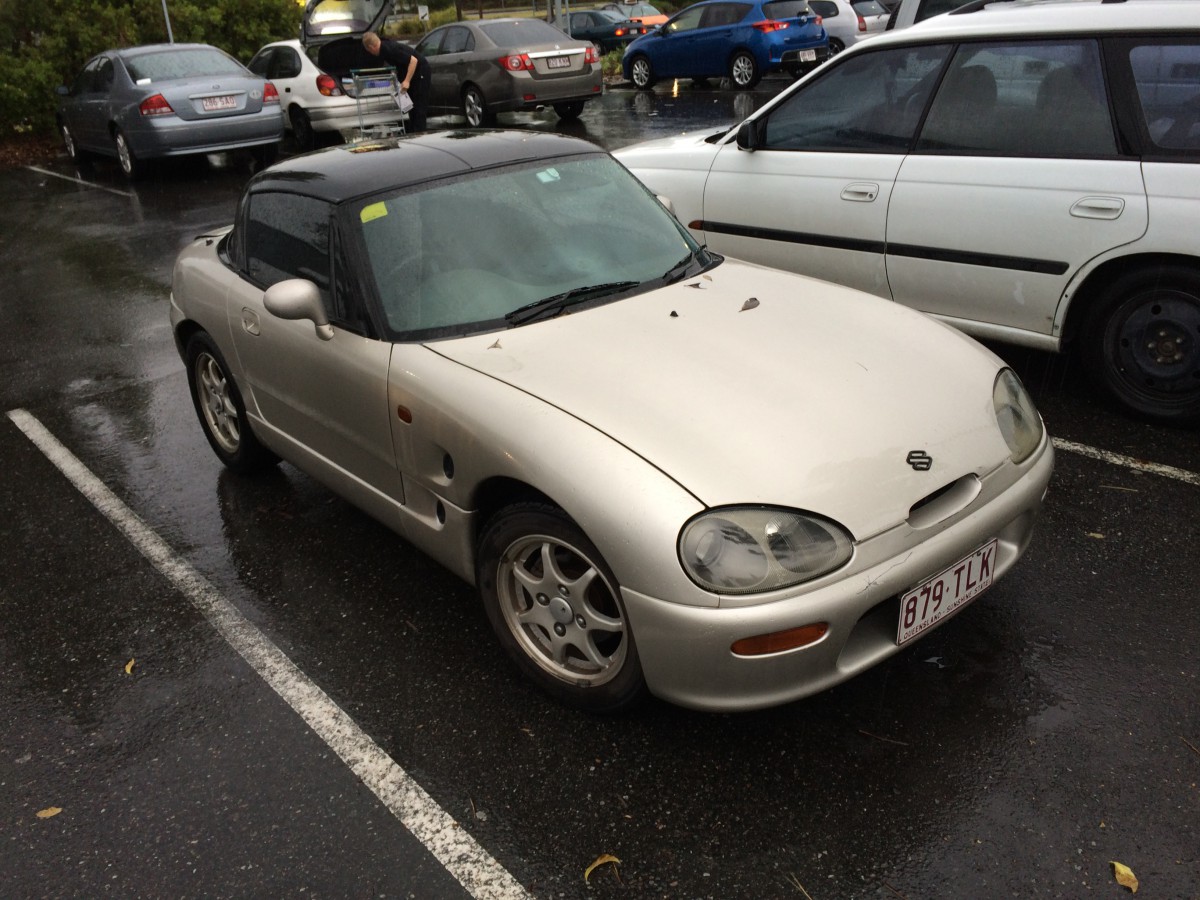
But it did lead me down the “import a car from Japan” rabbit hole, which is a good start to failing on my practical list. I had done this once before when I really wanted a Suzuki Cappuccino but ended up settling for a Nissan Fairlady Z. While the Z was in amazingly good condition, I always felt I had shortchanged myself by importing something a bit pedestrian. I could right that wrong, but even I could not convince myself that a Cappuccino was the answer this time around, as it was older and still a two-seat convertible. Besides, the ones in my price range were generally rather rough around the edges and I needed to get whatever I bought through a rigorous out of province safety inspection.

With the Cappuccino reluctantly struck off the list, I continued browsing the prospects. Since I had done this back in 2019 the list of neat cars that were 15-20 years old was less than I expected. Gone were the obvious fun cars like the Nissan Figaro, Honda Beat, Rover Mini, etc. These cars were still possible to buy, but either their prices had drastically increased or condition was poor. Also gone was any real choice in color. In their place was mostly a large array of white, silver and sometimes black, much less interesting vehicles. Manual transmissions were uncommon on anything beyond Kei class trucks. There were a few standouts like the Suzuki Swift, Volkswagen Polo Cross, Daihatsu Copen or Suzuki Lapin. But were any of those special enough to warrant importing and the eventual parts supply hassle?

I would have really liked a Suzuki Hustler but, alas, they are still too new and will not be legal until 2029.

I have a long-standing desire for a Japanese firetruck. Hear me out on this. They generally have crazy low mileage, four-wheel drive and are attractively priced. I figured they could haul a small motorbike (with the fire stuff removed), go down a gravel road / light off-road path and serve as a reasonable commuter. And really … who can ever be unhappy when driving a firetruck? In fact, Great Beater Challenge founder, Peter, has gone this exact path. Unfortunately, my wife is allergic to the idea so, uncharacteristically, I compromised automotively and passed on the firetruck dream.

There were a few other Kei class trucks and vans I was interested in. I quite like these Subaru Sambars with this Classic front end. A good number are four-wheel drive but sadly they are getting up there in age and come with a carburetor. Beyond having a fixed roof these did not really score well on my practical checklist.

Even more appealing was the later fuel injected Sambar with the larger cabin. I really like the novelty factor of an aftermarket front end like this UAZ inspired one. These exist through some importers but are hard to find and generally expensive. They are often paired with an automatic gearbox which I was not interested in equipped to a small engine. The big downside to these is they are highway capable but just. Despite all this I seriously considered one but could not find one at the price I was willing to pay.

A Suzuki Alto Lapin SS like this 2006 example would be a lot of fun. These could be had with a five-speed manual, turbo and all wheel drive. These score not bad on the practicality scale with highway capable performance, four door body style but fall on parts availability. Ultimately, the desirable and low mileage examples were more money than other options.

I like the look of these Daihatsu Mira Cocoas but they never came with a manual transmission. I was seriously tempted to pull the trigger on this five-speed swapped example. But is it reasonable to own a daily driver car in right hand drive, with parts that are hard to source and has a transmission swap? Maybe a bridge too far.

This 2006 Lancia Ypsilon almost got me past my “no automatics in small cars” rule. It was wild looking, had a lovely interior as well as being priced very low. Plus, you could constantly bring up “my Lancia” in conversations. It scores reasonably well on the practical scale with left hand drive and a hatchback body style. I came close to moving forward with this one and have a little bit of regret of not picking it.

I did some serious searching and gave up with a few options of what I wanted not needed including a Citroen 2CV. There are some very nice and low mileage 2CVs from the Eighties available in Japan with no rust issues. Most of them were well out of my self-imposed budget but one was priced quite well such that I could probably make a few bucks when I sold it. This was not practical, but by this point practical had clearly lost its seat at the table.

I should have bought this left-hand drive classic Rover Mini. While a 1988 model someone had back dated the interior and it was keenly priced with a manual transmission. I went back and forth about the color as I do not really care for white. Apparently, I took too long as someone else jumped on a good deal. These Rover generation Minis are more rust prone than the earlier cars so it would have been a shame to press this one into winter car duty, so perhaps it was for the best.

One interesting option was a Renault Twingo. I had seen a number of these last year on my trip to France last year. They were only made in left hand drive which is quite nice. There were a handful on offer, but the prices seemed quite high. I put a few on the watch list to consider. After about of month searching and waffling the price of this green Twingo was suddenly reduced significantly. The only snag was there was only a single photo which is not enough to go on. Doing a reverse image search, I was able to find it listed on a local Japanese classified site with a full array of photos. It appeared to be in good condition, had a nice color and had never owned a French car. It met almost none of the original brief, but it had two major advantages: it was left-hand drive, and I could not stop thinking about it, so I pressed the Buy Now button.
So, to recap: I needed a sensible winter-capable vehicle with a roof, cargo space, and fewer compromises than a Miata. Naturally, I bought a mid-1990s Renault Twingo sight-unseen from Japan. I have not yet received the car so we shall find out together the wisdom of picking this particular one. In the next installments, I’ll explore this specific car more and the import process.
In the Twingo Series:
Part 1 – In Search of A Practical Winter Car … And Ending With Something French?
Part 2 – Small, French and Quirky – What Is A Renault Twingo And Why Would You Want One























Now THIS is a buying adventure. I have bought several cars sight unseen, but never a French car from Japan. You’ll have the only one like it at the golf course, I assume. 🙂
Twingos are awesome! I had one for a few years as my practical runabout vehicle when all the others were sportscars or motorcycles. You are going to love this car – super practical, definitely highway capable and lovely to drive with the roof open. They are pretty reliable too in my experience.
The one thing mine suffered from was a broken front spring – apparently a common fault – check yours for this, as it is an easy fix, but can lead to unhappiness if ignored. I would also advise getting it rust treated or lanolin spraying the underside and cavities, as they can rust and I believe many manufacturers at the time supplied Japanese market cars without the standard European wax protection.
I hope the little Frenchie is as good as it looks in the photos (love that color, BTW) when it arrives and wish you many happy kilometers with it…
Sadly experience wise mine does not have the large sunroof. But from a parts/keeping it alive perspective it is probably a good thing.
I’ve seen the front spring issue with someone on YouTube so I’ll take a look for it.
Excellent, another DS ownership experience to follow along on! I have missed these, especially since the demise of the ‘other site’ so this should be a lot of fun.
Funny last night I was looking down the Japan rabbit hole too, but not seriously but it is fun to look and dream.
Still plenty of them around, as daily drivers, that is. Good ones have become collectables and don’t come very cheap any longer.
First gen Twingos have turned out to be remarkably tough little cars, maybe unexpectedly. They’re utterly basic, which helps a lot in that regard. Very roomy and practical to boot.
Happy winter driving!
That was unexpected! I’ve always loved the Twingo, so yes, it gets a thumbs up from me. Looking forward to hearing how it turns out for you.
I don’t think the Chev SS sport sedan (née Holden Commodore SSV Redline) was sold in Japan, but it actually would tick off most of your list (with exception that mine had a sunroof and given its captive import status would likely get much harder to repair from a parts standpoint as time marched on).
I owned it four years (about 78K miles through 28 States and two Provinces), and threw snow tires on it every IL winter. 415 HP/415 torque, 6MT, RWD. Did fine in the snow and ice.
Nevertheless, you considered some quirky and fun options! At one point, while considering my next automotive move, I briefly looked at 2CVs, but decided it would be too high maintenance for a DD.
I never thought of looking for Australian cars in Japan. The Chev SS sport sedan would have been a fine choice. Parts would still be tough but I would imagine easy than the Twingo. Maybe next time.
These are fantastic little things and they can take a beating like nobody’s business. Back in the early 2000’s I was in a band, and one of our guitarists had a first gen Twingo. We used it to haul gear to and from gigs (it accepted two of us and almost the full death metal drum kit with near-infinite hardware, or two 4×12 cabinets, amps and guitars), and as it had barely enough power to get out of its own way it was always driven flat out. Also, for the same reason, you felt compelled to conserve momentum, so corner entry speeds were sometimes quite ambitious. Lifting off would then reveal a rear axle that helped you steer the car, but it never snapped on us like, say, a Peugeot 106 would. It saw precious little maintenance (I actually imposed on him so he would at least let me change the car’s oil regularly) but other than that and the compulsory yearly technical inspection and work resulting from it, it got nothing. Regardless, it soldiered on happily and never missed a beat and to my surprise as an Alfista, it also refused to rust. After six years he got rid of it to buy (of all cars) a Jaguar XJ40 which had always been his favorite. He lamented not keeping the little Renault after getting introduced to the permanent neediness of the Jag, but that’s another story.
It is stories like these that give me hope that I will love this little car once it gets here. The waiting game is tough as doubt about making the right choice starts to grow.
They are very lovable cars. Not flawless, but then, which car is? As you drive a Miata, I think the Twingo will be to your liking. Obviously, they’re very different cars, but I feel like there are similarities. Both appear to be designed around a clear and unambiguous brief and to a budget, resulting in a car that excels in the areas it is intended to while consciously making sacrifices in other areas. As an engineer, I can only appreciate that. The Twingo is an incredibly practical little car that is cheap to run and own – which is all it sets out to be. Surprisingly, it’s fun to drive and rides well, too – even if the chassis components are cheap as chips. On the flip side it (especially the first gen phase 1 car which is in my opinion the nicest one of the lot) has an unrefined, clattery and underpowered engine that was already out-of-date when the car was launched, the trim is flimsy, and the seating position is only so-so. That being said, I would not mind adding one to the fleet as a runabout – I’ll be keeping an eye out on the local classifieds sites.
Nice, my mom still drives her 1999 Twingo, very few problems over the years, though little cars. Next month the subframe gets replaced, finally rotted to far to pass the annual inspection. At this point, another car would be smarter, but she simply can’t part with that car, also because my late dad bought it for her. (Mom is 84, still fit and driving maybe 2500 miles a year)
Haha, I love your thought process David. Reliable practical car = Renault Twingo!
Looking forward to hearing about the importation process and drive home.
This was such a fun read! The gen1 Twingos are such great-looking little cars, I was always sorry there wasn’t a RHD version until the boring gen2.
We’ve had four French cars in the family over the past quarter-century, one Renault and three Peugeots. All were all very practical daily drivers in all seasons – they each had some aluminium or plastic body panels, and there were zero corrosion problems.
The Peugeots were/are reliable, and two are still our daily drivers, but my late grandparents’ Renault was somewhat problematic, and really put the ‘Oh!!!’ in Ren-oh. Or possibly the ‘no!!’ in Re-no! Not enough power to get out of its own way either, but so extraordinarily practical that
allmost was forgiven and it finally went to the scrapyard last month aged 25.Really looking forward to the next chapters of your Twingo Tale!
I did briefly consider a second generation as they are available in Japan quite cheaply for a nice specification one. But I just could not bring myself to buy a gen2 when a gen1 was an option.
It is very strange they were never offered in right hand drive as I think they would have been a hit in many places like the UK. I can only imagine they were already at production capacity or something similar.
I missed something : you said a Cube with the hard to find 6 speed manual box and then you didn’t buy it because you (wisely) don’t trust CVT boxes .
So which is it ? . I’d think a lightly dented Cube at bargain price would be a good place to start .
The Sambar would make my list, no locking golf club storage alas .
Having owned a Citroen 2CV I can tell you they’re fantastic cars, total death traps to be sure but so much fun =8-) .
As long as the Twingo is in good shape and YOU take the time to change all belts, fluids etc. I expect it’ll be fine, I await hearing how the heater / defroster and fresh air ventilation are .
Reading this article makes me wish I were 50 Y.O. again because I’m always stumbling across some odd little car / truck I know I’d love but have difficulty doing the labor these days .
-Nate
Sorry – I probably did not explain it well. That example I was looking at was a 6spd manual. Its condition was a little too rough. I was not interested in other Cubes that might have been in better shape because of the CVT.
The Twingo only makes sense if I do the mechanical work on it. Sadly most professional mechanics have no interest or patience for something cheap and quirky.
Well at least there appears to be an English language manual available online. That’ll help.
Are you going to start stocking maintenance parts ahead of time or just wait for the failures? That’s one of the reasons I wouldn’t daily my 63 VW, if anything goes wrong it’s a week wait for parts.
I am going to assess it then order what it needs for the safety inspection as well as stock some future bits.
I suspect I will need to do shocks and brakes for the inspection so they should it theory be good for a while so have some maintainance bits on hand. Shipping is the most expensive part so it makes sense to build a bit of a parts surplus.
Where did you find the manual?
This was an entertaining read! And I guess you reached the end of your wife’s automotive patience with the Japanese firetruck idea. I think my two finalists on this list would also be the Twingo and the Lancia.
Since I live in a relatively mild climate, the concept of a winter car is a tough one for me to grasp, so the big downside for me would be going to the effort to import a French car from Japan, and then pressing it into service as a winter beater. I’d probably end up feeling sorry for it, reserve it for summer use only, and then buy a boring mid-sized SUV as my practical winter car.
Can’t wait to hear about the Twingo when you get it!
Our winters are relatively mild compared to a lot of other places so I do not expect it to turn into a ball of rust with a couple years. It is more about ground clearance and a fixed roof for me.
The original Twingo is my ultimate small car. I can’t imagine a more fun little car for tootling around in.
When I went to Germany they were everywhere, being driven by folks who appeared to have very little money.
…’being driven by folks who appeared to have very little money’…
And what makes you think that?
I’d have gone for the Mini [ and some welding equipment] – you can get parts for a Mini.
Re folks who “appeared to have very little money” . A lot of the people I see with expensive new cars near me here in the West of Scotland don’t have a pot to piss in – they’re up to their eyeballs in monthly payments.
I have always loved the Twingo, although I have no experience with them. I had the opportunity to drive a Subaru Sambar van with a manual transmission, and I quite liked it, but I don’t know how it would fare in Canadian weather and traffic.
I use my 2CV around town in the summer, and through poor planning I have driven it in a snowstorm. One of my sources for parts for it is Der Franzose in Germany, and they carry parts for other French brands, including Renault. I looked at what they list for Twingo, and it is limited to parts that also fit other cars like R4. It is certainly not comprehensive.
Good luck – always enjoyed driving these in France as hire cars. Surprisingly spacious and almost Mini like to drive
Have fun with your Twingo:) Looking forward to reading about your experience with it. Charming little cars, very practical and modern enough to feel refined even on longer trips.
A late model 2cv like this is perhaps one of the easiest vintage cars to keep going. Super simple and great parts support, at least in Europe. I drive an Ami 6 with a later 2cv6 drivetrain swapped in and basically everything is available new from Der Franzose in Germany.
Interesting Cube example , because I’ve never seen a front-loading washing machine that’s received the “overland-style” treatment.