

After encountering a 1963 Cadillac Series 62 convertible with a beautiful special order turquoise-and-white leather interior, I was curious to learn more about Cadillac interior and color special orders in the 1960s. Here’s what I gleaned from the Cadillac dealer data books about how ’60s customers could “create trim combinations according to their personal preference and expression of individuality.”
Cadillac by Special Request
In its ’60s heyday, Cadillac offered an array of exterior and interior color and upholstery choices that’s difficult to fathom in a modern automotive environment dominated by silver, white, gray, and black. In 1964, for example, Cadillac offered 16 standard exterior color choices, most of them Cadillac exclusives, plus five “Firemist” colors. (The most popular choice by far, you may be sad to learn, was still white.) There were also 124 regular trim/upholstery choices in five different styles in 1964, with 150 combinations in eight styles for 1965.

Nevertheless, there were still people who weren’t satisfied with the standard options or who wanted extra distinction and exclusivity. The factory was happy to accommodate “special request” orders — at least to a point, and naturally for an additional charge — to enhance the “aura of Cadillac custom quality” that was part of the brand’s mystique.

The main reason for the extra charge, as the data book explained, was not that upholstery cost more in one color than another (although of course leather cost more than cloth or vinyl), but that variations from the regular color and trim selections required special handling. “No matter how seemingly minor, any deviation from a standard trim combination makes necessary the removal of the entire order from regular production for individual handling,” the data book cautioned. It advised explaining to customers:
Primarily, the extra cost is incurred by the necessity of hand cutting the material singly instead of in multiple sets of four or more at once. … Thus, the efficiency of modern production methods, which utilize time and material to the best advantage, is disrupted with the resulting higher charge for special handling.
From what I could find, the extra charges were usually not huge, and were certainly less than a buyer would have paid taking the car to a custom shop after delivery. For some customers, the bigger penalty was the extra time involved: The average time required for a special order was about six weeks, and it might take even longer if there were questions about the order — perhaps too long for customers who waltzed into a Cadillac showroom looking for immediate gratification. (There were a lot of middle-class Cadillac customers in those days, but there were also a fair number of affluent buyers who paid cash for their cars and traded in every year or two.)

So, if a customer was willing to wait a bit and pay a bit more to get exactly what they wanted, what could — and couldn’t — they get on a special order basis?
Paint Colors
The first question for many car buyers is what color they want. For ’60s Cadillac buyers, the second question was whether they were interested in any of the new high-luster paints Cadillac now offered: metallic “Fire-Frost” colors, offered only in 1963, and similarly shiny but nonmetallic “Firemist” paint from 1964 on. These paints, which used extra-large pigment flakes for an almost iridescent sheen, were a no-cost option on the Eldorado convertible and available at extra cost for other models.
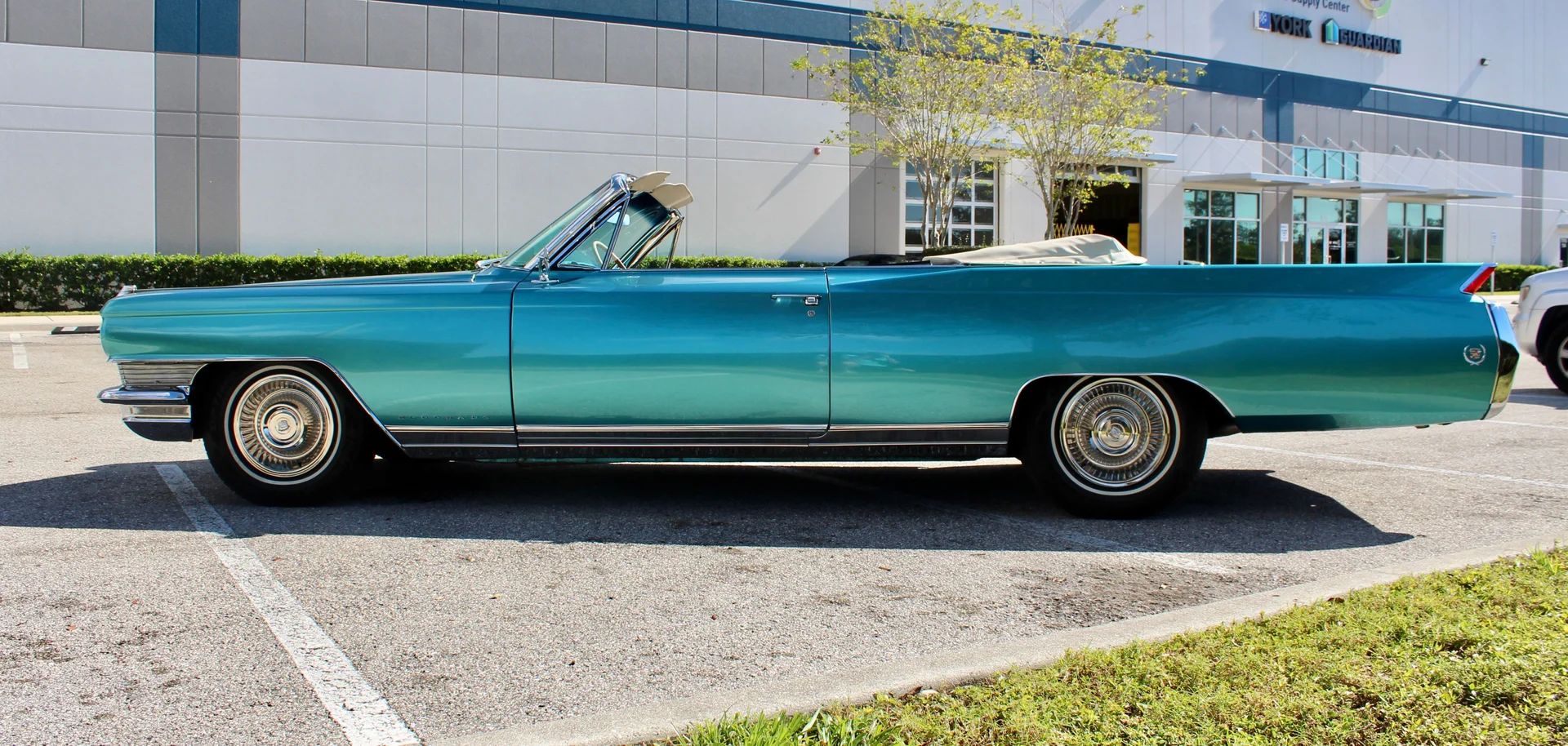
The original dealer invoice of the Peacock Firemist 1965 De Ville convertible shown below indicates that its Firemist paint was coded as a $134.40 SR (special request) option, but Firemist paint didn’t actually require a special order — it was a regular factory option.
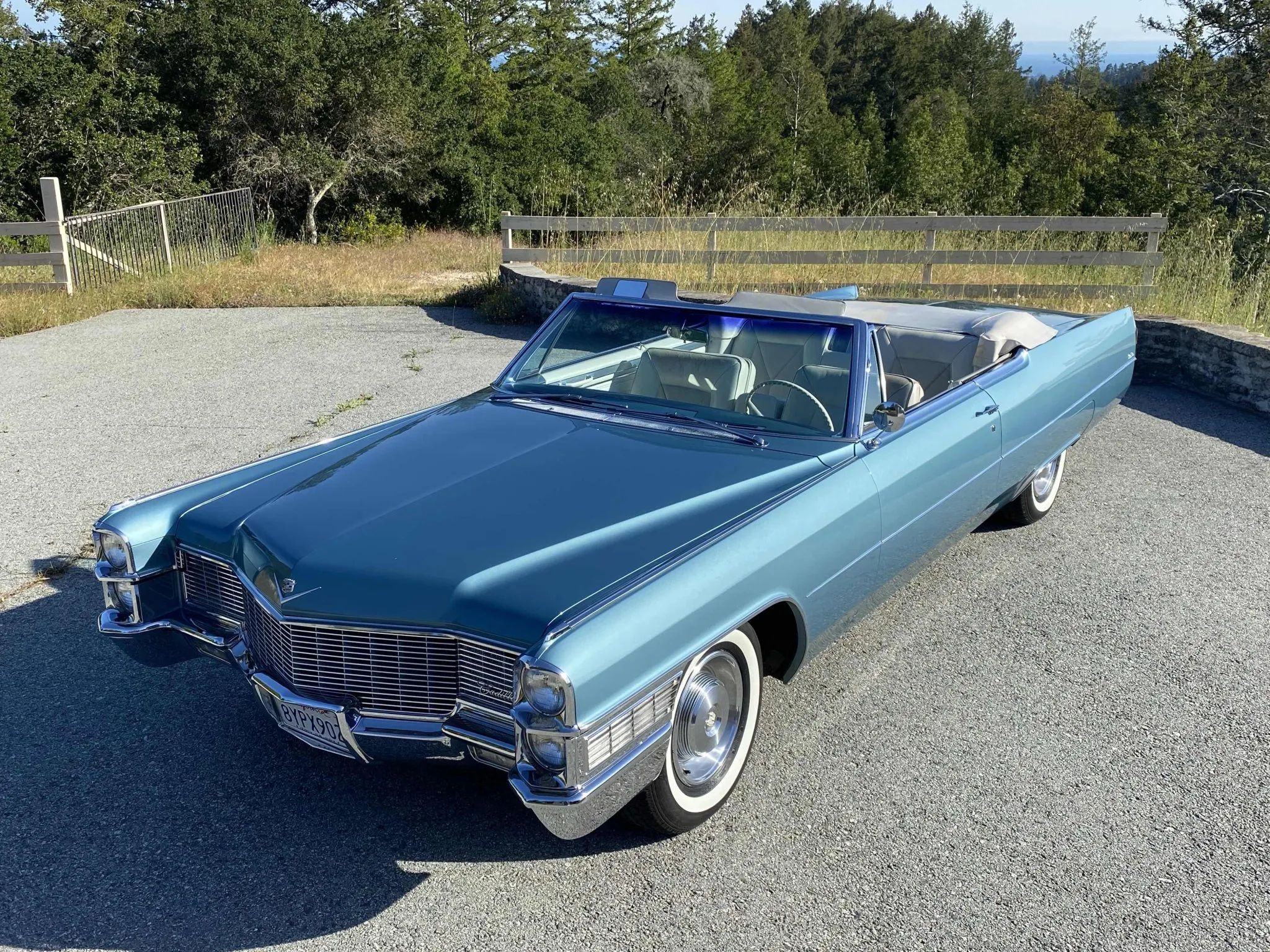
If none of the regular color choices suited you, you could request other paint colors on a special order basis. A common scenario was a customer who really wanted a discontinued color from a previous model year, but you could theoretically request any nonstandard color. The normal charge for special paint in early 1965 was $134.30, although the data book warned that the cost would be higher for metallic paint, with prices “furnished upon request.”

That might sound like a hefty price for a different color paint, but the data book explained:
The procurement of special colors requires extra time for mixing, by a qualified chemist who must take time out from his regular duties, to formulate the single special color order.
Cadillac policy on two-tone paint jobs varied from year to year. In some years, two-tone combinations were a regular factory option, often at no extra cost; in other model years, Cadillac said two-tone paint was not available because that year’s body design “does not permit a separation of color between the upper structure and lower panels.”

One of the reasons for the growing popularity of padded vinyl roofs was that they offered a way to create two-tone effects even when two-tone paint wasn’t available. However, in the ’60s, the range of top colors available was more limited than in the ’70s: There were typically only four or five options, including black and white. A padded vinyl roof was normally a regular factory option, not a special order.
Styling Nomenclature
Some of what I’m going to say below will make more sense if I show you how Cadillac defined the different parts of the upholstery. I’ve added color to this data book illustration to make it easier to distinguish: turquoise segments are the inserts, dark gray segments are the bolsters, light gray segments are the cushion faces, the light turquoise section is the center armrest; and the dark turquoise areas are the seaming laces.

This is a generic illustration, reused year after year, so it doesn’t look exactly like any particular year’s actual upholstery choices. In this era, the bolsters actually extended over parts of the seat cushion — at least in a strip through the center of the cushion and sometimes also along the sides and leading edge. The cushion faces and center armrest were usually color-matched to the bolsters, although they were often vinyl even if the bolsters were leather. This 1965 Coupe de Ville has black cloth inserts with white leather bolsters; you’ll notice that the cushion faces match the leather:

Bucket Seats
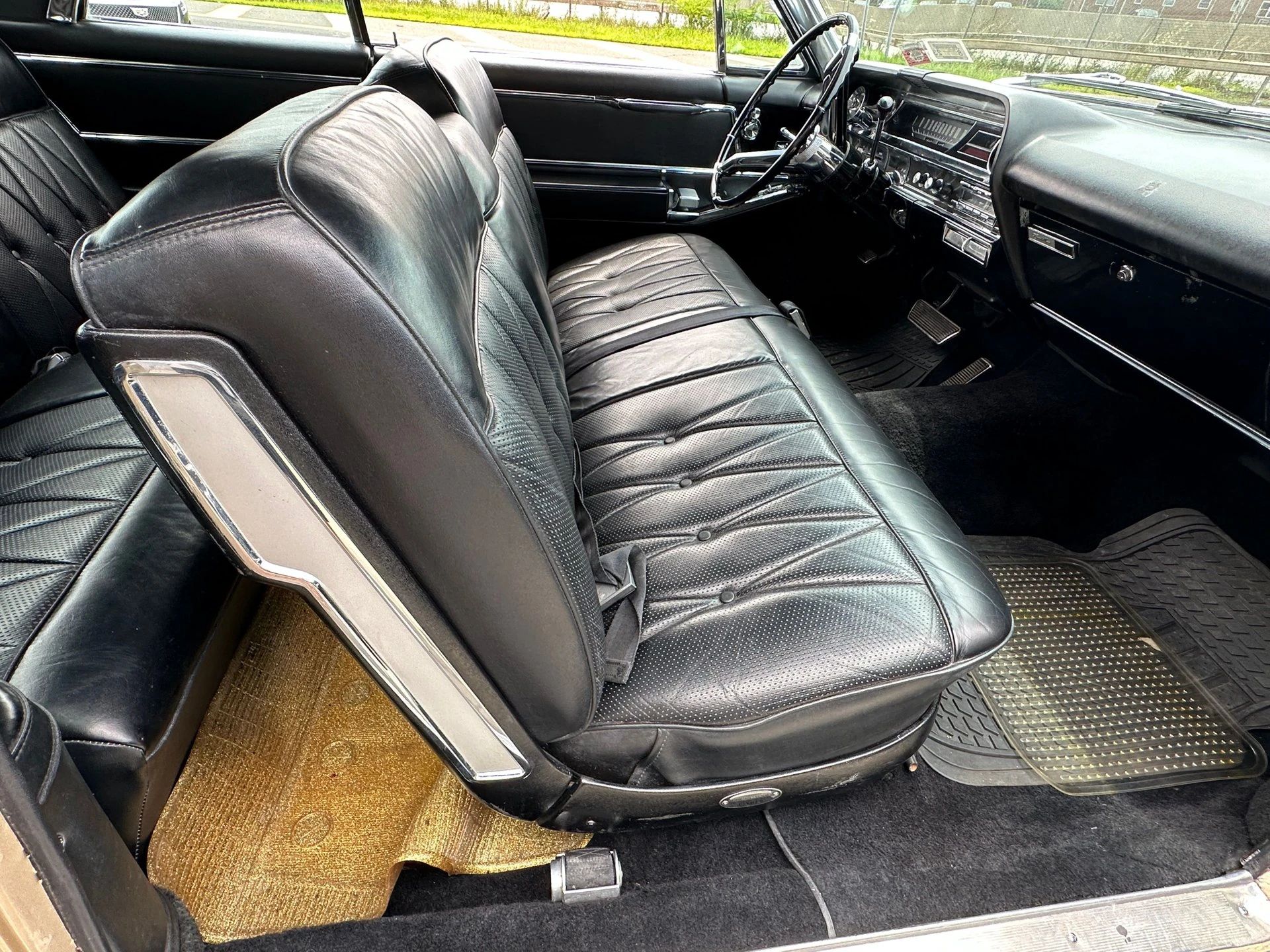
It often surprises people to learn that Cadillac offered bucket seats and a center console in the early and mid-’60s. These were not necessarily a special order: Buckets were a $187.85 regular option for a De Ville convertible or a Coupe de Ville with leather upholstery, and a no-cost option on the Eldorado convertible:
Surprisingly, you could also get leather buckets and a center console as a regular option on a hardtop Sedan de Ville, although they were a special order on the pillared Sedan de Ville or Fleetwood Sixty Special. A Sixty Special with bucket seats would be a real unicorn, as I can’t imagine many were built.

Most Cadillac buckets were leather. Cloth bucket seats were only available by special order, and only on closed De Ville and Sixty Special models.

Cadillac wouldn’t install bucket seats in the cheaper Series 62 or Calais even by special order.
Leather Upholstery
Leather upholstery on a ’60s Cadillac was a complicated subject. Leather was standard on all convertibles. De Ville closed bodies came with leather bolsters, but adding leather rather than cloth inserts cost extra. Closed Series 62 models and the 1965 Calais could only have leather upholstery by special order. (After 1965, Cadillac no longer offered leather on the Calais even by special order.)
Except on Eldorado convertibles, leather upholstery included color-matched vinyl on cushion faces and certain other areas. The Eldorado had cowhide on most areas except on molded components like seat backs; you could special order similar “all leather” or “maximum leather” upholstery on other models for an additional charge.

Where leather upholstery was used for seat inserts, it was normally perforated “Aztec” grain (natural grain for black or white); seat bolsters were non-perforated “Antique” grain leather. You could special order all Antique grain non-perforated leather inserts for an extra charge ($21.45 in 1965), but you couldn’t have perforated leather bolsters, which Cadillac said was due to the production limitations of the mills that supplied the division’s upholstery materials.
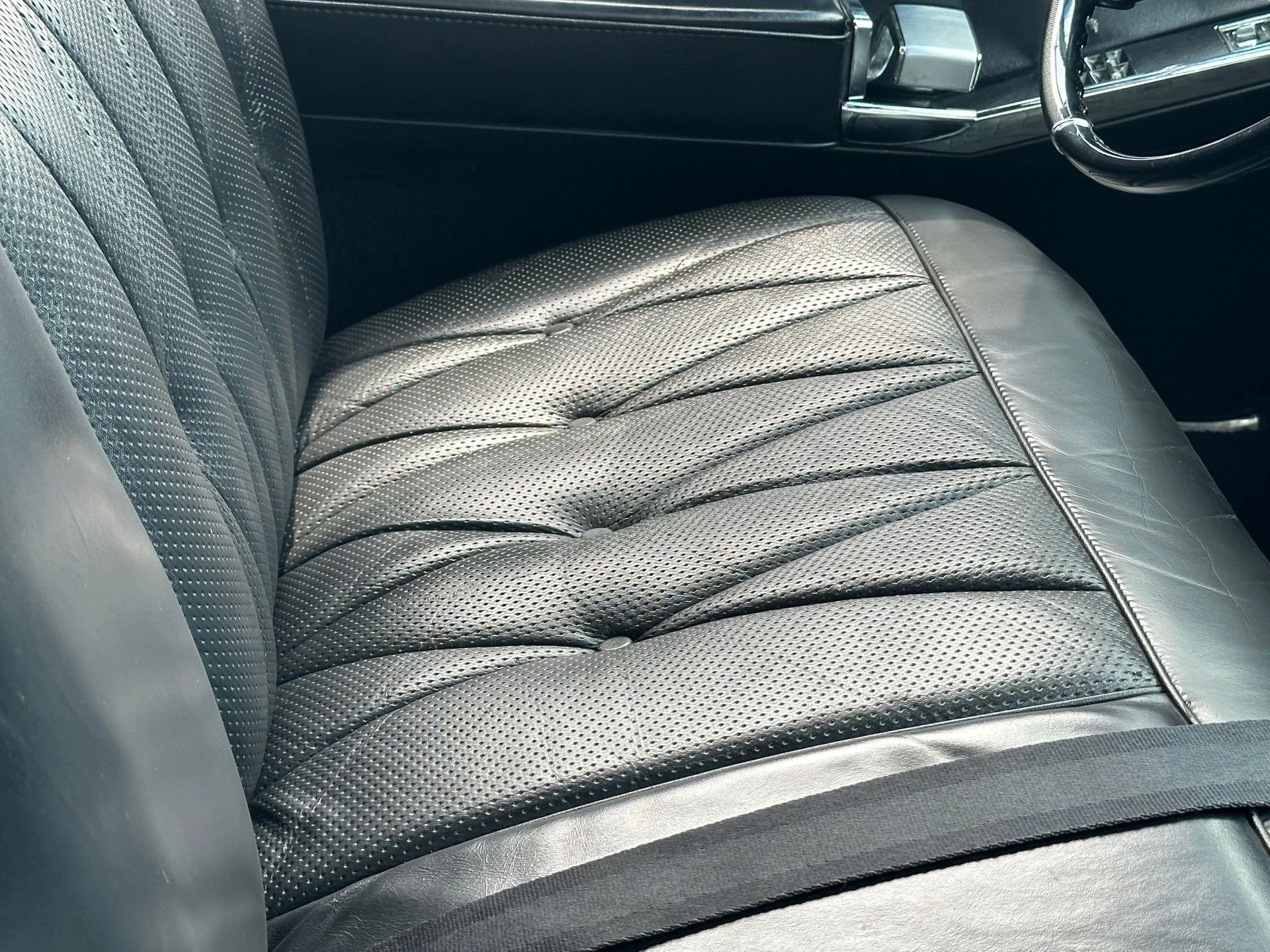
I know some people don’t like leather upholstery, but it was a sensible purchase on a ’60s Cadillac. You got almost the entire cost back at trade-in, and it gave you the most options for interior colors. With cloth upholstery, all you could really do was substitute standard cloth trim choices available elsewhere in the line (e.g., ordering Sixty Special cloth upholstery on a Series 62).
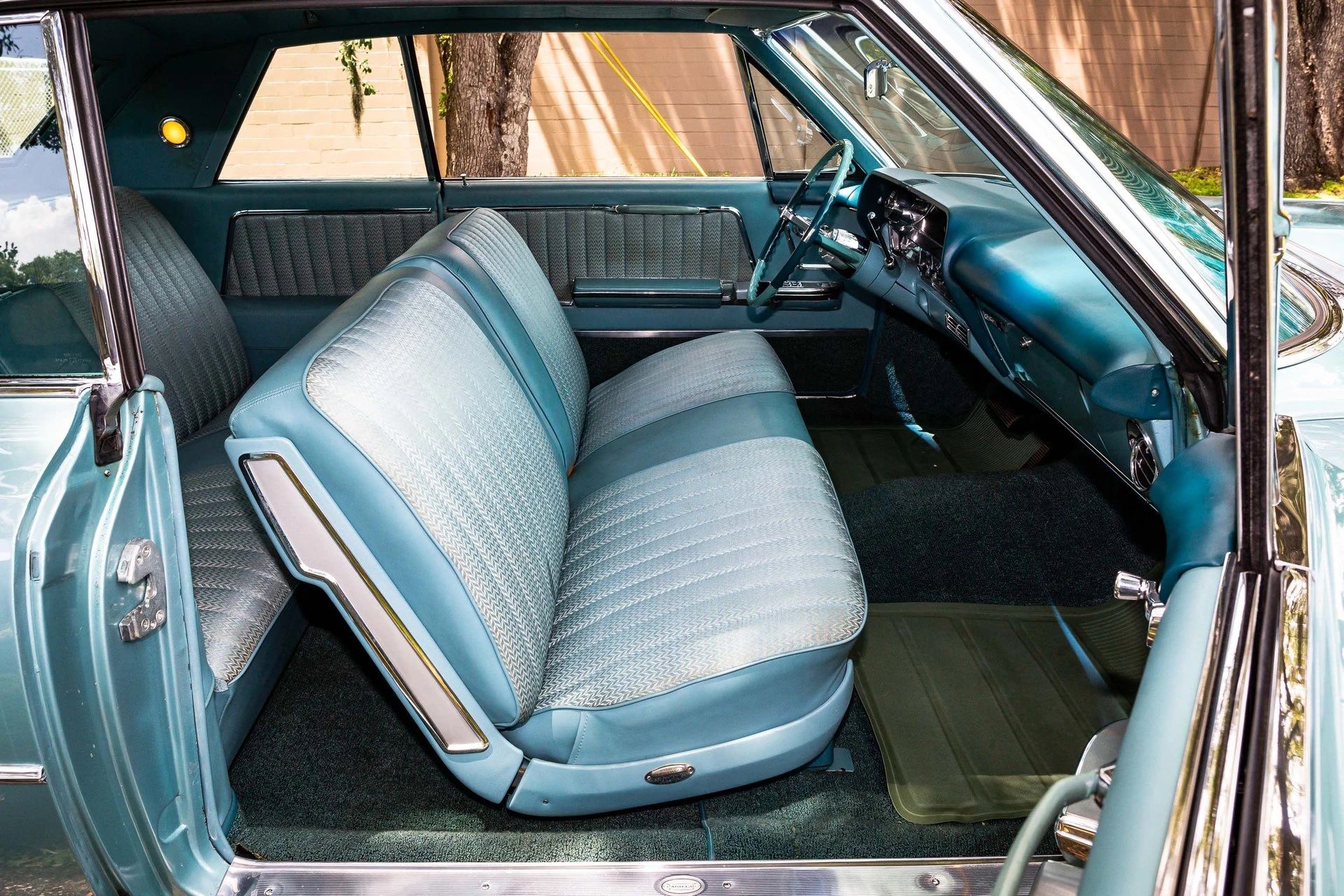
Leather Colors
Each Cadillac model and body style offered a selection of recommended trim combinations that were available as regular factory options. In any given model year, there were usually at least five and sometimes as many as a dozen trim combinations in cloth, leather, and vinyl. On some models, Cadillac confusingly described the recommended leather trim as a “standard option” even where it cost extra — it just meant that that trim combination was available as a regular production line option, not a special order.

If you ordered leather upholstery (or if leather was standard on the model you wanted) and you didn’t like the recommended choices, you could pay extra to special order from the more extensive non-standard leather list. Let’s suppose you were buying a new 1964 Coupe de Ville. Closed De Ville body styles normally came with leather bolsters and cloth inserts. Adding leather inserts was an extra $140.90 if you opted for one of the standard color choices, which were limited to black, white (with black carpeting), sandalwood, or red. If you were willing to pay extra to go the special order route, this unlocked 11 additional leather color options:
- Gray-blue
- Aquamarine
- Dark blue-green
- Light blue
- Palomino
- Lime
- Green
- Gray
- Midnight blue
- Turquoise
- Beige
If you instead ordered a De Ville convertible, which came with leather upholstery at no extra charge, four of these colors (light blue, Palomino, lime, and green) were regular options in 1964, not requiring a special order or an extra charge. For example, light blue leather was a regular option for the Aspen White De Ville convertible pictured below, but would have required a special order in a Coupe de Ville.

With either an open or closed body, you could also get white leather with dark red rather than black carpeting as a special order in 1964. This apparently proved very popular — starting in 1964, Cadillac began offering white leather with either red, blue, or medium turquoise carpeting as regular options.
Special Interior Components
With a few exceptions, each standard and non-standard color choice normally included a color-keyed instrument panel, headlining or convertible top boot, steering wheel, carpet, and so on. However, with a special order, you could select different colors for different parts of the interior.

Cadillac divided the interior into a series of distinct areas (e.g., inserts, bolsters, carpeting, lower instrument panel). The color of each of these areas could be specified individually to create two- or even three-color interiors. The Firemist Aquamarine 1964 Eldorado pictured earlier in this post has a special order two-tone white and aqua interior:
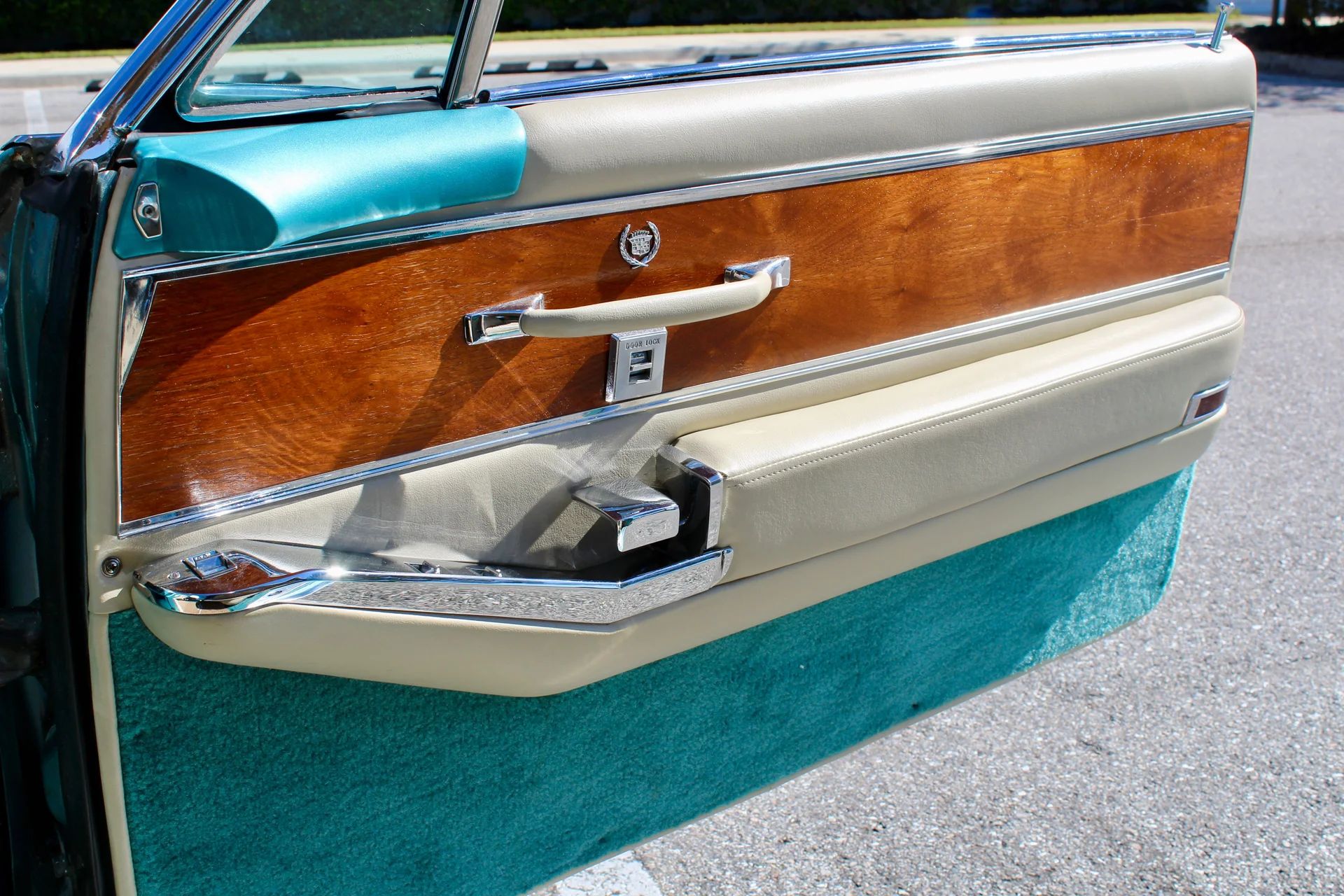
With an aquamarine leather interior (a regular option on the 1964 Eldorado), the upper door sections and door armrests would normally be aqua, but this one was special ordered with those areas in white, plus a white steering wheel and while lower instrument panel:
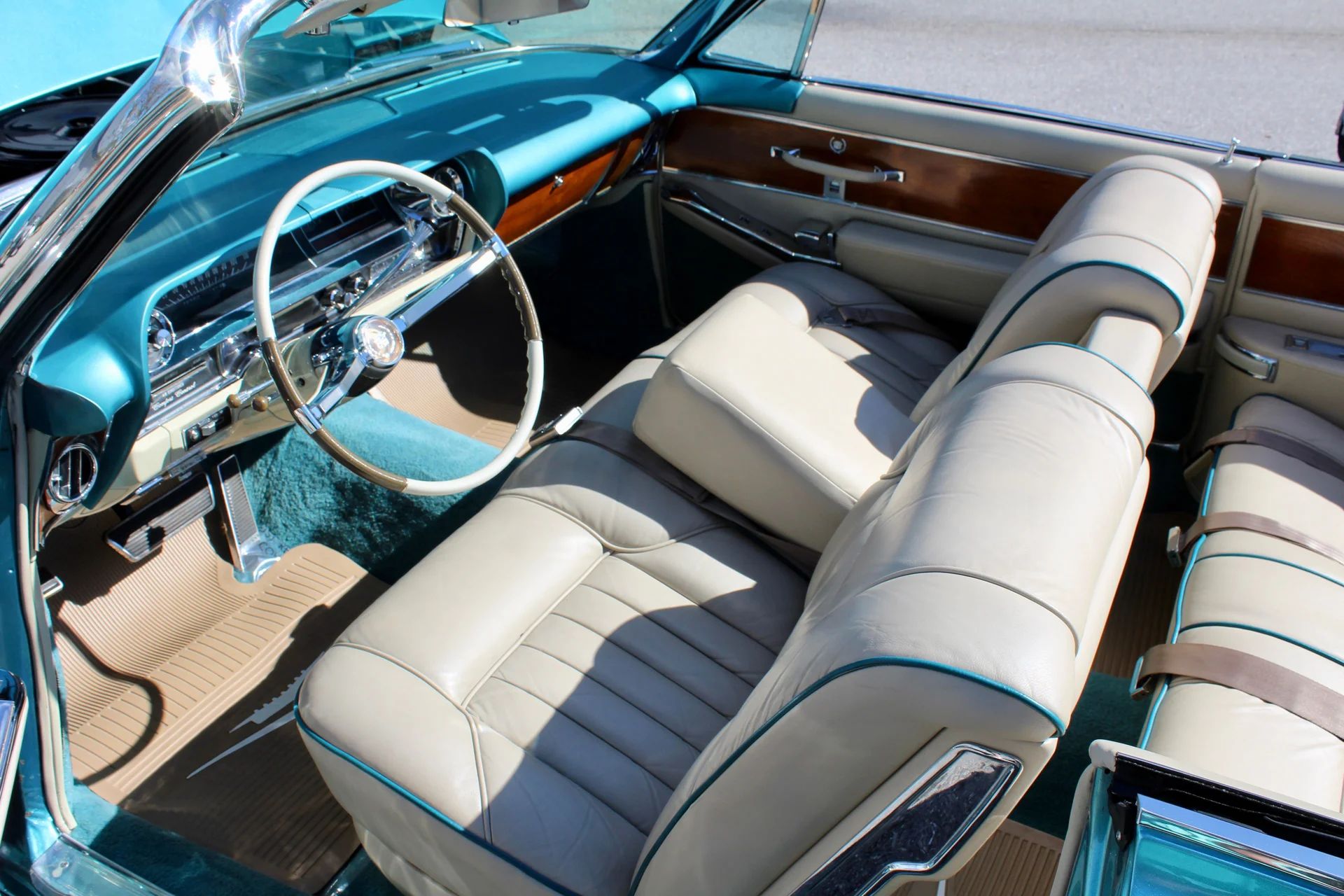
While the seats are white leather, they have aqua piping for some of the seaming laces:
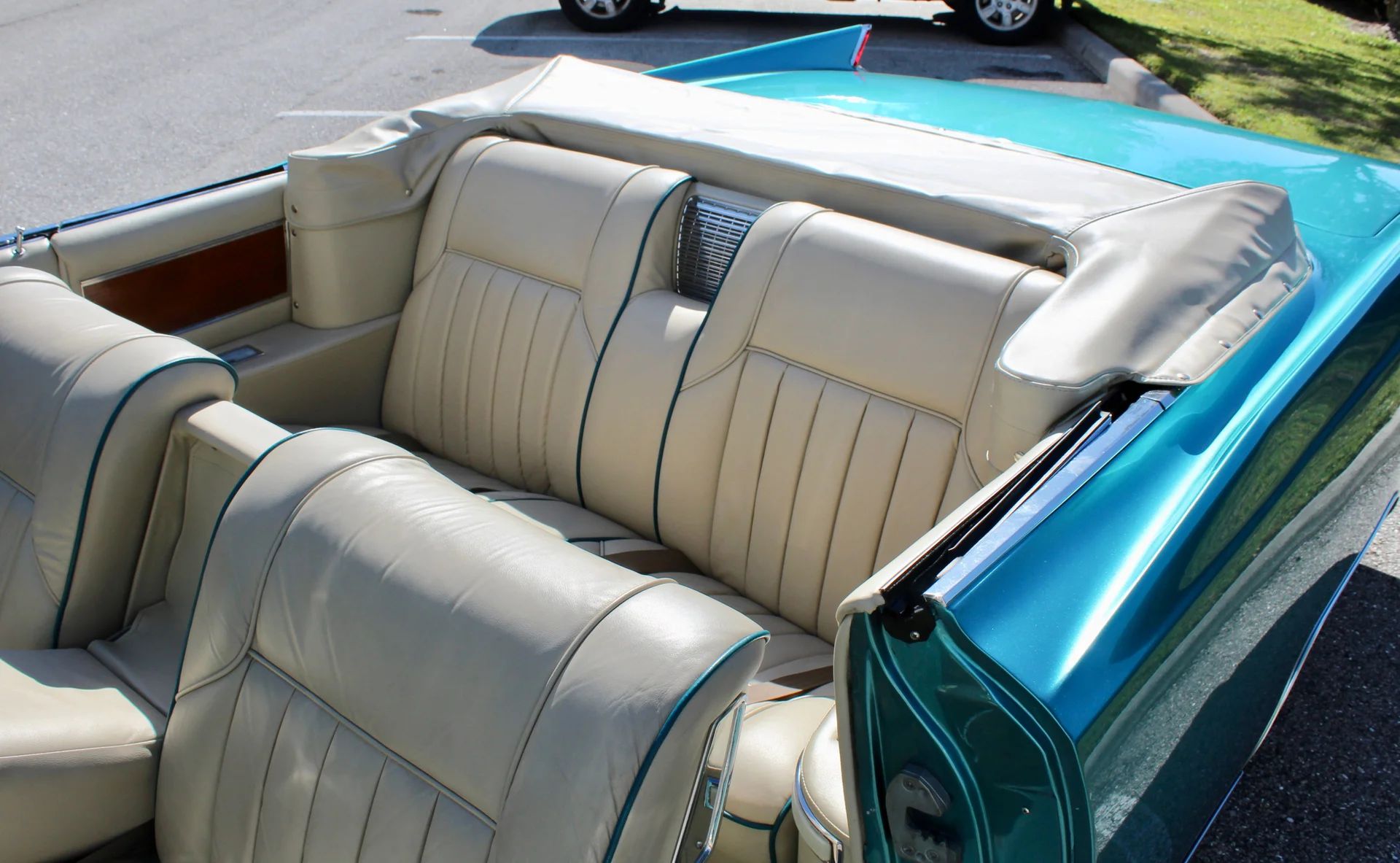
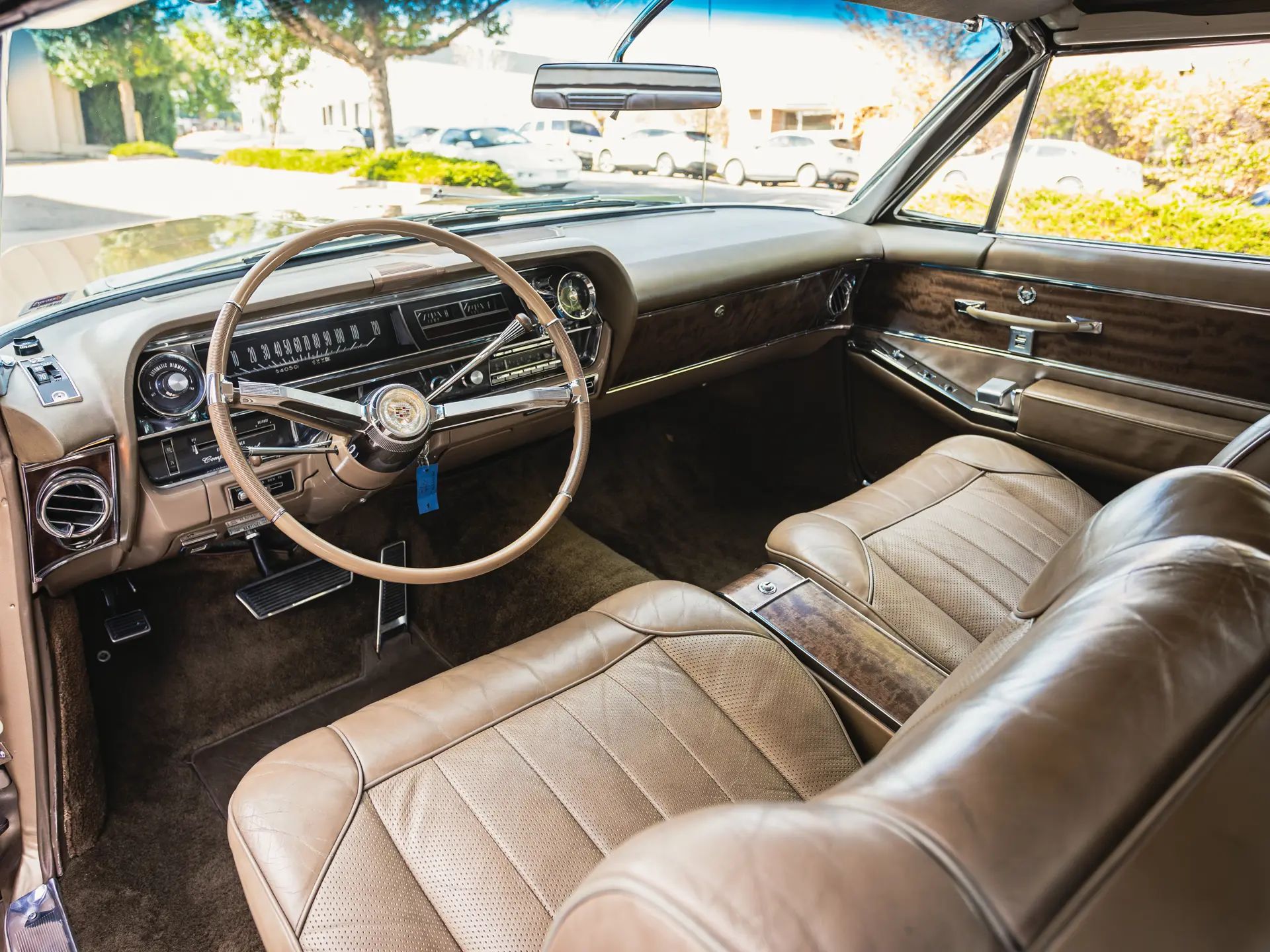
The copies of the Cadillac data books I have are vague about pricing for these options: Only the 1965 book has prices for special leather combinations; the 1963 and 1964 data books have blank spaces where that information was supposed to be written in. However, the bill of sale for the turquoise 1963 Series 62 convertible I found earlier indicates that the original purchaser was charged $86.00 for the special two-tone leather interior, which is also what the 1965 book quotes for special leather on a De Ville convertible. The prices for non-standard leather were lower for an Eldorado convertible ($59.15 in 1965), and higher on closed bodies.

Although the data book suggests there were separate charges for substituting different colors for different interior areas, it doesn’t appear customers were always charged on an itemized basis. The turquoise 1963 convertible (whose interior is pictured above) also had a non-standard white lower dashboard as well as non-standard two-tone leather, but the bill of sale indicates the buyer paid only the single $86 charge for special leather.

Since what you were really paying for with a special order was the special handling at the factory, Cadillac may have be willing to throw in the additional changes for the price of the more expensive one.

Interior No-Nos
While Cadillac offered a lot of interior trim choices, there were certain things they would not allow as a matter of policy:
- No style substitutions: Each trim series had a distinct style of stitching, seams, pleats, etc. You could special order a nonstandard material, but it would be applied in the same style otherwise supplied for that series. Cadillac was surprisingly adamant about this, insisting that the way the patterns and components were made (particularly molded or formed pieces like rubber seat pads) meant they were not interchangeable between models.
- No light-colored dashboard pads or package shelves: The dealer data books noted that buyers sometimes wanted the top of the instrument panel to be white or some other light color to match the rest of the interior. The data book recommended that salespeople demonstrate why this was a bad idea “by laying a white sheet of paper or handkerchief on the panel” to illustrate the hazardous reflections it created in the windshield. With color-keyed interiors, the upper dashboard pad and package shelf were usually darker shades than the rest of the upholstery, and the factory would reject orders requesting lighter-color or white upper dashboards.

- No white carpets: Cadillacs with white upholstery could sometimes be ordered with several carpet colors, but you couldn’t get white carpeting because it was too easily soiled. With most other colors, the carpeting was typically a darker shade of the upholstery color, for similar reasons.
- No cloth upholstery in convertibles: Cadillac convertibles of the ’60s had standard leather upholstery, and the data books generally indicated that cloth wasn’t available on open cars.
- No interchangeable steering wheel grips: Cadillac steering wheels of this period often had the grip sections on either side molded in a contrasting color or contrasting shade. Although there were various color options, you couldn’t choose nonstandard steering wheel combinations — Cadillac said the way the thermoplastic wheels were molded didn’t permit mixing and matching colors.

The Limits of Good Taste
The question you may be asking now is, “So, other than those policies, would Cadillac make just ANYTHING to special order? What if someone ordered their new Cadillac with each interior piece in a different color, like Joseph’s Amazing Technicolor Dreamcoat?” While Cadillac dealer literature didn’t suggest that the factory would refuse orders on grounds of dubious taste, the data books urged dealers and salespeople to steer customers towards more “harmonious” combinations, offering this warning:
RECOMMENDED COLOR-UPHOLSTERY. Interior colors are selected and toned to harmonize with their counterpart exterior colors. … The upholstery selection involves the complete interior decor of the car and if not harmonized with the exterior color, it becomes uncomplimentary to the automobile. When selections opposing the experienced judgment of trained specialists in color harmony are made, the results may sometimes be disappointing even to the customer making them. It may be regarded as poor styling judgment by others, although it was the original purchaser’s choice.
A firm stand should be exercised to channel the upholstery selection according to the recommended options; otherwise, the finished product may present an appearance contrary to the customer’s expectations.
GOOD TASTE. Taste, which is a developed skill, is frequently confused with untrained personal preference. Most customers respect and adhere to Cadillac color-upholstery recommendations, as they are based upon standards of esthetic principles and experience. They are part of Cadillac’s quality standards.
After the factory Custom Order Department received a special order, they would normally send back a copy within 10 days indicating how they interpreted the order. If it seemed especially bizarre, they might kick it back as a typographical error unless the dealer made it clear that was definitely what the customer wanted. If it was, the order couldn’t be cancelled or changed even if the customer thought better of it later. (This is frequently the case with retail special orders, especially where they involve additional labor or require the retailer or manufacturer to purchase special materials.)

Would a very unusual special order risk the dealer being stuck with a basically unsalable car? In most cases, I think the customer would be on the hook for it, at least from a legal standpoint. Different jurisdictions have different laws on such things, but if it ended up in court, the dealer would likely win if they could demonstrate that the car was definitely what the customer ordered and that the customer was definitely told that orders couldn’t be cancelled after they were placed. The exception would be if the car wasn’t what was ordered, or was finished in some negligent way. For instance, in 1973, a Baltimore Cadillac buyer sued Chesapeake Cadillac for $67,150 for allegedly fulfilling his order for a gold 1972 Cadillac with a black vinyl top by spray-painting the white vinyl roof black! (I don’t know if he won his suit.)

Also, in some cases, it might be the dealer who ordered an oddball color combination, like colors chosen to match the colors of a local sports team. As the dealer data book sagely noted, “A customer may be attracted to visit the showroom by the lure of a ‘one-of-a-kind’ Cadillac automobile.”
How to Tell If It Was a Special Order
As you’ve probably noticed, older cars sometimes sport curious non-standard paint jobs. Some sellers will try to insist the cars were special ordered that way from the factory, whether they actually were or not. On a Cadillac of this vintage, cars ordered with special exterior colors should have a “00” in the “PAINT” section of the trim plate. (Current-year Firemist or Fire-Frost colors will have the actual paint code instead, even if they were invoiced as SR options; a no-longer-offered previous-year Firemist choice would have a “00” paint code.)

Special request interior trim combinations should have a “00” (or “000” from 1965 on) in the “TRIM” space.
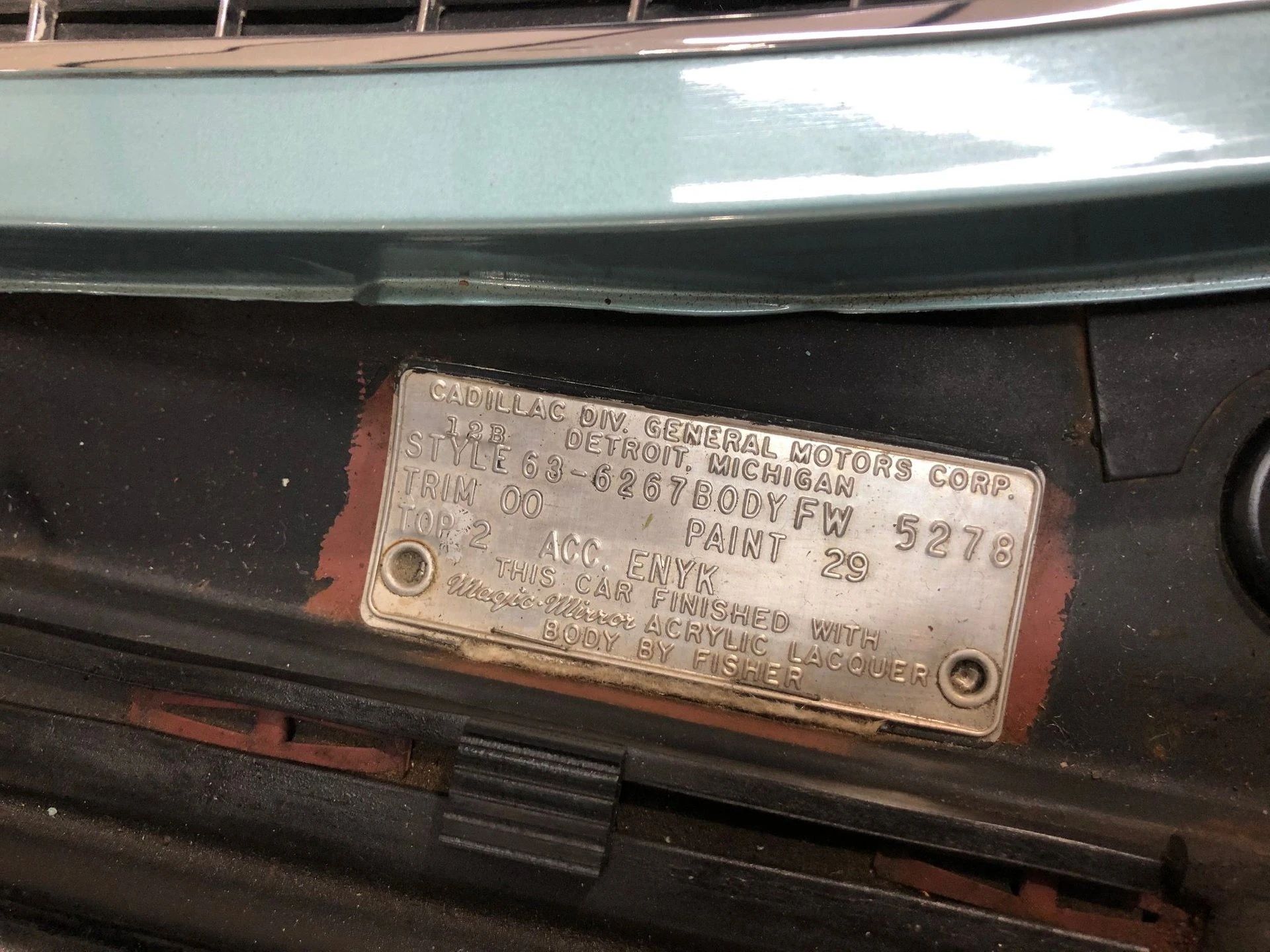
With the exception of Fire-Frost or Firemist colors, if neither the PAINT nor the TRIM code is 00 (or 000), the car was not a factory special order, whatever fanciful story the seller may cook up.

Even if the trim plate DOES indicate a special order, there’s almost certainly no way to know what color or trim combination was originally ordered. So, even if the Cadillac has a “00” paint code and is painted a weird non-standard color, you can’t be sure it’s the SAME weird non-standard color in which it left the factory all those years ago.
Related Reading
1963 Cadillac Series 62 Convertible – Search Engine Snafu Returns A Magnificent Special Order Treat (by me)
General Motors Greatest Hit #13: Were The 1963-64 Cadillacs the Greatest Postwar Cadillacs? (by Laurence Jones)
1964 Cadillac Fleetwood Eldorado – The Brief Return Of The Open-Wheel Eldorado (by me)
1966 Cadillac Fleetwood Eldorado Convertible – The Last Fading Ember of the Rear-Drive Eldorado (by me)
Color-Coordinated Cadillacs: Colorful Eldorados, De Villes, And Fleetwood Broughams (by me)























I saved a bunch of photos and the description of a 64 Fleetwood with buckets.
Wow! Definitely a special order car.
This is an interesting look back at the ability to get semi-custom colors and trims on a mass produced car. The era of true coachbuilt customs had been gone for quite awhile by the 1960’s, so it is interesting to see how Cadillac navigated between custom colors and trims and a need to stick to their standard manufacturing processes as much as possible.
I think there is some confusing language when describing paint colors here. Most of the standard no-extra-cost paint colors for Cadillac all through the 1960’s were metallics. In 1963, for example, I think that black, white and beige (Bahama Sand) were the only non-metallic colors offered out of the 16 standard paint choices. The 5 Fire Frost metallics were the extra charge colors, almost certainly for specially formulated paints that used more exotic compounds for an extra metallic look. I am unclear on who made the Fire Frost paints, but the Firemist paints that came on in 1964 were apparently a product of the Englehard Company out of New Jersey, and were more costly paints because of the pigments and materials used for the more pronounced metallic appearance. So “metallic” is not the same thing as a Fire Frost or a Firemist metallic. All Fire Frosts/Firemists were metallics, but not all metallics were Fire Frost/Firemist.
Yes and no. In any case, I could have explained it better, so I amended the text. (Twice now this morning …)
I hadn’t wanted to get too much into the Fire-Frost/Firemist paints here because I had been thinking of doing a separate post about them (that’s why I was originally looking for a Frost Aquamarine ’63), but I was able to determine:
Wow…..while I’m very familiar with `63-`65 Cadillacs, the dizzying array of choices for paint/interiors in those years was like nothing anyone else offered! My favorite combo shown was the blue `65 sedan DeVille with all-white leather and buckets!
Great essay! I wish that we could have color-keyer and special color-keyed interiors today. I miss those good looks.
Great essay! I wish that we could have color-keyer and special color-keyed interiors today. I miss those good looks.
Cadillac will again offer complete color and trim customization on the upcoming Celestiq flagship. Colors, fabrics, speciies of wood, and other features are yours to choose. However, these will be extremely expensive, will over $300.000. Sort of the spiritual successor to the Eldorado Broughams of the late 1950s.
An excellent article. During the 1950s-60s so many body & interior color selections it would boggle the mind of the current generation of auto buyers. After reading this I will stop saying I have special ordered most of my cars over the decades, I just ordered them. I have only bought three new cars in my lifetime that came off the lot only because I needed something fast. One, a 1970 Nova 396 SS, only because Dad had wrecked my 1963 Bird and I had to return to college. Two was a 1974 Buick LeSabre convertible because Dad thought I needed a new car as I was returning to college after a time off and the bronze convertible was the only conv. on the lot. Third was a 1985 Dodge Colt hatch after seeing a newspaper sales ad, plus perhaps too many drinks during a Saturday brunch. All my other cars I ordered to get them my way and didn’t mind waiting, but I realize they could not be called “special ordered”. I only had one Cadillac, lets say it was a combination of winning a bet with a friend and a gift. In late 1975 I ordered a 1976 Eldorado conv., white with red leather interior. But I suppose the color combination was not so special but I like white cars with red interiors.
Other than the three previous autos mentioned, I have always ordered my cars to get them my way and didn’t mind waiting or paying extra. My last new car purchase was a 2011 Camaro 2LT, I ordered in 2010. I wanted white w / beige & charcoal interior (sad but no red interiors). The dealership didn’t even have prices on the 2011 models at the time, nor factory pictures of the beige & charcoal interior. That is what I wanted & what I got after more than a two month wait.
The only car I currently have that was optioned unique is my yellow 1966 T-Bird convertible. It was ordered and delivered to a dealership in Dallas. What I found interesting it has almost all the options but it was ordered with the black vinyl interior with black cloth inserts. Its the only 1966 T-Bird yellow conv. I have found that was ordered with the combination of vinyl & cloth interior. Makes sense as I lived in Dallas for years, it gets hot, perhaps the original owner wanted a less hot to the touch interior. Thankfully, the previous owner had the interior replaced in all black vinyl. My opinion, the two most stupid interiors in convertibles are cloth and leather.
Although offered in 69 and 70, IMO the most beautiful and unique Cadillac color was CHATEAU MAUVE Firemist.
My Dad lived in an apartment complex in the late ‘70s in Millbrae, California. There was an older woman (probably in her early to mid 70s), that had a ‘69 deVille convertible in Iris Mist, with a black full leather interior and white top. The color had been used by Chevrolet and Pontiac and called Evening Orchid. At the time, the car had less than 5,000 miles on it- she drove it to the grocery store and shopping center that were just down the street. It was gorgeous and I always wonder what became of it.
“Taste, which is a developed skill, is frequently confused with untrained personal preference.”
OMG, truer words were never.
Very interesting, thank you!
In my hometown of Anchorage, Alaska there was a man that had a ’68 Coupe deVille that was green with a matching vinyl roof and a red leather interior. I don’t recall what details I might have known at the time, but I do remember thinking it was a special order car. He later replaced it with a ’73 Coupe deVille in the same color combination. They were interesting, to say the least.
Great Cadillac article. Has CC ever done an article on Cadillac accessories?
Not mentioned, is some features one would forfeit should one special ordered a certain item like bucket seats in a 1966 Fleetwood Brougham, for example. The buyer would not get those opulent fold-down walnut tables the rear seat passengers got to enjoy, and (I could stand corrected), the foot rests were omitted as well.