

Automakers responded to the 1973-1974 gas crisis in a variety of different ways: captive imports, eliminating big block engines, revising axle ratios, overdrive transmissions, etc.. Plymouth upped the ante considerably with the Feather Duster, which was modified extensively to improve fuel economy. Thanks to some strategic use of aluminum parts, they were able to reduce its weight by almost 200 pounds compared the regular Duster. Not surprisingly, that made the Feather Duster especially attractive to those with rather different inclinations, as in stuffing in a big V8 to maximize its performance. That explains why there’s so few original Feather Dusters left in the world.

The Feather Duster has to rank up there as one of the more oddly named cars, which is perhaps why it is more remembered today than its similar in concept but significantly rarer sibling; the Dodge Dart Lite (above). This one may be the last original one left.

For 1976 only Plymouth offered the $50.56 Feather Duster Fuel Economy Package which turned your normal Duster into a Feather Duster. Included in the package was a very tall 2.94:1 axle ratio, special exhaust, re-calibrated single barrel carburetor and distributor.

In the quest to reduce weight aluminum parts were substituted for the hood, inner trunk structure, bumper mounts, intake manifold and transmission housing on the manual gearbox. This diet took 187lbs off the weight of a normal Duster which is quite significant on a car that started out under 3,000lbs.

Transmission offerings were either a four speed manual with an overdrive fourth gear or three speed automatic. The result was advertised fuel economy of 24 mpg city and 36 mph highway but acceleration suffered slightly. It may not sound like much to modern ears but it was quite impressive for a car of its size and era. On paper the fuel economy was quite close to the much smaller compacts.

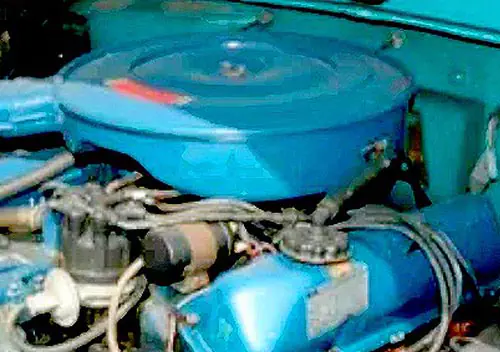
This particular Feather Duster likely won’t achieve anywhere close to those mileage estimates as its fugal slant six has been tossed in favor of a high performance 360cid small block V8. Somewhat ironically the Feather Duster’s weight advantage made it in demand with racers looking for an extra edge on the competition and many have been similarly modified. Only some 5,800 Feather Dusters were ever built.

The Feather Duster and its Dart Lite twin are two of those seemingly questionable attempts to make existing cars more efficient. But it was too little, too late, as by 1976 gas supplies had stabilized already over a year earlier and folks didn’t care as much. or if they did, they bought one of the growing number of Japanese imports. And within two years, Chrysler would have its own subcompacts (Dodge Omni, Plymouth Horizon) for those that preferred a domestic fuel saver.
Related CC Reading
Curbside Classic: 1974 Plymouth Gold Duster – There’s Gold In Them Thar’ Hips by PN
Curbside Classic: 1972 Plymouth Duster 340 – The Tweaker by PN
Curbside Classic: 1972 Plymouth Duster In “Plum Crazy”- Sweetened Deal by Rich Baron













I had a ’72 Duster back in the early eighties. It had the Slant Six engine, and averaged about 18 mpg the way I drove it. I loved that car!
That last picture is hilarious to me, as the hubcaps appear to be hand drawn over the photograph…badly!
Was thinking that myself. ‘DEEP Dog Dish’ Caps.
Also, what’s with the shadow under the front end? What is causing the two “pokey out” bits in the shadow? I don’t see anything that shape on the car.
Totally hand-drawn. I have some press photos of the ’76 Plymouth Volaré from the same time period where the entire rear panel was also hand-drawn. I had to think of when the artist (who did much better work than I could have) handed in his or work and said, “That looks good enough.”
Wait, I get the aluminum parts substitutions and everything, but if someone puts a 340 or a 360 CID engine in to race it, they’ll need stiffer suspension and an improved rear axle ratio right? They would be subtracting much of the advantage of the lighter car they had to begin with.
No. It would still be some 200 lbs lighter than if they’d started with a regular Duster, right? And FWIW, stiffer torsion bars aren’t really any heavier nor is a different rear axle ratio gear set.
You would throw away the entire original drivetrain as it was all weak junk.
You would also weld up the unibody seams, subframe connectors, reinforce the torque boxes, aftermarket K-member, upgraded suspension, steering, springs, shocks, brakes.
Then, hopefully, your upgraded Feather Duster is lighter than a regular Duster with the same modifications!
Yes no difference only aluminum bottom trunk and hood skin.
Worse is heavy steel inner bumper structure. And get rid of heavy bumper shocks.
Transmission was fine with a V8 bell, though the wide-ratio wasn’t great for a drag car. (It’s the same A833 used by all Mopar muscle cars, with a different gearset.) Rear axle was either the weak 7.25″, or the same 8.25″ used by the Duster 360. There’s absolutely no need for an aftermarket K-member.
I remember seeing the ads for these. I was 11 and had started to get into the data and mechanical specs of cars, looking at car magazines.
In that vein, I thought the Feather Duster was a really neat car, lol
That same year, I found it interesting that the new Volare/Aspen twins EPA rating was 19/27 for the sedan/coupe, but 18/30 for the wagon, for the base slant six with the base 3-speed (that no one bought), the wagon got better highway mpg.
Given my age, I gravitated toward the highway figure–THIRTY mpg. To be very young and naive again, lol
I mowed a lawn for an elderly widow who owned a Feather Duster. If my memory serves me, it was white over a blue interior. And it had 0 options! I recall it was the manual transmission and there was a blank plate where the radio would be.
She didn’t drive it much and she bought it more because it was cheap than for economy.
She offered me a chance to buy that car because I never charged her for mowing, but a nephew swooped in and got it before I could give her an answer. I do remember that she had never had one issue with it.
I don’t remember the details (but I’m sure someone else will) but this 4-speed overdrive was the old 4-speed transmission with the 3rd gearset switched for an overdrive, and the shift rods flipped around. The result was normal 1st & 2nd gears, then 3rd gear was 1:1, and 4th was an overdrive ratio. That left a huge gearing gap between 2nd and 3rd.
Yes, it was the modified 4-speed. But the other gear ratios were changed too otherwise the hole would have been absurdly huge making it essentially useless. Chrysler wasn’t that stupid.
The A-833 6-cylinder 4-speed ratios were: 3.09, 1.92, 1.39, 1.0 (V8 gears were different)
The OD 833 had these ratios; 3.09, 1.67, 1.00, 0.73
In essence, gears 1-3 were essentially the same as a typical 3-speed.
Coming after the popular Gold Duster, I thought Plymouth’s name was clever. The Dart Lite maybe less so. Chrysler was building so many Dusters and Dart Sports around that time, I wonder if there were production constraints that kept them from promoting it more. In these pre-CAFE years, there was no reason to build more of these if they would come at the expense of higher profit models.
I wouldn’t have been able to tell you that the Dodge equivalent was called the Dart Lite. And while there are lots of examples of economy-oriented models during this era, the Feather Duster is definitely memorable because of the name.
Too bad that there weren’t a lot of ads for it – but here’s one, with the car (of course) riding on a feather:
That’s great. I just added it to the post. Thanks.
24/36 is actually pretty impressive for a car that size and an engine of that displacement.
Wonder what they REALLY did in the fuel economy department. I know the old way the EPA rated cars was VERY optimistic, like you might do that using hyper-miler techniques.
Anyways I still think the old 60/70s slant six Dart and Valiant is the best car Chrysler ever built. I would have bought one over a six cylinder Nova or a god awful Ford Falcon or Maverick.
And speaking of funny names, what years did they make the Dodge Dart “Swinger” I cant help but giggle like Beavis or Butthead cause I cant imagine any non-dirty use for that word.
The Swinger name plate ran from 1969 to 1976. It was considered a high performance package in1969 but I don’t think that high performance continues throughout the rest of the years. I’ve read that a person could order a Swinger with an inline 6 and that’s not very high performance. I currently own a 1972 Swinger with the factory 318 engine.
I believe that 1972 was the last year for a “performance” 340 Swinger. (Canadian package?) Other cars, like the Challenger, had a 6 cylinder option as well. They even started using 318 and slant 6s as base engines in cars like Road Runners & R/Ts later in the ’70s. Show, but no Go!.
Chrysler weren’t the only ones marketing a product called the Swinger at the time:
https://www.youtube.com/watch?v=e9lvcFlUBxM
(’65-’70, ~$200 in today’s Dollars, decent Wikipedia article)
Fascinating. Chrysler engineers historically seemed to have often done more with less. The Duster was a likeable car, and even if most didn’t go for the Feather Duster’s extreme thrift with fuel, I love that it existed for those who wanted it. Great article!
Nice ;
I could see using one as a daily driver in So. Cal., tall final drive and all .
I too feel that those old ‘A’ body MoPars hit it out of the park .
-Nate
I have a 68 Dart 2 door Sedan I’m building right now . It had the Red Slant 6 in it but not running , I’ve pulled it and I’m dropping a 360 cubic inch 320 hp small block in it . Beefed up rear end to handle the horse power . Should be sweet when I’m done with it . Can’t wait to take it to the strip and see what it’ll do .
…on the 4-speed cars, instead of the 3.2 ratio usually furnished. Automatic FeatherLites got 2.45 rather than 2.76.
2¼” (57mm) headpipe rather than the usual 1¾” (44.5mm), with a 318 muffler and tailpipe.
The aluminum 1bbl intake was the first such a one since the first-year (1960) Slant-6s, and the FeatherLite carburetor had a vacuum-operated idle speed stabilizer widget Chrysler called “Automatic Idle Speed” to keep the idle from sagging into stall territory during transient loads (full-lock with power steering, A/C engagement, backglass defogger switched on, etc). Probably needed on the FeatherLites because of the extra-lean carburetor calibration. The distributor had a vacuum advance with an extra-long throw to bring in a whackload of advance under steady-throttle cruise conditions.
That aluminum housing on the A833OD transmission had some teething problems in the form of casting porosity which let the specified lube (ATF) through and onto the garage floor. I think they might’ve “fixed” it with a heavier oil (because once the certification tests were done, the effect on gas mileage didn’t officially matter).
Nice to see you here and thanks for the additional details. I’ve always been a bit fascinated by this, and can’t help wonder why some of these more obvious changes weren’t made across the six cylinder line? I suppose a larger diameter exhaust did cost a couple of dollars more…
Somehow, Chrysler’s engineers managed to get that exact upgrade past the beancounters for 1977. Maybe because the beancounters had all been let go for want of money to pay them.
(I’m not sure what made them hallucinate that 1.88″ (47.7mm) pipe diameter; the pre-upgrade size was 1.75″. Who the hell ever made 1.88″ pipe? Maybe they measured the OD of the previous size and the ID of the upgraded size.)
Yes, the not-quite-hyper Super Six.
1.88″ might actually be 1.875″…or in the 70s, 1 7/8″ pipe.
That’s probably it – and I doubt if that size is stocked in many exhaust shops. The early cars (’60s) had 1.75″ headpipes, and perhaps the 1.75″ headpipes I saw on ’70s cars were field replacements.
Great to see your comments again.
“extra-long throw to bring in a whackload of advance…”
I didn’t know there was a new unit of “____load” available.
I’ve using the existing boat-, butt- and other types of load for far too long, apparently.
Thanks for the update.
I have had a 73 Duster 318, 72 Duster and 74 Dart with 225s. Drove them many essentually problem free years. For the tiny difference in gas mileage I prefer the 318 that has significantly more power and better drivability. The 73 Duster was one of best cars I ever owned. Family had 76 Aspen with a “Super 6” 225. Slight power increase with the 2 barrel with no noticeable decrease in gas mileage. I recommend that upgrade for all 225’s. Better exhaust helped them both with noticable gas mileage and power increases as well.
A little more trivia that some may not be aware of:Feather Duster and Dart Lite hoods are about 15 lbs lighter than all steel versions due to their aluminum underside bracing. That also saved about 5+ lbs on the trunk lid. It’s easy to recognize a Feather and Lite hood because the aluminum underside is crimped to the steel top around their perimeter. You can barely make out the crimps unless you can blow up the pic. You’ll need a magnet for the trunk. Hoods need a a specific lighter spring assembly and the trunk tension needs readjusting due to the lighter weight. I never weighed the bumpers but the huge aluminum reinforcements tucked inside the bumpers provided a big difference in weight over the standard assemblies using the 5-mph, “shock absorber” bumper bracket assemblies. The 1973 standard bumper bracket assemblies may have been the lightest combo but unfortunately I never weighed them for comparison.