

(Updated 4/29/2026) I spotted these two Rambler Americans just a few blocks apart in Berkeley; same name, same hometown, similar colors, and both clearly still part of daily life. In their own ways, each feels like “peak Rambler.” One is a 1960 Custom, the top trim of the first-generation American, with its rounded, then-unhip, bulbous styling, but with the budget-friendly appeal that helped AMC climb the charts. The other, a 1964 redesign, shows how quickly things evolved back then. Sharper, more modern, and widely seen as a styling success that carried Rambler forward into the next few years.

The top one is an example of the Custom trim level, the top-of-the-line in 1960, the last year of the first generation American. By this time the design, a direct descendant of the 1950 Nash Rambler (notable for its ground-breaking and somewhat ridiculous fully-enclosed front wheels), was quite behind the times stylistically. I actually think the styling has worn well. The front is unique and purposeful, and from the sides and the rear, it looks to me quite similar to the Volvo Amazon sedan – and who doesn’t like the Amazon?

I don’t know if you can still fold the seats down flat in one of these, though I think you could in earlier versions. Interesting, though, it has split-bench front seats. I didn’t know they had those!
You could get a 3-speed auto (a Borg-Warner unit) or get your 3-speed with or without overdrive; the latter is probably the ticket for modern highway speeds. I took these shots a long time ago, and I think I remember seeing a clutch pedal. From looking at Rambler brochures, the lever position was basically the same for an auto and a three-speed, but the auto had a little gear-position indicator to the right of the instrument panel, which you don’t see in these photos. So my memory is probably correct that this one had a manual.

The rear seat looks reasonably inviting too, especially compared with, oh, say, an AMC Pacer for example. Sorry, this last picture has a lot of glare, I did my best.

Ramblers came with the famous Nash “Weather-Eye” climate control system, at one time the leader in the industry, and still at this time I believe top-of-the-heap.

I believe by this time the Rambler American was available with an optional, and somewhat peppy OHV six, shared with its larger stablemates, though this example probably has the economical ~90 hp flathead six. Probably the biggest thing the Rambler had going against it was the 1950’s-era styling. I’m told that the bulbous styling meant it was quite tight width-wise in the interior; a lot of space was wasted in those flow-through fenders. Even so, with unibody construction, it was light-weight, peppy enough, was the least-expensive car you could buy, and helped AMC to 3rd place in sales for 1960.
The next few years saw Rambler sales hit pretty hard though, as the Falcon, Valiant, Dart, resurgent Studebaker Lark, and the Corvair and Chevy II all took a bite out of Rambler American sales, which were also compromised by a restyle which to my mind was entirely unsuccessful, “nautical” in a manner that was much more successfully explored by the first-generation Corvair and the BMW 2002. You might say the design was all-wet from the get-go.
All that was rectified with the completely redesigned third-generation American, unveiled in 1964, the year (could also be a 1965, as best as I can tell, the plates once more do not come up in any search) of our other featured Rambler. It was considered a styling success from the start, and to my eyes, its styling continued to evolve in a generally positive direction up until it was replaced by the Hornet in 1970.

Like many of its contemporaries (Falcon, Dart, Valiant), the design was clean, practical, and with performance acceptable even to this day. I don’t really know what happened to American automobile manufacturers in the 1970’s, but they seemed to know what they were doing in the 1960’s. I have read a number of histories, and still don’t quite understand the forces (engineering/manufacturing/marketing) that drove what I consider a devolution of the American car from a peak in the mid-1960’s, especially in the area of “compact” cars, to the lows that each and every manufacturer reached in the 1970’s. As far as I can tell, it was not necessarily the oil shocks or the prospect of emissions standards that drove these developments, because the direction had been set before the full weight of these forces had been appreciated.
In any case, this 1964 Rambler American 330 (not the top-of-the-line 440) is still running strong. It could even have the same 196 cubic inch flathead (or optional ohv) six as its older sibling. This was again a banner year for Rambler, with a record number of Americans sold, more than 160,000. You can see why, it’s actually a pretty sharp looking car to my eyes, worlds apart from the dowdiness of the previous generations, but still maintaining the same set of Rambler virtues on the inside.

It is also regularly driven, and perhaps has led a bit harder life than its older sibling.


The original owner of this one looks to have splurged though, and bought it with an automatic, which from my research was a Borg-Warner M35 three-speed, which was also available on the previous generations.
Despite the presence of the automatic, the rest of this Rambler is sensibly spartan, though again it does share the split-bench seats of its older sibling. Quite well-worn, if still serviceable.

Seems to me there’s a little less rear-seat leg-room in the more modern of our two Ramblers (just like in the airlines!), though perhaps a little more in the width category. That may just be an optical illusion, however.

You did get some nice steelies with some rather-fetching hubcaps.

The tinworm has taken a few bites out of this Rambler, but I betcha there are still a few more miles left in it, given the mildness of the Bay Area climate.

Looks like this one is a refugee from a less-forgiving climate – and a recent one at that. Quite a miracle the tinworm hasn’t taken a bigger bite already.
So, there you have it. Peak Rambler. 1960, 1964. Just a few short years later, AMC would go from the highs seen here to the lows of the Matador Coupe, the Pacer, and the Gremlin. Here, at least, are examples of how good AMC could get, if they only could have kept the clear vision that led to these eminently practical and rather fetching designs – and some pretty nice colors on these two examples as well. Which one would you choose? I’d take the 1960, but I’m a little weird like that.























One often-overlooked early factor in the decline came from the original Mustang’s success; beginning in the late ’60s *everything* had to have long hood/short deck proportions, even full-size sedans and once-rational compacts. Of course, they had to get yet lower as well and this time there were no engineering tricks to ameliorate that, the models they were to replace already had unibodies or cowbelly frames.
The 1970 AMC Hornet born to that had less interior room than both the ’64-69 American it directly replaced and the much taller ’56-62 senior Ramblers it shared a 108″ wheelbase with. It was by no means alone in that; Popular Mechanics’ owner surveys from the era are full of gripes about cramped rear seats, small trunks and wasted space between the radiator support and grille.
It wasn’t until the first cars developed in the wake of the ’73 oil crisis hit the showrooms that that was fixed, and by then some of the other problems were happening.
And lack of a horn ring.
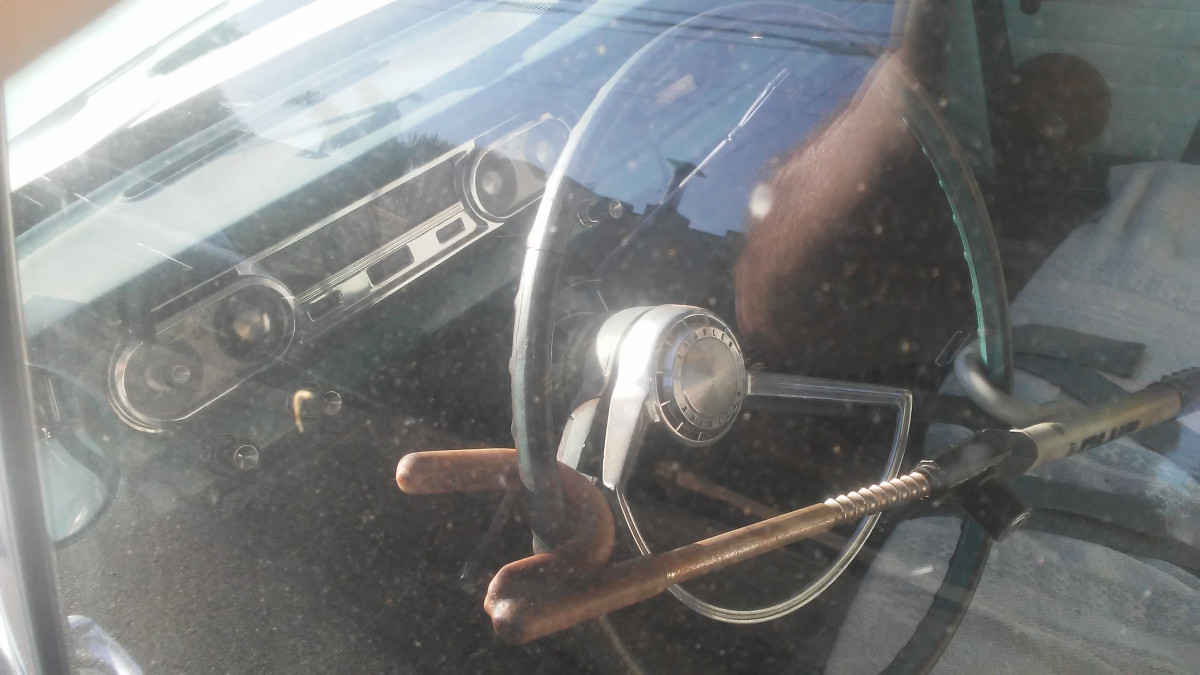
Nice write up; thanks. It looks like both owners have taken the same step to protect their cars from theft – the “club”. As an aside, I’ve often wondered whether those things work.
I agree with your comment about the direction US automakers took in the 70’s, even allowing for fuel shocks and emissions restrictions. They seemed bent on de-contenting their products, with the bottom line the most important thing. It wasn’t just automakers, either – just look at what happened to Harley Davidson and makers of electric guitars, to name just two.
The “club” works, as do most theft-deterrents, by simply being there. It makes the car less easy to pilfer, not pilfer proof. A thief is looking for the quickest and easiest one to steal, and anything to deter that is better than nothing. Just having a club, or a small blinking light on the stereo or dash, or a sticker advising of an alarm system works better than not having anything.
Fair enough. I was mainly struck by the fact that both cars had a club! Wondering if that was a weird CC coincidence, or whether clubs are common in that neck of the woods.
The Club is a very basic and rudimentary anti theft device. It’s easily defeated with a bit of effort and basic hand tools. But a thief must arrive prepared with those tools and a willingness to work at defeating it for a few minutes (and possibly be seen) before they can drive away. So they work and they fend off the casual thief.
The Club has some advantages, they are cheap, easy to use and highly visible as a deterrent. Ironically they have a bad rap because when they do work, nothing happens so the owners don’t know it worked. When they are defeated, they’re blamed for being ineffective when in reality a determined thief will get your car no matter what you do
These particular cars lack certain basic anti theft devices like locking steering wheels, so even a basic Club is better than nothing.
Clubs occasionally got jammed in the locked position. I learned that the point of the thing was for the thief to see it there, so he wouldn’t bother with your car, and move to the next one. Which meant all you had to do was hang it on the steering wheel, not actually use the lock. Doing it that way made using the Club a whole lot easier, as well.
If Rambler had kept pace with the evolving sway bar suspensions of other makes and done away with the vintage, rarely-ever lubricated trunnion front suspension, there would be many more well-used but serviceable specimens to be found. I have driven a Rambler (1959 I believe), and I found it almost impossible to maintain a straight-line bearing w/o constant minute corrections.I have turned down several great deals ownership of hobby Ramblers for that reason. It might also be a (financial) hardship to find anyone alive today that can repair trunnions, R & L. I drove an AMC Concord and my father, fresh out of the Navy, bought a 1950 Statesman, first car I ever drove.
A determined thief can saw the catalytic converter, cut thru your steering wheel with the same tool…mayB 5-6 minutes for both procedures. The ignition can be activated using high tech gadgets and your vehicle is gone. Yes, three-pedals are effective. Stories abound about car jacking where the perpetrator is not able to drive away, leaving the vehicle not far from the owner.
I think the devolution of the American car into the ’70s had the two things mentioned, and they worked together. “High styling” was learned from the Mustang phenomenon, and the manufacturers also tried to steer style conscious buyers “up” to the more expensive and larger cars. Looking at the Beetle and the early Japanese imports, Detroit saw that buyers didn’t care much about the looks of the things, so they decontented the smaller cars, and gave them some quirky looks (Gremlin, Pinto), to give them a bit of a visual “signature”, again emulating the Beetle. It is hard, now, to understand how deeply the Beetle, an underpowered, uncomfortable, unsafe car, vexed Detroit with its popularity in the U.S.
I wonder if it’s not so much the Mustang phenomenon, as the influence of the third-generation Corvette, the 1968-up one with the Coke-bottle fenders. Or maybe it’s a combination of both.
The first-generation Mustang did have the short-deck/long-hood, and lower seating position than the Falcon, but it was still relatively upright, though I guess with the shorter wheelbase rear-leg room was worse than the Falcon. The first-generation Camaro likewise was relatively practical, I remember a schoolmate of mine, his Mom had one, and we rode in the back of that a lot. Again, maybe for a full-size adult this wasn’t ideal.
By the time of the second-generation Camaro (1970), and the facelifted 1969 Mustang, things had changed. Window openings had been reduced, fenders had started to bulge, space-utilization and practicality had gone out the window. The same with the 1967 Javelin versus the 1971 version. To me, everything seemed to be trying to Corvette-ize their products. You can also see that in the Vega, the Maverick, and even to some extent the Hornet.
I think the Pinto is a pretty good looking contemporary design. The Gremlin was a sawed off Hornet, so of course it was weird. The designers were making do with what they had with little money to spend in order to get AMC into the subcompact market.
The 1979 Spirit was also a sawed-off Hornet/Concord, and looked a whole lot better than the Gremlin did. AMC could have done the Spirit way back in 1970; wonder if it would have sold better than the oddball-looking Gremlin.
Yup, it’s impossible to deter the serious well prepared thief, but the harder you make it the more casual thieves you will deter. So the club is better than nothing.
I grew up around Ramblers so the American has a special place in my heart. Love that 1964, I’d gladly putter around in one of those.
I can take out a club with one kick, dash ignitions are 3 wires
, 3 mins max…..and imma mechanic not a car thief…..
Still on the topic of space utliization, one of my favorite car stats is that the 1960 American (and indeed the 1950 Nash Rambler) is 73″ wide, the 1961-63 “nautical” reskin that finally trimmed away the width needed for the ’50-54 enclosed front wheels is 70″ wide. In modern terms that’s the difference between a Honda Accord and a Honda Civic. That has to be a record width difference for something less than a full redesign, with an unchanged passenger compartment.
And yet the interior is significantly narrower. The ’60 had 51.5F/49.8R inches of shoulder room; the ’64 had 54.8/54.8 rear hip room was even worse: 45.3 vs. 57.2. Rambler made a point to call this a 5 seater, with only two in the back because of the narrowness there, although three in the front would be a real squeeze.
That’s the ’64 which *was* all-new, I’m talking about the ’61-63. Even so, it was a small step forward, the ’61 picked up a touch of rear headroom and trunk space thanks to the squaring-off, but its’ ancient hard points still showed, and certainly do comparing to the ’64’s numbers, THAT was a huge leap ahead.
That’s a good illustration of what a good car the Willys Aero was with 61 inch wide seats, the same width as a Buick Roadmaster.
These “early American” sedans are the ones that fascinate me. It is not well enough known that the new 1954 Rambler 4 door (on an enlarged 108 inch wheelbase) served as both the basis for the 56-62 “regular Rambler” and (with its old body) as the American sedan after having 8 inches hacked out of its wheelbase. A 55 sedan is shown for comparison. It got a restyling for 61-63 but ran for a decade.
The 64 American (back up to a 106 inch wheelbase) would be in the top 5 styling jobs ever to come out of AMC. That car wore well through the decade until it was replaced by the Hornet. I wonder if anyone thought to keep the American as the budget/traditional car while selling the Hornet as a premium or sporty compact – sort of the way we had both Valiant and Duster. But then there was not much about the Hornet that felt premium.
It is not well enough known that the new 1954 Rambler 4 door (on an enlarged 108 inch wheelbase) served as both the basis for the 56-62 “regular Rambler” and (with its old body) as the American sedan after having 8 inches hacked out of its wheelbase. A 55 sedan is shown for comparison. It got a restyling for 61-63 but ran for a decade.
I think you’re oversimplifying things a bit. The ’56 108″ Ramblers had an all new body compared to the ’54 4 door; all the key dimensions are different: wider track front and rear, and different interior dimensions. That’s not to say that they didn’t share fundamental similarities in terms of their suspensions and such, as all these Ramblers did, but the body architecture of the ’56 was new.
Also, the ’58-’60 American was just an updated original 2 door Rambler; what exactly did the ’54 contribute to it? Yes, they’re all related, the original 2 door, the ’54-’55 4 door and the ’58-up 2 door, to various degrees, but the wheelbase and basic body shell of the ’58-60 2 door are pretty obviously from the earlier 2 door. of course it got new front fenders and a wider track and some other updates. or am I missing something?
No, you are not missing anything — a very cogent summary!
I was thinking of that 1960 4 door. It is hard to believe that a good amount of the 54-55 sedan body wasn’t put to work there in the back half of the body, cut down to fit the shorter wheelbase, of course.
It was odd that the sedan didn’t join the original Rambler lineup until its last 2 years (54-55) and then did not become part of the American line until 1960, for a single year before the 1961 restyling.
Comparing the profile views of the four door ’54-’55 Nash Rambler with the ’60 American, its surprising how much retooling had to be done to reduce the wheelbase eight inches. Why they bothered is a mystery unless they feared a 108″ wheelbase American that was same as the Classic would divert sales from the latter. Then, to make the change for only one model year to be completely restyled for 1961 seems a huge waste of development money.
Edmund Andersen was very proud of his ’61-’63 American restyle according to AMC maven Pat Foster. Dick Teague told the story that when he and a clay modeler colleague who happened to be from Britain saw the mock-up he said “My god, Dick, it looks like a ruddy ordinance vehicle!” Prefect characterization of that homely little box!
Agreed about the changes to make the four door. Why bother? The two door was the bigger seller, as these were really mostly bottom fisher cars. I assume knowing that the falcon, Corvair and Valiant were all going to have 4 doors was the impetus not to be left behind.
The ’61 restyle is just about the worst thing done in modern US history. truly abysmal.
Here’s a picture of both of them. Looks like the front doors are the same, not surprisingly. But from there back I see nothing that could have been re-used, as the doors are all different, and on the inside, the 100″ cars had those big intrusions. But yes, the rear fender ends/tips, and the trunk are undoubtedly the same.
And here’s the Volvo Amazon 4-door!
From Wikimedia Commons. Here’s the caption:
1969 Volvo Amazon B18 – Yours for a cool $3,200…!
4-cylinder 1778 cc engine – The B18 engine is reputed to be very durable. The world’s highest mileage car, a 1966 Volvo P1800, has run all its more than 4,000,000 km (2,500,000 mi) on its original B18 engine.
Date 6 January 2013, 22:01
Source Berkeley, California – USA
This image was originally posted to Flickr by Mic V. at https://www.flickr.com/photos/33756577@N08/8754035910. It was reviewed on 3 March 2015 by FlickreviewR and was confirmed to be licensed under the terms of the cc-by-2.0.
It looks as if they wasted a ton of tooling money to create a car better just built with the 1954-’55 tooling they had.
Regarding the “ruddy ordinance vehicle”, they’re the best proof that cheap-skate, low-priced car buyers don’t give a hang about styling. Worst of it, we had a successful AMC dealer here and the area was lousy with those ugly little boxes!
I can’t help thinking that Volvo Amazon is a much more professional-looking design. But then, it wasn’t using the hard points and black metal from an earlier car. Still, the Rambler’s skin could have looked better.
A big part of the downfall of AMC seems to be the decision to chase the Big Three with new large car models at the wrong time. The resources to make this happen sapped away much of their economy car culture.
I know this is the conventional wisdom, but I’m not sure there was anything AMC could have done. By 1965 compacts were a shrinking market that was fully occupied by the big 3. The only place AMC could have gone was smaller where VW was a player, but that would have required a new engine and everything else, and would probably not have paid real dividends for years.
The 63-66 Classic was never going to remain competitive after GM took over the mid size market with the 1964+ A body and the American was no better than the compacts coming from the big 3 (and far worse in its driving dynamics). And then there was the Mustang. I think AMC was cooked by 1965 but they just didn’t realize it yet.
They should have invested more in factory quality control and dealer service customer satisfaction. Folks burned repeatedly by the Big 3 bad dealer experience would have had a US equivalent to how VW service was reputed to be at the time. VWs sold on service and quality construction, not their 1930s driving dynamics, which were poor at best, even to this VW gearhead.
A good dealer experience IMO makes up for better driving dynamics to 99.9% of drivers: “My dealer always washes and vacuums my car when I get it serviced” “My dealer handles warranty complaints professionally and didn’t give me the runaround, say it was my fault or ‘wall job’ my car for three days and then tell me they couldn’t find the problem” and so on. AMC could have done this and prospered as The Big Three kept driving people into the arms of the Japanese – and AMC.
Very well said, and even with Jeeps and 4×4 Eagles, unique products, it wasn’t enough, Witness the end of Pontiac and Oldsmobile also. but AMC fought right up to the end.
We’ve all heard this before, but the truth is AMC made lots of money with those bigger models
Money is only made when a car line sells in significant volumes. Many of these larger AMCs failed to do that, so do not assume they made money just because they were bigger. There’s a reason AMC was in increasing financial straits during this era: Their large cars weren’t making money.
Good pix. The split bench was the “bed”. In fact the “bed” was useless, but the stepwise reclining was a good feature. The setting chosen by this owner was pretty typical. Driver upright, passenger relaxed.
The left door has what looks like a map pouch. I don’t remember seeing that on Ramblers or any US car in those years. US carmakers provided lots of interior storage in the ’20s and ’30s but stopped after WW2, until Japan forced the issue in the ’80s.
Maybe this pouch was added by the owner?
“The left door has what looks like a map pouch. I don’t remember seeing that on Ramblers or any US car in those years.”
Yes, this may just be a bunch of wrinkly door panels. The one exception to your rule that I can think of is the 1961 and maybe 1962 Lark Cruiser which tried to sell itself as a little limousine. I don’t think those survived the 1963-64 interior restyling.
I had a daily driver “67 for a few years. It was the epitome of the little old lady story. Dark metallic green 2 door 232 6 cylinder 2V with the automatic. No other options whatsoever. It had rubber instead of carpet and the Achilles heel of the whole car, vacuum wipers. That sucker was no slouch and was a nice driving car. Rambler used a 1 piece fiberglass mat for the headliner making for a rather quiet ride for an old car.
If Rambler had kept pace with the evolving sway bar suspensions of other makes and done away with the vintage, rarely-ever lubricated trunnion front suspension, there would be many more well-used but serviceable specimens to be found. I have driven a Rambler (1959 I believe), and I found it almost impossible to maintain a straight-line bearing w/o constant minute corrections.I have turned down several great deals ownership of hobby Ramblers for that reason. It might also be a (financial) hardship to find anyone alive today that can repair trunnions, R & L. I drove an AMC Concord and my father, fresh out of the Navy, bought a 1950 Statesman, first car I ever drove.
They must have kept trunnions for economy purpose, but it greatly shortened the life of these cars when those trunnions wore out and no one had any available. Same for the big Nash, and the Aero Willys cars. Now some of those are reproduced today, but not all of them. Having rebuilt many, the trunnion design is very easy to repair and simple, but the lack of replacements killed that design. The Willys Aero in particular, with the spring above the upper control arm had no need at all for a sway bar, that design produced perfect handling, as the road tests of that day said. For some reason similar Nash Ramblers didn’t have as good of handling.
Best theft deterrent today might be a clutch pedal.
Think you are right.
Conversion kits made for replacing trunions and spindels with contemporary suspension designs have been available for a while now
The 64 Rambler to 69 Rambler were a good looking car. They fit in well with the 1960s “squared off” of many of the sedans of that time. The 1960 was also a decent looking car and “fit in” in terms of 1950s styling. It had more of an early to mid 1950s look to it though. The 1961 to 1963 Ramblers were a weird looking restyle. Was almost a contest between Rambler and the Studebaker Lark as to see who could make their 1950s underpinnings last the longest. AMC bowed out with the 1964 Rambler and Studebaker lasted through 1966. The 1966 Studebaker wasn’t a bad looking car and was restyled well. Both were considered “old folks” cars in their time.
AMC should have stuck to its small car strategy. It had some nice looking cars in the late 1960s and early 1970s. The 1967 Rebel was a nice looking car especially the 2 doors. Had a 68 Charger sort of a look. The AMC Hornet Sportabout Wagon was innovative and was the only US compact wagon from 1971 or 1972 until the 1976 Aspen and Volare Wagons. The Javelin was nice looking in the 1968 to 1979 versions then it got to be too big like the early 1970s Mustangs. The AMC Hornet Hatchback in 1973 was also good looking. AMC compacts also kept a shorter overall length in the Hornet at around 185 inches long as the other compacts grew longer. AMC then got into strange looking cars with the 1974 Matador coupe and 1975 Pacer which killed the company. They were each both on a unique chassis unlike the Hornet chassis which was used from Gremlins to Eagles to Concords.
I may offend the cadre of Studebaker Lark fans here, but I think that 1960 American looks better. The 1953 Studebaker greenhouse with small windows and thick pillars did not age well and I think that is the main reason I have always hated the Lark.
Yes, those window frames on the Studebaker’s doors were the main culprit and looked awkward on the sedans back in ’53. But for ’60, I think I’d still go for the Studebaker rather than the Rambler.
With the benefit of hindsight, the way out for AMC would have been to differentiate its product by adopting premium technology, something it had more flexibility to do than the big 3 because it was less vertically integrated. Rather like BMW did when it introduced the neue klasse 1500.
But yet that’s exactly what AMC did when they manufacture’d the unique, one of a kind, genius all wheel drive for sedans, wagons, coupes, remember the Eagles? They also produced the “first wide small car” the Pacer.
It’s interesting that the 1960 actually shares more design features with 21st century cars than its mid-60’s sibling. The high beltline, high hood, blunt front end, short hood and deck shorter than the hood, they all came back.
Nice pictures. And as former 122S (Amazon) owner, I never noticed the tail-end similarity. Now I’ll see it forever. Ramblers were very popular in Berkeley back when these were new, a lot of thrifty academics who may have still preferred to buy domestic. Maybe these two are natives, purchased at Gil Ashcomb’s dealership which was pictured in the dealership postcard post a few days ago. Our priest drove a black example of the earlier car shown here (replaced by a yellow Corolla), and I remember taking some carpool rides in a tan ‘64 or ‘65 four door, when it was a pretty new but to me very uninteresting car.
Someone mentioned the vacuum wipers. When did AMC go to electric wipers on their cars?
My guess would be on higher trim models, 1966. Base models still came out with vacuum wipers. Probably 1968, all models. I know all 1970 AMCs had electric wipers.
Not quite. Vacuum wipers were still standard in 1970 and in 1971!
Nightmare, wipers. We had them on our “70, Rebel SST”. Lord those things suck.
Electric wipers became optional on ’64 AMCs and finally standard in 1972. By ‘661/2 AMC had the most modern straight 6 and small block V-8’s in the business….not sure why they couldn’t get rid of those vacuum wipers! Granted, they were simple. But I calculated once that because of those silly wipers, an AMC factory would have had to build and have available on the line twice as many different engine/accessory combinations (like 232 vac wipers, 232 electric; 232 Power steering and vacuum, 232 PS and electric and so forth) to install in cars. It just couldn’t make sense from a manufacturing point of view.
BTW, I have one of those ‘bread box’ ’62 Americans (a convertible) and learned to drive on a ’65 American with the 232. And yes, both had reclining seats!
I learned to drive in my Dad’s ’64 four door he bought new. 3 on the tree, 258 with a “Tri-Poised Power” sticker right on the air cleaner. I was 14 years old, my dad was in the hospital for a month, my mom was there a lot, and it was our second car, so I got a key blank from the hardware store, filed it to fit, and drove it around the neighborhood trying to impress my friends. Unfortunately the shift linkage was sticky so it would lock up, which required crawling underneath and hitting the linkage with a hammer to free it up. Fortunately no police drove up while I was hammering on the side of the road.
Shortly after my brother got his license and beat the heck out of the car as only 16-year-old can do. It still ran when we gave it away to a neighbor.
My linkage on a 1964 Malibu would routinely “hang up” between the 2nd and 3rd shift. I found by lifting the lower shift arm at the base of the steering column, it would go into neutral.That 6cyl 3spd was the last column shift I owned. No more dress shirts with grease on the right cuff n sleeve.
My ’68 el Camino with the 250 would do that too. I’d have to open the hood and align two tabs (shift arms maybe?) by hand to get it to work properly again. It would just randomly happen. After the upteenth time, I had a floor shifter installed.
Same thing with my ’71 C10 pickup. It would hang in neutral during the 1-2 shift and coast to the side of the road. Open the hood and fix the linkage.
Same with Dad’s ’67 Falcon.
I’ve had many 3 on the tree, and with proper adjustments they work well like butter. Kaiser, Willys, Ford, Chevy, all of them
An interesting CC history article would be all the one-year wonder body type and styles AMC produced over their history like this one-year four door with this styling or the ’62 two door Classic-Ambassadors. Or the ’67 Marlin. For a company that had to be careful with its tooling expenditures, they sure wasted a lot on one-year dead-ends.
Anyone thinks that top Rambler is a good design?
It looks horrible. The greenhouse is stretched too far to the rear, and it is angled down a bit to much. They just managed to get a rear door in there, the rear wheel is uncomfortably too far to the front – the wheel arch does not follow it.
Before the B post it looks pretty good but after the B post it is a mess. Proportions are all wrong. Rear end tapers down too much.
To compare it with the very good, clean styled 4 door Amazon is an insult to the Amazon.
But a good find on the street. Much better to see this very awkwardly styled sedan than just another boring modern car.
As a styling example, that second Rambler is 100% better.
I had one of these in high school. In 1966, the styling, well, not cool. It was an heirloom from my grandmother. Like the cars from the old Superman serial TV show. Rambler put very little effort into the looks of the car as highlighted by the fit of the rear wheels in the wheelwell. “Close enough” they said. The shifter kinda came out of the dash oddly, I remember having to move the shifter around in a small circle in neutral before going to second, or something in the linkage would jam. The car was so ugly, it was funky, I never even took the hubcaps off. It was also the most dependable car of all my friends. Flesh color with a wine top, great combo. I traded it for a 1956 2dr wagon as soon as I could, a real high school car. Ha!
Also, the Peak Rambler 1964 American served along with the Rambler Classic as the basis for an Argentinian legend, the IKA-Renault Torino. https://www.curbsideclassic.com/curbside-classics-american/cohort-classic-1971-ika-torino-ts-the-legendary-rambler-south-american/
I always thought the older American’s mechanical engineer forgot to tell the stylist the exact length of its wheelbase
My first car was a 1964 Rambler American 330 four door with the flat head six and the Flash-O-Matic transmission. Bought it in the spring of 1974 for $150 and sold it a year later for $200. It was quite peppy up to about 45 mph but ran out of steam after that. Over 20 seconds 0-60 and top speed was about 70. Those vacuum wipers were very annoying.
Lots of memories in these two .
-Nate