
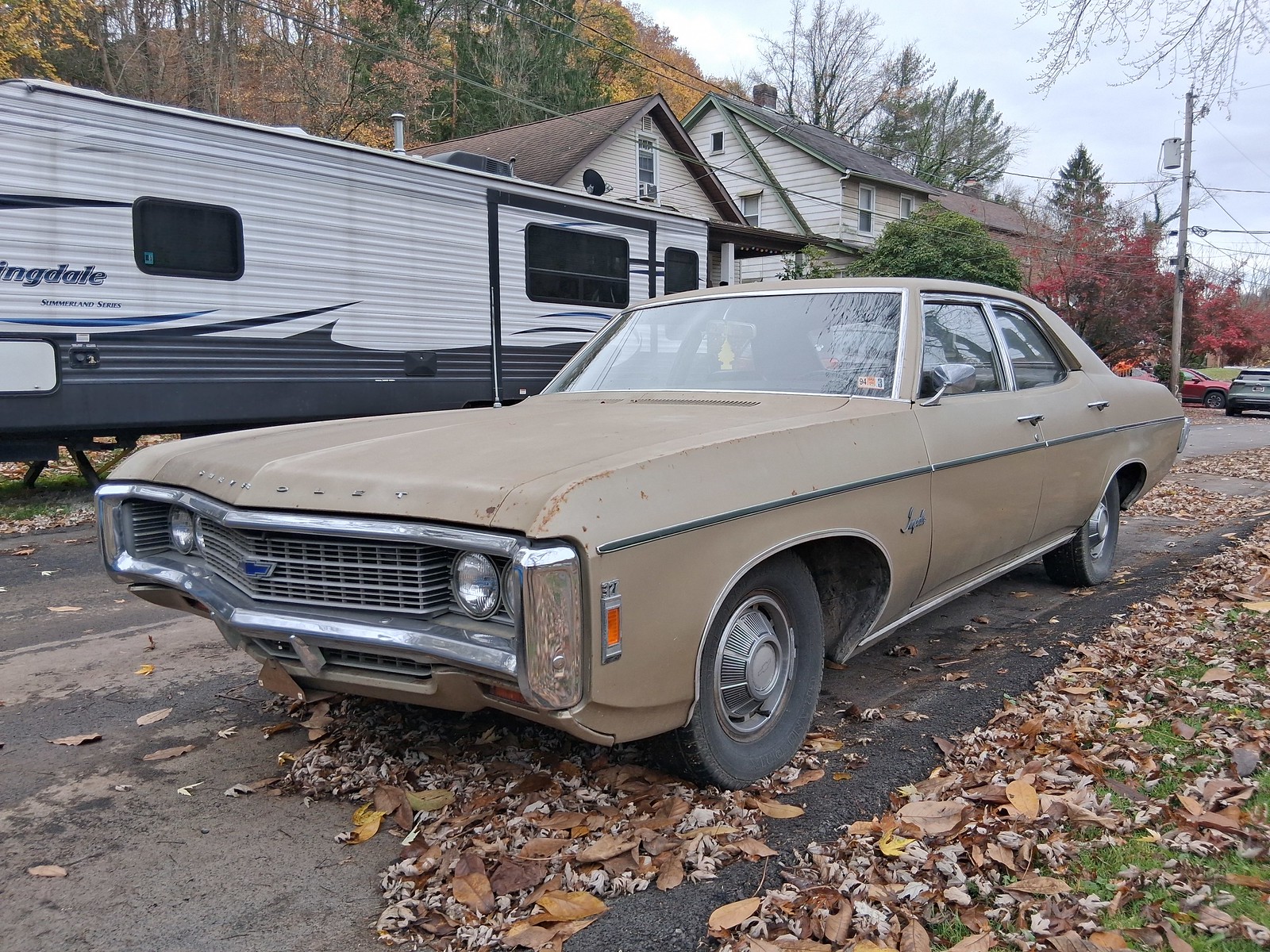
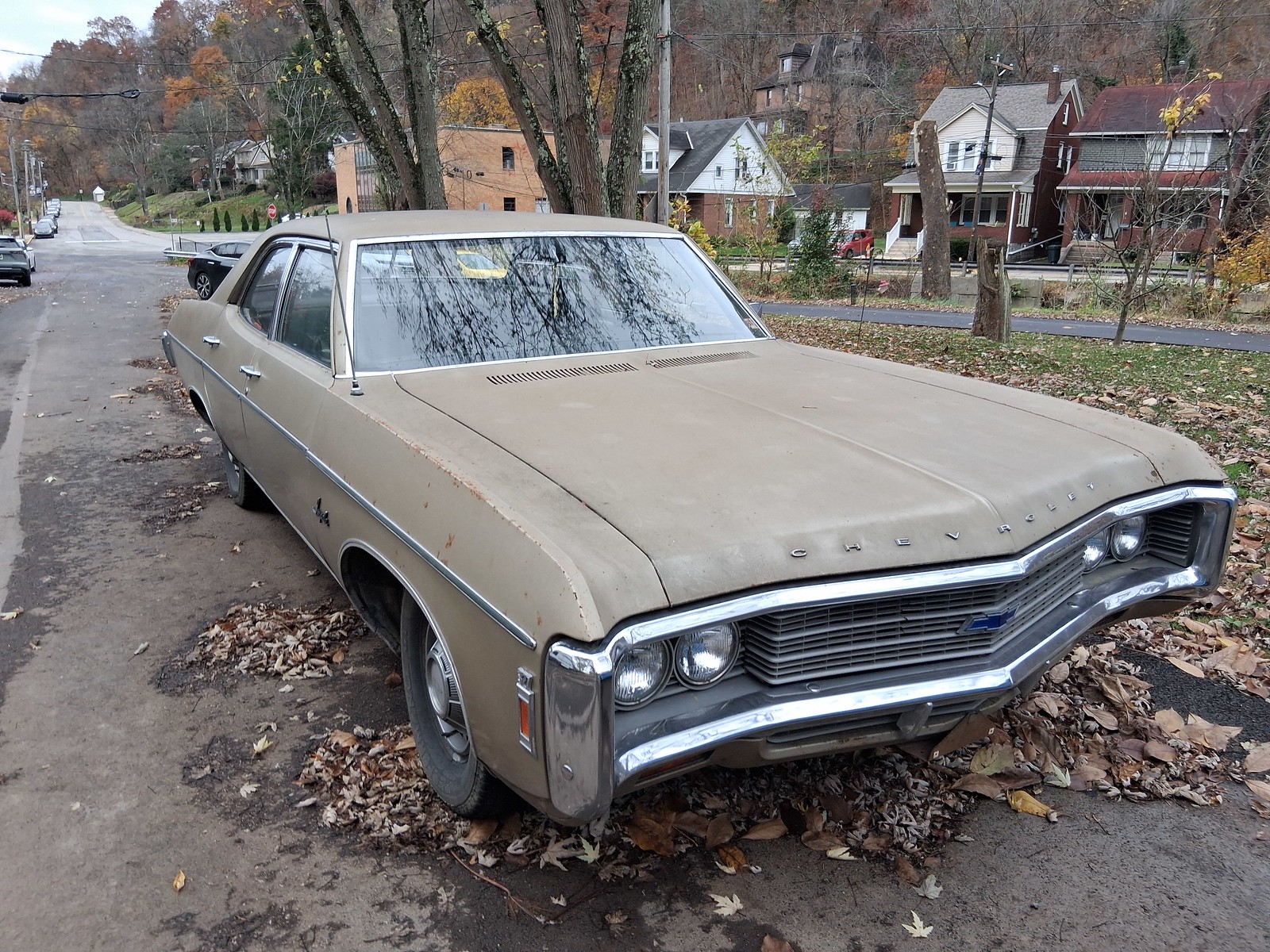
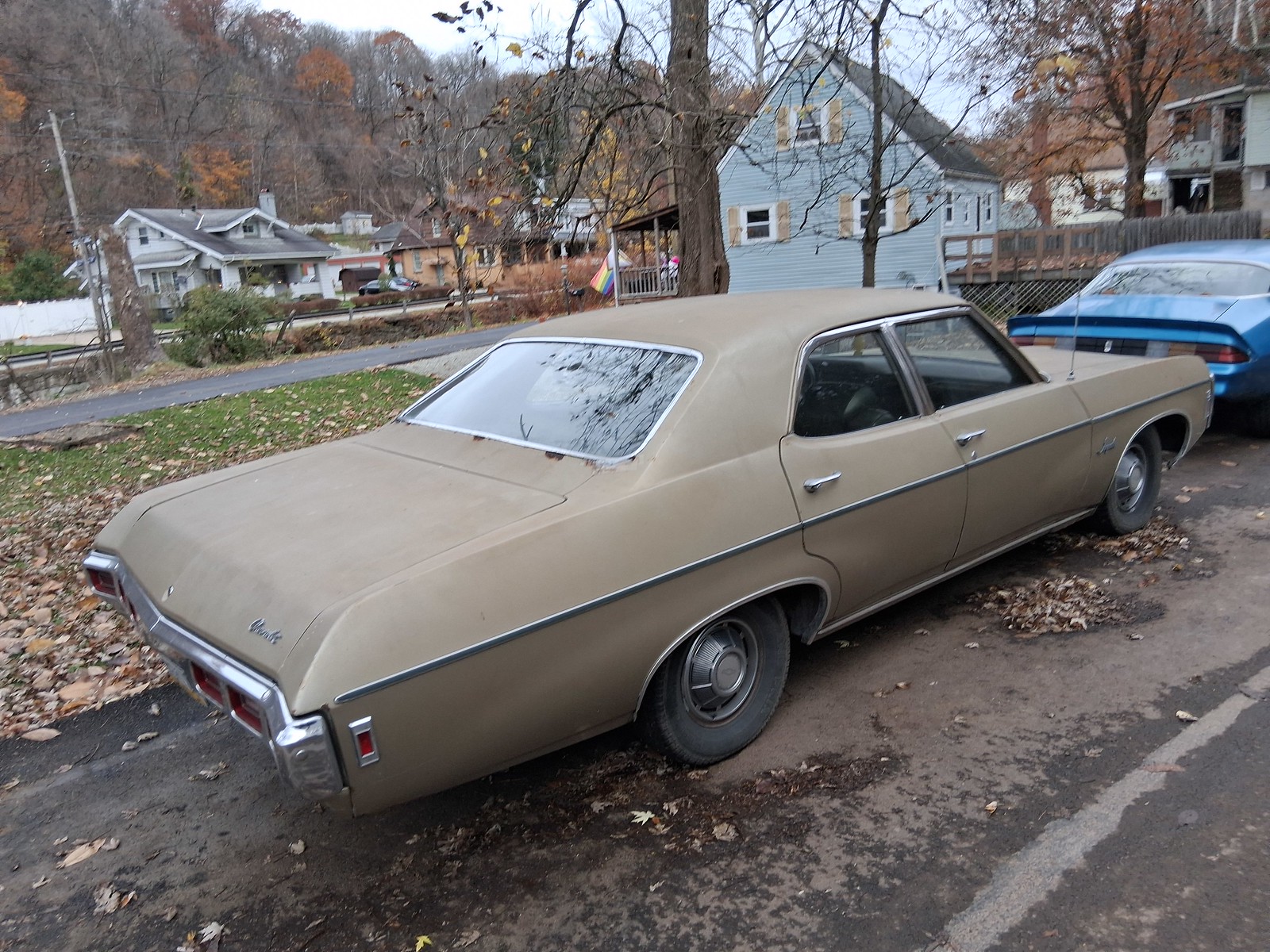
The full-size Chevrolet was America’s bestselling car in 1969, and the Impala accounted for the lion’s share of that, with production totaling about 777,000 cars (not including the cheaper Biscayne and Bel Air or the fancier Caprice). However, the factors that had made the big Chevy an American superstar were already slipping away. This oxidized but still intact survivor, wearing a Pennsylvania license plate, was captured by Hyperpack on the Curbside Cohort.
For decades, the full-size Chevrolet was America’s No. 1 car. While Ford sometimes managed to edge it out for brief periods, Chevrolet was the default choice for many people. Not only did it offer generally attractive styling and, from 1955 on, lively and endlessly modifiable V-8 engines, Chevrolet had a reputation for quality and value. “Body by Fisher” was once a mark of pride, contributing to above-average residuals in the low-price field and the promise of relatively trouble-free ownership.
The reality had become somewhat less sunny. Car magazine and consumer reviewers had been complaining since the mid-’60s that Chevrolet quality control was too often slipshod, and it would get worse before it got better. John DeLorean, who became general manager of Chevrolet in early 1969, laid a lot of the blame on the proliferation of options: “Chevrolet cars soon had 15,000 parts, with a combination of body types, engine sizes, colors, axle ratios and interior arrangements which was almost incalculable,” DeLorean said later. “We could build one million Chevrolets and not have two cars exactly alike.” There were also worrying design lapses like under-specified tires and inadequate brakes.
By the late ’60s, Consumers Union (CU), publisher of Consumer Reports, reported that in its frequency-of-repair survey results, the full-size Chevrolet was now consistently worse than average. CU found the assembly quality of many contemporary cars frustratingly poor, even in the more expensive classes, but when they compared the 1969 Impala to the latest Ford Galaxie, Pontiac Catalina, and Plymouth Fury, they felt obliged to warn buyers, “if it [the Impala] behaves like its predecessors (like virtually any Chevrolet product, in fact), over the years it will spend more time than the others in the shop for repairs.” They offered hope that maybe the 1969 model would be better, but their subsequent survey results showed little improvement.
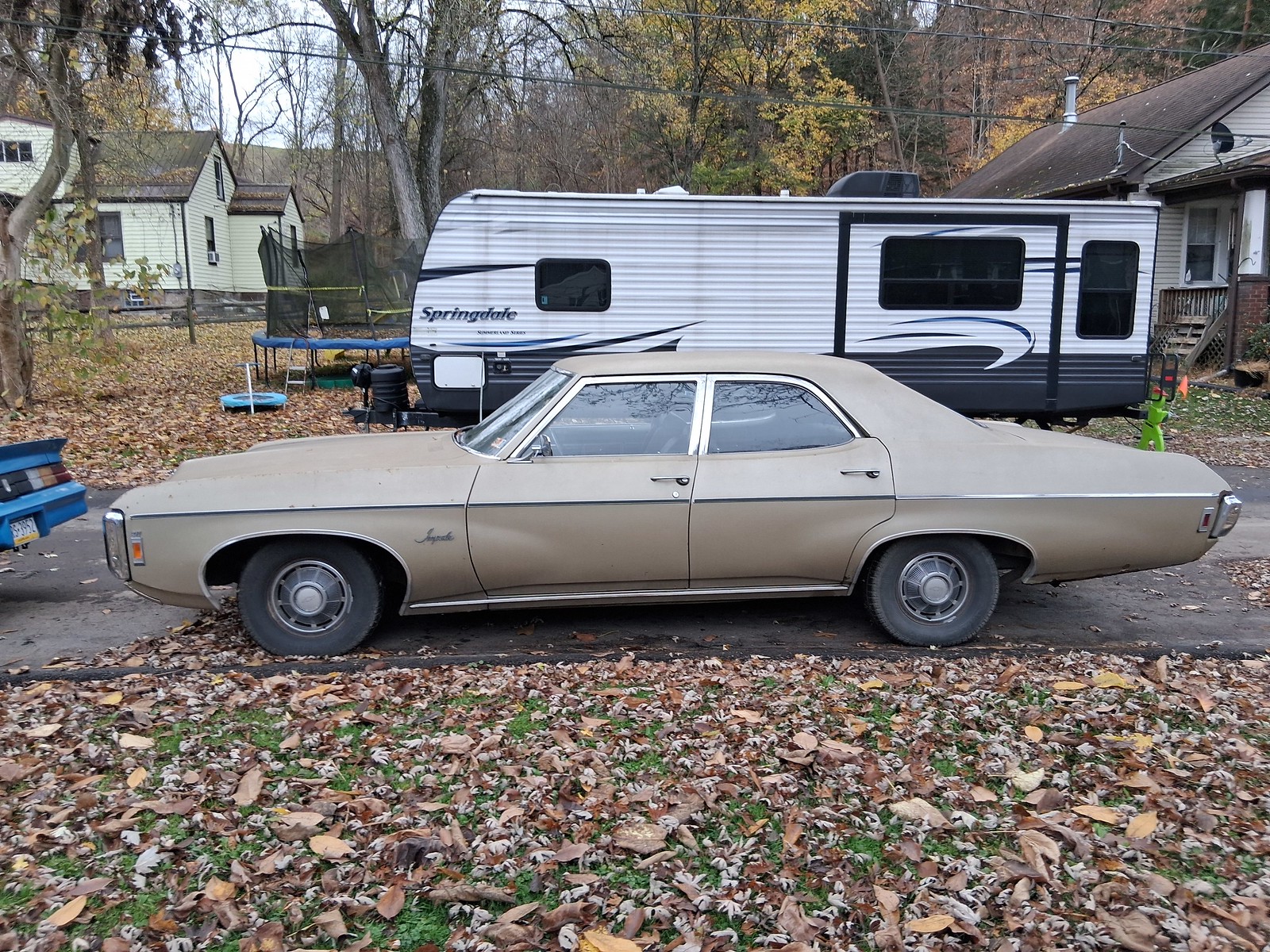
The full-size Chevrolet had grown steadily bigger since 1957, and it grew a little more for 1969. (It was 1.2 inches longer than in 1968, on the same 119-inch wheelbase.) Its once-handsome styling also seemed to have gone to seed. For all its popularity, I don’t find this Impala a particularly good-looking car, and it’s another reminder of how GM designers of the time seemed to treat the four-door pillared sedans as the poor relation compared to the hardtops. The basic proportions are okay, but on the sedans, the various bulges and curves just seem fussy and graceless.
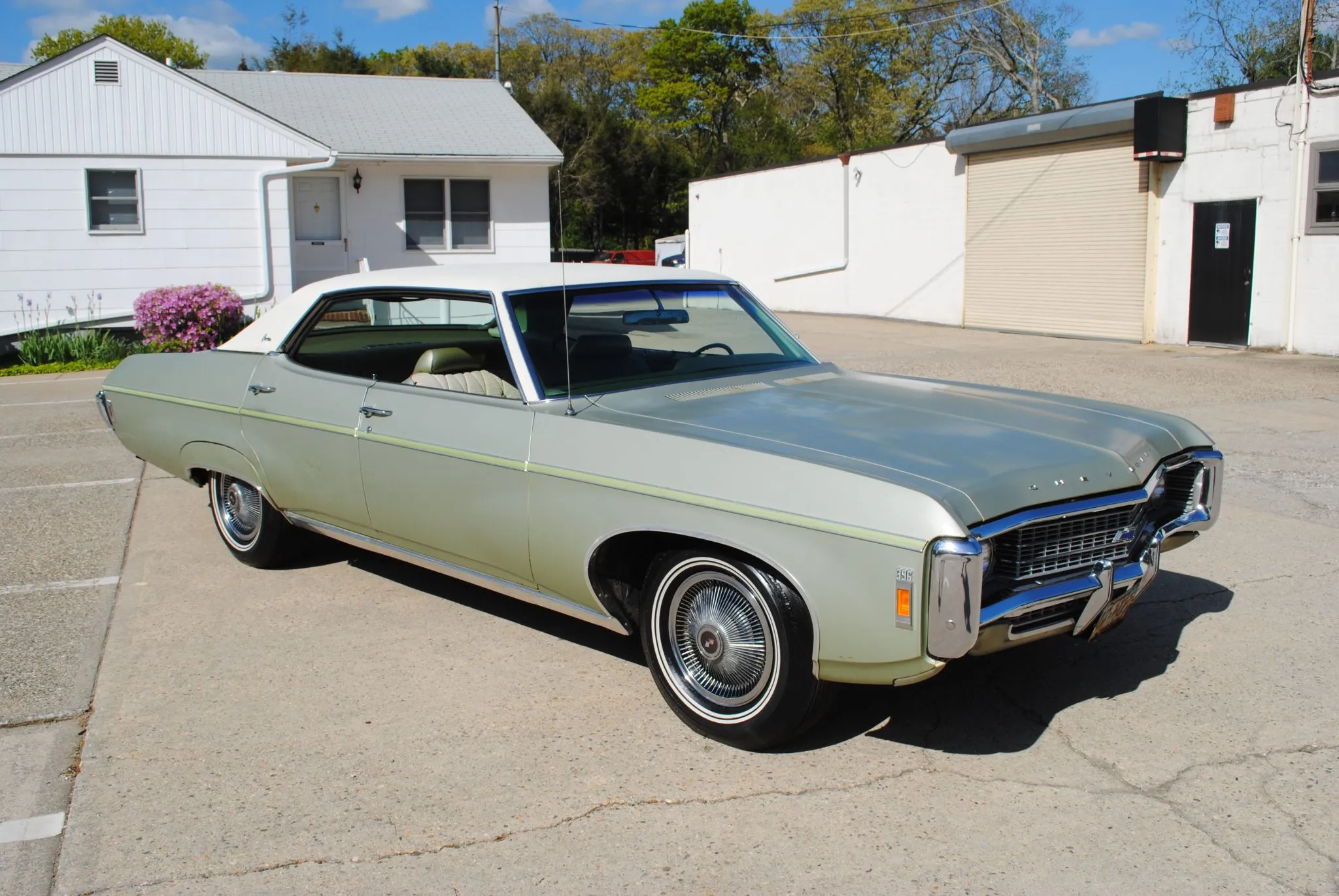
This Caprice four-door hardtop was a somewhat prettier iteration of the same themes. (Also, the Caprice pictured above better shows off the color our featured Impala was originally, Frost Lime.) Still, while Chevrolet had some legendary designs in the ’60s, I don’t think this was one of them, in any of its available body styles.
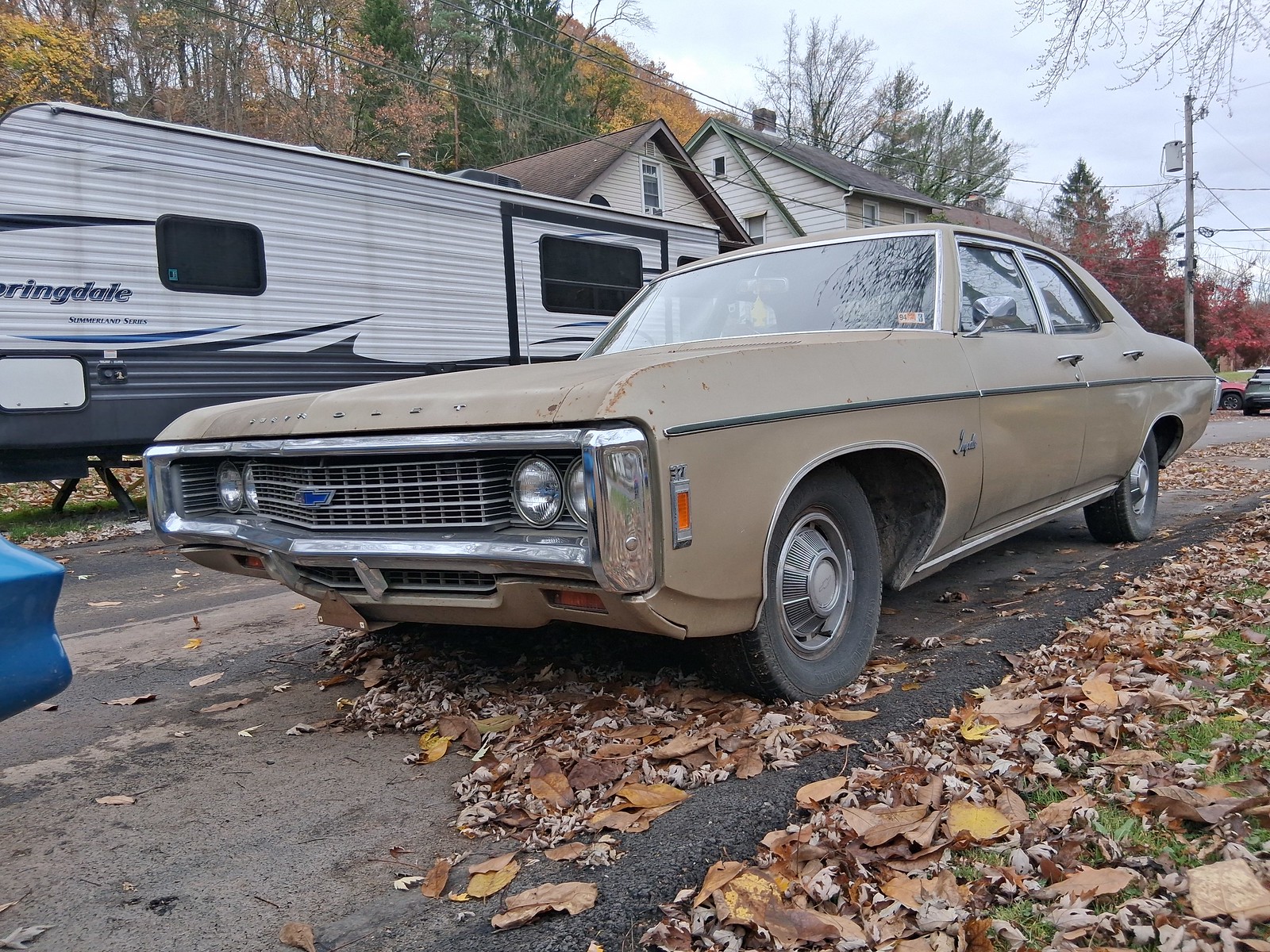
When it comes to mass-market family cars, being inoffensive is often more important than being handsome, and the Impala sedan was certainly inoffensive. Although the new car market was fragmenting into a range of size classes and specialty market segments, this was about as you could get to a generic big American car, and more than three-quarters of a million people were content with that.
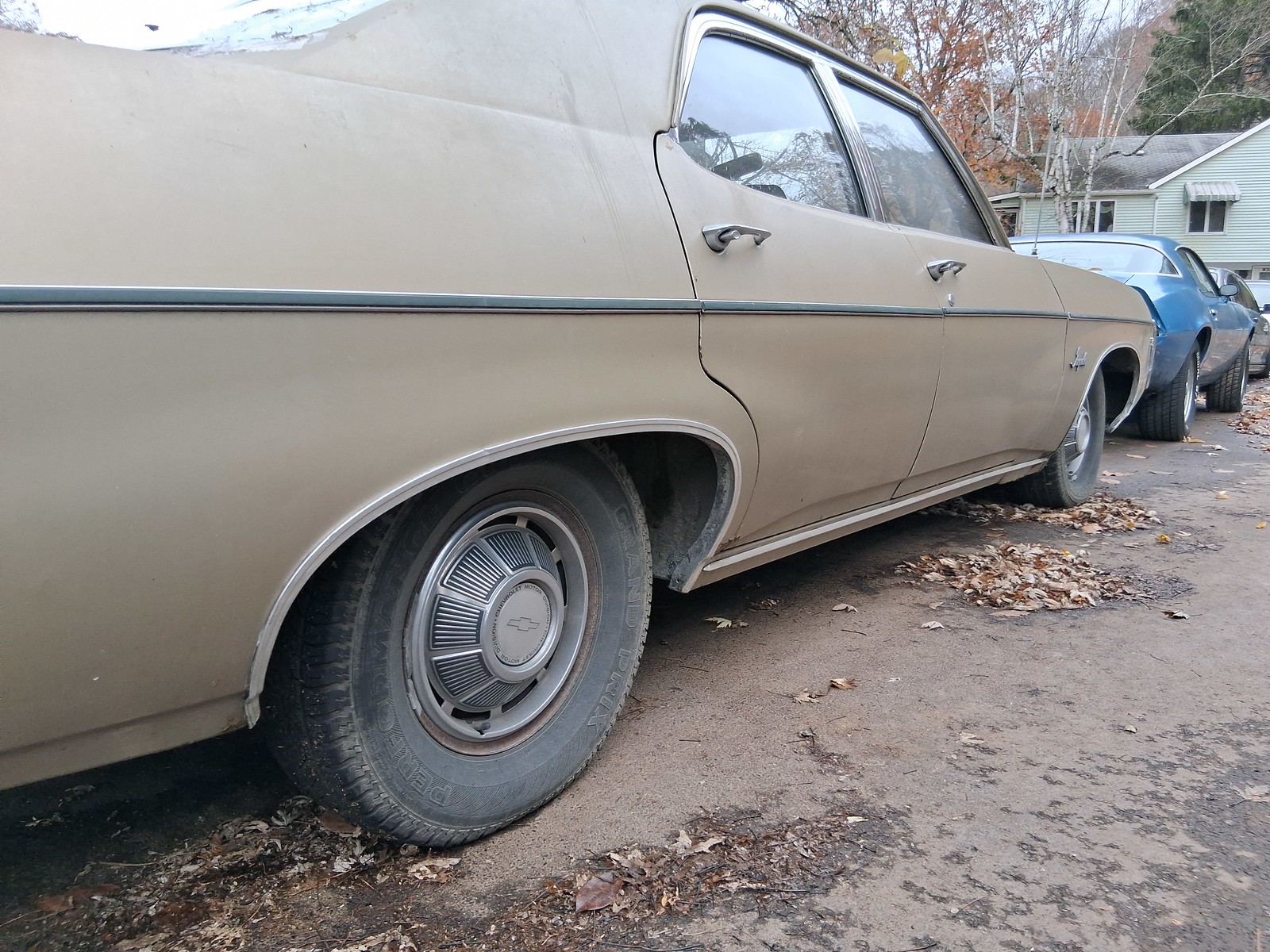
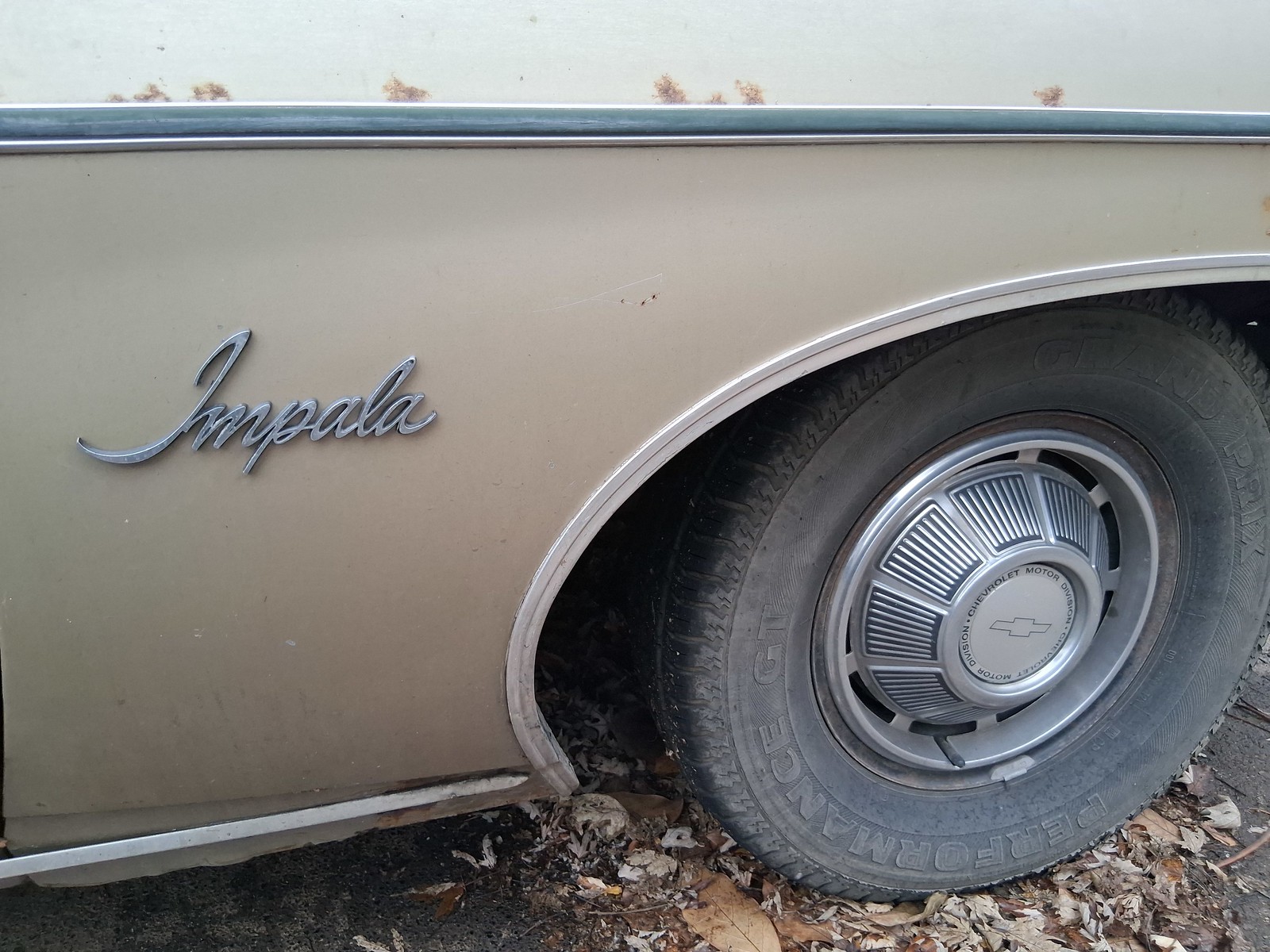
This one might look better if even a hint of its original metallic green was apparent through the patina, and if it had whitewall tires rather than well-worn blackwalls. Although they cost extra on most models, about 75 percent of all OEM passenger car tires in 1969 were whitewalls, and it was sometimes very apparent that designers presumed their presence. This Impala has 14-inch wheel covers, which were a $21.10 option, but with blackwall tires, they look distinctly undersized — from 40 feet away, you could mistake them for hubcaps.
From a functional standpoint, the Impala was competent in most respects. It was comfortable for four and could handle six for brief periods without too many tears. CU found it had competent handling and decent brakes even with the standard non-power drums. (Only 42.5 percent of full-size Chevy buyers ordered power brakes, and just 11.0 percent got front discs.) Its biggest dynamic lapse was that it didn’t ride very well, or very quietly. CU complained:
The Impala’s ride when lightly loaded was characterized by rather frequent, abrupt, small motions over nearly all road surfaces. Side-to-side rocking motions were evident, too, as was trembling of the body structure. The Impala’s response to large bumps was well controlled. Both road noise transmitted to the car interior and wind noise were somewhat higher than usual for Chevrolets.
They thought the arch-rival Ford Galaxie had a substantially better ride, albeit offset by slower, vaguer steering. Most Chevrolet buyers (91.7 percent) paid $105.35 for the excellent variable-ratio power steering, which was reasonably precise and kept wheel-winding to a minimum.
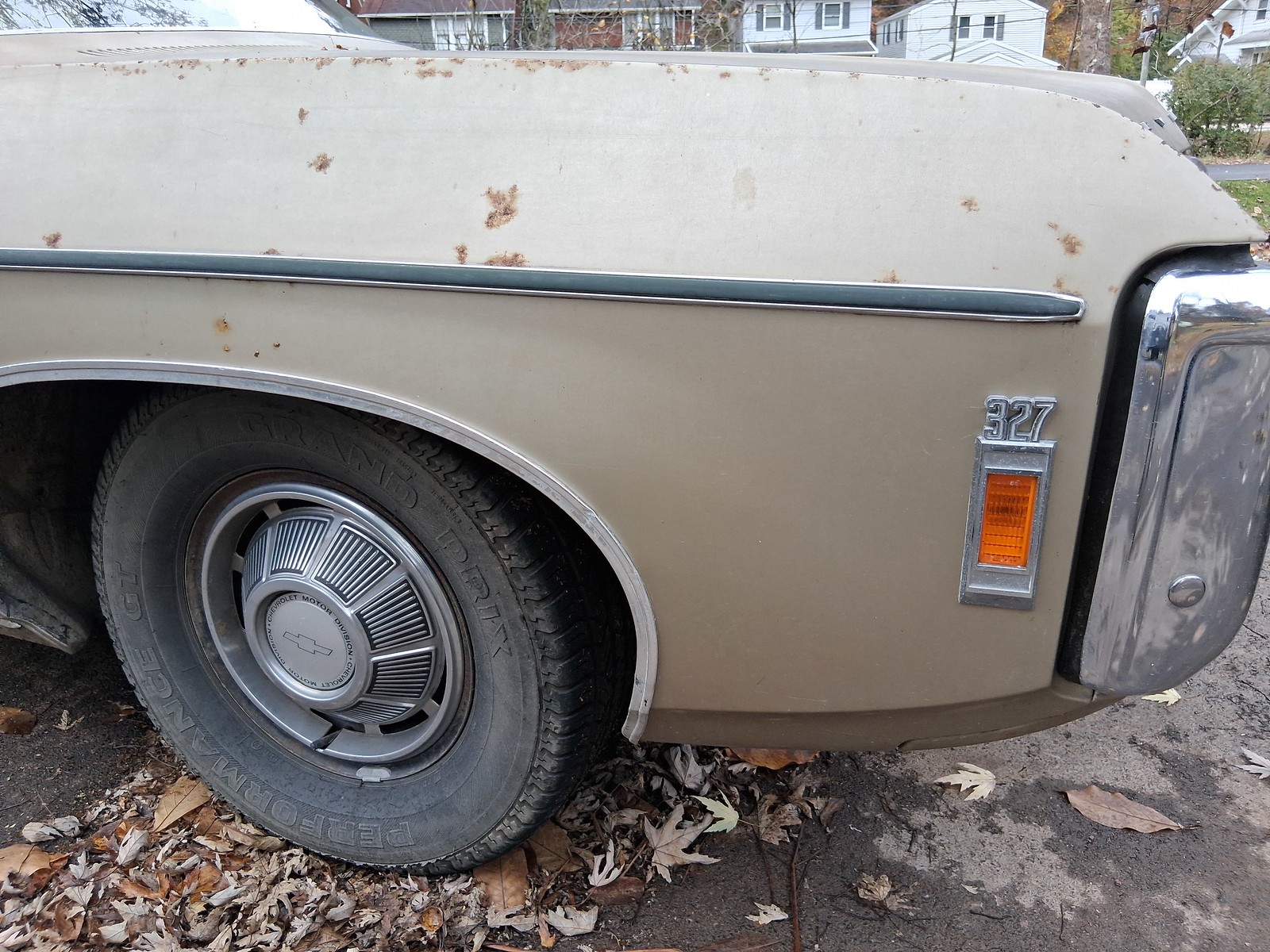
The Turbo-Fire 327 was now the “standard” V-8 engine on the full-size Chevrolet. (I put “standard” in quotation marks because it cost an extra $105–$106 over the standard six, which was increasingly rare in these cars.) In the past, the 327 had been arguably the best iteration of the ubiquitous small block Chevrolet V-8 — sweeter than a 350 and considerably more powerful than the old 283. However, the two-barrel 1969 version was de-tuned to 235 gross horsepower, with a noticeable decline in its level of enthusiasm.
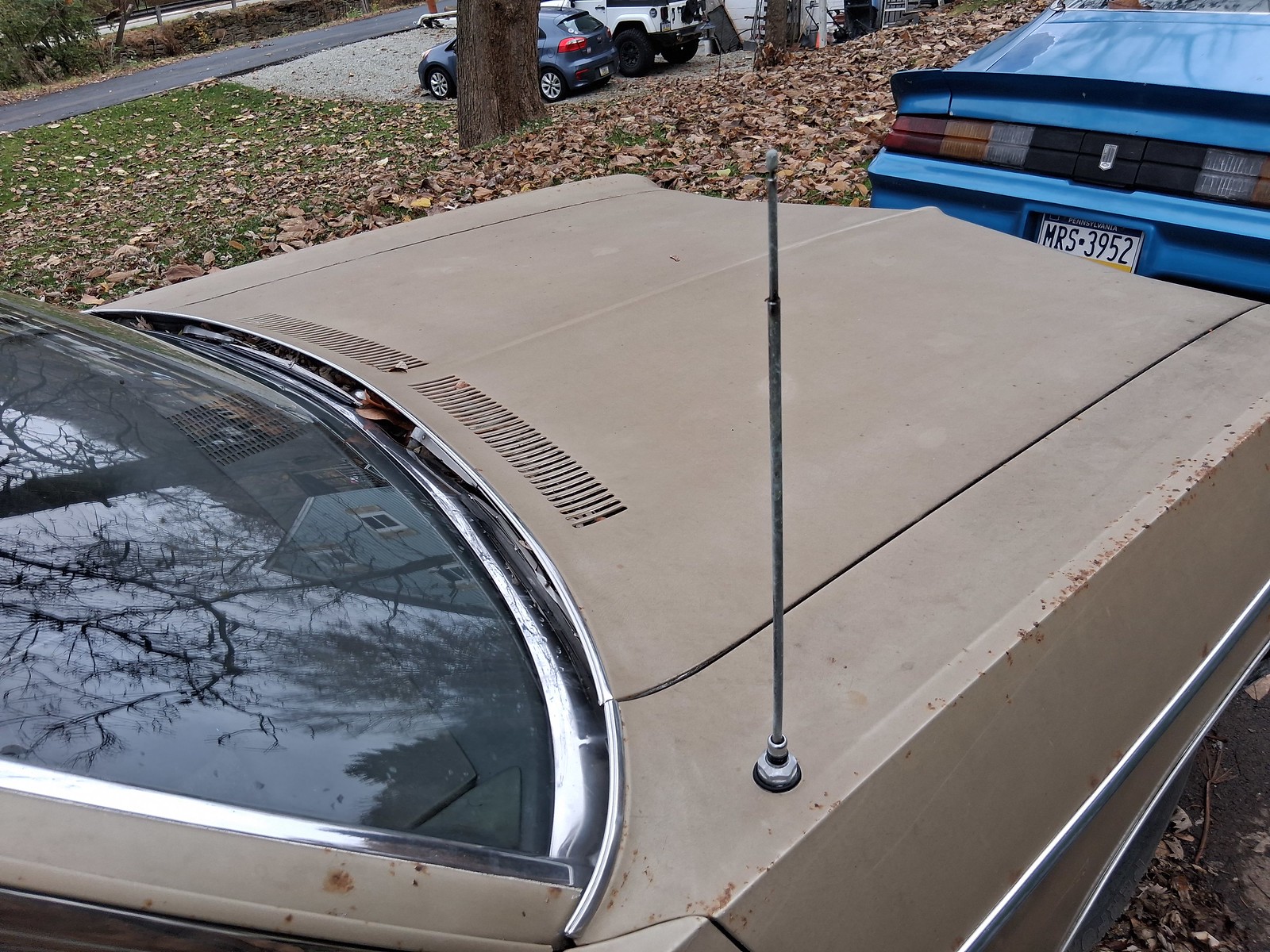
Although some buyers still ordered the 2-speed Powerglide, all of the smaller Chevrolet engines were now available with the new 3-speed medium-duty Turbo Hydra-Matic 350, which cost only $26.40 more than Powerglide. The downside was that if you ordered TH350 with the standard 327, it was normally accompanied by a 2.73 axle ratio, which really took the wind out of the 327’s sails. The CU Impala, which had the 327 and TH350, needed 14 seconds to reach 60 mph, a full second longer than a 302-powered Galaxie and a second and a half longer than a 318-powered Fury III. This slower progress was not accompanied by significantly better fuel economy, although the Impala was about average on that front.
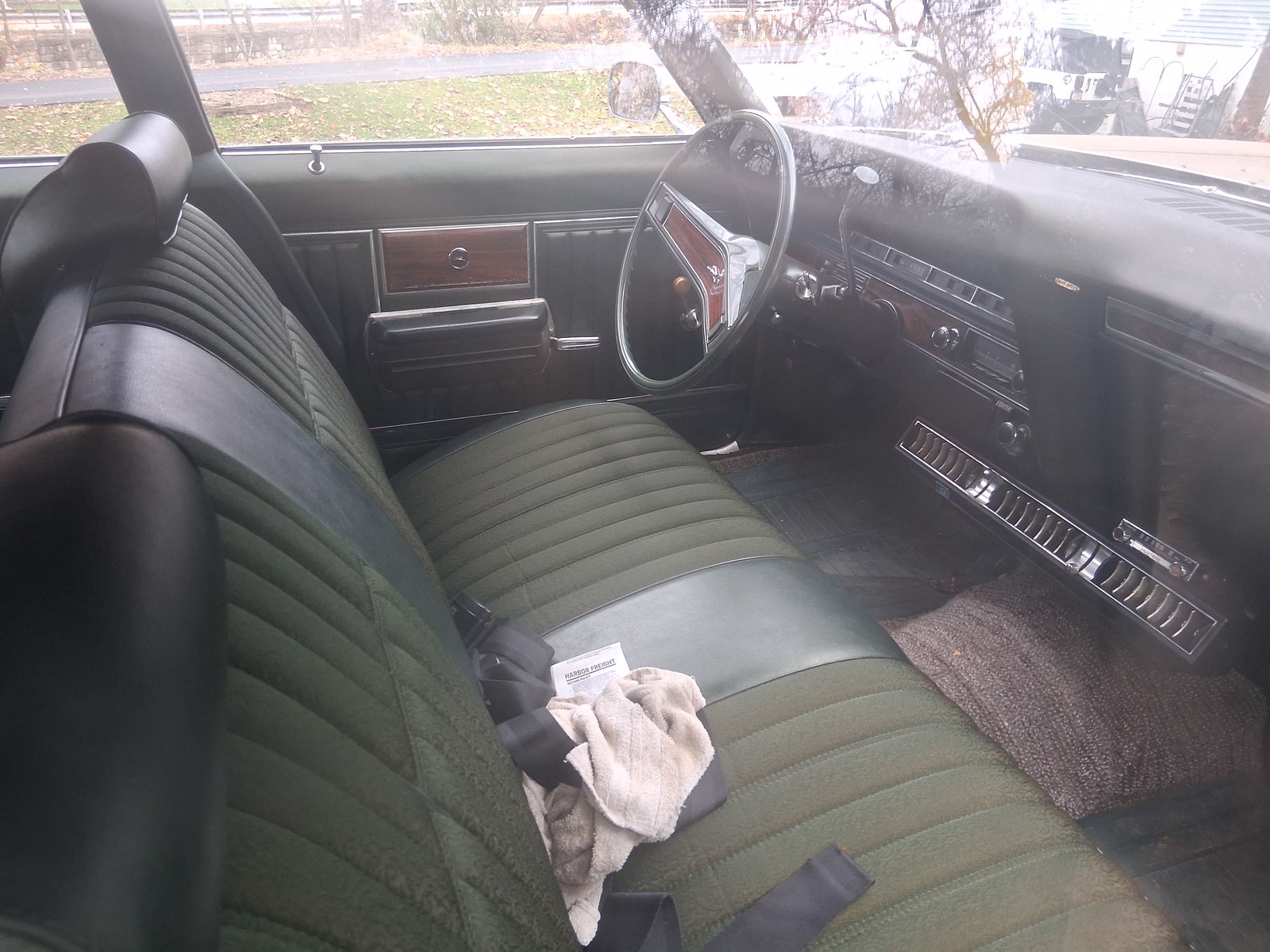
Hyperpack was only able to get one shot of the interior, through the passenger-side window. However, seeing the dark green cloth bench seat (trim code 860) is how I was able to identify the faded exterior, which otherwise could have been any of several different 1969 Chevrolet colors. I think the under-dash air conditioner is an aftermarket installation. (Almost three-fourths of big Chevy buyers ordered factory air, and you could still get a dealer-installed air conditioner on these cars, but this car’s installation doesn’t look like the dealer unit.)
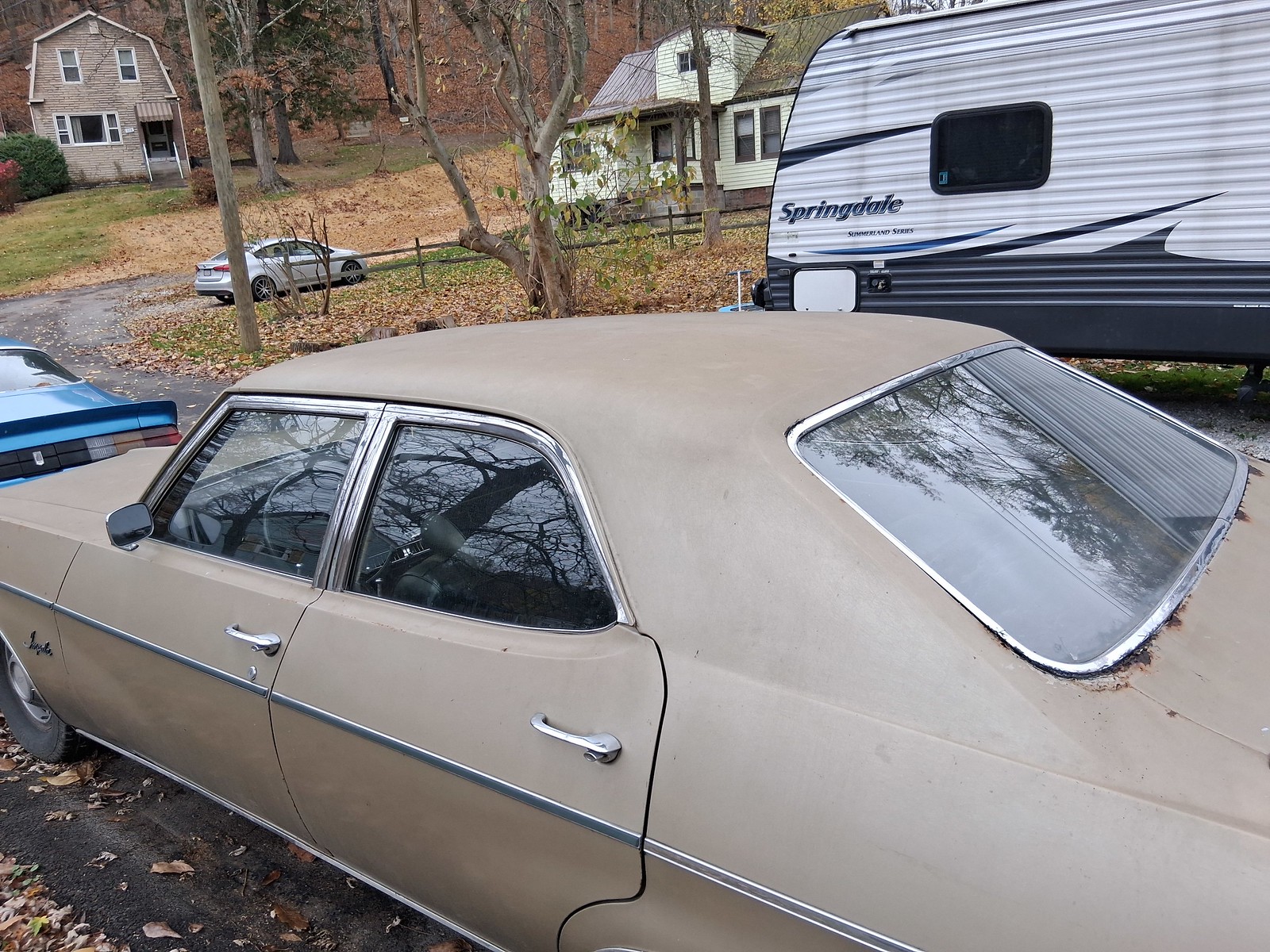
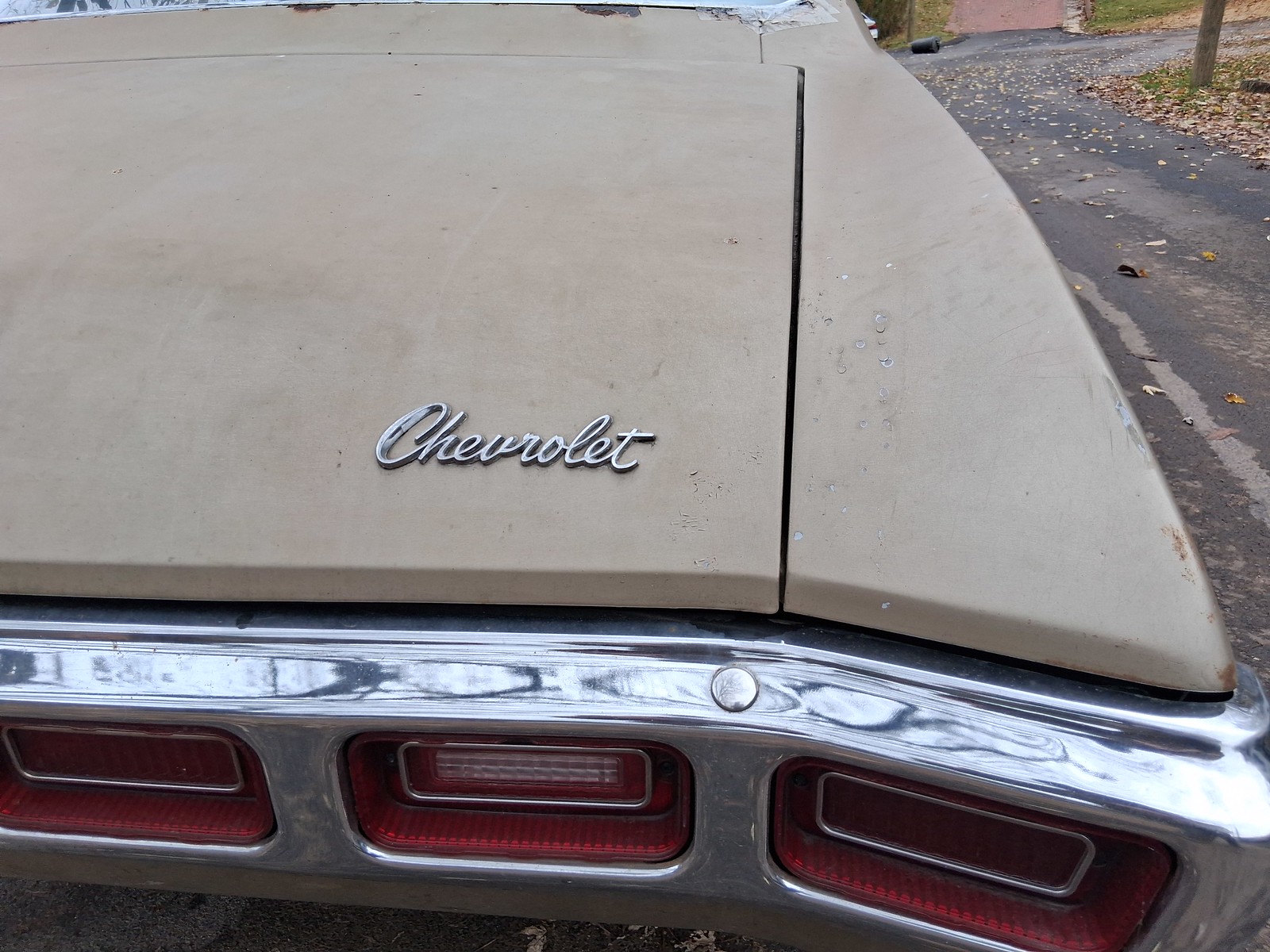
While its paint has seen better days and its oxidization seems to be escalating — there’s rust around the base of the back glass and spattering the front fenders and A-pillars — this particular Impala is probably still not past the point of repair, if someone wanted to go to that trouble for a four-door sedan.
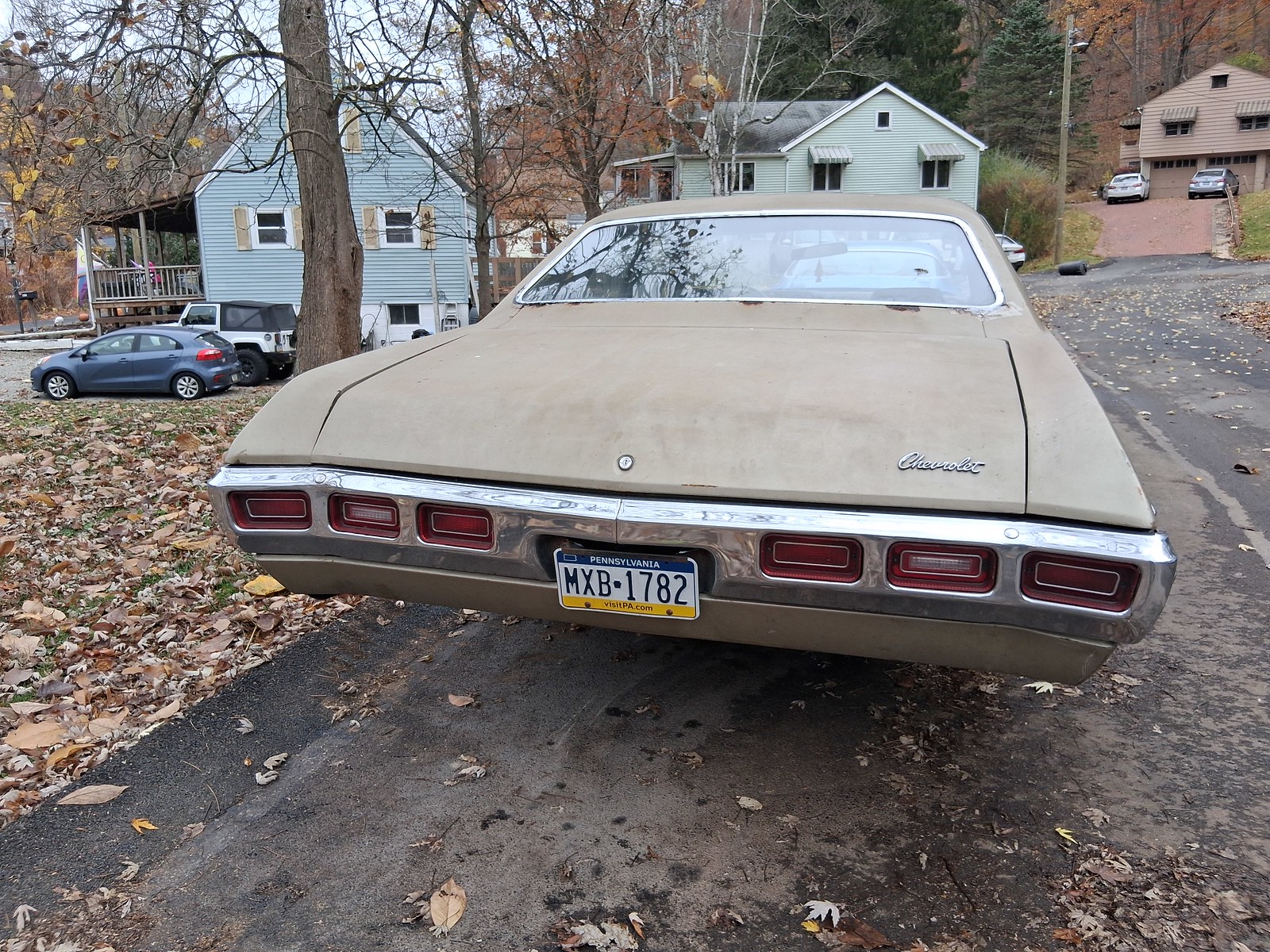
However, in its faded, somewhat tatty state, I think this Impala more honestly represents the median ’69 Chevy than any polished show-ready example. People didn’t buy these cars as collector’s items or objets d’art. Most were basic transportation, chosen based on reputation and brand loyalty, and driven until they wore out or rusted away. At one time, you could find thousands just like this, parked on every street of Everytown, USA. Many have succumbed to attrition over the years, but this one is still beating the odds.
Related Reading
Curbside Classic: 1969 Chevrolet Impala – America’s Favorite Car (by Jason Shafer)
Curbside Classic: 1970 Chevrolet Impala – The Best Big Car Of Its Time (by Paul N)























General Motors Holden (GMH) never assembled 1969 Chevrolet Impalas in Australia. So they are rarely seen on Australian roads.
GMH did however continued to assembled 1968 Chevrolet Impala 4 door sedans and Sport Sedans alongside 1968 Pontiac Parisienne Sports Sedan through all of 1969 and into the first half of 1970, as the GMH luxury cars.
These 1968 Chevrolets & Pontiacs cost three times more than the most expense Holdens of the time and many Australians believed they were 1969 and 1970 models
Great article, thank you. I feel as if I drank too much wine last night……. Is that really frost lime? It looks gold to me
It was originally Frost Lime. Today, it’s “Basic Patina.”
This was the only new car I remember my parents buying. A 1969 4-door Impala. I was 8. I remember the 240-mile trips to our grandparents with us 5 kids in the back seat. We had lots of room to frolic. My little sisters could curl up on the floorboard, while I rode on the shelf under the window. That left the back seat wide open. This car was where my car obsession would start. Mom would let me go start the car in the winter before taking us to school. “Pump the pedal twice” she said. I didn’t know at the time why I was instructed to do this, but it always started. I remember moving it closer to the house and spinning the tires in the wet yard. I was amazed I could do 40mph as the speedometer bounced around. I also remember the dash lights and how I could faintly see the writing in the little black squares. Some never came on, but a flashlight would show a “LOW FUEL” and “SEAT BELT” lens. I also remember how the “BRIGHT” headlight lens would illuminate that cool blue hue! Ours had a 327. My middle school teacher at school had a Caprice and her 396 number above her front side marker lights had me intrigued. That’s when I started learning about cars, engine and all those other things that helped me make a career out of being a mechanic for 34 years.