
 Photo from the CC Cohort by Guillaume Vachey.
Nope, that’s not a typo in this post’s title; it really is a Chrysler Stratus, the badge and name under which these mid-size JA-platform models were sold in Europe. A rare find from the days of Chrysler’s Nineties resurgence, which included a serious push into the European market.
That effort partially paid off, though not in a way all that different from Chrysler’s trajectory in the U.S.: its improved fortunes on the Old Continent came largely through the minivans that had become the company’s signature product. Meanwhile, sedans like this cloud-named JA did little business. In France, where this one resides, the best sales year for this generation was 1996, when about 1,400 were sold; the only year to move over 1K units. So take a good look at this one; if the weather changes, this cloud may disappear at any moment.

A lot of modern American cars have had a tough time being taken seriously in Europe, but the sleek cab forward JA cars had a bit of international flavor: They were developed using the platform engineering concepts brought to Chrysler by Renault veteran Francois Castaing, and JA platform vehicle program manager Steve Bartoli had come from Diamond-Star Motors, Chrysler’s joint venture with Mitsubishi. After years of K-car derivatives, the JA cars gave Chrysler sleek, modern designs with up-to-date hardware and chassis tuning comparable to the popular European Ford Mondeo (Ford Contour/Mercury Mystique). At least on paper, the models looked like they could be world players, so you can’t blame Chrysler for having international ambitions.
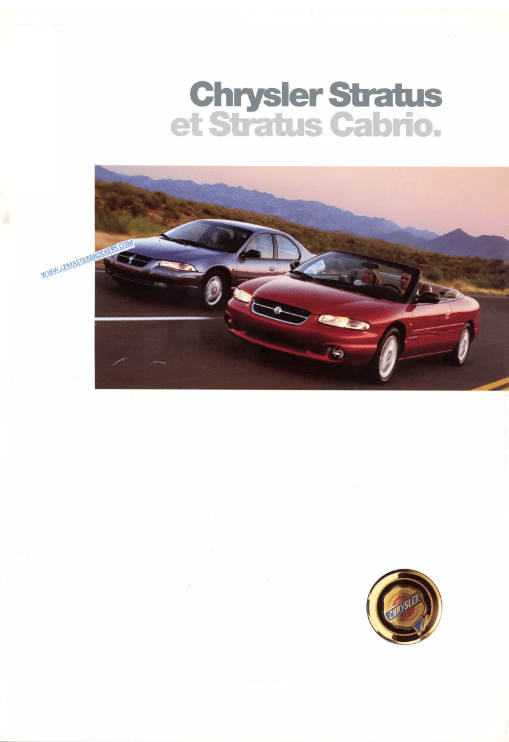
Size-wise, the JA mid-sizers were well suited to several international markets, and in Europe showed up under the Chrysler badge in both sedan and cabriolet form. Trim and badging varied throughout their run (in ways that can seem rather random to U.S. eyes), and they soldiered on until the second generation arrived for 2001, remaining on the European market through 2006.

If you’re a fan of the JA cloud-siblings, you can probably spot some differences from US versions that speak to European market adaptations. Today’s find is a 1995–98 model and appears to wear a Plymouth Breeze grille; other model years used a Dodge Stratus one, while a more distinctly Chrysler-like U.S.-style front end arrived for 1999. More importantly, European cars received rear disc brakes and a firmer suspension. The main hardware is a mix from Chrysler’s catalog; power came via a 16-valve 2.0-liter four-cylinder or a Mitsubishi-sourced 24-valve 2.5-liter V6, with shifting via a 4-speed auto or a 5-speed manual.
Of course, Chrysler’s global player ambitions were short-lived, and the wheels came off in the wake of the 1998 Daimler merger. This Stratus/Cirrus/Breeze is one interesting artifact of that brief international push. It may never have been a big seller abroad, but that obscurity is what makes this particular cloud deserving of a few CC minutes of attention before it disappears for good.
Related CC reading:
Curbside Classic: 1999 Chrysler Cirrus LXi – Remember When Chrysler Showed Hope?
1998 Dodge Stratus ES – Middle Child Syndrome
1999 Plymouth Breeze – Breeze In, Breeze Out
1998 Chrysler Cirrus LXi – Head In The Clouds













A friend bought a new Stratus in light gray/green in ’95, and it was a decent commuter car for him from out in the country about 35 miles to Gaithersburg IBM for a few years, but then he got a hankering for the new model Jeep Wrangler so he bought a nice looking dark blue one with 4.0 6cyl in late ’97. The Stratus was much better as a DD car but he loved that Jeep and kept that for over 20 years. It fitted his self image better than the Stratus, a competent but ultimately boring car.
Fascinating. I sometimes wonder what could have been, if Chrysler had remained unBenzed. Could they have really become a global player? On paper they seemed to be set to do well, with advanced styling, and respectable/interesting engineering (Neon’s automatic aside). But there was the perennial question: was the quality there? Is it a shame we missed out on these Down Under, or did we dodge a bullet? The condition of this car some thirty years later, far from its native land, makes me wonder.
What Daimler did to Chrysler was worse than what Fiat did to Lancia. They came in, promising to save the marque and just took their engineers and ideas, leaving them with a shell of a company and a small budget to produce American cars.
I’ll admit I haven’t been able to look objectively at an M-B since then. I keep thinking bad thoughts about the company’s attitude, ethos, morals – call it what you will.
NOMB4ME
I never did drive one of these but I did get a ride in one once. It had the then novel autostick transmission. They seemed like quite reasonable and practical cars. Perhaps a little dull.
The paint is in really nice shape on this one.
I suppose we got the Mitsubishi 380, the final iteration of the Magna (an interesting story in its own right).
Seems to me lightning struck twice with Chrysler, once with the 57’s and again with the K cars, asides from those big sellers (the 57’s for one maybe two years the K cars had a longer life span) the company was very very fortunate to exist, I believe. If not for government intervention Chrysler would’ve ceased being a car manufacturer some time in the early 1980’s IMHO.
The other point I was going to make regarded the splintering of the market starting in the early 1960’s, and how it became increasingly important to have a strong line of models covering all the market segments. It would seem to me that Chrysler was struggling to field a winning model in any category and in some segments had nothing
The 380 deserved better than to be the last Aussie Mitsubishi. I still see them every day. They must have been well made. My dad’s 93 TR Magna SE wagon has 550,000km on the original engine and 5 speed. The build quality is excellent.
Here in Italy Chrysler had moderate success. Minivans were a staple, but the PT Cruiser was also popular in the early years, and the Stratus was not so rare, but certainly hampered by the lack of a diesel engine
Many years ago my employer had several of these (Dodge Stratuses) that we used in the course of our duties driving around the state. They weren’t all that popular in our office. Generally people preferred driving the Chevy Malibus. I know that I was always hitting my head on the roof or the A-pillar when getting into the Stratuses.
I read a road test in a European magazine where they were not a bit impressed by the Chrysler. (Of course, they wouldn’t be.) They had a particularly mocking tone when they wrote about a small sticker in one of the windows that was apparently applied in the factory that said something along the lines of, “Made with Pride by the workers of Sterling Heights, Michigan.”
I rented a 2000 Dodge Stratus for a week while on a work trip. It was brand new and I was only the second or third customer. Not even 1,000 miles on it. It was largely forgettable like most rental fleet cars are, but up until not many years ago still saw the first generation of these JA body cars still running around, so that’s saying a lot! Also just for clarification, the first generation JA sedans were model years 1995-2000.
Neat find and with that number plate it’s been in the same ownership for maybe 20 years.
IIRC these were assembled by Magna Steyr in Austria alongside the minivans?
Whenever you saw one here in my mother’s land, it was almost always a convertible—preferably finished in solid red or silver metallic.
As bad as the US/Canada model’s headlamps were, the European-spec ones were worse. They were made by a company with more and better technology, but there was much less light in the low beam pattern on account of using only just over half the tiny total reflector surface to gather light from the bulb.