
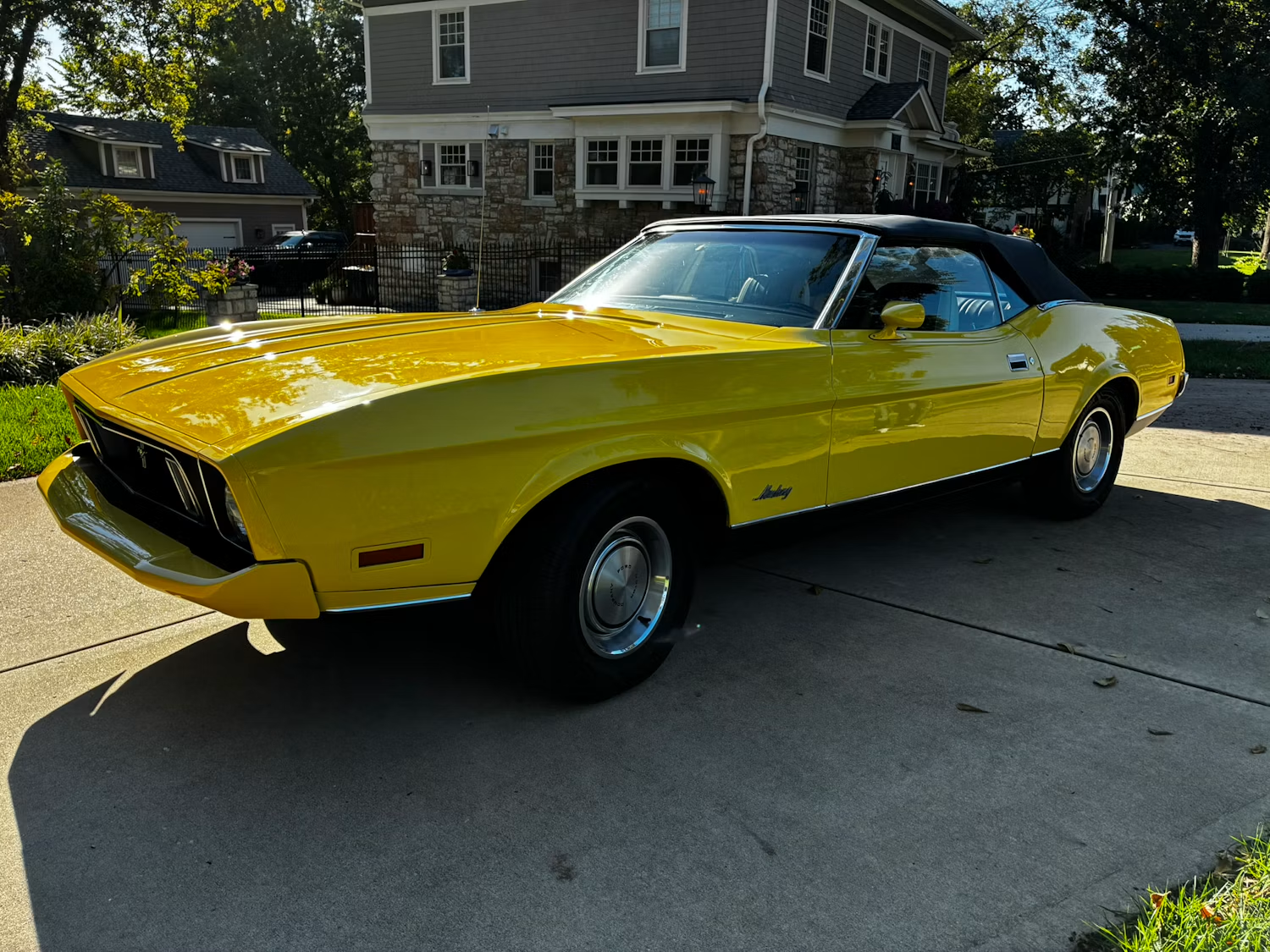
While the 1971-73 Ford Mustang may look nothing like the car that captured America’s heart a mere handful of years beforehand, it has a charm all its own; besides, how do you follow up a car that was the hit of its generation? While my preferences lean toward the Mach 1 of this era, I also have a soft spot for 1973 convertibles, the last such bodystyle in the Mustang lineup for a decade. Paint it Medium Bright Yellow and slap on a set of the surprisingly stylish basic “Ford Motor Company” hubcaps with trim rings, and I’m hooked. For those ready to spend the money on such an extravagance, it’s for sale on Hagerty Marketplace in Kansas City, Missouri.
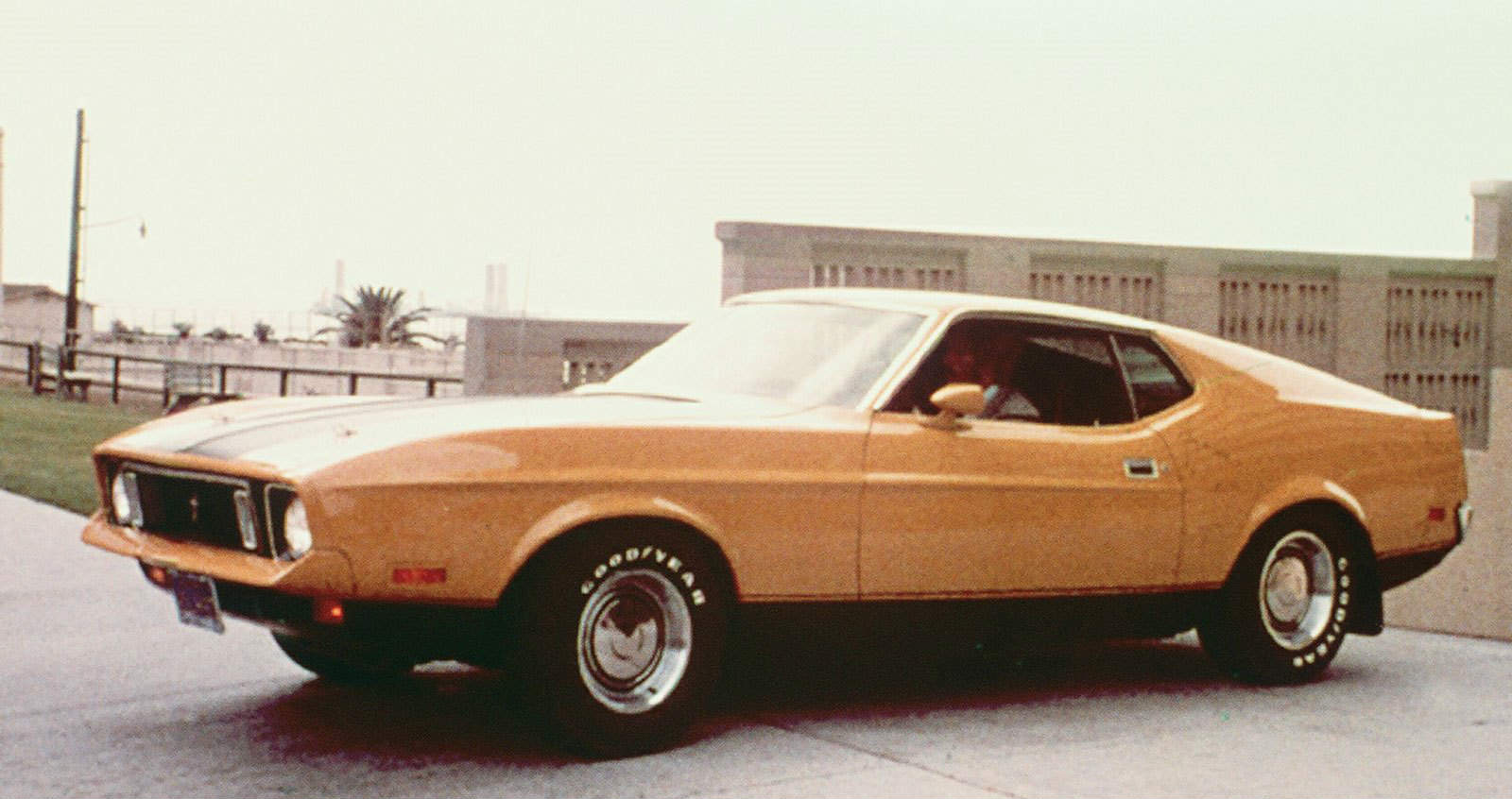
Not to be too obvious, but the Medium Bright Yellow convertible can’t help reminding you of the hero car Eleanor from Toby Halicki’s Gone in 60 Seconds, a film that lined up so closely with my sensibilities as a kid that I certainly wore out the VHS tape from the local video rental store. Never mind that Eleanor was actually a 1971 Mustang with a grille from a ’73, or that it was painted a generic “School Bus Yellow”; it’s close enough to our featured convertible to see the similarities.
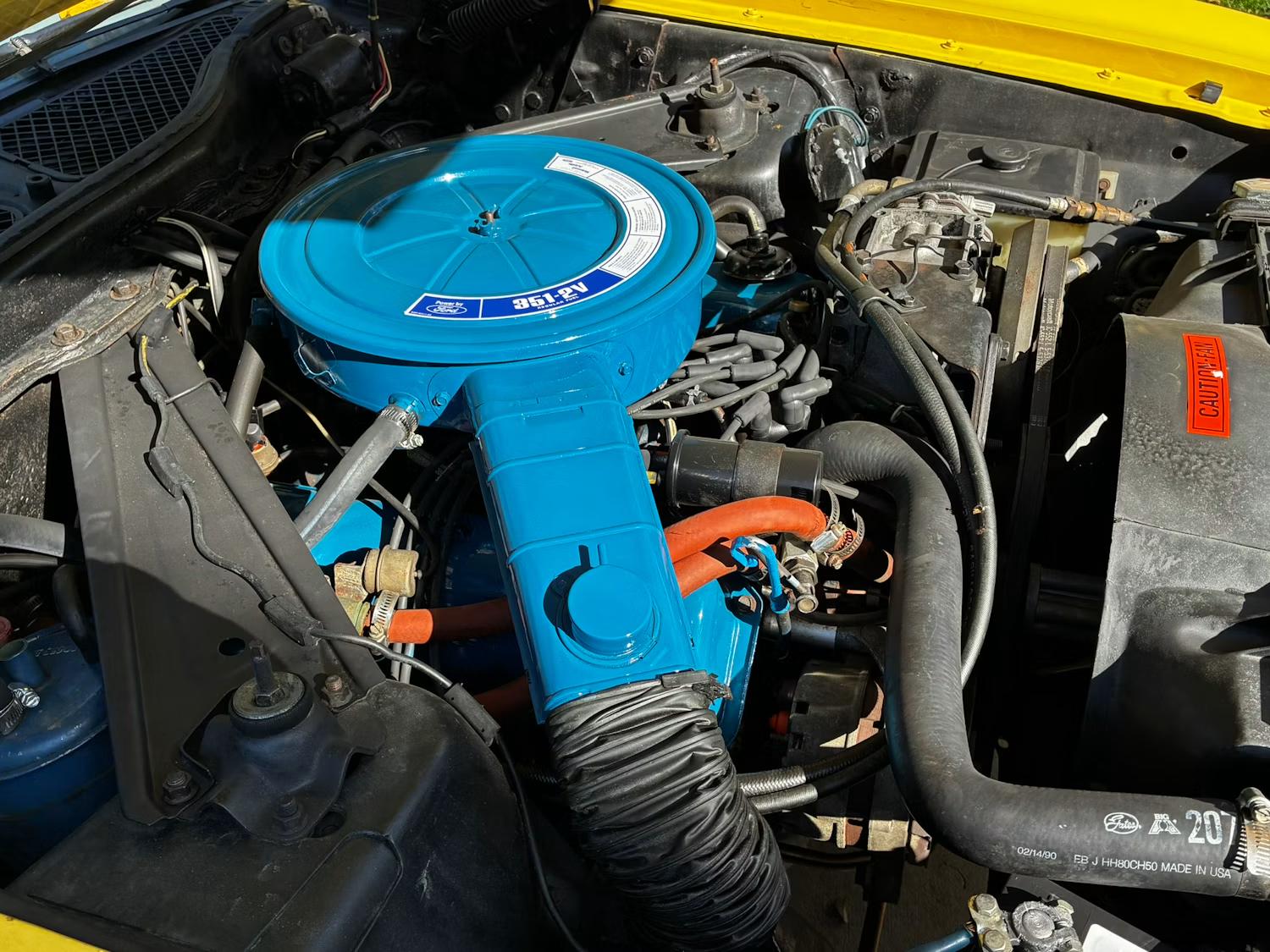
Where it might diverge a little is in the engine compartment. Like it does in many 1973 Mustang Convertibles, the H-Code 351 Cleveland with a two-barrel carburetor provides the propulsion. The Cleveland was a short-lived engine, but Ford saw fit to equip the H-Code with smaller valves and ports than its four-barrel cousin; however, they were still generously sized, and the engine was easily hopped-up. In stock form, it produced 177 net horsepower, more than enough to put the wind through your hair, even if it wasn’t enough to evade the Long Beach Police Department as Halicki’s character Mandrian Pace did in the movie.
The 351 is backed up by the cast-iron FMX automatic and a freeway-friendly 2.75:1-geared nine-inch. The odometer reads 58,000 miles, but the owner doesn’t try to assert that it’s on its first orbit, although there’s also no comment on whether or not anything in the driveline has been rebuilt, or if the car’s optional air conditioning is currently functional. The cold start video provided with the sales posting shows that it starts and runs well with no strange sounds.
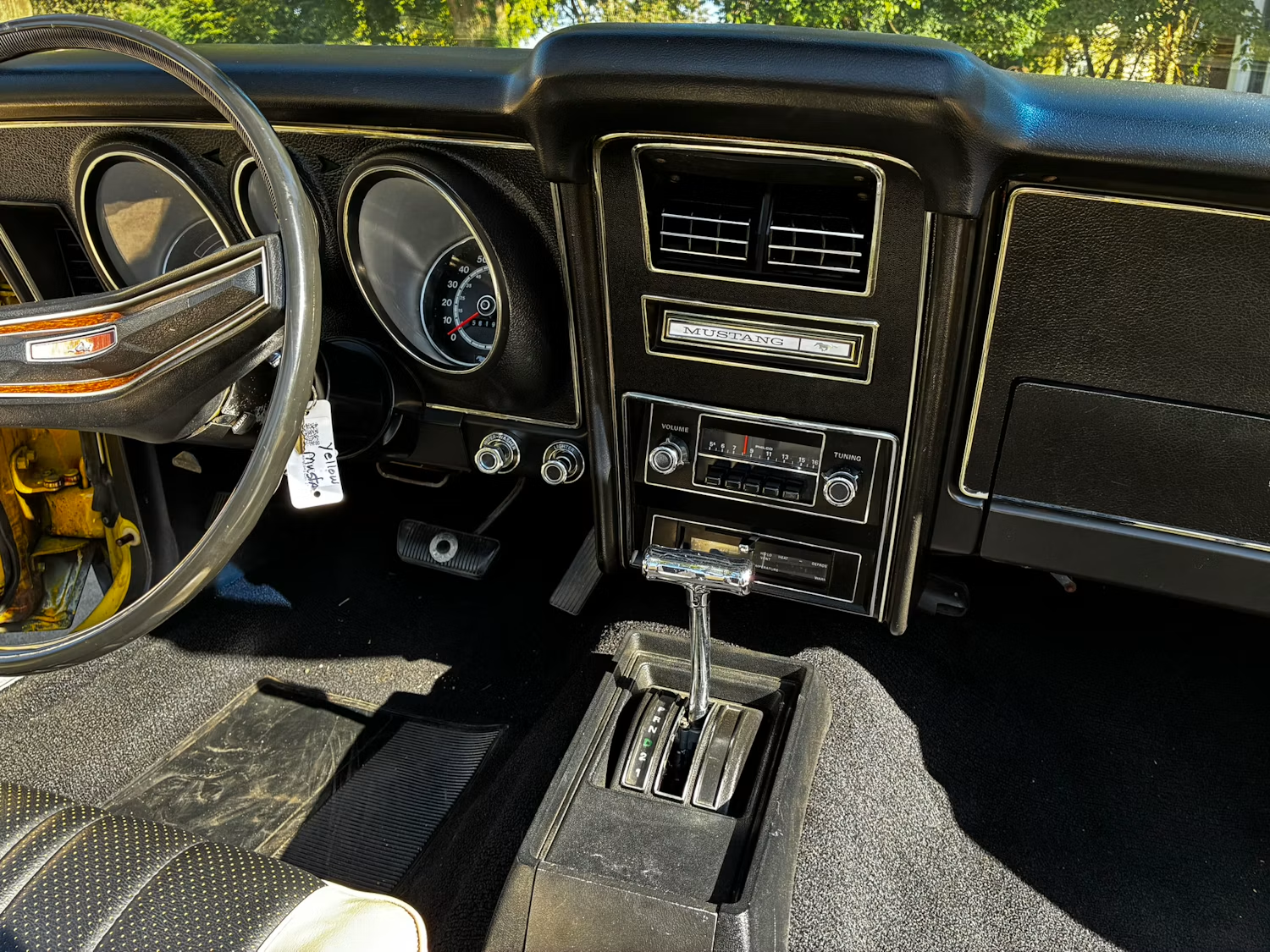
The Mustang has just about all the options the convertible buyer would need. In 1973, Ford offered Basic Equipment Groups “A” and “B”; the former offered power steering and brakes, automatic, AM radio, and whitewalls; the latter added air conditioning, tinted glass, and a full-length console. It’s a fair guess that this car was ordered with Group “A” but not “B,” given the lack of a console.
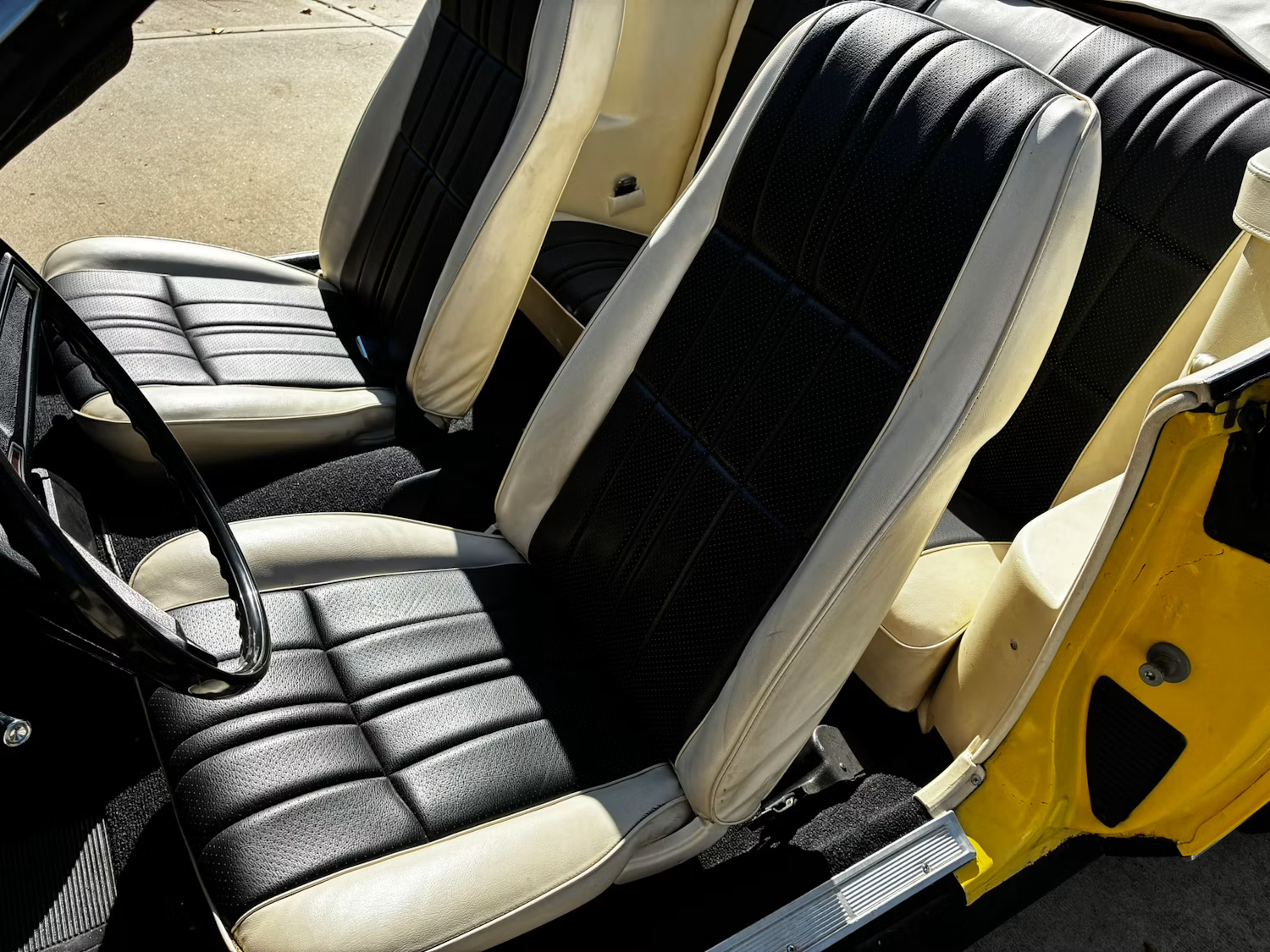
The seller picked up the car in 2023, and it sounds like it was repainted and reupholstered at that time. The driver’s seat looks somewhat disheveled for three years of wear, but as my wife will attest, wearing one’s garage clothes in a vehicle with white upholstery is not a good idea. The car’s “CW” trim code denotes that it was ordered with a white “knitted vinyl” interior, so the black inserts are not original.
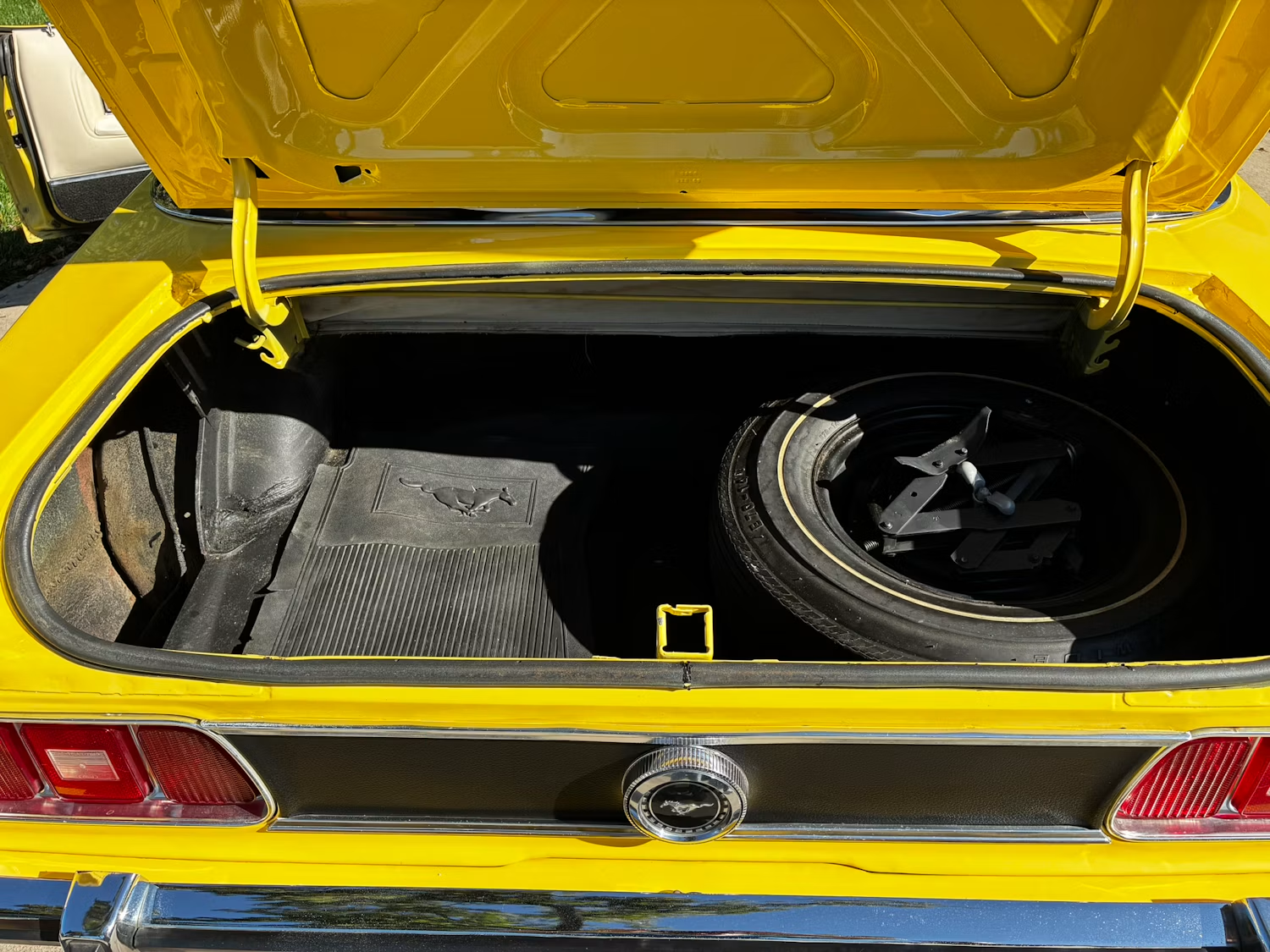
Pictures can deceive, but it looks like someone has welded in a lower quarter panel patch on the driver side (at least). While the welds could have been cleaned up a little better inside the trunk, I wouldn’t for a minute let that keep me from buying the car if I were interested. Panel patches on Mustangs go together like Elvis and karate kicks, maybe better.
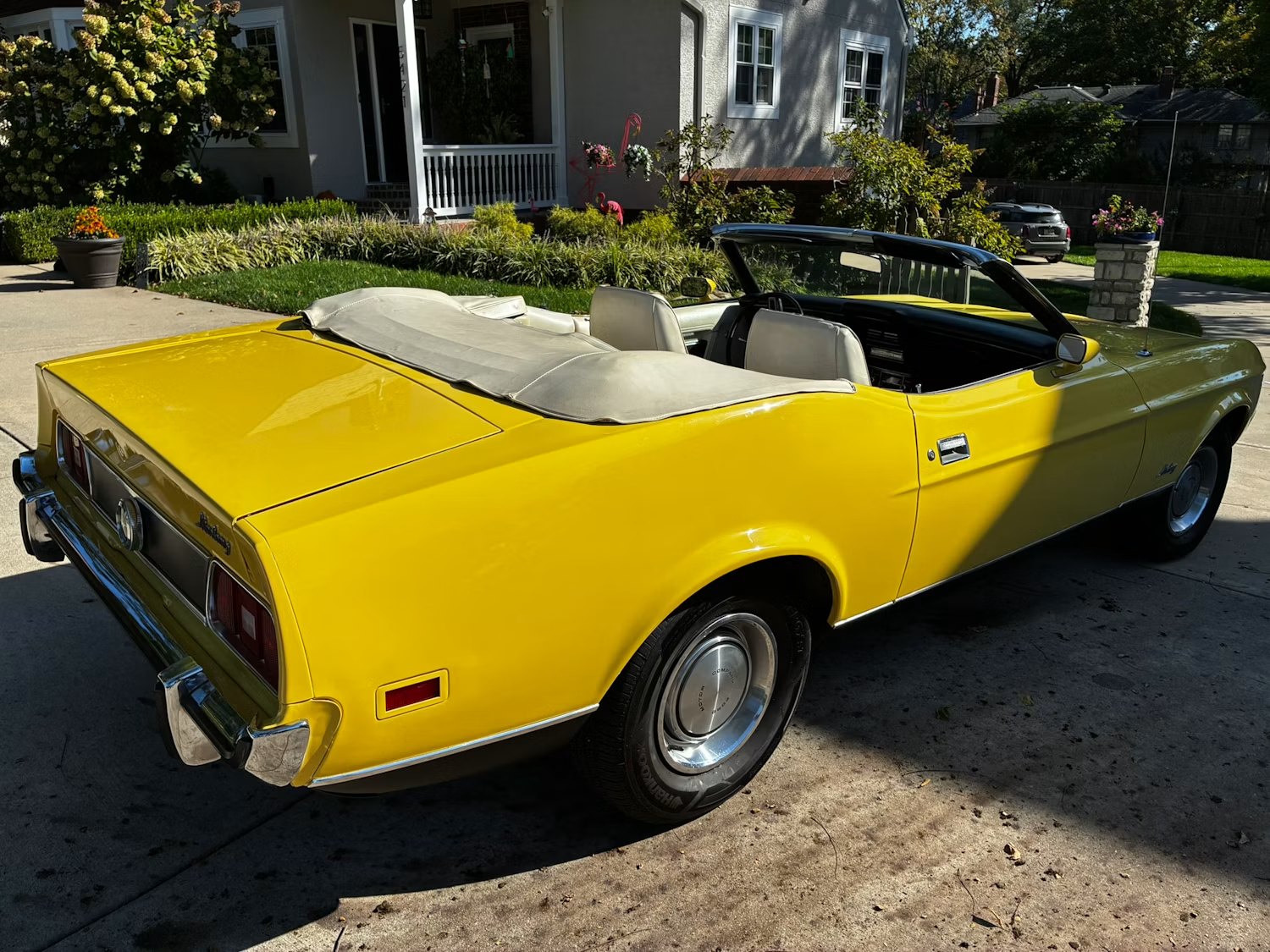
There are a few questions about this 1973 Mustang that could probably be quickly answered by a message to the seller, but it looks like a nice convertible painted a bright, sunny color. In Gone in 60 Seconds, Maindrian Pace said that this was “the last of the Mustangs.” That was premature, but if it was a car worth stealing then, it’s a car worth buying now.
Related Reading
1973 Ford Mustang – The Long Road to Reputational Rehab (by JP Cavanaugh)
Curbside Musings: 1973 Ford Mustang Convertible – At A Canter (by Joseph Dennis)
Curbside Classic: 1973 Mustang – No Apologies Necessary (by Paul N)























Love the car, love the writeup, and love the movie. The “last of the Mustangs” line in that 1974 film has cracked me up from the first time I watched it in the ’80s, even if I am also a Mustang II fan.
Thanks Joe,
It’s a shame that when Halicki’s widow re-released the movie, she was unable to use the original soundtrack. It had the perfect 1970s cheesiness to match the film.
Aaron, I’m glad you mentioned the original soundtrack – which was *awesome*. The updated one… not so much.
The “Lois Lane Blues”, for example, adds so much to the scene where Pumpkin is all depressed and smoking in that dark wood-paneled room.
I repurchased the DVD at a thrift store thinking and hoping it had the original soundtrack, but alas it didn’t. I ended up giving it to a buddy who also loves the movie.
Junkman is way better with the original soundtrack too. Both movies can be found in full on YouTube with the original soundtracks.
From what I heard some of the music was performed by Halicki’s family members who didn’t care for Denise, and they got into a legal battle over his estate after his death… of which Robert Kardashian was her attorney during and later fiancé.
To be fair, the 1971-73 car was developed under ‘Bunkie’ Knudson’s brief tenure as Ford president. Coming from Pontiac’s go-go years in the sixties, he was a performance guy and had to match where Chrysler and GM were going/had gone with their ponycars, i.e., big-block motivation and easy assembly line installation.
Of course, by the time the 1971 Mustang hit showrooms, Bunkie was gone, and big-block V8 muscle/ponycars were dead in the water. Low insurance rates, emissions, and fuel economy (after the 1973 OPEC Oil Crisis) were the name of the game by then. Today, the Pinto-based Mustang II gets no love but, for 1974, it was the right car at the right time.
This period Mustang always reminds me of the Mach I in “Diamonds Are Forever”.
Wayward youth…I so miss it!!!
I wonder if Ford’s “woven vinyl” material has become unobtanium. I don’t think it was out long.
It looks like it’s available at National Parts Depot.
https://www.npdlink.com/product/front-bucket-rear-bench-full-upholstery-set-deluxe-with-comfortweave-white/141194/203078
It’s been said before: virtually any part for a 1st gen Mustang can be had as a repop. Yeah, those things are a dime a dozen, but for the lowest cost CC that someone wants to keep OEM, they can’t be beaten.
My 73 Grande’ had the 351Q 4V. Someone ordered it the heavy duty suspension, Traction Lok, AMFM stereo,PS PB and AC. The only options it did not have was tilt and power windows. Mine also had the trim rings and hub caps like the car above. This was the 80s so I put 235/65/14s on it.
If felt like driving a torpedo and I loved every second of driving it. I took off the iron intake and Motorcraft carb and put an aluminum and a spread bore Holley 600. The huge valves on the Q made it a pain in slow traffic. The spread bore Holley with its small primaries made in town driving with the AC on much smoother. A pair of Walker Super Turbos and Blackjack headers made it mellow until the secondaries opened.
I had my 72 Fastback with the 351C 2V bought new and as Bodyblue said above, loved every minute of it for 7 years.
I actually prefer the Cougar of this era, had a 73 with a Cleveland, great car
Have always been ambivalent about the dash in the 71-73 cars. Top to bottom depth always seemed excessive and not to mention it was always black, a lot of black. Prefer the 67-68 first, tie between 65-66 and 69-70, and this last. Actually don’t care for the hardtop at all.
I’ve never warmed to the hardtop either; the sail panels just don’t quite work with the deck length for me.
Sort of CC Effect, I saw a “big” Mustang just yesterday, though it was red – and a notchback. First one I’ve noticed on the road in many years.
It might be cliché, but hard to go wrong with a Mustang Convertible. I quite like the ’71 to ’73s, especially the way the hood and fenders flow into the front: it looks very muscular.
This would make a very fun weekend car