
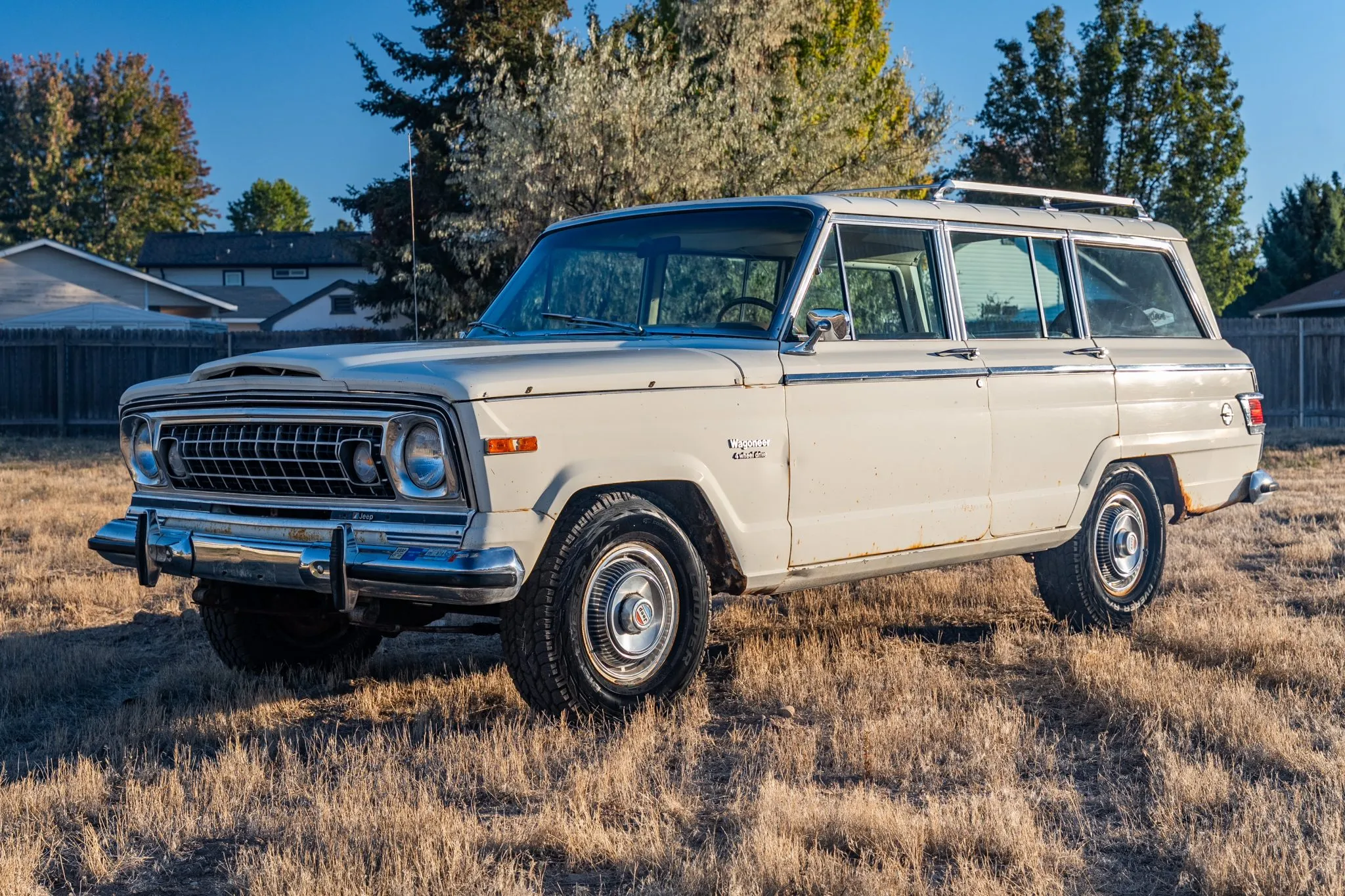
Is the Jeep Wagoneer the greatest piece of peacetime industrial design in the automotive world? I think so, and why not? It’s the prototype for the modern SUV, but its good looks transcended decades. It’s a trim size, functional without being austere, powerful enough for expressway use, and is capable in almost any conditions its owner is liable to encounter. This 1975 Wagoneer Custom has the desirable AMC 401 and it’s in a well-used original state; in other words (and I hold my nose as I say this), it has patina. It’s also a bit of a project, but it’s being sold with no reserve on Bring a Trailer in Meridian, Idaho.
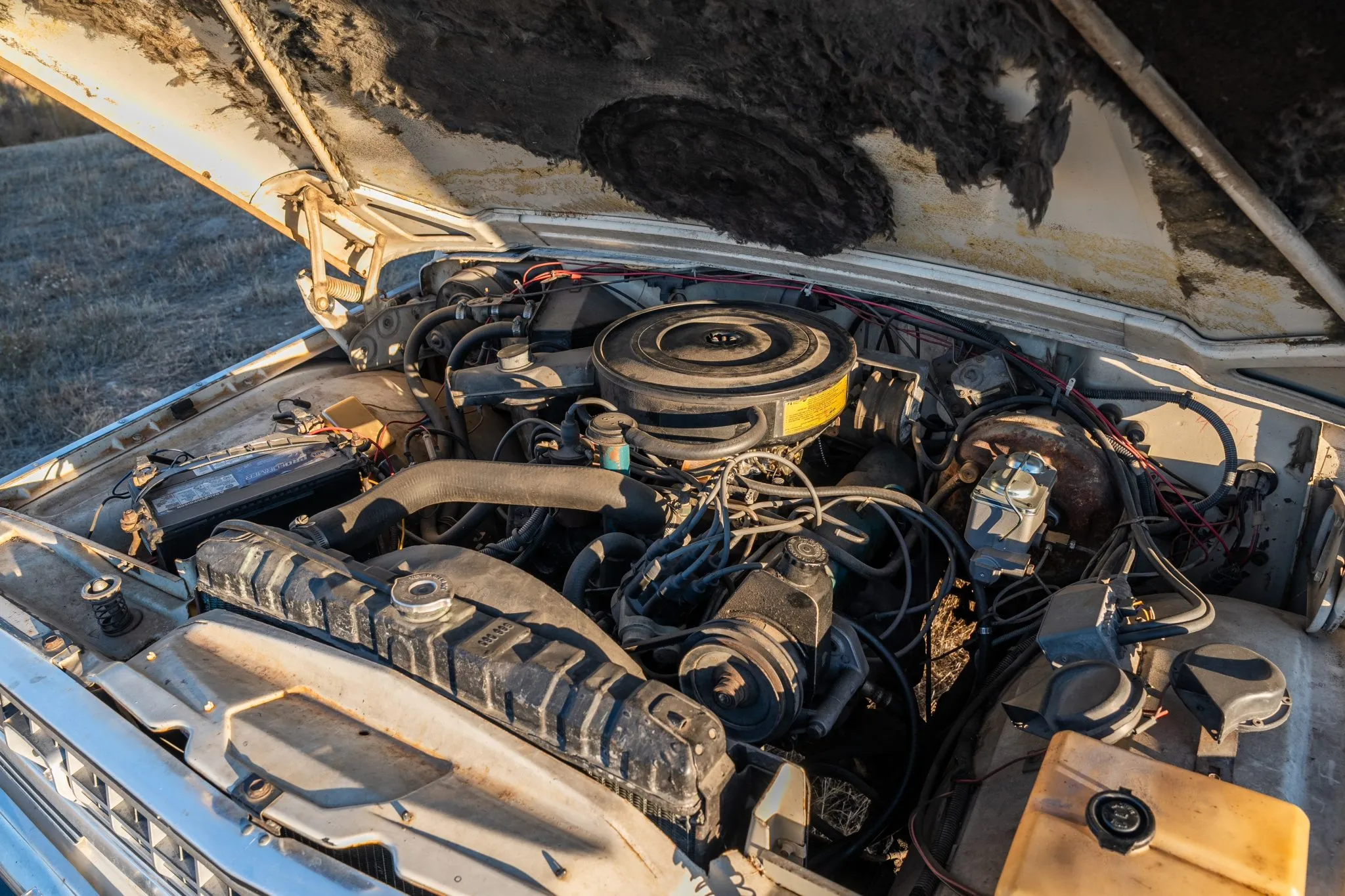
The Wagoneer was purchased by the seller’s father as a project, and it has had a lot of the basic “get it back on the road” work done, including brake and fuel system service, but it sounds like the brakes aren’t quite there yet. Regardless, once it can stop, it will certainly go, for it has the 215-horsepower AMC 401, an engine that when modified can produce a surprising amount of power. In the Wagoneer, it’s backed by a Turbo-Hydramatic 400 transmission, Quadra-Trac four-wheel drive, and Dana 44 front and rear axles. With power steering and power front disc brakes, the Wagoneer should be as easy to drive as a modern SUV.
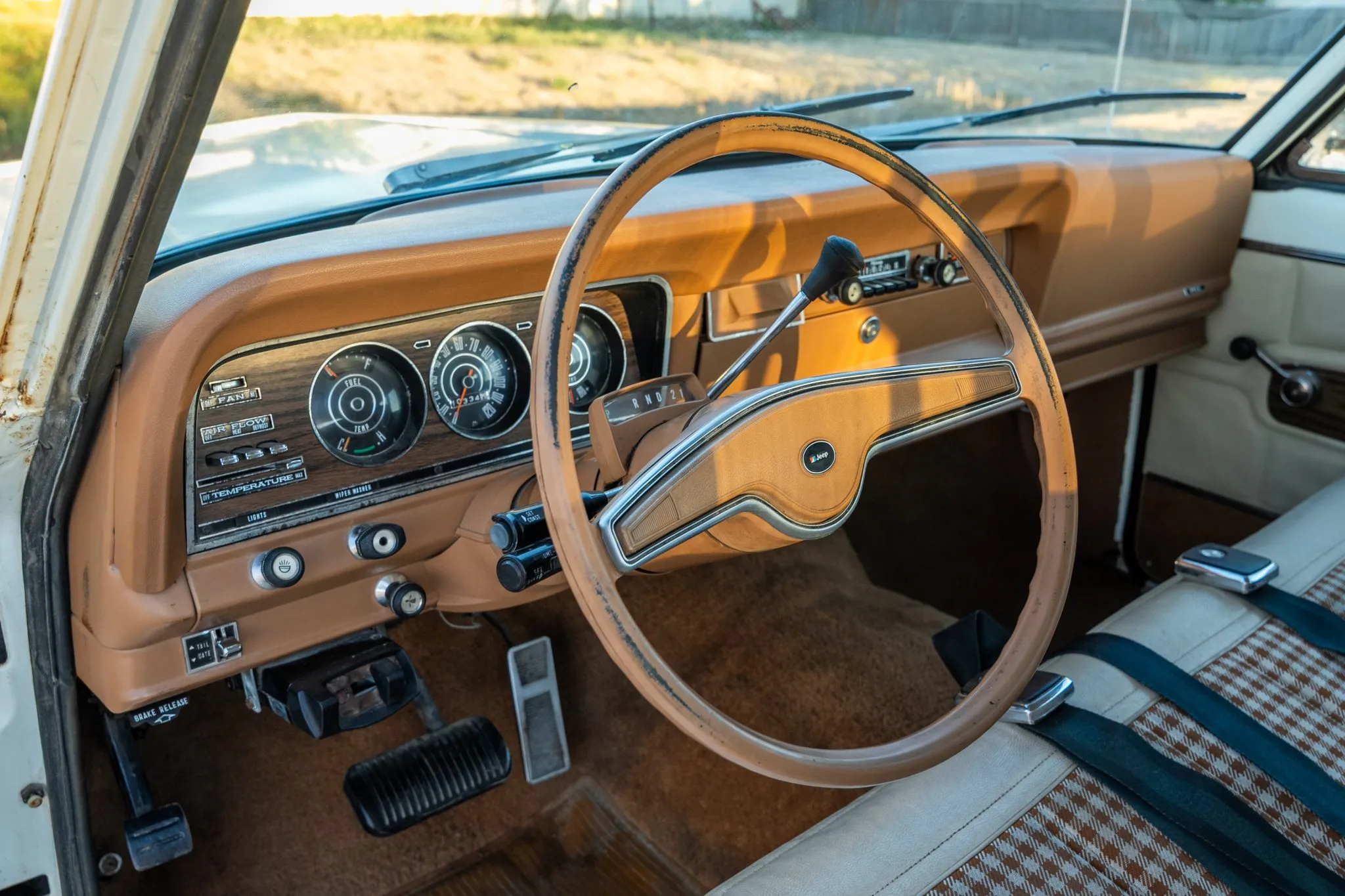
The interior is tasteful as far as 1970s vehicles go, with some fake wood on the instrument cluster surround, which features useful gauges to monitor that 401 up front. The rest of the dashboard is more austere, but the full carpeting tells you that this is a luxury SUV, 1975-style.
You may notice that there is no transfer-case lever on that carpeted floor, and that’s because the Wagoneer with Quadra-Trac was not really marketed toward the typical Jeep off-road types; instead, it was an “automatic 4-wheel-drive system” that “[offered] the ultimate in traction plus greater stability and control regardless of road surface.” In a way, it was like a full-time all-wheel-drive system akin to what you might find on a modern SUV. Here’s a description of how it works.
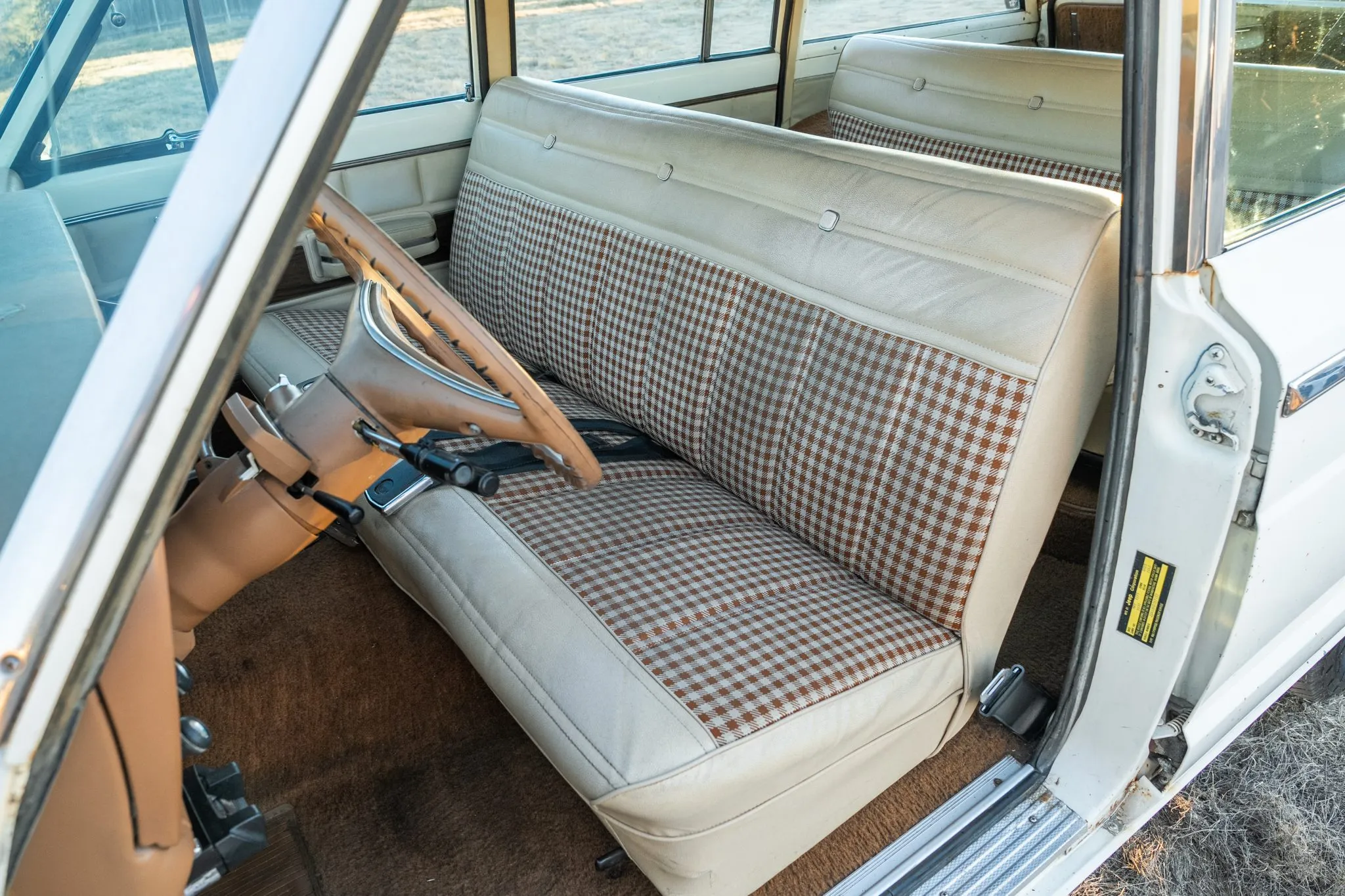
And those seats are a perfect combination of white and plaid that few outside of the 1970s would truly understand or appreciate. They’re glorious. Obviously, this will never be a show-winning interior as it sits, but it’s perfectly usable, and if some steps are taken to minimize further corrosion damage on the outside, it will fit right in with the ambiance of the rest of the Wagoneer.
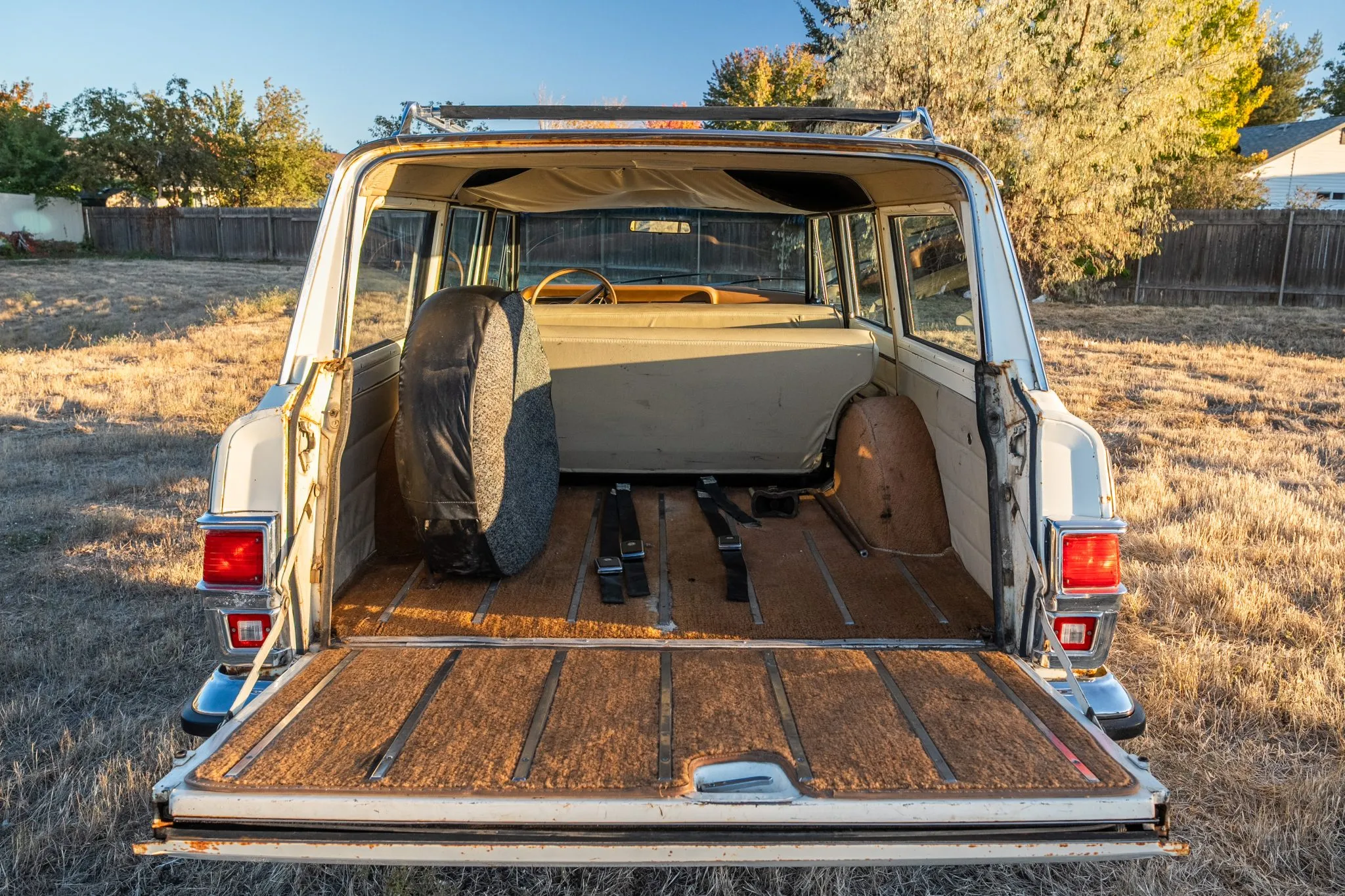
While a Wagoneer would never supplant a pickup truck because of its luxurious carpeted load floor, it was never intended to. The Big Three and Jeep itself made a truck if that was what you needed, but if you needed a posh-in-its-way family hauler or something with a little more verve than a truck, you had an option.
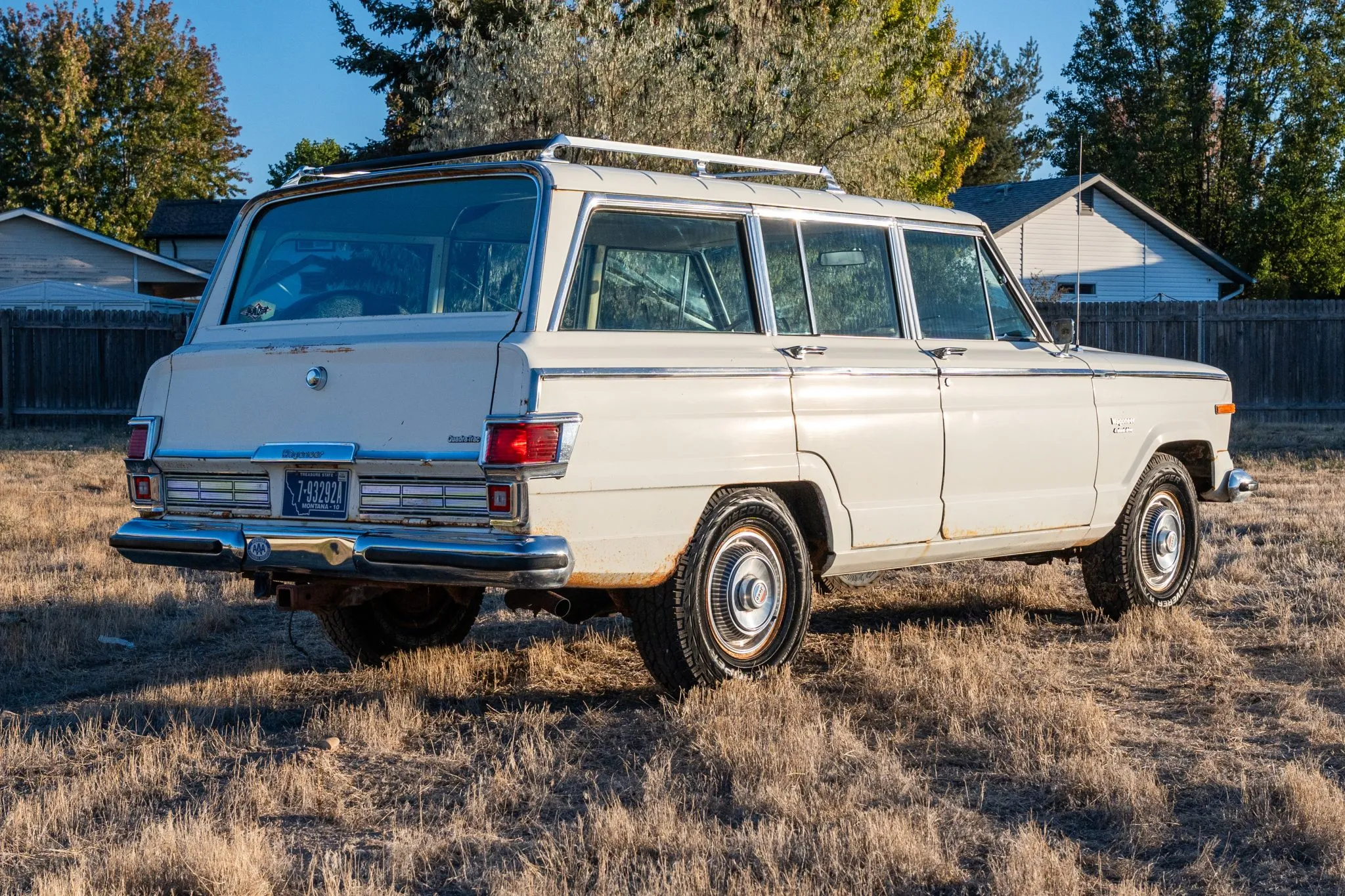
The best part of the Wagoneer, however, was not its load capacity, neat period interior, or powerful V8. It was its timeless styling, done by that magician from Milwaukee, Brooks Stevens. Few can manage to draw a car that looked as good as ever 30 years after its introduction, but the Jeep did and still does. It’s simple but there isn’t a line out of place, and that’s why I think it’s one of the most important designs of the 20th century. This example will need a little love, but it’s optioned right, and it still has the purposeful look of the original before it got the wood siding and nose-turned-up reputation. I’ll bet it will sell for more than you might expect.
Related Reading
Auction Capsule: 1976 Jeep Wagoneer – Driven to the Auction (by Jim Grey)
Curbside Classic: Jeep Grand Wagoneer — Three Jeep Wagoneers and One Lifelong Crush (by Jon Stephenson)
Curbside Find: Jeep Wagoneer – Mix And Match (by Paul N)







The early ones, sure. But the square headlights and di-noc ones are foul.
Yes but the GMC-M 109 actually went to war.
That’s why I qualified my comment with “peacetime” in my first sentence. I’d argue that the WWII Jeep might be the best wartime piece of automotive industrial design.
A nice old survivor, the AMC 401CID V8 is well known for it’s weak oiling system and common bottom end bearing failures, I have never heard it referred to as “desirable” by anyone who’s owned or worked on one .
-Nate
I have worked on plenty of AMC V8s. They are great engines. Bearing failures? Ha! Who blew that smoke up your buttocks
https://www.hotrod.com/features/alternative-engine-series-amc-401-982-1637-101-1
I spent a little time reading this old article from Hot Rod Magazine about hopping up the AMC V8. It sounds like oiling to the rear main bearings isn’t great, but I imagine that became more of an issue in high-performance applications. Either way, there are some pretty easy oiling modifications that you can do if the engine comes apart.
This was a great design, no question. There is a great combination of cleanliness and character in the styling – a balance that is not always easy to find. And like much from the early 60s, it aged well.
Was this the first iteration of Quadra-Trac? That, alone, would make this a game-changer in the SUV world of not having to do anything to engage 4WD (or AWD) when it was needed, i.e., the loss of traction of the normally non-engaged wheels (in this case, the fronts). In effect, you’d have an all-season vehicle that drivers could just get in and go without any other input should road conditions warrant it. Subaru was the only other manufacturer that would happily ride that wave which, ironically, also began in 1975 with the GL/Leone 4WD station wagon. Today, you can’t swing a dead cat without hitting an on-demand AWD vehicle.
https://www.curbsideclassic.com/curbside-classics-asian/curbside-classic-1977-subaru-leone-the-revolutionary-four-wheel-drive-wagon-that-started-the-subaru-legacy/
The ’75 Subaru Leone still used a truck-style part-time 4WD with a rear axle that could only be engaged in slippery weather, not a modern-style fully automatically engaging AWD system of various sorts. The first appearance of full-time 4WD/AWD in a standard passenger car would be the ’80 AMC Eagle to my knowledge, which borrowed the similar system from Jeeps.
Yes. But it had no low range yet, so it was used only behind the automatic and obviously targeted at a different type of buyer than the traditional 4×4 buyer who wanted/needed a Low range transfer case. Later versions did have a Low range.
Nice vehicles except for Quadra-trac. I had a 74. The system has a big chain in the xfer case that stretched and would hop over the sprockets and cause a wicked shudder and noise. Plus fuel mileage was horrible w/ basically full time 4wd.
There was a kit available to convert to part-time with hubs and it came with a new chain. Aftermarket in the 80’s. I don’t recall the manufacturer. I installed on mine. Big job, but that’s the only way I’d want one.
Ford seemed to do okay with the 4WD Explorer (as well as the Chevy S-10 Blazer and Jeep Cherokee). But they were still 4WD systems not far removed from their small pickup trucks.
It doesn’t seem that the whole CUV crossover thing didn’t really come into its own until the car-based AWD Toyota RAV4 arrived for 1996. It was the one that really turned the corner as an acceptable, comfortable all-wheel-drive vehicle that got away from the detriments of 4WD for the vast majority of street driving.
You make a good case for it. I like this better than the ’87 we had for a year or so, which had awful interior quality. QuadraTrac is extremely capable, ours was mated to a AMC 360. Its downfall was the 9-10 mpg, and that’s on a good day. We traded it for a Trooper.
Was surprised first time I drove one, a 1990, the interior was high style AMC, fake plasticky wood, the interior not poured in but stapled in, creaky plastics, all around aspiring to be upscale. For the good helped AMC’s bottom line using AMC parts.
Define “greatest”. We had one of the ones with the fake wood and the power windows and everything and it got 7 to 8 miles to the gallon, consistently. It was so great that it ended up getting relegated to trips to the dump. And you wanted to make sure you had enough trash to fill up the back of the thing, you didn’t want to have to feed it Reaganomics era gas. Oh yeah, the air conditioner used to drip water right into the cabin, and the tailgate was so heavy, with the power operated rear window, it was practically a two-person job to put it back up. Not intending the troll this, but we had one, to this day it’s still like a family regret. At the time, I was driving a slightly hotrodded 1976 Lincoln Mark IV with a 460, Cartier Edition, and I managed to squeeze 12 miles a gallon out of THAT. Grandpa’s Sedan DeVille with the 500 cubic inch engine still got better mileage, and both of those vehicles were certainly more pleasant places to spend time in. We also used to have one of the two-door Wagoneer strippo Jeep models that didn’t even have rubber mats, it was all steel inside, for trips to the horse barn, I still have a scar on the side of my face from getting bounced around unexpectedly in the back of that thing when I was 8. I don’t think it even had seat belts…Put me down as a Jeep trauma victim I guess LOL. Don’t think I’m anti-American vehicles either… I don’t have it on the phone but I do have a photo of my beloved grandfather in full tank gear during World War II, guess what? leaning on a Jeep… thanks for letting me vent guys… those Wagoneers still come up in family convos about vehicular horror stories… now do a piece on how great Volkswagen Rabbit diesels were… I’m over here on the website everyday so I’ll be waiting to see that article. %^)
He was specifically referring to the styling/design of the original Wagoneer which held up better than most over such a long production run. FWIW, the original Wagoneer came with an OHC six that got considerably better mileage than these later ones with the big V8s. Mission creep.
That dash color and dash pad are right out of my 72 Ambassador. The wheel is an exact copy.